Understanding Eggcorns
Sravana Reddy
Department of Computer Science The University of Chicago
Abstract
An eggcorn is a type of linguistic error where a word is substituted with one that is seman-tically plausible– that is, the substitution is a semantic reanalysis of what may be a rare, archaic, or otherwise opaque term. We build a system that, given the original word and its eggcorn form, finds a semantic path between the two. Based on these paths, we derive a ty-pology that reflects the different classes of se-mantic reinterpretation underlying eggcorns.
1 Introduction
The term “eggcorn” was coined in 2003 by Geof-frey Pullum (Liberman, 2003) to refer to a certain type of linguistic error where a word or phrase is replaced with one that is phonetically similar and semantically justifiable. The eponymous example is acorn→eggcorn, the meaning of the latter form
be-ing derived from the acorn’segg-like shape and the fact that it is a seed (giving rise tocorn). These er-rors are distinct from mere misspellings or mispro-nunciations in that the changed form is an alternate interpretation of the original.
The reinterpretation may be related to either the word’s perceived meaning or etymology (as in the case ofacorn), or some context in which the word is commonly used. In this sense, eggcorns are similar tofolk etymologies– errors arising from the misin-terpretation of borrowed or archaic words – with the difference being that the latter are adopted by an en-tire culture or linguistic community, while eggcorns are errors made by one or more individual speakers. The formation of eggcorns and folk etymolo-gies, mistakes though they are, involves a creative
leap within phonetic and semantic constraints (much like what is required for puns or certain classes of jokes). Eggcorns range from simple reshapings of foreign words (paprika→pepperika) and substitu-tions from similar domains (marshal→martial), to
the subtly clever (integrate→intergrade), the
tech-nological (sound bite → sound byte), or the funny (stark-raving mad→star-craving mad). The source
of reinterpretation may be a weak imagined link (wind turbine→wind turban), or an invented myth (give up the ghost→give up the goat1). And often, it is not clear what the exact link is between the de-rived and the original forms, although it is usually obvious (to the human eye) that there is a connec-tion.
This paper explores some ways ofautomatically tracing the linkbetween a word and its eggcorn.
In reality, we are chiefly concerned with comput-ing the connections between a word and its rein-terpreted form. Such pairs may also occur as folk etymologies, puns, riddles, or get used as a poetic device. However, we use eggcorns as a testbed for three main reasons: there are a number of doc-umented examples, the reanalyses are accidental (meaning the semantic links are more unpredictable and tenuous than in the cases of deliberate reshap-ings), and the errors are idiosyncratic and relatively modern – and hence have not been fossilized in the lexicon – making them transparent to analysis (as opposed to many folk etymologies and other histor-ical errors). That said, much of the work described here can be potentially applied to other instances of semantic reinterpretation as well.
1http://eggcorns.lascribe.net/english/ 714/goat/
The first part of the paper describes an algorithm (the “Cornalyzer”) for finding a semantic path be-tween the original and reinterpreted forms of an eggcorn pair. We then proceed to use the results of this algorithm to cluster the eggcorn examples into 5 classes, with a view to learning a typology of eggcorns.
2 Related Work
One work related to this area (Nelken and Ya-mangil, 2008) uses Wikipedia to automatically mine eggcorns by searching for pairs of phonemically similar words that occur in the same sentence con-text in different revisions. However, the mined ex-amples are reported to contain many false positives since the algorithm does not include a notion of se-mantic similarity.
Folk etymologies, the closest cousin to eggcorns, have been studied from a linguistic point of view, in-cluding some of the same questions we tackle here (only, not from a computational side) – how is an new word derived from the original, and what are the different categories of folk etymologies? (Rund-blad and Kronenfeld, 1998), (Scholfield, 1988). To the best of our knowledge, there has been no pre-vious work in inducing or computationally under-standing properties of neologisms and errors de-rived through misinterpretation. However, there is a substantial literature on algorithmic humor, some of which uses semantic relationships – (Stock and Strapparava, 2006), (Manurung et al., 2008), among others.
3 Data
The list of eggcorns is taken directly from the
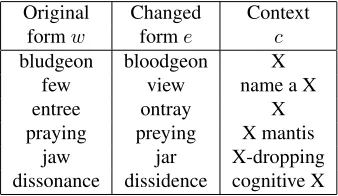
Eggcorn Database2 as of the submission date. To assure soundness of the data, we include only those examples whose usage is attested and which are con-firmed to be valid and contemporary reanalyses3, giving a total of509instances. Table 1 shows a sam-ple of the data.
Every example can be denoted by the tuple (w, e, c)wherecis the list of obligatorycontextsin
2http://eggcorns.lascribe.net/
[image:2.612.341.510.108.206.2]3In other words, all examples that are classified as ‘ques-tionable’ (or otherwise indicated as being questionable), ‘not an eggcorn’, ‘citational’ or ‘nearly-mainstream’ are eliminated.
Table 1: A few eggcorns. ‘X’ can be replaced forwor
eto give the original form in context, or the eggcorn in context respectively.
Original Changed Context formw forme c
bludgeon bloodgeon X few view name a X entree ontray X praying preying X mantis
jaw jar X-dropping dissonance dissidence cognitive X
which the reanalysis takes place, w is the original form, andeis the modified (eggcorned) form.
The Cornalyzer uses WordNet (Fellbaum, 1998) version 3.0, including the built-in morphological tools for lemmatization and dictionary definitions4.
4 Automated Understanding of Eggcorn Generation
Broadly speaking, there are two types of eggcorns:
1. Ones whereeor a part ofeis semantically
re-lated to the original word w (lost → loss in
‘no love lost’) or the context c (pied → pipe in ‘pied-piper’).
2. Eggcorns whereeis related to an image or
ob-ject that isconnected toor evoked by the origi-nal (like ‘song’ inlip-sync→lip-sing).
For the first, a database of semantic relations be-tween words (like WordNet) can be used to find a semantic connection between w and e. The
sec-ond type is more difficult since external knowledge is needed to make the connection. To this end, we make use of the “glosses” – dictionary definitions of word senses – included in WordNet. For instance, the ‘lip-sing’ eggcorn is difficult to analyze using onlysemantic relations, since neither ‘sync’ nor ‘lip’ are connected closely to the word ‘sing’. However, the presence of the word song in the gloss of lip-sync:
move the lips in synchronization (with recorded speech or song)
makes the semantic connection fairly transparent. The Cornalyzer first attempts to analyze an eggcorn tuple (w, e, c) using semantic relations
(§4.1). If no sufficiently short semantic path is
found, the eggcorn is presumed to be of the second type, and is analyzed using a combination of seman-tic relations and dictionary glosses (§4.2).
4.1 Analysis using Word Relations 4.1.1 Building the Semantic Graph
WordNet is a semantic dictionary of English, con-taining a list of synsets. Each synset consists of a set of synonymous words or collocations, and its re-lations (like hypernymy, antonymy, or meronymy) with other synsets. The dictionary also includes lex-ical relations– relations between words rather than synsets (for instance, a pertainym of a noun is an adjective that is derived from the noun).
WordNet relations have been used to quantify se-mantic similarity between words for a variety of ap-plications (see Budanitsky and Hirst (2001) for a re-view of similarity measures). The Cornalyzer uses the same basic idea as most existing measures – find-ing the shortest path between the two words – with some modifications to fit our problem.
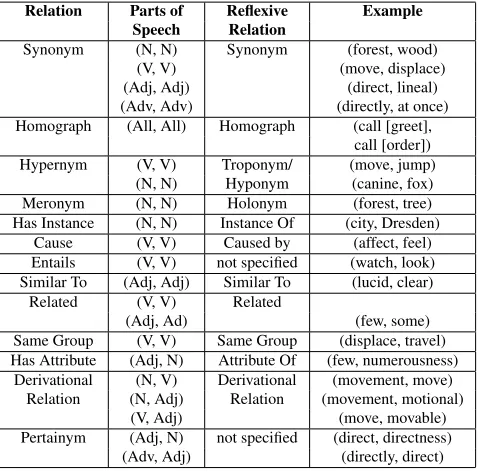
We adopt the convention that two wordsw1 and w2have the relationRif they are in different synsets S1andS2, andR(S1, S2)is true. We also define two
new lexical relations that are not directly indicated in the dictionary: w1 andw2 aresynonyms if they
are in the same synset, andhomographsif they have identical orthographic forms and lexical categories but are in different synsets.5
This relational network can hence be used to de-fine a graphGsover words, where there is an edge of typetRfromw1 tow2 ifR(w1, w2)holds. Some of the relations in WordNet (like antonymy) are ig-nored, either because they invert semantic similarity, or are not sufficiently informative. Table 2 summa-rizes the relations used.
This graph can be used to find the semantic re-lationships between an original word w and its
[image:3.612.314.553.86.322.2]5This paper uses ‘word’ to include sense – i.e, ‘bank’ as in slope beside a body of waterand ‘bank’ as infinancial institu-tionare distinct. When required for disambiguation, the Word-Netsense number, which is the index of the sense in the list of the word’s senses, is added in parenthesis; e.g. bank (2) for the financial institutionsense.
Table 2: WordNet relations used to build the semantic graph.
Relation Parts of Reflexive Example Speech Relation
Synonym (N, N) Synonym (forest, wood) (V, V) (move, displace) (Adj, Adj) (direct, lineal) (Adv, Adv) (directly, at once) Homograph (All, All) Homograph (call [greet],
call [order]) Hypernym (V, V) Troponym/ (move, jump)
(N, N) Hyponym (canine, fox) Meronym (N, N) Holonym (forest, tree) Has Instance (N, N) Instance Of (city, Dresden)
Cause (V, V) Caused by (affect, feel) Entails (V, V) not specified (watch, look) Similar To (Adj, Adj) Similar To (lucid, clear)
Related (V, V) Related
(Adj, Ad) (few, some) Same Group (V, V) Same Group (displace, travel) Has Attribute (Adj, N) Attribute Of (few, numerousness)
Derivational (N, V) Derivational (movement, move) Relation (N, Adj) Relation (movement, motional)
(V, Adj) (move, movable) Pertainym (Adj, N) not specified (direct, directness)
(Adv, Adj) (directly, direct)
eggcorn forme, if both forms are in the dictionary,
and there exists a path fromwtoe. However, it is
often the case thateorware not in the dictionary,
or that a path does not exist. This could be because one of the forms is an inflected form or compound, or that some substring ofe– rather than the whole
word or collocation – is the reinterpreted segment. It is also essential to consider the strings inc, since
many eggcorns result from semantic reinterpretation of the contexts.
Hence, three new non-semantic relations are de-fined: w1 is a substring of w2 if the orthographic
form ofw1 is a substring of that ofw2, andw1and w2arecontextually linkedif they occur in the same
collocation or compound. Ifw2can be derived from w1 using WordNet’s lemmatizer,w2 is aninflected
form ofw1.
A new graph Ge is constructed by adding edges of typestsubstring, tcontext, and tinf lect toGs. For all eggcorn tuples(w, e, c):
1. Ifeorware not in the dictionary, add them to Geas a vertex
2. Add edges of typeinflectbetweeneand its base
form.
substring of length≥3that is in the dictionary (except those substrings which are base forms ofe), and edges of typesupstring in the other
direction.
4. Extract a set of ‘context words’ fromcby
split-ting it along spaces and hyphenation. Select those words which are in the dictionary.
5. Add edges of typecontextfromwandeto each
extracted context word.
For example, given the data in table 1, the follow-ing vertices and edges will be added toGe:
Vertices bloodgeon, ontray, preying, praying
Substring edges (bloodgeon, blood), (bloodgeon, loo), (bloodgeon, eon), (view, vie), (entree, tree), (ontray, ray), (ontray, tray)
Superstring edges above edges in the other direction
Inflectional edges (preying, prey), (praying, pray). These edges are bidirectional.
Context edges (few, name), (view, name), (few, a), (view, a), (praying, mantis), (preying, mantis), (jaw, dropping), (jar, dropping), (dissonance, cognitive), (dissidence, cognitive). These edges are also bidi-rectional.
4.1.2 Tracing the Semantic Path
Given the semantic graph, our working assump-tion is thateis generated fromw by following the shortest path fromwtoe(denoted byP(w, e, c)).
1. If w and e are both in the dictionary, find P1(w, e) =the shortest path fromwtoeinGs
2. FindP2(w, e, c) =the shortest path using
sub-strings ofeand/orcinGe
(Since the edges are unweighted, the shortest path fromwtoeis found simply by performing
breadth-first search starting atw.)
P(w, e, c)is simply the shorter ofP1(w, e) (if it
exists) andP2(w, e, c). Note that there may be
sev-eral shortest paths, especially since words that are synonymous have almost the same incident semantic edges. Since the candidate shortest paths generally do not differ much from one another (as far as their
semantic implications), an arbitrary path is chosen to beP.
Table 3 shows the paths found by the algorithm for some eggcorns.
4.2 Analysis using Dictionary Definitions
As described in §4, the source of many eggcorns is knowledge external to the original word or con-texts through some concept or object suggested by the original. In such cases, a semantic network will not suffice to find the reinterpretation path. One pos-sible way of accessing the additional information is to search forw andein a large corpus, and extract
the key words that appear in conjunction with these forms.
However, filtering and extracting the represen-tative information can quickly become a complex problem beyond the scope of this paper. Hence, as a first approximation, we use the dictionary definitions (glosses) that accompany synsets in WordNet. To optimize efficiency and to avoid having noise added by the definitions, the Cornalyzer only resorts to this step if asufficiently short path – that is, a path of length≤kfor some thresholdk– is not found when
only using word relations. (The results suggest 7 as a good threshold, since most of discovered paths that are longer than7tend not to reflect the semantic relationships between the eggcorn and the original form.)
Every gloss from all senses of a lexical item6 x (for all x in the dictionary) is first tokenized, and
punctuation stripped. All tokens are stemmed using the built-in lemmatizer. Only those tokenstthat are
already present as vertices inGeare taken into con-sideration. However, it should be clear that not all tokenstare equally relevant tox. For instance,
con-sider one gloss of the noun “move”:
the act of changing location from one place to another
which gives the tokens act, changing, location, one, place, another. Clearly, the tokens changing, location, and place rank higher than the others in terms of how indicative they are of the meaning of the noun.
Table 3: A sample of semantic similarity paths. x −→R y means “y is an R of x”. When relevant, WordNet sense numbers are indicated.
Eggcorn tuple Path from word to eggcorn
(word, eggcorn, context)
(mince, mix, ‘X words’) mince−−−−−−−→hypernym change−−−−−−→hyponym mix
(few, view, ‘name a X’) few−−−→deriv fewness−−−−−−−→hypernym number−−−−−−−→hypernym amount hypernym
−−−−−−−→magnitude−−−−−−→hyponym extent−−−−−−→hyponym scope−−−−−−→hyponym view
(dissonance, dissidence, dissonance−−−−−−→synonym disagreement (1)−−−−−−−→homograph disagreement (3) cognitive X) −−−−−−→hyponym dissidence
(ado, [to-do, to do], [‘much X ado−−−−−−→synonym stir (3)−−−−−−−→homograph stir (1)−−−−−−−→hypernym to-do about nothing’, ‘without further X’])
(jaw, jar, X-dropping) jaw context
−−−−−→dropping−−−−→inf lect drop−−−−−−−→hypernymdisplace−−−−−−→hyponymjar
(ruckus, raucous, X) ruckus−−−−−−−→homograph din deriv
−−−→cacophonous similar
−−−−−→raucous
(segue, segway, X) segue−−−−−−−→hypernym passage (1)−−−−−−−→homograph passage (3)−−−−−−−→hypernym
way−−−−−−→supstring segway
One way of reflecting these distinctions in the Cornalyzer is to weight these terms appropriately, with something resembling the TF-IDF (Salton and Buckley, 1988) measure used in information re-trieval. Let tf(t, x) = the frequency of the
to-ken t in the glosses of x, and idf(t) = logdfN(t)
whereN =the number of lexical items in the
dic-tionary and df(t) = the number of lexical items
in the dictionary whose glosses contain t. Define W(t, x) =tf(t, x)·idf(t).
A new graphGdis constructed fromGeby adding edges of type hasdef from every lexical item x to
tokens t in its glosses with the edge-weight 1 +
1/W(t, x), and reflexive edges of type indeffrom tto xwith the same weight. All existing edges in
the original graphGeare assigned the weight1. The semantic path from w to e is found by the process similar to what was described in §4.1.2: first find P1(w, e) and P2(w, e, c) as well as P3(w, e, c) = the shortest path fromw toeinGd, and letP(w, e, c)be the shortest of the three. Since Gdhas weighted edges, the shortest pathP3is
com-puted using Dijkstra’s algorithm.
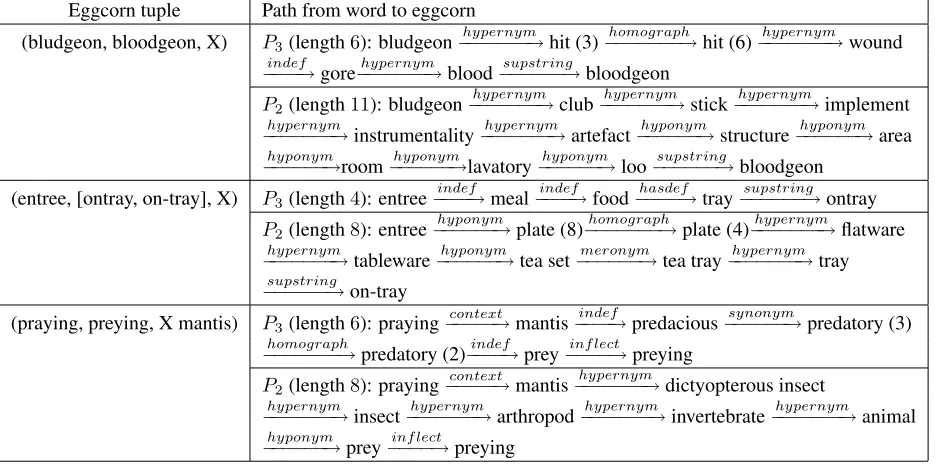
Dictionary-definition-based paths P2 for some
eggcorns are shown in Table 4. The shortestP2paths
are also shown for comparison. TheP3paths
gener-ally appear to be closer to a human judgment of what the semantic reinterpretation constitutes. In the case
of(bludgeon→bloodgeon), for example,P2 shows
no indication of the key connection (bleeding due to being bludgeoned), whereasP3captures it perfectly.
Of the 509 eggcorns, paths were found for 238 instances by using onlyGs orGe as the relational graph. Paths for a total of372eggcorns were found when using dictionary glosses in the graphGd.
5 From Generation to Typology
A quick glance at tables 3 and 4 shows that the paths vary in shape and structure: some paths move up and down the hypernym/homonym tree, while oth-ers move laterally along synonyms and polysemes; some use no external knowledge, while others make primary use of context information and dictionary glosses. A natural next step, therefore, is to group the eggcornsinto some number of classes that rep-resent general categories of semantic reanalysis. We can achieve this by clustering eggcorns based on their semantic shortest paths.
5.1 Clustering of Paths
One natural choice for a feature space is the set of all 24 relations (edge-types) used in Gd. An eggcorn
(w, e, c) is represented as a vector [v1, v2, . . . v24]
wherevi =the number of times that relationRi (or the reflexive relation ofRi) appears inP(w, e, c).
Table 4: Some semantic paths using dictionary glosses. As before,x−→R ystands for “y is an R of x”, and the numbers in parentheses following a lexical item are the WordNet sense numbers corresponding to that word.
Eggcorn tuple Path from word to eggcorn (bludgeon, bloodgeon, X) P3(length6): bludgeon
hypernym
−−−−−−−→hit (3)−−−−−−−→homograph hit (6)−−−−−−−→hypernym wound
indef
−−−−→gore−−−−−−−→hypernym blood−−−−−−→supstring bloodgeon
P2(length11): bludgeon
hypernym
−−−−−−−→club−−−−−−−→hypernym stick−−−−−−−→hypernym implement hypernym
−−−−−−−→instrumentality−−−−−−−→hypernym artefact−−−−−−→hyponym structure−−−−−−→hyponym area
hyponym
−−−−−−→room−−−−−−→hyponym lavatory−−−−−−→hyponym loo−−−−−−→supstring bloodgeon (entree, [ontray, on-tray], X) P3(length4): entree
indef
−−−−→meal−−−−→indef food−−−−→hasdef tray−−−−−−→supstring ontray
P2(length8): entree
hyponym
−−−−−−→plate (8)−−−−−−−→homograph plate (4)−−−−−−−→hypernym flatware hypernym
−−−−−−−→tableware−−−−−−→hyponym tea set−−−−−−→meronym tea tray−−−−−−−→hypernym tray supstring
−−−−−−→on-tray
(praying, preying, X mantis) P3(length6): praying−−−−−→context mantis indef
−−−−→predacious−−−−−−→synonym predatory (3) homograph
−−−−−−−→predatory (2)−−−−→indef prey−−−−→inf lect preying
P2(length8): praying context
−−−−−→mantis−−−−−−−→hypernym dictyopterous insect hypernym
−−−−−−−→insect−−−−−−−→hypernym arthropod−−−−−−−→hypernym invertebrate−−−−−−−→hypernym animal hyponym
−−−−−−→prey−−−−→inf lect preying
and a Euclidean distance metric. We experimented with a few different values ofkand found thatk=
5 produces clusters that are the most semantically coherent.
5.2 Results
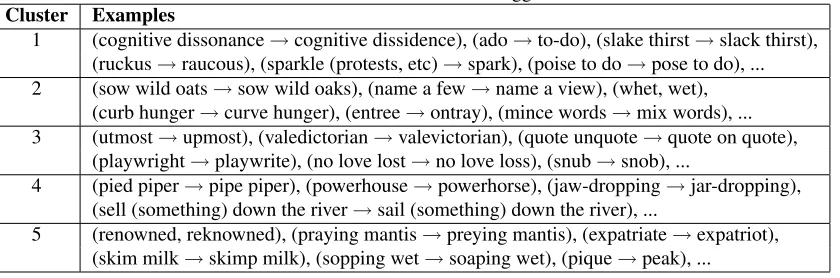
The five clusters roughly correspond to the each of the following characteristic pathsP(w, e, c):
1. Independent of dictionary glosses and of con-text, and mostly containsynonym,homograph, related, orsimilar totypes of edges.
2. Contain severalhypernymandhyponymedges.
3. Contain severalsubstring,supstring, andinflect orderivationaledges.
4. Heavily dependent oncontextedges.
5. Heavily dependent on dictionary glosses.
Eggcorns in these clusters can be interpreted to be (1)Near-synonyms, (2)Semantic cousins– de-riving from a common general concept or entity, (3)Segmentally related– being linked by morpho-logical operations, (4)Contextually similar, or (5)
Linked by implication– deriving from an implicit concept.
A sample of the cluster membership is shown in Table 5.
6 Discussion
This paper presents a procedure for computationally understanding the semantic reanalyses of words. We identified the two general types of eggcorns, and built the appropriate networks overlying the Word-Net graph and dictionary in order to trace the se-mantic path from a word to its eggcorn.
An obvious drawback to our method stems from the fact that the semantic dictionary is not perfect, or fully reflective of human information. Similarly, dictionary glosses are a limited source of external in-formation. It would hence be worth exploring data-driven methods to augment a source like WordNet, such as building a word graph from co-occurrences in text, or using corpora to derive distributional sim-ilarity measures.
Table 5: A look at the clustered eggcorns. Cluster Examples
1 (cognitive dissonance→cognitive dissidence), (ado→to-do), (slake thirst→slack thirst), (ruckus→raucous), (sparkle (protests, etc)→spark), (poise to do→pose to do), ... 2 (sow wild oats→sow wild oaks), (name a few→name a view), (whet, wet),
(curb hunger→curve hunger), (entree→ontray), (mince words→mix words), ... 3 (utmost→upmost), (valedictorian→valevictorian), (quote unquote→quote on quote),
(playwright→playwrite), (no love lost→no love loss), (snub→snob), ...
4 (pied piper→pipe piper), (powerhouse→powerhorse), (jaw-dropping→jar-dropping), (sell (something) down the river→sail (something) down the river), ...
5 (renowned, reknowned), (praying mantis→preying mantis), (expatriate→expatriot), (skim milk→skimp milk), (sopping wet→soaping wet), (pique→peak), ...
be set based on the paths found for known eggcorns, thus helping separate them from false positives (ty-pos and misspellings).
Another possible line of work is finding general-izations inpronunciationchanges from the original. “The Eggcorn Database” website includes a partial catalogue of phonetic changes like t-flapping and cot/caught merger– it would be interesting to see if such patterns and categories can be learnt. The basic model of the Cornalyzer can potentially also be ex-tended to applications in other domains of semantic reanalysis like folk etymologies and puns.
Acknowledgments
We would like to thank the anonymous reviewers for their excellent and insightful comments.
References
Alexander Budanitsky and Graeme Hirst. 2001. Seman-tic distance in wordnet:an experimental, application-oriented evaluation of five measures. InProceedings of the ACL Workshop on WordNet and Other Lexical Resources.
Christiane Fellbaum, editor. 1998. WordNet: An Elec-tronic Lexical Database. MIT Press, Cambridge, MA. Mark Liberman. 2003. Egg corns: folk et-ymology, malapropism, mondegreen, ??? http://158.130.17.5/ myl/languagelog/archives/000019.html. Ruli Manurung, Graeme Ritchie, Helen Pain, Annalu
Waller, Dave O’Mara, and Rolf Black. 2008. The con-struction of a pun generator for language skills devel-opment.Applied Artificial Intelligence, 22:841–869. Rani Nelken and Elif Yamangil. 2008. Mining
Wikipedia’s article revision history for training com-putational linguistics algorithms. In Proceedings of
the AAAI Workshop on Wikipedia and Artificial Intel-ligence.
Gabriella Rundblad and David B Kronenfeld. 1998. Folk-etymology: Haphazard perversion or shrewd analogy? In Julie Coleman and Christian Kay, edi-tors, Lexicology, Semantics, and Lexicography. John Benjamins, Manchester.
Gerard Salton and Christopher Buckley. 1988. Term weighting approaches in automatic text retrieval. In-formation Processing and Management, 24(5):513– 523.
Phil Scholfield. 1988. Documenting folk etymological change in progress.English Studies, 69:341–347. Oliviero Stock and Carlo Strapparava. 2006. Laughing