Quantifying Word Order Freedom in Dependency Corpora
Richard Futrell, Kyle Mahowald, and Edward Gibson Department of Brain and Cognitive Sciences
Massachusetts Institute of Technology
{futrell, kylemaho, egibson}@mit.edu
Abstract
Using recently available dependency cor-pora, we present novel measures of a key quantitative property of language, word order freedom: the extent to which word order in a sentence is free to vary while conveying the same meaning. We discuss two topics. First, we discuss linguistic and statistical issues associated with our measures and with the annotation styles of available corpora. We find that we can measure reliable upper bounds on word order freedom in head direction and the ordering of certain sisters, but that more general measures of word order freedom are not currently feasible. Second, we present results of our measures in 34 lan-guages and demonstrate a correlation be-tween quantitative word order freedom of subjects and objects and the presence of nominative-accusative case marking. To our knowledge this is the first large-scale quantitative test of the hypothesis that lan-guages with more word order freedom have more case marking (Sapir, 1921; Kiparsky, 1997).
1 Introduction
Comparative cross-linguistic research on the quantitative properties of natural languages has typically focused on measures that can be ex-tracted from unannotated or shallowly annotated text. For example, probably the most inten-sively studied quantitative properties of language are Zipf’s findings about the power law distribu-tion of word frequencies (Zipf, 1949). However, the properties of languages that can be quantified from raw text are relatively shallow, and are not straightforwardly related to higher-level properties of languages such as their morphology and syntax.
As a result, there has been relatively little large-scale comparative work on quantitative properties of natural languagesyntax.
In recent years it has become possible to bridge that gap thanks to the availability of large depen-dency treebanks for many languages and the de-velopment of standardized annotation schemes (de Marneffe et al., 2014; Nivre, 2015; Nivre et al., 2015). These resources make it possible to per-form direct comparisons of quantitative proper-ties of dependency trees. Previous work using de-pendency corpora to study crosslinguistic syntac-tic phenomena includes Liu (2010), who quanti-fies the frequency of right- and left-branching in dependency corpora, and Kuhlmann (2013), who quantifies the frequency with which natural lan-guage dependency trees deviate from projectiv-ity. Other work has studied graph-theoretic prop-erties of dependency trees in the context of lan-guage classification (Liu and Li, 2010; Abramov and Mehler, 2011).
Here we study a particular quantitative property of language syntax: word order freedom. We fo-cus on developing linguistically interpretable mea-sures, as close as possible to an intuitive, relatively theory-neutral idea of what word order freedom means. In doing so, a number of methodological issues and questions arise. What quantitative mea-sures map most cleanly onto the concept of word order freedom? Is it feasible to estimate the pro-posed measure given limited corpus size? Which corpus annotation style—e.g., content-head de-pendencies or dede-pendencies where function words are heads—best facilitates crosslinguistic compar-ison? In this work, we argue for a set of method-ological decisions which we believe balance the interests of linguistic interpretability, stability with respect to corpus size, and comparability across languages.
We also present results of our measures as ap-plied to 34 languages and discuss their
tic significance. In particular, we find that lan-guages with quantitatively large freedom in their ordering of subject and object all have nomina-tive/accusative case marking, but that languages with such case marking do not necessarily have much word order freedom. This asymmetric rela-tionship has been suggested in the typological lit-erature (Kiparsky, 1997), but this is the first work to verify it quantitatively. We also discuss some of the exceptions to this generalization in the light of recent work on information-theoretic properties of different word orders (Gibson et al., 2013).
2 Word Order and the Notion of Dependency
We define word order freedom as the extent to which the same word or constituent in the same form can appear in multiple positions while retain-ing the same propositional meanretain-ing and preserv-ing grammaticality. For example, the sentence pair (1a-b) provides an example of word order free-dom in German, while sentence pair (2a-b) pro-vides an example of a lack of word order freedom in English. However, the sentences (2a) and (2c) donotprovide an instance of word order freedom in English by our definition, since the agent and patient appear in different syntactic forms in (2c) compared to (2a). We provide dependency syntax analyses of these sentences below.
(1a)
Hans sah den Mann
Hans saw the-ACC man nsubj
dobj
det
Meaning: “Hans saw the man.” (1b)
den Mann sah Hans
the-ACC man saw Hans dobj
det nsubj
Meaning: “Hans saw the man.” (2a)
John saw the man.
nsubj
dobj det
(2b)
*The man saw John.
dobj
det nsubj
Cannot mean: “John saw the man.”
(2c)
The man was seen by John.
det
nsubjpass aux
nmod case
In the typological literature, this phenomenon has also been called word order flexibility, prag-matic word order, and a lack ofword order rigid-ity. These last two terms reflect the fact that word order freedom does not mean that that word order is random. When word order is “free”, speakers might order words to convey non-propositional as-pects of their intent. For example, a speaker might place certain words earlier in a sentence in order to convey that those words refer to old informa-tion (Ferreira and Yoshita, 2003); a speaker might order words according to how accessible they are psycholinguistically (Chang, 2009); etc. Word or-der may be predictable given these goals, but here we are interested only in the extent to which word order is conditioned on the syntactic and composi-tional semantic properties of an utterance.
In a dependency grammar framework, we can conceptualize word order freedom as variability in the linear order of words given an unordered de-pendency graph with labelled edges. For example, both sentences (1a) and (1b) are linearizations of this unordered dependency graph:
sah
Hans Mann
den
nsubj dobj
det
produce and which will allow the comprehender to recover the structure robustly. That is, the ut-terance must be informative about which pairs of words are linked in a dependency, and what the relation types of those links are.
Here we focus on the communication of rela-tion types. In the English and German examples above, the relation types to be conveyed arensubj
anddobj in the notation of the Universal Depen-dencies project (Nivre et al., 2015). For the task of communicating the relation type between a head and dependent, natural languages seem to adopt two non-exclusive solutions: either the order of the head, the dependent, and the dependent’s sis-ters is informative about relation type (a word or-der code), or the wordform of the head or depen-dent is informative about relation type (Nichols, 1986) (a case-marking code). Considerations of robustness and efficiency lead to a prediction of a tradeoff between these options. If a language uses case-marking to convey relation type, then word order can be repurposed to efficiently con-vey other, potentially non-propositional aspects of meaning. On the other hand, if a language uses in-flexible word order to convey relation type, then it would be inefficient to also include case marking. However, some word order codes are less robust to noise than others (Gibson et al., 2013; Futrell et al., 2015), so certain rigid word orders might still require case-marking to maintain robustness. Sim-ilarly, some case-marking systems might be more or less robust, and so require rigid word order.
The idea that word order freedom is related to the prevalence of morphological marking is an old one (Sapir, 1921). A persistent generalization in the typological literature is that while word order freedom implies the existence of morphological marking, morphological marking does not imply the existence of word order freedom (Kiparsky, 1997; McFadden, 2003). These generalizations have been made primarily on the basis of native speaker intuitions and analyses of small datasets. Such data is problematic for measures such as word order freedom, since languages may vary quantitatively in how much variability they have, and it is not clear where to discretize this variabil-ity in order to form the categories “free word or-der” and “fixed word oror-der”. In order to test the reality of these generalizations, and to explore ex-planatory hypotheses for crosslinguistic variation, it is necessary to quantify the degree of word order
freedom in a language. 3 Entropy Measures
Our basic idea is to measure the extent to which the linear order of words is determined by the un-ordered dependency graph of a sentence. A natural way to quantify this isconditional entropy:
H(X|C) =X c∈C
pC(c)
X
x∈X
pX|C(x|c)logpX|C(x|c), (1)
which is the expected conditional uncertainty about a discrete random variable X, which we
call the dependent variable, conditioned on an-other discrete random variable C, which we call
the conditioning variable. In our case, the “per-fect” measure of word order freedom would be the conditional entropy of sequences of words given unordered dependency graphs. Directly measur-ing this quantity is impractical for a number of rea-sons, so we will explore a number of entropy mea-sures over partial information about dependency trees.
Using a conditional entropy measure with de-pendency corpora requires us to decide on three parameters: (1) the method of estimating entropy from observed joint counts ofXandC, (2) the
in-formation contained in the dependent variableX,
and (3) the information contained in the condition-ing variableC. The two major factors in deciding these parameters are avoiding data sparsity and re-taining linguistic interpretability. In this section we discuss the detailed considerations that must go into these decisions.
3.1 Estimating Entropy
The simplest way to estimate entropy given joint counts is through maximum likelihood estimation. However, maximum likelihood estimates of en-tropy are known to be biased and highly sensi-tive to sample size (Miller, 1955). The bias is-sues arise because the entropy of a distribution is highly sensitive to the shape of its tail, and it is difficult to estimate the tail of a distribution given a small sample size. As a result, entropy is systematically underestimated. These issues are exacerbated when applying entropy measures to natural language data, because of the especially long-tailed frequency distribution of sentences and words.
their sample size, from 1017 sentences of Irish to 82,451 sentences of Czech. An entropy difference between one language and another might be the result of sample size differences, rather than a real linguistic difference.
We address this issue in two ways: first, we estimate entropy using the bootstrap estimator of DeDeo et al. (2013), and apply the estimator to equally sized subcorpora across languages1. Sec-ond, we choose dependent and conditioning vari-ables to minimize data sparsity and avoid long tails. In particular, we avoid entropy measures where the conditioning variable involves word-forms or lemmas. We evaluate the effects of data sparsity on our measures in Section 4.
3.2 Local Subtrees
In order to cope with data sparsity and long-tailed distributions, the dependent and conditioning vari-ables must have manageable numbers of possible values. This means that we cannot compute some-thing like the entropy over full sentences given full dependency graphs, as these joint counts would be incredibly sparse, even if we include only part of speech information about words.
We suggest computing conditional entropy only on local subtrees: just subtrees consisting of a head and its immediate dependents. We conjec-ture that most word order and morphological rules can be stated in terms of heads and their depen-dents, or in terms of sisters of the same head. For example, almost all agreement phenomena in nat-ural language involve heads and their immediate dependents (Corbett, 2006). Prominent and suc-cessful generative models of dependency struc-ture such as the Dependency Model with Valence (Klein and Manning, 2004) assume that depen-dency trees are generated recursively by generat-ing these local subtrees.
There are two shortcomings to working only with local subtrees; here we discuss how to deal with them.
First, there are certain word order phenom-ena which appear variable given only local sub-tree structure, but which are in fact determinis-tic given dependency structure beyond local sub-trees. The extent to which this is true depends
1At a high level, the bootstrap algorithm works by mea-suring entropy in the whole sample and in subsamples and uses these estimates to attempt to correct bias in the whole sample. We refer the reader to DeDeo et al. (2013) for de-tails.
on the specifics of the dependency formalism. For example, in German, the position of the verb de-pends on clause type. In a subordinate clause with a complementizer, the verb must appear after all of its dependents (V-final order). Otherwise, the verb must appear after exactly one of its depen-dents (V2 order). If we analyze complementiz-ers as heading their verbs, as in (3a), then the lo-cal subtree of the verbsahdoes not include infor-mation about whether the verb is in a subordinate clause or not.
(3a)
Hans sah den Mann
Hans saw the-ACC man
nsubj
dobj det
(3b)
Ich weiß, dass Hans den Mann sah
I know that Hans the man saw
nsubj dobj det dobj
nsubj
As a result, if we measure the entropy of the or-der of verbal dependents conditioned on the local subtree structure, then we will erroneously con-clude that German is highly variable, since the or-der is either V2 or V-final and there is nothing in the local subtree to predict which one is appropri-ate. However, if we analyze complementizers as the dependent of their verb (as in the Universal Dependencies style, (3c)), then the conditional en-tropy of the verb position given local subtree struc-ture is small. This is because the position of the verb is fully predicted by the presence in the lo-cal subtree of amarkrelation whose dependent is
dass,weil, etc.
(3c)
sah
dass Hans Mann
den
mark nsubj dobj
Ich weiß, dass Hans den Mann sah
I know that Hans the-ACC man saw
nsubj
dobj mark
dobj det nsubj
We deal with this issue by preferring annotation styles under which the determinants of the order of a local subtree are present in that subtree. This often means using the content-head dependency style, as in this example.
The second issue with looking only at local sub-trees is that we miss certain word order variabil-ity associated with nonprojectivvariabil-ity, such as scram-bling. Due to space constraints, we do not address this issue here.
When we condition on the local subtree struc-ture and find the conditional entropy of word or-ders, we call this measure Relation Order
En-tropy, since we are getting the order with which
relation types are expressed in a local subtree.
3.3 Dependency Direction
Another option for dealing with data sparsity is to get conditional entropy measures over even less dependency structure. In particular we consider the case of entropy measures conditioned only on a dependent, its head, and the relation type to its head, where the dependent measure is simply whether the head is to the left or right of the depen-dent. This measure potentially suffers much less from data sparsity issues, since the set of possible heads and dependents in a corpus is much smaller than the set of possible local subtrees. But in re-stricting our attention only to head direction, we miss the ability to measure any word order free-dom among sister dependents. This measure also has the disadvantage that it can miss the kind of conditioning information present in local subtrees, as described in Section 3.2.
When we condition only on simple dependen-cies, we call this measure Head Direction En-tropy.
3.4 Conditioning Variables
So far we have discussed our decision to use con-ditional entropy measures over local subtrees or single dependencies. In this setting, the condition-ing variable is the unordered local subtree or de-pendency, and the dependent variable is the linear order of words. We now turn to the question of
what information should be contained in the con-ditioning variable: whether it should be the full unordered tree, or just the structure of the tree, or the structure of the tree plus part-of-speech (POS) tags and relation types, etc.
In Section 3.1 we argued that we should not condition on the wordforms or lemmas due to sparsity issues. The remaining kinds of informa-tion available in corpora are the tree topology, POS tags, and relation types. Many corpora also in-clude annotation for morphological features, but this is not reliably present.
Without conditioning on relation types, our en-tropy measures become much less linguistically useful. For example, if we did not condition on de-pendency relation types, it would be impossible to identify verbal subjects and objects or to quantify how informative word order is about these rela-tions crosslinguistically. So we always include de-pendency relation type in conditioning variables.
The remaining questions are whether to include the POS tags of heads and of each dependent. Some annotation decisions in the Universal De-pendencies and Stanford DeDe-pendencies argue for including POS information of heads. For example, the Universal Dependencies annotation for copu-lar sentences has the predicate noun as the head, with the subject noun as a dependent of typensubj, as in example (4):
(4)
Bob is a criminal
nsubj cop
det
This has the effect that the linguistic meaning of thensubjrelation encodes one syntactic relation when its head is a verb, and another syntactic rela-tion when its head is a noun. So we should include POS information about heads when possible.
There are also linguistic reasons for including the POS of dependents in the conditioning vari-able. Word order often depends on part of speech; for example, in Romance languages, the standard order in the main clause is Subject-Verb-Object if the object is a noun but Subject-Object-Verb if the object is a pronoun. Not including POS tags in the conditioning variable would lead to mislead-ingly high word order freedom numbers for these clauses in these languages.
3.5 Annotation style and crosslinguistic comparability
We have discussed issues involving entropy esti-mation and the choice of conditioning and depen-dent variables. Here we discuss another dimension of choices: what dependency annotation scheme to use.
Since the informativity of dependency trees about syntax and semantics affects our word order freedom measures, it is important to ensure that dependency trees across different corpora convey the same information. Certain annotation styles might allow unordered local subtrees to convey more information in one language than in another. To ensure comparability, we should use those an-notation styles which are most consistent across languages regarding how much information they give about words in local subtrees, even if this means choosing annotation schemes which are less informative overall. We give examples below. In many cases, dependency annotation schemes where function words are heads provide more in-formation about syntactic and semantic relations, so such annotation schemes lead to lower esti-mates of word order freedom. For example, con-sider the ordering of German verbal adjuncts. The usual order is time adjuncts followed by place ad-juncts. Time is often expressed by a bare noun such as gestern“yesterday”, while place is often expressed with an adpositional phrase.
We will consider how our measures will behave for these constructions given function-word-head dependencies, and given content-head dependen-cies. Given function-word-head dependencies as in (5a), these two adjuncts will appear with rela-tionsnmodandadpmodin the local subtree rooted by the verbtanzte; their order will be highly pre-dictable given these relation types inasmuch as time adjuncts are usually expressed as bare nouns and place adjuncts are usually expressed as adpo-sitional phrases. On the other hand, given content-head dependencies as in (5b), the adjuncts will ap-pear in the local subtree asnmod and nmod, and their order will appear free.
(5a)
Ich tanzte gestern in der Stadt I danced yesterday in the city
nsubj nmod
adpmod
pobj det
(5b)
Ich tanzte gestern in der Stadt I danced yesterday in the city
nsubj nmod
nmod
case det
However, function-word-head dependencies do not provide the same amount of information from language to language, because languages differ in how often they use adpositions as opposed to case marking. In the German example, function-word-head dependencies allowed us to distinguish time adjuncts from place adjuncts because place adjuncts usually appear as adpositional phrases while time adjuncts often appear as noun phrases. But in a language which uses case-marked noun phrases for such adjuncts, such as Finnish, the function-word-head dependencies would not pro-vide this information. Therefore, even if (say) Finnish and German had the same degree of free-dom in their ordering of place adjuncts and time adjuncts, we would estimate more word order freedom in Finnish and less in German. However, using content-head dependencies, we get the same amount of information in both languages. There-fore, we prefer content-head dependencies for our measures.
Following similar reasoning, we decide to use only the universal POS tags and relation types in our corpora, and not finer-grained language-specific tags.
Using content-head dependencies while condi-tioning only on local subtrees overestimates word order freedom compared to function-word-head dependencies. At first glance, the content-head dependency annotation seems inappropriate for a typological study, because it clashes with standard linguistic analyses where function words such as adpositions and complementizers (and, in some analyses, even determiners (Abney, 1987)) are heads, rather than dependents. However, content-head dependencies provide more consistent mea-sures across languages. Therefore we present re-sults from our measures applied to content-head dependencies.
3.6 Summary of Parameters of Entropy Measures
measure of word order freedom. They are: 1. Annotation style: function words as heads or
content words as heads.
2. Whether we measure entropy of lineariza-tions of local subtrees (Relation Order En-tropy) or of simple dependencies (Head Di-rection Entropy).
3. What information we include in the condi-tioning variable: relation types, head and dependent POS, head and dependent word-forms, etc.
4. Whether to measure entropy over all depen-dents, or only over some subset of interest, such as subjects or objects.
The decisions for these parameters are dic-tated by balancing data sparsity and linguistic in-terpretability. We have argued that we should use content-head dependencies, and never include wordforms or lemmas in the conditioning vari-ables. Furthermore, we have argued that it is gen-erally better to include part-of-speech information in the conditioning variable, but that this may have to be relaxed to cope with data sparsity. The deci-sions about whether to condition on local subtrees or on simple dependencies, and whether to restrict attention to a particular subset of dependencies, depends on the particular question of interest.
3.7 Entropy Measures as Upper Bounds on Word Order Freedom
We initially defined an ideal measure, the entropy of word orders given full unordered dependency trees. We argued that we would have to back away from this measure by looking only at the con-ditional entropy of orders of local subtrees, and furthermore that we should only condition on the parts of speech and relation types in the local sub-tree. Here we argue that these steps away from the ideal measure mean that the resulting measures can only be interpreted as upper bounds on word order freedom.
With each step away from the ideal measure, we also move the interpretation of the measures away from the idealized notion of word order free-dom. With each kind of information we remove from the independent variable, we allow instances where the word order of a phrase might in fact be fully deterministic given that missing information, but where we will erroneously measure high word order freedom. For example, in German, the or-der of verbal adjuncts is usually time before place.
However, in a dependency treebank, these rela-tions are all nmod. By considering only the or-dering of dependents with respect to their relation types and parts of speech, we miss the extent to which these dependentsdohave a deterministic or-der determined by their semantics. Thus, we tend to overestimate true word order freedom.
On the other hand, the conditional entropy ap-proach do not in principleunderestimate word or-der freedom as we have defined it. The condition-ing information present in a dependency tree rep-resents only semantic and syntactic relations, and we are explicitly interested in word order variabil-ity beyond what can be explained by these factors. Therefore, our word order freedom measures con-stitute upper bounds on the true word order free-dom in a language.
Underestimation can arise due to data sparsity issues and bias issues in entropy estimators. For this reason, it is important to ensure that our mea-sures are stable with respect to sample size, lest our upper bound become a lower bound on an up-per bound.
The tightness of the upper bound on word order freedom depends on the informativity of the rela-tion types and parts of speech included in a mea-sure. For example, if we use a system of relation types which subdividesnmod relations into cate-gories likenmod:tmod for time phrases, then we would not overestimate the word order freedom of German verbal adjuncts. As another example, to achieve a tighter bound for a limited aspect of word order freedom at the cost of empirical cov-erage, we might restrict ourselves to relation types such asnsubjanddobj, which are highly informa-tive about their meanings.
4 Applying the Measures
Here we give the results of applying some of the measures discussed in Section 3 to dependency corpora. We use the dependency corpora of the HamleDT 2.0 (Zeman et al., 2012; Rosa et al., 2014) and Universal Dependencies 1.0 (Nivre et al., 2015). All punctuation and dependencies with relation typepunctare removed. We only examine sentences with a single root. Annotation was nor-malized to content-head format when necessary. Combined this gives us dependency corpora of 34 languages in a fairly standardized format.
en-● ● ●
● ●
●
● ●
● ● ●
● ●
● ● ●
● ●
●
● ●
● ●
● ● ●
●
● ●
● ●
●
● ●
Ancient GreekLatin Basque Croatian Slovak German Estonian Russian Slovenian Danish Hungarian PersianCzech Hebrew FinnishDutch Spanish Modern Greek Catalan Bulgarian Romanian SwedishBengali Portuguese Italian French Japanese Arabic Turkish English Hindi Irish Telugu Tamil
0.0 0.2 0.4 0.6
Head Direction Entropy
Mostly head−final
●
● FALSE
[image:8.595.86.256.71.266.2]TRUE
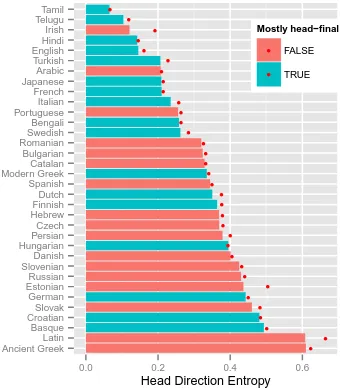
Figure 1: Head direction entropy in 34 languages. The bar represents the average magnitude of head direction entropy estimated from subcorpora of 1000 sentences; the red dot represents head direc-tion entropy estimated from the whole corpus.
tropies using the bootstrap estimator of DeDeo et al. (2013). We report the mean results from apply-ing our measures to subcorpora of 1000 sentences for each corpus. We also report results from apply-ing measures to the full corpus, so that the differ-ence between the full corpus and the subcorpora can be compared, and the effect of data sparsity evaluated.
4.1 Head Direction Entropy
Head direction entropy, defined and motivated in Section 3.3, is the conditional entropy of whether a head is to the right or left of a dependent, condi-tioned on relation type and part of speech of head and dependent. This measure can reflect either consistency in head direction conditioned on rela-tion type, or consistency in head direcrela-tionoverall. Results from this measure are shown in Figure 1. As can be seen, the measure gives similar results when applied to subcorpora as when applied to full corpora, indicating that this is measure is not un-duly affected by differences in sample size.
We find considerable variability in word order freedom with respect to head direction. In lan-guages such as Korean, Telugu, Irish, and English, we find that head direction is nearly determinis-tic. On the other hand, in Slavic languages and in Latin and Ancient Greek we find great variabil-ity. The fact that entropy measures on subcorpora
of 1000 sentences do not diverge greatly from en-tropy measures on full corpora indicates that this measure is stable with respect to sample size.
We find a potential relationship between pre-dominant head direction and word order freedom in head direction. Figure 1 is coded according to whether languages have more than 50% head-final dependencies or not. The results suggest that lan-guages which have highly predictable head direc-tion might tend to be mostly head-final languages. The results here also have bearing on appro-priate generative models for grammar induction. Common generative models, such as DMV, use separate multinomial models for left and right de-pendents of a head. Our results suggest that for some languages there should be some sharing be-tween these distributions.
4.2 Relation Order Entropy
Relation order entropy (Section 3.2) is the con-ditional entropy of the order of words in a local subtree, conditioned on the tree structure, relation types, and parts of speech. Figure 2 shows relation order entropy for our corpora. As can be seen, this measure is highly sensitive to sample size: for cor-pora with a medium sample size, such as English (16535 sentences), there is a moderate difference between the results from subcorpora and the re-sults from the full corpus. For other languages with comparable size, such as Spanish (15906 sen-tences), there is a larger difference. In the case of languages with small corpora such as Bengali (1114 sentences), their true relation order entropy is almost certainly higher than measured.
While relation order entropy is the most easily interpretable and general measure of word order freedom, it does not seem to be workable given current corpora and methods. In further experi-ments, we found that removing POS tags from the conditioning variable does not reduce the instabil-ity of this measure.
4.3 Relation Order Entropy of Subjects and Objects
● ● ● ● ● ● ● ● ● ● ● ● ● ● ● ● ● ● ● ● ● ● ● ● ● ● ● ● ● ● ● ● ● ● Latin Basque Ancient Greek Estonian Telugu Russian Bulgarian Persian Romanian Bengali Turkish Hebrew Croatian German JapaneseFinnish Spanish Slovak Czech Danish Modern Greek Arabic Catalan Tamil Portuguese Slovenian Hungarian Italian Dutch French Hindi Swedish Irish English
0.0 0.1 0.2 0.3
[image:9.595.87.257.71.267.2]Relation Order Entropy
Figure 2: Relation order entropy in 34 languages. The bar represents the average magnitude of rela-tion order entropy estimated from subcorpora of 1000 sentences; the red dot represents relation or-der entropy estimated from the whole corpus.
the case of HamleDT corpora), conditioned on the parts of speech for these dependents.
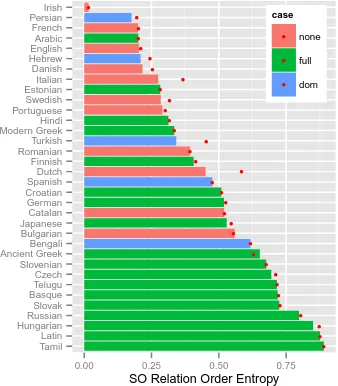
The languages Figure 3 are colored accord-ing to their nominative-accusative2 case marking on nouns. We consider a language to have full case marking if it makes a consistent morpho-logical distinction between subject and object in at least one paradigm. If the distinction is only present conditional on animacy or definiteness, we mark the language as DOM for Differential Object Marking (Aissen, 2003).
The figure reveals a relationship between mor-phology and this particular aspect of word order freedom. Languages with relation order entropy above .625 all have relevant case marking, so it seems word order freedom in this domain im-plies the presence of case marking. However, case marking does not imply rigid word order; sev-eral languages in the sample have rigid word or-der while still having case marking. Our result is a quantitative sharpening of the pattern claimed in Kiparsky (1997).
Interestingly, many of the exceptional languages—those with case marking and rigid word order—are languages with verb-final or verb-initial orders. In our sample, Persian, Hindi,
2Or ergative-absolutive in the case of Basque and the Hindi past tense.
● ● ● ● ● ● ● ● ● ● ● ● ● ● ● ● ● ● ● ● ● ● ● ● ● ● ● ● ● ● ● ● ● ● TamilLatin Hungarian Russian Slovak Basque Telugu Czech Slovenian Ancient Greek Bengali Bulgarian Japanese Catalan German Croatian Spanish Dutch Finnish Romanian Turkish Modern GreekHindi Portuguese Swedish Estonian Italian Danish HebrewEnglish Arabic French Persian Irish
0.00 0.25 0.50 0.75
SO Relation Order Entropy
[image:9.595.322.491.72.265.2]case ● ● ● none full dom
Figure 3: Relation order entropy for subject and object in 34 languages. Language names are an-notated with corpus size in number of sentences. Bars are colored depending on the nominative-accusative case marking system type for each lan-guage. “Full” means fully present case marking in at least one paradigm. “dom” means Differential Object Marking.
and Turkish are case-marking verb-final languages where we measure low levels of freedom in the order of subject and object. Modern Standard Arabic is (partly) verb-initial and case-marking (although case marking is rarely pronounced or explicitly written in modern Arabic). This finding is in line with recent work (Gibson et al., 2013; Futrell et al., 2015) which has suggested that verb-final and verb-initial orders without case marking do not allow robust communication in a noisy channel, and so should be dispreferred.
5 Conclusion
knowledge the first large-scale quantitative valida-tion of the old intuivalida-tion that languages with free word order must have case marking.
Acknowledgments
K.M. was supported by the Department of Defense through the National Defense Science & Engineer-ing Graduate Fellowship program.
References
Steven Paul Abney. 1987. The English noun phrase in its sentential aspect. Ph.D. thesis, Massachusetts Institute of Technology.
Olga Abramov and Alexander Mehler. 2011. Auto-matic language classification by means of syntactic dependency networks. Journal of Quantitative Lin-guistics, 18(4):291–336.
Judith Aissen. 2003. Differential object marking: Iconicity vs. economy. Natural Language & Lin-guistic Theory, 21(3):435–483.
Franklin Chang. 2009. Learning to order words: A connectionist model of Heavy NP Shift and acces-sibility effects in Japanese and English. Journal of Memory and Language, 61:374–397.
Greville G Corbett. 2006. Agreement. Cambridge University Press.
Marie-Catherine de Marneffe, Timothy Dozat, Na-talia Silveira, Katri Haverinen, Filip Ginter, Joakim Nivre, and Christopher D. Manning. 2014. Univer-sal Stanford Dependencies: A cross-linguistic typol-ogy. InProceedings LREC’14, Reykjav´ık, Iceland. Simon DeDeo, Robert X. D. Hawkins, Sara
Klin-genstein, and Tim Hitchcock. 2013. Bootstrap methods for the empirical study of decision-making and information flows in social systems. Entropy, 15(6):2246–2276.
Matthew S Dryer. 1992. The Greenbergian word order correlations. Language, 68(1):81–138.
Victor S Ferreira and Hiromi Yoshita. 2003. Given-new ordering effects on the production of scrambled sentences in Japanese. Journal of psycholinguistic research, 32(6):669–692.
Richard Futrell, Tina Hickey, Aldrin Lee, Eunice Lim, Elena Luchkina, and Edward Gibson. 2015. Cross-linguistic gestures reflect typological universals: A subject-initial, verb-final bias in speakers of diverse languages. Cognition, 136:215–221.
Edward Gibson, Steven T Piantadosi, Kimberly Brink, Leon Bergen, Eunice Lim, and Rebecca Saxe. 2013. A noisy-channel account of crosslinguistic word-order variation. Psychological science, 24(7):1079– 1088.
Joseph Greenberg. 1963. Some universals of grammar with particular reference to the order of meaningful elements. In Joseph Greenberg, editor, Universals of Language, pages 73–113. MIT Press, Cambridge, MA.
Paul Kiparsky. 1997. The rise of positional licensing. In Ans von Kemenade and Nigel Vincent, editors,
Parameters of morphosyntactic change, pages 460– 494. Cambridge University Press.
Dan Klein and Christopher D Manning. 2004. Corpus-based induction of syntactic structure: Models of de-pendency and constituency. In Proceedings of the ACL, page 478. Association for Computational Lin-guistics.
Marco Kuhlmann. 2013. Mildly non-projective de-pendency grammar. Computational Linguistics, 39(2):355–387.
Haitao Liu and Wenwen Li. 2010. Language clusters based on linguistic complex networks. Chinese Sci-ence Bulletin, 55(30):3458–3465.
Haitao Liu. 2010. Dependency direction as a means of word-order typology: A method based on depen-dency treebanks. Lingua, 120(6):1567–1578. Thomas McFadden. 2003. On morphological case and
word-order freedom. InProceedings of the Berkeley Linguistics Society.
George Miller. 1955. Note on the bias of informa-tion estimates. InInformation Theory in Psychol-ogy: Problems and Methods, pages 95–100. Johanna Nichols. 1986. Head-marking and
dependent-marking grammar. Language, 62.
Joakim Nivreet al.2015.Universal Dependencies 1.0. Universal Dependencies Consortium.
Joakim Nivre. 2015. Towards a universal grammar for natural language processing. InComputational Linguistics and Intelligent Text Processing, pages 3– 16. Springer.
Rudolf Rosa, Jan Maˇsek, David Mareˇcek, Martin Popel, Daniel Zeman, and Zdenˇek ˇZabokrtsk´y. 2014. HamleDT 2.0: Thirty dependency treebanks Stanfordized. InProceedings LREC’14, Reykjavik, Iceland.
E Sapir. 1921. Language, an introduction to the study of speech. Harcourt, Brace and Co., New York. Daniel Zeman, David Marecek, Martin Popel,
Loganathan Ramasamy, Jan Step´anek, Zdenek Zabokrtsk´y, and Jan Hajiˇc. 2012. HamleDT: To parse or not to parse? In Proceedings LREC’12, pages 2735–2741.