Sentiment Classification via a Response Recalibration Framework
Phillip Smith & Mark Lee School of Computer Science,
University of Birmingham, Birmingham,
UK
Abstract
Probabilistic learning models have the ability to be calibrated to improve the per-formance of tasks such as sentiment clas-sification. In this paper, we introduce a framework for sentiment classification that enables classifier recalibration given the presence of related, context-bearing doc-uments. We investigate the use of prob-abilistic thresholding and document simi-larity based recalibration methods to yield classifier improvements. We demonstrate the performance of our proposed recalibra-tion methods on a dataset of online clinical reviews from the patient feedback domain that have adjoining management responses that yield sentiment bearing information. Experimental results show the proposed recalibration methods outperform uncali-brated supervised machine learning mod-els trained for sentiment analysis, and yield significant improvements over a ro-bust baseline.
1 Introduction
Probabilistic classifiers are a typically used method for the classification of documents by the sentiment they convey (Pang et al., 2002). Given an unlabelled document, a trained probabilistic model is able to determine an appropriate labelling in relation to a given confidence for the proposed labelling. In the two-class sentiment classifica-tion problem a labelling confidence that is greater than 0.5 will lead to a particular sentiment being attached to the input document. However, it is questionable whether a classifier confidence out-put of 0.51 is sufficiently suitable for the applica-tion of any given label. This low confidence poses a problem for sentiment classification, and can of-ten lead to documents being labelled incorrectly, to the detriment of a sentiment analysis system.
A low classifier confidence in sentiment analy-sis may be produced due to inherent linguistic dif-ficulties that plague systems developed for natu-ral language processing. For example, documents where a sentiment is conveyed implicitly, ambigu-ously, or in a sarcastic manner can cause prob-lems for machine learning approaches to senti-ment classification. Methods have been proposed to deal with such facets of language in sentiment analysis. These tend to focus on hand-crafted lexi-cons (Balahur et al., 2011) or intra-document con-textual cues (Greene and Resnik, 2009) to disam-biguate the polarity of a document. We propose a method that takes into consideration related doc-uments in the classification process, and duly ad-justs classification output using asentiment recal-ibration framework.
Our proposed method takes into account exter-nal but relevant documents during the sentiment recalibration process. We use these documents to make adjustments to classifier outputs, in an ad-justment and correction phase. To our knowledge, this is the first work in sentiment classification to attempt the recalibration of a sentiment classifier given relevant documents. We attribute this ability to the dataset used for our experiments.
The remainder of the paper is structured as fol-lows: in Section 2 we describe the data and an-notation experiments devised to observe the rele-vance of a response to a comment. Section 3 then outlines the motivation for sentiment recalibration, and section 4 details our proposed methodology for the construction of a calibration framework for sentiment classification. Section 5 gives the base-line for evaluation. Section 6 details the results of experimentation with the framework, and dis-cusses the implications. Section 7 describes re-lated work and we conclude and give direction for future work in Section 8.
2 Data and Annotation
The monologic nature of current datasets for eval-uating sentiment classifiers, while valuable to the development of the field, are not applicable to our proposed recalibration framework. Most relevant to our work is the forum post data set (Murakami and Raymond, 2010). However, this is too general for the purposes we are examining due to deviation in discourse topic. Therefore we have developed a dataset for sentiment classification with the related documents that are required for the response recal-ibration framework. We use patient feedback data provided by the National Health Service (NHS). This has been used before (Smith and Lee, 2014), however author responses were not a feature ex-amined in this work. In this dataset, each feed-back item consists of a patient’s comment and a re-sponse from the NHS. Unlike other online reviews used to investigate the potency of sentiment clas-sification algorithms, this dataset does not contain a user ranking or score to accompany their com-ment. An annotation phase is therefore required in order to use the documents as an evaluation dataset for our algorithms.
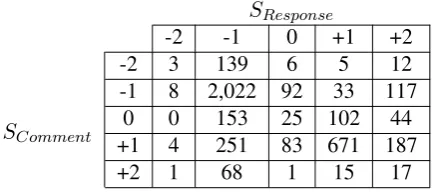
We annotate a subset of 4,059 comments and their related responses for their sentiments expressed and responded to, at the document level. The comments contained 254,611, of which 10,325 were unique. Responses contained 403,315 words, of which 9,115 were unique. De-spite a larger average document size, the response vocabulary was smaller that the comment vocabu-lary. This indicates that the responses given were constrained in nature. An initial pass of the data highlighted that reviews were not merely binary, but often weighed up mixed sentiments before giv-ing a conclusion. Due to this observation, we ini-tially annotate the data with a five-class annotation scheme. This includes, neutral, mixed-positive and mixed-negative categories. The mixed cate-gories denote that varying sentiments are present in the document, but one sentiment is more salient than the other.
Results of this annotation are presented in ta-ble 1. Given the annotations, we calculate inter-category agreement using Cohen’s kappa coeffi-cient. Between all categories κ = 0.4294, and observing positive and negative onlyκ= 0.761, a good level of agreement. This agreement is indica-tive of the level to which the sentiment expressed in a comment is mirrored and acknowledged in a
SResponse
-2 -1 0 +1 +2
-2 3 139 6 5 12
-1 8 2,022 92 33 117
SComment +1 40 0 153251 25 10283 671 18744
[image:2.595.312.532.64.160.2]+2 1 68 1 15 17
Table 1: Comment-response sentiment label con-fusion matrix.
related response. Due to this result, we proceed with our experiments using only the positive and negative data.
3 Sentiment Classification Recalibration
This work examines the potential for the out-come of sentiment classifiers to be recalibrated given the presence of a related document. In this work, the response to a sentiment-bearing com-ment is the related docucom-ment under consideration. Typical approaches to recalibration may rely on the Platt scaling or binning methods. Platt scal-ing trains a logistic regression model on the out-put of an SVM classifier, enabling the produc-tion of posterior classificaproduc-tion probabilities (Platt and others, 1999). Binning is another calibration method that is particularly effective for classifica-tion (Zadrozny and Elkan, 2001). Such recalibra-tion methods focus on statistical methods of recal-ibrating classifier output. However, when dealing with related natural language documents, we can use inferences from the content of the related text to guide the recalibration process. We therefore propose the use of the response to recalibrate the labelling of the initial comment. This takes a re-sponse directed at a comment, and uses the out-come of its classification as a starting point for re-calibration. We discuss in further detail the recali-bration protocols in the following section.
4 Method
the role of classifying comment and response sen-timent individually. A probabilistic classifier will output a confidence associated with a particular label. Given a confidence greater than .5 a label will be applied. However, a confidence of .51 is probably of no more use than a random guess in the two-class sentiment classification task. Given a complete iteration of the confidence thresholds at .01 confidence intervals, we examine the clas-sifier performance. At each interval, given each instance, where the response label differs to the comment’s we assign this label to the review. The third method judges the level of lexical similarity between the comment and response before making a judgement regarding recalibration.
4.1 Probabilistic Threshold Calibration In classification, the probability of labelling a doc-ument with a certain category is just as impor-tant as the labelling itself. A classifier may not be overly confident with its initial labelling, and so an external but relevant source of information may help guide and recalibrate the outcome of the initial calibration. Recalibration methods attempt to determine at what threshold the labelling would be most effective. These are typically guided by a line of best fit related to a posterior probability (Zadrozny and Elkan, 2001). We propose a recali-bration framework to examine the effects of recal-ibrating the threshold. The first approach is to iter-ate over the probabilities at intervals of 0.01, and recalibrate the labelling if the confidence of given labelling is below the threshold. The recalibration is given through the labelling of the response rela-tive to the original comment instance. In the pro-tocol experiments, the confidence of the response classifier is not observed, only the labelling. The label is then commuted to the comment.
The second set of experiments observing proba-bility thresholds imposes the constraint that the re-sponse classifier must yield a more confident sification outcome than that of the comment clas-sifier. Both may exhibit the same sentiment, but in order to overcome any confusion due to ambigu-ous or implicit expressions we commute the re-sponse labelling if and only if the confidence out-put by the response classifier is higher than that of the comment classifier.
4.2 Document Similarity
Classifier confidence is just one potential method of determining cases for instance relabelling
where sentiment classifiers may yield incorrect classifications. Another method that deserves con-sideration is determining the level of lexical sim-ilarity between the comment and response. The assumption is made that is that if a response is replying to the content of the original comment, there will be elements of language reuse in the re-sponse. Then, the greater the similarity, the more likely the relative document sentiments are homo-geneous. We implement the Greedy String Tiling algorithm (Wise, 1993) as a measure of document similarity. The algorithm outputs a score between [0,1], given the level of similarity. As with the pre-vious experiments with relabelling given a classi-fier confidence, we take the same approach here. Our experiment iterates over varying thresholds, with a 0.01 interval at each step. However, we do not make any adjustments for classifier confi-dence, only taking the binary labelling as the pri-mary label.
4.3 Baseline
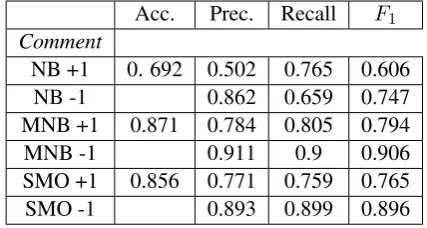
Comments in our dataset receive responses that both acknowledge and concisely respond to the content of the original message. We identify fea-tures of these responses that are useful to the sen-timent classification process. We employ a rule-based system rule-based on these observations to test the hypothesis that given the presence of these fea-tures, the sentiment of the response mirrors that of the original comment. Using a small set of regular expressions for frequent word stems we achieve a recall of .9004. Given the categorisation of the terms we then classify the sentiment of the response and compare the labelling to the gold-standard labelling of the comment. This yields an accuracy of 0.6634. We also cross-validate the three classifiers on the dataset to form another baseline, results of which are shown in Table 2.
Acc. Prec. Recall F1
Comment
NB +1 0. 692 0.502 0.765 0.606
NB -1 0.862 0.659 0.747
MNB +1 0.871 0.784 0.805 0.794
MNB -1 0.911 0.9 0.906
SMO +1 0.856 0.771 0.759 0.765
[image:3.595.309.523.604.718.2]SMO -1 0.893 0.899 0.896
0.6 0.8 1 0.7
0.8 0.9
Probability
Accurac
y
0 0.5 1
0.7 0.8 0.9
Similarity
0.6 0.8 1 0.7
0.8 0.9
Probability
(a) (b) (c)
[image:4.595.111.501.61.228.2]NB MNB SVM
Figure 1: Accuracy comparison graphs for our recalibration methods: (a) confidence threshold (b) simi-larity threshold (c) confidence threshold whereP r(R)> P r(A).
5 Results and discussion
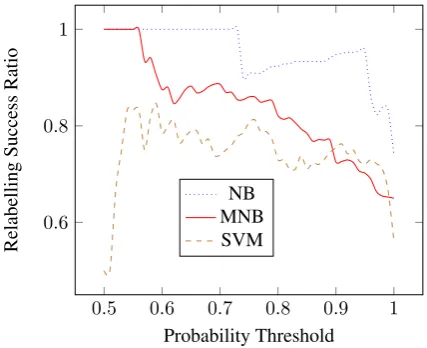
Results of the probabilistic relabelling experiment highlight an improvement in classifier accuracy as the probability threshold increases, contrary to ex-pectation. We must look to both Figures 1 and 2 in order to understand this result. One would ex-pect that a classifier outputting a low confidence of classification would yield a higher accuracy given the recalibration process. Results highlight the rel-ative over-confidence of all classifiers when pre-dicting the class of an instance as the number of candidates eligible for relabelling is relatively low. In particular, if we observe the candidates returned for the NB this classifier does not exhibit a great variance in confidence, with the majority of la-bellings being≥0.99. The hubristic nature of the NB labelling confidence is not beneficial where re-sults are unable to be recalibrated. Given the total relabelling scenario for the NB classifier, whereby all labels from the responses are commuted to an-notate the comment, there is a significant increase in classification accuracy of 0.15. In the case of the other two classifiers, such a scenario leads to a decrease in performance. This indicates the poor quality of model initially produced by the NB learner. This also shows the relative strength in model building qualities of the MNB and SVM learners.
The SVM outperforms the NB, but falls short of MNB performance. Figure 2 indicates that poten-tially poor relabelling choices contribute to this. The success ratio drops dramatically as SVM con-fidence tends towards 1. This trait is similarly present in both the NB and MNB, also. This is
0.5 0.6 0.7 0.8 0.9 1
0.6 0.8 1
Probability Threshold
Relabelling
Success
Ratio
NB MNB SVM
Figure 2: Relabelling success rate given varying classifier confidence thresholds.
to be expected however, and suggests that a highly confident initial judgement by the comment senti-ment classifier should not be altered.
Contrasting the probabilistic thresholding re-sults with the similarity threshold relabelling ex-periments we notice that classifier confidence is a substantially better calibration method. Given the similarity thresholding experiments, decreases in classification accuracy are shown for MNB and SVM. However for NB, significant gains in classi-fier accuracy are made. This is in contention with the results of the probabilistic thresholding exper-iments, where gains for NB classification were minimal. We can attribute this to the relaxed string matching method of the implemented similarity measure.
[image:4.595.311.525.285.459.2]of the MNB for in the recalibration framework. Recall increases over all iterations≤0.99, which then yields a drop when full relabelling is ap-plied. Precision peaks at a threshold of 0.78 and decreases following this. The SVM follows suit, however performance degrades almost 0.06 when full relabelling is applied. Precision sees a drop for the negative class, although the NB exhibits recon-ciling traits. The SVM suffers from a drop in pre-cision of 0.05. The positive class however shows signs of strengthening as the similarity threshold increases. The MNB remains the dominant clas-sifier throughout precision comparison. The recall follows an inverse pattern. As similarity threshold increases for in our negative class experiments, re-call gradually increases for MNB and SVM, how-ever makes gains of 0.22 for the NB. The positive recall drops however for all classifiers.
The strong response classification experiments impose a constraint that labelling of the comment can only be commuted from the response classi-fication if and only if the response classifier con-fidence is higher than that of the comment clas-sification of a given instance. The constraint ap-pears to have a stabilising quality. Comparing graphs (a) and (c) in Figure 1, we see a substan-tially smoother gradient to the curve of the strong response classification curves in comparison to the general threshold commutation experiments. We do not see the drops in performance for the MNB and SVM classifiers, much to the benefit of the overall classification, but similarly, we do not see the steep climb in classifier accuracy demonstrated by the NB. The precision and recall rates achieved by strong response classification only mimics that of the general probabilistic threshold experiments. Closer comparison of the two shows marginal dif-ferences.
Results indicate that there is no requirement for the confidence of the response classifier output to be higher than that yielded for the correspond-ing instance classified by the model trained on the comment data. Comparing Figure 1 with the com-ment baseline given in Table 2, accuracy results from the classifiers in the experiments marginally succeed the baseline for the MNB classifier, but for the SVM and NB, accuracy is detrimentally effected. We can conclude that in this case of re-sponse relabelling the constraint is too strict.
6 Related Work
Work has observed the useful nature of relation-ships between documents hen classifying stocks based on the contents of related posts on social networks (Si et al., 2014) and classifying senti-ment in posts on online forums based on user re-lationships, or user stances in online debates (Mu-rakami and Raymond, 2010).
Work on bagging in sentiment classification is somewhat related to our work (Dai et al., 2011; Nguyen et al., 2013). Bagging trains a number of models on a similar set of training data. Dur-ing classification, each model then classifies the given instance, and a voting protocol labels the instance with the majority label suggested. Our framework however does not train multiple clas-sifiers, although the framework could be extended to incorporate this. Instead, a related document is used to guide and recalibrate the outcome of the initial classification. Our method does not suffer from the issue of low classifier trustworthiness, as we have shown the results of response only clas-sification to be reliable in our baselines. The need for further methods such as stacking is therefore eliminated.
The use of management response in online re-views has been examined to empirically determine the effectiveness in improving a firm’s reputation (Proserpio and Zervas, 2014). Analysis has shown moderate improvements where a management re-sponse was given. This work did not computation-ally evaluate the content of reviews, however.
7 Conclusion
increases, we would like to examine and evaluate our method on additional datasets.
References
Alexandra Balahur, M. Jes´us Hermida, and Andr`es Montoyo. 2011. Detecting implicit expressions of sentiment in text based on commonsense knowl-edge. In Proceedings of the Second Workshop on Computational Approaches to Subjectivity and Sen-timent Analysis, pages 53–60. ACL.
Salem Benferhat, Karim Tabia, Mouaad Kezih, and Mahmoud Taibi. 2014. Post-processing a classi-fier’s predictions: Strategies and empirical evalua-tion. InECAI, pages 965–966.
Lin Dai, Hechun Chen, and Xuemei Li. 2011. Improv-ing sentiment classification usImprov-ing feature highlight-ing and feature bagghighlight-ing. InICDMW, pages 61–66. IEEE.
Stephan Greene and Philip Resnik. 2009. More than words: Syntactic packaging and implicit sentiment. InACL-HLT, pages 503–511.
David Jensen, Jennifer Neville, and Brian Gallagher. 2004. Why collective inference improves relational classification. InICKDDM, pages 593–598.
Akiko Murakami and Rudy Raymond. 2010. Support or oppose?: Classifying positions in online debates from reply activities and opinion expressions. In COLING, pages 869–875.
Quoc Dai Nguyen, Quoc Dat Nguyen, and Bao Son Pham. 2013. A two-stage classifier for sentiment analysis. InIJCNLP, pages 897–901.
Bo Pang, Lillian Lee, and Shivakumar Vaithyanathan. 2002. Thumbs up? sentiment classification using machine learning techniques. InEMNLP.
John Platt et al. 1999. Probabilistic outputs for sup-port vector machines and comparisons to regularized likelihood methods. Advances in large margin clas-sifiers, 10(3):61–74.
Davide Proserpio and Georgios Zervas. 2014. Online reputation management: Estimating the impact of management responses on consumer reviews. Tech-nical Report 2521190, Boston U. School of Manage-ment.
Jianfeng Si, Arjun Mukherjee, Bing Liu, Jialin Sinno Pan, Qing Li, and Huayi Li. 2014. Exploiting so-cial relations and sentiment for stock prediction. In EMNLP, pages 1139–1145.
Phillip Smith and Mark Lee. 2014. Acknowledging discourse function for sentiment analysis. In CI-CLING, volume 8404 ofLNCS, pages 45–52.
Benjamin Taskar, Eran Segal, and Daphne Koller. 2001. Probabilistic classification and clustering in relational data. In IJCAI, volume 17, pages 870– 878.
Michael J Wise. 1993. String similarity via greedy string tiling and running karp-rabin matching. On-line Preprint, Dec, 119.