A Rough Set and GIS Based Approach for Selecting
Suitable Shelters during an Evacuation Process
Sara S. Elheishy, Ahmed A. Saleh, Aziza Asem
Department of Information Systems, Mansoura University, Mansoura, Egypt Email: [email protected]
Received November 19, 2012; revised December 20, 2012; accepted January 21, 2013
ABSTRACT
Humanity suffers an ever-present threat of crises. In the event of a crisis, the population in affected areas will be in danger and will need to be evacuated to a safer in order to protect their lives. One of the difficulties in emergency man- agement is quickly and accurately selecting suitably safe areas of refuge. This paper aims to explain an evacuation shelter selection process that uses rough set theory and a geographical information system (GIS). The proposed ap- proach uses rough set theory concepts to classify shelters and selects suitable shelters on the basis of three factors: dis-tance, capacity, and the availability of life requirements. The preparation of data and reporting of results are performed via the GIS environment. The proposed approach was implemented using Masoura, Egypt, as a case study and the re- sults of this implementation are presented.
Keywords: Rough Set Theory; GIS; Shelter Selection; Evacuation Planning
1. Introduction
Urban areas are frequently subject to various crises. Whether natural or man-made, a crisis is an event that happens suddenly, surprises and threatens people, and affects the environment. In a crisis, such as an earthquake, fire, or explosion, decisions need to be made quickly and accurately to minimize loss of life and economic reper- cussions. To make such decisions, the situation must be managed through a crisis management plan. This allows for the mitigation of the effects of a crisis before, during, and after the event. A primary component of any crisis management plan is the evacuation plan.
Evacuation is an operation whereby all or part of a particular population is temporarily relocated to a safe location in an organized manner from a region that has been, or is about to be, struck by a disaster [1]. Many fac- tors may affect an evacuation process, such as evacuee behavior, traffic control, safe area selection, and evacua- tion routes. This paper focuses on the process of select- ing safe evacuation areas and the factors that affect se- lecting a safe location. A suitable area should be a safe, open, and large area where basic life requirements are available.
In recent years, many studies have attempted to solve and enhance the evacuation shelter selection process from a variety of perspectives. M. Saadatseresht et al. [2] proposed a multi-objective evolutionary algorithm, cou- pled with a geographical information system (GIS) to
provide better visualization, to determine the distribution of evacuees into safe areas by selecting candidate safe areas, and to determine viable paths between city blocks and the candidate safe areas. This method selected an optimal safe area based on the shortest distance and the capacity of the safe area. J. Coutinho-Rodrigues et al. [3] identify six objective functions to find evacuation paths and location of shelters by a method that minimizes total travel distance, risk, time, and number of shelters. Chung- Hung Tasi et al. [4] studied the uncertainty of geogra- phical data and proposed an integrated TS decision-ma- king system that combined TS fuzzy models with GIS space analysis to investigate effective distribution of peo- ple to urban shelters during an emergency.
In this paper, a rough set approach coupled with a GIS is proposed for selecting the most suitable shelters during the evacuation process. Shelter selection schema is based on three criteria: distance between the incident point and a shelter, the capacity of the shelter, and the availability of basic life requirements in proximity to the shelter lo- cation. The shelter selection process is carried out by a set of rough set rules and the input data are prepared and the results are reported using the GIS environment.
The remainder of this paper is organized as follows. Section 2 provides a review of rough set theory literature. Section 3 presents an overall review of GISs. In Section 4, the shelter selection process framework is introduced and Section 5 details the implementation of the proposed methodology as demonstrated through a case study. Fi-
nally, in Section 6, a summary is provided and future work is briefly discussed.
2. Rough Set Theory
Rough set theory, introduced by Z. Pawlak [5], presents a mathematical approach for dealing with imperfect know- ledge; its methodology is concerned with the classifica- tion and analysis of imprecise, uncertain, or incomplete information and knowledge, and is considered one of the first non-statistical approaches to data analysis. Imperfect knowledge has become a serious issue for computer sci- entists, and there are many approaches to understanding and manipulating imperfect knowledge. The most suc- cessful approach is based on the fuzzy set notion. The main advantage of rough set theory is that it does not need any preliminary or additional information about da- ta, such as probability in statistics or grade of member- ship in the fuzzy set theory.
2.1. Indiscernibilty Relations
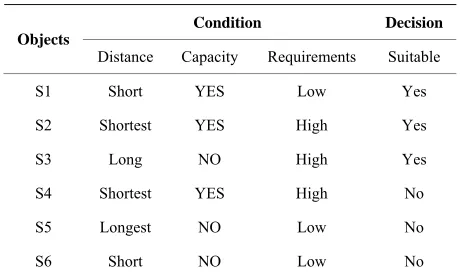
The starting point of rough set theory is the indiscernibi- lity relation, which is generated by information about ob- jects of interest. An indiscernibility relation is a relation between two or more objects, where all the values are identical in relation to a subset of considered attributes [6]. The indiscernibility relation is intended to express the fact that, due to a lack of knowledge, we are unable to discern some objects with the available information. For example, Table 1 shows that shelters (S1, S2, S4) are
indiscernible with respect to the attribute Capacity as they have the same value for that attribute. Shelters (S5, S6) are indiscernible with respect to the attributes Ca- pacity and Requirements.
2.2. Information Table versus Decision Table
[image:2.595.57.287.597.736.2]An information table is required to represent data that will be utilized by rough set theory; an information table consists of rows representing objects and columns repre- senting attributes relating to the objects.
Table 1. Example of a decision table.
Condition Decision Objects
Distance Capacity Requirements Suitable
S1 Short YES Low Yes
S2 Shortest YES High Yes
S3 Long NO High Yes
S4 Shortest YES High No
S5 Longest NO Low No
S6 Short NO Low No
Decision tables, a type of information table, contain two types of attributes; condition attributes and decision attributes. A decision table specifies what decisions should be undertaken when certain conditions are satisfied. They are useful tools in decision-making problems, such as de- termining suitable evacuation shelters. Table 1 shows an
example of a decision table.
As shown in Table 1, rows represent shelters (objects),
the columnsDistance, Capacity, and Requirements rep- resent condition attributes, and the column Suitable re- presents the decision attribute. Each row of a decision table determines a decision rule specifying the decision (action) that must be made when the conditions indicated by condition attributes are satisfied [6]. For example, in
Table 1, the conditions (Distance, Short), (Capacity, YES),
and (Requirements, Low) determine the decision (Suit- able, Yes).
2.3. Simplification of Decision Table
Simplification of a decision table involves reducing the number of condition attributes by removing unnecessary conditions while allowing the same decision to be reach- ed.
3. Geographical Information Systems
The data involved in the evacuation shelter selection pro- cess has obvious geographical features, and the best way to deal with such features is with a GIS. A GIS captures, stores, checks, integrates, analyzes, displays, and allows manipulation of data that are spatially referenced to the earth [7]. These data can be further analyzed using mo- dels to build computer systems for geographic research and decision-making services [8]. Additionally, a GIS is attractive because it is both intuitive and cognitive. It combines a powerful visualization environment with a strong analytic and modeling framework that is rooted in the science of geography [9].
In this paper, a GIS is used as a platform to prepare and display the data required for the shelter selection process. The primary tasks performed by the GIS are: creating two layers to store city road and shelter attri- butes, displaying the incident location, creating the eva- cuation zone area (a buffer around the incident point de- fining the danger zone), determining road routes from the incident location to all shelters, computing the distance of each route, and displaying the most suitable shelter location on a map.
Copyr JGIS
complicated process that associates several factors, which may depend on the type of crisis. This paper proposes a method for selecting evacuation shelters independent of crisis type. Such an approach could, generally, be applied to any crisis evacuation plan.
ight © 2013 SciRes.
The Guidelines for Hurricane Evacuation Shelter Se- lection (ARC 4496) [10], provided by the American Red Cross and the Home Community World institute, pro- vides primary guidelines for hurricane evacuation shelter selection. In our case study we did not consider the crisis type; therefore, we followed only the ARC 4496 guide- lines that relate generally to selecting an evacuation shel- ter, such as location and capacity. We did not consider conditions specific to hurricanes, such as wind speed, rainfall, flooding, and hurricane force, etc.
The guidelines for selecting evacuation shelters ap- plied in this paper are:
No evacuation shelter should be located in the eva-
cuation zone (ARC 4496).
Evacuation shelters should be in open areas. If the affected city does not have adequate open areas, then schools can be used as evacuation shelters.
Shelter space requirements should be determined us- ing 40 square feet per shelter resident. Shelter space requirements may be reduced using no less than 20 square feet per person (ARC 4496).
The shelter location should have basic life require- ments or can have basic requirements delivered easily. The idea behind the approach is to classify all shelters in the city under study. Each shelter is classified accor- ding to a set of rough set rules, and each class has a de- gree of suitability. Then, under certain conditions, the most suitable shelter is chosen from one of the classes. A flow- chart of the proposed framework is presented in Figure 1.
The following subsections provide a detailed description of the methodology.
START
Generate Decision Table Preparing Data
Generate Shelters Table Simplification
Discretization of Distances Define Rules
Classify Shelters
Risk Bad Accep
table Good GoodVery
Best
Haa data
Haa data
Haa
data Haadata
Haa data
Haa data
No No
No No
Choose Best Shelter
Safe shelter info.
END Risky
Shelters
Ye
s
Ye
s
Ye
s
Ye
s
Ye
s
4.1. Preparing Required Data
The first step of our methodology is the preparation of the required data. This preparation includes creating a database to store road information and safe locations that can be used as shelters, determining the incident point where the crisis occurs, defining the evacuation area, and calculating the distance from the incident location to each shelter. All these preparations are carried out by the GIS.
4.2. Generate Shelters Table
The shelters table should contain information about areas in the city that can be used as shelters. This information will be used to define the classification process. The table consists of three basic attributes: Distance, Enough_Ca- pacity, and Requirements.
The Distance attribute contains the value that repre- sents the distance from the incident location to each shel- ter.
The capacity of each evacuation shelter is computed according to ARC 4496 guidelines, which state that shel- ter space requirements should be determined using 40 square feet per person (shelter resident). A Check_Ca- pacity method has been developed to check the capacity of a shelter against the number of displaced people within the incident location and assigns the result to the capacity attribute in the table. The Enough_Capacity attribute contains a value of “YES” or “NO”; the value is “YES” if the shelter’s Capacity will accommodate the number of displaced people and “NO” if the shelter’s Capacity will not.
The Requirements attribute contains a value that re- presents whether or not this shelter has basic life re- quirements, such as electricity, food, water, medicine, etc. If these requirements are available and are in good con- dition, then the attribute value is “High”. If these require- ments are available but are in poor condition or are dif- ficult to use, the attribute value is “Low”. If these require- ments are not available, then the attribute value is “Not Available”.
4.3. Discretization Process
Because distance values are continuous values, we need a method to convert these values to discrete values so they may become useful in the classification process. Discre- tization techniques can be used to reduce the number of values for a given continuous attribute by dividing the range of the attribute into intervals. Interval labels can then be used to replace actual data values [11]. There are a number of discretization methods available, such as Boolean reasoning, equal-frequency binning, entropy- based, naïve-Bayes, etc.
According to Z. Marzuki and F. Ahmad (2007)[12], these methods were developed for specific problems or domains; therefore, using these methods in other do- mains may be inappropriate or cause serious problems that affect the accuracy of the results. Regardless of how each method works, the basic idea is to define a cut point to split the continuous values and to define a stopping criterion for the discretization process.
Unfortunately, these discretization techniques are not appropriate in our case because, according to ARC 4496 guidelines, no evacuation shelter should be located in the evacuation zone. Therefore, we need to consider the dif- ference in distance between each shelter and the evacua- tion zone and consider a cut point to compare the diffe- rence. In order to overcome this problem, we developed a simple discretization method called DiscreteDistances. The algorithm starts by checking if there is a distance value in the distance list that is less than or equal to the evacuation zone value. If present, the shelter is located inside the evacuation zone and is in a dangerous area. In this case the discretization algorithm assigns the interval label “Risk” to the distance.
If this is not the case, the algorithm computes the dif- ference between each distance in the distance list and the evacuation zone value and compares this difference value to the predetermined cut points in order to assign the dis- tance to one of the defined intervals (“Shortest”, “Short”, “Long”, “Longest”).
4.4. Generate the Decision Table
Parallel with the data preparation, a decision table is generated using all possible scenarios for a shelter’s status. This forms the basis of the classification process. The table consists of two types of attributes; the condi- tion attributes, Discrete_Distance, Capacity, and Re- quirements_Status, and a decision attribute that repre- sents a shelter’s degree of suitability. An expert opinion is required to determine the right decision for each sce- nario.
4.5. Simplification
Each row in the decision table represents a decision that should be made under the corresponding conditions. In some cases, the same decision can be reached by fewer conditions. The simplification of the decision table is a very important step whereby the table is reduced in a manner that allows the same decision to be reached using fewer conditions. This type of simplification eliminates the need to check unnecessary conditions. The table sim- plification method [13] used herein consists of the fol- lowing steps:
cision table.
2) Elimination of duplicate rows.
3) Elimination of superfluous attribute values.
4.6. Define Decision Rules and Perform Classification
In this step, a set of decision rules are defined based on the simplified decision table. Each row in the simplified decision table represents a decision rule. The advantage of defining rules in advance is that these rules are reu- sable; the rules can be applied to multiple evacuation shel- ter selection problems under equal conditions.
Subsequently, the defined rules function as the basis for the Classify method. The Classify method interprets the set of rules as implications called “if … then” rules and generates six classes (Risk, Best, Very Good, Good, Acceptable, Bad). It then assigns each shelter in the Shel- ters table to one of the classes according to the defined rules.
The Risk class contains a set of shelters that are not suitable for the evacuation process. All other classes con- tain shelters suitable for the evacuation process; however, their degrees of suitablity differ. In other words, shelters in the Best class are the most suitable shelter and the degree of suitability decreases from Best to Bad.
4.7. Choosing the Most Suitable Shelter
The last step of the approach is selecting the most sui- table shelter from the classes, Best, Very Good, Good, Acceptable, and Bad. The Suitable_Shelter method was developed to achieve this. First, the Best class is checked for data (shelters). If data exists in the Best class, the Sui- table_Shelter method chooses the entry with the mini- mum distance. If no data is present in the Best class, the next class (Very Good) is checked, and so on, until it reaches the Bad class. If the selected shelter does not have enough capacity, then a shelter with the next minimum distance is selected.
5. Implementation and Analysis Results
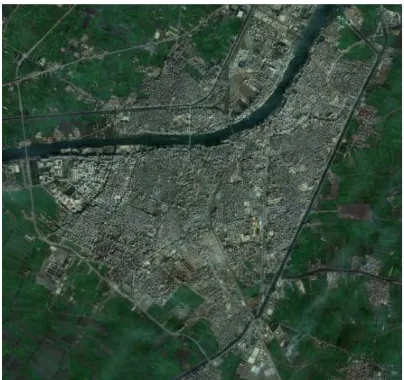
To test our approach, we applied our methodology to a case study using Mansoura, Egypt. Mansoura is the ca- pital city of Al-Daqhlia province and lies on the east bank of the Damietta branch of the Nile, in the Delta region. It is located approximately 120 km northeast of Cairo, the capital of Egypt. Mansoura covers 327.62 squ- are kilometers and has a population of 992,605, accord- ing to 2011 provincial statistics. Figure 2 shows a satel-lite image of Mansoura.
[image:5.595.322.524.83.273.2]According to the Mansoura Crises Management Unit’s shelter selection plan, Mansoura has only four shelters to house displaced people in the event of a crisis, and a
Figure 2. Satellite image of mansoura.
shelter is selected depending on its proximity to the in- cident. This means that the decision depends solely on the distance factor. These four shelters are: Mansoura Sports Club, Omaal Club (workers’ club), Al Saha Al Shaabia (the popular arena), and Al Magzr Al Aalie (the automated slaughterhouse).
Our methodology was applied to Mansoura to increase the number of shelters and to determine the most suitable evacuation shelter(s). Due to a lack of actual data regard- ing a real crisis, we simulated a crisis and applied our ap- proach to this virtual scenario.
We used ArcInfo 9.3 as the GIS software to manage the geographical aspects of the case study.
5.1. Preparing Map Data
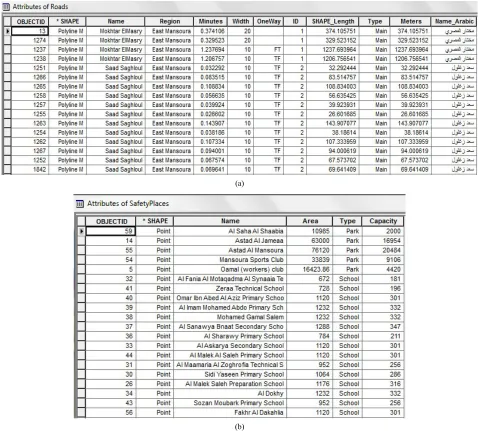
The first step in preparing the data is to create and build the GIS database, known as a Geo-database. Two feature classes were created, Roads and Safety Places. Figures 3(a) and (b) show snapshots of a portion of the attribute
feature classes.
The Roads feature class stores data on all roads in the city. It has a Minutes attribute, which stores travel time for each road assuming a vehicle speed of 60 km/h.
The Safety Places feature class stores the shelter loca- tion and other shelter-specific data. Because of the small number of open green areas in Mansoura, we included schools as shelters. Thus, we had 32 shelters; 5 parks and 27 schools. The Area attribute stores the shelter’s area in square meters, and the Capacity attribute computes and stores the capacity of each shelter. The capacity is calcu- late by dividing the Area by 3.716 square meters (40 square feet), according to ARC 4496 requirements for evacuation shelter selection. Figure 4 presents the final
view of the digitized map, including the locations of helters.
s
(a)
(b)
Figure 3. (a) Roads feature class; (b) Safety Places feature class.
5.2. Preparing Incident Data
0 650 1300
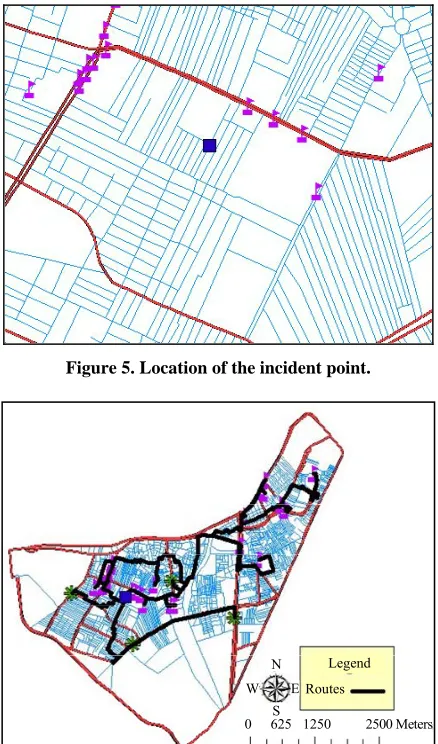
To simulate an evacuation shelter selection process, we first need to position the incident. For network analysis, we use the ArcInfo 9.3 Network Analyst extension. As shown in Figure 5, the incident point is displayed as a
small blue square and is located in Mashaal Square in east Mansoura.
2600 Meters W E
N
S
Legend Roads
Local
According to the Al Dakahlia Emergency Manage- ment Unit’s expert, computing an evacuation zone area depends on the type of incident and other related factors. For our simulated case study, the evacuation zone area was set to 500 meters.
Main
Park
School SafetyPlaces
[image:6.595.58.536.85.516.2] [image:6.595.60.286.543.714.2]ferred to the discretization algorithm. The routes from the incident point to all shelters are illustrated in Figure 6.
5.3. Generating Shelters Table
As mentioned in Section 4.2, the Shelters table should contain information about safe areas in the city that can be used as shelters. This information will be used for the classification process. Figure 7 shows a sample of the
Shelters table. The Distance attribute contains the con- tinuous values that express the distances, obtained from the network analyst tool, from the incident point to each of the shelters. The Check_Capacity method is used to determine the value of the Enough_Capacity attribute by comparing the capacity of each shelter against the num- ber of displaced people. Finally, a value indicating to what extent basic life requirements are available at the shelter is placed in the Requirements attribute; “H” for high, “L” for low, and “N” for not available. Fortunately, the study showed that all evacuation shelters in the area have basic life requirements; this meant that there were no “N” va-
Figure 5. Location of the incident point.
0 625 1250 2500 Meters W E
N
S
[image:7.595.63.282.341.713.2]Legend Routes
Figure 6. Routes from incident point to all shelters.
lues. However, values for the Requirements attribute did range from high to low.
5.4. Discretization Process
The discretization process was used to reduce the number of values for a given continuous attribute by dividing the range of the attribute into intervals. Here, we use our Dis- creteDistances method to assign each value from con- tinuous distance values to the appropriate interval from the intervals Risk, Shortest, Short, Long, or Longest. Fig- ure 8 shows a sample of the discretization results; the
Name column represents the shelter name, the Distance column represents the real distance value, and the Dis- tance_Quant column represents the corresponding inter- val for that value.
5.5. Generation of the Decision Table and Simplification
The decision table specifies what decisions should be
[image:7.595.365.481.562.719.2]Figure 7. Sample of shelter table.
Figure 8. Sample of output from the discretization process.
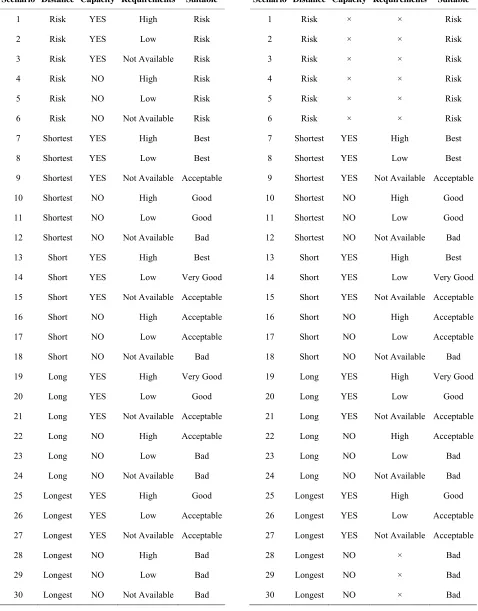
made when certain conditions are satisfied. In this step, a decision table is created using three conditional attributes (Distance, Capacity, and Requirements), and one deci- sion attribute (Suitable) to indicate the shelter’s degree of suitability. We must then fill the decision table with all possible scenarios for the condition attributes and attempt to capture expert knowledge by consulting expert opinion. In our case study, the Mansoura Crises Management Unit provided expert knowledge for each scenario in the decision table. Table 2 in Appendix A shows the deci-
sion table.
The simplification of decision tables is a very impor- tant step; the process reduces the number of conditions so that the same decision can be reached by fewer condi- tions. As mentioned in Section 4.5, the approach used for table simplification consists of three steps. The following shows the result of each step:
1) The computation of reducts of condition attributes. This is equivalent to eliminating columns from the de- cision table:
• By removing Distance we found that the table beca- me inconsistent; therefore, so the Distance attribute is indispensable to the decision table.
• By removing Capacity we found that the table be- came inconsistent; therefore, the Capacity attribute is indispensable to the decision table.
• By removing Requirements we found that the table became inconsistent; therefore, the Requirements at- tribute is indispensable to the decision table.
The above implies that (Distance, Capacity, Require- ments) are relative reducts for this decision table.
2) The elimination of duplicate rows. Since no co-
lumns were eliminated, and by examination of the deci- sion table, we found no duplicate rows to eliminate.
3) The elimination of superfluous attribute values.
Table 3 in Appendix B shows the decision table after eli-
minating superfluous values.
5.6. Classification and Choosing the Most Suitable Shelter
From Table 3 we can derive the rules that define the
shelter classification process. The 23 rules generated from the simplified decision table are presented in Appendix C.
The classification process begins using the Classify method to apply the 23 rules, defined by the simplified decision table, to the Shelters table such that each shelter in the Shelters table is assigned one of the six predefined classes (Risk, Best, Very Good, Good, Acceptable, Bad).
Afterthe six classes are generated, the Suitable_Shelter method checks each class and determines shelters with the minumum distance and adequate capacity. Figure 9
shows the results of the classification process combined with identification of the most suitable shelter. For our incident case study, Shakrt El Dor School from the Best class was determined to be the most suitable shelter.
5.7. Displaying the Results
To display implementation results, we use the ArcInfo 9.3 Network Analyst tool. This tool displays the route and driving directions from the incident place to the se-lected shelter. Figure 10 shows the displayed route and
driving directions; the bold black line represents the
[image:8.595.140.458.480.720.2]Figure 10. Driving directions to the selected shelter.
route from the incident point to the identified shelter, Shakrt El Dor School.
5.8. Comparison
To measure the effectiveness of our approach, we com- pared it to the current plan that the Mansoura Emergency Unit uses for selecting shelters. The Mansoura Emer- gency Unit’s plan has only 4 shelters and selects shelters based on their proximity to the incident. In our approach, we increased the number of shelters to 32, and the suit- able shelter was identified using three factors: distance, capacity, and availability of basic life requirements through
a set of rough set rules. Legend
N Routes_Current Plan The Mansoura Emergency Unit’s shelter selection ap-
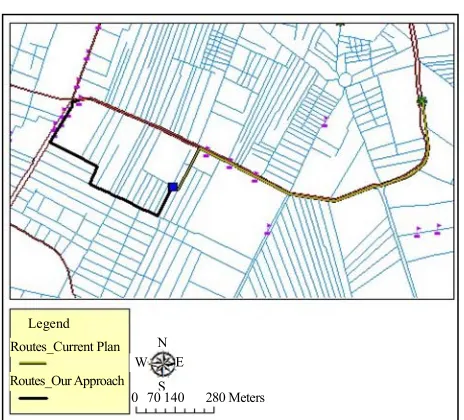
proach identified the Mansoura Sports Club, which has a route distance from the incident point of 2490 meters. Assuming a vehicle speed of 60 km/h, the travel time to this shelter would be approximately 2 minutes and 49 se- conds. On the other hand, our proposed approach se- lected Shakrt El Dor School as the most suitable shelter. The route distance to this shelter is 847.5 meters; reach- ing this shelter would take approximately 51 seconds at 60 km/h. From this, we postulate that our proposed ap- proach for selecting the most suitable shelter in the event of a crisis is more effective than the currently used ap- proach.
As shown in Figure 11, the olive line represents route
generated by the Mansoura Emergency Unit’s shelter se- lection approach, and the black line represents the route generated by our method.
0 70 140 280 Meters W E
[image:9.595.130.468.84.347.2]Routes_Our Approach S
Figure 11. Comparison between shelters selected by the pro- posed and currently employed approaches.
6. Conclusion and Future Work
This paper proposes a rough set and GIS based approach to select suitable shelters during an evacuation process. The approach uses a GIS to prepare data for roads, shel- ter locations, and distances from the incident point to each shelter location. A decision table is generated using all possible scenarios from the three criteria attributes (Distance, Capacity, Requirements). The simplification method is performed on the decision table to reduce the number of conditions, and a set of rough set rules are de-
[image:9.595.308.540.360.570.2]fined from the simplified decision table. Subsequently, the shelter classification process is performed according to the predefined rules, and six classes are generated from this classification process. The shelter with the shortest distance and adequate capacity is identified as the most suitable. Finally, the results are displayed in the GIS en- vironment.
The proposed approach was tested using Mansoura, Egypt as a case study, and a comparison of our proposed approach and the currently used plan was conducted. The comparison shows that our proposed approach is more effective than the currently used plan; it increases the number of shelters in the city and selects the shelter with the minimum distance and adequate capacity.
Further research needs to be done to consider how tra- ffic control strategies and evacuee behavior may impact the evacuation shelter selection process.
7. Acknowledgements
The authors would like to thank people works in Man- soura Emergency Unit for providing us with helpful in- formation about the current plan that the Mansoura Emer- gency Unit uses for selecting shelters. We would also like to thanks Enago (www.enago.com) for the English language review.
REFERENCES
[1] Brampton Flower City, “The City of Brampton Emer- gency Evacuation Plan,” 2011.
http://www.Brampton.ca/EN/RESIDENTS/Pages/Welco me.aspx
[2] M. Saadatseresht, A. Mansourian and M. Taleai, “Evacu- ation Planning Using Multiobjective Evolutionary Opti- mization Approach,” European Journal of Operation Re- search, Vol. 198, No. 1, 2008, pp. 305-314.
doi:10.1016/j.ejor.2008.07.032
[3] J. Coutinho-Rodrigues, L. Tralhão and L. Alcada-Alme- ida, “Solving a Location-Routing Problem with a Multi- objective Approach: The Design of Urban Evacuation Plans,” Journal of Transport Geography, Vol. 22, 2012, pp. 206-218. doi:10.1016/j.jtrangeo.2012.01.006
[4] C. Tasi, W. Wang, C. Chen, H. Chen and M. Len, “The Construction of Decision Model for Tourism Disaster Evacuation Based on GIS and Fuzzy Theory,” World Academy of Science, Engineering and Technology, Vol. 54, 2009, pp. 82-85.
[5] Z. Pawlak, “Rough Sets,” International Journal of Com- puter and Information Sciences, Vol. 11, No. 5, 1982, pp. 341-356.
[6] J. Ponce and A. Karahoca, “Data Mining and Knowledge Discovery in Real Life Applications,” I-Tech, Vienna, 2009.
[7] Department of the Environment, “Handling Geographic Information,” HMSO, London, 1987.
[8] C. S. Peng, L. X. Jun and Z. C. Hu, “Introduction to Geo- graphic Information Systems,” Science Press, Marrick- ville, 1999.
[9] F. Q. Tang and X. Zhang, “A GIS-Based 3D Simulation for Occupant Evacuation in a Building,” Tsinghua Sci-ence and Technology, Vol. 13, No. S1, 2008, pp. 85-64. [10] American Red Cross, “ARC 4496—Guidelines for Hur-
ricane,” 2012. http://www.redcross.org
[11] S. Chakrabarti, et al., “Data Mining: Know It All,” Mor- gan Kaufmann publishing, Burlington, 2009.
[12] Z. Marzuki and F. Ahmad, “Data Mining Discretization Methods and Performances,” Proceedings of the Interna- tional Conference on Electrical Engineering and Infor- matics, Institute Teknologi Bandung, Bandung, 17-19 June 2007, pp. 535-537.
Appendix A
Table 2. Decision table.
Scenario Distance Capacity Requirements Suitable
1 Risk YES High Risk
2 Risk YES Low Risk
3 Risk YES Not Available Risk 4 Risk NO High Risk 5 Risk NO Low Risk 6 Risk NO Not Available Risk
7 Shortest YES High Best
8 Shortest YES Low Best
9 Shortest YES Not Available Acceptable
10 Shortest NO High Good
11 Shortest NO Low Good
12 Shortest NO Not Available Bad
13 Short YES High Best
14 Short YES Low Very Good
15 Short YES Not Available Acceptable
16 Short NO High Acceptable
17 Short NO Low Acceptable
18 Short NO Not Available Bad
19 Long YES High Very Good
20 Long YES Low Good
21 Long YES Not Available Acceptable 22 Long NO High Acceptable
23 Long NO Low Bad
24 Long NO Not Available Bad
25 Longest YES High Good
26 Longest YES Low Acceptable 27 Longest YES Not Available Acceptable
28 Longest NO High Bad
29 Longest NO Low Bad
30 Longest NO Not Available Bad
[image:11.595.62.293.141.735.2]Appendix B
Table 3. Simplified decision table.
Scenario Distance Capacity Requirements Suitable
1 Risk × × Risk
2 Risk × × Risk
3 Risk × × Risk
4 Risk × × Risk
5 Risk × × Risk
6 Risk × × Risk
7 Shortest YES High Best
8 Shortest YES Low Best
9 Shortest YES Not Available Acceptable
10 Shortest NO High Good
11 Shortest NO Low Good
12 Shortest NO Not Available Bad
13 Short YES High Best
14 Short YES Low Very Good
15 Short YES Not Available Acceptable
16 Short NO High Acceptable
17 Short NO Low Acceptable
18 Short NO Not Available Bad
19 Long YES High Very Good
20 Long YES Low Good
21 Long YES Not Available Acceptable 22 Long NO High Acceptable
23 Long NO Low Bad
24 Long NO Not Available Bad
25 Longest YES High Good
26 Longest YES Low Acceptable 27 Longest YES Not Available Acceptable
28 Longest NO × Bad
29 Longest NO × Bad
30 Longest NO × Bad
Appendix C
Rough Set Generated Rules
Rule 1: (Distance, Risk) (Shelter, Risk)
Rule 2: (Distance, Shortest) ˄ (Capacity, Yes) ˄ (Re-quirements, High) (Shelter, Best)
Rule 3: (Distance, Shortest) ˄ (Capacity, Yes) ˄ (Re-quirements, Low) (Shelter, Best)
Rule 4: (Distance, Shortest) ˄ (Capacity, Yes) ˄ (Re-quirements, Not Available) (Shelter, Acceptable)
Rule 5: (Distance, Shortest) ˄ (Capacity, No) ˄ (Re-quirements, High) (Shelter, Good)
Rule 6: (Distance, Shortest) ˄ (Capacity, No) ˄ (Re-quirements, Low) (Shelter, Good)
Rule 7: (Distance, Shortest) ˄ (Capacity, No) ˄ (Re-quirements, Not Available) (Shelter, Bad)
Rule 8: (Distance, Short) ˄ (Capacity, Yes) ˄ (Re-quirements, High) (Shelter, Best)
Rule 9: (Distance, Short) ˄ (Capacity, Yes) ˄ (Re-quirements, Low) (Shelter, Very Good)
Rule 10: (Distance, Short) ˄ (Capacity, Yes) ˄ (Re-quirements, Not Available) (Shelter, Acceptable)
Rule 11: (Distance, Short) ˄ (Capacity, No) ˄ (Re-quirements, High) (Shelter, Acceptable)
Rule 12: (Distance, Short) ˄ (Capacity, No) ˄ (Re-quirements, Low) (Shelter, Acceptable)
Rule 13: (Distance, Short) ˄ (Capacity, No) ˄ (Re-quirements, Not Available) (Shelter, Bad)
Rule 14: (Distance, Long) ˄ (Capacity, Yes) ˄ (Re-quirements, High) (Shelter, Very Good)
Rule 15: (Distance, Long) ˄ (Capacity, Yes) ˄ (Re-quirements, Low) (Shelter, Good)
Rule 16: (Distance, Long) ˄ (Capacity, Yes) ˄ (Re-quirements, Not Available) (Shelter, Acceptable)
Rule 17: (Distance, Long) ˄ (Capacity, No) ˄ (Re-quirements, High) (Shelter, Acceptable)
Rule 18: (Distance, Long) ˄ (Capacity, No) ˄ (Re-quirements, Low) (Shelter, Bad)
Rule 19: (Distance, Long) ˄ (Capacity, No) ˄ (Re-quirements, Not Available) (Shelter, Bad)
Rule 20: (Distance, Longest) ˄ (Capacity, Yes) ˄
(Requirements, High) (Shelter, Good)
Rule 21: (Distance, Longest) ˄ (Capacity, Yes) ˄
(Requirements, Low) (Shelter, Acceptable)
Rule 22: (Distance, Longest) ˄ (Capacity, Yes) ˄
(Requirements, Not Available) (Shelter, Acceptable) Rule 23: (Distance, Longest) ˄ (Capacity, No)