Evaluating Spoken Dialogue Processing for Time-Offset Interaction
David Traum, Kallirroi Georgila, Ron Artstein, Anton Leuski USC Institute for Creative Technologies
12015 Waterfront Drive, Playa Vista CA 90094-2536, USA
{traum|kgeorgila|artstein|leuski}@ict.usc.edu
Abstract
This paper presents the first evaluation of a full automated prototype system for time-offset interaction, that is, conversa-tion between a live person and record-ings of someone who is not temporally co-present. Speech recognition reaches word error rates as low as 5% with general-purpose language models and 19% with domain-specific models, and language un-derstanding can identify appropriate di-rect responses to 60–66% of user utter-ances while keeping errors to 10–16% (the remainder being indirect, or off-topic re-sponses). This is sufficient to enable a nat-ural flow and relatively open-ended con-versations, with a collection of under 2000 recorded statements.
1 Introduction
Time-offset interaction allows real-time
synchro-nous conversational interaction with a person who is not only physically absent, but also not engaged in the conversation at the same time. The ba-sic premise of time-offset interaction is that when the topic of conversation is known, the partici-pants’ utterances are predictable to a large ex-tent (Gandhe and Traum, 2010). Knowing what an interlocutor is likely to say, a speaker can record statements in advance; during conversa-tion, a computer program selects recorded state-ments that are appropriate reactions to the inter-locutor’s utterances. The selection of statements can be done in a similar fashion to existing inter-active systems with synthetic characters (Leuski and Traum, 2011).
In Artstein et al. (2014) we presented a proof of concept of time-offset interaction, which showed that given sufficiently interesting content, a rea-sonable interactive conversation could be demon-strated. However that system had a very small
amount of content, and would only really work if someone asked questions about a very limited set of topics. There is a big gap from this proof of concept to evidence that the technique can work more generally. One of the biggest questions is how much material needs to be recorded in order to support free-flowing conversation with naive in-teractors who don’t know specifically what they can ask. This question was addressed, at least for one specific case, in Artstein et al. (2015). There we showed that an iterative development process involving two separated recording sessions, with Wizard of Oz testing in the middle, resulted in a body of material of around 2000 responses that could be used to answer over 95% of questions from the desired target audience. In contrast, the 1400 responses from the first recording session alone was sufficient to answer less than 70% of users’ questions. Another question is whether cur-rent language processing technology is adequate to pick enough appropriate responses to carry on interesting and extended dialogues with a wide va-riety of interested interactors. The proof of con-cept worked extremely well, even when people phrased questions very differently from the train-ing data. However, that system had very low per-plexity, with fewer than 20 responses, rather than something two orders of magnitude bigger.
In this paper, we address the second question, of whether time-offset interaction can be automat-ically supported at a scale that can support interac-tion with people who know only the general topic of discussion, not what specific content is avail-able. In the next section, we review related work that is similar in spirit to time-offset interaction. In Section 3 we review our materials, including the domain of interaction, the system architecture, di-alogue policy, and collected training and test data. In Section 4, we describe our evaluation method-ology, including evaluation of speech recognition and classifier. In Section 5, we present our results,
showing that over 70% of user utterances can be given a direct answer, and an even higher percent-age can reach task success through a clarification process. We conclude with a discussion and future work in Section 6.
2 Related Work
The idea for time-offset interaction is not new. We see examples of this in science fiction and fantasy. For example, in the Hollywood movie “I, Robot”, Detective Spooner (Will Smith) inter-views a computer-driven hologram of a recently deceased Dr. Lanning (James Cromwell).
The first computer-based dialogue system that we are aware of, that enabled a form of time-offset interactions with real people was installed at the Nixon Presidential Library in late 1980s (Chabot, 1990). The visitors were able to select one of over 280 predefined questions on a computer screen and observe a video of Nixon answering that ques-tion, taken from television interviews or filmed specifically for the project. This system did not allow Natural language input.
In the late 1990s Marinelli and Stevens came up with the idea of a “Synthetic Interview”, where users can interact with a historical persona that was composed using clips of an actor playing that historical character and answering questions from the user (Marinelli and Stevens, 1998). “Ben Franklin’s Ghost” is a system built on those ideas and was deployed in Philadelphia from 2005– 2007 (Sloss and Watzman, 2005). This system had a book in which users could select questions, but, again, did not use unrestricted natural language in-put.
What we believe is novel with our New Dimen-sions in Testimony prototype is the ability to inter-act with a real person, not an inter-actor playing a his-torical person, and also the evaluation of its ability to interact naturally, face to face, using speech. 3 Materials
3.1 Domain
Our initial domain for time-offset interaction is the experiences of a Holocaust survivor. Currently, an important aspect of Holocaust education in mu-seums and classrooms is the opportunity to meet a survivor, hear their story firsthand, and interact with them. This direct contact and ability to ask questions literally brings the topic to life and moti-vates many toward further historical study and
ap-preciation and determination of tolerance for oth-ers. Unfortunately, due to the age of survivors, this opportunity will not be available far into the fu-ture. The New Dimensions in Testimony project (Maio et al., 2012) is an effort to preserve as much as possible of this kind of interaction.
The pilot subject is Pinchas Gutter, who has pre-viously told his life story many times to diverse audiences. The most obvious topic of conversa-tion is Pinchas’ experiences during World War II, including the Nazi invasion of Poland, his time in the Warsaw Ghetto, his experiences in the concen-tration camps, and his liberation. But there are many other topics that people bring up with Pin-chas, including his pre- and post-war life and fam-ily, his outlook on life, and his favorite songs and pastimes.
3.2 System architecture
The automatic system is built on top of the com-ponents from the USC ICT Virtual Human Toolkit,
which is publicly available.1 Specifically, we use
the AcquireSpeech tool for capturing the user’s
speech, CMU PocketSphinx2and Google Chrome
ASR3 tools for converting the audio into text,
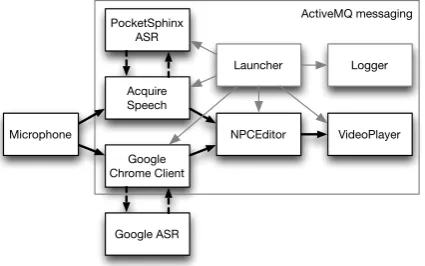
NPCEditor (Leuski and Traum, 2011) for classi-fying the utterance text and selecting the appropri-ate response, and a video player to deliver the se-lected video response. The individual components run as separate applications on the user’s machine
and are linked together by ActiveMQ messaging4:
An instance of ActiveMQ broker runs on the ma-chine, each component connects to the server and sends and receives messages to other components via the broker. The system setup also includes the JLogger component for recording the messages, and the Launcher tool that controls starting and stopping of individual tools. For example, the user can select between PocketSphinx and Google ASR engines by checking the appropriate buttons in the Launcher interface. Figure 1 shows the over-all system architecture. We show the data flow through the system as black lines. Gray arrows indicate the control messages from the Launcher interface. Solid arrows represent messages passed via ActiveMQ and dotted lines represent data go-ing over TCP/IP.
While most of the system components already
1http://vhtoolkit.ict.usc.edu 2http://cmusphinx.sourceforge.net
ActiveMQ messaging
Acquire Speech PocketSphinx
ASR
Google Chrome Client
NPCEditor VideoPlayer Microphone
Google ASR
Launcher Logger
Figure 1: System architecture
existed before the start of this project, the Google Chrome ASR Client and VideoPlayer tools were developed in the course of this project. Google Chrome ASR client is a web application that takes advantage of the Google Speech API available in the Chrome browser. The tool provides push-to-talk interface control for acquiring user’s speech; it uses the API to send audio to Google ASR servers, collect the recognition result, and broad-cast it over the ActiveMQ messaging. We de-veloped the VideoPlayer tool so that we can con-trol the response playback via the same ActiveMQ messaging. VideoPlayer also implements custom transition between clips. It has video adjustment controls so that we can modify the scale and posi-tion of the video image, and it automatically dis-plays a loop of idle video clips while the system is in resting or listening states.
While the system was developed to be cross-platform so that it can run both on OS X and Win-dows, we conducted all our testing and experi-ments on OS X. The system is packaged as a single OS X application that starts the Launcher interface and the rest of the system. This significantly sim-plifies distribution and installation of the system on different computers.
3.3 Speech recognition
Currently the system can work with two speech recognition engines, CMU PocketSphinx and Google Chrome ASR. But for our experiments we
also considered Apple Dictation.5
One major decision when selecting a speech recognizer is whether it allows for training
domain-specific language models (LMs) or not.6
5https://support.apple.com/en-us/HT202584
6While the acoustic models of a speech recognizer
recog-nize individual sounds, the LM provides information about
[image:3.595.77.290.64.197.2]Purely domain-specific LMs cannot recognize out-of-domain words or utterances. On the other hand, general-purpose LMs do not perform well with domain-specific words or utterances. Un-like PocketSphinx, which supports trainable LMs, both Google Chrome ASR and Apple Dictation come with their own out-of-the-box LMs that can-not be modified.
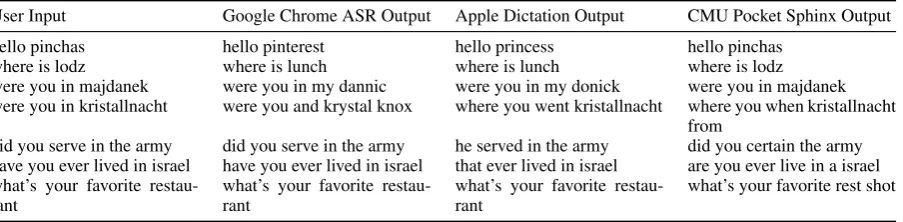
Table 1 shows example outputs of all three rec-ognizers (PocketSphinx examples were obtained with a preliminary LM). As we can see, Google Chrome ASR and Apple Dictation with their general-purpose LMs perform well for utterances that are not domain-specific. On the other hand, PocketSphinx clearly is much better at recogniz-ing domain-specific words, e.g., “Pinchas”, “Maj-danek”, etc. but fails to recognize general-purpose utterances if they are not included in its LM. For example, the user input “what’s your favorite restaurant” is misrecognized as “what’s your fa-vorite rest shot” because the word “restaurant” or the sequence “favorite restaurant” was not part of the LM’s training data. Similarly, the user in-put “did you serve in the army” is misrecognized as “did you certain the army” because the word “serve” or the sequence “serve in the army” was not included in the LM’s training data.
For training LMs for PocketSphinx we used the CMU Statistical Language Modeling toolkit (Clarkson and Rosenfeld, 1997) with back-off 3-grams. The CMU pronouncing dictionary v0.7a (Weide, 2008) was used as the main dictionary with the addition of domain-dependent words, such as names. We used the standard US En-glish acoustic models that are included in Pock-etSphinx.
3.4 Dialogue policy
As mentioned in section 3.2, NPCEditor combines the functions of Natural Language Understanding (NLU) and Dialogue Management – understand-ing the utterance text and selectunderstand-ing an appropri-ate response. The NLU functionality is a classifier trained on linked question-response pairs, which identifies the most appropriate response to new (unseen) user input. The dialogue management logic is designed to deal with instances where the classifier cannot identify a good direct response. During training, NPCEditor calculates a response
User Input Google Chrome ASR Output Apple Dictation Output CMU Pocket Sphinx Output
hello pinchas hello pinterest hello princess hello pinchas
where is lodz where is lunch where is lunch where is lodz
were you in majdanek were you in my dannic were you in my donick were you in majdanek were you in kristallnacht were you and krystal knox where you went kristallnacht where you when kristallnacht
from
did you serve in the army did you serve in the army he served in the army did you certain the army have you ever lived in israel have you ever lived in israel that ever lived in israel are you ever live in a israel what’s your favorite
[image:4.595.77.529.63.174.2]restau-rant what’s your favorite restau-rant what’s your favorite restau-rant what’s your favorite rest shot
Table 1: Examples of speech recognition outputs
threshold based on the classifier’s confidence in the appropriateness of selected responses: this threshold finds an optimal balance between false positives (inappropriate responses above thresh-old) and false negatives (appropriate responses be-low threshold) in the training data. At runtime, if the confidence for a selected response falls be-low the predetermined threshold, that response is replaced with an “off-topic” utterance that asks the user to repeat the question or takes initia-tive and changes the topic (Leuski et al., 2006); such failure to return a direct response, also called non-understanding (Bohus and Rudnicky, 2005), is usually preferred over returning an inappropri-ate one (misunderstanding).
The current system uses a five-stage off-topic selection algorithm which is an extension of that presented in Artstein et al. (2009). The first time Pinchas fails to understand an utterance, he will assume this is a speech recognition error and ask the user to repeat it. If the misunderstanding per-sists, Pinchas will say that he doesn’t know (with-out asking for repetition), and the third time he will state that he cannot answer the user’s utter-ance. In a severe misunderstanding that persists beyond three exchanges, Pinchas will suggest a new topic in the fourth turn, and if even this fails to bring the user to ask a question that Pinchas can understand, then in the fifth turn Pinchas will give a quick segue and launch into a story of his choice. If at any point Pinchas hears an utterance that he can understand (that is, if the classifier finds a re-sponse above threshold), Pinchas will answer this directly, and the off-topic state will reset to zero.
A separate component of the dialogue policy is designed to avoid repetition. Normally, Pin-chas responds with the top-ranked response if it is above the threshold. However, if the top-ranked response has been recently used (within a 4-turn window) and a lower ranked response
is also above the threshold, Pinchas will respond with the lower ranked response. If the only re-sponses above threshold are among the recently used then Pinchas will choose one of them, since repetition is considered preferable to responding with an off-topic or inappropriate statement.
3.5 Data collection
The development process consisted of several stages: preliminary planning and question gather-ing, initial recording of survivor statements, Wiz-ard of Oz studies using the recorded statements to identify gaps in the content, a second recording of survivor statements to address the gaps, assembly of an automated dialogue system, and continued testing with the automated system. The develop-ment process has been described in detail in Art-stein et al. (2015); here we describe the data col-lected at the various stages of development, which constitute the training and test data for the auto-mated system.
In the preliminary planning stages, poten-tial user questions were collected from various sources, but these were not used directly as sys-tem training data. Instead, these questions formed the basis for an interview script that was used for eliciting the survivor statements during the record-ing sessions. The first trainrecord-ing data include the actual utterances used during these elicitation in-terviews. The interviewer utterances were manu-ally linked to the survivor responses; in the typ-ical case, an utterance is linked to the response it elicited during the recording sessions, but the links were manually adjusted to remove instances when the response was not appropriate, and to add links to additional appropriate responses.
Data source Questions Links
Elicitation 1546 2147
Wizard of Oz 1753 3329
System testing 2014 1825 1990
System testing 2015 1823 1959
[image:5.595.307.528.65.172.2]Total 6947 9425
Table 2: Training data sets
following the second recording. Wizard of Oz testing took place in June and July 2014; partic-ipants sat in front of a screen that showed rough-cut video segments of Mr. Gutter’s statements, se-lected by human operators in response to user ut-terances in real time. Since the Wizard of Oz test-ing took place prior to the second recordtest-ing, wiz-ards were only able to choose statements from the first recording. The user utterances were recorded, transcribed, and analyzed to form the basis for the elicitation script for the second recording. Sub-sequent to the second recording, these utterances were reannotated to identify appropriate responses from all of the recorded statements, and these re-annotated question-response links form the Wiz-ard of Oz portion of the training data.
Testing with the automated system was carried out starting in October 2014, following the second recording of survivor statements. Users spoke to the automated system, and their utterances were recorded, transcribed, and annotated with appro-priate responses. These data are partitioned into two – the testing that took place in late 2014 was mostly internal, with team members, other insti-tute staff, and visitors, while the testing from early 2015 was mostly external, conducted over 3 days at a local museum. We thus have 4 portions of training data, summarized in Table 2.
Test data for evaluating the classifier perfor-mance were taken from the system testing in late 2014. We picked a set of 400 user utterances, col-lected during the last day of testing, which was conducted off-site and therefore consisted primar-ily of external test participants (these utterances are not counted in Table 2 above). We only in-cluded in-domain utterances for which an appro-priate on-topic response was available. The eval-uation therefore measures the ability of the sys-tem to identify an appropriate response when one is available, not its ability to identify instances where an on-topic response is unavailable. There
Code Interpretation
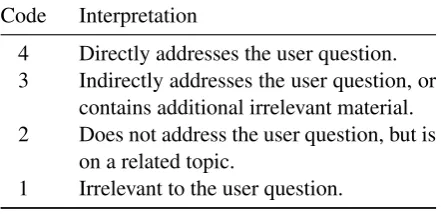
4 Directly addresses the user question.
3 Indirectly addresses the user question, or
contains additional irrelevant material.
2 Does not address the user question, but is
on a related topic.
1 Irrelevant to the user question.
Table 3: Coherence rating for system responses
is some overlap in the test questions, so the 400 instances contain only 341 unique question types, with the most frequent question (What is your name?) occurring 5 times. We believe it is fair to include such overlap in the test set, since it gives higher weight to the more frequent tions. Also, while the text of overlapping ques-tions is identical, each instance is associated with a unique audio file; these utterances may therefore yield different speech recognizer outputs, result-ing in different outcomes.
The test set was specially annotated to serve as a test key. There is substantial overlap in content be-tween the recorded survivor statements, so many user utterances can be addressed appropriately by more than one response. For training purposes it is sufficient to link each user utterance to some ap-propriate responses, but the test key must link each
utterance to all appropriate responses. It is
4 Method
4.1 Speech recognition
As mentioned above, neither Google nor Apple ASRs allow for trainable LMs. But for Pocket-Sphinx we experimented with different domain-specific LMs and below we report results on Pock-etSphinx performance with two different domain-specific LMs: one trained on Wizard of Oz and system testing data (approx. 5000 utterances) col-lected until December 2014 (LM-ds), and another one trained on additional data (approx. 6500 utter-ances) collected until January 2015 (LM-ds-add). The test set was the 400 utterances mentioned above. There was no overlap between the training and test data sets.
In order to evaluate the performance of the speech recognizers we use the standard word er-ror rate (WER) metric:
WER=Substitutions+Deletions+Insertions
Length of transcription string
4.2 Classifier evaluation
Evaluation of the classifier is difficult, because it has to take into account the dialogue policy: the classifier typically returns the top-ranked re-sponse, but may return a lower-ranked response if it is above threshold and the higher-ranked re-sponses were used recently. So while the classi-fier ranks all the available responses, anything be-low the top few will never be selected by the di-alogue manager, rendering measures such as pre-cision and recall quite irrelevant. An ideal evalua-tion should give highest weight to the correctness of the top-ranked response, with rapidly decreas-ing weight to the next several responses, but it is difficult to determine what weights are appropri-ate. We therefore focus on the top answer, since in most cases the top answer is what will get served to the user.
The top answer can be one of three outcomes: it can be appropriate (good), inappropriate (bad), or below threshold, in which case an off-topic re-sponse is served. A good rere-sponse is better than an off-topic, which is in turn better than a bad re-sponse. This makes it difficult to compare systems with different off-topic rates: how do two systems compare if one gives more good and bad responses than the other, but fewer off-topics? We therefore compare systems using error return plots, which show the error rate across all possible return rates (Artstein, 2011): for each system we calculate the
number of errors at each return rate, and then plot the number of errors against the number of off-topics.
We used 6 combinations of the training data de-scribed in section 3.5. The baseline is trained with only the elicitation questions, and represents the performance we might expect if we were to build a dialogue system based on the recording sessions alone, without collecting user question data (ex-cept to the extent that user questions influenced the second recording session). To this baseline we successively added training data from the Wiz-ard of Oz testing, system testing 2014, and sys-tem testing 2015. Our final training sets include the elicitation questions and system testing 2014 (without Wizard of Oz data), and the same with the system testing 2015 added.
All of the classifiers were trained in NPCEdi-tor using the same options: text unigrams for the question language models, text unigrams plus IDs for the response language models, and F-score as the classifier scoring function during training. We used 3 versions of the test utterances: the transcribed text, the output of Google ASR, and the output of PocketSphinx, and ran each ver-sion through each of the 6 classifiers – a total of 18 configurations. For each testing configu-ration, we retrieved the top-ranked response for each utterance, together with the classifier confi-dence and a true/false indication of whether the response matched the answer key. The responses were ranked by the classifier confidence, and for each possible cutoff point (from returning zero off-topic responses to returning off-off-topic responses for all 400 utterances), we calculated the number of errors among the on-topic responses and plotted that against the number of off-topics. Each plot represents the error-return tradeoff for a particular testing configuration (see section 5.2).
5 Results
5.1 Speech recognition evaluation
Table 4 shows the WERs for the three different speech recognizers and the two different LMs.
Note that we also experimented with interpolat-ing domain-specific with background LMs
avail-able from http://keithv.com/software.
Speech Recognizer
Language Model
General LM-ds LM-ds-add
Google 5.07% — —
Apple 7.76% — —
[image:7.595.71.293.63.146.2]PocketSphinx — 22.04% 19.39%
Table 4: Speech recognition results (WER). Gen-eral LM stands for genGen-eral-purpose LM, LM-ds stands for domain-specific LM trained with data collected until December 2014, and LM-ds-add stands for domain-specific LM trained with addi-tional data collected until January 2015.
WERs. In the latter cases, having a background model meant that there were more choices for the speech recognizer to choose from, which instead of helping caused confusion.
We also noticed that PocketSphinx was less tol-erant of environmental noises, which most of the time resulted in insertions and substitutions. For example, as we can see in Table 1, the user input “have you ever lived in israel” was misrecognized by PocketSphinx as “are you ever live in a israel”. These misrecognitions do not necessarily confuse the classifier, but of course they often do.
5.2 Classifier evaluation
Classifier performance is best when training on all the data, and testing on transcriptions rather than speech recognizer output. Figure 2 shows the ef-fect of the amount of training data on classifier performance when tested on transcribed text (a similar effect is observed when testing on speech recognizer output). Lower curves represent better performance. As expected, performance improves with additional training data – training on the full set of data cuts error rates by about a third com-pared to training on the elicitation questions alone. Additional training data (both new questions and question-response links) are likely to improve per-formance even further.
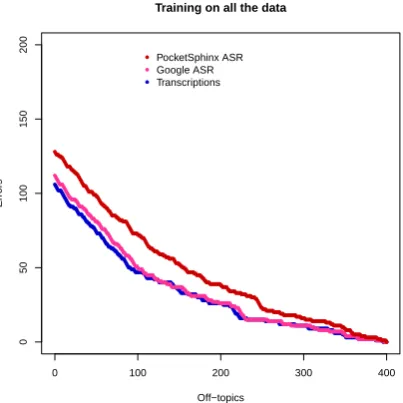
The effect of speech recognition on classifier performance is shown in Figure 3. Automatic speech recognition does impose a performance penalty compared to testing on transcriptions, but the penalty is not very large: classifier errors when testing with Google ASR are between 1 and 3 percentage points higher than with transcriptions, while PocketSphinx fares somewhat worse, with classifier errors about 5 to 8 percentage points
0 100 200 300 400
0
50
100
150
200
Test set: Transcriptions
Off−topics Errors ● ● ● ● ● ● ● ● ● ● ● ● ● ● ● ● ● ● ● ● ● ● ● ● ● ● ● ● ● ● ● ● ● ● ● ● ● ● ● ● ● ● ● ● ● ● ● ● ● ● ● ● ● ● ● ● ● ● ● ● ● ● ● ● ● ● ● ● ● ● ● ● ● ● ● ● ● ● ● ● ● ● ● ● ● ● ● ● ● ● ● ● ● ● ● ● ● ● ● ● ● ● ● ● ● ● ● ● ● ● ● ● ● ● ● ● ● ● ● ● ● ● ● ● ● ● ● ● ● ● ● ● ● ● ● ● ● ● ● ● ● ● ● ● ● ● ● ● ● ● ● ● ● ● ● ● ● ● ● ● ● ● ● ● ● ● ● ● ● ● ● ● ● ● ● ● ● ● ● ● ● ● ● ● ● ● ● ● ● ● ● ● ● ● ● ● ● ● ● ● ● ● ● ● ● ● ● ● ● ● ● ● ● ● ● ● ● ● ● ● ● ● ● ● ● ● ● ● ● ● ● ● ● ● ● ● ● ● ● ● ● ● ● ● ● ● ● ● ● ● ● ● ● ● ● ● ● ● ● ● ● ● ● ● ● ● ● ● ● ● ● ● ● ● ● ● ● ● ● ● ● ● ● ● ● ● ● ● ● ● ● ● ● ● ● ● ● ● ● ● ● ● ● ● ● ● ● ● ● ● ● ● ● ● ● ● ● ● ● ● ● ● ● ● ● ● ● ● ● ● ● ● ● ● ● ● ● ● ● ● ● ● ● ● ● ● ● ● ● ● ● ● ● ● ● ● ● ● ● ● ● ● ● ● ● ● ● ● ● ● ● ● ● ● ● ● ● ● ● ● ● ● ● ● ● ● ● ● ● ● ● ● ● ● ● ● ● ● ● ● ● ● ● ● ● ● ● ● ● ● ● ● ● ● ● ● ● ● ● ● ● ● ● ● ● ● ● ● ● ● ● ● ● ● ● ● ● ● ● ● ● ● ● ● ● ● ● ● ● ● ● ● ● ● ● ● ● ● ● ● ● ● ● ● ● ● ● ● ● ● ● ● ● ● ● ● ● ● ● ● ● ● ● ● ● ● ● ● ● ● ● ● ● ● ● ● ● ● ● ● ● ● ● ● ● ● ● ● ● ● ● ● ● ● ● ● ● ● ● ● ● ● ● ● ● ● ● ● ● ● ● ● ● ● ● ● ● ● ● ● ● ● ● ● ● ● ● ● ● ● ● ● ● ● ● ● ● ● ● ● ● ● ● ● ● ● ● ● ● ● ● ● ● ● ● ● ● ● ● ● ● ● ● ● ● ● ● ● ● ● ● ● ● ● ● ● ● ● ● ● ● ● ● ● ● ● ● ● ● ● ● ● ● ● ● ● ● ● ● ● ● ● ● ● ● ● ● ● ● ● ● ● ● ● ● ● ● ● ● ● ● ● ● ● ● ● ● ● ● ● ● ● ● ● ● ● ● ● ● ● ● ● ● ● ● ● ● ● ● ● ● ● ● ● ● ● ● ● ● ● ● ● ● ● ● ● ● ● ● ● ● ● ● ● ● ● ● ● ● ● ● ● ● ● ● ● ● ● ● ● ● ● ● ● ● ● ● ● ● ● ● ● ● ● ● ● ● ● ● ● ● ● ● ● ● ● ● ● ● ● ● ● ● ● ● ● ● ● ● ● ● ● ● ● ● ● ● ● ● ● ● ● ● ● ● ● ● ● ● ● ● ● ● ● ● ● ● ● ● ● ● ● ● ● ● ● ● ● ● ● ● ● ● ● ● ● ● ● ● ● ● ● ● ● ● ● ● ● ● ● ● ● ● ● ● ● ● ● ● ● ● ● ● ● ● ● ● ● ● ● ● ● ● ● ● ● ● ● ● ● ● ● ● ● ● ● ● ● ● ● ● ● ● ● ● ● ● ● ● ● ● ● ● ● ● ● ● ● ● ● ● ● ● ● ● ● ● ● ● ● ● ● ● ● ● ● ● ● ● ● ● ● ● ● ● ● ● ● ● ● ● ● ● ● ● ● ● ● ● ● ● ● ● ● ● ● ● ● ● ● ● ● ● ● ● ● ● ● ● ● ● ● ● ● ● ● ● ● ● ● ● ● ● ● ● ● ● ● ● ● ● ● ● ● ● ● ● ● ● ● ● ● ● ● ● ● ● ● ● ● ● ● ● ● ● ● ● ● ● ● ● ● ● ● ● ● ● ● ● ● ● ● ● ● ● ● ● ● ● ● ● ● ● ● ● ● ● ● ● ● ● ● ● ● ● ● ● ● ● ● ● ● ● ● ● ● ● ● ● ● ● ● ● ● ● ● ● ● ● ● ● ● ● ● ● ● ● ● ● ● ● ● ● ● ● ● ● ● ● ● ● ● ● ● ● ● ● ● ● ● ● ● ● ● ● ● ● ● ● ● ● ● ● ● ● ● ● ● ● ● ● ● ● ● ● ● ● ● ● ● ● ● ● ● ● ● ● ● ● ● ● ● ● ● ● ● ● ● ● ● ● ● ● ● ● ● ● ● ● ● ● ● ● ● ● ● ● ● ● ● ● ● ● ● ● ● ● ● ● ● ● ● ● ● ● ● ● ● ● ● ● ● ● ● ● ● ● ● ● ● ● ● ● ● ● ● ● ● ● ● ● ● ● ● ● ● ● ● ● ● ● ● ● ● ● ● ● ● ● ● ● ● ● ● ● ● ● ● ● ● ● ● ● ● ● ● ● ● ● ● ● ● ● ● ● ● ● ● ● ● ● ● ● ● ● ● ● ● ● ● ● ● ● ● ● ● ● ● ● ● ● ● ● ● ● ● ● ● ● ● ● ● ● ● ● ● ● ● ● ● ● ● ● ● ● ● ● ● ● ● ● ● ● ● ● ● ● ● ● ● ● ● ● ● ● ● ● ● ● ● ● ● ● ● ● ● ● ● ● ● ● ● ● ● ● ● ● ● ● ● ● ● ● ● ● ● ● ● ● ● ● ● ● ● ● ● ● ● ● ● ● ● ● ● ● ● ● ● ● ● ● ● ● ● ● ● ● ● ● ● ● ● ● ● ● ● ● ● ● ● ● ● ● ● ● ● ● ● ● ● ● ● ● ● ● ● ● ● ● ● ● ● ● ● ● ● ● ● ● ● ● ● ● ● ● ● ● ● ● ● ● ● ● ● ● ● ● ● ● ● ● ● ● ● ● ● ● ● ● ● ● ● ● ● ● ● ● ● ● ● ● ● ● ● ● ● ● ● ● ● ● ● ● ● ● ● ● ● ● ● ● ● ● ● ● ● ● ● ● ● ● ● ● ● ● ● ● ● ● ● ● ● ● ● ● ● ● ● ● ● ● ● ● ● ● ● ● ● ● ● ● ● ● ● ● ● ● ● ● ● ● ● ● ● ● ● ● ● ● ● ● ● ● ● ● ● ● ● ● ● ● ● ● ● ● ● ● ● ● ● ● ● ● ● ● ● ● ● ● ● ● ● ● ● ● ● ● ● ● ● ● ● ● ● ● ● ● ● ● ● ● ● ● ● ● ● ● ● ● ● ● ● ● ● ● ● ● ● ● ● ● ● ● ● ● ● ● ● ● ● ● ● ● ● ● ● ● ● ● ● ● ● ● ● ● ● ● ● ● ● ● ● ● ● ● ● ● ● ● ● ● ● ● ● ● ● ● ● ● ● ● ● ● ● ● ● ● ● ● ● ● ● ● ● ● ● ● ● ● ● ● ● ● ● ● ● ● ● ● ● ● ● ● ● ● ● ● ● ● ● ● ● ● ● ● ● ● ● ● ● ● ● ● ● ● ● ● ● ● ● ● ● ● ● ● ● ● ● ● ● ● ● ● ● ● ● ● ● ● ● ● ● ● ● ● ● ● ● ● ● ● ● ● ● ● ● ● ● ● ● ● ● ● ● ● ● ● ● ● ● ● ● ● ● ● ● ● ● ● ● ● ● ● ● ● ● ● ● ● ● ● ● ● ● ● ● ● ● ● ● ● ● ● ● ● ● ● ● ● ● ● ● ● ● ● ● ● ● ● ● ● ● ● ● ● ● ● ● ● ● ● ● ● ● ● ● ● ● ● ● ● ● ● ● ● ● ● ● ● ● ● ● ● ● ● ● ● ● ● ● ● ● ● ● ● ● ● ● ● ● ● ● ● ● ● ● ● ● ● ● ● ● ● ● ● ● ● ● ● ● ● ● ● ● ● ● ● ● ● ● ● ● ● ● ● ● ● ● ● ● ● ● ● ● ● ● ● ● ● ● ● ● ● ● ● ● ● ● ● ● ● ● ● ● ● ● ● ● ● ● ● ● ● ● ● ● ● ● ● ● ● ● ● ● ● ● ● ● ● ● ● ● ● ● ● ● ● ● ● ● ● ● ● ● ● ● ● ● ● ● ● ● ● ● ● ● ● ● ● ● ● ● ● ● ● ● ● ● ● ● ● ● ● ● ● ● ● ● ● ● ● ● ● ● ● ● ● ● ● ● ● ● ● ● ● ● ● ● ● ● ● ● ● ● ● ● ● ● ● ● ● ● ● ● ● ● ● ● ● ● ● ● ● ● ● ● ● ● ● ● ● ● ● ● ● ● ● ● ● ● ● ● ● ● ● ● ● ● ● ● ● ● ● ● ● ● ● ● ● ● ● ● ● ● ● ● ● ● ● ● ● ● ● ● ● ● ● ● ● ● ● ● ● ● ● ● ● ● ● ● ● ● ● ● ● ● ● ● ● ● ● ● ● ● ● ● ● ● ● ● ● ● ● ● ● ● ● ● ● ● ● ● ● ● ● ● ● ● ● ● ● ● ● ● ● ● ● ● ● ● ● ● ● ● ● ● ● ● ● ● ● ● ● ● ● ● ● ● ● ● ● ● ● ● ● ● ● ● ● ● ● ● ● ● ● ● ● ● ● ● ● ● ● ● ● ● ● ● ● ● ● ● ● ● ● ● ● ● ● ● ● ● ● ● ● ● ● ● ● ● ● ● ● ● ● ● ● ● ● ● ● ● ● ● ● ● ● ● ● ● ● ● ● ● ● ● ● ● ● ● ● ● ● ● ● ● ● ● ● ● ● ● ● ● ● ● ● ● ● ● ● ● ● ● ● ● ● ● ● ● ● ● ● ● ● ● ● ● ● ● ● ● ● ● ● ● ● ● ● ● ● ● ● ● ● ● ● ● ● ● ● ● ● ● ● ● ● ● ● ● ● ● ● ● ● ● ● ● ● ● ● ● ● ● ● ● ● ● ● ● ● ● ● ● ● ● ● ● ● ● ● ● ● ● ● ● ● ● ● ● ● ● ● ● ● ● ● ● ● ● ● ● ● ● ● ● ● ● ● ● ● ● ● ● ● ● ● ● ● ● ● ● ● ● ● ● ● ● ● ● ● ● ● ● ● ● ● ● ● ● ● ● elicitation elicitation−wizard elicitation−system2014 elicitation−system2014−system2015 elicitation−wizard−system2014 elicitation−wizard−system2014−system2015
Figure 2: Tradeoff between errors and off-topics for various training sets (tested on transcribed text)
0 100 200 300 400
0
50
100
150
200
Training on all the data
[image:7.595.312.514.70.273.2]Off−topics Errors ● ● ● ● ● ● ● ● ● ● ● ● ● ● ● ● ● ● ● ● ● ● ● ● ● ● ● ● ● ● ● ● ● ● ● ● ● ● ● ● ● ● ● ● ● ● ● ● ● ● ● ● ● ● ● ● ● ● ● ● ● ● ● ● ● ● ● ● ● ● ● ● ● ● ● ● ● ● ● ● ● ● ● ● ● ● ● ● ● ● ● ● ● ● ● ● ● ● ● ● ● ● ● ● ● ● ● ● ● ● ● ● ● ● ● ● ● ● ● ● ● ● ● ● ● ● ● ● ● ● ● ● ● ● ● ● ● ● ● ● ● ● ● ● ● ● ● ● ● ● ● ● ● ● ● ● ● ● ● ● ● ● ● ● ● ● ● ● ● ● ● ● ● ● ● ● ● ● ● ● ● ● ● ● ● ● ● ● ● ● ● ● ● ● ● ● ● ● ● ● ● ● ● ● ● ● ● ● ● ● ● ● ● ● ● ● ● ● ● ● ● ● ● ● ● ● ● ● ● ● ● ● ● ● ● ● ● ● ● ● ● ● ● ● ● ● ● ● ● ● ● ● ● ● ● ● ● ● ● ● ● ● ● ● ● ● ● ● ● ● ● ● ● ● ● ● ● ● ● ● ● ● ● ● ● ● ● ● ● ● ● ● ● ● ● ● ● ● ● ● ● ● ● ● ● ● ● ● ● ● ● ● ● ● ● ● ● ● ● ● ● ● ● ● ● ● ● ● ● ● ● ● ● ● ● ● ● ● ● ● ● ● ● ● ● ● ● ● ● ● ● ● ● ● ● ● ● ● ● ● ● ● ● ● ● ● ● ● ● ● ● ● ● ● ● ● ● ● ● ● ● ● ● ● ● ● ● ● ● ● ● ● ● ● ● ● ● ● ● ● ● ● ● ● ● ● ● ● ● ● ● ● ● ● ● ● ● ● ● ● ● ● ● ● ● ● ● ● ● ● ● ● ● ● ● ● ● ● ● ● ● ● ● ● ● ● ● ● ● ● ● ● ● ● ● ● ● ● ● ● ● ● ● ● ● ● ● ● ● ● ● ● ● ● ● ● ● ● ● ● ● ● ● ● ● ● ● ● ● ● ● ● ● ● ● ● ● ● ● ● ● ● ● ● ● ● ● ● ● ● ● ● ● ● ● ● ● ● ● ● ● ● ● ● ● ● ● ● ● ● ● ● ● ● ● ● ● ● ● ● ● ● ● ● ● ● ● ● ● ● ● ● ● ● ● ● ● ● ● ● ● ● ● ● ● ● ● ● ● ● ● ● ● ● ● ● ● ● ● ● ● ● ● ● ● ● ● ● ● ● ● ● ● ● ● ● ● ● ● ● ● ● ● ● ● ● ● ● ● ● ● ● ● ● ● ● ● ● ● ● ● ● ● ● ● ● ● ● ● ● ● ● ● ● ● ● ● ● ● ● ● ● ● ● ● ● ● ● ● ● ● ● ● ● ● ● ● ● ● ● ● ● ● ● ● ● ● ● ● ● ● ● ● ● ● ● ● ● ● ● ● ● ● ● ● ● ● ● ● ● ● ● ● ● ● ● ● ● ● ● ● ● ● ● ● ● ● ● ● ● ● ● ● ● ● ● ● ● ● ● ● ● ● ● ● ● ● ● ● ● ● ● ● ● ● ● ● ● ● ● ● ● ● ● ● ● ● ● ● ● ● ● ● ● ● ● ● ● ● ● ● ● ● ● ● ● ● ● ● ● ● ● ● ● ● ● ● ● ● ● ● ● ● ● ● ● ● ● ● ● ● ● ● ● ● ● ● ● ● ● ● ● ● ● ● ● ● ● ● ● ● ● ● ● ● ● ● ● ● ● ● ● ● ● ● ● ● ● ● ● ● ● ● ● ● ● ● ● ● ● ● ● ● ● ● ● ● ● ● ● ● ● ● ● ● ● ● ● ● ● ● ● ● ● ● ● ● ● ● ● ● ● ● ● ● ● ● ● ● ● ● ● ● ● ● ● ● ● ● ● ● ● ● ● ● ● ● ● ● ● ● ● ● ● ● ● ● ● ● ● ● ● ● ● ● ● ● ● ● ● ● ● ● ● ● ● ● ● ● ● ● ● ● ● ● ● ● ● ● ● ● ● ● ● ● ● ● ● ● ● ● ● ● ● ● ● ● ● ● ● ● ● ● ● ● ● ● ● ● ● ● ● ● ● ● ● ● ● ● ● ● ● ● ● ● ● ● ● ● ● ● ● ● ● ● ● ● ● ● ● ● ● ● ● ● ● ● ● ● ● ● ● ● ● ● ● ● ● ● ● ● ● ● ● ● ● ● ● ● ● ● ● ● ● ● ● ● ● ● ● ● ● ● ● ● ● ● ● ● ● ● ● ● ● ● ● ● ● ● ● ● ● ● ● ● ● ● ● ● ● ● ● ● ● ● ● ● ● ● ● ● ● ● ● ● ● ● ● ● ● ● ● ● ● ● ● ● ● ● ● ● ● ● ● ● ● ● ● ● ● ● ● ● ● ● ● ● ● ● ● ● ● ● ● ● ● ● ● ● ● ● ● ● ● ● ● ● ● ● ● ● ● ● ● ● ● ● ● ● ● ● ● ● ● ● ● ● ● ● ● ● ● ● ● ● ● ● ● ● ● ● ● ● ● ● ● ● ● ● ● ● ● ● ● ● ● ● ● ● ● ● ● ● ● ● ● ● ● ● ● ● ● ● ● ● ● PocketSphinx ASR Google ASR Transcriptions
Figure 3: Tradeoff between errors and off-topics for different test sets (trained on the full data)
[image:7.595.312.514.352.554.2]6 Discussion
This paper has demonstrated that time-offset inter-action with a real person is achievable with present day spoken language processing technology. Not only are we able to collect a sufficiently large and varied set of statements to address user utter-ances (Artstein et al., 2015), we are also able to use speech recognition and language understand-ing technology to identify appropriate responses frequently enough to enable a natural interaction flow. Future work is needed in three areas: in-vestigating the interaction quality of the dialogue system, improving the language processing, and generalizing the process to additional situations.
To investigate the interaction quality, we need to look at dialogues in context rather than as iso-lated utterances, and to collect user feedback. We are presently engaged in a joint testing, demon-stration, and data collection effort that is intended to address these issues. The time-offset interac-tion system has been temporarily installed at the Illinois Holocaust Museum and Education Center in Skokie, Illinois, where visitors interact with the system as part of their museum experience (Isaacs, 2015). The system is set up in an auditorium and users talk to Pinchas in groups, in a setting that is similar to in-person encounters with Holocaust survivors which also take place at the museum. Due to physical limitations of the exhibit space, interaction is mediated by museum docents: each user question is relayed by the docent into the mi-crophone, and Pinchas responds to the docent’s speech. An excerpt of museum interaction is in the Appendix. Data and feedback from the mu-seum installation will be used to evaluate the in-teraction quality, including user feedback as to the naturalness of the interaction and user satisfaction. The ongoing testing also serves the purpose of data collection for improving system performance: Figure 2 shows that errors diminish with addi-tional training data, and it appears that we have not yet reached the point of diminishing returns with about 7000 training utterances. We hope to collect an average of 10 training utterances per response, that is about 17000 user utterances. Annotation is also incomplete: the test key has an average of 4.6 links per utterance, as opposed to an average of around 1.4 links per utterance in the training data. While complete linking is not necessary for clas-sifier operation, improving the links will probably improve performance.
In addition to improving performance through improved data, there are also algorithmic improve-ments that can be made to the language process-ing components. One goal is to leverage the rela-tive strengths of the general purpose and domain-specific ASRs, e.g., through the classifier: past work has shown that language understanding can be improved by allowing NLU to select from among several hypotheses provided by a single speech recognizer (Morbini et al., 2012), and we propose to try a similar method to utilize the out-puts of separate speech recognizers. Another idea is to combine/align the outputs of the speech rec-ognizers (before they are forwarded to the clas-sifier) taking into account information from the recognition confidence scores and lattices. This will potentially help in cases where different rec-ognizers succeed in correctly recognizing different parts of the utterance.
Time-offset interaction has a large potential im-pact on preservation and education – people in the future will be able to not only see and listen to historical figures, but also to interact with them in conversation. Future research into time-offset interaction will need to generalize the develop-ment process, in order to enable efficient use of resources by identifying common user questions that are specific to the person, ones that are spe-cific to the dialogue context or conversation topic, and ones that are of more general application.
Acknowledgments
References
Ron Artstein, Sudeep Gandhe, Jillian Gerten, Anton Leuski, and David Traum. 2009. Semi-formal eval-uation of conversational characters. In Orna Grum-berg, Michael Kaminski, Shmuel Katz, and Shuly Wintner, editors,Languages: From Formal to Natu-ral. Essays Dedicated to Nissim Francez on the Oc-casion of His 65th Birthday, volume 5533 ofLecture Notes in Computer Science, pages 22–35. Springer, Heidelberg, May.
Ron Artstein, David Traum, Oleg Alexander, An-ton Leuski, Andrew Jones, Kallirroi Georgila, Paul Debevec, William Swartout, Heather Maio, and Stephen Smith. 2014. Time-offset interaction with a Holocaust survivor. InProceedings of IUI, pages 163–168, Haifa, Israel, February.
Ron Artstein, Anton Leuski, Heather Maio, Tomer Mor-Barak, Carla Gordon, and David Traum. 2015. How many utterances are needed to support time-offset interaction? In Proceedings of the Twenty-Eighth International Florida Artificial Intelligence Research Society Conference, pages 144–149, Hol-lywood, Florida, May. AAAI Press.
Ron Artstein. 2011. Error return plots. In Proceed-ings of SIGDIAL, pages 319–324, Portland, Oregon, June.
Dan Bohus and Alexander I. Rudnicky. 2005. Sorry, I didn’t catch that! – An investigation of non-under-standing errors and recovery strategies. In Proceed-ings of SIGDIAL, pages 128–143, Lisbon, Portugal, September.
Lucy Chabot. 1990. Nixon library technology lets vis-itors ‘interview’ him. Los Angeles Times, July 21. Philip Clarkson and Ronald Rosenfeld. 1997.
Statisti-cal language modeling using the CMU-Cambridge toolkit. In Proc. of Eurospeech, Rhodes, Greece, September.
Sudeep Gandhe and David Traum. 2010. I’ve said it before, and I’ll say it again: An empirical investiga-tion of the upper bound of the selecinvestiga-tion approach to dialogue. InProceedings of SIGDIAL, pages 245– 248, Tokyo, September.
Mike Isaacs. 2015. Holocaust Museum: Pilot program aims to preserve survivor voices for future genera-tions. Chicago Tribune, May 19.
Anton Leuski and David Traum. 2011. NPCEditor: Creating virtual human dialogue using information retrieval techniques. AI Magazine, 32(2):42–56. Anton Leuski, Ronakkumar Patel, David Traum, and
Brandon Kennedy. 2006. Building effective ques-tion answering characters. InProceedings of SIG-DIAL, Sydney, Australia, July.
Heather Maio, David Traum, and Paul Debevec. 2012. New dimensions in testimony. PastForward, Summer:22–26.
Donald Marinelli and Scott Stevens. 1998. Syn-thetic interviews: The art of creating a ‘dyad’ be-tween humans and machine-based characters. In Proceedings of the Sixth ACM International Con-ference on Multimedia: Technologies for Interactive Movies (MULTIMEDIA), pages 11–16, New York, NY, USA. ACM.
Fabrizio Morbini, Kartik Audhkhasi, Ron Artstein, Maarten Van Segbroeck, Kenji Sagae, Panayiotis Georgiou, David R. Traum, and Shri Narayanan. 2012. A reranking approach for recognition and classification of speech input in conversational di-alogue systems. InProceedings of the Fourth IEEE Workshop on Spoken Language Technology (SLT), pages 49–54, Miami Beach, Forida, December. Eric Sloss and Anne Watzman. 2005. Carnegie
Mel-lon’s Entertainment Technology Center conjures up Benjamin Franklin’s ghost. Press release, Carnegie Mellon Media Relations, June 28. http://www. cmu.edu/PR/releases05/050628_etc.html. R.L. Weide. 2008. The CMU pronouncing dictionary.
A Dialogue sample
The following dialogue excerpt is taken from the beta testing in Illinois (see section 6). Speech recognition output is shown in italics when it de-parts substantially from the spoken text.
User Hello Pinchas, how are you?
Las Vegas how are you
Pinchas Can you just repeat that?
User Can you hear me OK?
Pinchas I can see you and I can hear you.
User Hello Pinchas, can you hear me?
how thick is can you hear me
Pinchas I can hear you, yeah.
User Pinchas, can you tell me how old you are?
Vegas can you tell me how old you are
Pinchas I was born in nineteen thirty two and we are now in two thousand and fourteen and you can make your own reckoning.
User Can you tell me a little bit about your
child-hood?
User Have you ever met Hitler? mermaid Hitler
Pinchas Please repeat that.
User Did you ever meet Hitler?
Pinchas Did I ever meet Hitler? Well, Hitler was a F¨uhrer of Germany and I was born in Poland and I was a little Jewish boy, so the chances of somebody like me meeting Hitler was impossible, because Hitler was. . .
User What would you do if you met Hitler?