Towards Taxonomy of Errors in Chat-oriented Dialogue Systems
Ryuichiro Higashinaka1, Kotaro Funakoshi2, Masahiro Araki3, Hiroshi Tsukahara4,Yuka Kobayashi5,Masahiro Mizukami6
1NTT Corporation,2Honda Research Institute Japan,3Kyoto Institute of Technology, 4Denso IT Laboratory, Inc.,5Toshiba Corporation,6Nara Institute of Science and Technology
Abstract
This paper presents a taxonomy of errors in chat-oriented dialogue systems. Com-pared to human-human conversations and task-oriented dialogues, little is known about the errors made in chat-oriented di-alogue systems. Through a data collection of chat dialogues and analyses of dialogue breakdowns, we classified errors and cre-ated a taxonomy. Although the proposed taxonomy may not be complete, this pa-per is the first to present a taxonomy of er-rors in chat-oriented dialogue systems. We also highlight the difficulty in pinpointing errors in such systems.
1 Introduction
The last decade has seen an emergence of systems that can engage in chat, small talk, or open-domain conversation. Such systems can be useful for culti-vating trust between a system and users (Bickmore and Cassell, 2001), entertaining users (Wallace, 2004; Banchs and Li, 2012; Wilcock and Jokinen, 2013), and obtaining preferences from users for recommendations (Bang et al., 2015).
Error analysis is important to improve any sys-tem. However, little is known about the types of errors that can be made in chat-oriented dialogue systems. This is in contrast with many studies on task-oriented dialogue systems in which vari-ous taxonomies of errors have been proposed (Dy-bkjær et al., 1996; M¨oller et al., 2007; Ward et al., 2005; Green et al., 2006).
This paper presents a taxonomy of errors in chat-oriented dialogue systems. In our approach, we collect dialogues with a chat-oriented dia-logue system and identify breakdowns (situations in which users cannot proceed with the conversa-tion (Martinovsky and Traum, 2003)) as possible points of errors. Then, we classify the errors that
led to such breakdowns to create a taxonomy. By having such a taxonomy, we hope to better grasp the main causes of breakdown in current chat-oriented dialogue systems; thereby, making it pos-sible to make improvements. The contributions of this paper are that this is the first attempt to cre-ate a taxonomy of errors in chat-oriented dialogue systems and that we quantitatively show, by the distribution of error categories and inter-annotator agreement, the possibilities and difficulties in pin-pointing errors in chat-oriented dialogue systems.
In Section 2, we cover related work on creating a taxonomy of errors in dialogue systems. In Sec-tion 3, we describe our data collecSec-tion followed by the annotation of breakdowns in Section 4. In Section 5, we discuss the taxonomy we devised. In Section 6, we evaluate the taxonomy in terms of the distribution of errors and inter-annotator agree-ment. In Section 7, we summarize the paper and mention future work.
2 Related Work
In task-oriented dialogue systems, there is a good body of research related to the classification of er-rors. There are several ways to categorize erer-rors.
One is to adopt the general taxonomy of mis-communication proposed by Clark (1996). Ac-cording to Clark, there are four levels in com-munication; channel, signal, intention, and con-versation, and by using these four levels, errors can be classified into four categories depending on which level the errors occurred. For exam-ple, if the system fails to take in audio input, it is regarded as a channel-level error. Bohus and Rudnicky (2005) applied this taxonomy to classify their non-understanding errors. A similar catego-rization was used by M¨oller et al. (2007) for their smart home and restaurant information systems. Paek (2003) discussed the generality of using the four levels for error analysis in dialogue systems, referring to the use cases across disciplines.
From the viewpoint of cooperativeness in dia-logue, there is also a taxonomy based on Grice’s maxims (Grice, 1975). Dybkjær et al. (1996) and Bernsen et al. (1996) had four categories of errors related to Grice’s maxims; quantity, qual-ity, relevance, and manner. They also added part-ner asymmetry, background knowledge, and meta-communication as error categories from their ob-servation. Their evaluation indicated that the taxonomy can appropriately classify errors in their flight reservation system. The work by M¨oller (2005) also incorporated Grice’s maxims into “cooperativity-related parameters” as impor-tant elements that affect interaction quality in telephone-based services.
There is also an approach to creating a task or system-specific taxonomy or errors. Aberdeen and Ferro (2003) analyzed misunderstandings by a DARPA communicator system and classified its errors into such categories as failure to obey com-mand and repeated prompt. There is also a tax-onomy for a service robot (Green et al., 2006), in which major errors are robot-specific, such as tim-ing and reference (pointtim-ing) errors. Dzikovska et al. (2009) also classified errors in a tutorial dia-logue system.
Dialogue systems are usually composed of var-ious modules. Therefore, there is also an ap-proach to attributing errors to modules. Ward et al. (2005) attributed causes of errors to modules, such as speech recognition, understanding, gener-ation, and synthesis, and discussed their relative impact on usability. This approach is useful when the system has clear separation of modules.
Our approach is similar to that of (Dybkjær et al., 1996) in that we incorporate Grice’s maxims into our error categories (See Section 5) and that we add other categories by our observation. The difference is that we deal with chat, which is very different from task-oriented dialogue. In this pa-per, we do not use their taxonomy to avoid pre-conception about possible errors. In this work, we did not use the four levels by Clark because we currently deal with text-based systems in which channel and signal level errors rarely occur. In ad-dition, we do not categorize errors by modules as in (Ward et al., 2005) because chat-oriented dia-logue systems usually do not have clear separation of modules.
3 Data Collection
Since there are no chat data available for analy-sis, we decided to create our own data set using a publicly available chat API. In this section, we describe our system based on the API, data collec-tion procedure, and statistics of the collected dia-logues.
3.1 System
We built a web-based dialogue data collection sys-tem using a chat API by NTT DOCOMO (Onishi and Yoshimura, 2014). The system is text-based, and users can chat with it in Japanese. Since the API is based on the system by Higashinaka et al. (2014a), which uses a number of natural lan-guage processing techniques (e.g., zero anaphora resolution, language generation from predicate-argument structures, and open-domain question answering), the system can be regarded as one of the most advanced (or at least complex) chat-oriented dialogue systems.
Users can chat with the system on a web browser to create 21-utterance-long dialogues; each dialogue consists of one system prompt fol-lowed by ten user-system utterance pairs. Figure 1 shows an excerpt of a dialogue collected with the system. As can be seen, the content of the con-versation is open-domain. See (Higashinaka et al., 2014a) for more dialogue examples.
3.2 Procedure
We called for dialogue researchers (and their laborators) in Japan to participate in our data col-lection. Since the system may not live up to their full expectations, we instructed them to follow a simple guideline that basically asked them to be as cooperative as possible. We also restricted the use of emoticons such as facial expressions. Other than that, the participants were free to chat about any topic.
3.3 Collected dialogues
One-hundred sixteen participants including the au-thors conversed using the system, resulting in the collection of 1,146 dialogues. Table 1 lists the statistics. This is a reasonably large data set for analyses with over 10,000 user utterances.
4 Annotation of dialogue breakdowns
S: Hello! I’ve been waiting for you.
U: Today, the temperature will hit 36 degrees Celsius. It’s really hot.
S: Is the max temperature expected to be 17? U: Not at all. It’s a heat wave!
S: Are you prepared for a heat wave?
U: Yeah, with sunshades, water, and air-conditioners. . .
S: Air-conditioners make it comfortable. U: Yeah, my company doesn’t allow me to
use air-conditioners in the morning, I’m gonna die.
S: In the company, air-conditioners really work.
U: Daytime, they work. They are necessary because we have many PCs here.
S: They don’t work.
[image:3.595.310.524.62.118.2]U: Really? Ours are fine here. S: PCs are not user-friendly.
Figure 1: Excerpt of collected dialogue. S and U stand for system and user utterances, respectively. Dialogue was originally in Japanese and translated by authors.
# of Dialogues 1,146 # of Participants 116 User System # of Utterances 11,460 12,606 # of Unique Utterances 10,452 7,777 # of Words 86,367 76,235 # of Unique Words 6,262 5,076
Table 1: Statistics of collected dialogues
annotators (researchers and their collaborators as in Section 3.2) to label system utterances indicat-ing whether the utterances led to dialogue break-downs. We used three labels depending on how easy/difficult it is to continue the conversation af-ter each system utaf-terance. The three labels are as follows:
(1) Not a breakdown: It is easy to continue the conversation.
(2) Possible breakdown: It is difficult to con-tinue the conversation smoothly.
(3) Breakdown: It is difficult to continue the con-versation.
We first divided the data into two sets: init100 (consisting of 100 randomly sampled dialogues)
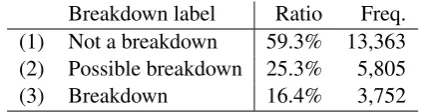
Breakdown label Ratio Freq. (1) Not a breakdown 59.3% 13,363 (2) Possible breakdown 25.3% 5,805 (3) Breakdown 16.4% 3,752
Table 2: Distributions of breakdown annotations for rest1046 data set
and rest1046 (the remaining 1046 dialogues). Af-ter some trial annotations with init100, we split rest1046 into eleven subsets (a–k) of 100 dia-logues each (subset k contained only 46 diadia-logues) and allocated two annotators for each subset. For ten dialogues within each subset, we asked the an-notators to provide reasons for their annotations as comments.
Table 2 shows the distribution of the three breakdown labels for the entire rest1046 data set. This shows that we have a good percentage (about 40%) of breakdowns for analysis. The inter-annotator agreement in Fleiss’ κ was 0.28 (the macro-average over the subsets), showing the sub-jective nature of dialogue breakdown.
5 Creating taxonomy of errors
We manually examined the system utterances an-notated with breakdowns and the comments pro-vided by the annotators to create our taxonomy of errors. After several iterations of devising error categories and annotating system utterances with the categories, we reached our agreed-upon taxon-omy. We explain the taxonomy in detail as fol-lows.
5.1 Taxonomy
Since there were many comments related to the grammar and semantics of single utterances as well as the violation of adjacency pairs (Schegloff and Sacks, 1973) and pragmatic constraints, we thought it was better to havemain categoriesthat distinguish to which scope of the context the errors relate; namely, we distinguished utterance-level, response-level (adjacency pair), context-level (lo-cal context (Allen, 1995)), and environment-level (not within the local context) errors.
[image:3.595.83.282.398.495.2]We describe each error category with examples as follows.
5.1.1 Utterance-level errors
Utterance-level errors are those that can be rec-ognized as errors by looking at single utterances. They typically come from language-generation deficiencies of the system. Note that the sys-tem generates on the basis of automatically ac-quired resources from the web (Higashinaka et al., 2014a). In this level, we identified three sub-categories.
Syntactic error: The utterance is not grammati-cal or lacks important elements to be a valid sen-tence such as missing necessary arguments and particles.
(1) *Necchuusho
Heat stroke niDATkicarewoACCtsuketake kaQ ‘Do you take care against heat stroke?’
Here, ‘tsuke’ (take) should be ‘tsukeru’ or ‘tsuke-masu’ for valid Japanese conjugation.
Semantic error: The utterance is semantically invalid such as when the combination of a pred-icate and its arguments cannot constitute any meaning.
(2) I am good at raining.
(one cannot be good at raining) (3) The work is honest.
(work cannot be honest)
Uninterpretable: The utterance is not under-standable. There are no recognizable words or it is just a fragment of an utterance.
(4) Chu-Chu
(seemingly expressing some noise)
5.1.2 Response-level errors
Response-level errors are those that can be rec-ognized as errors by looking at adjacency pairs. In this level, we identified five sub-categories in which the first four relate to Grice’s maxims.
Excess/lack of information: The utterance vio-lates the maxim of quantity. The utterance misses some piece of information in response to the pre-vious user utterance or contains unnecessary in-formation.
(5) U: Good morning! It’s nice and cool, re-cently.
S: I like. (missing object for a predi-cate)
(6) U: I think simple is best. S: Oh, it’s a serious problem.
(missing reason for a proposition)
Non-understanding: The utterance violates the maxim of quality. Because of the lack of un-derstanding, the content of the utterance is false or inappropriate in terms of the previous user ut-terance such as when the system says something that contradicts what the user has said.
(7) U: I’m into video games lately.
S: Do you stay away from video games?
No-relevance: The utterance violates the maxim of relation. The utterance does not have a relation to the previous user utterance such as when the system ignores a user’s question and continues with other topics.
(8) U: What is your hobby, then? S: When was your last trip?
Unclear intention: The utterance violates the maxim of manner. The utterance relates to the previous user utterance in some way but the re-lation is not clear, leading to the difficulty in un-derstanding the underlying intention of the utter-ance.
(9) U: What catches fire? S: Fire goes into the oven.
Misunderstanding: The utterance displays the misunderstanding of the previous user utterance such as when the system mishandles the sense of a polysemic word.
(10) U: Good evening. I think watermelons are delicious.
S: Are you shopping using a SUICA?
5.1.3 Context-level errors
Context-level errors are those that can be recog-nized as errors by looking at the local context, not just by adjacency pairs. In this level, we identified five sub-categories in which the first four relate to Grice’s maxims. Compared to response-level er-rors, the errors here are more to do with proposi-tions and topics in the current context.
Excess/lack of proposition: The utterance vio-lates the maxim of quantity. The utterance does not provide any new proposition to the discourse context (e.g., repetition of already mentioned propositions) or provides excessive information than required.
(11) S: A typhoon is strong. U: Because of it, I got soaked.
S: The force of the typhoon is strong.
Contradiction: The utterance violates the maxim of quality. The utterance contains propositions that contradict what has been said by the system or by the user. For example, the system changes its opinion or preferences within a dialogue.
(12) S: It’s nice to go shopping alone. U: I agree. That’s nice.
S: Shopping takes time.
U: Window shopping is also fun. S: It’s fun to go shopping with
some-body.
Non-relevant topic: The utterance violates the maxim of relation. The topic of the utterance is irrelevant to the current context such as when the system suddenly jumps to some other topic triggered by some particular word in the previous user utterance.
(13) S: I lose my SUICA. U: Don’t lose it!
S: I can get it reissued.
U: But, you can’t get your deposit back. S: I’ll be careful.
U: Why don’t you hang it from your neck.
S: You swing it, don’t you?
‘It’ seems to refer to ‘neck’, which is a totally different topic from the previous topic “SUICA”.
Unclear relation: The utterance violates the maxim of manner. Although the utterance relates to the previous user utterance, its relation to the current topic is unclear. Note that the utterance constitutes an appropriate adjacency pair but is contextually inappropriate.
(14) S: You are good at surfing. U: I haven’t tried yet.
S: The style is important. U: Good style is cool.
S: Slender are stylish.
Although the system is talking about “style”, its relation to surfing is unclear.
Topic switch error: The utterance displays the fact that the system missed the switch in topic by the user, continuing with the previous topic.
(15) S: I am going to the pool in the after-noon.
U: I envy you. S: Oh!
U: It seems to continue to be hot in the afternoon.
S: The pool is dirty.
5.1.4 Environment-level errors
Environment-level errors are those that cannot be recognized as errors by the local context but by other issues outside the dialogue. In this level, we identified three sub-categories.
Lack of common ground: The utterance intro-duces, out of the blue, a proposition that has not been yet grounded.
(16) Tuna is stale, isn’t it? (Not all tuna is stale.)
Lack of common sense: The utterance displays a lack of common sense such as when the utterance has a proposition that is believed to be false in the real world.
(17) It’s good to have a disease.
Lack of sociality: The utterance violates social common sense such as when the utterance breaks the social relationships with users such as insults and lack of politeness.
Main cat. # of Ann Ratio UTT 220 0.126 RES 889 0.511 CON 521 0.299 ENV 110 0.063
Table 3: Number of annotations given to each main category. UTT, RES, CON, and ENV denote utterance, response, context, and environment lev-els, respectively.
6 Evaluation of the taxonomy
To test the validity of our taxonomy, we asked an-notators to label system utterances in our data with our error categories.
One way to check the validity of a taxonomy is to observe the distribution of the annotations. When the annotations are biased towards cer-tain categories, it is an indication that the taxon-omy is not decomposing the phenomena appro-priately. Another way for verifying the taxon-omy is to check inter-annotator agreement. If the inter-annotator agreement is high, it is an indica-tion that the categories are appropriately separated from each other.
We assigned three annotators for each subset of a–j (See Section 4; we did not use subset k because it had a small number of dialogues). Within each subset, we asked the annotators to annotate system utterances in the ten dialogues that had obligatory comments for breakdowns so that they could use the comments as hints to facilitate annotation. For each system utterance in question, a single error category label (i.e. sub-category label) was anno-tated. We instructed the annotators to check er-ror categories from the utterance level to the en-vironment level; that is, they first check whether the system utterance is an utterance-level error, if it is not, the check proceeds to the response level. For checking the response-level error, it was rec-ommended that the annotators hide the context so that they can just focus on the adjacency pairs.
With this annotation process, 580 system uttances were annotated by 3 annotators with our er-ror categories, resulting in 1740 (580×3) tions. Note that we could not use the same annota-tors for all data because of the high burden of this annotation.
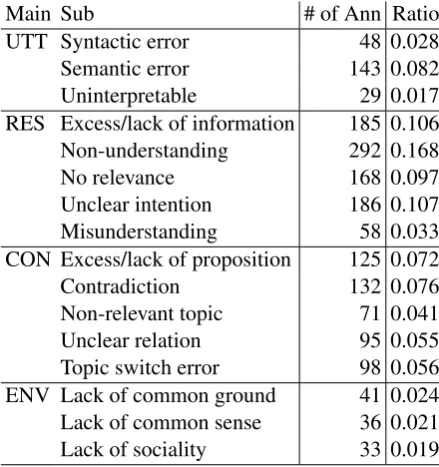
[image:6.595.307.527.63.297.2]Main Sub # of Ann Ratio UTT Syntactic error 48 0.028 Semantic error 143 0.082 Uninterpretable 29 0.017 RES Excess/lack of information 185 0.106 Non-understanding 292 0.168 No relevance 168 0.097 Unclear intention 186 0.107 Misunderstanding 58 0.033 CON Excess/lack of proposition 125 0.072 Contradiction 132 0.076 Non-relevant topic 71 0.041 Unclear relation 95 0.055 Topic switch error 98 0.056 ENV Lack of common ground 41 0.024 Lack of common sense 36 0.021 Lack of sociality 33 0.019 Table 4: Number of annotations given to each sub-category. Ratio is calculated over all annotations.
6.1 Distribution of error categories
Table 3 shows the distribution of annotations sum-marized by the main categories. As can be seen from the table, the response-level error has the most annotations (more than 50%), followed by the context-level error. We also see quite a few utterance-level and environment-level errors.
Table 4 shows the distribution of annotations by sub-category. Within the utterance-level category, the semantic error is dominant. For the other lev-els, the errors seem to be equally distributed under each main category, although the number of Non-understandings is larger and that of RES-Misunderstandings is less than the others. This is an indication that the taxonomy has a good cat-egorization of errors since the distribution is not biased to only a small number of categories.
6.2 Inter-annotator agreement
Table 5 shows Fleiss’ κ for main and sub-categories of errors. The kappa values were cal-culated within each subset because the annotators were different for each subset. The average value indicates the macro-average over the subsets.
For the main categories, the averaged Fleiss’κ
cate-Subset # of Utts Main cat. Sub cat.
a 45 0.472 0.284
b 46 0.263 0.208
c 59 0.372 0.252
d 67 0.405 0.207
e 55 0.485 0.098
f 81 0.528 0.336
g 54 0.353 0.312
h 61 0.359 0.275
i 46 0.367 0.131
j 66 0.396 0.292
[image:7.595.82.281.61.224.2]Avg 0.400 0.239
Table 5: Fleiss’ κfor main and sub-categories of errors. # of Utts indicates number of annotated utterances in each subset.
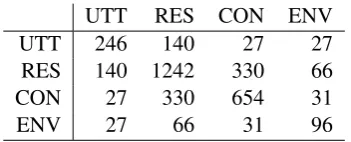
UTT RES CON ENV UTT 246 140 27 27 RES 140 1242 330 66 CON 27 330 654 31 ENV 27 66 31 96 Table 6: Confusion matrix for main categories
gories (See Table 6). There was most confusion with RES vs. CON. This may be understandable because responses are closely related to the con-text. It is also interesting that there was much confusion regarding UTT vs. RES. Some anno-tators seemed to be lenient on syntactic/semantic errors and considered such errors to be response-level. Another interesting point is regarding ENV because it was most confused with RES, not CON, which is in the next level. This may be attributable to the fact that ENV is concerned with some-thing more than the discourse scope. Although we instructed annotators to proceed from utterance-level to environment-utterance-level errors, it might have been difficult for them to ignore easy-to-find er-rors related to sociality and common sense.
For the sub-categories, the averaged Fleiss’ κ
was 0.239, which is rather low. For subset e, the kappa value was as low as 0.098. To further in-vestigate the cause of this low agreement, we cre-ated a confusion matrix for the sub-category anno-tations. Since there are 16 sub-categories and the number of possible confusing pairs is 120 (16C2),
for brevity, we only show the top-10 confusing sub-category pairs (See Table 7). From the table, the top six pairs are all between response-level er-rors. The top six confusing pairs comprise about
20% of all confusions. After that, the confused pairs are mostly between response and context lev-els.
The confusion between RES-Non-understan-ding and RES-No-relevance was probably because of the perception of “what the system really un-derstood”. Some annotators thought the system made an utterance that did not match the content of the previous user utterance because it did not “understand” the user; therefore, he/she used the RES-Non-understanding category, whereas oth-ers just used the RES-No-relevance category. In fact, other confusing pairs in the response level had similar problems. For example, the cat-egory RES-Excess/lack-of-information was con-fused with RES-Unclear-intention because some annotators thought the intention was unclear due to the lack of information. This lack of infor-mation also made an utterance seem irrelevant in some cases.
This analysis made it clear that it is difficult to distinguish between the categories related to Grice’s maxims. This may be reasonable since Grice’s maxims are not claimed to be mutually exclusive. However, considering that the maxims have been successfully used to classify errors in task-oriented dialogue (Bernsen et al., 1996; Dy-bkjær et al., 1996), this can be due to the nature of chat-oriented dialogue systems. Our hypothesis for this confusion is that system utterances in cur-rent chat-oriented dialogue systems are far from being cooperative; thus, are not placed within the understandable regions of conversational implica-ture, making the classification highly subjective. Another hypothesis is that there can be multiple cooperativeness errors for the same utterance. In this case, our single-label classification scheme may not be appropriate because it necessitates the subjective choice between the cooperativeness er-rors.
6.3 Discussions
[image:7.595.94.270.289.360.2]distinguish-Confusing sub-categories Ratio Accum 1 RES-Non-understanding RES-No relevance 0.048 0.048 2 RES-Excess/lack of information RES-Unclear intention 0.034 0.082 3 RES-Excess/lack of information RES-Non-understanding 0.032 0.114 4 RES-Excess/lack of information RES-No relevance 0.028 0.142 5 RES-No relevance RES-Unclear intention 0.027 0.169 6 RES-Non-understanding RES-Unclear intention 0.025 0.194 7 RES-Non-understanding CON-Topic switch error 0.024 0.218 8 RES-Non-understanding CON-Contradiction 0.017 0.235 9 CON-Non-relevant topic CON-Unclear relation 0.017 0.252 10 RES-Unclear intention CON-Unclear relation 0.017 0.270
Table 7: Top-10 confusing sub-category pairs
ing among the categories related to Grice’s max-ims that attributed to this low agreement, due to the possible reason of subjectivity.
While we improve the categories and the la-beling scheme to cope with the subjectivity, our suggestion for the time being is to shrink Grice’s maxim-related categories (in both RES and CON) to one “cooperativeness error” category. To sup-port this idea, we shrank such categories and re-calculated Fleiss’ κ. As a result, we found that the inter-annotator agreement increased to 0.358 (macro-average over the subsets). Considering that this kappa value is bounded by that of the main categories (i.e., 0.4), the reliability of this classification is reasonable.
7 Summary and Future Work
We presented a taxonomy of errors in chat-oriented dialogue systems. Through a data col-lection of chat dialogues and analyses of dialogue breakdowns, we created a taxonomy of errors. We then evaluated the validity of our taxonomy from two view points: the distribution of error cate-gories and inter-annotator agreement. We argued that our taxonomy is reasonable, although some amendments are necessary. Our contributions are that we presented the first taxonomy of errors in chat-oriented dialogue systems and quantitatively evaluated the taxonomy and highlighted the dif-ficulties in mapping errors to Grice’s maxims in such systems.
There are a number of limitations in this work. First, the kappa is still low. We need to refine the categories and their definitions to reduce subjec-tivity in our classification scheme. It may also be necessary to incorporate a multi-label scheme. Another limitation is that the research was
con-ducted using a single system. Although the sys-tem we adopted had many advanced features in terms of natural language processing, for gener-ality, we need to verify our taxonomy using data of other chat-oriented dialogue systems. Another limitation is the modality considered. We only dealt with text, whereas there are many systems based on other modalities. The research was con-ducted only in Japanese, which is another lim-itation. Although we believe our approach is language-independent, we need to verify this with systems using other languages.
Our ultimate goal is to reduce errors in chat-oriented dialogue systems. Although we strive to reduce errors ourselves, since the errors concern many aspects of conversation, we are planning to make dialogue-breakdown detection an open chal-lenge. To this end, we have released the data1
to the public so that researchers in the field can test their ideas for detecting breakdowns. Al-though there have been approaches to detecting errors in open-domain conversation, the reported accuracies are not that high (Xiang et al., 2014; Higashinaka et al., 2014b). We believe our taxon-omy will be helpful for conceptualizing the errors, and the forthcoming challenge will encourage a more detailed analysis of errors in chat-oriented dialogue systems.
Acknowledgments
In Japan, there is an error analysis campaign called “Project Next NLP”, and within this project, there is a dialogue task as a sub-group. This research was conducted with the collaboration of more than 32 researchers from 15 institutions in the dialogue
1The data are available athttps://sites.google.
task. Although the authors of this paper are those who participated in the final design of the taxon-omy, we thank all members of the dialogue task for data collection, annotation, and fruitful discus-sions. We also thank NTT DOCOMO for letting us use their chat API for data collection.
References
John Aberdeen and Lisa Ferro. 2003. Dialogue
pat-terns and misunderstandings. InProc. ISCA
Work-shop on Error Handling in Spoken Dialogue Sys-tems, pages 17–21.
James Allen. 1995. Natural language understanding.
Benjamin/Cummings.
Rafael E Banchs and Haizhou Li. 2012. IRIS: a chat-oriented dialogue system based on the vector space
model. InProc. the ACL 2012 System
Demonstra-tions, pages 37–42.
Jeesoo Bang, Hyungjong Noh, Yonghee Kim, and Gary Geunbae Lee. 2015. Example-based chat-oriented dialogue system with personalized
long-term memory. InProc. BigComp, pages 238–243.
Niels Ole Bernsen, Hans Dybkjaer, and Laila Dybk-jaer. 1996. Principles for the design of cooperative
spoken human-machine dialogue. InProc. ICSLP,
volume 2, pages 729–732.
Timothy W. Bickmore and Justine Cassell. 2001. Relational agents: a model and implementation of building user trust. InProc. CHI, pages 396–403.
Dan Bohus and Alexander I Rudnicky. 2005.
Sorry, i didn’t catch that!–an investigation of non-understanding errors and recovery strategies. In
Proc. SIGDIAL, pages 128–143.
Herbert H Clark. 1996. Using language. Cambridge
university press.
Laila Dybkjær, Niels Ole Bernsen, and Hans Dybkjær. 1996. Grice incorporated: cooperativity in spoken
dialogue. InProc. COLING, volume 1, pages 328–
333.
Myroslava O Dzikovska, Charles B Callaway, Elaine Farrow, Johanna D Moore, Natalie Steinhauser, and Gwendolyn Campbell. 2009. Dealing with interpre-tation errors in tutorial dialogue. InProc. SIGDIAL, pages 38–45.
Anders Green, Kerstin Severinson Eklundh, Britta Wrede, and Shuyin Li. 2006. Integrating miscom-munication analysis in natural language interface de-sign for a service robot. InProc. IEEE/RSJ, pages 4678–4683.
H. P. Grice. 1975. Logic and conversation. In P. Cole
and J. Morgan, editors, Syntax and Semantics 3:
Speech Acts, pages 41–58. New York: Academic Press.
Ryuichiro Higashinaka, Kenji Imamura, Toyomi Me-guro, Chiaki Miyazaki, Nozomi Kobayashi, Hiroaki Sugiyama, Toru Hirano, Toshiro Makino, and Yoshi-hiro Matsuo. 2014a. Towards an open-domain con-versational system fully based on natural language
processing. InProc. COLING, pages 928–939.
Ryuichiro Higashinaka, Toyomi Meguro, Kenji Ima-mura, Hiroaki Sugiyama, Toshiro Makino, and Yoshihiro Matsuo. 2014b. Evaluating coherence in
open domain conversational systems. InProc.
IN-TERSPEECH, pages 130–133.
Bilyana Martinovsky and David Traum. 2003. The er-ror is the clue: Breakdown in human-machine
inter-action. InProc. ISCA Workshop on Error Handling
in Spoken Dialogue Systems, pages 11–16.
Sebastian M¨oller, Klaus-Peter Engelbrecht, and Antti Oulasvirta. 2007. Analysis of communication
fail-ures for spoken dialogue systems. InProc.
INTER-SPEECH, pages 134–137.
Sebastian M¨oller. 2005. Parameters for quantifying the interaction with spoken dialogue telephone
ser-vices. InProc. SIGDIAL, pages 166–177.
Kanako Onishi and Takeshi Yoshimura. 2014. Ca-sual conversation technology achieving natural
di-alog with computers. NTT DOCOMO Technical
Jouranl, 15(4):16–21.
Tim Paek. 2003. Toward a taxonomy of
communica-tion errors. InProc. ISCA Workshop on Error
Han-dling in Spoken Dialogue Systems, pages 53–58. Emanuel A Schegloff and Harvey Sacks. 1973.
Open-ing up closOpen-ings. Semiotica, 8(4):289–327.
Richard S. Wallace. 2004. The Anatomy of A.L.I.C.E.
A.L.I.C.E. Artificial Intelligence Foundation, Inc. Nigel G Ward, Anais G Rivera, Karen Ward, and
David G Novick. 2005. Root causes of lost time and user stress in a simple dialog system. InProc. INTERSPEECH, pages 1565–1568.
Graham Wilcock and Kristiina Jokinen. 2013.
Wik-italk human-robot interactions. In Proc. ICMI,
pages 73–74.
Yang Xiang, Yaoyun Zhang, Xiaoqiang Zhou, Xiao-long Wang, and Yang Qin. 2014. Problematic situa-tion analysis and automatic recognisitua-tion for Chinese
online conversational system. InProc. CLP, pages