Shared Tasks of the 2015 Workshop on Noisy User-generated Text:
Twitter Lexical Normalization and Named Entity Recognition
Timothy Baldwin
University of Melbourne
Young-Bum Kim
University of Wisconsin
Marie Catherine de Marneffe
The Ohio State University
Alan Ritter
The Ohio State University
Bo Han
IBM Research
Wei Xu
University of Pennsylvania
Abstract
This paper presents the results of the two shared tasks associated with W-NUT 2015: (1) a text normalization task with 10 participants; and (2) a named entity tagging task with 8 participants. We outline the task, annotation process and dataset statistics, and provide a high-level overview of the participating systems for each shared task.
1 Introduction
As part of the 2015 ACL-IJCNLP Workshop on Noisy User-generated Text (W-NUT), we orga-nized two shared tasks: (1) a text normalization task (Section 2); and (2) a named entity tagging task (Section 3).
In the text normalization task, participants were asked to convert non-standard words to their stan-dard forms for English tweets. Participating sys-tems were classified by their use of resources, into a constrained and an unconstrained category: con-strained systems were permitted to use only the provided training data and off-the-shelf tools; un-constrained systems, on the other hand, were free to use any public tools and resources. There were 6 official submissions in the constrained category, and 5 official submissions in the unconstrained category. Overall, deep learning methods and methods based on lexicon-augmented conditional random fields (CRFs) achieved the best results. The winning team achieved a precision of 0.9061 precision, recall of 0.7865, and F1 of 0.8421.
The named entity recognition task attracted 8 participants. The majority of teams built their sys-tems using linear-chain conditional random fields (Lafferty et al., 2001), and many teams also used brown clusters and word embedding fea-tures (Turian et al., 2010). Notable new tech-niques for named entity recognition in Twitter in-clude a semi-Markov MIRA trained tagger (nrc),
an end-to-end neural network using no hand-engineered features (multimedialab), an approach that weights training data to compensate for con-cept drift (USFD), and a differential evolution ap-proach to feature selection (iitp). The submission from the winning team (ousia) achieved supris-ingly good performance on this difficult task, near the level of inter-rater agreement.
2 Text Normalization Shared Task In this section, we outline the Twitter Text Nor-malization Shared Task, describing the data and annotation process, and outlining the approaches adopted by participants.
2.1 Background
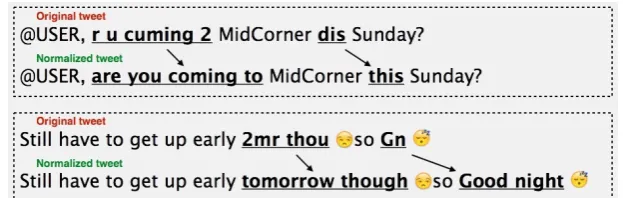
Non-standard words are present in many text gen-res, including advertisements, professional fo-rums, and SMS messages. They can be the cause of reading and understanding problems for hu-mans, and degrade the accuracy of text process-ing tools (Han et al., 2013; Plank et al., 2014a; Kong et al., 2014). Text normalization aims to transform non-standard words to their canonical forms (Sproat et al., 2001; Han and Baldwin, 2011) as shown in Figure 1. Common examples of non-standard words include abbreviations (e.g.,
u“you”), and non-standard spellings (e.g.,cuming
Figure 1: Normalization examples
translation task, whereby non-standard words are mapped to more canonical expressions (Aw et al., 2006). Other approaches have involved deep learning (Chrupała, 2014), cognitively-inspired approaches (Liu et al., 2012), random walks (Has-san and Menezes, 2013), and supervision us-ing automatically-mined parallel data (Lus-ing et al., 2013).
One major challenge in text normalization re-search has been the lack of annotated data for training and evaluating methods. As a result, most Twitter text normalization methods have been un-supervised or semi-un-supervised (Cook and Steven-son, 2009; Han et al., 2012; Yang and Eisen-stein, 2013), and evaluated over small-scale hand-annotated datasets. This has hampered analysis of the strengths and weaknesses of individual meth-ods, and was our motivation in organizing the lex-ical normalization shared task.
2.2 Shared Task Design
This lexical normalization shared task is focused exclusively on English, and was designed with three primary desiderata in mind: (1) to construct a much larger dataset than existing resources; (2) to allow all of 1:1, 1:N andN:1 wordn-gramm ap-pings; and (3) to cover not just OOV non-standard words but also non-standard words that happen to coincide in spelling with standard words. In all three regards, the shared task expands upon the scope of the de facto evaluation datasets of Han and Baldwin (2011) and Liu et al. (2011).
One constraint that was placed on candidate to-kens for normalization was that they should be all-alphanumeric. For normalization, we adopted American spelling.
In order to establish a more level playing field for participants, but also encourage the use of a wide range of resources, participants were re-quired to nominate their system categories:
• Constrained: participants could not use any data other than the provided training data to perform the text normalization task. They were allowed to use pre-trained tools (e.g., Twitter POS taggers), but no normalization lexicons or extra tweet data.
• Unconstrained: participants could use any publicly accessible data or tools to perform the text normalization task.
Evaluation was based on token-level precision, recall and F-score.
2.2.1 Preprocessing
We first collected tweets using the Twitter Stream-ing API over the period 23–29 May, 2014, and then usedlangid.py(Lui and Baldwin, 2012)1 to remove all non-English tweets. Tokenization was performed with CMU-ARK tokeniser.2 To ensure that tweets had a high likelihood of requiring lexical normalization, we filtered out tweets with less than 2 non-standard words (i.e. words not occurring in our dictionary — see Sec-tion 2.2.3). While this biases the sample of tweets, the decision was made at a pragmatic level to en-sure a reasonable level of lexical normalization and “annotation density”. This was based on a pi-lot study over a random sample of English tweets, in which we found that many non-standard words were actually unknown named entities which did not require normalization. In all, 5,200 randomly-sampled English tweets were annotated for the shared task dataset.
2.2.2 Annotation
12 interns and employees at IBM Research Aus-tralia were involved in the data annotation. All
1https://github.com/saffsd/langid.py 2https://github.com/myleott/
annotators had a high level of English proficiency (IELTS 6.0) and were reasonably familiar with Twitter data. Each annotator labeled at least 200 tweets, and each tweet was independently labeled by two annotators based on the annotation guide-lines.3 As part of this, any non-English tweets misclassified bylangid.py were manually re-moved from the dataset. This resulted in the fi-nal size of the annotated dataset dropping to 4,917 tweets. All annotations were completed within two weeks, and achieved an average Cohen’sof 0.5854.
For all instances of annotator disagreement, an annotator who was not involved in the first-pass annotation process was asked to adjudicate in the following week. During the course of the shared task, we additionally examined and incorporated a small number of annotation corrections reported by participants.
2.2.3 English Lexicon
It is impossible to reach consensus on the di-viding line between standard words and non-standard words (e.g. are footie, y’all and youse
non-standard or standard words?). We artificially arrive at such a dividing line via membership in a prescribed lexicon of English. Specifically, we use theSCOWLdatabase with American spellings as the default English lexicon.4 The SCOWL database integrates words from multiple sources and also contains valid word spelling variations, which makes it an excellent English lexicon for this shared task. As suggested in the database guidelines, we used a dictionary size of 70%, such that the lexicon contains words found in most dic-tionaries, but also many high-frequency proper nouns such asObamaandFacebook.
The overall English lexicon (after de-duplication) contains 165,458 words. This lexicon was used: (a) to pre-filter data, i.e., tweets with less than two tokens not in this lexicon are dropped from our annotations; and (b) as the basis of the standard words for normalization.
2.2.4 Dataset Statistics
The dataset was randomly split 60:40, into 2,950 tweets for the training data and 1,967 tweets for the test data. Table 1 details the number of (possi-bly multi-word) tokens in each of the training and
3http://noisy-text.github.io/files/
annotation_guideline_v1.1.pdf
4Version 2014.11.17 was used.
Category 1:1 1:N N:1 Overall Training 2,875 1,043 10 3,928
Test 2,024 704 10 2,738
Training ratio 0.587 0.597 0.500 0.589
Table 1: Numbers of non-standard words in the training and test datasets for the lexical normal-ization task, broken down into 1:1, 1:N andN:1 mappings from non-standard words to standard words. “Training ratio” represents the number of non-standard words in the training data divided by the overall non-standard words in that category.
Rank Training Test Combined
1 u 333 u 236 u 569
2 lol 272 lol 197 lol 469
3 im 182 im 154 im 336
4 dont 92 nigga 60 dont 149 5 omg 67 dont 57 nigga 117 6 nigga 57 lmao 45 omg 101
7 niggas 52 n 43 lmao 96
8 lmao 51 niggas 42 niggas 94
9 n 49 omg 34 n 92
10 ur 46 ur 28 ur 74
Table 2: Top-10 most frequent non-standard words in each partition of the lexical normalization dataset.
test data that were normalized based on a 1:1, 1:N
orN:1 mapping. We additionally include the pro-portion of tokens in each category that were con-tained in the test data, to confirm that the dataset is relatively balanced in composition between the training and test partitions.
2.3 Normalization Approaches and Discussion
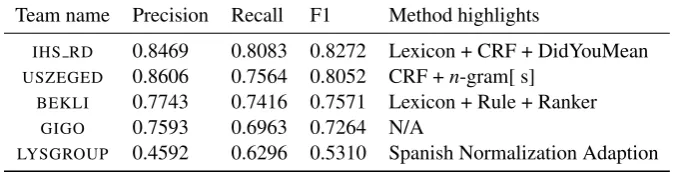
Overall, 10 teams submitted official runs to the shared task: 6 teams participated in the con-strained category, 5 teams in the unconcon-strained category, and 1 team in both categories.5 The normalization results for each category are shown in Tables 3 and 4. Overall, common approaches were lexicon-based methods, CRFs, and neu-ral network-based approaches. Among the con-strained systems, neural networks achieved strong results, even without off-the-shelf tools. In con-trast, CRF- and lexicon-based approaches were shown to be effective in the unconstrained cat-egory. Surprisingly, the best overall result was achieved by a constrained system, suggesting that the relative advantage in accessing additional datasets or resources has less impact than the qual-ity of the underlying model that is used to model the task.
NCSU SAS NING (Jin, 2015) Normalization
candidates were generated based on the training data, and scored based on Jaccard index over character n-gram[ s]. Candidates were evaluated using random forest classifiers to offset parameter sensitivity, using features including normalization statistics, string similarity and POS.
NCSU SAS WOOKHEE (Min et al., 2015)
Word-level edits are predicted based on long-short term memory (LSTM) recurrent neural networks (RNN), using character sequences and POS tags as features. The LSTM is further complemented with a normalization lexicon induced from the training data.
NCSU SAS SAM (Leeman-Munk et al., 2015)
Two forward feed neural networks are used to pre-dict: (1) the normalized token given an input to-ken; and (2) whether a word should be normalized or left intact. Normalized tokens are further edited by a “conformer” which down-weights rare words as normalization candidates.
IITP (Akhtar et al., 2015b) A CRF model is
trained over the training data, with features in-cluding word sequences, POS tags and morphol-ogy features. Post-processing heuristics are used to post-edit the output of the CRF.
5One team (GIGO) didn’t submit a description paper.
DCU-ADAPT (Wagner and Foster, 2015) A
generalized perceptron method is used generate word edit operations, with features including char-actern-gram[ s], character classes, and RNN lan-guage model hidden layer activation features. The final normalization word is selected based on the noisy channel model with a character language model.
IHD RD (Supranovich and Patsepnia, 2015)
non-standard words are identified using a CRF tagger, using features such as token-level features, contextual tokens, dictionary lookup, and edit dis-tance. Multiple lexicons are combined to gener-ate normalization candidgener-ates. A query misspelling correction module (i.e., DidYouMean) is used to post-process the output.
USZEGED(Berend and Tasn´adi, 2015) A CRF
model is used to identify tokens requiring normal-ization, and determine the type of normalization required. Normalization candidates are then pro-posed based on revised edit distance. The final normalization candidate is selected on the basis of
n-grams tatistics.
BEKLI (Beckley, 2015) A substitution dictio-nary is constructed in which keys are non-standard words and values are lists of potential normaliza-tions. Frequent morphology errors are captured by hand-crafted rules. Finally, the Viterbi algorithm is applied to bigram sequences to decode the nor-malized sentence with maximum probability.
LYSGROUP (Mosquera et al., 2015) A system
originally developed for Spanish text normaliza-tion was adapted to English text normalizanormaliza-tion. The method consists of a cascaded pipeline of sev-eral data adaptors and processors, such as a Twitter POS tagger and a spell checker.
3 Named Entity Recognition over Twitter
state-Team name Precision Recall F1 Method highlights NCSU SAS NING 0.9061 0.7865 0.8421 Random Forest NCSU SAS WOOKHEE 0.9136 0.7398 0.8175 Lexicon + LSTM
NCSU SAS SAM 0.9012 0.7437 0.8149 ANN IITP 0.9026 0.7191 0.8005 CRF + Rule
DCU-ADAPT 0.8190 0.5509 0.6587 Generalized Perceptron
[image:5.595.130.469.222.308.2]LYSGROUP 0.4646 0.6281 0.5341 Spanish Normalization Adaption
Table 3: Results of the constrained systems for the lexical normalization shared task
Team name Precision Recall F1 Method highlights
IHS RD 0.8469 0.8083 0.8272 Lexicon + CRF + DidYouMean USZEGED 0.8606 0.7564 0.8052 CRF +n-gram[ s]
BEKLI 0.7743 0.7416 0.7571 Lexicon + Rule + Ranker GIGO 0.7593 0.6963 0.7264 N/A
LYSGROUP 0.4592 0.6296 0.5310 Spanish Normalization Adaption
Table 4: Results of the unconstrained systems for the lexical normalization shared task
of-the-art performance on Twitter data lags far be-hind.
The diverse and noisy style of user-generated content presents serious challenges. For instance tweets, unlike edited newswire text, contain nu-merous nonstandard spellings, abbreviations, un-reliable capitalization, etc.
Another challenge is concept drift (Dredze et al., 2010; Fromreide et al., 2014); the distribu-tion of language and topics on Twitter is constantly shifting leading to degraded performance of NLP tools over time. To evaluate the effect of drift in a realistic scenario, the current evaluation uses a test set from a separate time period, which was not announced to participants until the (unannotated) test data was released at the beginning of the eval-uation period.
To address these challenges, there has been an increasing body of work on adapting named entity recognition tools to noisy social media text (Der-czynski et al., 2015b; Plank et al., 2014a; Cherry and Guo, 2015; Ritter et al., 2011; Plank et al., 2014b), however different research groups have made use of different evaluation setups (e.g. train-ing / test splits) maktrain-ing it challengtrain-ing to perform direct comparisons across systems. By organiz-ing a shared evaluation we hope to help establish a common evaluation methodology (for at least one dataset) and also promote research and develop-ment of NLP tools for user-generated social media
text genres.
3.1 Training and Development Data
The training and development data for our task was taken from previous work on Twitter NER (Ritter et al., 2011), which distinguishes 10 dif-ferent named entity types (see Table 5 for the set of types). The data was split into 1,795 annotated tweets for training (train) and 599 as a devel-opment set (dev). Participants were allowed to use the development data for training purposes in their final submissions. This data was gathered in September 2010 and annotated by the 5th author.
3.2 Test Data Annotation
The test data was randomly sampled from Decem-ber 2014 through February 2015. Two native En-glish speakers were recruited to independently an-notate the test data. The annotators were presented with a set of simple guidelines6 that cover com-mon ambiguous cases and also instructed to re-fer to the September 2010 data for rere-ference. The BRAT tool7was used for annotation. A screenshot of the interface presented to annotators is shown in Figure 2. During an initial training period, both annotators independently labeled a set of 200 tweets after which disagreements were discussed and resolved before moving on to annotate the fi-nal test set. This initial annotation was only done
for the purpose of training the annotators and the resulting data was discarded.
[image:6.595.320.501.87.255.2]The annotators then went on to double-annotate a set of 1,425 messages. An adjudicator, the an-notator of the training and dev sets, went through each message and resolved disagreements. The dataset was randomly split into 425 messages as an additional development set (dev2015) which was released to participants at the beginning of the evaluation period. The remaining 1,000 messages (test) were used for the final evaluation; annota-tions on the test data were withheld from partici-pants until the end of the evaluation period.
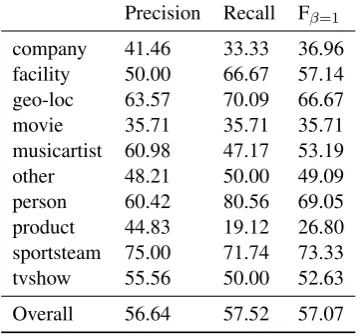
Table 5 presents precision and recall for each of the 10 categories treating one annotator’s labels as gold and the other’s as predicted. This exposes the challenging nature of this annotation task and can be viewed as a kind of human upper bound on pos-sible system performance, though we believe the consistency of the final annotations to be some-what higher due to the second pass made by the adjudicator. The value of Cohen’sas measured on word-level annotations is 0.607.
A baseline system was provided to participants which takes a simple approach based on CRF-suite8 using a standard set of features which in-clude contextual, orthographic and gazetteers gen-erated from Freebase (Bollacker et al., 2008). The evaluation consisted of 2 sub-tasks: one in which participants’ systems were required to segment and classify 10 named entity types and one where the task is only to predict entity segmentation (no types).
3.3 Approaches
Eight teams (Table 6) participated in the named entity recognition shared task. A wide variety of approaches were taken to tackle this task. Table 7 summarizes the features used by each team and the machine learning approach taken. Many teams made use of word embeddings and Brown clus-ters as features. One team (multimedialab) used absolutely no hand-engineered features, relying entirely on word embeddings and a feed-forward neural-network (FFNN) architecture (Godin et al., 2015). Other new approaches to Twitter NER in-clude a semi-Markov MIRA trained tagger devel-oped by the NRC team (Cherry and Guo, 2015) and the use of entity-linking based features by
ou-8http://www.chokkan.org/software/
crfsuite/
Precision Recall F =1
[image:6.595.308.507.339.434.2]company 41.46 33.33 36.96 facility 50.00 66.67 57.14 geo-loc 63.57 70.09 66.67 movie 35.71 35.71 35.71 musicartist 60.98 47.17 53.19 other 48.21 50.00 49.09 person 60.42 80.56 69.05 product 44.83 19.12 26.80 sportsteam 75.00 71.74 73.33 tvshow 55.56 50.00 52.63 Overall 56.64 57.52 57.07
Table 5: Precision and recall comparing one an-notator against the other. Cohen’s kappa between the annotators was 0.607. Disagreements between the annotators resolved by a 3rd adjudicator for the final datasets.
Team ID Affiliation Hallym Hallym University
iitp Indian Institute of Technology Patna lattice University Paris 3
multimedialab UGent - iMinds
NLANGP Institute for Infocomm Research nrc National Research Council Canada ousia Studio Ousia
USFD University of Sheffield
Table 6: Team ID and affiliation of the named en-tity recognition shared task participants.
sia (Yamada et al., 2015). All the other teams used CRFs. On top of a CRF, the iitp team used a differ-ential evolution based technique to obtain an opti-mal feature set.
Most systems used the training data as well as both dev sets provided to train their system, ex-cept multimedialab which did not usedev2015
as training data and NRC which only usedtrain. 9
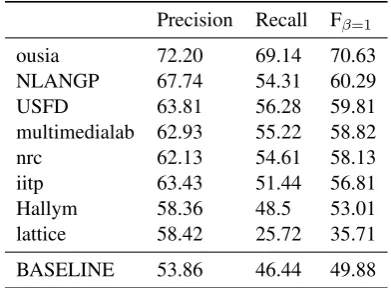
Tables 8 and 9 report the results obtained by each team for segmentation and classification of the 10 named entity types and for segmentation only, respectively.
3.4 System Descriptions
Following is a brief description of the approach taken by each team:
9A post-competition analysis of the effect of training on
Figure 2: Annotation interface.
POS Orthographic Gazetteers Brown clustering Word embedding ML
BASELINE – X X – – CRFsuite
Hallym X – – X correlation analysis CRFsuite
iitp X X X – – CRF++
lattice X X – X – CRF wapiti
multimedialab – – – – word2vec FFNN NLANGP – X X X word2vec & GloVe CRF++
nrc – – X X word2vec semi-Markov MIRA
ousia X X X – X entity linking
[image:7.595.91.287.452.599.2]USFD X X X X – CRF L-BFGS
Table 7: Features and machine learning approach taken by each team.
Precision Recall F =1
ousia 57.66 55.22 56.41
NLANGP 63.62 43.12 51.40
nrc 53.24 38.58 44.74
multimedialab 49.52 39.18 43.75
USFD 45.72 39.64 42.46
iitp 60.68 29.65 39.84
Hallym 39.59 35.10 37.21 lattice 55.17 9.68 16.47 BASELINE 35.56 29.05 31.97
Table 8: Results segmenting and categorizing en-tities into 10 types.
Hallym (Yang and Kim, 2015) The Hallym team used an approach based on CRFs using both Brown clusters and word embeddings trained using Canonical Correlation Analysis as features.
iitp (Akhtar et al., 2015a) The iitp team
pro-Precision Recall F =1
ousia 72.20 69.14 70.63
NLANGP 67.74 54.31 60.29
USFD 63.81 56.28 59.81
multimedialab 62.93 55.22 58.82
nrc 62.13 54.61 58.13
iitp 63.43 51.44 56.81
Hallym 58.36 48.5 53.01
lattice 58.42 25.72 35.71 BASELINE 53.86 46.44 49.88
Table 9: Results on segmentation only (no types).
posed a multi-objective differential evolution based technique for feature selection in twit-ter named entity recognition.
[image:7.595.311.507.453.597.2]dev 2015 and evaluated this model on train and dev.
multimedialab (Godin et al., 2015) The goal of the multimedia lab system was to only use neural networks and word embeddings to show the power of automatic feature learn-ing and semi-supervised methods. A Feed-Forward Neural Network was first trained, that used only word2vec word embeddings as input. Word embeddings were trained on 400 million unlabeled tweets. Leaky ReLUs were used as activation function in combina-tion with dropout to prevent overfitting. A context window of 5 words was used As in-put (2 words left and right). The outin-put is a single tag of the middle word. Afterwards, a rule-based post-processing step was executed to ensure every I-tag has a B-tag in front of it and that all tags within a single span are of the same type. Train and dev were used as training data and used dev 2015 as validation set.
NLANGP (Toh et al., 2015) The NLANGP team modeled the problem as a sequential labeling task and used Conditional Random Fields. Several post-processing steps (e.g. rule-based matching) were applied to refine the system output. Besides Brown clusters, K-means clusters were also used; the K-K-means clusters were generated based on word em-beddings.
nrc (Cherry et al., 2015) NRC applied a MIRA-trained semi-Markov tagger with Gazetteer, Brown cluster and Word Embedding fea-tures. The Word Embeddings were built over phrases using Word2Vec’s phrase finder tool, and were modified using an auto-encoder to be predictive of Gazetteer membership.
ousia (Yamada et al., 2015) The main character-istics of the ousia method is enhancing the performance of Twitter named entity recog-nition using entity linking. Once entity men-tions are disambiguated to the knowledge base entries, high-quality knowledge can be easily extracted from a knowledge base such as the popularity of the entity, the classes of the entity, and the likelihood that the entity appears in the given context. They adopted supervised machine-learning with features
including the results of NER and various in-formation of the entity in knowledge bases. We use Stanford NER was used for the NER and in-house end-to-end entity linking soft-ware was applied for entity linking.
USFD (Derczynski et al., 2015a) Feature extrac-tion was based on large Brown clusters, gazetteers tuned to the input data, and distant supervision from Freebase. The representa-tion was tuned for drift by down-weighting temporally distant training examples. The classifier was a linear chain CRF with hyper-parameters tuned for Twitter.
4 Summary
In this paper, we presented two shared tasks on Twitter text processing: Lexical Normalization and Named Entity Recognition. We detailed the task setup and datasets used in the respective shared tasks, and also outlined the approach taken by the participating systems. Both shared tasks were of a scale substantially larger than what had previously been attempted in the literature, with two primary benefits. First, we are able to draw stronger conclusions about the true potential of different approaches. Second, through analyzing the results of the participating systems, we are able to suggest potential research directions for both fu-ture shared tasks and noisy text processing in gen-eral.
Acknowledgments
We would like to thank Svitlana Volkova and Jun-ming Xu for feedback on a previous draft of this paper. We also thank Javier Angel and Gabriella Talvy for annotating the test data for the named entity recognition shared task, and IBM Research Australia for the generous support in doing the an-notation for the lexical normalization shared task.
References
Md Shad Akhtar, Utpal Kumar Sikdar, and Asif Ek-bal. 2015a. Iitp: Multiobjective differential evolu-tion based twitter named entity recognievolu-tion. In pro-ceedings of WNUT.
AiTi Aw, Min Zhang, Juan Xiao, and Jian Su. 2006. A phrase-based statistical model for SMS text nor-malization. InProceedings of COLING/ACL 2006, pages 33–40, Sydney, Australia.
Russell Beckley. 2015. Bekli:a simple approach to twitter text normalization. Inproceedings of WNUT, Beijing, China.
Gabor Berend and Ervin Tasn´adi. 2015. Uszeged: Correction type-sensitive normalization of english tweets using efficiently indexed n-gram statistics. In proceedings of WNUT, Beijing, China.
Kurt Bollacker, Colin Evans, Praveen Paritosh, Tim Sturge, and Jamie Taylor. 2008. Freebase: a col-laboratively created graph database for structuring human knowledge. InProceedings of the 2008 ACM SIGMOD international conference on Management of data, pages 1247–1250. ACM.
Colin Cherry and Hongyu Guo. 2015. The unreason-able effectiveness of word representations for twitter named entity recognition. NAACL.
Colin Cherry, Hongyu Guo, and Chengbi Dai. 2015. Nrc: Infused phrase vectors and updated gazetteers for named entity recognition in twitter. In proceed-ings of WNUT.
Grzegorz Chrupała. 2014. Normalizing tweets with edit scripts and recurrent neural embeddings. In Proceedings of the 52nd Annual Meeting of the Association for Computational Linguistics (ACL 2014), pages 680–686, Baltimore, USA, June. Paul Cook and Suzanne Stevenson. 2009. An
unsu-pervised model for text message normalization. In Proceedings of the Workshop on Computational Ap-proaches to Linguistic Creativity (CALC ’09), pages 71–78, Boulder, USA.
Leon Derczynski, Isabelle Augenstein, and Kalina Bontcheva. 2015a. Usfd: Twitter ner with drift compensation and linked data. In proceedings of WNUT.
Leon Derczynski, Diana Maynard, Giuseppe Rizzo, Marieke van Erp, Genevieve Gorrell, Rapha¨el Troncy, Johann Petrak, and Kalina Bontcheva. 2015b. Analysis of named entity recognition and linking for tweets. Information Processing & Man-agement, 51(2):32–49.
Mark Dredze, Tim Oates, and Christine Piatko. 2010. We’re not in kansas anymore: detecting domain changes in streams. InProceedings of the 2010 Con-ference on Empirical Methods in Natural Language Processing, pages 585–595. Association for Com-putational Linguistics.
Hege Fromreide, Dirk Hovy, and Anders Søgaard. 2014. Crowdsourcing and annotating ner for twit-ter# drift.European language resources distribution agency.
Fr´ederic Godin, Baptist Vandersmissen, Wesley De Neve, and Rik Van de Walle. 2015. multime-dialab @ acl wnut ner shared task: Named entity recognition for twitter microposts using distributed word representations. Inproceedings of WNUT. Bo Han and Timothy Baldwin. 2011. Lexical
normal-isation of short text messages: Makn sens a #twit-ter. In Proceedings of the 49th Annual Meeting of the Association for Computational Linguistics: Human Language Technologies (ACL HLT 2011), pages 368–378, Portland, USA.
Bo Han, Paul Cook, and Timothy Baldwin. 2012. Au-tomatically constructing a normalisation dictionary for microblogs. In Proceedings of the Joint Con-ference on Empirical Methods in Natural Language Processing and Computational Natural Language Learning 2012 (EMNLP-CoNLL 2012), pages 421– 432, Jeju Island, Korea, July.
Bo Han, Paul Cook, and Timothy Baldwin. 2013. Lexical normalisation for social media text. ACM Transactions on Intelligent Systems and Technology, 4(1):5:1–5:27.
Hany Hassan and Arul Menezes. 2013. Social text nor-malization using contextual graph random walks. In Proceedings of the 51st Annual Meeting of the Asso-ciation for Computational Linguistics (ACL 2013), pages 1577–1586, Sofia, Bulgaria, August.
Ning Jin. 2015. Ncsu-sas-ning: Candidate genera-tion and feature engineering for supervised lexical normalization. In proceedings of WNUT, Beijing, China.
Lingpeng Kong, Nathan Schneider, Swabha
Swayamdipta, Archna Bhatia, Chris Dyer, and A. Noah Smith. 2014. A dependency parser for tweets. InProceedings of the 2014 Conference on Empirical Methods in Natural Language Processing (EMNLP), pages 1001–1012.
John D. Lafferty, Andrew McCallum, and Fernando C. N. Pereira. 2001. Conditional random fields: Probabilistic models for segmenting and labeling se-quence data. InProceedings of the Eighteenth Inter-national Conference on Machine Learning. Samuel Leeman-Munk, James Lester, and James Cox.
2015. Ncsu sas sam: Deep encoding and recon-struction for normalization of noisy text. In proceed-ings of WNUT, Beijing, China.
Wang Ling, Chris Dyer, Alan W Black, and Isabel Trancoso. 2013. Paraphrasing 4 microblog normal-ization. InProceedings of the 2013 Conference on Empirical Methods in Natural Language Processing (EMNLP 2013), pages 73–84, Seattle, USA, Octo-ber.
Meeting of the Association for Computational Lin-guistics: Human Language Technologies (ACL HLT 2011), pages 71–76, Portland, USA.
Fei Liu, Fuliang Weng, and Xiao Jiang. 2012. A broad-coverage normalization system for social me-dia language. In Proceedings of the 50th Annual Meeting of the Association for Computational Lin-guistics (ACL 2012), pages 1035–1044, Jeju Island, Korea, July.
Marco Lui and Timothy Baldwin. 2012. langid.py: An off-the-shelf language identification tool. In Pro-ceedings of the 50th Annual Meeting of the Asso-ciation for Computational Linguistics (ACL 2012) Demo Session, pages 25–30, Jeju, Republic of Ko-rea.
Wookhee Min, Bradford Mott, James Lester, and James Cox. 2015. Ncsu sas wookhee: A deep contextual long-short term memory model for text normaliza-tion. Inproceedings of WNUT, Beijing, China. Yerai Doval Mosquera, Jes´us Vilares, and Carlos
G´omez-Rodr´ıguez. 2015. Lysgroup: Adapting a spanish microtext normalization system to english. Inproceedings of WNUT, Beijing, China.
Barbara Plank, Dirk Hovy, Ryan McDonald, and An-ders Søgaard. 2014a. Adapting taggers to twit-ter with not-so-distant supervision. InProceedings of COLING 2014, the 25th International Confer-ence on Computational Linguistics: Technical Pa-pers, pages 1783–1792.
Barbara Plank, Dirk Hovy, and Anders Søgaard. 2014b. Learning part-of-speech taggers with inter-annotator agreement loss. InProceedings of EACL. Alan Ritter, Sam Clark, Oren Etzioni, et al. 2011.
Named entity recognition in tweets: an experimental study. InProceedings of the Conference on Empiri-cal Methods in Natural Language Processing, pages 1524–1534. Association for Computational Linguis-tics.
Richard Sproat, Alan W. Black, Stanley Chen, Shankar Kumar, Mari Ostendorf, and Christopher Richards. 2001. Normalization of non-standard words. Com-puter Speech and Language, 15(3):287–333. Dmitry Supranovich and Viachaslau Patsepnia. 2015.
Ihs rd: Lexical normalization for english tweets. In proceedings of WNUT, Beijing, China.
Tian Tian. 2015. Data adaptation for named entity recognition on tweets with features-rich crf. In pro-ceedings of WNUT.
Erik F Tjong Kim Sang and Fien De Meulder. 2003. Introduction to the conll-2003 shared task: Language-independent named entity recognition. In Proceedings of the seventh conference on Natural language learning at HLT-NAACL 2003-Volume 4, pages 142–147. Association for Computational Lin-guistics.
Zhiqiang Toh, Bin Chen, and Jian Su. 2015. Improv-ing twitter named entity recognition usImprov-ing word rep-resentations. Inproceedings of WNUT.
Joseph Turian, Lev Ratinov, and Yoshua Bengio. 2010. Word representations: a simple and general method for semi-supervised learning. InProceedings of the 48th annual meeting of the association for compu-tational linguistics, pages 384–394. Association for Computational Linguistics.
Joachim Wagner and Jennifer Foster. 2015. Dcu-adapt: Learning edit operations for microblog nor-malisation with the generalised perceptron. In pro-ceedings of WNUT, Beijing, China.
Pidong Wang and Hwee Tou Ng. 2013. A beam-search decoder for normalization of social media text with application to machine translation. In Proceedings of the 2013 Conference of the North American Chapter of the Association for Computa-tional Linguistics: Human Language Technologies (NAACL HLT 2013), pages 471–481, Atlanta, USA, June.
Ikuya Yamada, Hideaki Takeda, and Takefuji Yoshiyasu. 2015. Enhancing named entity recognition in twitter messages using entity linking. Inproceedings of WNUT.
Yi Yang and Jacob Eisenstein. 2013. A log-linear model for unsupervised text normalization. In Proceedings of the 2013 Conference on Empirical Methods in Natural Language Processing (EMNLP 2013), pages 61–72, Seattle, USA, October. Eun-Suk Yang and Yu-Seop Kim. 2015. Hallym: