D S Sharma, R Sangal and E Sherly. Proc. of the 12th Intl. Conference on Natural Language Processing, pages 84–88, Trivandrum, India. December 2015. c2015 NLP Association of India (NLPAI)
A temporal expression recognition system for medical documents by
taking help of news domain corpora
Naman Gupta1 Aditya Joshi1,2,3
Pushpak Bhattacharyya1
1IIT Bombay, India,2Monash University, Australia 3IITB-Monash Research Academy, India
{adityaj,pb}@cse.iitb.ac.in [email protected]
Abstract
A bottleneck for medical domain Tem-poral Expression Recognition (TER) is the availability of data. An open-domain TER system may not be able to cap-ture domain-specific expressions, while domain-specific TER may be cumber-some to implement. We present a novel neural network based medical TER sys-tem that uses corpora from news and medical domains. Thus, it serves as a middle ground between an open-domain and a domain-specific TER. We show that our system outperforms state-of-art open-domain baselines, and gets close to domain-specific skylines. Thus, our sys-tem proves to be a promising alterna-tive for domain specific TER for domains where data may be limited.
1 Introduction
Temporal Expression Recognition (TER) is the process of locating phrases that denote temporal information. Temporal expressions may be an ex-pressed point in time, a duration or a frequency (Wikipedia, 2014). These expressions can be used in information extraction and question-answering to (a) answer time-specific queries, (b) arrange in-formation in a chronological manner, etc. Early work in TER considers it as a part of named entity recognition (Bikel et al., 1999). TER, as a sepa-rate task, was introduced as Temporal Expression Recognition and Normalization (TERN). TER in general domain has been widely studied. Rule-based methods for specific domains were adopted by popular systems like Heideltime (Str¨otgen and Gertz, 2010), SUTime (Chang and Manning, 2012), MayoTime (Sohn et al., 2013). The rules were regular expressions over word or tokens. Su-pervised Classifiers like SVM, CRF using
linguis-tic features have been explored (Adafre and de Ri-jke, 2005; Bethard, 2013). Joint inference-based classifiers like Markov Logic have also been re-ported (UzZaman and Allen, 2010). Medical do-main TER (Sun et al., 2013; Bethard et al., 2015) has resulted in alternate methods and systems for detecting and normalizing temporal expressions. Our system uses a neural network based architec-ture which has hitherto not been used for TER. In addition, we also deal with a specific situation: In-domain data being difficult to obtain. Research in TER mostly deals with news domain text, ar-guably because of availability of large corpora and abundance of temporal expressions in news docu-ments. In recent times, TER has also been applied to other domains like medical. Approaches for medical domain TER in the past have been either rule-based (Sohn et al., 2013; Jindal and Roth, 2013), statistical (Xu et al., 2013; Roberts et al., 2013) or hybrid (Lin et al., 2013).
However, a bottleneck for medical domain TER is the availability of data. Medical docu-ments such as discharge summaries are of clas-sified nature, and also must be de-identified (i.e., anonymized) before being used. Our paper is motivated by this limitation. An open-domain TER system (i.e., a TER not learned from medical domain data) may not be able to capture domain-specific expressions (for example, Latin acronyms like bid, tidthat are used in medical documents). On the other hand, a domain-specific TER sys-tem is time-consuming to construct1.We address the question:
Can a TER system that uses documents of two domains serve as a middle ground between an open-domain and a domain-specific TER, in case domain-specific data is difficult to obtain ? The novelty of our work lies in: (a) A simple yet effective neural network based architecture for
1This holds irrespective of whether it is rule-based or sta-tistical.
TER, (b) Use of a combination of open-domain and domain-specific data. Thus, our TER sys-tem combines information from medical and news domain, to perform TER of medical doc-uments. In the rest of the paper, we refer to news as out-of-domain corpora, and medical documents as in-domain corpora.
2 Our System: Neural Network based TER
In the past, TER has been modeled either as a sequence labeling (Bethard, 2013) or a classi-fication task (Tissot et al., 2015). We choose the latter design. Our model takes as input a word and outputs the most probable tag. We have used 9 tags, namely DATE, DURATION, B-FREQUENCY, B-TIME, I-DATE, I-DURATION, I-FREQUENCY, I-TIME and O. For a temporal expression, B,I,O indicate beginning, inside and outside respectively.
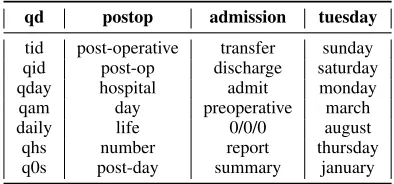
[image:2.612.326.523.367.459.2]Our three-layer neural network model is shown in Figure 1. It makes use of vector representa-tion of words. Mikolov et al. (2013) proposed a computationally efficient method for learning distributed word representation such that words with similar meanings will map to similar vec-tors. We use the same approach for learning word vectors using word2vec (https://code. google.com/p/word2vec/). Table 1 shows nearest neighbors for four sample words that are commonly used as temporal expressions. We then create alookup tableLT ∈ R|C|×d to store ad -dimensional representation of every word in vo-cabularyC.
Figure 1: Our Neural network-based architecture
A neural network is trained with a word as a data unit. First, the size of a context window
ws is chosen. The word along with its context words forms a n-gram sequence S represented as {Wi−1, Wi, Wi+1} in the network. Every word
Wiis mapped to its corresponding word vectorVi using lookup tableLT. Word vectorsVi’s are
pro-jected onto the input layer. In order to preserve word order, projection concatenates the word vec-tors into single vector X ∈ R|ws∗d| which are
passed to non-linearhardtanhlayer.
After applying the hardtanh transformation,
we get theHas the output of the hidden layer
H=hardtanh(W1TX+b1) (1)
We then transform the output of the hidden layer using asoftmaxlayer.
O =W2TH+b2 (2)
The output layerO∈Rthas the dimensionality of number of tags t. Errors on cost are back
propa-gated into the network using back-propagation al-gorithm (Russell and Norvig, 1967) to generate probability distribution over output tagsti1, ti2.
qd postop admission tuesday tid post-operative transfer sunday qid post-op discharge saturday
qday hospital admit monday
qam day preoperative march
daily life 0/0/0 august
qhs number report thursday
q0s post-day summary january Table 1: Nearest neighbors for sample temporal expressions
3 Experimental Setup
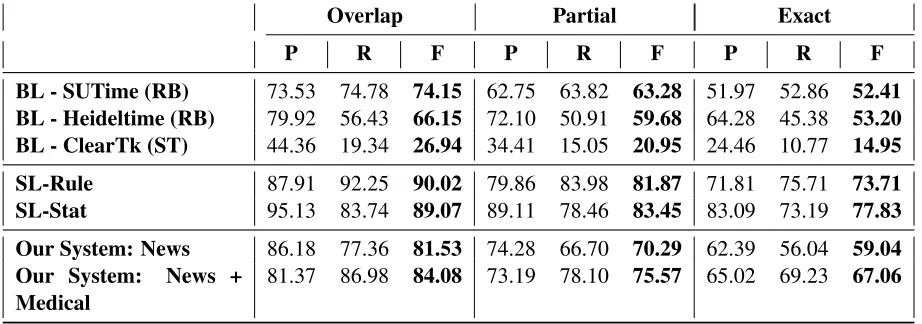
We evaluate our systems in three settings: (1) Overlap, where overlapping spans are consid-ered as match, (2) Exact, where precise matches are counted, and (3) Partial, where full credit is awarded for exact match, and half credit for over-lapping match. All the systems (baseline, skyline and our system) are tested on a publicly avail-able dataset from the i2b2 2012 Temporal Rela-tion Challenge (Sun et al., 2013). This is a bench-mark dataset, and consists of 120 discharge sum-maries from Partners Healthcare and Beth Israel Deaconess Medical Center.
Type Sentences Tokens Vocabulary Medical 20,125 481,601 12,142
News 24.445 717,698 30,527
Table 2: Statistics of the datasets
[image:2.612.83.295.526.693.2]Overlap Partial Exact
P R F P R F P R F
BL - SUTime (RB) 73.53 74.78 74.15 62.75 63.82 63.28 51.97 52.86 52.41 BL - Heideltime (RB) 79.92 56.43 66.15 72.10 50.91 59.68 64.28 45.38 53.20 BL - ClearTk (ST) 44.36 19.34 26.94 34.41 15.05 20.95 24.46 10.77 14.95 SL-Rule 87.91 92.25 90.02 79.86 83.98 81.87 71.81 75.71 73.71 SL-Stat 95.13 83.74 89.07 89.11 78.46 83.45 83.09 73.19 77.83 Our System: News 86.18 77.36 81.53 74.28 66.70 70.29 62.39 56.04 59.04 Our System: News +
[image:3.612.79.540.40.202.2]Medical 81.37 86.98 84.08 73.19 78.10 75.57 65.02 69.23 67.06 Table 3: Comparison of our system with baseline (BL-*) and skyline (SL-*) systems
3.1 Datasets
The datasets used for training word vectors were created as follows. The statistics are shown in Ta-ble 2.
1. In-domain dataset: Medical discharge sum-maries are collected from i2b2. The docu-ments are pre-processed by removing markup tags and irrelevant information in the form of document numbers and codes.
2. Out-of-domain dataset: Out-of-domain word vectors are learned from Timebank, AQUAINT (Pustejovsky et al., 2003), and TE-3 silver dataset (UzZaman et al., 2012)
3.2 Baseline: Open-domain TER
Rule-based temporal taggers like Heideltime (Str¨otgen and Gertz, 2010) and SUTime (Chang and Manning, 2012) and Statistical tagger like ClearTk2 were developed as a part of TempEval-2,3 challenges for news text. They are our baselines: SUTime, Heideltime, and BL-ClearTk.
3.3 Skyline: Medical TER
State-of-art rule-based (Sohn et al., 2013) and a statistical (Roberts et al., 2013) medical domain TER systems are chosen as skylines. These system (indicated by SL-Rule and SL-Stat respectively) were developed as a part of i2b2 2012 challenge, and trained on medical data. We call them as sky-line because the availability of medical data itself is the best situation for medical TER.
2https://code.google.com/p/cleartk/
wiki/ClearTKTimeML
4 Results
We now compare our results of our system with the existing systems, and then describe how pro-portion of in-domain data impacts the perfor-mance. Finally, we discuss a detailed error anal-ysis.
4.1 Comparative performance against baseline and skyline
Table 3 compares the performance of the base-line (BL-*) (first three rows) and skyline (SL-*) approaches (next two rows) with our system, for overlap, partial and exact matches. For our sys-tem, we experiment with two settings: (1) Word vectors trained on out-of-domain dataset (indi-cated byOur System: News), and (2) Word vec-tors trained on both datasets (indicated by Our System: News + Medical). In case of overlap match, the best performance of baseline systems is 74.15% in case of BL-SUTime. When neural net-work architecture is usedeven in absence of any in-domain data, the F-score increases to 81.53%. This value rises to 84.08% when a combination of medical and news domain is used.
News dataset had a vocabulary size of 300K3.
[image:4.612.81.298.326.463.2]4.2 Impact of proportion of in-domain data Availability of in-domain data is restricted for medical documents as compared to news text. To find how our system peforms if a combination of in-domain and out-of-domain data is to be used, we conduct experiments by incrementally adding in-domain data to learn word vectors. Figure 2 plots the F-score against the percentage of total in-domain data used during training. 10 on the X-axis indicates that 10% of the total available med-ical domain data (along with the complete news data) was used during training. For all three kinds of matches, the F-score stabilizes beyond 40% (which is 5K sentences). There is a dip in per-formance for all three matches when 10% medical data is used. This may be due to dilution of word vectors, since only a small portion of a new do-main has been added to the training set.
Figure 2: Performance of our system on addition of in-domain data
4.3 Error Analysis
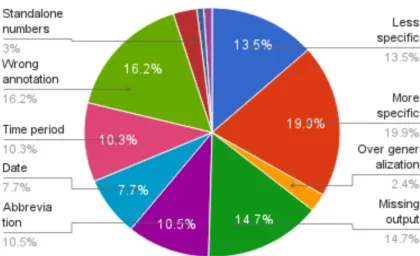
We manually labeled 468 erroneous instances into one out of 11 broad categories. The distribution of these errors is shown in Figure 3.
Figure 3: Distribution of errors made by our system 3https://code.google.com/p/word2vec/
‘More specific’ errors form 19.9% of total er-rors. This means that our system could extract temporal expressions that were more specific than the annotations. For example, our system tags ‘one day prior to admission’ when only ‘one day’ was expected. 16.2% of our errors arise due to wrong annotations. ‘More specific’ output is ac-ceptable. ‘Wrong annotations’ are the ones where a second manual check revealed that the labels were disputable. Thus, 36% errors do not di-rectly point to deficiencies in the system.
‘Less specific’ errors (13.5%) are when our system leaves out a part of the temporal expres-sion. 10.3% of errors are related to time periods and frequency-related words like ‘daily’. Over-generalization errors are said to occur when an ex-tracted time expression contains some non-time-related words. Medical domain text is fraught with abbreviations (such as q.i.d.) leading to 10.5% er-rors, and peculiar date formats (for example, 12-20 as a date indicates 12-20th December) leading to 7.7% errors. ‘Special’ words are related to seasons and events like Halloween. Standalone numbers indicate situations like the ‘2’ in ‘see you at 2’. The ‘Others’ category includes errors due to gar-bled characters, relative days (‘tomorrow’), ordi-nal numbers and WSD errors (two senses of ‘may‘ can be derived out of ‘this may’, in absence of cap-italized ‘M‘)
5 Conclusion & Future Work
We presented a simple yet effective three-layer neural network based TER system for medical do-main. Our system used out-of-domain news text to extract temporal expressions from medical doc-uments. Our system, without any in-domain data at all, improves the F-score by 7% over three base-line systems, and to a greater degree when in-domain data is used. With a dataset of 5K medical domain sentences, we obtain a good performance . Our error analysis showed that the top three kinds of errors are: ‘More specific output’, ‘Wrong an-notations’ and ‘Missing output’. We, thus, show that our TER system can act as a middle ground between an open-domain and a domain-specific TER, in situations where in-domain data is diffi-cult to obtain. A possible future work is to model TER as a sequence labeling task while still using a neural network based system.
[image:4.612.84.294.582.710.2]References
Sisay Fissaha Adafre and Maarten de Rijke. 2005. Feature engineering and post-processing for tempo-ral expression recognition using conditional random fields. InProceedings of the ACL Workshop on Fea-ture Engineering for Machine Learning in Natural Language Processing, pages 9–16. Association for Computational Linguistics.
Steven Bethard, Leon Derczynski, James Pustejovsky, and Marc Verhagen. 2015. Semeval-2015 task 6: Clinical tempeval. In Proceedings of the 9th In-ternational Workshop on Semantic Evaluation (Se-mEval 2015). Association for Computational Lin-guistics.
Steven Bethard. 2013. Cleartk-timeml: A minimalist approach to tempeval 2013. InSecond Joint Con-ference on Lexical and Computational Semantics (* SEM), volume 2, pages 10–14.
Daniel M. Bikel, Richard Schwartz, and Ralph M. Weischedel. 1999. An algorithm that learns whats in a name.Mach. Learn., 34(1-3):211–231, feb.
Angel X Chang and Christopher D Manning. 2012. Sutime: A library for recognizing and normalizing time expressions. InLREC, pages 3735–3740.
Prateek Jindal and Dan Roth. 2013. Extraction of events and temporal expressions from clinical nar-ratives. Journal of biomedical informatics, 46:S13– S19.
Yu-Kai Lin, Hsinchun Chen, and Randall A Brown. 2013. Medtime: A temporal information extraction system for clinical narratives.Journal of biomedical informatics, 46:S20–S28.
Tomas Mikolov, Kai Chen, Greg Corrado, and Jeffrey Dean. 2013. Efficient estimation of word represen-tations in vector space.CoRR, abs/1301.3781.
James Pustejovsky, Patrick Hanks, Roser Sauri, An-drew See, Robert Gaizauskas, Andrea Setzer, Dragomir Radev, Beth Sundheim, David Day, Lisa Ferro, et al. 2003. The timebank corpus. InCorpus linguistics, volume 2003, page 40.
Kirk Roberts, Bryan Rink, and Sanda M Harabagiu. 2013. A flexible framework for recognizing events, temporal expressions, and temporal relations in clin-ical text. Journal of the American Medical Informat-ics Association, 20(5):867–875.
S Russell and P Norvig. 1967. The most popu-lar method for learning in multilayer networks is called back-propagation. Artif. Intel. Mod. Ap-proach, pages 201–218.
Sunghwan Sohn, Kavishwar B Wagholikar, Dingcheng Li, Siddhartha R Jonnalagadda, Cui Tao, Raviku-mar Komandur Elayavilli, and Hongfang Liu. 2013. Comprehensive temporal information detec-tion from clinical text: medical events, time, and
tlink identification. Journal of the American Med-ical Informatics Association, 20(5):836–842.
Jannik Str¨otgen and Michael Gertz. 2010. Heideltime: High quality rule-based extraction and normaliza-tion of temporal expressions. InProceedings of the 5th International Workshop on Semantic Evaluation, pages 321–324. Association for Computational Lin-guistics.
Weiyi Sun, Anna Rumshisky, and Ozlem Uzuner. 2013. Evaluating temporal relations in clinical text: 2012 i2b2 challenge.Journal of the American Med-ical Informatics Association, 20(5):806–813.
Hegler Tissot, Cel Franc H dos Santos, Genevieve Gor-rell, Angus Roberts, Leon Derczynski, and Mar-cos Didonet Del Fabro. 2015. Ufprsheffield: Con-trasting rule-based and support vector machine ap-proaches to time expression identification in clinical tempeval.
Naushad UzZaman and James F Allen. 2010. Trips and trios system for tempeval-2: Extracting tempo-ral information from text. In Proceedings of the 5th International Workshop on Semantic Evaluation, pages 276–283. Association for Computational Lin-guistics.
Naushad UzZaman, Hector Llorens, James Allen, Leon Derczynski, Marc Verhagen, and James Pustejovsky. 2012. Tempeval-3: Evaluating events, time ex-pressions, and temporal relations. arXiv preprint arXiv:1206.5333.
Wikipedia. 2014. Temporal expressions — wikipedia, the free encyclopedia. [Online; accessed 12-June-2015].
Yan Xu, Yining Wang, Tianren Liu, Junichi Tsujii, I Eric, and Chao Chang. 2013. An end-to-end sys-tem to identify sys-temporal relation in discharge sum-maries: 2012 i2b2 challenge. Journal of the Amer-ican Medical Informatics Association, 20(5):849– 858.