Well-Nested Tree Languages and Attributed Tree Transducers
Uwe M¨onnich
Theoretische Computerlinguistik Universit¨at T¨ubingen
Wilhelmstr. 19 72074 T¨ubingen
Abstract
Well-nested word languages have been adver-tised as adequate formalizations of the notion of mild context-sensitivity. The main result of this paper is a characterization of well-nested tree languages in terms of simple attributed tree transducers.
1 Introduction
The intuitive notion of mild context-sensitivity has led to two competing candidates claiming to be an exact formal rendering of the intentions Joshi (1985) was trying to capture when introducing this con-cept. On the one hand multiple context-free gram-mars and their equivalents exhibiting a variety of wildly different specifications provide impressive evidence that this precise counterpart of the infor-mal description of mild context-sensitivity consti-tutes a natural class. On the other hand the well-nested subclass of the multiple context-free gram-mars has recently been advertised as a formalization more in accordance with Joshi’s original intentions ((Kanazawa, 2009), (Kuhlmann, 2007)). Both can-didates have counterparts in the realm of tree lan-guages and it is in this context that they are eas-ily recognized as mathematically precise charac-terizations of two leading linguistic models, min-imalist syntax and tree adjoining grammars (cf. (Harkema, 2001), (Michaelis, 2001), (Kepser and Rogers, 2007), (M¨onnich, 1997), (M¨onnich, 2007)). The tree languages in question are the multi-ple regular tree languages ((Raoult, 1997)) and the simple context-free tree languages ((Engelfriet
and Maneth, 2000)). Both language families are proper subfamilies of the tree languages generated by context-free hyperedge-replacement graph gram-mars and the latter family is identical with the output languages of logical tree-to-tree transductions ap-plied to regular tree languages. The obvious ques-tion that poses itself is whether the two restricted rule formats or their corresponding tree transducers, finite-copying top-down tree transducers and simple macro tree transducers (M T T), respectively, can be given an equivalent logical characterization in terms of restrictions on the logical formulae defin-ing the relations in the target structures of logical transductions. This is indeed the case. From re-sults presented in (Bloem and Engelfriet, 2000) and in (Engelfriet and Maneth, 1999) it follows that the tree languages which are the output of finite-copying top-down tree transducers applied to regular tree lan-guages are exactly the output tree lanlan-guages of logi-cal tree transducers which are direction preserving in the sense that edges in the output trees corre-spond to directed paths in the input trees. As a pre-liminary step towards an analogous result for lan-guages generated by simple context-free tree gram-mars (CF Tsp) we’ll show in this paper that they are equivalent to the output languages of a highly re-stricted form of attributed tree transducers(AT T). As emphasized by (Bloem and Engelfriet, 2000), attribute grammars are to be regarded as a specifi-cation language and, as such, they are much closer to logical specifications than context-free tree gram-mars.
(Fischer, 1968) as the output string languages of attribute grammars with one synthesized attribute only. In a nutshell, we lift their result to the tree level and restrict it to the case of well-nested tree lan-guages, which are immune to differences of deriva-tion mode ((Kepser and M¨onnich, 2006)) and, a for-tiori, are inside-out. In their paper mentioned above Engelfriet and Maneth (2000) point out that well-nested tree grammars can be regarded as a notational variant of simpleM T T s. Our result could
accord-ingly be interpreted as showing the equivalence be-tween simple AT T s and simple M T T s. We be-lieve that our construction that avoids the detour via
M T T s has the advantage of establishing a direct link between a procedural and a declarative formal-ization of well-nestedness.
After these introductory remarks we will recall some basic concepts from the theory of tree lan-guages and the theory of attributed tree transduc-ers. The following section is an attempt at reviewing briefly the notion of mild context-sensitivity from the perspective of context-free graph languages. We will then proceed to prove the equivalence ofCF Tsp and simple AT T s with one attribute only (1S − AT Tss,si). We shall close with some remarks re-garding the problems to be solved for a logical char-acterization ofCF Tsp.
2 Preliminaries
For any set A, A∗ is the set of all strings over A. ε is the empty string, |w|is the length of a string
w. N denotes the set{0,1,2,3, . . .}of nonnegative integers.
LetSbe a finite set ofsorts. AnS-signature is a setΣgiven with two mappings ar : Σ → S∗ (the
aritymapping) andso: Σ→ S (thesortmapping). The length ofar(σ)is called therankofσ, and is denoted by rank(σ). The typeofσ (σ ∈ Σ) is the pair har(σ), so(σ)i. The elements of Σε,s are also called constants (of sorts).
In case S is a singleton set {s}, i.e. in case Σ is asingle-sorted or ranked alphabet (over sort s), we usually writeΣ(n) to denote the (unique) set of operators of rankn ∈ N; we also writeσ(n) to in-dicate thatrank(σ) = n. In this case, which is of particular interest to us, the set of trees TΣ is de-fined recursively as follows. Each constant of Σ,
i.e., each symbol of rank 0, is a tree. If σ is of rank k and t1, . . . , tk are trees, then σ(t1, . . . , tk) is a tree. A tree language L ⊆ TΣ over Σ is a subset of TΣ. With each tree t ∈ TΣ we can as-sociate a string s ∈ Σ∗0 by reading the leaves of t from left to right. This string is called the yield oft, denoted byyd(t). More formally, yd(t) = t if t ∈ Σ0, and yd(t) = yd(t1)· · ·yd(tk) when-ever t = σ(t1, . . . , tk) with k ≥ 1. The yield of tree language L is defined straightforwardly as yd(L) ={yd(t)|t∈L}.
If A is a set (of symbols) disjoint from Σ, then TΣ(A) (alternatively T(Σ, A)) denotes the set of trees TΣ∪A where all elements of A are taken as constants. Let X = {x1, x2, x3, . . .} be a fixed denumerable set ofinput variables andY =
{y1, y2, y3, . . .} be a fixed denumerable set of pa-rameters. LetX0 =Y0 =∅and, fork ≥ 1, Xk =
{x1, . . . , xk} ⊂ X, andYk = {y1, . . . , yk} ⊂ Y. For k ≥ 0, m ≥ 0, t ∈ TΣ(Xk), andt1, . . . , tk ∈ TΣ(Xm), we denote by t[t1, . . . , tk] the result of substitutingtiforxiint. Note thatt[t1, . . . , tk]is in TΣ(Xm). Note also that fork= 0,t[t1, . . . , tk] =t.
Definition 1 Acontext-free tree(CF T) grammar is a tupleG= (F,Ω, S, P)whereFandΩare ranked alphabets of non-terminals and terminals, respec-tively,S ∈ F(0)is the start symbol andP is a finite set of productions of the form
F(y1, . . . , ym)→ξ
whereF ∈ F andξis a tree overF,ΩandYm. If for every F ∈ F(m) eachy ∈ Ym occurs ex-actly once on the right-hand side of the correspond-ing rule then the context-free tree grammar is called simple in the parameters (sp). The family of tree languages which is generated by context-free tree grammars which are simple in their parameters is designated asCF Tsp.
A grammar G = F,Ω, S, P) is called aregular tree (REGT)grammar if F = F(0), i.e., if all non-terminals are of rank0.
mother. Consequently, arbitrary tree walks can be realized by attributed tree transducers.
Definition 2 Anattributed tree transducer(AT T) is a tuple
A= (Syn, Inh,Σ,Ω, αm, R),
where Syn andInhare disjoint alphabets of syn-thesizedandinheritedattributes, respectively,Σand Ωare ranked alphabets ofinputandoutputsymbols, respectively,αmis a synthesized attribute, andRis a finite set of rules of the following form: For every σ ∈Σ(m), for every(γ, ρ) ∈insσ (the set of inside attributes ofσ), there is exactly one rule inRσ:
(γ, ρ)→ξ
where ξ ∈ TΩ∪outσ andoutσ is the set of outside
attributes ofσ.
Definition 3 For everyσ ∈ Σ(m), the set ofinside attributes is the set insσ = {(α, π)|α ∈ Syn} ∪
{(β, πi)|β ∈ Inh, i ≤ m} and the set of outside attributes is the set outσ = {(β, π)|β ∈ Inh} ∪
{(α, πi)|α ∈ Syn, i ≤m}. πandρare path vari-ables ranging over node occurrences in the input tree.
AT T s with rules Rσ at an input symbol σ in which each outside attribute occurs exactly once are called simple attributed tree transducers. We de-note this class by AT Tss,si on the model of macro tree transducers that are simple, i.e., linear and non-deleting, both in their input variables and in their parameters(M T Tsi,sp).
The dependencies between attribute occurrences in an input tree scan be represented with the help ofRσ. An instance of an attribute occurrence(α, π) depends on another occurrence (α′, π′) if σ labels nodeuins, Rσ contains the rule(α′, π′) → ξ and (α, π)labels one of the leaves inξ.
Thedependency graphD(s)of an input trees∈ TΣ consists of the set of attribute occurrences to-gether with the dependencies according to the rules inR. Reversing the direction of these dependencies leads to the notion of asemantic graph S(s) of an input trees∈TΣ.
An attributed tree transducer isnoncircularif the paths of attribute dependencies are noncircular. It is
well known that noncircularAT Ts have unique dec-orations dec, functions which assign each attribute occurrence a tree overΩ∪outσ in accordance with the productionsRσ.
Definition 4 Thetransductionrealized by a noncir-cular attributed tree transducer A is the function
τA={(s, t)|s∈Tσ, t∈TΩ, t=decs(αm, ǫ)}
Remark 1 AT Ts which have synthesized attributes only are very close to top-down tree tranducers. Their rules
(γ, ρ)→ξinRσ
correspond to tree transducer rules
α(σ(x1, . . . , xm))→ξ′
whereσ ∈Σ(m)andξ′is obtained fromξby substi-tuting every(α, πi)byα(xi).
3 Mild Context-Sensitivity
Even though the list of characteristic properties Joshi (1985) has suggested as characteristic features of a linguistically adequate extension of context-freeness can hardly be considered as a formally ex-plicit definition it has become accepted as an in-formal description of a precise counterpart that has turned out to be remarkably stable with respect to a variety of wildly different specifications. This stability provides impressive evidence that the pre-cise counterpart of the informal description of mild context-sensitivity constitutes a natural class. Over the last couple of years the formal characterizations assembled in Tabel 1, which all satisfy the crite-ria for membership in the class of mildly context-sensitive languages, have turned out to be weakly equivalent.
M CF L =languages generated by multiple context-free grammars
M CT AL =languages generated by multi-component tree adjoining grammars LCF RL =languages generated by linear context-free rewriting systems
LU SCL =languages generated by local unordered scattered context grammars
ST R(HR) =languages generated by string generating hyperedge replacement grammars
OU T(DT W T) =output languages of deterministic tree-walking tree-to-string transducers
ydDTf c(REGT) =yields of images of regular tree languages
under deterministic finite-copying top-down tree transduction
[image:4.595.328.493.232.316.2]P GRP T =languages defined by pregroups with tupling
Table 1: Classes of mildly context-sensitive word languages
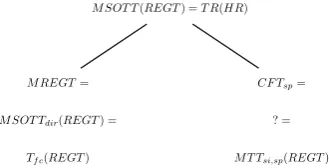
the most prominent member of the first mathe-matically precise rendering of the notion of mild sensitivity. Well-nested multiple context-free string grammars satisfy the additional condi-tion of a matching-like or well-nested rearrangement of the arguments of non-terminals on the right-hand sides of possible rules allowed by this type of gram-mar. Furthermore, it is obvious that well-nested multiple context-free languages are included in the multiple context-free languages in general. Besides this formal characterization in terms of well-nested multiple context-free languages, a number of further precise representatives of this second version of mild context-sensitivity have been found. This group as-sembled in Table 2 may not be as impressive as the long list of equivalent formalizations that was listed in connection with the first proposal for a formal ren-dering of mild context-sensitivity. Still, the equiv-alence of such wildly different systems as abstract categorial grammars and (subclasses of) macro tree transducers cannot be a pure coincidence, but has to be accepted as a sign of an underlying conceptual coherence.
The Table 2 contains besides examples of well-nestedness on the level of word languages two spec-imens of well-nested tree languages. Needless to say, the derived tree structures are well-nested in both alternatives suggested as formal renderings of mild-context-sensitivity. The well-nestedness con-dition concerns exclusively the rule format. In sharp contrast with the situation on the word level the multiple regular tree languages and the sim-ple context-free languages mentioned in the intro-duction as candidate formalizations of minimalist syntax and tree adjoining grammars, respectively, are proper subfamilies of the tree languages
gen-M SOT T(REGT) =T R(HR)
M REGT=
M SOT Tdir(REGT) =
Tf c(REGT)
CF Tsp=
? =
M T Tsi,sp(REGT)
Figure 1: Classes of mildly context-sensitive tree lan-guages
erated by context-free hyperedge-replacement graph grammars(T R(HR))and the latter family is iden-tical with the output languages of logical tree-to-tree transductions applied to regular tree lan-guages(M SOT T(REGT)). Both mildly context-sensitive subfamilies of tree languages can be given descriptions in terms of grammatical systems and syntax-directed tree transducers. To repeat their formal characterizations, the multiple regular tree languages are exactly the output tree languages of finite-copying top-down tree transducers (Tf c) which, in turn, are the same as the output tree lan-guages of direction preserving logical transductions (M SOT Tdir). The simple context-free tree guages, analogously, are exactly the output tree lan-guages of simple macro tree transducers which, in turn, are the same as the output tree languages of simple attributed tree transducers with one synthe-sized attribute only, as shown in this paper. Their logical characterization is still open. Figure 1 sum-marizes the overview of the previous discussion con-cerning the inclusion relation among mildly context-sensitive tree languages.
investi-M CF Lwn = well-nested multiple context-free languages
M ACsp = simple macro languages
ydCF Tsp = yields of context-free tree languages
ydM T Tsi,sp(REGT) = yields of output languages of tree transductions realized
by simple macro tree transducers taking regular tree languages as input
CF Tsp = simple context-free tree languages
ACG(2,3) = abstract categorial languages with abstract vocabulary
of order at most 2 and lexical images of atomic types of order at most 3
Table 2: Classes of well-nested mildly context-sensitive word and tree languages
gation of their formal properties is of obvious inter-est for the evaluation of the corresponding linguistic frameworks. Should it turn out that ill-nested struc-tures are needed for an adequate representation of structures exemplified in natural syntax the theory of ”mildly context-sensitive” graph languages might still be the framework of choice as long as these structures are more tree- than graph-like.
Trees can be uniquely characterised by specifying their hierarchical structure, they can be enumerated by means of a production system and they can be fed into an abstract automaton. For graphs no suitable notion of finite automaton has been proposed. Sim-ilarly, Graph grammars, on the other hand, do not generate their output in a way that is patterned by an independently given hierarchical structure which would be intrinsic to this data type.
In spite of this difference of the two data struc-tures, the fact that certain linguistic phenomena are graphs does not as such preclude the possibility of an approach which sees them as the result of a logi-cally defined tree transduction. Bauderon and Cour-celle (1987) present an approach to graphs by defin-ing a (generally infinite) set of graph operations such that every finite graph can be constructed by finitely many applications of these graph operations. For the particular licensing theory, head-driven phrase struc-ture grammar (HP SG), we have shown ((Kepser and M¨onnich, 2003)) that the classes of finite graphs defined by a finite HP SGsignature and grammar are indeed such that they cannot be generated by a finite set of graph operations. But this purely meta-theoretic limitation ofHP SGin general is not sup-ported by the amount of tree-likeness retained in concrete analysis structures proposed for grammati-cal phenomena in languages like Serbo-Croatian. It is thus not excluded that the general approach in
terms of syntax-directed morphisms by means of tree-to-tree or tree-to-(tree-like) graph transducers can also be applied to a conceptual framework in which ill-nested derived structures enjoy full citizen-ship.
4 Main Result
In this section we will present our main result. The proof requires two constructions that reduce sim-ple context-free tree grammars (CF Gsp) to simple attributed tree transducers with one synthesized at-tribute only (1S−AT Tss,si) and vice versa.
4.1 FromCF Tspto1S−AT Tss,si
Before showing that for every CF GspG an 1S −
AT Tss,siAGcan be constructed with the same out-put language we first regularizeGby translating its rules into terms over a new signature that is obtained from the original one by a so-called lifting process (cf. (Maibaum, 1974)). It would have been possible to reduce a given CF Gsp directly into an equiva-lent1S−AT Tss,si. We have opted for the indirect approach, because the lifting technique is closely re-lated to a decomposition result forM T T sto the
ef-fect that the transformation performed by this family of tree transducers can be split into a symbolic re-placement and a second-order substitution (cf. (En-gelfriet and Vogler, 1985)). We shall see in the last section that the recourse to context attributes in coping with the second-order substitution cannot be avoided, destroying the prospect of a characteriza-tion of well-nestedness by means of straightforward tree homomorphisms.
Figure 2: Derivation ofaabccd.
Σ′ε,n = {f′|f ∈ Σn} is a new set of symbols of typehε, ni; for eachn ≥1and eachi,1 ≤i ≤n, πn
i is a new symbol, theithprojection symbolof type
hε, ni; for eachn, k≥0the new symbolc(n,k)is the (n, k)thcomposition symbolof typehnk1· · ·kn, ki withk1=. . .=kn=k.
Fork≥ 0,LIF TkΣ : T(Σ, Xk) → T(Σ′, k)is defined as follows:
LIF TkΣ(xi) = πki
LIF TkΣ(f) = c0,k(f′)f or f ∈Σ0
LIFTΣ
k(f(t1, . . . , tn)) =
cn,k(f′, LIF TkΣ(t1), . . . , LIF TkΣ(tn))f or f ∈ Σn, n≥1
By way of example, we consider the effect of the lifting transformation on aCF Tsp G that gen-erates the language L(G) = {anbmcndm}, where we have omitted the concatenation symbols. The grammar consists of the terminal alphabet Ω =
{ε(0), a(0), b(0), c(0), d(0),•(2)}, the non-terminal al-phabetF ={S(0), F(4)}and the following groupP of rules:
S → ε
S → F(a, ε, c, ε)
S → F(ε, b, ε, d)
F(x1, x2, x3, x4) → F(•(a, x1), x2,•(c, x3), x4))
F(x1, x2, x3, x4) → F(x1,•(b, x2), x3,•(d, x4))
[image:6.595.314.527.379.461.2]F(x1, x2, x3, x4) → •(•(•(x1, x2), x3), x4)
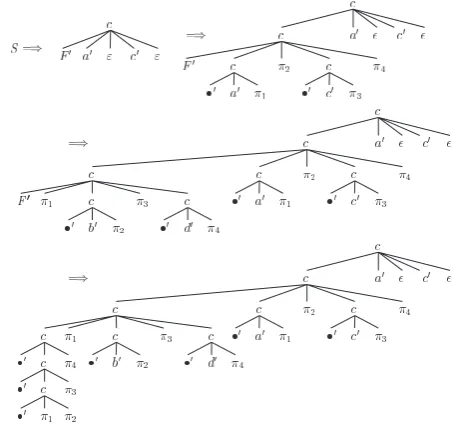
Figure 2 illustrates a derivation of the string aabccdwith explicit concatenation.
Figure 3: Dervation of liftedaabccd.
The process of applying the lifting transformation to the grammarGgiven above returns a regular tree grammarG′with the following group of rulesP′:
S′ → ε
S′ → c(F′, a′, ε, c′, ε)
S′ → c(F′, ε, b′, ε, d′)
F′ → c(F′, c(•′, a′, π4
1), π24, c(•′, c′, π34), π44)
F′ → c(F′, π14, c(•′, b′, π4
2), π43, c(•′, d′, π44))
F′ → c(•′, c(•′, c(•′, π41, π24), π43), π44)
We parallel the derivation of the example string aabccd with the corresponding derivation in the lifted grammarG′ in Figure 3.
The terminal tree in Fig 3 over the lifted signature is yet to be translated into the structures generated by theCF TspG. These latter structures are coded into the lifted trees and are easily retrieved by unraveling the information contained in the projection and com-position symbols. Algebraically speaking, the step from the lifted to the intended structures is nothing but the value of the unique homomorphism from the free term algebra into the substitution algebra over the lifted signature. This homomorphism is simu-lated by the attributed tree transducer which consti-tutes the core of the proof of the crucial lemma.
[image:6.595.57.287.584.684.2]Proof For a givenCF Gsp G = (F,Ω, S, P) an 1S−AT Tss,si = (Syn, Inh,Σ,Ω, αm, R)AGthat outputs the same language is defined from the com-ponents ofGslifted version in the following way.
• Syn={α}withα=αmat the root node
• Inh= {βj|1 ≤ j ≤ m}withmthe maximal sort of a lifted non-terminalF′
• Every symbol in the derivation trees is assigned one synthesized attribute.
• Every projection symbol is assigned one inher-ited attribute
• Every lifted terminal symbolf′ of sortnis as-signedninherited attributes.
• The function assinh assigning inherited sym-bols to composition symsym-bols c is defined by structural induction on the trees on the rhs of P′:
assinh(t) =proj(assinh(t1)
where t = c(t1, . . . , tn) and where proj deletes all inherited attributes oft1that have no counterparts inassinh(ti) (2≤i).
• EachRπn
i contains the rule
απ→βiπ
• EachRf′ contains the rule
απ→f(β1, . . . , βn)
wherenis the sort off′.
• EachRccontains the rules
απ → απ1
βiπ1 → απi+ 1
βiπj → βiπ
provided that the inherited attributes belong to the outside attributes of the composition sym-bolc.
The correctness of the construction follows from an easy rule induction.
Remark 2 In the proof of Lemma 1 we have slightly departed from the official definition of an ATT by assigning inherited attributes to composition sym-bols in a context-dependent way. This could be repaired by labeling composition symbols with the non-terminals on the lhs of P.
By way of example, consider the slightly sim-plified lifted tree in Figure 4 which is decorated with both the synthesized and inherited attributes and their values. Evaluating the meaning attribute αm by traveling along the semantic graph results in the output tree•(•(•(•(a, a), ε),•(c, c)), ε).
4.2 From1S−AT Tss,si toCF Gsp
It was mentioned above that attributed tree trans-ducers are attribute grammars with all their attribute values restricted to trees and their semantic func-tions to substitution of trees for dependent leaves. Second–order substitution for internal nodes of trees is achieved through the upward information trans-port that is made possible by the inherited attributes. Integrating this information transfer with the leaf substitution leads to the kind of substitution or ad-junction, for that matter, characteristic of context-free grammars.
Lemma 2 For every1S −AT Tss,siA, there exists an equivalentCF GspGA.
Proof Let A = (Syn, Inh,Σ,Ω, αm, R) be an attributed tree transducer with one synthesized at-tribute only such that each outside atat-tribute at an in-put symbolσoccurs exactly once inRσ. An equiva-lent simple context-free tree grammarGAis defined as follows:
• F = Σ where the arity of non-terminals is given by the number of interited attributes as-signed to them in the input tree.
• Ω = Ω
• S ={σ(0)}withσ ∈Σlabeling the root of an input tree.
• For everyσ∈Σwe construct a rule
σ(x1, . . . , xn)→t
c(0)αm(α1)
β(α2)c(1)α(α11)
β(α12)c(11)α(α111)
. . .β(β11)•!•!!•!!!(111)α(•!(•!!(•!!!(β111), . . .)))
β(β1)c(12)α(α121)
β!(α123)•!(121)α(•!(β121,β!121)) a!(122) β(β12)π1(123)α(β123)
π2(13) c(14) π4(15)
a!(2)α(a!) ε(3) c!(4) ε(5)
Figure 4: Evaluation of lifted sample tree
The right-hand sides of rules inRσ are desig-nated byrhs(γπ, σ)in the following:
(i) Ifξ =απithen
COM P(ξ) =ρ(t1, . . . , tm)
whereρ labels the ith daughter ofσ, m is the arity ofρand
tj =COM P(rhs(βjπi, σ))
(ii) Ifξ=βjπthen
COM P(ξ) =xi
(iii) Ifξ =f(ξ1, . . . , ξr)forf ∈Ω(r)
COM P(ξ) =f(COM P(ξ1), . . . , COM P(ξr))
By a routine inspection it is easy to verify that the resulting grammarGA is indeed simple and that it generates exactly the output language ofA.
Remark 3 The construction in the preceding lemma is inspired by the proofs of Lemma 6.1 in (Engelfriet and Maneth, 1999) and of Lemma 5.11 in (F¨ul¨op and Vogler, 1998). In these references it was shown how to turn an AT T into an equivalent M T T.
M T T scan be regarded as tree grammars in which the generation process is controlled by the input trees. In the present case these input structures as-sume the role of derivation trees. This leads to a cer-tain amount of proliferation in the rule component of the resulting grammar. It is not difficult to prove that this rule proliferation is of no consequence for the derived tree language, i.e., the derived structures.
By Lemmas 1 and 2 we obtain our main result.
Theorem 1 The well-nested tree languages are ex-actly the output languages of simple attributed tree transducers with one synthesized attribute only ap-plied to regular tree languages.
5 Envoi
Bloem and Engelfriet (2000) have shown that the output language of single use attributed tree trans-ducers applied to regular tree languages are equal to the translations definable by monadic second-order logic. By the result presented in this paper this could be extended to a logical description of simple context-free tree languages. The question, though, of how to give a logical characterization for this fam-ily of tree languages is still open. The same question regarding the special case of monadic context-free tree languages was answered in (M¨onnich, 2008). The main theorem of that talk states that the edge definitions of a logical characterization with respect to these languages are either direction preserving or direction reversing. This characterization depends crucially on the possibility of proving a Greibach normal form for monadic simple context-free gram-mars, a result that would require a completely differ-ent proof in the case of non-monadic alphabets.
defined asB ={(φ(t), ψ(t)|t ∈L}. It is interest-ing to note that the relations specified by tree trans-ducers are captured by bimorphisms in which ψis unrestricted and φ is a relabeling. Shieber (2004)
has shown that the relations defined by synchronous tree-substitution grammars correspond exactly to bi-morphism relations in which both homobi-morphisms are linear and non-deleting. An analogous result is not possible for simple context-free tree grammars. Take the familiar example of a simple context-free tree grammarGover a monadic alphabet that gen-erates the language L = {an(bn(e))}. According to a well-known theorem due to Rounds (1970) ev-ery monadic output tree language of a tree trans-ducer applied to a regular language is regular. Con-sequently, there is no hope of giving a characteri-zation of context-free tree languages without having recourse to context attributes enabling an upward in-formation transport in the controlling input tree.
References
Andr´e Arnold and Max Dauchet. 1982. Morphismes et bimorphismes d’arbres. Theoretical Computer Sci-ence, 20:33–93.
Michel Bauderon and Bruno Courcelle. 1987. Graph ex-pressions and graph rewritings. Mathematical Systems
Theory, 20:83–127.
Roderick Bloem and Joost Engelfriet. 2000. A Com-parison of Tree Transductions Defined by Monadic Second-Order Logic and by Attribute Grammars. J.
Comp. System Sci., 61:1–50.
J. Duske, R. Parchmann, M. Sedello, and J. Specht. 1977. Io-macrolanguages and attributed translations.
Infor-mation and Control, 35:87–105.
Joost Engelfriet and Sebastian Maneth. 1999. Macro Tree Transducers, Attribute Grammars, and MSO De-finable Tree Translations. Information and Computa-tion, 154:34–91.
Joost Engelfriet and Sebastian Maneth. 2000. Tree Lan-guages Generated by Context-Free Graph Grammars. In Hartmut Ehrig et al., editor,Graph Transformation,
number 1764 in LNCS, pages 15–29. Springer. Joost Engelfriet and Heiko Vogler. 1985. Macro tree
transducers. Journal of Computer and System
Sci-ences, 31(1):71–146.
Michael J. Fischer. 1968. Grammars with Macro-Like Productions. In Proc. 9th IEEE Symp. on Switching
and Automata Theory, pages 131–142.
Zolt´an F¨ul¨op and Heiko Vogler. 1998. Syntax-Directed Semantics - Formal Models Based on Tree Transduc-ers. Springer, New York and Berlin.
Hendrik Harkema. 2001. Parsing Minimalist
Lan-guages. Ph.D. thesis, University of California at Los
Angeles.
Aravind Joshi. 1985. Tree adjoining grammars: How much context-sensitivity is required to provide reason-able structural descriptions. In David Dowty, Lauri Karttunen, and Arnold Zwicky, editors,Natural
Lan-guage Parsing, pages 206–250. Cambridge University
Press.
M. Kanazawa. 2009. The convergence of well-nested mildly context-sensitive grammar formalisms. In14th
Conference on Formal Grammar. Slides available at
http://research.nii.jp/˜kanazawa/.
Stephan Kepser and Uwe M¨onnich. 2003. (Un- )Decid-ability results for head-driven phrase structure gram-mar. In Giuseppe Scollo and Anton Nijholt, editors,
Proceedings Algebraic Methods in Language
Process-ing (AMiLP-3), pages 141–152.
Stephan Kepser and Uwe M¨onnich. 2006. Closure prop-erties of linear context-free tree languages with an ap-plication to optimality theory. Theoretical Computer
Science, 354:82–97.
S. Kepser and J. Rogers. 2007. The equivalence of tree adjoining grammars and monadic linear context-free tree grammars. In M. Kracht, G. Penn, and E. Stabler, editors,Mathematics of Language 10.
M. Kuhlmann. 2007. Dependency Structures and and
Lexicalized Grammars. Ph.D. thesis, Saarland
Uni-versity.
Thomas S. E. Maibaum. 1974. A generalized approach to formal languages. Journal of Computer and System
Sciences, 8(3):409–439.
Jens Michaelis. 2001. On Formal Properties of
Mini-malist Grammar, volume 13 ofLinguistics in Potsdam.
Universit¨at Potsdam.
Uwe M¨onnich. 1997. Adjunction as substitution. In G-J. M. Kruijff, G. Morill, and R. Oehrle, editors,Formal
Grammar ’97, pages 169–178.
U. M¨onnich. 2007. Minimalist syntax, multiple regular tree grammars and direction preserving tree transduc-tions. In J. Rogers and S. Kepser, editors,Proceedings
Model Theoretic Syntax at 10.
Uwe M¨onnich. 2008. How to Church a Joshi. InTAG+9.
Maurice Nivat. 1968. Transductions des langages de chomyky. Th`ese d’´etat, Paris 1968.
Jean-Claude Raoult. 1997. Rational Tree Relations.
Bull. Belg. Math. Soc., 4:149–176.
William C. Rounds. 1970. Mappings and grammars on trees. Mathematical Systems Theory, 4(3):257–287.