Study of Diffusion Instability in Some Ternary Gas
Mixtures at Various Temperatures
Vladimir Kossov1, Dyussembek Kulzhanov2, Igor Poyarkov3, Olga Fedorenko1
1Institute of Experimental and Theoretical Physics, Al-Farabi Kazakh National University, Almaty, Kazakhstan 2Atyrau Institute of Oil and Gas, Atyrau, Kazakhstan
3National Research University Moscow Energy Institute, Moscow, Russia
Email: [email protected]
Received December 24, 2012; revised March 26, 2013; accepted April 17,2013
Copyright © 2013 Vladimir Kossov et al. This is an open access article distributed under the Creative Commons Attribution License, which permits unrestricted use, distribution, and reproduction in any medium, provided the original work is properly cited.
ABSTRACT
Within the linear theory of stability, the process of isothermal mixing of three-component gas mixtures in a channel of final dimensions in the absence of mass-transfer through its walls is considered. The comparison of experimental data with the results of theoretical calculations for the mixtures He+Ar-N2 and H2+N2-CH4 is shown, that a stable diffusion
process as the temperature increased will remain the same and be described by the ordinary diffusion laws, but unstable one lost its intensity and tend to the stable diffusion.
Keywords: Diffusion; Convection; Diffusion Instability; Linear Theory of Stability; Rayleigh Numbers
1. Introduction
The study of a diffusion process in multicomponent gas mixtures showed that mutual influence of components to each other under certain conditions lead to phenomena no taking place in ordinary binary diffusion. One of the most interesting peculiarities both in scientific and prac- tical application is diffusion instability [1]. Diffusion in- stability is characterized by strong convective flows, which considerably exceed purely molecular transfer sub- stantially distorting presumable results. Previous experi- ments showed that the process of diffusion instability depends on certain conditions and parameters, for exam- ple, pressure, concentration, temperature, viscosity, geo- metry of diffusion channel and etc. [2-6].
The determination of a transition boundary of mixture from the stable state to the unstable one and back is one of the main factors in the study of regime change of mixing. In the paper [1], the stability limits for the onset of convection in ternary gaseous mixture having a den- sity inversion are obtained with a stability theory based on Rayleigh’s treatment and the Stefan-Maxwell equa- tions [7]. However, the theory outlined in this paper is only approximate, and the agreement with experiment is far from perfect.
Experimental data reported in [2-6] in their physical meaning resemble the problem of instability which arises under conditions of thermal convection [8-10]. Applica-
tion of stability theory [11] allowed formulating an ap- proach to revealing common regularities in determining the transition from the diffusion regime to the gravita- tional concentration convection. This methodology was used to determine the stability limits of isothermal three- component gas mixtures in the case of a horizontal plane layer or in the form of an infinite plane vertical slot [12]. However, the geometry of the considered problem made it possible to achieve just qualitative agreement with the experiment as a cylindrical channel was used in [2-6]. Solving the stability problem of ternary gas mixtures in conditions maximally approximate to the experiment be- comes a question of fundamental importance.
The aim of this study is to examine the transition from the state of diffusion to the regime of concentration gra- vitational convection (diffusion instability) in a channel of finite size in the absence of mass-transfer through its wall. In addition, the obtained data are compared with the experiments presented in [2], where the transition from the state of diffusion to the regime of convection is stud- ied at different temperatures.
2. Mathematical Model of Diffusion
Instability
2.1. General System of Equations
namic equations, that includes the Navier-Stokes equa- tions, equations for conservation of the number of parti- cles in the mixture and the components. Taking into ac- count the conditions of independent diffusion, for which the 3 and are valid, the system of equa-
1 0
i i
j 31 1 i i c
tions takes the following form [11]:
2 div ,
3 div 0, div , , i i i
i ii i ij j
p t n n t c c t
D c D c
u u u u u g
ν
ν j
j
(1) where “practical” coefficients of three-component diffu- sion are defined in accordance with expressions:
13 1 32 2 3 12 11
1 23 12 13 12
23 2 13 1 3 12 22
2 13 12 23 21
1 23 2 13 3 12 ,
,
,
, ,
D c D c c D
D
D c D D D D
D
D c D c c D
D
D c D D D D
D D c D c D c D
where ij are the mutual diffusion coefficients indicat-
ing interference of two components.
D
The system of Equation (1) is supplemented with the environmental state equation
с с р1, 2,
,T cons t,
interrelating the thermodynamic parameters entering into the system of Equation (1).
The method of small perturbations [11] has been used by solution of the system of Equation (1). Taking into ac- count that at L » r (L, r are the length and radius of diffu- sion channel accordingly) the differences between per- turbations of the average and weight-average velo- cities in the Navier-Stokes equation will be inconsiderable, then the final system of equations of gravitational concen- tration convection for perturbation values in dimension- less quantities takes the form:
ν u
2 2 1 222 11 1 12 2
1
2 2
2 1
22 21 1 2
2 2
1 11 1 2 2
, , , div 0, c A P c t A c A P c t A
p R c R c
t u u u u u
where Pii Dii
is the Prandtl diffusion number,
4
i i i ii
R g A d D is the Rayleigh partial number,
22
ij D Dij
denotes the parameters, which determine
the relationship between the “practical” diffusion coeffi- cients.
2.2. Line of Stability for a Limited Cylindrical Diffusive Channel
Three-dimensional motions are essential in the diffusion cylindrical channel of final length. Therefore, when ap- proximating the velocity, it is necessary to consider all components of the vector differ from zero. Examin- ing the periodical motions along φ in the cylindrical co- ordinate and satisfying the conditions on the hard boun- daries
u
z h (h L d is the geometry parameter characterizing stability), the velocity approximation can be written as [11]:
2 2 2 2 2 2 21 cos ,
4
cos , sin , 0,1, 2, .
z r
u h z u r n
u z h z r n
u z h z r n
n (3)
The radial functions u, υ,ω should be vanish on the hard lateral surface of cylinder (at ). The relation binding these functions follows from the continuity equa- tion: 1 r
1 d 0 d n r ur r r
though
1 1 2 , 1 , 1 , n n n n n n n n n n n J kr u r J kJ kr J k r kJ k
n J kr J k r r
k J k (4)
where J krn
is n-order Bessel function, but the para-meter k can be found from the equation:
1
n
kJ k n J kn . (5)
c
c
(2)
Assuming for the first two equations in the set of Equations (2), that ci 0
t
, we determine the concentra-
tion of components from the following equations:
2 , 1, 2
i z i
c u K i
,
where
2 1
12 11 21
1 2
1 2
We will consider, thatci f r zi
, cosn, then instability for the systems He+Ar-N2 and H2+N2-CH4 for 1n . The region that lies below the line MM corre- sponds to diffusion.
2 2 2
2 2 2
2 2 2 1
1 .
4
i i i
i
n n
i n
f f n f f
r r
r r z
J kr
r h z K
J k
(6) From the condition of zero density gradient of the mix- ture and with allowance for the determined values of par- tial Rayleigh numbers (2), we obtain the following equa-tion for the line in the plane
R R1, 2
:Supposing that the perturbations of concentrations va- nish on the end surface , then the addi- tional condition implying that the second derivative van- ishes at the ends of diffusion channel results from Equa- tion (6):
0 i
f
z h
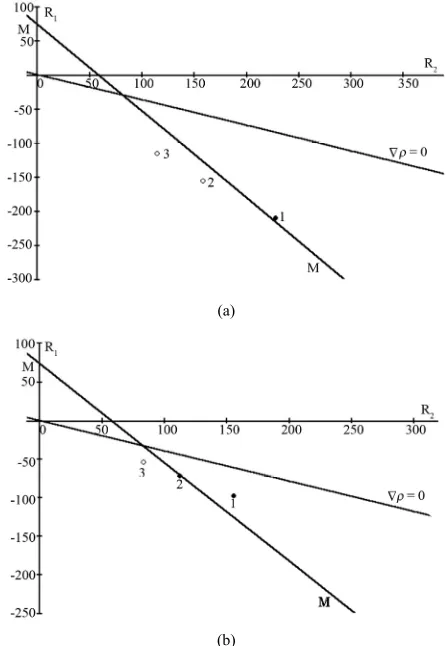
11 1R R2. (12)The mutual position of the line of monotonic insta- bility MM (Equation (11)) and the line 0 (Equa- tion (12)) for n1 is shown in Figures 1 and 2. As follows from figures, there exists a region in the plane
R R1, 2
where the line MM is situated below the line(12). In this region, the mixture appears to be unsta- ble.
2
2 0,
i f z
(7)
that permits to select the following approximation:
,
2 2
5 2 2
i i ,
f r z h z h z C r (8)
3. Results of Numerical Experiment
whereСi
r is the radial function of concentration.For determination we use Kantorovich method. Substituting Equation (8) into Equation (6), multiplying by depending on z part of the function
i
С r
,i
f r z and integrating between – h and h we obtain the equation:
2 2 2
1 11 ,
248
n n
i i i
n J kr n
C C C r K
r r J
To compare the approach proposed in Paragraph 2 with the experimental data is shown in [2] we represent them in the form of partial Rayleigh numbers. The partial Rayleigh numbers in accordance with (2) can be written as follows:
4 4
1 1 2 2
1 2
11 22
, ,
gnr m c gnr m c
R R
z z
D D
(13)
i
k (9)
where 2 2 153
, 1, 2 62h i
where is the molecular mass of the i-th component,
1 1 3 2 2 3
i m
m m m, m m m
. If conditions of the ex- periment are known (pressure, temperature, composition of mixtures in each of the flasks, the size of the diffusion channel), then according to Equation (13) we can find R1
and R2 and thus determine the point representing this
experiment on the plane
R R1, 2
. From experiment, weknow what the regime (diffusion or convection) occurs under the given conditions. In addition, we assume that the number 1 refers to the component with the lowest density, while the numbers 2 and 3 refer to the compo- nents with the highest and intermediate densities respect- tively.
. Finding components concen- trations of Equation (9) were solved with the boundary condition
1 0 i
r
С
r
, and then the final solution in the
center becomes (see Equation (10)):
where Jn and In are n-order Bessel functions of the first
kind.
In order to determine the monotonous stability bound- ary of the problem under consideration, the third equa- tion of the system (2) can be scalarly multiplied by the vector and integrated all over the volume V of the diffusion channel. This can be done under the conditions,
u
Figures 1 and 2 show the experimental data in terms of the Rayleigh numbers for the systems
0.4688Не(1)+0.5312Ar(2)-N2(3) and
0.6179Н2(1)+0.3821N2(2)-CH4(3) and for the systems
0.6192Не(1)+0.3808Ar(2)-N2(3) and
0.6463Н2(1)+0.3537N2(2)-CH4(3) respectively, obtained
by varying the temperature. The full circles correspond to the convective mixing process while the open circles con- that p 0, 0
t
u . Then we have:
2
1 11 1 2 2
dV R u c V R u c Vz d z d
u u
0
. (11) This equation in the coordinates gives a straight line MM, dividing the region of molecular trans- port and the region of the diffusion instability. Figures 1
and 2 show the location of the neutral line of monotonic
R R1, 2form to the diffusion one.
2 2 2 2 '
2 2 2 2 2
2 2 2
11 5 cos
, 248
i
i n n n n
n n n
c
K h z h z n J kr I r J k
n k k k r
J k I J k
k
2
(a)
(b)
Figure 1. (a) Boundary lines of monotonic instability MM and zero density gradient 0 for the system 0.4688Не
+0.5312Ar-N2. Symbols ● correspond to data that deter- mine unstable state. The calculation is carried out at the temperatures values: T = 293.0 (1), 313.0 (2), 333.0 (3), 353.0 (4) K. (b) Boundary lines of monotonic instability MM and zero density gradient 0 for the system 0.6179Н2+ 0.3821N2-CH4. Symbols ● correspond to data that deter-mine unstable state. The calculation is carried out at the tem- peratures values: T = 273.0 (1), 293.0 (2), 313.0 (3), 333.0 (4), 353.0 (5) K.
On Figures 1, all points displaying the experiment are situated in the area of instability (region between the line stability MM and the line of zero density gradient), but with temperature rise tend to the region of stable diffu- sion (region below the line MM).
As is seen, in Figure 2(a) that at the temperature 353.0 K the system 0.6192Не+0.3808Ar-N2 is in the area of
stable diffusion. It is conformed to the data given in [2]. According to Figure 2(a) point 1 corresponds to the tem- perature 293.0 K is situated practically at the curve of monotonic disturbances. That indicates the instable pro- cess observes at the considered temperature. Figure 2(b)
shows that for the system 0.6463Н2+0.3537N2-CH4 tran-
sition into the unsteady regime occurs at the temperature 323.0 K.
Thus, the results reveal that the unstable diffusion pro- ce
4. Conclusion
ave studied the instability of mechani- ss tends to stable one by raising the temperature, but a decrease in the temperature can cause transition to the unstable state of a diffusion-stable system.
In this paper, we h
cal equilibrium (diffusion instability) in ternary gas mix- tures at different temperatures. Linear stability theory is applied to determine the boundary of transition from the state of diffusion to the region of the concentration con- vection. The problem has been solved for a cylindrical channel of finite size and boundary conditions, suggest- ing the absence of component transfer through the walls of the diffusion channel. The comparison of theoretical results with the experimental data for the study of the
(a)
(b)
Figure 2. (a) Boundary lines of monotonic instability MM and zero density gradient 0 for the system 0.6192Не
+0.3808Ar-N2. Symbols ○, spond to data that deter- mine stable and unstable state respectively. The calculation is carried out at the temperatures values: T = 293.0 (1), 323.0 (2), 353.0 (3) K. (b) Boundary lines of monotonic in- stability MM and zero density gradient 0
● corre
for the sys- tem 0.6463Н2+0.3537N2-CH4. Symbols rrespond to data that determine stable and unstable state respectively. The calculation is carried out at the temperatures values: T = 293.0 (1), 323.0 (2), 353.0 (3) K.
[image:4.595.61.281.80.408.2] [image:4.595.310.533.286.609.2]temperature dependence of the diffusion mixing of ter- nary gas mixtures He+Ar-N and H2 2+N2-CH4 indicates
qualitative and quantitative agreement. Therefore, it can be concluded that the proposed calculation technique per- mits estimation of the critical parameters of the transi- tion to the unstable regime.
5. Acknowledgements
This work has been performed under the support of the
REFERENCES
[1] L. Miller and Instabiliti
Multicompone Fluids, Vol. 9, N
Fund of Science of the Ministry of Education and Sci- ence of Republic of Kazakhstan (the project number: No. 1134/GF).
E. A. Mason, “Oscillating
nt Diffusion,” Physics of es in o. 4, 1966, pp. 711-721. doi:10.1063/1.1761737
[2] Yu. I. Zhavrin and V. N. Kosov, “Effect of Temperature on Diffusional Instability,” Journal of Engineering Phys- ics, Vol. 55, No. 1, 1988, pp. 774-778.
doi:10.1007/BF00878123
[3] Yu. I. Zhavrin, A. Z. Aitkozhaev, V. N. Kosov Krasikov, “Effect of Visc
and S. A. osity on Stability of Diffusion
“Effect of Pressure on the Diffusion Stabilit
V.
Mass Transfer in Isothermal Three-Species Gas Systems,”
Technical Physics Letters, Vol. 21, No. 3, 1995, pp. 206- 207.
[4] Yu. I. Zhavrin, N. D. Kosov, S. M. Belov and S. B. Tara-
sov, y in
Some Three-Component Gas Mixtures,” Zhurnal Tekh- nicheskoi Fiziziki, Vol. 54, No. 5, 1984, pp. 943-947.
[5] Yu. I. Zhavrin, V. N. Kosov, D. U. Kul’zhanov, I. Poyarkov and N. B. Ankusheva, “Effect of Cell Rotation Speed on Mutual Diffusion in a Three-Component Gas Mixture,” Technical Physics Letters, Vol. 29, No. 2, 2003, pp. 108-110. doi:10.1134/1.1558740
[6] V. N. Kossov, N. B. Ankusheva and V. D. Seleznev, “Ef- fect of Diffusion Channel Inclination on Stability of Me- chanical Equilibrium in Isothermal Binary Gas Mixtures,”
Journal of Applied Mechanics and Technical Physics, Vol. 51, No. 1, 2010, pp. 62-64.
doi:10.1007/s10808-010-0009-y
[7] J. O. Hirschfelder, Ch. F. Curtiss and R. Bird, “Molecular
tability of Fluid Motions,” Springer,
Convective Instability Mechanism for a Theory of Gases and Liquids,” John Willey & Sons, Inc., New York, 1954.
[8] D. D. Joseph, “S Berlin, 1976. [9] L. Kh. Ingel, “
Binary Mixture at a Vertical Surface,” Technical Physics, Vol. 54, No. 2, 2009, pp. 204-209.
doi:10.1134/S1063784209020078
[10] S. Chen, J. Tӧlke and M. Krafczyk, “Numerical Investi- gation of Double-Diffusive (Natural) Convection in Ver- tical Annuluses with Opposing Temperature and Concen- tration Gradients,” International Journal of Heat and Fluids Flows, Vol. 31, No. 2, 2010, pp. 217-226.
doi:10.1016/j.ijheatfluidflow.2009.12.013
[11] G. Z. Gershuni and E. M. Zhukhovitskii, “Convective Sta- bility of Incompressible Fluids,”Keter, Jerusalem, 1976. [12] V. N. Kosov, V. D. Seleznev and Yu. I. Zhavrin, “The