A Tree-Type Memory Formation by Sensorimotor
Feedback: A Possible Approach to the Development
of Robotic Cognition
Fady Alnajjar1, Indra M. Zin2, Abdl R. Hafiz2, Kazuyuki Murase2 1Brain Science Institute, RIKEN, Nagoya, Japan
2Department of Human and Artificial Intelligence Systems, Fukui, Japan
Email: [email protected]
Received August 6, 2012; revised January 28, 2013; accepted February 7,2013
Copyright © 2013 Fady Alnajjar et al. This is an open access article distributed under the Creative Commons Attribution License, which permits unrestricted use, distribution, and reproduction in any medium, provided the original work is properly cited.
ABSTRACT
Based on indications from neuroscience and psychology, both perception and action can be internally simulated in or- ganisms by activating sensory and/or motor areas in the brain without actual external sensory input and/or without any resulting behavior (a phenomenon called Thinking). This phenomenon is usually used by the organisms to cope with missing external inputs. Applying such phenomenon in a real robot recently has taken the attention of many researchers. Although some work has been reported on this issue, none of this work has so far considered the potential of the robot’s vision at the sensorimotor abstraction level, where extracting data from the environment takes place. In this study, a novel visiomotor abstraction is presented into a physical robot through a memory-based learning algorithm. Experi- mental results indicate that our robot with its vision could develop a kind of simple anticipation mechanism into its tree-type memory structure through interacting with the environment which would guide its behavior in the absence of external inputs.
Keywords: Visiomotor Abstraction; Memory Based Learning; Artificial Cognition; Internal Representation
1. Introduction
Real world applications are usually subject to change and very difficult to be predicted. Any sudden changes in the environment can possibly cause temporary lose in com- munication with the external world. Some organisms, those that have the ability of cognition or thinking, can cope with such situations by replacing the external miss- ing or corrupted sensory data with their own internal representation (or experience).
In recent decades, a branch of science called cognitive neuroscience, an interdisciplinary link between cognitive psychology and neuroscience, has been established to introduce such phenomena to the mobile robot [1]. It was hoped that adding this feature to the robot would move autonomous robots closer to interfacing with real world applications.
Cognitive Roboticsis concerned with endowing robots with mammalian and human-like cognitive capabilities to enable them to accomplish complex tasks in complex environments. Cognitive ability is the ability to under- stand and try to make sense of the world. In [2], the au-
thors have argued that all living creatures are cognitive to some degree. Several authors have argued in recent years that cognition and consciousness can be achieved to some extent on the mobile robots [3-5]. We believe that the level of or how much the robot could be conscious of the surrounding environment depends on how much the robot knows about this environment. Cognition in robots includes perception processing, attention allocation, an- ticipation, etc. One of the possible approaches to meas- uring these capabilities in the robot is by examining its ability to cope with missing external sensory data during performance of a specific task. Said in a different and operational way, it is the ability of a robot to perform blindfolded navigation, where the robot navigates within a known environment using only its internal representa- tion.
two-level network architecture; 1) low-level abstraction from sensorimotor values to a limited number of simple abstract “concepts”, following the work done by Linker and Niklasson [6,10], and 2) higher-level prediction/ representation of the agent’s interaction with the envi- ronment, inspired by the work done by Nolfi and Tani [11]. These efforts have to some degree succeeded in allowing the robot to anticipate long chains of future situations. However, they have failed to support a com- pletely blindfolded navigation [8], in which the robot repeatedly uses its own internal representation values instead of the real sensory inputs for a certain number of times for its navigation. The failure partly seems to be due to the short range of the robot’s proximity sensors that they used, which limits the amount of data that could be abstracted from the environment. The consequence of this limitation is that the robot does not have enough sen-sitivity about the environment. We argue here that im-proving the robot’s sensorimotor abstraction level, there- fore, could possibly overcome this problem. For instance, instead of relying only on the limited data provided by the robot proximity sensors, let the robot see the envi- ronment using its camera, abstract enough data, and ar- range it well in its memory to aid in building its internal representation.
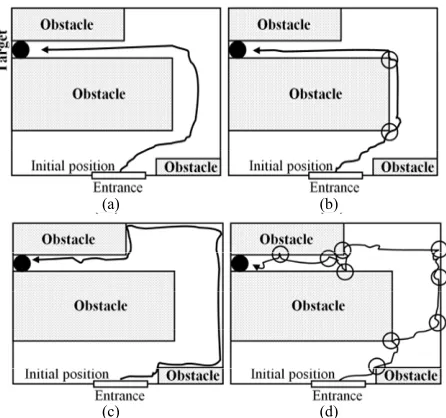
To support our argument, we have done psychological experiments, similar to the one introduced by Lee and Thompson [12] with a little change. In a series of two experiments, we demonstrated the accuracy with which humans can guide their behavior based only on their in- ternally sensory experiences. Two subjects were asked to do the same task under different conditions. The first subject X was asked to “look” around in a given room and locate a specific target (Figure 1(a)). He was then blindfolded and asked to locate the target again. The subject performed the task accurately with closed eyes, in the same manner as when he was free to “look” (Figure 1(b)). However, he could not predict the exact time needed to turn to the target and this caused the two hits with the obstacle (the empty circles in Figure 1(b)). The second subject Y was not allowed to explore the room with his eyes (no vision input). Instead, he was blind- folded and walked around the room touching things around him until he found the target (Figure 1(c)). He was then asked to seek the target again blindfolded from the initial position. Though successful in reaching the target, he took more time than that needed by subject X. In addition, the number of times that he hit the wall or touched it to correct or locate his direction was greater (Figure 1(d)).
From the above experiment we can conclude that sub- ject X had collected a sufficient amount of data from the environment during his first “eyes open” navigation. This data could be various dimensions in the room which the
(a) (b)
[image:2.595.313.536.83.292.2](c) (d)
Figure 1. The track of subject X in the first case: (a) Eyes were opened; (b) Eyes were closed. The track of the subject Y in the second case (closed eyes); (c) The first try to reach the target; (d) The second try. The empty circles present the places where the agent was using the wall to correct or lo- cate his position.
subject related to times and distances that helped him to build internally—in his inner world where sensory ex- periences and consequences of different behaviors may be anticipated—his own internal image. In contrast, the amount of data that subject (Y) had collected was limited to the objects that his hand touched during his first blindfolded navigation and their relation to his moving steps. This data, however, was not good enough to accu- rately perform the task.
In the above experiment, subject Y could be a demon- stration of the results of the most recently reported works (e.g., [7]), since they used the short-range proximity sensors for building the sensorimotor abstraction level.
We also tried to demonstrate the inner world that was automatically built inside both subjects’ memory by giv- ing each of them a sheet of white paper and asking them to draw the outline of the room that they trained in (note that subject Y had never seen the room). It was not sur- prising to find out that subject X could draw almost all the details of the room (Figure 2(a)). However, subject Y could hardly draw the layout of just the objects that he touched during his movement (Figure 2(b)).
Entrance Entrance (a) (b)
Figure 2. (a) and (b) illustrate the environment as it is per-ceived “imagined” by subjects X and Y, respectively.
2. Background
A number of researchers have tried to investigate the robot’s internal representation or as it called by some; the robot’s inner world [5,13]. In [5], for instance, the au- thor describes development of three simulation hypothe- ses in order to explain the robot’s inner world. This was also discussed by Stening in [7]; and we summarized it in this section. The first is covert behavior, which is the ability to generate internally neural motor responses that are not actually externally executed. The second is sensor imagery, which is the ability to internally activate the sensory areas in the brain, so as to produce the simulated experience without actual external inputs. The third is anticipation, which is the ability to predict the sensory consequences of the motor response. More information regarding each assumption is given by [5,7].
Based on the above hypotheses, the internal sequences of the robot behaviors could be illustrated by Figure 3. In Figure 3(a), a situation S1 elicits internal activity s1,
which in turn leads to a motor response preparation r1
and thereafter results in the overt behavior R1, which
causes a new situation S2. In Figure 3(b), because of the
robot’s past experiences, the response preparation r1
could directly elicit the internal activity s2. In Figure 3(c),
if the robot trains the network to some degree, then it should be possible to simulate long sequences of motor responses and sensory consequences.
Several modelers have translated the ideas shown in
Figure 3(c), directly into the robot [7]. From the figure, these modelers (Figure 3(d) for an example) have not only mapped the sensory input to motor output but also predicted the next time step’s sensory input based on the network’s experience with the environment, which is stored in a kind of a short-term memory that is then used instead of the real one in each time step.
Much of the later work has been following a similar basis, e.g. [14-16]. All of these studies, however, have considered only the robot’s short-range proximity sen- sors (e.g., IR sensor) in their experiments, which there- fore, cannot provide enough data about the environment for the robot to build its internal representation.
From the psychological experiments reported in the
S1
S1
S1
S1
S1
S1
S1
s1
s1
s1
s1
s1
s1
s1
R1
R1
R1 R1 R1 R1 r1
r1
r1
r1
r1
r1
r1 (a)
(b)
(c) Predicted sensors
Predicted sensors
Motor output
Motor output Feedback
Feedback Sensor Input
t + 1
Time t
(d)
Figure 3. (a)-(c) The basic principle of Hesslow’s simulation hypothesis (adopted from [5]); (d) The basic approach to simulation of perception in robots used by [7,13].
previous section, we agree with [4,5,7] that the weak spot in simulation theories is concerning the matter of the abstraction level at which internal representation are re- lied on. Therefore, improving the ability of this level should result in building a better internal representation in the robot, and therefore, better cognition ability.
[image:3.595.316.529.86.557.2] [image:3.595.61.284.86.185.2]3. Robot and Environment
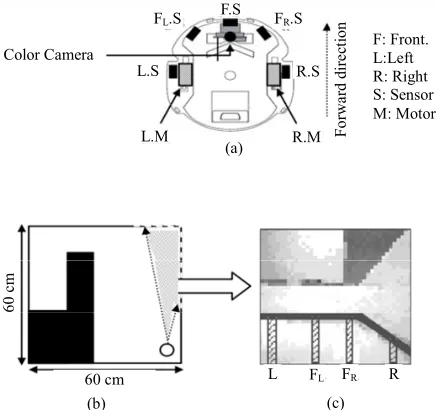
All the experiments in this study were conducted in a physical mobile robot “Hemisson”. Hemisson is a mi- niature mobile robot that was originally developed for educational purposes by K-team (www.k-team.com) (Figure 4(a)). It is equipped with several IR sensors and a programmable 8bit MCU. The robot is able to avoid ob- stacles, detect ambient light intensity and follow a line on the floor. Other components are also included, such as a programmable LED, a buzzer, and switches. Hemisson is also equipped with a wireless camera mod- ule to transmit video images to a receiver that is con- nected to a PC for image processing.
As discussed earlier, we used the robot’s IR sensors to supply the sensory input in the first network, while the robot’s camera sensors were used to supply the second network. The robot’s camera view has been divided into 4 parts, as illustrated in Figure 4(c). Each part covers a number of pixels that represent the distance to the ob- stacles (by counting the number of white pixels from the lower edge of the image till the lower edge of the obsta- cle). We have applied the idea of flood fill algorithm [17] to filter the robot’s view and to easily clarify the bounda- ries between the floor and the obstacles. We arranged an ideal environment for the robot to navigate in to avoid a large amount of image processing, since image process- ing is not the main target of this work. The combination of these pixel parts was used to identify the current con- cept of the robot’s view CC. The average of FL and FR were used to calculate the real distance Dcm to the fron- tal obstacles. A simple neural network was trained by Back-Propagation algorithm (BP) to convert the number of pixels in each part into a real distance. The environ- ment structure that we used was similar to the one used by [7,11], consisting of two different-sized rooms con- nected by a short corridor (Figure 4(b)).
4. Experiments
4.1. Proposed Architecture
The general network architecture presented in this study was inspired by the architecture presented in [7,13]. In their work, they used two-level neural network architect- ture. The lower level consisted of an unsupervised vector quantizer that categorized the current IR-sensory and motor values into a more abstract level they called “con- cepts”, such as “corner” or “corridor”. The higher level consisted of a recurrent neural network that trained to predict the sequence of lower-level concepts and their respective duration, (for example, following a right wall for 45 time steps would be followed by a left-turn corner that lasted for 3 time steps, etc.)
Our architecture, in contrast, differs from this previous
Color Camera F: Front.L:Left
R: Right S: Sensor M: Motor
Fo
rw
ar
d d
ir
ec
tion
60
cm
60 cm L FL FR R
FL.S F.S FR.S
L.S
L.M R.M
R.S
(a)
(b) (c)
Figure 4. (a) Schematic drawing illustrates the position of the IR-Sensors, color camera and motors on Hemisson; (b) Robot environment. The empty circle illustrates the robot. The doted area illustrates the range of the robot’s view; (c) Robot’s view in the position shown in B. Black thick line illustrates the lower edge of the obstacle. The vertical lines L, FL, FR and R, illustrate the left, left-front, right-front and right pixels range reading, respectively.
work in two main aspects. First, instead of using only the robot’s IR sensors as an input for the abstract level, we added the robot’s vision sensors to the system. The sec- ond main difference is that the robot has two separated networks. The first network is used to control the robot’s navigation system within the environment, as shown in
Figure 5(a). The second network represents the robot’s memory, as shown in Figure 5(b). It is used to abstract data from both the first network (motors’ speed) and the environment. It also learns the relationships between these data to build the robot’s internal representation, and to predict both the upcoming concept (PNC) and the time needed to go through each concept (PT).
We initially trained the second network with BP. However, the error ratio was high even when we trained the robot for a very long time. We also tried to evolve the network with standard Genetic Algorithm (GA), but un- fortunately the results did not improve. The reasons for these failures could be one of the following. First, the number of concepts generated by the robot’s camera could have created a sequence which is too complex for such algorithms to learn. Second, we are dealing with a physical mobile robot that makes learning through these types of evolutionary algorithms quite impossible, since it may require several days to complete one experiment.
[image:4.595.312.530.85.290.2]IR Sensory Input Motor Speed (S)
Camera Input (CC)
Motor Speed (S) PT PNC
Memory Hidden Layer
(a)
(b)
Figure 5. (a) Architecture of the SNN used in the first net- work. White/black circles represent excitatory/inhibitory neurons which have positive/negative connection, respect- tively. The neurons in the hidden layer are fully connected to each other; (b) Architecture of the second network. PNC and PT are the output of the robot’s memory at each time step. The dashed line illustrates the connection that was done in experiment 4, where the outputs of the network were replaced with the real input values.
of [18] with small changes, i.e., while the robot is navi- gating in the environment using the first network, the second network predicts from its past experience, or randomly, what will be the next view or action, and then corrects its prediction layer by the actual fact when it faces it (See Figure 6 for an example). This algorithm turned out to be reasonably successful.
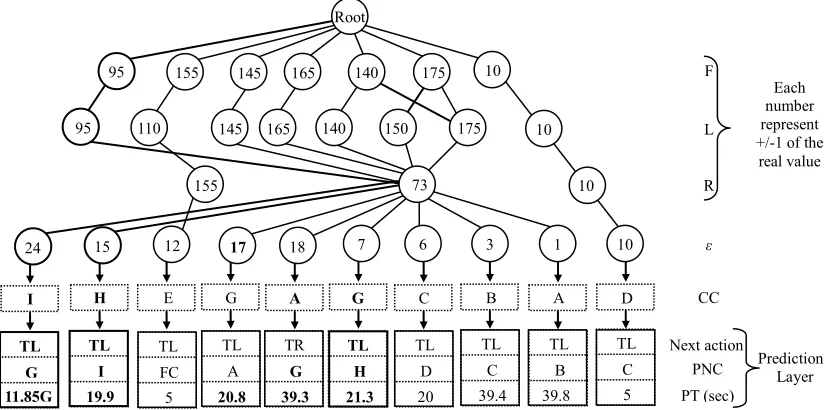
A tree-type memory structure has been introduced to the second network (robot’s memory), similar to the one introduced in [19] (Figure 7). This memory has a dy- namic structure and simple storing and retrieving me- chanism. It was also supported by forgetting and cluster- ing mechanisms to control its general size and to provide maximum memorizing ability. More details can be found in [19]. The memory was divided into five levels. The first three levels were used to store the robot camera in- puts to identify each concept. The fourth level (ε) was used to count the number of concepts in each environ- ment, so as to identify the environment. The last level represents the prediction layer.
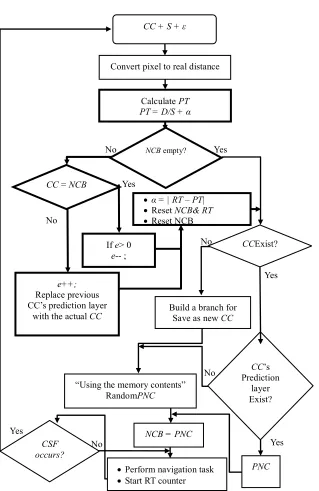
During the navigation, the robot built its memory based on its experiences and gradually learned from them for its future action. The flowchart in Figure8 shows the working mechanism of the memory. According to the chart, when the robot returns to its straight state after performing the turning in the corridor or corner, two phases are operated sequentially: the learning phase, where the robot learns and updates its memory with the currently available facts, and the predicting phase, where the robot explores the environment and gradually builds its experiences. The following points briefly summarize- ing the flowchart:
A
Prediction I think I can walk to
the front corner within 20 sec. Then,
I think, I will find another corner on
the left
Fact Aha, it took 30 sec.
to reach the corner from the previous position. And there is a corridor on the left not a corner, as I
thought before
B
[image:5.595.321.527.81.283.2]A
Figure 6. An example of how the robot’s memory builds and updates its knowledge.
Front (F) Left (L)
ε
Prediction Layer Root
CC
Right (R)
Figure 7. Tree-memory structure used in this study (ado- pted from [19]). Each concept has its own prediction layer, which contains PNC, PT and the end action of each concept, e.g., turns right (TR) or turns left (TL).
Learning phase (the thick lines in Figure 8):
Robot takes a photo of its current view CC, finds the distance to the obstacle (D), finds its motor speed (S), and calculates PT (PT = D/S + α). Where (α) is the prediction time delay between the real time that the robot manually counts during its movement (RT) and the time that the robot predicts based on its experi- ence (PT) (α = |RT − PT|).
If the robot has previously predicted the current con- cept from the previous stage, i.e., the next concept buffer (NCB) is not empty, and RT contains the real time needed for the robot to finish the previous stage, then the robot needs to ascertain the validity of the previous stage’s prediction layer PNC, which also is stored in NCB, with the current concept.
[image:5.595.60.287.87.232.2] [image:5.595.310.535.323.460.2]No
No
Yes No
CC + S + ε
CCExist?
Build a branch for Save as new CC
CC’s Prediction
layer Exist?
PNC “Using the memory contents”
RandomPNC
Calculate PT PT = D/S + α
NCB empty? Yes
CC = NCB Yes
If e> 0 e-- ; No
e++; Replace previous CC’s prediction layer
with the actual CC
Yes
NCB = PNC α = | RT – PT| Reset NCB& RT Reset NCB
Perform navigation task
Start RT counter CSF
occurs?
No
No Convert pixel to real distance
[image:6.595.139.458.73.564.2]Yes
Figure 8. The working mechanism of the robot’s memory. Thick lines illustrated the learning phase, while thin lines illus-trated the predicting phase.
i.e., the previous stage prediction layer PNC is incor-rect and should be replaced by the current CC. The prediction time delay α is also updated by the current value of RT to adjust the value of PT.
Predicting phase (the thin lines in Figure 8):
If the current concept CC does not exist in the robot’s memory, i.e., the robot has not seen the view before, a new branch will grow up in the memory to hold the value of the new CC.
If the CC exists in the robot’s memory, then the ro- bot’s history buffer ε and CC’s prediction layer are
combined to predict the next concept PNC. Where (ε
= ε + CC) if CC exists in ε queue, otherwise, (ε = ε – CC). If CC’s prediction layer has no experience about the next view, the memory will randomly choose a PNC from any existing data in the memory and store it in the NCB, which will be corrected later by the learning phase (step 2).
The robot starts to perform wall-following behavior until the next activation of changing-state flag (CSF),
ing right or left).
4.2. Experimental Results
4.2.1. First Stage (Wall-Following Behavior)
In order to control the robot’s initial behavior in the en- vironment, several learning algorithms could be used. In this study, however, the robot was equipped with a pre-trained simple self-organizing spiking neural net- work (SOSNN) [20, Figure5(a)]. This network took ac- tivation from IR sensors as input and gave the desired left and right motor values as output. The randomly se- lected excitatory and inhibitory hidden neurons were fully connected to each other. For simplicity, the weight connection was represented by 1 or 0, specifying the presence or absence of the connection, respectively. During the robot’s navigation, the connection between the neurons in the network, from input to hidden layer or from hidden to output layer, were gradually adjusted, following a predefined condition (Table 1), until the ro-bot performed the desired task (Figure9).
As previously stated, the robot used this network ex- clusively for performing the navigation task; no data ab-straction from the environment was processed in this level. The activation of CSF at every new state, however, excited the second network to do its task.
[image:7.595.55.288.513.698.2]To simplify the second network’s task, which partly depended on the motor output from the first network, we adjusted the robot’s forward speed to a fixed value, equal to the average of the robot’s forward speed in 10 success rounds in the environment, i.e., S = 1.25 cm/sec.
Table 1. The desired sensory-motor states for right-side wall-following behavior by SOSNN. θ is the sensor reading that keep the robot within a range ≈ 1.5 cm of the wall (θ = 500).
IR sensory state Motor State
All Sensors < θ L.M > R.M
R.S ≥θ L.M = R.M > 0
F.S or FR.S > θ R.M > L.M
X X X
X X
X X
X
The turning action The activation of
CSF
Figure 9. Robot’s right-side wall-following behavior by SOSNN controller. X represent the places where CSF were activated.
4.2.2. Second Stage (Data Abstraction & Prediction)
The main objective of this stage is to examine the valid- ity of the second network to build the robot’s internal representation, so that, the robot can keep tracking its own relative position in the environment and to antici- pate the upcoming event.
In this experiment, we left the robot, using the first network, to perform the wall-following task in the envi- ronment for 5 rounds, simultaneously with the existence of the second network whenever CSF was activated. At the beginning of each concept, the network trained both PNC and PT.
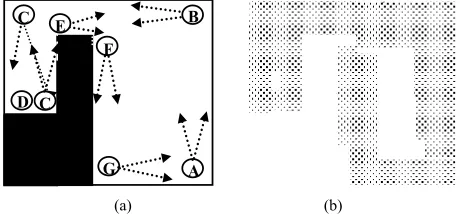
Figure 10 shows the number of concepts that the robot could identify from the environment using its camera view (A~G). From the figure we can see that our method abstracted 7 different concepts from the environment, while in [7]/[13] only 5/3 concepts were found by using the short range IR sensors, respectively. Notice that the number of concepts indicates to what degree the robot is sensitive about the environment, and as a consequence, it would results in better anticipation.
Table 2 shows the evolvement of the learning and predicting phases in the robot’s memory during the 5 complete rounds in the environment. From the table, at the first round, the robot is not able to predict neither the PNC nor PT correctly. The robot set these values ran- domly since it does not have experience about them. In the learning phase, however, it updates both of these values in each concept by learning online from the value of RNC and RT, respectively. It is worthwhile to men- tion that the robot built a suitable knowledge about the surrounding environment within the first two rounds. From the table, within the 3rd round the robot was able to predict all the PNC correctly, i.e., PNC = RNC and e decreases to 0. Although, the robot was unable to predict PT 100% correctly, i.e., PT ≠ RT, however, its value comes very close to RT and α turned out to be very close to 0.
4.2.3. Third Stage (Robot’s Internal Representation)
In [7,13], they used several slightly different environments
A B C
D E
F
G C
C
D E
C
(a) (b)
Figure 10. (a) The 7 concepts that robot’s camera could identify in the environment; (b) The dotted area illustrates how the robot internally represents (imagines) the whole
[image:7.595.309.539.579.686.2]Table 2. Second network evolvements for 5 rounds. (Each concept identified by CC’s value that automatically generated in sequential manner). RNC = the CC of the next step.
Predicting phase Learning phase
D (pixel) Round
L F R D(cm) CC CC Value ε S cm/sec D/S PT PNC RT α RNC e
1 175 175 73 40.04 A 1 1 1.25 32.032 32.032 A 39.5 7.5 B 1
1 150 175 73 40.04 B 2 3 1.25 32.032 32.032 A 39.1 7.1 C 2
1 140 140 72 24.88 C 3 6 1.25 19.904 19.904 B 21.0 1.1 D 3
1 10 10 10 5.01 D 4 10 1.25 4.008 4.008 D 5.1 1.1 C 4
1 140 140 73 24.55 C 3 7 1.25 19.64 19.64 D 18.5 −1.1 E 5
1 110 155 155 32.65 E 5 12 1.25 0 0 B 4.5 4.5 F 6
1 165 165 71 36.8 F 6 18 1.25 29.44 29.44 C 33.8 4.4 G 7
1 145 145 73 27.7 G 7 25 1.25 22.16 22.16 B 21.3 −0.9 A 8
2 173 173 74 39.4 A 1 24 1.25 31.52 39.0 B 39.1 0.1 B 7
2 150 175 76 40.04 B 2 22 1.25 32.032 39.1 C 39.4 0.3 C 6
2 138 138 72 23.84 C 3 25 1.25 19.072 20.2 E 20.5 0.3 D 7
2 10 10 10 5.01 D 4 21 1.25 4.008 5.1 C 5.1 0.0 C 6
2 140 140 71 24.88 C 3 18 1.25 19.904 18.8 D 19.5 0.7 E 7
2 112 154 154 32.17 E 5 13 1.25 0 4.5 F 5.0 0.5 F 6
2 163 163 72 36.06 F 6 7 1.25 28.848 33.2 G 33.0 −0.2 G 5
2 144 144 73 27 G 7 0 1.25 21.6 20.7 A 20.4 −0.4 A 4
3 173 173 73 39.4 A 1 1 1.25 31.52 39.1 B 40.2 1.1 B 3
3 149 172 73 39.09 B 2 3 1.25 31.272 38.6 C 38.9 0.3 C 2
3 139 139 73 24.36 C 3 6 1.25 19.488 20.9 D 20.5 −0.4 D 1
3 10 10 10 5.01 D 4 10 1.25 4.008 5.1 C 5.0 −0.1 C 0
3 140 140 71 24.88 C 3 7 1.25 19.904 19.5 E 18.8 −0.7 E 0
3 110 163 163 36.06 E 5 12 1.25 0 5.0 F 5.0 0.0 F 0
3 165 165 73 36.8 F 6 18 1.25 29.44 33.6 G 33.5 −0.1 G 0
3 144 144 72 27 G 7 25 1.25 21.6 20.4 A 21.0 0.6 A 0
4 173 173 73 39.4 A 1 24 1.25 31.52 40.2 B 39.3 −0.9 B 0
4 149 175 73 40.04 B 2 22 1.25 32.032 39.7 C 39.4 −0.3 C 0
4 140 140 72 24.88 C 3 25 1.25 19.904 20.9 D 20.0 −0.9 D 0
4 10 10 10 5.01 D 4 21 1.25 4.008 5.0 C 5.0 0.0 C 0
4 139 139 73 24.36 C 3 18 1.25 19.488 18.4 E 19.5 1.1 E 0
4 110 155 155 32.65 E 5 13 1.25 0 5.0 F 5.0 0.0 D 0
4 164 164 71 36.52 F 6 7 1.25 29.216 33.3 G 32.7 −0.6 G 0
4 145 144 73 27 G 7 0 1.25 21.6 21.0 A 20.0 −1.0 A 0
5 175 175 73 40.04 A 1 1 1.25 32.032 39.8 B 40.0 0.2 B 0
5 150 175 72 40.04 B 2 3 1.25 32.032 39.4 C 38.9 −0.5 C 0
5 140 140 72 24.88 C 3 6 1.25 19.904 20 D 20.5 0.5 D 0
5 10 10 10 5.01 D 4 10 1.25 4.008 5.0 C 5.0 0.0 C 0
5 140 140 73 24.88 C 3 7 1.25 19.904 19.9 E 18.8 −1.1 E 0
5 110 155 155 32.65 E 5 12 1.25 0 5.0 F 5.0 0.0 F 0
5 165 165 71 36.8 F 6 18 1.25 29.44 32.9 G 33.8 0.9 G 0
5 144 144 73 27 G 7 25 1.25 21.6 20.0 A 21.0 1.0 A 0
to show that their robot could capture some features from the original environment in its internal representations by monitoring the prediction error function in each step. A similar investigation was performed in this stage using environment II shown in Figure11 (where the tunnel to the small room was closed and an extra stationary object was added to the initial environment). After the robot was trained in the original environment, i.e., its memory gained enough experience about the environment through 5 successful complete rounds, we moved the robot to environment II.
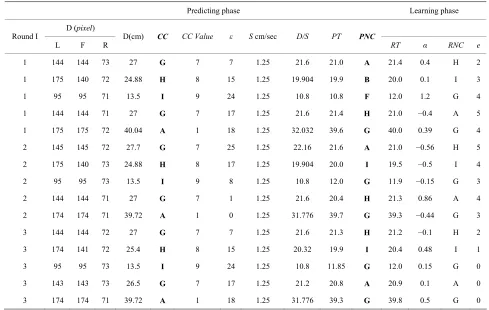
The results in Table 3 show that the robot became confused and could not predicted correctly during most of the first two rounds, i.e., PNC ≠ RNC, and the value of e increased. During the 2nd round e gradually de- creaseddue to the number of changes that happened in the memory. For instance, the prediction layer of con- cept’s A changed from B to G, and two new branches were created in the memory to handle the new concepts, H&I and their prediction layer. From these results, we can claim that our robot, at the beginning, sensed the changes in the environment and gradually adapted its memory (see Figure 12). In round 3, all the concepts were predicted correctly.
Figure 13 shows the final memory structure after 3 rounds in environment II. From the figure we can see that
due to the memory type we used, the data that referred to (environment I) was still stored in some nodes in the memory and could be recalled whenever the robot moves back to the original environment or whenever the robot faces a similar concepts in the new environment. The overall memory structure was retained with a little modi- fication to cope with the changes in the new environ- ment.
4.2.4. Fourth Stage (Blindfolded Navigation)
The objective of this stage is to examine the ability of the robot to replace all of its external IR sensory input with its own internal representation, i.e., repeatedly using the sequences of its own prediction for a certain number of times without external sensory input, see the dashed lines in Figure 5(b). In other words, have the robot navigate itself blindfolded in the environment.
A G H
I
[image:9.595.364.482.301.380.2]G
[image:9.595.52.541.425.735.2]Figure 11. Environment II.
Table 3. Memory evolvement by robot navigations in environment Figure 12.
Predicting phase Learning phase
D (pixel) Round I
L F R D(cm) CC CC Value ε S cm/sec D/S PT PNC RT α RNC e
1 144 144 73 27 G 7 7 1.25 21.6 21.0 A 21.4 0.4 H 2
1 175 140 72 24.88 H 8 15 1.25 19.904 19.9 B 20.0 0.1 I 3
1 95 95 71 13.5 I 9 24 1.25 10.8 10.8 F 12.0 1.2 G 4
1 144 144 71 27 G 7 17 1.25 21.6 21.4 H 21.0 −0.4 A 5
1 175 175 72 40.04 A 1 18 1.25 32.032 39.6 G 40.0 0.39 G 4
2 145 145 72 27.7 G 7 25 1.25 22.16 21.6 A 21.0 −0.56 H 5
2 175 140 73 24.88 H 8 17 1.25 19.904 20.0 I 19.5 −0.5 I 4
2 95 95 73 13.5 I 9 8 1.25 10.8 12.0 G 11.9 −0.15 G 3
2 144 144 71 27 G 7 1 1.25 21.6 20.4 H 21.3 0.86 A 4
2 174 174 71 39.72 A 1 0 1.25 31.776 39.7 G 39.3 −0.44 G 3
3 144 144 72 27 G 7 7 1.25 21.6 21.3 H 21.2 −0.1 H 2
3 174 141 72 25.4 H 8 15 1.25 20.32 19.9 I 20.4 0.48 I 1
3 95 95 73 13.5 I 9 24 1.25 10.8 11.85 G 12.0 0.15 G 0
3 143 143 73 26.5 G 7 17 1.25 21.2 20.8 A 20.9 0.1 A 0
-2.0 0.0 2.0 4.0 6.0 8.0 10.0 12.0
0 10 20 30 40 50
e+
a
R1 R2 R3 R4 R5 R1 R2 R3
Environment II Environment I
Figure 12. (e + a) during 5 rounds in environment I and 3 rounds in environment II.
155 175
Root 175 73 1 150 3 140 140 6 10 10 10 10 7 110 155 12 165 165 145 145 18 17 F L R ε CC Next action PNC PT (sec) D TL C 5 TL B 39.8 TL C 39.4 TL D 20 TL H 21.3 TR G 39.3 TL A 20.8 TL FC 5 A B C G A G E Each number represent +/-1 of the
real value Prediction Layer 15 TL I 19.9 H 24 TL G I 11.85G 95 95
Figure 13. The final tree-type memory structure after 3 rounds in the environment of Figure 12. Thick lines illustrate the changes that occurred in the memory. The robot used some of the past experiences to predict concept in the new environ-ment.
[image:10.595.107.499.59.263.2]In this stage, after the robot trained in the original en- vironment for 5 rounds, we removed the surrounding environment completely, eliminated the external sensory inputs, and let the robot move in a wide space using only the last found sequence of the concepts in its memory.
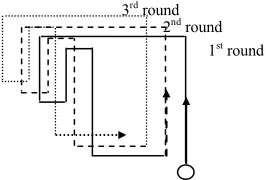
Figure 14 shows the robot’s best behavior. It is inter- esting to note that the robot built experiences about the environment in its memory sensitive enough so that it could navigate in the environment without any interact- tion with the external world. All the concepts were memorized correctly, and the robot moved according to the environment’s layout. Unfortunately, the robot has slightly shifted its movement in each round, and this was probably due to the error in predicting the time of each concept a, as can be seen from Table 2.
5. Discussion and Future Work
We have presented some initial experiments with the aim to contribute toward the development of robot models in sensorimotor abstraction, simulation and anticipation. In particular, and unlike most previous related work, we have here presented: 1) a robot equipped with a video camera to extract data from the environment during its navigation, and 2) a tree-type memory structure to store this data in a simple manner as the robot experiences it to use to anticipate upcoming events and to guide its be- havior in the absence of external inputs.
[image:10.595.91.503.297.502.2]1st round 2nd round 3rd round
Figure 14. Robot’s behavior during the navigation in a wide space using only the sequences of its internal representation for 3 rounds.
and of navigating the robot blindfolded in the environ- ment, replacing missing IR-sensory input.
The results in the 2nd stage indicated that our algo- rithm had memorized the sequences of concepts found in the environment, as well as the robot’s behavior in each one. The results in the 3rd stage showed that the internal representation had captured the topology of the original environment and dynamically adapted to changes in it. The overall memory structure remained as it is and a little change occurred to cope with the changes in the environment. With such memory structure, the robot’s previous knowledge could be recalled easily. In the final stage, the robot indeed was able to navigate, to some degree, blindfolded using only its own internally built representation without any external world interaction. The robot used its “mind” to navigate from one concept to another in the environment by operating through a series of actions and situations that it learned. The ro- bot’s memory was not very good at predicting the real time needed for each concept, but neither can humans (Figure1(c)), and this caused a little delay in the robot’s movement, as illustrated in Figure14.
Although some studies have reported on the issue of robot imaginations and anticipations in different ways (e.g., [21]), where the robot can use its sensorimotor rep- resentation in the brain to simulate its movement inter- nally before the actual movement and to reason about its ability to perform the task in a short time and a safe manner, the robot, however, has been told the layout of the environment and/or the position of the targets in ad- vance. We showed in this study, that the robot could build an environment’s map and an appropriate sequence of events in it through its own experiences. The robot can then use this data to recover any missing or corrupted data and even plan its future movement within its internal representation before any actual move (Figure10(b)).
We believe that the work presented here illustrates some promising directions for further experimental in- vestigations of visiomotor abstraction and for further developments of the synthetic phenomenology approach in general.
As a possible future set of experiments, it would be
interesting to try to improve the learning algorithm of the second network by building a higher-level to control the prediction-layer operations in the prediction phase (ex- periment 2). This will decrease the learning time for newly created prediction-layers. Currently, we are trying to improve the robot’s sight sense ability to enhance the time prediction, by introducing a new 3D image proc- essing algorithm to the system. We are also trying to im- prove the memory operating ability so that the robot can guess the result of an action that it has never gone through before and which is similar to a combination of actions that it has experienced earlier.
6. Acknowledgements
Supported by grants to KM from Japanese Society for Promotion of Sciences, and the University of Fukui. Au- thors would like to thank Mr. Edmont Katz for his valu- able discussion.
REFERENCES
[1] M. S. Gazzaniga, “The Cognitive Neurosciences III,” MIT Press, Cambridge, 2004.
[2] F. J. Varela, E. Thompson and E. Rosch, “The Embodied Mind: Cognitive Science and Human Experience,” MIT Press, Cambridge, 1991.
[3] A. Clark and R. Grush, “Towards a Cognitive Robotics,” Adaptive Behavior, Vol. 7, No. 1, 1999, pp. 5-16. doi:10.1177/105971239900700101
[4] R. Grush, “The Emulation Theory of Representation: Motor Control, Imagery, and Perception,” Behavioral and Brain Sciences, Vol. 27, No. 3, 2004, pp. 377-435. doi:10.1017/S0140525X04000093
[5] G. Hesslow, “Conscious Thought as Simulation of Be- haviour and Perception,” Trends in Cognitive Science, Vol. 6, No. 6, 2002, pp. 242-247.
doi:10.1016/S1364-6613(02)01913-7
[6] F. Linåker and L. Niklasson, “Extraction and Inversion of Abstract Sensory Flow Representations,” Proceedings of the 6th International Conference on Simulation of Adap- tive Behavior, from Animals to Animates, Vol. 6, MIT Press, Cambridge, 2000, pp. 199-208.
[7] J. Stening, H. Jacobsson and T. Ziemke, “Imagination and Abstraction of Sensorimotor Flow: Towards a Robot Mo- del,” In: R. Chrisley, R. Clowes and S. Torrance, Eds., Proceedings of the Symposium on Next Generation Ap- proaches to Machine Consciousness, Hatfield, 2005, pp. 50-58.
[8] J. Stening, “Exploring Internal Simulations of Perception in a Mobile Robot Using Abstractions,” Masters Thesis, School of Humanities and Informatics, University of Sköv- de, Sweden, 2004.
[10] F. Linåker and L. Niklasson, “Time Series Segmentation Using an Adaptive Resource Allocating Vector Quantiza- tion Network Based on Change Detection,” Proceedings of the International Joint Conference on Neural Networks, IEEE Computer Society, Vol. 6, 24-27 July 2000, pp. 323- 328.
[11] D. S. Nolfi and J. Tani, “Extracting Regularities in Space and Time through a Cascade of Prediction Networks: The Case of a Mobile Robot Navigating in a Structured Envi- ronment,” Connection Science, Vol. 11, No. 2, 1999, pp. 125-148. doi:10.1080/095400999116313
[12] D. N. Lee and J. A. I. Thompson, “Vision in Action: The Control of Locomotion,” In: D. Ingle, M. A. Goodale and R. J. W. Mansfield, Eds., Analysis of Visual Behavior, MIT Press, Cambridge, 1982, pp. 411-433.
[13] G. Hesslow, “Will Neuroscience Explain Consciousness?” Journal of Theoretical Biology, Vol. 171, No. 1, 1994, pp. 29-39. doi:10.1006/jtbi.1994.1209
[14] D. A. Jirenhed, G. Hesslow and T. Ziemke, “Exploring Internal Simulation of Perception in Mobile Robots,” In: K. Arras, C. Balkenius, A. Baerfeldt, W. Burgard and R. Siegwart, Eds., The 4th European Workshop on Advanced Mobile Robotics, Lund University Cognitive Studies, Vol. 86, Lund, 2001, pp. 107-113.
[15] T. Ziemke, D. A. Jirenhed and G. Hesslow, “Blind Adap- tive Behavior Based on Internal Simulation of Percep- tion,” Department of Computer Science, University of Skövde, Sweden, 2002.
[16] N. Jakobi, P. Husbands and I. Harvey, “Noise and the
Reality Gap: The Use of Simulation in Evolutionary Ro- botics,” Proceedings of the Third European Conference on Advances in Artificial Life, Lecture Notes in Computer Science, Vol. 929, Springer Verlag, London, 1995, pp. 702-720.
[17] T. Taylor, S. Geva and W. W. Boles, “Monocular Vision as a Range Sensor,” In: M. Mohammadian, Ed., Pro- ceedings of International Conference on Computational Intelligence for Modeling, Control and Automation, 2004, pp. 566-575.
[18] S. Schaal and C. G. Atkenson, “Robot Juggling: An Im- plementation of Memory-Based Learning,” Control Sys- tem Magazine, Vol. 14, No. 1, 1994, pp. 57-71.
doi:10.1109/37.257895
[19] F. Alnajjar, I. MohdZin and K. Murase, “A Spiking Neu- ral Network with Dynamic Memory for a Real Autono- mous Mobile Robot in Dynamic Environment,” Proceed- ings of International Joint Conference on Neural Net- works, Hong Kong, 1-6 June 2008, pp. 2207-2213. [20] F. Alnajjar and K. Murase, “Self Organization of Spiking
Neural Network that Generates Autonomous Behavior in a Real Mobile Robot,” International Journal of Neural Systems, Vol. 16, No. 4, 2006, pp. 229-239.
doi:10.1142/S0129065706000640
![Figure 3. (a)-(c) The basic principle of Hesslow’s simulation hypothesis (adopted from [5]); (d) The basic approach to simulation of perception in robots used by [7,13]](https://thumb-us.123doks.com/thumbv2/123dok_us/7768227.715917/3.595.316.529.86.557/figure-principle-hesslow-simulation-hypothesis-approach-simulation-perception.webp)
![Figure 7. Tree-memory structure used in this study (ado- pted from [19]). Each concept has its own prediction layer, which contains PNC, PT and the end action of each concept, e.g., turns right (TR) or turns left (TL)](https://thumb-us.123doks.com/thumbv2/123dok_us/7768227.715917/5.595.321.527.81.283/figure-memory-structure-concept-prediction-contains-action-concept.webp)