Forecasting and the Role of Churn in
Software-as-a-Service Business Models
Anthony E. R. Sukow1, Rebecca Grant2
1
Advanced Ecommerce Research Systems Inc., Palo Alto, CA, USA; 2Gustavson School of Business, University of Victoria, Victoria, BC, Canada.
Email: [email protected], [email protected]
Received February 2nd, 2013; revised March 9th, 2013; accepted March 15th, 2013
ABSTRACT
This article demonstrates a revenue forecasting model for Software-as-a-Service (SaaS) business models. Due to the highly predictable nature of subscriptions, a SaaS business can often project future revenue on the basis of a few key metrics. However, understanding and predicting the churn rate of the subscription base is critical to successful projec- tions. The authors explain SaaS churn and demonstrate the use of critical variables in a predictive SaaS revenue model. The model allows a business to project future revenues based on historical and expected customer subscription behavior. The methodology combines research with the experience of a senior executive in a SaaS-driven business to build the predictive platform.
Keywords: SaaS; Churn; Software; Subscription; Revenue Forecasting
1. Introduction
Software-as-a-Service (SaaS) is an application delivery model whereby software is delivered online over the in- ternet. Also known as on-demand software, it is one of the most popular business models in the information age [1]. The SaaS model takes advantage of high data through- put over the internet, using virtual machines for server- side storage of data and associated code. The user inter- acts with the software via a thin client or web browser. The revenue model is a pay-for-service subscription, with regularly-scheduled, recurring payments in exchange for continued access to the application. Firms are rapidly moving from one time licenses for use of software and online services to recurring payments structured as sub-scription based services.
Worldwide SaaS revenue is forecast to reach $14.4 bil-lion US in 2012, a 17.9 percent increase from 2011 revenue of $12.3 billion USD [2]. Industry watchers predict that SaaS-based delivery will experience healthy growth through 2015, with worldwide revenue reaching $22.1 billion US [3]. The shift from one-time license revenue to recurring service revenue has produced new business language deal- ing with revenue modeling and customer lifecycle. A clearly-defined and rigorous predictive model is critical to the ability of SaaS businesses to: 1) forecast the growth of their customer base; 2) predict revenue; and 3) project future cash flows.
This paper first defines key industry terms and maps the
interactions among the variables representing them. It then demonstrates a model incorporating the key variables. The model, implemented as a computer algorithm, can then be used to predict revenue for a SaaS based businesses.
2. Software as a Service
2.1. Definition
SaaS uses software owned, delivered and managed re- motely by one or more providers. The provider delivers software based on one set of common code and data de- finitions. The software is then consumed in a one-to- many model by contracted clients at any time.
There are two basic forms of SaaS billing, subscription and pay-per-use [4]. SaaS subscription model users pay a flat, fixed monthly fee for unlimited access to and usage of an online software application. With SaaS pay-per-use, often called “metered usage”, the client pays for each use of the service. Pay-per-use is distinguished from sub- scription SaaS by the fixed versus metered approach to billing. If the client has a scheduled use scenario with one or two uses per month, then pay-per-use provides the client with the best value. If the client accesses the ap- plication often, then a monthly recurring billing model typically provides better value for the client.
2.2. Key Characteristics of SaaS
models along five dimensions:
1) Method of Access—The software or service deliv-ered in a SaaS product is accessed over a network and requires internet access;
2) Storage of Data—The client interacts with data stored on third-party servers;
3) Storage of Code—The code that defines the opera- tion of the software and its output is executed server side; 4) System Compatibility—SaaS services are agnostic to hardware architectures or operating systems;
5) Hardware Architecture—The servers that store the client data and deliver the SaaS services are virtualized in a cloud based computing environment. Client-side com- puters require an internet browser to use the SaaS appli- cation.
The availability of high bandwidth internet connec- tions is an important factor in the adoption of SaaS ser- vices. Clients can upload, download and access their data in real time over the internet with minimum latency. Since the service is delivered in a web browser, the code typically works independently of any hardware or oper- ating system. The interoperability of SaaS helps organi- zations easily adopt and roll out the service across many types of computers running different operating systems on differing hardware [1].
Examples of current SaaS businesses include:
Salesforce (CRM)
Google Docs (Documents, Spreadsheets)
Drop Box (File Sharing)
Zuora (Payment System)
Badgeville (Loyalty, User Behaviour)
Eloqua (Marketing)
An example of a high-growth SaaS business is Sales- force, which has been based on the SaaS model since its first day of business. In FY 2005 Salesforce did appro- ximately $172 million in revenues [5]. Over the past seven years in the SaaS business, Salesforce has grown quickly: In 2012 Salesforce did approximately $2.27 bil- lion in revenues [6]. All Salesforce services are subscrip- tion-based, with recurring payments.
2.3. Advantages and Disadvantages of SaaS
The SaaS business model has a number of advantages over conventionally-installed, boxed software. First and foremost, the code is never exposed to the client, pro- tecting the provider from having the software copied or pirated.
Second, the SaaS business can monitor and shut off the client’s access if the client is abusing or misusing the service. The ability to track and monitor service use also provides insight into client processes, which can be used to improve future versions of the application.
Third, all clients access the same code base. Thus, all clients benefit from improvements and upgrades.
Fourth, the highly predictable payment schedule in a subscription model provides significant financial benefits to the provider, in terms of being able to forecast reve- nues and cash flow.
Fifth, acquiring subscribers online has excellent eco- nomies of scale and efficiency—in many cases the po- tential subscriber will self-serve. The cost to acquire a cus- tomer is reduced as the process is automated through online signup.
From a client perspective, the ease of implementing a SaaS option is important. Clients can use the SaaS appli- cation from any internet-connected computer that has a web browser. This greatly simplifies the rollout of SaaS based services in large firms with many types of software and hardware.
SaaS models reduce the client’s upfront purchase costs; in essence, the client is trading a large purchase price for smaller, “rental” payments. The commitment is also de- creased as often there is no long term commitment re- quired to use a SaaS service.
The primary disadvantage of SaaS is the requirement that it be accessed over a network. Network outages make it impossible to use the SaaS application, leading to business slowdowns or—in extreme cases—shutdowns. The requirement to share resources with other clients means that service may sometimes be slow. An overload- ed network can dramatically reduce the speed of delivery of the SaaS service [7].
SaaS clients also can have a negative experience with forced upgrades. The client can experience migration stress and waste time learning new features and function- ality as the SaaS product is upgraded.
3. Review of Prior Research
3.1. Industry Research
Industry research is commonly presented as web content, published by a practitioner or practitioner organization. While recent and active, it is rarely peer-reviewed. The work is typically written from a practitioner perspective, using industry terminology and focusing on tactical case studies.
3.2. Scholarly Research
Peer-reviewed scholarly work centers around some dis- tinct research topics. The primary areas of research we identified are:
1) Pricing SaaS solutions [1,4,11]; 2) SaaS scalability [12];
3) Risk and opportunity assessment of SaaS [7]; 4) The SaaS business model [13];
5) Predicting SaaS churn [14-17].
While our review points to numerous studies about SaaS, most of the work tends to focus on a few applica- tions. In particular, prior work on subscriber churn tends to base its analysis on data from subscribers in the areas of mobile phones [14,16,18], credit cards [15], and pro- viding internet services [19].
Another stream of research develops algorithms to pre- dict the likelihood that a subscriber will churn. That re- search concentrates on detecting at-risk subscribers (those likely to churn) and predicting the probability of churn. Its methods include:
1) ADTrees [14];
2) Partial Least Squares (PLS) Model [16]; 3) Support Vector Machines (SVMs) [17].
Other authors have developed machine learning algo- rithms to target at-risk subscribers. The more accurate the predictions, the more effectively the business can develop communications to retain the customer and improve fu-ture products.
Pricing analysis [1,11] provides insight into the most profitable ways to price SaaS solutions and when to ap- ply these pricing models. It is connected to the analysis of churn by the impact pricing can have on churn. Pricing can affect the client’s perception of the value delivered for the subscription payment. It also directly affects the lifetime value of a subscriber.
3.3. Contrast to Prior Research
The analysis presented in this paper differs from prior research in a number of ways.
First, we propose a foundational view of SaaS metrics that merges industry and scholarly perspectives. We have built a SaaS forecasting tool that can model churn to analyze subscribers, subscriptions, payments and revenue at a tactical level. In contrast, prior research has present- ed analyses that are tightly focused and often only con-sider a single element of the SaaS business model.
Second, our analysis uses data from a software appli- cation development firm with SaaS subscribers. This differs from prior research in that it is not a telecom, util- ity, or credit card data set, but instead is directly relevant to software-as-a-service subscribers. Thus the model is specific to the SaaS industry.
Third, prior research uses algorithms to predict churn,
whereas our model uses historical cohort retention curves. This approach reduces complexity and produces a model accessible to any executive with the math and software skills of a typical mid-level manager. The model can be adapted to use more advanced machine learning tech- niques around churn prediction; however, that would in- crease the complexity and reduce the generalizable na-ture of the model.
Fourth and finally, this analysis does not depend on SaaS price analysis. Nor does it attempt to propose price optimization. Instead, it considers price as an exogenous variable determined by the business and inserted into the model.
4. Churn Rates—Retention Curves
Churn rate refers to the loss of subscribers (or clients). Churn impedes the growth of a SaaS-based business. It also determines the maximum number of users a business can support in a steady state [20]. Churn rates can be reported as “continuous” or “discrete”, each of which can provide different levels of accuracy. Continuous churn describes the behavior of a cohort of subscribers in which the rate of churn remains the same from month to month over the entire life cycle of the cohort. Discrete churn describes the behavior of a cohort in which each term of the subscription may have a different churn rate.
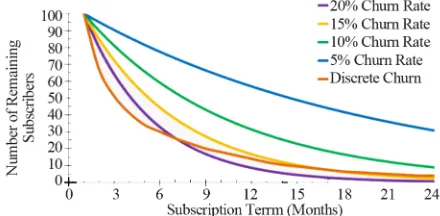
The churn rate curves shown in Figure1 express the number of subscribers retained after a given number of months in their subscription, for five different churn sce- narios. The cohort slowly shrinks in size as users end their subscriptions.
The discrete churn curve (orange line) shows how in months 1 - 7 of the subscription the discrete churn is greater than 20%, while for months 7 - 16 the churn rate is less than 20% but greater than 15%. For months 16 on, the churn rate is marginally better than 15%. No single continuous churn rate curve accurately matches the re- tention curve generated by a discrete set of churn rates.
[image:3.595.311.531.611.719.2]From the authors’ experience, this concept is impor- tant to organizations because management teams often look for a single number with which to measure churn improvement. Since management understands that churn
is bad the general goal is to reduce churn for all custom- ers for all time. When the question “What is our churn rate?” is asked, the average churn rate is the number that is usually quoted. That average rate then becomes the reference to gauge future improvement and progress.
The average churn rate provides a level of accuracy similar to a continuous churn rate. As shown in Figure1, above, the average churn rate will only be correct at two points in comparison to the actual discrete churn curve. Because the subscriber’s propensity to leave is higher at the beginning of the subscription, the churn rate is higher at the start of subscription. Once a subscriber has actively used the application and received value from the service, the probability of cancellation is reduced and the churn rate decreases. Because the subscriber’s behavior changes over the life cycle of the subscription, using a continuous churn rate over the life the subscription will result in in- accurate subscription analysis.
5. Key Variables
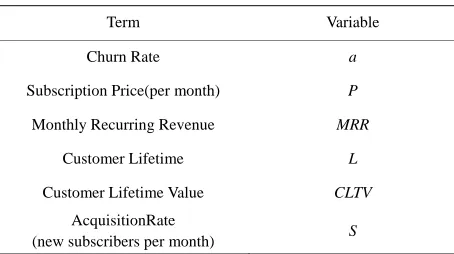
SaaS businesses have a few important metrics or vari- ables, which create the foundation for predicting revenue. The subscription model makes use of these critical vari- ables. Other metrics for measuring aspects of SaaS busi- nesses exist, but those variables shown in Table1 form the core needed to project revenue.
In order to demonstrate these variables and the rela- tionships among them, our discussion uses exemplar va- lues typical of those found in a subscription SaaS busi- ness:
1) Subscription Price: $49.95 per month; 2) Churn Rate: 0.175%;
3) Acquisition Rate: Ranging from 1000 to 2000 new subscribers per month;
4) Total Subscriber base of 10,000.
5.1. Churn Rate (a)
Cancels
Churn Rate a C C t
[image:4.595.59.286.610.737.2]where “a” is the monthly churn rate, “C” = number of
Table 1. Key terms and variables.
Term Variable
Churn Rate a
Subscription Price(per month) P
Monthly Recurring Revenue MRR
Customer Lifetime L
Customer Lifetime Value CLTV
AcquisitionRate
(new subscribers per month) S
subscribers, “t” = term (in months), “CCancels” = Number
of cancelled subscriptions in the period.
For example, imagine that 1000 subscribers signup for a service and, at the beginning of the next subscription period, 175 of those subscribers end their subscriptions. The churn rate in this example is 17.5% (175/1000). The corresponding retention rate is 82.5% because (825/1000) users remained for the second term of their subscriptions.
5.2. Subscription Price (P)
The subscription price is the fixed monthly fee charged to a single subscription client.
5.3. Monthly Recurring Revenue (MRR)
Recurring revenue is the amount of subscription revenue earned based on the value of services delivered in single month. SaaS providers have followed the practices of industries such as utilities, internet service providers, newspapers and telecom companies. These businesses typically bill for service on a monthly basis, with dis- count incentives to encourage clients to commit to yearly contracts. Subscription based billing models produces a reliable and predictable source of recurring revenues.
At a subscription price of $49.95, the MRR for a sin- gle subscriber is $49.95. The MRR for the company as a whole assuming a total subscriber base of 10,000 sub- scribers on monthly subscriptions is calculated as:
Total Subscriptions
MRR P
Using our exemplar values,
10, 000 $49.95 $499, 500
MRR
5.4. Customer Lifetime (L)
The term length of a subscriber is the amount of time, on average, from the start to the end of a subscription. One can calculate the term length as follows [20]:
1 1
5.7 Months 0.175
L a
If the churn rate is not known, one can determine the average term length as follows:
Subscription Terms Number of Subscribers AVG
L
For example, if a client’s five subscribers have sub- scription lengths of 2, 2.5, 6, 8, and 10 months respec- tively. Using the formula above:
2 2.5 6 8 10
5.7 Months 5
L
5.5. Customer Lifetime Value (CLTV)
business is the sum of all subscription payments over the total lifetime of the subscriber [20].
P CLTV
a
Using our exemplar values,
$49.95
$285.43 0.175
CLTV
One reaches same results is by calculating the average term length of a subscriber in months and multiplying that by the monthly subscription price.
1
1 0.175 5.71months
$49.95 5.71 $285.43
CLTV P L
L a CLTV
5.6. Acquisition Rate (S)
The subscriber acquisition rate is the number of new cli- ents that the business enrolls each month. This could also be the number of new paying subscribers, or the number of free trial users depending on the structure of the sign- up process. If 1000 new subscribers sign up for service each month then the customer acquisition rate is 1000 per month.
5.7. Cohort
A subscription cohort is a group of subscribers that joined in the same period or under the same subscription conditions. Members of a cohort exhibit similar behavior in terms of key variables.
6. Model Design
This analysis uses arrays to model the retention of sub- scribers in a given cohort. The arrays are appended toge- ther to determine the number of subscribers at any given time.
6.1. Time Frame
The model presented here covers a time frame of 11 years (132 months). We have chosen this time frame to:
acknowledge that SaaS businesses experience an ini-tial period during which the business is ramping up; and.
provide a sufficient period of time to analyze the outcomes of changes in churn and acquisition rates in the model.
Because we are using a 48-month retention curve, re- sulting subscriptions for any given cohort span the sub- sequent four years. Small changes in acquisition rate or churn rate will be expressed over those 48 months. For
that reason it is important to extend the model well be- yond four years.
Any SaaS business with a churn rate greater or equal to 10% will capture 99.293% of a cohort’s revenue with- in the first 48 months of the cohort’s term.
At a churn rate of 5% the proportion of revenue cap- tured within 48 months is 91.03%.
For SaaS businesses that have churn rates lower than 2.5% the discrete churn array can be extended to 96 months to accurately predict subscriber activity over an 8-year time frame.
6.2. Model Length Phases
When the SaaS business first starts, there are no previous historical subscribers contributing payments. Thus, reve- nues gradually increase as new subscribers sign up for service. This gradual increase in revenue is the “ramp” (Table2).
The first cohort in the first month will equal the num- ber of payments one will receive. In the second month, one will have payments from the second cohort as well as payments from the remaining subscribers of the first cohort. This continues as one fills the model with cohorts. In month 48, one should receive subscription payments from 47 historical subscriber cohorts. By the 48th month, one will a have full analysis of the first cohort that started the model.
7. Discrete Churn Cohort Maps
While a model based on continuous churn rate is easy to understand, it does not predict the discrete churn curve generated from 48 discrete and incremental month-over- month churn rates.
The use of a discrete churn rate for each term increases the accuracy of SaaS predictive models. When churn is continuous, the model is easier to build, but lacks the flexibility to adapt to spikes or anomalies in churn. In- stead, we use discrete churn curves because they offer the flexibility to use either discrete or continuous churn rate arrays. If the model were designed to use only con- tinuous churn rates it would not be possible to switch to discrete churn rate arrays. However, continuous churn rate arrays can be easily fit into discrete churn rate arrays.
7.1. Acquisition Rate Array
The Acquisition Rate Array is thus represented by an
a1,132 array of values.
Table 2. Ramp & historical cohorts.
Ramp Analysis Period
1,132 1, , 132aa a a
Each element in the array represents the estimated number of subscriptions to occur each month over the 11 year period. Each month is considered as a cohort of us-ers that exhibit similar churn behavior over time. To de- monstrate, consider the following example:
1,132 1000,1500, 2000,1000,1500,
aa
In this example, the company acquires 1000 users in the first month, 1500 in the second, 2000 in the third and so forth.
7.2. Churn Rate Array
The churn rate retention curves are represented by 132 individual churn matrices (with dimensions crn,1)
con-taining the values that represent the expected number of subscribers still remaining after “n” months of a sub- scription. 1 ,1 n n cr cr cr
Position 1.1 in the churn rate matrix is the percentage of subscribers remaining at the end of the first month of that cohort subscription life. Position 2.1 in the churn rate matrix is the number of subscribers remaining at the end of the second month of that cohort’s subscription life, and so on.
For example, the churn rate curves shown in Section 3.2 would be represented as follows:
48,1 1.0000 0.8250 0.0118 cr
7.3. Diagonal Array
The diagonal array stores the number of subscribers re- maining after a given number of months in a subscription.
1,1 1,1
1,1 2,1
1,1 48,1
1000 1.00 1000
1000 0.825 825
1000 0.0118 11.8
aa cr aa cr aa cr
The above numbers are stored in a diagonal array shown below.
1,1
1000 0 0 0
0 825 0 0
0 0 0
0 0 0 11.8
aa da
The process is repeated 132 times creating 132 diago- nal arrays. These arrays each represent a single subscrip- tion cohort’s retention curve and thus the expected reve- nue and term length of each cohort.
For aa1,2 the array would look as follows, and would
be shifted one column to the right.
1,2
1500 0 0 0 0 1238 0 0
0 0 0
0 0 0 17.7 aa da
7.4. Combined Array
The diagonal arrays are combined to produce one large array. Each diagonal array’s position is based on the monthly cohort of subscribers that the array represents. The combined arrays should have 48 rows, and 132 columns, containing the exact expected number of sub- scribers for any given cohort, or any given month. The diagonals will provide the lifetime value for the cohort, and the columns will sum to the total predicted number of subscribers that will pay their subscription that month.
1,1 1,2
Combined andda aa aa
1000 1500 0 0 0
0 825 1238 0 0
0 0 0
0 0 0 11.8 17.7
7.5. Seven Cohort Small Scale Model
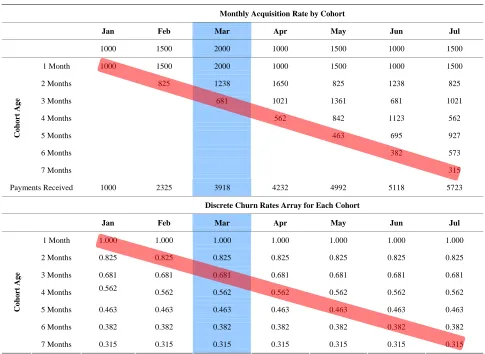
Table 3 presents a seven-month analysis of expected customer acquisition and corresponding churn. Each of the cohorts has a corresponding churn rate array (as seen in the lower discrete churn rates arrays). As the cohort ages, it has a corresponding reduction in subscribers as a function of the churn rate and the acquisition rate—this is the shaded diagonal region.
The number of active subscribers can be determined by summing the column for the given monthly cohort.
SubscribersMar 2000 1238 681 3918
*
Blue-shaded column.
By summing the diagonal, we can determine the cu- mu-lative number of subscription months for an entire cohort of users.
Cohort 1000 825 681 562 463 382 315
4228
Jan
*
Table 3. Example cohort analysis.
Monthly Acquisition Rate by Cohort
Jan Feb Mar Apr May Jun Jul
1000 1500 2000 1000 1500 1000 1500
1 Month 1000 1500 2000 1000 1500 1000 1500
2 Months 825 1238 1650 825 1238 825
3 Months 681 1021 1361 681 1021
4 Months 562 842 1123 562
5 Months 463 695 927
6 Months 382 573
Cohort Age
7 Months 315
Payments Received 1000 2325 3918 4232 4992 5118 5723
Discrete Churn Rates Array for Each Cohort
Jan Feb Mar Apr May Jun Jul
1 Month 1.000 1.000 1.000 1.000 1.000 1.000 1.000
2 Months 0.825 0.825 0.825 0.825 0.825 0.825 0.825
3 Months 0.681 0.681 0.681 0.681 0.681 0.681 0.681
4 Months 0.562 0.562 0.562 0.562 0.562 0.562 0.562
5 Months 0.463 0.463 0.463 0.463 0.463 0.463 0.463
6 Months 0.382 0.382 0.382 0.382 0.382 0.382 0.382
Cohort Age
7 Months 0.315 0.315 0.315 0.315 0.315 0.315 0.315
beginning of SaaS subscription data must be aligned with the start of the model. The model is designed with a ramp to reflect and predict the startup phase of the business. In seven months 1000 subscribers will result in 4228
subscription months, given the churn rate arrays ex- pressed.
The maximum revenue from the January cohort is
de-termined using the following method.
8. Limitations of the Model
January Subscribers Cohort Revenue
1000
$49.95 $285, 428 0.175
P a
When developing this analysis the goal was to build a rigorous base model that can be adapted to fit more ad-
vanced or complex needs. By focusing on the base model, we have limited the number of variables. The model can be adjusted to different SaaS businesses by: 1) duplicate- ing the retention curves and cohort arrays; and 2) in- creasing the retention curve arrays beyond 48 months. The maximum revenue that can be expected from a
cohort of 1000 subscribers starting in January is $285,000. With an average churn rate of 17.5% the entire cohort will have churned out within 48 months.
As discussed earlier in the analysis, it is also possible to introduce some of the machine learning algorithms to develop churn and retention curves. This will reduce the reliance on historical data at the beginning of the model. 7.6. Applying the Model
In order to apply this model to another SaaS business, two actions are important. First, past subscriptions will drive future payments. Thus, historically accurate data is needed to ensure accuracy in the model’s later predic- tions of payments, subscribers and MRR. Second, the
9. Conclusions
SaaS revenue can be readily modeled using historical behavior of subscribers. By combining the variables dis- cussed in this analysis, it is possible to predict future subscribers and subscription payments and, thus, reve- nue.
Forecasting provides management with expected fu- ture outcomes that are based on the best understanding of the business and current environmental variables it faces. Accurate predictions are a function of accurate historical data, a sufficiently robust model and knowledge of the business and its fundamental drivers. Understanding the SaaS business model equips the management team with critical forecast knowledge and allows them to take ac- tion to focus the business to maximize the return on in- vestment of capital.
The body of research on SaaS has set the stage for un-derstanding SaaS pricing, subscriber churn and retention, and the risks and costs associated with deploying SaaS solutions. Both academic and industry perspectives also provide approaches to continue the exploration and ex- pansion of the SaaS business model.
This paper defines and uses specific formulae to pro- vide a foundation of analysis. Any executive could use that foundation to develop a predictive model showing the future level of subscribers, subscriptions and pay- ments derived from historic churn and retention activity. Our analysis also provides an alternative to the simple view of churn as a single continuous rate. It does so by developing a flexible model that can be used with multi- ple discrete churn rates. Such flexibility in regard to the subscriber retention curve allows for highly accurate pre- dictions of future subscription payments and subsequent- ly revenue.
The use of a model allows executives to conduct risk- free tests of different scenarios, looking at the future ef- fect of a contemporary decision. This model can act as a type of “SaaS radar” highlighting predicted increases or decreases in the subscriber base resulting from changes in churn or acquisition rates.
As the SaaS business model becomes more widely adopted, more firms will search for methods of enhance- ing their reporting and forecasting capabilities. Measur- ing churn and retention is integral to the success of any SaaS business. This analysis provides the foundational definitions, formula and model structure to build a highly accurate forecasting model and in turn provides insights into future subscribers, subscriptions, payments and re- venue.
REFERENCES
[1] D. Durkee, “Why Cloud Computing Will Never Be Free,”
Communications of the ACM, Vol. 3, No. 5, 2010, pp.
62-69. doi:10.1145/1735223.1735242
[2] Gartner Research, “Gartner Says Worldwide Cloud Ser-vices Market to Surpass $10.9 Billion in 2012,” 2012. http://www.gartner.com/it/page.jsp?id=2163616
[3] Gartner Research, “Gartner Says Worldwide Software- as-a-Service Revenue to Reach $14.5 Billion in 2012,” 2012. http://www.gartner.com/it/page.jsp?id=1963815.
[4] R. S. Randhawa and S. Kumar, “Usage Restriction and Subscription Services: Operational Benefits of Rational Users,” Manufacturing & Service Operations Manage-ment, Vol. 10, No. 3, 2008, pp. 429-447.
doi:10.1287/msom.1070.0180
[5] J. Fitzgerald and J. Hynes, “Salesforce.Com Announces Third Quarter Fiscal Year 2005 Results,” 2012.
http://www.sfdcstatic.com/assets/pdf/investors/EarningsP R_Q305.pdf
[6] D. Havlek, “Salesforce,” 2012.
http://www.stdcstatic.com/assets/pdf/investors/Q412_Press_ release_Final_financials.pdf
[7] A. Benlian and T. Hess, “Opportunities and Risks of Soft- ware-as-a-Service: Findings from a Survey,” Decision
Support Systems, Vol. 52, No. 1, 2011, pp. 232-246.
doi:10.1016/j.dss.2011.07.007
[8] Bessemer Venture Partners, “Bessemer’s Top 10 Laws of Cloud Computing and SaaS,” 2010.
http://www.bvp.com/sites/default/files/bvps_10_laws_of_ cloud_saas_winter_2010_release.pdf
[9] S. Noble, “Defining Churn Rate,” 2011.
http://www.shopify.com/technology/4018382-defining-churn- rate-no-really-this-actually-requires-an-entire-blog-post
[10] T. Tzuo, “The Only Three SaaS Metrics That Matter,” 2012. http://www.slideshare.net/Zuora/zuora-always-on20123-s aas-metrics-that-matter-12301579
[11] R. Doctors, R. Katz, J. Berstein and B. Schefers, “Is the Price Right? Strategies for New Introductions,” Journal
of Business Strategy, Vol. 31, No. 3, 2010, pp. 29-37.
doi:10.1108/02756661011036682
[12] J. Espadas, A. Molina, G. Jimenez, M. Molina, P. Rami-rez and D. Concha, “A Tenant-Based Resource Alloca-tion Model for Scaling Software-as-a-Service Applica-tions over Cloud Computing Infrastructures,” Future Ge-
neration Computer Systems, Vol. 29, No. 1, 2012, pp.
273-286. doi:10.1016/j.future.2011.10.013
[13] K. Popp, “Software Industry Business Models,” IEEE
Software, Vol. 28, No. 4, 2011, pp. 26-30.
doi:10.1109/MS.2011.52
[14] J. Qi, L. Zhang, Y. Liu, L. Li, Y. Zhou, Y. Shen, L. Liang and H. Li, “ADTreesLogit Model for Customer Churn Prediction,” Annals of Operations Research, Vol. 168, No. 1, 2009, pp. 247-265. doi:10.1007/s10479-008-0400-8 [15] G. Nie, W. Rowe, L. Zhang, Y. Tian and Y. Shi, “Credit
Card Churn Forecasting by Logistic Regression and De-cision Trees,” Expert Systems with Applications, Vol. 38, No. 12, 2011, pp. 15273-15285.
doi:10.1016/j.eswa.2011.06.028
Support Systems, Vol. 52, No. 1, 2011, pp. 207-216. doi:10.1016/j.dss.2011.07.005
[17] K. Coussement and D. Van den Poel, “Churn Prediction in Subscription Services: An Application,” Expert
Sys-tems with Applications, Vol. 34, No. 1, 2008, pp. 313-327.
doi:10.1016/j.eswa.2006.09.038
[18] J. Ahna, S.-P. Han and Y.-S. Lee, “Customer Churn Ana- lysis: Churn Determinants and Mediation,”
Telecommu-nications Policy, Vol. 30, No. 10-11, 2006, pp. 552-568.
[19] G. Madden, S. Savage and G. Coble-Neal, “Subscriber Churn in the Australian ISP Market,” Information
Eco-nomics and Policy, Vol. 11, No. 2, 1999, pp. 195-207.
doi:10.1016/S0167-6245(99)00015-3
[20] J. York, “SaaS Metrics Guide to SaaS Financial Perfor- mance,” 2010.