http://www.scirp.org/journal/health ISSN Online: 1949-5005
ISSN Print: 1949-4998
Satisfaction of the Service Provider with the
Organization of the Timely Cervical Cancer
Detection Program
Gutiérrez-Enríquez Sandra Olimpia
1, Terán-Figueroa Yolanda
1*, Gaytán-Hernández Darío
1,
Díaz-Oviedo Aracely
1, Zúñiga-Martínez Ma. de Lourdes
2, Hernández-Nava Nereyda
2,
Cruz Ortíz Maribel
1, Pérez Rodríguez María del Carmen
1, Ramírez-Ramírez Rocío
11Faculty of Nursing and Nutrition, Autonomous University of San Luis Potosi, San Luis Potosi, Mexico 2Academic Coordination Altiplano Region, Autonomous University of San Luis Potosi, San Luis Potosi, Mexico
Abstract
Cervical cancer is a priority health problem in Mexico. The objective of this work was to know the degree of satisfaction of the service provider with the organization of the program of Timely Detection of Cervical Cancer, specifi-cally in taking of the cervical cytology. The study design was observational, transversal and prospective conducted from January to May 2015 in Jurisdic-tion 1 of the Health Services of San Luis Potosí, Mexico, in 20 health centers. Participants were 87 service providers whose function is to take cervical cy-tology (Pap smears). A 32-question questionnaire was applied, with Likert scale with 5 levels of response: 1 (dissatisfied), 2 (little satisfied), 3 (indiffe-rent), 4 (satisfied) and 5 (very satisfied). The score range was 32 points (min-imum job satisfaction) up to 160 points (Max(min-imum job satisfaction). We ana-lyzed 2 dimensions: 1) intrinsic factors that have to do with motivation and professional recognition, and 2) extrinsic factors related to infrastructure, materials, remuneration and labor policies. Each factor consisted of four cat-egories. Descriptive statistics and linear correlation of Pearson were applied for the analysis of data. Participants signed an informed consent letter. Of 4 categories, in the intrinsic dimension, the one with the highest percentage of satisfaction was “delegation of activities” with 28.8%. In the extrinsic dimen-sion, the category with the highest percentage of satisfaction was “infrastruc-ture and materials” with 49.4%; while satisfaction increase in intrinsic dimen-sions also does in extrinsic dimendimen-sions, such correlations are significant (p < 0.05), except between delegation of activities and remuneration (r = 0.074 and p = 0.497). The higher hierarchical level, the men, the bachelor academic level and older people showed the highest level of satisfaction.
How to cite this paper: Olimpia, G.-E.S., Yolanda, T.-F., Darío, G.-H., Aracely, D.-O., de Lourdes, Z.-M.Ma., Nereyda, H.-N., Ma-ribel, C.O., del Carmen, P.R.M. and Rocío, R.-R. (2017) Satisfaction of the Service Pro- vider with the Organization of the Timely Cervical Cancer Detection Program. Health, 9, 289-298.
https://doi.org/10.4236/health.2017.92020
Received: January 24, 2017 Accepted: February 14, 2017 Published: February 17, 2017
Copyright © 2017 by authors and Scientific Research Publishing Inc. This work is licensed under the Creative Commons Attribution International License (CC BY 4.0).
Keywords
Job Satisfaction, Cervical Cancer, Health Providers
1. Introduction
Cervical cancer (CC) is the malignant neoplasia that usually arises in the region of the squamo-columnar junction of the cervical epithelium of the uterus and worldwide has a negative impact on the female population. Despite the existence of screening programs, women suffer and die from this disease [1]. In 2012 there were 5,280,000 new cases [2], affecting approximately six out of every 100,000 women; this represents approximately 275,000 deaths per year in developing countries, which corresponds 88% of the cases worldwide [3]. Mortality rates are 3 times higher in Latin America and the Caribbean than in North America, which reveals enormous inequalities in health [4]. One of the CC’s research lines is the health systems, where quality management indicators such as evaluation are used, in this case, of the Cervical Cancer Screening Program.
The Specific Action Program 2007-2012 of CC in Mexico [5] indicates that the inefficiency of this is due in large part to environmental factors, like favorable conditions of work and infrastructure (extrinsic factors). These refer to the fact that workers like to perform their work in a pleasant environment, of indepen-dence and therefore, favoring the welfare and quality of their work. Here also in-fluences the organizational culture of the company, where it is sought that the organizational and personal goals are compatible, and if this happens, the work-ers will perceive it in a positive way, thus promoting a higher degree of job satis-faction. They also influence salary compensation and promotion strategies [6].
It is thus that this work has as research line the satisfaction of the service pro-vider that implements the Cervical Cancer Timely Detection program. Frederick Herzberg was taken as a theoretical reference, who in his theory of motivation and hygiene, also known as the two-factor theory, points out that satisfaction result of motivational factors and that the lack of them causes job dissatisfaction. His studies show that motivation in work environments stems from two sets of independent and specific factors: Intrinsic and extrinsic. Thus, intrinsic factors are related to the challenge to work, compatibility between personalities, job post and job opportunity. On the other hand, the extrinsic factors are the favorable conditions of work, the remuneration and the policies of the company [7]. In this way, the present study analyzes the satisfaction of the personnel with the in-frastructure, inputs and the organization of the program of Timely Detection of Cervical Cancer, as well as the motivation of the employee towards his work.
2. Methods
2.1. Data Source
in the period of January-May 2015 in Jurisdiction 1 of the Health Services of San Luis Potosí, Mexico, in 20 health centers. Were studied 87 people, which are the total number of staff whose function is to take cervical cytology (Pap smears).
To evaluate the level of satisfaction of the personnel participating in the Pro-gram for the Timely Detection of Cervical Cancera questionnaire was carried out. It consists of 32 questions; each one structured using a Likert scale, of 1 - 5 in the sense of lower to higher degree of satisfaction as follows: 1) (dissatisfied), 2) (little satisfied), 3) (indifferent), 4) (satisfied) and 5) (very satisfied). The score range of the entire questionnaire ranged from 32 (minimum work satisfaction) to 160 (maximum job satisfaction). The 2 factors explored were: extrinsic by categories (self-realization, professional recognition, delegation of activities and recognition of contributions to the program); and intrinsic categories (infra-structure and materials, remuneration, labor relations and policies of the institu-tion). The survey was answered as an interview.
2.2. Data Analysis
Statistical analysis was performed through the SPSS version 18 program. Pear-son’s linear correlation was applied to the scores obtained in each of the intrinsic and extrinsic dimensions and a level of significance of 0.05. Applied the mean and standard deviation for determine the variables of the job satisfaction of the professionals in charge of cytology at each health center.
2.3. Ethical Considerations
The legal provisions on risk-free investigations promulgated by the General Health Law article 17 [8] were taken in to account. The present study complies with the principles of the Helsinki Declaration. Participants signed an informed consent letter. The present research was approved by the Ethics Committee of the Faculty of Nursing and Nutrition of the UASLP with the registration number CEIFE 2015-108.
3. Results
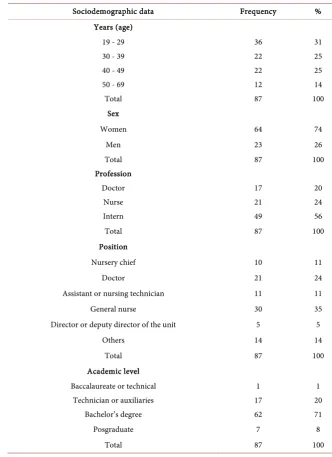
(bac-calaureate or technical) (Table 1).
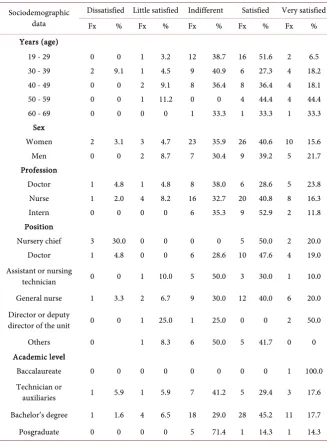
[image:4.595.199.532.265.723.2]The age of the service provider was organized for decades from 19 to 29 years, 30 to 39 years, 40 to 49 years, 50 to 59 years and 60 to 69 years. The range with the highest percentage of satisfaction was 50 to 59 years (44.4% satisfied), fol-lowed by the range of 60 to 69 years (33.3% highly satisfied), the range of 30 to 39 years (18.2% satisfied), the range of 40 to 49 years (18.1% satisfied), and the range of 19 to 29 years (6.5% satisfied). In relation to the sex of the service pro-vider, 74% are women and 26% are men. The men reported a higher degree of equivalent satisfaction than women (21.7%, vs. 15.6%, very satisfied, respective-ly). The highest percentage after those mentioned above is the indifferent with 35.9% in women and 30.4% in men.
Table 1. Sociodemographic data of study participants. n = 87.
Sociodemographic data Frequency %
Years (age)
19 - 29 36 31
30 - 39 22 25
40 - 49 22 25
50 - 69 12 14
Total 87 100
Sex
Women 64 74
Men 23 26
Total 87 100
Profession
Doctor 17 20
Nurse 21 24
Intern 49 56
Total 87 100
Position
Nursery chief 10 11
Doctor 21 24
Assistant or nursing technician 11 11
General nurse 30 35
Director or deputy director of the unit 5 5
Others 14 14
Total 87 100
Academic level
Baccalaureate or technical 1 1
Technician or auxiliaries 17 20
Bachelor’s degree 62 71
Posgraduate 7 8
Total 87 100
In relation to the profession of the service provider, 23.8% of the medical staff is very satisfied and the nursing staff 16.3%. The internship service provider (doctor or nurse), 11.8% said they were very satisfied. On the other hand, as re-gards the position of the provider, the one who has the functions of head of Nursery chiefis dissatisfied 30.0% and 50.0% satisfied. The medical staff is indif-ferent 28.6% and very satisfied 19.0%. The staff that works as an auxiliary or nursing technician is very satisfied 10.0% and 50.0% indifferent, while the staff that performs as a general nurse is very satisfied at 20.0% and 30.0% is indiffe-rent. As for the staff that holds a management position 50.0% is very satisfied. Regarding the academic level, 41.2% of technicians or auxiliaries are indifferent, as well as staff with a degree (29%) and staff with some postgraduate (71.4%) (Table 2).
Table 2. Overall satisfaction in relation to sociodemographic variables. N = 87.
Sociodemographic data
Dissatisfied Little satisfied Indifferent Satisfied Very satisfied
Fx % Fx % Fx % Fx % Fx %
Years (age)
19 - 29 0 0 1 3.2 12 38.7 16 51.6 2 6.5 30 - 39 2 9.1 1 4.5 9 40.9 6 27.3 4 18.2 40 - 49 0 0 2 9.1 8 36.4 8 36.4 4 18.1
50 - 59 0 0 1 11.2 0 0 4 44.4 4 44.4
60 - 69 0 0 0 0 1 33.3 1 33.3 1 33.3
Sex
Women 2 3.1 3 4.7 23 35.9 26 40.6 10 15.6
Men 0 0 2 8.7 7 30.4 9 39.2 5 21.7
Profession
Doctor 1 4.8 1 4.8 8 38.0 6 28.6 5 23.8 Nurse 1 2.0 4 8.2 16 32.7 20 40.8 8 16.3
Intern 0 0 0 0 6 35.3 9 52.9 2 11.8
Position
Nursery chief 3 30.0 0 0 0 0 5 50.0 2 20.0 Doctor 1 4.8 0 0 6 28.6 10 47.6 4 19.0 Assistant or nursing
technician 0 0 1 10.0 5 50.0 3 30.0 1 10.0 General nurse 1 3.3 2 6.7 9 30.0 12 40.0 6 20.0 Director or deputy
director of the unit 0 0 1 25.0 1 25.0 0 0 2 50.0
Others 0 1 8.3 6 50.0 5 41.7 0 0
Academic level
Baccalaureate 0 0 0 0 0 0 0 0 1 100.0
Technician or
auxiliaries 1 5.9 1 5.9 7 41.2 5 29.4 3 17.6 Bachelor’s degree 1 1.6 4 6.5 18 29.0 28 45.2 11 17.7 Posgraduate 0 0 0 0 5 71.4 1 14.3 1 14.3
In relation to the intrinsic dimension, the category with the highest percen-tage of satisfaction (28.8%) is “delegation of activities”, and the category with the highest percentage of dissatisfaction (20.9%) is “professional recognition” (Table 3).
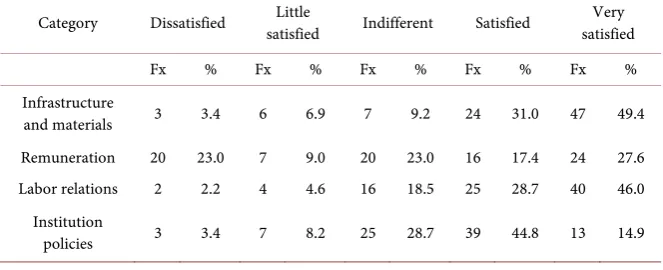
Regarding the extrinsic dimension, according to satisfaction level, the catego-ry with the highest degree of satisfaction (49.4%) was “infrastructure and mate-rials” and the category with the highest degree of dissatisfaction (23%) was the “remuneration”. It is observed that the staff is indifferent to the category “poli-cies of the institution” by 28.7% (Table 4).
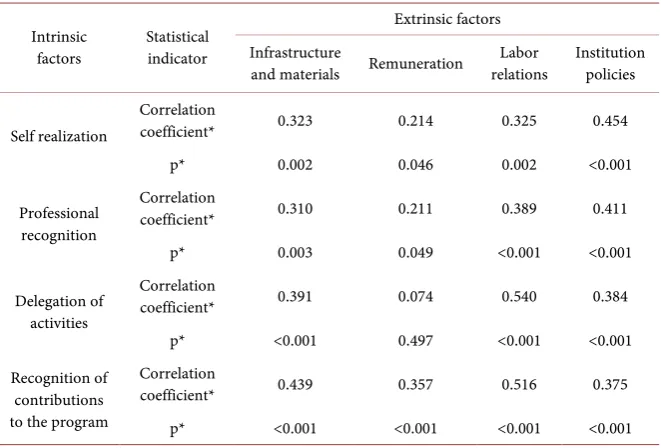
The value of all correlation coefficients are positive, indicating that while sa-tisfaction increases in intrinsic dimensions also does in extrincical dimensions, such correlations are significant (p < 0.05), except between Delegation of ac-tiv- ities and Remuneration (r = 0.074 and p = 0.497) (Table 5).
4. Discussion
[image:6.595.208.539.417.540.2]Regarding the socio-demographic data of this study, it was found that the age prevalence range was 19 - 29 years, similar to the study carried out by Cifuentes Rodríguez in 2012, on the working conditions and the degree of satisfaction of the Nursing professionals [9], where the participants were also young people between ages of 22 and 48 years. On the other hand, in a study carried out by Adams in 2000, it is found that at older age there is a greater dissatisfaction due
Table 3. Level of satisfaction by categories of the intrinsic dimension. N = 87.
Category Dissatisfied satisfied Indifferent Satisfied Little satisfied Very
Fx % Fx % Fx % Fx % Fx %
Self realization 9 10.4 19 21.8 19 21.8 23 26.5 17 19.5 Professional recognition 17 20.9 24 27.9 25 28.9 17 18.0 4 4.3
Delegation of activities 5 5.7 9 10.3 18 20.7 30 34.5 25 28.8 Recognition of contributions to
the program 3 3.4 16 18.5 27 31.0 26 29.9 15 17.2
Source: direct.
Table 4. Level of satisfaction by categories of the extrinsic dimension. N = 87.
Category Dissatisfied satisfied Little Indifferent Satisfied satisfied Very
Fx % Fx % Fx % Fx % Fx %
Infrastructure
and materials 3 3.4 6 6.9 7 9.2 24 31.0 47 49.4 Remuneration 20 23.0 7 9.0 20 23.0 16 17.4 24 27.6 Labor relations 2 2.2 4 4.6 16 18.5 25 28.7 40 46.0
Institution
policies 3 3.4 7 8.2 25 28.7 39 44.8 13 14.9
[image:6.595.207.539.590.725.2]Table 5. Correlation between intrinsic and extrinsic factors.
Intrinsic
factors Statistical indicator
Extrinsic factors Infrastructure
and materials Remuneration relations Labor Institution policies
Self realization
Correlation
coefficient* 0.323 0.214 0.325 0.454
p* 0.002 0.046 0.002 <0.001
Professional recognition
Correlation
coefficient* 0.310 0.211 0.389 0.411 p* 0.003 0.049 <0.001 <0.001
Delegation of activities
Correlation
coefficient* 0.391 0.074 0.540 0.384 p* <0.001 0.497 <0.001 <0.001 Recognition of
contributions to the program
Correlation
coefficient* 0.439 0.357 0.516 0.375 p* <0.001 <0.001 <0.001 <0.001
Source: direct. *Linear correlation of Pearson.
to the monotony of work [10], and in the present investigation it was found that the young population reported being more dissatisfied in most categories, unlike older service providers. In this study, the male population was most satisfied, in contrast to was found in a study carried out by Carrillo and co-workers in 2013, which indicates that women show greater satisfaction than men with work or ac-tivity they perform [11].
Regarding satisfaction according to the profession performed by the service provider, it was found that physicians present a higher degree of job satisfaction in all categories, unlike what was found by Acamer-Raga and co-workers in 2009 [12]. In this study, the physicians showed a lower degree of job satisfaction, in relation to a less varied distribution of tasks and a greater burden of care. The functioning of the teams, incentives and opportunities for professional devel-opment, as well as workload and environmental conditions, were assessed nega-tively by this group, in front of the nursing staff.
of activities, supervision received and recognition of contributions to the pro-gram of Timely Detection of Cervical Cancer of Mexico was found to be mostly indifferent. In a study done in Argentina by Briseño 2005 [14], occupational sa-tisfaction was measured in the nursing staff and it was found that the degree of dissatisfaction is 100% with respect to the salary or possibilities of promotion and 100% refer to little overall satisfaction. With regard to the relationship with bosses, superiors and the organization of work, most were little satisfied. Health personnel are satisfied with regard to the “self-actualization” category in relation to the training they receive, as well as opportunities to develop professionally in the workplace. The percentage that follows is indifferent. With regard to the category of professional recognition, the level of satisfaction of health personnel was evaluated in relation to the economic and moral stimuli granted by their superiors; it was obtained that the majority of the staff is not satisfied especially in the aspect of the economic remuneration for their services, as in the study carried out by Tapia Martínez and co-workers in 2010 [15] where it was found that the staff is not satisfied with the way in which it is supported and supervised by the immediate superiors, and in turn it alludes to the nonconformity with the perceived salary. In relation to the categories of “delegation of activities and recognition of contributions” to the program, it was obtained that the main re-sults are: satisfied. These categories are within the intrinsic factors, that is to say the motivational factors, which, if modified, are able to increase. The two cate-gories mentioned above include the autonomy and freedom of the personnel in relation to their work, as well as the participation that this has and the attention of superiors to their suggestions. In the present study the staff reports that there are limitations to their autonomy in relation to the work method and task plan-ning, as well as in the strategies to be able to provide a better attention to the pa-tients.
professionals, administrative support, the relationship with the immediate au-thorities and the equality and fairness in the treatment they receives, health per-sonnel refers to feeling satisfied, the result with the purchase of a match with Wyatt and Harrison in 2010,where 87% of the participants considered that their job satisfaction was excellent or good. The factor most identified for job satisfac-tion was “interpersonal relasatisfac-tionships with colleagues”, as well as the support they receive from their work environment and the recognition they receive for their status [18]. In the present study while satisfaction increases in intrinsic di-mensions also does in extrinsic didi-mensions, such correlations are significant, except between delegation of activities and remuneration, the majority of staff surveyed reported having no problems regarding communication and relation-ship with other colleagues, but they emphasized the relationrelation-ship with their supe-riors and immediate bosses, since they consider that there is a great lack of communication. This is very important since Herzberg considers that the rela-tionship of an individual to his work is fundamental and that his attitude toward work can determine his success or failure. In the “institution policy” category, degree of satisfaction of the personnel with regard to the regulations was taken into account; the latter refers to the legal framework of the Mexican Cervical Cancer Timely Detection program, achievements of goals and objectives of the same, as well as the system of complaints and benefits. The health staff is very satisfied, in relation to the issues mentioned above.
5. Conclusion
Finally, for future research it is recommended to study the factors that influence the motivation of the personnel to strengthen their training and professional development, as well as the aspects involved for the service provider to have a high satisfaction in the work.
References
[1] United States of Mexico, Ministry of Health (2006) Official Mexican Standard NOM-014-SSA2-1994, for the Prevention, Detection, Diagnosis, Treatment, Con-trol and Epidemiological Surveillance of Uterine Cancer. Official Newspaper of the Federation.
[2] Ferlay, J., Soerjomataram, I., Dikshit, R., Eser, S., Mathers, C., Rebelo, M., Parkin, D.M., Forman, D. and Bray, F. (2015) Cancer Incidence and Mortality Worldwide: Sources, Methods and Major Patterns in GLOBOCAN 2012. International Journal of Cancer, 136, E359-E386. https://doi.org/10.1002/ijc.29210
[3] GLOBOCAN Cancer Fact Sheets: Cervical Cancer (2012).
http://www.discoverymedicine.com/Lynette-Denny/2012/08/27/cervical-cancer-pre vention-and-treatment/
[4] International Agency of Research in Cancer (IARC) Cervical Cancer (2014).
http://screening.iarc.fr/cervicalindex.php
[5] Ministry of Health (2008) Undersecretary of Prevention and Social Promotion. Spe-cific Action Program 2007-2012, Cervical Cancer. United States of Mexico. [6] Torres Lobatón, L., Rojo Herrera, G., Torres Rojo, A., Hurtado Estrada, G. and
Risk Factors. Ginecología y Obstetricia de México, 72, 466-474.
[7] Montoya-Fuentes, H., Suárez-Rincón, A.E., Ramírez-Muñoz, M.P., Arévalo-Lagunas, I., Morán-Moguel, M.C., Gallegos-Arreola, M.P., Flores-Martínez, S.E., Rosales- Quintana, S. and Sánchez-Corona, J. (2001) The Detection of Human Papillomavi-rus 16, 18, 35 and 58 in Cervical-Uterine Cancer and Advanced Degree of Squam-ous Intraepithelial Lesions in Western Mexico: Clinical-Molecular Correlation. Gi-necologíay Obstetricia de México, 9, 137-142.
[8] United States of Mexico (1986) Presidency of the Republic. Regulation of the Gen-eral Health Law on the Provision of Health Care Services.
[9] Cifuentes Rodríguez, J.E. and Manrique, F.G. (2014) Job Satisfaction in Nursing in a Fourth Level Attention Health Institute, Bogotá, Colombia. Revista Avances de En-fermería, 32, 217-227. https://doi.org/10.15446/av.enferm.v32n2.46207
[10] Adams, B. (2000) Hospital Nurses’ Job Satisfaction, Individual and Organizational Characteristics. Journal of Advanced Nursing, 32, 563-543.
https://doi.org/10.1046/j.1365-2648.2000.01513.x
[11] Carrillo-García, C., Solano-Ruíz, M.C., Martínez-Roche, M.E. and Gómez-García, C.I. (2013) Influence of Gender and Age: Job Satisfaction of Health Professionals. Revista Latino-Americana de Enfermagem, 21, 1314-1320.
https://doi.org/10.1590/0104-1169.3224.2369
[12] Acámer Raga, F., López Arribas, C. and López-Torres Hidalgo, J. (1997) Work Sa-tisfaction of Primary Care Health Professionals. Atención Primaria, 20, 401-407. [13] García-Ramos, M., Luján-López, M. and Martínez Corona, M. (2010) Work
Satis-faction of Health Personnel. Revista de Enfermeríadel IMSS, 15, 63-72.
[14] Briseño, C.E. (2005) Job Satisfaction in the Nursing Staff in the Health Sector Pub-lic. Electronic Journal of Intensive Medicine. Argentina: Especial Article, 5.
http://remi.uninet.edu/2005/05/REMIA030.pdf
[15] Tapia Martínez, H., Ramírez Rodríguez, C. and Islas García, E. (2009) Job Satisfac-tion in Nurses of the Oncology Century XXI Hospital NaSatisfac-tional Medical Center IMSS. Enfermería Universitaria, 6, 21-25.
http://www.redalyc.org/articulo.oa?id=358741831004
[16] Sarwar, S. and Abugre, J. (2013) The Influence of Rewards and Job Satisfaction on Employees in the Service Industry. The Business and Management Review, 3, 23-32.
http://www.abrmr.com/myfile/best_track/best_track_50317.pdf
[17] Solano-Aguilar, S. (2010) Labor Satisfaction in Nursing Professionals. Revista CUIDARTE, 1, 53-62. http://www.redalyc.org/articulo.oa?id=359533177008 [18] Wyatt, J. and Harrison, M. (2010) Certified Pediatric Nurses’ Perceptions of Job
Submit or recommend next manuscript to SCIRP and we will provide best service for you:
Accepting pre-submission inquiries through Email, Facebook, LinkedIn, Twitter, etc. A wide selection of journals (inclusive of 9 subjects, more than 200 journals)
Providing 24-hour high-quality service User-friendly online submission system Fair and swift peer-review system
Efficient typesetting and proofreading procedure
Display of the result of downloads and visits, as well as the number of cited articles Maximum dissemination of your research work
Submit your manuscript at: http://papersubmission.scirp.org/