A Conceptual Model for Success in Implementing
Knowledge Management: A Case Study in Tehran
Municipality
Manoucher Ansari1, Hossein Rahmany Youshanlouei2*, Mohammad Mirkazemi Mood3
1Faculty Management, University of Tehran Chamran Highway, Tehran, Iran; 2Young Research Club, Salmas Branch, Islamic Azad
University, Salmas, Iran; 3Management Faculty, University of Tehran, Tehran, Iran.
Email: {*Rahmani82,md.mirkazemi}@gmail.com,[email protected]
Received January 20th,2012; revised February 24th, 2012; accepted March 1st, 2012
ABSTRACT
In this “information and knowledge” age, instead of traditional financial assets and even large markets, knowledge capital has been the competitive edge for major corporations. This has lead to a new concept called “knowledge man-agement”. Indeed, the identification of knowledge in business sectors as a competitive advantage and strategic resource intensifies the necessity of implementation of knowledge management (KM) in organizations. Knowledge management is the process of identifying, selecting, organizing, and transferring important information and skills, which exists as disorganized form in the organization. However, there are several stories of failed implementation of knowledge man-agement in organizations. In order to succeed in implementing knowledge manman-agement, identification of the success factors for knowledge management is of great importance. The current research has therefore presented a conceptual model for implementing knowledge management successfully in Tehran municipality. This study has first identified effective variables on success of knowledge management; then has evaluated its significance and developed a concep-tual model for the critical factors on successful knowledge management in the organization under study. According to the conceptual model offered by this research, these critical success factors are dimensions of organizational culture, strategy and leadership, organizational structure, information technology infrastructure and human resources.
Keywords: Knowledge Management; Critical Success Factors; Tehran Municipality
1. Introduction
The current world is experiencing an era in which knowl- edge is a basic commodity, knowledge streams have been highlighted as the most important factor of economy [1]. And knowledge has been transformed into a competitive advantage. In such a situation, those organizations can hope to survive which rely on their knowledge itself rather than their physical assets [2]. Therefore, by ac-cepting the knowledge as a strategic resource for organi-zations and its significance on the organization’s capabil-ity and stabilcapabil-ity within the competitive environment, there has been appeared an urgent need to create tech-niques for creating, sharing, and employing knowledge in the organizations. In order to use this valuable asset, the organizations are required to manage their knowledge properly. Knowledge management is a process which helps the organizations to identify, choose, organize, dis- tribute and share significant information and skills, as a part of their context, and is usually available in unstruc-
unstructured form [3]. Applying the knowledge manage- ment based on their knowledge and intellectual capital will enable the organization to produce wealth or to cre-ate value from intellectual and knowledge-based assets [4]. However, lack of sound mechanisms to analyze and implement knowledge management as well as the essen-tial prerequisites, has made this kind of investment seem as an extra expenditure in managers’ point of view [5]. In order to prevent this issue, organizations must first launch to identify critical success factors for implement-ing knowledge management and then, provide appropri-ate base to implement it through investment on the iden-tified factors; since knowledge management is a set of factors by effective and coordinated interaction of which, it will be accomplished successfully. Critical success fac-tors are a limited number of activities which would lead to competitive success [6]. These factors can impose sig-nificant effect on success of competitive position for the organization if managed correctly [7]. They will also im- prove the chance to execute projects [8]. Critical success factors have a key role in successful implementation of
knowledge management meanwhile providing proper in- frastructure for them can lead to successful knowledge management [9]. This paper aims at suggesting a con-ceptual model for successful knowledge management in order to make solidarity among the results from previous studies which had commonly analyzed the effect and relation of effective elements of critical success factors in implementing knowledge management qualitatively and intellectually. It will also try to offer a localized model for a semi-governmental organization in Iran as a case study. The following sections of this paper deals with identifying literature review of critical success factors in implementing knowledge management in previous stud-ies and providing methodology to collect and analyze data. At the end, having compared results of the current research with that of the previous ones, practical conclu-sions will be made for managers to implement knowl-edge management successfully within organizations.
2. Literature Review
Knowledge management was at first just a process to adopt a systematic approach to gain, structure, manage and distribute knowledge throughout an organization in order to implement tasks quickly, reuse procedures and reduce unnecessary repeats[4]. However, Davenport be-lieves that knowledge management is trying to explore the properties hidden in individuals’ mind and transfer this hidden “treasure” to organizational assets which can be accessible and usable extensively by people who are responsible for organizational decision making [10]. In Jung’s point of view, knowledge management is an inte-grated systematic approach to identify, manage and share all informational properties of the organization including database, documents, policies and procedures. Benefits and necessities of using knowledge management have been frequently emphasized in the literature such that Drucker(1993) [11] argues that secret of success for or-ganizations of 21st century is concealed in adequate im-plementation of knowledge management which includes reusing the existing knowledge and prevention from re-peated expenditures to solve the same problems. Knowl-edge management reduces the time duration from prob-lem declaration to probprob-lem resolution. It also leads to re-inforce strategy of innovative organization, maximize in- ternal performance, coordination, service to customers and general profit, creation of value and creativity [12,13].
One of the most considerable parts of knowledge man- agement literature is the critical success factors of knowl- edge management. Various studies have been launched on these factors and their obtained results have dispari-ties regarding the differences between industry and envi-ronment of them. Critical success factors are used to identify and prioritize business requirements and
ef-fort to share knowledge, quality of knowledge manage-ment system, compensations and activity of knowledge management team will considerably affect knowledge management performance. Eventually, they have catego-rized nine enablers of knowledge management in three classes of organizational characteristics, information tech- nology and managerial support. Wong (2005) [21] intro-duces eleven success factors after studying several lit-eratures and identifies their limitations: support of man-agement and leadership, culture, information technology, strategy and goal, evaluation, organizational infrastruc-ture, activities and processes, motivation, resources, education and training, management of human resources. Chong & Choi (2005) [22] have noticed eleven key fac-tors in implementing knowledge management success-fully which are: training employees, involvement of em-ployees, teamwork, delegation, leadership and commit-ment of senior managecommit-ment, removal of organizational limitations, IT infrastructure, knowledge-based perform- ance criteria, knowledge-friendly culture, comparative study, and knowledge structure. Wong and Aspinwall (2005) [23] have examined eleven success factors in their research and have sorted them in terms of importance for medium and small organizations. Their factors were: leadership and support management, culture, strategy and goal, resources, processes and activities, education and training, management of human resources, information technology, motivational reinforcements, organizational infrastructure and evaluation. Hung et al. (2005) [24] have also chosen commitment and leadership of senior management, involvement of the employees, reliable teamwork, supporting the employees, infrastructure of informational systems and performance evaluation as the factors of successful knowledge management. Akhavan et al. (2006) [25] in their article named “Critical success factors of knowledge management systems: A multiple case study” have proposed a set of critical success factors in addition to a conceptual framework as the map for success in application of knowledge management sys-tems using approach of grounded theory and data from some successful companies in implementing knowledge management systems. Yeh et al. (2006) [26] presented a paper on “Enablers of knowledge management: A case study” in which they aim to analyze fundamental role of the enablers for execution of knowledge management inside the organization. They argue that these enablers can develop knowledge; stimulate, share and keep knowl-edge creation within the organization; and enhance or influence activities of knowledge management. They in- troduce organizational culture, individuals, information technology, and strategy and leadership as enablers of knowledge management by investigating on the previous literature. They claim that support from senior managers of the organization is the most significant part for
strat-egy and leadership. Anantatmula and Kanungo (2007) [27], in their study named “modeling the enablers to im-plement knowledge management successfully”, conclude from the literature that there are 13 factors which play role in successful implementation of knowledge manage- ment. Then, they determine underlying relations between these factors and develop strategies for successful im-plementation of knowledge management.
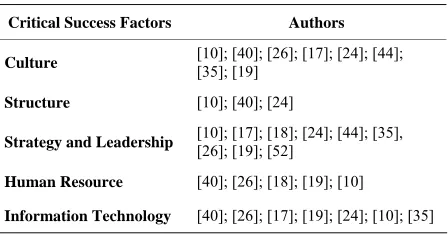
After extensive study on the literature in order to iden-tify critical success factors in of Knowledge Management (KM) according to the previous investigations from 1997 to 2010 within the organizations, 5 main factors were identified for successful implementation of KM. Table 1
has summarized these 5 factors along with the name of authors who have initially noticed them.
Next section deals with analyzing individually the most important critical success factors which was men-tioned in Table 1.
3. Critical Success Factors in Successful
Implementation of Knowledge
Management
3.1. Culture
[image:3.595.313.537.615.732.2]Organizational culture is comprised of common values, believes and norms for members of an organization which correlated them to each other [28]. Organizational culture determines how affairs are done in the organiza-tion for its employees. Indeed, culture is the same under-standing of organization which is observed within all members and is indicative of common and constant speci-fications which distinguish the organization from other organizations. In other words, Organizational culture speci- fies social identity studies of any organization [29]. Or-ganizational culture has emerged as a key factor for or-ganizational changes and modifications [29]. Based on Peter and Waterman, human elements which exist in the culture are regarded as effective key determinants on business performance and change management. Davenport and Pursak (2000) [2] notice organizational culture as the fundamental index to evaluate success of knowledge management within organizations; such that successful
Table 1. Critical success factors in the literature.
Authors Critical Success Factors
[10]; [40]; [26]; [17]; [24]; [44]; [35]; [19]
Culture
[10]; [40]; [24]
Structure
[10]; [17]; [18]; [24]; [44]; [35], [26]; [19]; [52]
Strategy and Leadership
[40]; [26]; [18]; [19]; [10]
Human Resource
[40]; [26]; [17]; [19]; [24]; [10]; [35]
knowledge management in the organization depends on its value in the organizational culture [2]. Trust, participa-tion, encouragements, participation leadership and forces to develop organizational goals are considered in relation with organizational culture [30]. Organizational culture is formed and supported through inter-related components of strategy, individuals, process and structures [31]. Many published works and experts in this field believe that the organizational culture has major effect on knowledge management or sharing. The same principles which are used for the culture can be also applied for knowledge management, since the organization can have a knowl-edge-based culture. Such a knowlknowl-edge-based culture may challenge individuals throughout the organization to dis-tribute the knowledge [2]. Many researchers have recog-nized organizational culture as one of the necessary fac-tors to implement knowledge within an organization [10, 32,33]. Achieving the knowledge culture requires mana-gerial attention to three aspects: preparation of organiza-tion, managing knowledge properties, and application of knowledge for competitive advantage [34]. If the or-ganization tends to distribute knowledge in essence, then enabling the distribution will be much easier. When the organization develops a culture to store knowledge, nega-tive consequences of its distribution must be kept away from the organization. People would like to share their knowledge and they want to be aware of knowledge abil-ity of others. Therefore, the required tools and environ-ment must be provided for those who choose to distribute their knowledge in this way, while some procedures must be created in order to support knowledge creation and distribution attempts [35]. As a result, managers of the organization should try to render knowledge manage-ment rules and procedures within the organization as cul- tural norms [32]. Table 2 has summarized criteria of cul-
tural factor which have been mentioned in the literature.
3.2. Structure
Increased competition and fast rate of technological-changes, have necessitated better transfer of knowledge within task boundaries of organization [36].
[image:4.595.59.287.635.737.2]The structure can be defined as a set of solutions in which people are categorized in different tasks. It also
Table 2. Organizational culture criteria.
Authors Criteria
Factor
[55]; [26]; [40] , [10]; [38] Trust
[55]; [56]; [40] Collaboration
[10]; [38]; [30]; [42] Open climate
[32]; [42] Learning from mistakes
[26]; [57] Creativity and innovation
[5]; [58]; [59]; [57] Knowledge sharing
Culture
[image:4.595.312.537.661.736.2]determines how to coordinate among different tasks [37, 38]. The organizational structure, determines a method in which the decision-making process is occurred as well as the responsibilities for materials, resources and human processes. Furthermore, such a structure must be flexible enough to increase knowledge distribution and coopera-tion from tradicoopera-tional borders of the organizacoopera-tion towards knowledge creative borders [36]. On the other hand, for- mality and non-centralization factors have significant in- fluence on coordination and cooperation inside the com-pany in addition to knowledge creation and distribution [38,39,40]. A concentrated structure will prevent com-munications between units and profusion of idea distri-bution; it will also cause deviation and discontinuance in ideas due to its time-consuming communication channels [40]. In order to ensure proper distribution of the knowl-edge, communicational channels are required to be made as smooth as possible [3]. Organizational structure has been particularly emphasized for successful implementa-tion of knowledge management. According to Ostroff, horizontal organizations are more convenient for infor-mation era. Horizontal organizations let much flexibility in relation to the environment with prompt and competi-tive changes of business [41]. Besides, successful im-plementation of knowledge management depends on flexible structure and elimination of conventional control systems [30]. Fault tolerance of management is depend-ent on policies to create a plain organizational structure which permits important decisions in all levels [42].
Ta-ble 3 has summarized criteria of structure factor which
were previously discussed in the literature.
3.3. Human Resource
Individuals inside the organization are denoted as social enablers of knowledge management or main factors of knowledge creation and distribution [39]. Employees build any organization so they are crucial for its success. Individuals, who are the end users of system and tech-nology, must have proper skill and sufficiency, task ex-pertise, attitude, positive thought and sound culture for acceptance. They are significant since any change or newly introduced technology affects labor within or-ganization [41]. McDermott (1999) [43] insists on the importance of individuals in the process of knowledge sharing which must be triggered for involvement in an
Table 3. Organizational structure criteria.
Authors Criteria
Factor
[40];[38];[30]; [41]; [36] Centralization
[40]; [59] Formalization
[10],[52],[35] Communicational channels
activity. This process needs additional time and may have risk of losing power and position. Therefore, it is necessary to evaluate organizational culture and personal preparedness in accepting innovative and new technolo-gies [41]. Generally speaking, Individuals are regarded as personal contributors who have skills and knowledge roles, motivation and self-reaction, support, learning/ social networks, dialogues, coordination and innovation [44]. They create knowledge within the organization and a significant part of the organizational knowledge is saved in their minds, thus small mutation in their task positions can impose a fundamental effect on its total performance [45]. Considerable effects on this concept have caused a movement in the market, from severely worker-based industries toward knowledge-based indus-tries, with increased educational opportunities [46,47]. Although the concept of knowledge workers is made for long time, few organizations have rather defined this role [10]. (Ruggles (1998) [48] explains that individuals should have a 50% concentration in time and budget of knowl-edge management. Individuals within organizations must be usually consistent with organizational culture. Change in the culture of organization requires change in the atti-tudes and demolition of the old traditions. Therefore, human affairs must be considered as main factor inside the organizational changes of knowledge management. These considerations in the organization have put for-ward the concept of knowledge workers [45]. Further-more, in order to execute knowledge management effi-ciently, human resources must contribute to form team of knowledge management, undertake plan of knowledge management, normalize rules of knowledge management, execute activities of knowledge management and en-hance plan of knowledge management [32] Table 4 has
summarized criteria of human resources factor which have been noticed in the literature.
3.4. Information Technology
[image:5.595.311.537.644.736.2]Information technology (IT) is one of the effective fac-tors on knowledge management. This factor covers all aspects of communications including software, hardware and their accessibility. This viewpoint is presented ac-cording to the technical ability of IT in receiving data, information and knowledge which has prominence in comparison with human capacity to attract and analyze data through a concentrated technique [49]. In spite of the importance of features related to technological per-
Table 4. Human resource criteria.
Authors Criteria
Factor
[44]; [55] Employees participation
[44] Employees training
Human resource
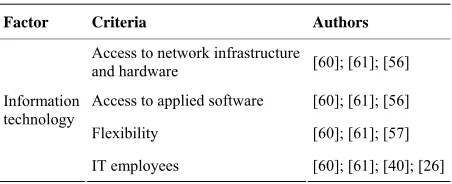
formance, they cannot run the requested job and will be useless when there is not sufficient infrastructure tech-nology [41]. Knowledge management activities are not practical software, but rather an infrastructure to distrib-ute information and communicate just with one part of knowledge management activities [35]. Ruggles (1998) [48] argues that technology must receive some 25% of total time and budget. Technology can be considered both as a key helper and enabler in knowledge manage-ment [10]. Role of IT for knowledge managemanage-ment is to backup knowledge repositories, increase access and trans- mission of knowledge and facilities of knowledge envi-ronment. It can also provide personal, group and organ-izational interactions [5]. Besides, IT can contribute to knowledge creation processes in scientific environments as the enabler tool of knowledge [50]. Intimacy of IT and KM is significant since both of them will help to promote structured knowledge [51]. IT must serve individuals although it enables knowledge management. As a result, it must be built simple and user-friendly such that em-ployees could use it without aid of IT experts [35]. IT is able to search quickly, access and recover information, backup cooperatively and communicate within members of the organization. In fact, it is able to play various roles for backing up processes of knowledge management. The goal of many organizations is to use advancements in IT in order to implement knowledge management properly [51]. Table 5 has summarized criteria of IT element
which have been mentioned previously.
3.5. Leadership and Strategy
Activities of organizational knowledge management are exposed to numerous challenges in its initial steps. To achieve their targets in the future, organizations need to direct their knowledge management activities toward real efforts based on a clear strategy or plan. Therefore, one basic element to succeed, is to form an official strategy of knowledge management throughout the organization as well as plans to learn from the best practices and de-velop modern knowledge management [45]. Another issue in the field of strategy is that knowledge manage-ment must be aligned with the organizational strategy[1]. One type of strategies to implement KM is using benchmarking. The organization can adopt the follow-
Table 5. Information technology criteria.
Authors Criteria
Factor
[60]; [61]; [56] Access to network infrastructure
and hardware
[60]; [61]; [56] Access to applied software
[60]; [61]; [57] Flexibility
[60]; [61]; [40]; [26] IT employees
[image:5.595.57.285.682.736.2]ings to do so:
provide guidance to actualize a pattern-made system,
encourage people for pattern-making from the best organizations in this field,
establish internal pattern-making based on strategy coordination, budget and systems of human resources [22].
Additionally, role of the leader has been emphasized within the organization in implementing KM since it has the key role in succeed of KM activities in the organiza-tion [22,30,35]. Leaders execute business strategies for survival and success in current dynamic environments. They also determine the vision and adopt to align KM with business strategies to proceed value of KM through-out the company [52]. Leaders should support KM pro-cedures and projects (Chong & Choi, 2005) [22] and en- sure sufficient allocation of resources in terms of time, labor and money for projects and operations [22,41]. The behavior which leaders try to promote among their cus-tomers has the most significant effect on the organization [35]. Furthermore, style of leadership and strategic role of him/her can improve the initial (basic) process and provide ideas for improvement and backup [30]. Com-mitment of leader is usually at the same level with senior management as they promote concepts and offer guides, instructions and supports [35]. A good example for role of leadership in successful implementation of KM is world bank in which supports of senior management of the organization has led to an infrastructure to promote and backup growth of practical communities of knowl-edge throughout the entire organization [35]. Table 6
demonstrates leadership and strategy criteria which have been previously discussed in the literature.
4. Conceptual Model of Research
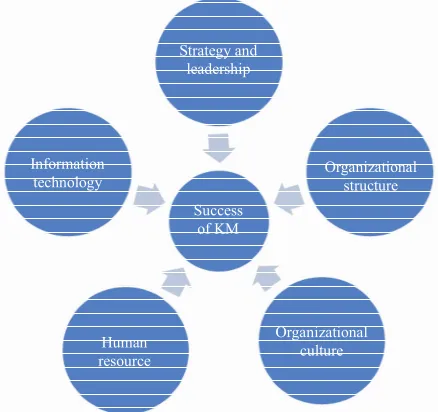
The following will proceed to represent a conceptual model of research taking into account the provided issues in introducing the crucial factors of successful KM ac-cording to Figure 1. Hypotheses of research have been
listed below regarding this model:
Organizational culture affects application of KM within organizations.
Organizational structure affects application of KM within organizations.
[image:6.595.314.533.87.293.2] Human resources affect application of KM within or- ganizations.
Table 6. Strategy and leadership criteria.
Authors Criteria
Factor
[26]; [59]; [1]; [22] Knowledge strategy
[60]; [26]; [59] Reward policies
[60]; [61]; [26]; [5] Supporting top management
Strategy and leadership
Strategy and leadership
Information
technology Organizationalstructure
Human resource
Organizational culture Success
of KM
Figure 1. Research conceptual model.
IT Infrastructure affects application of KM within or- ganizations.
Strategy and leadership affect application of KM within organizations.
5. Research Methodology
Since the aim of this research is to determine causal rela-tions between variables of organizational culture, strat-egy and leadership, organizational structure, IT infra-structure and human resources, the research is practical in terms of its target and correlative-descriptive in terms of method of collecting information; it is specifically based on structural equations. In order to evaluate the relations between different variables within the recent decades, numerous techniques have been proposed. One of these techniques is the model of structural equations model or multi-variant analysis using latent variables. Model of structural equations is a comprehensive ap-proach to examine hypotheses about relations between the observed variables and latent variables. By this ap-proach, one can check credibility of theoretical models in special communities. Since majority of the existing vari-ables are latent or hidden, necessity to use these models are being more pronounced every day. In the analysis model, organizational culture, strategy and leadership, organizational structure, IT infrastructure, human re-sources and success of knowledge management are ex-ogenous variables.
[image:6.595.57.287.670.737.2]tively, by 5-level Likert scale. Also, statistical sample of the research was 284 people of Tehran municipality em-ployees. In order to evaluate the reliability, an initial sample of 30 questions was pre-tested. Then, using the results obtained from this questionnaire, coefficient of confidence was calculated 87% from technique of Cron-bach’s Alfa. This value was also measured for the ques-tions of variables: organizational culture (73%), organ-izational structure (76%), IT infrastructure (79%), strat-egy and leadership (74%) and human resources (81%). These figures indicate that the questionnaire has the re-quired confidence or better to say reliability. In order to evaluate validity of the questions, factor validity was employed which is a form of structure credit and is ob-tained through factor analysis [53], Factor analysis is a statistical technique used extensively in humanism. In
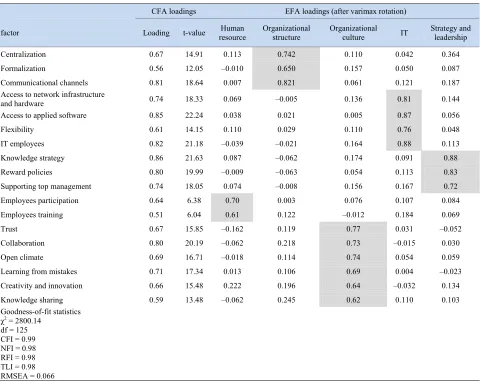
fact, application of factor analysis is necessary and es-sential where questionnaires and tests are used with la-tent variables [54]. Since all questions of the question-naire used in evaluating the structure were based on pre-vious studies, then revised by some professors and man-agers, and eventually the initial questionnaire has been edited and the final questionnaire has been codified based on their feedbacks and in order to decrease ambi-guities, one can ensure of validity of its contents. Valid-ity of the structure was also studied within the confirma-tory factor analysis based on Lisrel software and its re-sults are illustrated in Table 7.
6. Research Findings
[image:7.595.59.539.308.690.2]Two-phase procedures have been employed for testing the model. First, the measurement model has been tested
Table 7. The first order CFA and EFA results for the KM success.
EFA loadings (after varimax rotation) CFA loadings Strategy and leadership IT Organizational culture Organizational structure Human resource t-value Loading factor 0.364 0.042 0.110 0.742 0.113 14.91 0.67 Centralization 0.087 0.050 0.157 0.650 –0.010 12.05 0.56 Formalization 0.187 0.121 0.061 0.821 0.007 18.64 0.81 Communicational channels 0.144 0.81 0.136 –0.005 0.069 18.33 0.74 Access to network infrastructure
and hardware 0.056 0.87 0.005 0.021 0.038 22.24 0.85 Access to applied software
0.048 0.76 0.110 0.029 0.110 14.15 0.61 Flexibility 0.113 0.88 0.164 –0.021 –0.039 21.18 0.82 IT employees 0.88 0.091 0.174 –0.062 0.087 21.63 0.86 Knowledge strategy 0.83 0.113 0.054 –0.063 –0.009 19.99 0.80 Reward policies 0.72 0.167 0.156 –0.008 0.074 18.05 0.74 Supporting top management
0.084 0.107 0.076 0.003 0.70 6.38 0.64 Employees participation 0.069 0.184 –0.012 0.122 0.61 6.04 0.51 Employees training –0.052 0.031 0.77 0.119 –0.162 15.85 0.67 Trust 0.030 –0.015 0.73 0.218 –0.062 20.19 0.80 Collaboration 0.059 0.054 0.74 0.114 –0.018 16.71 0.69 Open climate –0.023 0.004 0.69 0.106 0.013 17.34 0.71 Learning from mistakes
0.134 –0.032 0.64 0.196 0.222 15.48 0.66 Creativity and innovation
0.103 0.110 0.62 0.245 –0.062 13.48 0.59 Knowledge sharing Goodness-of-fit statistics
χ2 = 2800.14 df = 125 CFI = 0.99 NFI = 0.98 RFI = 0.98 TLI = 0.98 RMSEA = 0.066
NOTE: CFA = Confirmatory factor analysis; EFA = Exploratory factor analysis; CFI = Comparative Fit Index; NFI = Normed Fit Index; RFI = Relative Fit Index; TLI = Tucker-Lewis Index; RMSEA = Root mean square error of approximation. a. Total variance extracted by the four factors = 74%; rotation method: oblimin with Kaiser normalization; average interfactor correlation = 0.51; loadings <0.30 not shown. b. These are standardized loading estimates from CFA using the Amos software package. c. Based on one-tailed tests, t-values greater than 1.65 are significant at p < 0.05; t-values greater than 2.33 are significant at
by confirmatory factor analysis and then, it was adopted to test the structural model. In order to determine the structural credibility and fit the pattern, confirmatory factor analysis was used while Structural Equations Mod-eling was utilized to fit the final model. Lisrel software was used to process the data.
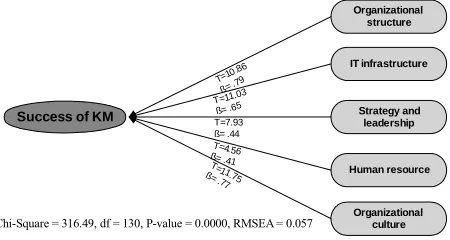
Figure 2 (model of success evaluation in KM)
pro-vides the model obtained from confirmatory factor analy-sis. It demonstrates five success factors of KM namely organizational structure, IT infrastructure, strategy and leadership, human resources, and organizational culture. Organizations whose above factors are in good situation can get more success than those whose above factors are not in an acceptable situation. Thus, these five factors can be noticed as complements for successful implemen-tation of KM within organizations.
For confirmation of the proposed model, it can be ar-gued that RMSEA value was obtained as 0.057 which was less than 0.08, meanwhile, two indexes of GFI and AGI were also calculated to be 0.93 and 0.92, respec-tively which are indicative of model’s good fit. The ratio of χ2 to freedom degree was measured 2.24 which was less than 3. Thus, it can be concluded that the produced model had sufficient and appropriate fit. As observed in
Figure 2, factors of organizational structure and
organ-izational culture have attained the most importance re-spectively among all 5 identified factors with the most significant regression coefficient on successful knowl-edge management. The next factors were IT infrastruc-ture, strategy and leadership, and human resources.
7. Conclusions
Nowadays, knowledge management has strategic role in realization of business targets of the organization in addi-tion to simplify its operaaddi-tional affairs, such that they are ought to codify strategic plan of KM in order to realize its role. This study aims to identify critical success fac-tors of KM. A review on literature revealed the effective factors on successful implementation of KM and their significance was evaluated using factor analysis. After-wards, conceptual model of these critical factors were
Organizational structure
Human resource Strategy and
leadership IT infrastructure
Organizational culture Success of KM
T=10 .86
ß= .79
T=11.03 ß= .65
T=7.93 ß= .44
T=4.56 ß= .41
T=11.75
ß= .77
Chi-Square = 316.49, df = 130, P-value = 0.0000, RMSEA = 0.057
Figure 2. The second order CFA.
developed within the organization under study. With respect to the proposed conceptual model, critical suc-cess factors of KM included aspects of organizational culture, organizational structure, strategy and leadership, IT infrastructure and human resources. Each of these features is composed of sub-criteria itself. Many of these criteria have been recognized in outspread researches as effective factors on successful KM. Comparing the re-search model with earlier studies shows that the recent model is much more complete than previous models; meanwhile it has been localized for the organization un-der study (Tehran Municipality, as a semi-governmental organization). Comparative study of the current results with the previous ones, indicates that models of Cherides et al. (2003), Simonch and Sinchler (2004), Holt (2007) [5], and Jalaldeen (2009) have also emphasized on the organizational culture in implementation of knowledge management. Furthermore, comparison with other pro-posed models such as Simonch and Sinchler (2004), Queen (2005), Holt et al. (2007) [5], and Jalaldeen (2009), reveals that they have all highlighted the effect of IT in-frastructure in preparedness for implementation of KM but Cherides et al. (2003)., Amiden and Skyrme (1997) [17], Holt (2007) [5], Suriya and Hamid (2007) have not attained to such a result. For the third important success factor in implementation of KM considering the impor-tance of leadership and strategy in various models in-cluding Simonch and Sinchler (2004), Queen (2005), Holt (2007) [5], and Jalaldeen (2009), they have insisted on its significance in proper implementation of KM and have offered results similar to the current research. The fourth important factor which has been obtained in the current research is the organizational structure. Holt (2007) [5] and Jalaldeen (2009), have emphasized on the impor-tance of organizational structure in success or failure of implementing KM. Various authors such as Simonch and Sinchler (2004), Quin et al. (2007), Holt (2007) [5], and Cherides et al. (2003) have also verified that human re-sources is one of the main factors to implement KM within any organization. Generally speaking, it can be argued that the effect and relation between critical factors have often been noticed qualitative and intrinsically. How- ever, this research, besides identifying the factors, has also adopted to study the extent of these effects in the framework of a comprehensive model. The practical re-sults obtained from this research are summarized below:
Organizational culture must be able to provide the required bases for sharing the knowledge during im-plementation of KM and encourage its creation and share focusing on the value of knowledge. The or-ganizational culture must also prepare a trust context based on cooperation within the organization.
en-ablers in constructing bases of IT which supports and coordinates KM. IT is one key enabler in executing KM since it is able to search quickly, access and re-cover information, support cooperation and relations among the members. Knowledge management should not be regarded the same as using IT systems, since KM has rather a broader concept which can employ IT as an enabler. For efficiency of KM it should be noted that IT must include simple technology, simple use, suitable for user needs and related to knowledge content.
Knowledge management in an organization is directed to a large extent by its strategies while the source of these strategies is composed of principles and plans within the organization. Leadership has also a concept dependent on KM strategy and application of KM re- quires supports from senior management (in order to allocate adequate resources and time for KM models and plans). Indeed, it can be said that one essential principle to succeed in KN plans is to create constant strategic commitment to KM by senior managers of the organization. Leadership in the context of KM must be indicative of special characteristics which lead to knowledge management, some of these char-acteristics are: ability to create an environment for discussions, specialized dialogues about topics related to removal of obstacles of traditional structures which have been built by links of commandership inside the organization.
Development of proper organizational infrastructures is one important aspect for implementation of KM. Since, organizational structure is crucial in applying technology. Particularly speaking, the organizational structures must be flexible enough to increase distri-bution of knowledge and cooperation through bounda- ries of the traditional organization towards knowledge creativity. Successful implementation of the KM strat- egy depends on the flexible structure and removal of control and traditional systems. For example, hori-zontal organizations have authority for much flexibil-ity against environments with quick and competitive changes of business.
Individuals are important factors in terms of social and cultural aspects of the organization. They build their or-ganization so they are important for success. Those who are end users of system and technology, should be equipped to adequate skill and sufficiency, task expertise, attitude, positive though and culture to be accepted. Human re-sources are significant since any change or newly intro-duced technology will affect labor of the organization. Thus it is necessary to evaluate organizational culture and preparedness of individuals in acceptance of innova-tive and new technologies. Generally speaking, Individu-als are regarded as personal contributors who have skills
and knowledge roles, motivation and self-reaction, sup-port, learning/social networks, dialogues, coordination and innovation. They create knowledge within the or-ganization and a significant part of the oror-ganizational knowledge is saved in their minds.
REFERENCES
[1] N. N. Sunassee and D. A. Sewry, “An Investigation of Knowledge Management Implementation Strategies,” Pro- ceedings of the 2003 Annual Research Conference of the South African Institute of Computer Scientists and In- formation Technologists on Enablement through Tech- nology, Tuinroete, 2003, pp. 24-36.
[2] T. H. Davenport and L. Prusak, “Working Knowledge: How Organizations Manage What they Know,” Harvard Business School Press, 2000.
[3] B. Gupta and L. S. Iyer and J. E. Aronson, “Knowledge Management: Practices and Challenges, Industrial Man- agement and Data Systems,” Industrial Management & Data Systems, Vol. 100, No. 1, 2000, pp. 17-21.
doi:10.1108/02635570010273018
[4] I. Nonaka and H. Takeuchi, “The Knowledge-Creating Company: How Japanese Companies Create the Dynam-ics of Innovation,” Oxford University Press, New York, 1995.
[5] D. T. Holt, S. E. Bartczak, S. W.Clark and M. R. Trent, “The Development of an Instrument to Assess Readiness for Knowledge Management,” Knowledge Management Research & Practice, Vol. 5, No. 2, 2007, pp. 75-92. doi:10.1057/palgrave.kmrp.8500132
[6] J. Rockart, “Chief Executives Define Their Own Informa- tion Needs,” Harvard Business Review, Vol. 57, No. 2, 1979, pp. 81-92.
[7] A. Bruno and J. Leidecker, Identifying and Using Critical Success Factors,” Long Range Planning, Vol. 17, No. 1, 1984, pp. 23-32. doi:10.1016/0024-6301(84)90163-8 [8] J. Pinto and D. Slevin, “Critical Factors in Successful
Project Implementation,” IEEE Transactions on Engi- neering Management, Vol. 34, No. 1, 1987, pp. 22-27. [9] S. M. Allameh, S. M. Zare and S. M. R. Davoodi, “Ex-
amining the Impact of KM Enablers on Knowledge Man- agement Processes,” Procedia Computer Science, Vol. 3, 2011, pp. 1211-1223. doi:10.1016/j.procs.2010.12.196 [10] T. Davenport, D. De Long and M. Beers, “Successful
Knowledge Management Projects,” Sloan Management Review, Vol. 39, No. 2, 1998, pp. 43-57.
[11] P. Drucker, “Post-Capital Society,” Harper & Collins, New York, 1993.
[12] M. Demerest, “Undestand Management,” Journal of Long Range Planning, Vol. 30, No. 3, 1997, pp. 374-384. doi:10.1016/S0024-6301(97)90250-8
[13] P. Gupara, “Why Knowledge Management Fails: How to Avoid the Common Pitfalls,” 2000. www.melcum.com [14] D. J. Flynn and E. A. Arce, “A Case Tool to Support
Technology, Vol. 39, No. 5, 1997, pp. 311-321. doi:10.1016/S0950-5849(96)01150-0
[15] T. M. Somers and K. Nelson, “The Impact of Critical Success Factors across the Stages of Enterprise Resource Planning Implementation,” Proceedings of the 34th Ha- waii International Conference on Systems Sciences, Maui, 3-6 January 2001.
[16] M. Stankosky and B. Carolyn, “A System Approach to Engineering a Knowledge Management System,” In: R. C. Barquin, A. Bennet and S. G. Remez, Eds., Knowledge Management: The Catalyst for Lectronic Government, Management Concepts, Vienna, 2001, p. 137.
[17] D. Skyrme and D. Amidon, “The Knowledge Agenda,” Journal of Knowledge Management, Vol. 1, No. 1, 1997, pp. 27-37. doi:10.1108/13673279710800709
[18] C. W. Holsapple and K. D. Joshi, “An Investigation of Factors That Influence the Management of Knowledge in Organizations,” Journal of Strategic Information Systems, Vol. 9, No. 2-3, 2000, pp. 235-61.
doi:10.1016/S0963-8687(00)00046-9
[19] P. Chourides, D. Longbottom and W. Murphy, “Excel- lence in Knowledge Management: An Empirical Study to Identify Critical Factors and Performance Measures,” Measuring Business Excellence, Vol. 7, No. 2, 2003, pp. 29-45. doi:10.1108/13683040310477977
[20] S.-H. Yu, Y.-G. Kim and M.-Y. Kim, “Linking Organiza- tional Knowledge Management Drivers to Knowledge Management Performance: An Exploratory Study,” 37th Hawaii International Conference on System Sciences, Big Island, 7-10 January 2002.
[21] Y. Wong, “Critical Success Factors for Implementing Knowledge Management in SME,” Industrial Manage- ment & Data Systems, Vol. 105, No. 3, 2005, pp. 261-279. doi:10.1108/02635570510590101
[22] S. C. Chong and Y. S. Choi, “Critical Factors in the Suc- cessful Implementation of Knowledge Management,” 2005. www.tlainc.com
[23] K. Y. Wong and E. Aspinwall, “An Empirical Study of the Important Factors for Knowledge-Management Adop- tion in the SME Sector,” Journal of Knowledge Man- agement, Vol. 9, No. 3, 2005, pp. 64-82.
doi:10.1108/13673270510602773
[24] Y. C. Hung, S. M. Huang, Q. Lin and M. L. Tsai, “Criti- cal Factors in Adopting a Knowledge Management Sys- tem for the Pharmaceutical Industry,” Journal of Knowl- edge Management, Vol. 105, No. 2, 2005, pp. 164-168. doi:10.1108/02635570510583307
[25] P. Akhavan, M. Jafari and M. Fathian, “Critical Success Factors of Knowledge Management Systems: A Multi- Case Analysis,” European Business Review, Vol. 18, No. 2, 2006, pp. 97-113.
doi:10.1108/09555340610651820
[26] Y.-J. Yeh, S.-Q. Lai and C.-T. Ho, “Knowledge Man- agement Enablers: A Case Study,” Industrial Manage- ment & Data Systems, Vol. 106, No. 6, 2006, pp. 793-810. doi:10.1108/02635570610671489
[27] V. Anantatmula and S. Kanungo, “Modeling Enablers for Successful Km Implementation,” Journal of Knowledge
Management, Vol. 14, No. 1, 2007, pp. 100-113. doi:10.1108/13673271011015598
[28] L. Huener, “Knowledge and Concept of Trust,” Sage, London, 2001.
[29] S. P. Robbins, “Organizational Behavior: Concepts, Con- troversies, Applications,” Prentice Hall, Upper Saddle River, 1996.
[30] F. J. Forcadell and F. Guadamillas, “A Case Study on the Implementation of a Knowledge Management Strategy Oriented to Innovation,” Knowledge and Process Man- agement, Vol. 9, No. 3, 2002, pp. 162-171.
doi:10.1002/kpm.143
[31] R. Sanchez, “Creating Modular Platforms for Strategic Flexibility,” Design Management Review, Vol. 15, No. 1, 2004, pp. 58-67.
doi:10.1111/j.1948-7169.2004.tb00151.x
[32] F. Soliman and K. Spooner, “Strategies for Implementing Knowledge Management: Role of Human Resources Management,” Journal of Knowledge Management, Vol. 4, No. 4, 2000, pp. 337-345.
doi:10.1108/13673270010379894
[33] M. Santoro and A. K. Chakrabarti, “Firm Size and Tech- nology Centrality in Industry-University Interactions,” Research Policy, Vol. 31, No. 7, 2002, pp. 1163-1180. doi:10.1016/S0048-7333(01)00190-1
[34] A. Abelland and N. Oxbrow, “Competing with Knowl- edge,” Library Association Publishing, London, 2001. [35] F. Hasanali, “Critical Success Factors of Knowledge
Management,” 2002. www.infotoday.com
[36] S. Walczak, “Organizational Knowledge Management Structure,” Learning Organization, Vol. 12, No. 4, 2005, pp. 330-339. doi:10.1108/09696470510599118
[37] H. Mintzberg, “Power in and Around Organizations,” Prentice Hall, Upper Saddle River, 1983.
[38] T. Andersson and T. Westterlind, “Sharing Knowledge over Company Borders Managing Knowledge in Key Customer Relations at ABB Sweden,” Master’s Thesis, Linköpings University, Linköpings, 1999.
[39] M. Adenfelt and K. Lagerstro, “Enabling Knowledge Creation and Sharing in Transnational Projects,” Interna- tional Journal of Project Management, Vol. 24, No. 3, 2005, pp. 191-198. doi:10.1016/j.ijproman.2005.09.003 [40] H. Lee and B. Choi, “Knowledge Management Enablers,
Processes, and Organizational Performance: An Integra-tive View and Empirical Examination,” Journal of Man-agement Information Systems, Vol. 20, No. 1, 2003, pp. 179-228.
[41] K. Ruikar, C. Anumba and P. Carrillo, “VERDICT—An E-Readiness Assessment Application for Construction Companies,” Automation in Construction, Vol. 15, No. 1, 2006, 98-110. doi:10.1016/j.autcon.2005.02.009
[42] A. Brand, “Knowledge Management and Innovation at 3M,” Journal of Knowledge Management, Vol. 2, No. 1, 1998, pp. 17-22. doi:10.1108/EUM0000000004605 [43] R. McDermott, “Why Information Technology Inspired
[44] S. Moffett, R. McAdam and S. Parkinson, “An Empirical Analysis of Knowledge Management Applications,” Jour- nal of Knowledge Management, Vol. 7, No. 3, 2003, pp. 6-26. doi:10.1108/13673270310485596
[45] Economic and Social For Western Asia, “Knowledge Management Methodology: An Empirical Approach in Core Sectors in Escwa Member Countries, Economic and Social For Western Asia,” United Nations, New York, 2003.
[46] S. Zuboff, “In the Age of the Smart Machine,” Heine- mann, London, 1988.
[47] H. Scarborough, J. Swan and J. Preston, “Knowledge Management: A Literature Review,” Institute of Person- nel and Development, London, 1999.
[48] R. Ruggles, “The State of the Notion: Knowledge Man-agement in Practice,” California Management Review, Vol. 40, No. 3, 1998, pp. 80-89.
[49] D. Shenk, “Data Smog,” Harper & Collins, New York, 1997.
[50] J. Tian, Y. N. Yoshiteru and P. W. Andrzej, “Knowledge Management and Knowledge Creation in Academia: A Study Based on Surveys in a Japanese Research Univer- sity,” Journal of Knowledge Management, Vol. 13, No. 2, 2009, pp. 76-92. doi:10.1108/13673270910942718 [51] M. Alavi and D. E. Leidner, “Review: Knowledge Man-
agement and Knowledge Management Systems: Concep- tual Foundations and Research Issues,” MIS Quarterly, Vol. 25, No. 1, 2001, pp. 107-136.
[52] K. Mathi, “Key Success Factors for Knowledge Man- agement,” Master’s Thesis, University of Applied Sci- ences/Fh Kempten, Kempten, 2004.
[53] F. Hair, E. R. Anderson, L. R. Tatham and C. W. Black, “Multivariate Data Analysis,” 5th Edition, Prentice Hall, Upper Saddle River, 1998.
[54] G. A. Churchil Jr., “Aparadigm for Developing Better Measures of Marketing Constructs,” Journal of Market- ing Research, Vol. 16, No. 1, 1979, pp. 64-73.
doi:10.2307/3150876
[55] R. Jalaldeen, et al., “Organizational Readiness and Its Contributing Factors to Adopt KM Processes: A Concep- tual Model,” Communications of the IBIMA, Vol. 8, No. 17, 2009, pp. 128-136.
[56] K. Mohammadi, A. Khanlari and B. Sohrabi, “Organiza- tional Readiness Assessment for Knowledge Manage- ment,” International Journal of Knowledge Management, Vol. 5, No. 1, 2009, pp. 29-45.
[57] C. Siemieniuch and M. Sinclair, “A Frame-Work for Or- ganizational Readiness for Knowledge Management,” In- ternational Journal of Operations & Production Man-agement,Vol. 24, No. 1, 2004, pp. 79-98.
doi:10.1108/01443570410511004
[58] T. Quin and Y. Tan, “Knowledge Management Readiness in Organisation: A Case of Public Sector in Malaysia,” International Conference on Knowledge, 7-9 July 2005. [59] W. A. Taylor and G. H. Wright, “Organizational Readi-
ness for Successful Knowledge Sharing: Challenges for Public Sector Managers,” Information Resources Man- agement Journal, Vol. 17, No. 2, 2004, pp. 22-37. [60] S. Gaffoor, “Assessing Readiness for the Implementation
of Knowledge Management in Local Governments: The case of Stellenbosch Municipality,” Master’s Thesis, Com- merce at Stellenbosch University, Stellenbosch, 2008. [61] K. R. Youshanloui, F. Daneshgar, N. Sarabi, H. R. You-