Time, Practices and Energy Demand:
implications for flexibility
1
Time, Practices and Energy Demand: implications for flexibility
Elizabeth Shove and Noel Cass
Abstract
The timing of energy demand is increasingly important given the pressure to decarbonise energy systems, accommodate more intermittent forms of renewable energy supply and reduce peak load. In the transport sector, rush hours and periods of congestion present problems of their own also related to the synchronisation and the sequencing of social practices. This document brings together DEMAND research on the social-temporal ordering of what people do and considers the implications of this work for ‘demand management’ and for efforts to develop more flexible energy systems.
Introduction
The timing of energy and especially electricity demand (and therefore supply) is increasingly significant for energy policy and for utilities and providers alike (Geller, Harrington et al. 2006, Anable, Anderson et al. 2014, Torriti, Hanna et al. 2015). There are several reasons for this. One relates to the challenge of accommodating supply from more intermittent renewable sources, and of coping with seasonal variations especially in the demand for heat. Another is that the fuels used to produce electricity at peak times are especially carbon intensive. In the transport sector, peaks in the timing of travel enable some forms of public transport to run at a profit but also generate congestion, increased carbon emissions and air pollution. Together, these concerns call for better understanding of the social and temporal rhythms that underpin present peaks and troughs in energy use and travel, and of how these might be changed or modified.
The challenge of coping with uneven patterns of demand is not new. Demand for gas is much greater in the winter and in the electricity sector, consumption rises and falls daily, weekly, and over the course of the year. Since electricity is difficult to store, provision and generation are organised to match these fluctuations. Historically, and at a national scale, the strategy has been to expand supply in order to meet maximum demand, whenever that occurs (Torriti, Hanna et al. 2015: 891-2). In practice, this means building enough additional generation to top up ‘baseload’ to meet peak demand and to ‘keep the lights on’ at all times (ENWL 2016). This response is complicated by new commitments to decarbonising the energy system and increasing the proportion of renewables in the supply mix (National Grid 2014, Energy UK 2016).
2
night or modify journeys to avoid the rush. To date, smart-metering feedback and current forms of real time pricing (in the domestic setting) have had only modest effect. Meta-studies of household smart metering feedback trials show reductions in demand of e.g. 3-5% (McKerracher and Torriti 2013, Torriti and Grunewald 2014). One plausible reason for this is that people are not free to re-arrange the timing of energy demand at will.
Instead, and as discussed below, daily and weekly schedules are defined by collective social and temporal rhythms, not by individual choice. In taking this idea further, we suggest that peaks and troughs in demand relate to the synchronisation and sequencing of practices that entail mobility and/or other forms of energy consumption. We go on to argue that these arrangements are, in turn, significant for understanding and conceptualising the extent and character of ‘flexibility. The conclusion that different forms of flexibility (for instance, of individual practices, or of people) are outcomes of how sets of social practices intersect over time has practical implications for those who seek to modify the timing and the location of energy demand.
The timing of energy demanding practices
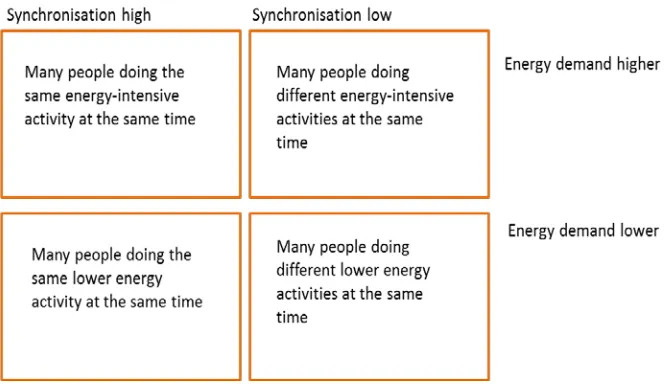
The temporal patterning of daily life is an established theme across the social sciences. Writers such as Pred (1981), Parkes and Thrift (1979) and Hägerstrand (Hägerstrand 1970) in geography; Schatzki (2009) and Lefebvre (1992, 2004) in philosophy, and Adam (2008) and Southerton (2003, 2006, 2012) in sociology, to name just a few, provide important insights into the development and detail of social-temporal order. Many of these analyses highlight the physical (day and night), biological (eating and sleeping) and essentially social (work, meals and leisure) organisation of what people do (Zerubavel 1981, 1982). This literature is crucial for energy research and policy in that peak loads, in travel and in energy demand, arise from situations in which many people do the same or different energy-demanding activities at the same time (Mattioli, Shove et al. 2014). Inspired by these ideas, projects within DEMAND (Torriti, Anderson, Mattioli) have used time-use data, qualitative research and methods of sequence analysis to investigate the synchronisation of practices (with each other and at specific times), and their sequencing,
and to show how temporal rhythms vary over time. In combination these studies show how practices become anchored to specific times (and places) in ways that constitute peak loads (Anderson 2016) and that determine the scope for re-scheduling and adjustment (Mattioli, Shove et al. 2014, Carlsson-Hyslop, Kiuijer et al. 2015, Torriti and McGraw 2016, Anderson and Torriti 2017).
3
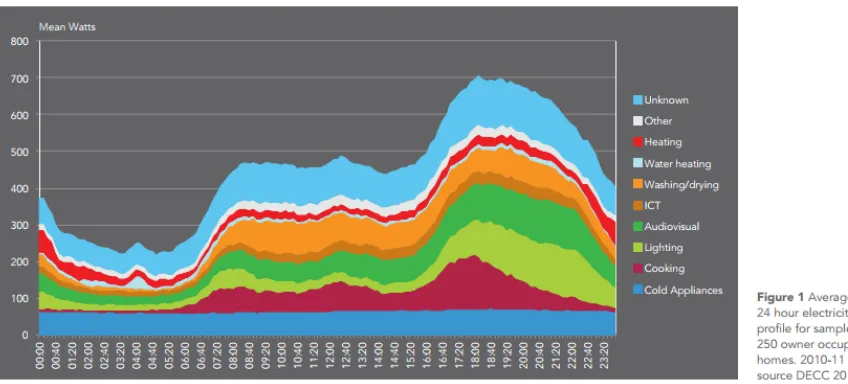
Figure 1: Average 24 hour electricity use profile for sample of 250 owner occupied homes. 2010-11 (data source DECC 2013: taken from Anderson 2016c:3)
As Figure 1 shows, and as one might expect, meal times are associated with an increase in electricity demand especially for cooking; and more energy is used for lighting when people are at home in the evening. Averaged figures like these can be compared with data from other countries (Durand –Daubin 2016), and used to reveal changes over time. It is also possible to compare the time profiles of different sectors of the population, or of week-ends and week days. Within DEMAND, researchers have used these and other techniques to identify and investigate the forms of coordination on which patterns of demand depend.
4
Figure 2: Synchronisation and energy demands
To understand the ebb and flow of energy demand (or traffic), we need to know more about exactly which practices are ‘synchronised’, and when, and we need to know how these arrangements develop historically and vary from one country to another.
5
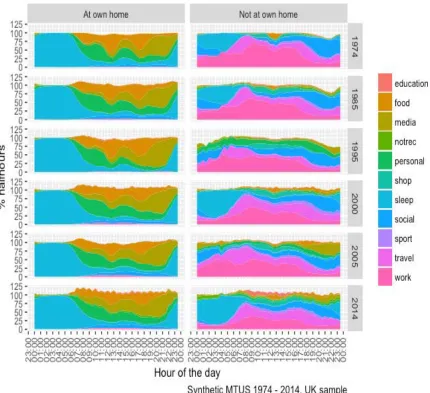
Figure 3: Anderson and Torriti, based on UK time-use data time-mapped in half-hour segments for home and other locations (data sources MTUS 1974-2014).
6
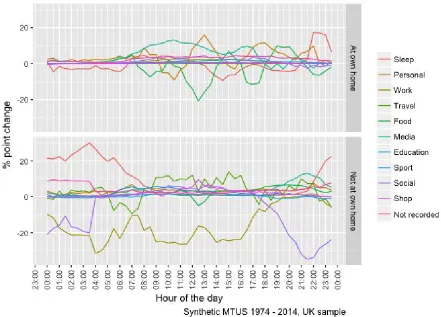
Figure 4: Anderson and Torriti. Percentage point changes in time-uses in half-hour periods at home and elsewhere in the UK (data source MTUS 1974-2014).
Trends like those of eating later in the evening and of and having shorter lunch times are not outcomes of energy policy, but they directly affect the details of demand.
To learn more about how these and other such patterns evolve and whether they can be deliberately modified – for example, to reduce peak load or adjust demand to better match renewable supply – we need to say more about the forms of synchronisation and sequencing of which socio-temporal rhythms are made, and about the various forms of flexibility that follow.
Synchronisation
Situations in which similar practices occur at the same time are not merely happenstance; they are to different degrees, outcomes of collective forms of societal synchronisation (Shove, Trentmann et al. 2009). As already mentioned, some explanations of why different people do similar things at similar times highlight natural, biological or physiological rhythms, not as independent forces, but as mediated by social conventions, technologies and institutions (Zerubavel 1981, Zerubavel 1982).
7
they represent one amongst other forms of ‘pace making’ associated with timekeeping technologies and with the conventions of measuring and representing time in minutes and hours (Parkes and Thrift 1979). Whether resolved with reference to clock time or not, practices often have what Hägerstrand calls ‘coupling constraints’ – meaning that they require the presence of other people or objects at set times (Hägerstrand 1970: 12-14). This is important in understanding why people and things move around as they do. Building on these ideas, Urry identifies various situations in which co-presence is important in daily life (Urry 2002). Being present at performances or collective events is one example; valuing face-to-face meetings with family members or work colleagues is another. Exactly how such ‘requirements’ play out depends, in part, on the range of different activities that people undertake; on related temporal features (such as duration, tempo and periodicity); and on how practices are linked across the day, week or year.
Forms of institutional timing – such as working and opening hours, school times and terms, and forms of leisure provision have a key role in defining the extent and character of societal synchronisation (Hui, Shove et al. 2013, Cass and Faulconbridge 2016, Anable, Cass et al. 2017, Blue 2017). The rush hour is a paradigmatic example of how institutional arrangements create peaks in demand. The convention of a 9am-5pm working day and that fact that this coincides with school times means that large numbers of people are mobile at the same time (Cass and Faulconbridge 2016). The early evening peak in electricity demand is similarly an outcome of many people returning home from work, and then making and eating a meal. Patterns of employment and education represent critical ‘orchestrating’ forces, but as the structuring of TV schedules and the notion of ‘prime time’ viewing demonstrates many organisations are involved in ‘making’ times when specific practices dominate and when other activities are temporarily set aside.
As these examples indicate, seemingly ‘private’ household routines are connected to the routines of others and shaped by distinctive arrays of practices some of which are anchored to fixed times and spaces (Hui 2017). Daily rhythms are a product of these arrangements, and of the fact that some practices have to take place before others.
Sequencing
What happens when, and the potential for rearranging daily schedules depends on how different practices connect to each other, and on the sequences or chains of action involved. As with forms of synchronisation, sequences relate to different kinds of material ‘necessity’, social convention and institutional ordering.
8
Sequences of practice are also important for when and whether journeys are made by car. Mattioli and Anable (2016) applied sequence-analysis to time-use data to identify practices that precede and follow driving. Their research showed that driving was typically embedded in chains of activity that involved the movement of people or things. Better understanding of this ‘cargo’ function is hugely important for understanding when trips are made by car and for the viability (or not) of using other modes, such as cycling or public transport. Analysing car driving not as an isolated activity but within and as part of a sequence of practices provided a more differentiated picture of ‘car use’ and of the timing of driving as a consequence of the specific practices in which it is embedded. This is not a natural or inevitable phenomenon. The existence of sequences in which driving is an essential part is relatively new and is, to an extent, an outcome of the possibilities afforded by what Urry describes as a system of automobility (Urry 2004), and of the forms of connectivity, speed and ‘convenience’ this enables. In other words, sequences change and evolve along with the practices they connect, and of which they are comprised. This is also the case for sequences that are more obviously defined by cultural conventions, including those associated with eating, sleeping and cleaning. In contemporary Western societies, breakfast, lunch and dinner are very different sorts of meals shaped by understandings of when they should occur and what it is socially appropriate and ‘normal’ to eat on each occasion (Durand-Daubin 2016). Exactly what is consumed (particularly, cold or hot, home or restaurant cooked, frozen or fresh) at different times of day is relevant for the energy demand that follows and for when and where this occurs. Other contemporary habits, like those of sleeping 7-8 hours a night, or of taking a daily shower (usually in the morning) also have the dual effect of structuring the time-scape of the day and reproducing shared interpretations of temporal propriety.
Finally, institutional procedures and working practices are clearly relevant for the order in which things happen, and for how sequences (and thus timings) are established and changed. In his study of institutional rhythms and energy demand, Stanley Blue (2017) shows that the timing of peak loads in hospital energy consumption and patient transport is an outcome of the interplay of job-roles, shift patterns, organisational and/or medical protocols and the ‘time sovereignty’ (Breedveld 1998) of more and less influential members of staff. These arrangements intersect with patient centred sequences of sleeping, eating and medication in ways that generate different peaks and troughs in hospital life. One consequence is that discharge procedures (which consist of a series of precisely defined steps and stages) are such that although patients arrive in hospital at all times of day and night, most of them leave between the hours of 3 and 5pm.
In hospitals and in other settings, institutional arrangements are aligned around what Pred describes as ‘dominant projects’ (Pred 1981). Dominant projects include things like delivering health care, organising family life, or achieving work-related goals. In any one society there are many such projects, all of which have effect on the scheduling, the synchronisation and, collectively, the sequencing of practices in ways that are more or less entangled and thus more or less amenable to change. These are not the only processes that matter but all are important in thinking about what it is that makes some practices, some people, and some relations between practices more flexible than others.
Conceptualising, measuring and influencing flexibility
9
kind, and how it might be achieved. For example, some contend that the timing of energy use is inherently flexible, and can be manipulated by setting appropriate real-time prices (Mohsenian-Rad and Leon-Garcia 2010). Others argue that such measures are unlikely to persuade consumers to change their ways, and that the best option is to develop methods of demand management that are ‘invisible’ at the point of use. Examples include automatically switching off devices (refrigerators, heating or cooling systems) at peak times but not for so long that consumers/occupants notice the difference (Hamidi et al. 2009, Di Giorgio and Pimpinella 2012, Finn et al.2013). These analyses situate ‘flexibility’ either as a matter of consumer choice or as something that suppliers can achieve, behind the scenes. DEMAND research points towards other ways of conceptualizing and influencing the timing of demand. For example, and as discussed in more detail below, certain practices are likely to be more ‘flexible’ than others depending on how they are positioned in relation to other practices. Second, some people (or groups of people) are likely to be more ‘flexible’ than others, depending on the range of practices with which they are engaged. Third, flexibility in both these senses appears to be an outcome of how entire complexes of social practices are configured in space and time.
Flexible practices
If we define flexibility as the converse of closely-coupled sequencing and/or rigid synchronisation, more flexible practices are those that are relatively detached (they are not tied to specific times or places); de-coupled (not requiring the co-presence of other things or people), or capable of being interrupted, restarted and broken into smaller parts (Shove 2009, Zhai, Cao et al. 2016). Figures 3 and 4 suggest that in general, and in the UK, social practices might be acquiring more of these features. For example, and as Southerton notes, there are now fewer ‘institutionally timed events’ than in the past (Southerton 2006) and so-called ‘convenience’ technologies have changed the time-profiles of various activities (cooking, laundry etc.) (Shove 2003). There is also some evidence that mobile technologies and smartphones (Lord, Hazas et al. 2015) are reconfiguring the temporal characteristics of activities like shopping and film/TV watching, and that they are also creating opportunities to work in small fragments of time or when on the move. It is also important to notice that certain practices, like working from home, appear to have the effect of reducing forms of synchronisation and of enabling greater variation in when other activities occur.
These observations suggest that energy and transport policy makers would do well to ‘target’ seemingly flexible practices: for example, focusing more on the timing of laundry and leisure than on eating or commuting. However, they also point to less obvious forms of intervention. For instance, non-energy policies that promote ‘flexible’ working might have long term, cumulative consequences for the timing of demand.
Flexible people
10
display ‘the highest level of flexibility, because their practices are associated with high active home occupancy, low spatial mobility, long duration of a small set of activities mainly not shared with others and low synchronisation with the rest of the population.’ (Torriti, 2015: 909). This conclusion is based on analysis using what Torriti describes as a flexibility index composed of ‘a set of component indices on synchronisation, variation, sharing and mobility [that…] feed into … an indication of the potential to shift demand’ (2015). Torriti’s index makes it possible to identify specific practices (e.g. laundry) that appear to be more flexible than others (e.g. eating meals). It also makes it possible to identify people (or groups of people) who engage in complexes of more and less closely-coupled, sequenced or synchronised practices. Amongst other things, use of the index enables Torriti and colleagues to show that lone and childless households are generally more time-flexible than those which include partners and children (2015: 891-904). However, a critical feature of this work is that flexibility is not treated as a fixed characteristic of any one practice, or of any one set of people. Instead it is conceptualised as something that is situated and variable, depending, as it does, on how specific practices are positioned in relation to others. From this point of view, the index can be used distinguish between the forms of flexibility (defined by specific relations between practices) such as those that (in general) characterise morning as opposed to evening peaks, or peaks during week-days compared with week-ends.
In the short term, this leads to the important insight that flexibility is itself ‘flexible’. In other words, the ‘flexibility to shift activities var[ies] throughout the day” (Torriti et al 2015: 891-2). More abstractly this approach builds on the idea that flexibility (of people, of practices, and of social systems) is an outcome of synchronisation and sequencing, and an emergent feature that is itself important for how future sequences and forms of synchronisation are established and enacted.
This work has different practical implications. At one level it argues for more differentiated forms of intervention. Rather than the blanket approach associated with real time pricing, it suggests that it might be more effective to identify, and in a sense ‘target’, people who are in a position to respond flexibly. It also supports the view that strategies of this kind only scratch the surface of what is in fact a much more systemic challenge.
Flexible societies?
11
such as browsing, payment, product trial and crucially delivery. This affects the temporal organisation of the activities of providing as well as of shopping and may also reduce energy and travel demands (Zhai, Cao et al. 2016, Cass and Shove 2018). This is not an isolated case. As Cox et al. note, many areas of public policy (including policies relating to health, education or employment), have immediate and obvious impacts on the scheduling of a host of interdependent activities (Cox, Royston et al. 2016, Royston 2016). In conclusion, the ambition of reducing peaks and adapting demand to the rhythms of more intermittent sources of supply calls for potentially significant changes in when different activities take place. Engendering social-temporal rhythms that are compatible with reduced and/or renewable energy consequently depends on much more than pricing, behind-the-scenes technology ‘fixing’ or individual persuasion. Instead, the possibilities for change on a societal scale depend on how social practices are arranged in relation to each other, and on the forms of flexibility (or not) that follow. Such arrangements are not fixed for all time, nor are they immune to the influences of business and policy. In fact there is some evidence to suggest that for various reasons certain patterns of work, of eating and of travel are ‘flexing’ and becoming more complicated and also more fragmented than in previous decades. Although not ‘driven’ by energy policy, trends like these are important for the design and operation of future energy systems (for instance, for investment in new forms of storage, for judgements about how much energy we ‘need’, and for assessments of the scale of provision). At a minimum, this argues for folding discussions of collective social-temporal rhythm into discussions of energy and transport policy, and for analysing and learning from past as well as present regimes of ‘flexibility’ in different sectors and at different scales.
References
Adam, B. (2008). Of Timescapes, Futurescapes, and Timeprints. Lüneburg University, Cardiff University. Anable, J., B. Anderson, E. Shove and J. Torriti (2014). Working Paper 3: Categories, Concepts and Units -
Representing energy demand in and through time. http://www.demand.ac.uk/29/07/2014/wp-3-categories-concepts-and-units/
Anderson, B. (2016). What makes peak electricity demand? Insights from time use analysis. Lancaster University, Demand Centre: http://www.demand.ac.uk/wp-content/uploads/2015/11/DEMAND-insight-1-peak-electricity-final.pdf
Blue, S. (2017). "Institutional rhythms: ideas and opportunities for energy and mobility demand management in the NHS [Research briefing paper]." http://www.demand.ac.uk/wp-content/uploads/2017/05/demand-institutional-rhythms.pdf
Breedveld, K. (1998). "The Double Myth of Flexibilization: Trends in Scattered Work Hours, and Differences in Time-Sovereignty." Time & Society 7(1): 129-143.
Cass, N. and J. Faulconbridge (2016). "Commuting practices: New insights into modal shift from theories of social practice." Transport Policy 45: 1-14.
Cox, E., S. Royston and J. Selby (2016). Impacts of non-energy policy on energy systems: a scoping paper, UKERC: http://www.demand.ac.uk/wp-content/uploads/2016/07/The-impacts-of-non-energy-policies-on-the-energy-system-scoping-paper.pdf
Durand-Daubin, M. (2016). Cooking in the night: peak electricity demand and people’s activity in France and Great Britain. Demand Centre Conference. Lancaster.
http://www.demand.ac.uk/wp-content/uploads/2016/03/DEMAND2016_Full_paper_158-Durand-Daubin.pdf Energy UK (2016). Pathways for the GB Electricity Sector to 2030: 125.
ENWL (2016). The 2016 update to our peak demand scenarios, Energy North West Limited: 5. Geller, H., P. Harrington, A. H. Rosenfeld, S. Tanishima and F. Unander (2006). "Polices for increasing
12
Hägerstrand, T. (1970). "What about people in Regional Science?" Papers of the Regional Science Association 24(1): 6-21.
Hitchings, R. (2011). "Researching air-conditioning addiction and ways of puncturing practice: Professional office workers and the decision to go outside” Environment and Plannng A. Vol 43, Issue 12, pp. 2838 - 2856.
Hui, A. (2017). Variation and the intersection of practices. The Nexus of Practices: connections, constellations, practitioners. A. Hui, E. Shove and T. Schatzki. London: Routledge.
Hui, A., E. Shove and G. Walker (2013) "School holiday shakeup brings unintended consequences." The Conversation. http://www.demand.ac.uk/24/10/2013/school-holiday-shakeup-brings-unintended-consequences-article-in-the-conversation/
Cass, N. and Shove, E. (2018). The last mile and the next day: the changing times and spaces of shoppping – implications for energy demand.
http://www.demand.ac.uk/wp-content/uploads/2017/12/The-Last-Mile-and-the-Next-Day-final.pdf Lefebvre, H. (1992). Éléments de rythmanalyse. Paris, Éditions Syllepse.
Lefebvre, H. (2004). Rhythmanalysis: Space, Time and Everyday Life. London, Bloomsbury.
Lord, C., M. Hazas, A. K. Clear, O. Bates, R. Whittam, J. Morley and A. Friday (2015). Demand in my pocket: mobile devices and the data connectivity marshalled in support of everyday practice. Proceedings of the 33rd Annual ACM Conference on Human Factors in Computing Systems, ACM. http://www.demand.ac.uk/wp-content/uploads/2016/06/Lord-Demand-in-pocket.pdf
Mattioli, G. and J. Anable (2016). Carrying Capacity - the cargo function of the car. Lancaster, Demand Centre: http://www.demand.ac.uk/wp-content/uploads/2016/10/DEMAND-insight-3.pdf
Mattioli, G., E. Shove and J. Torriti (2014). Working Paper 1: The timing and societal synchronisation of energy demand. Lancaster, Demand Centre. http://www.demand.ac.uk/14/02/2014/theme-1-working-paper-february-2014/
McKerracher, C. and J. Torriti (2013). "Energy consumption feedback in perspective: integrating Australian data to meta-analyses on in-home displays." Energy Efficiency 6(2): 387-405. National Grid (2014). UK Future Energy Scenarios: 220.
Parkes, D. and N. Thrift (1979). "Time Spacemakers and Entrainment." Transactions of the Institute of British Geographers 4(3): 353-372.
Pred, A. (1981). "Social Reproduction and the Time-Geography of Everyday Life." Geografiska Annaler. Series B. Human Geography 63(1): 17.
Royston, S. (2016). Invisible energy policy in higher education. DEMAND Centre Conference 2016. Lancaster, UK. http://www.demand.ac.uk/wp-content/uploads/2016/05/Royston-Invisible-energy-policy-in-HE.pdf
Schatzki, T. (2009). Timespace and the organization of everyday life. In Shove, E. Trentmann, F. and Wilk, R. (eds) Time, Consumption and Everyday Life: Practice, Materiality and Culture. Oxford, Berg. Shove, E. (2003). Comfort, cleanliness and convenience: the social organization of normality. Oxford,
Berg.
Shove, E. (2009). Everyday Practice and the Production and Consumption of Time. In Shove, E. Trentmann, F. and Wilk, R. (eds) Time, Consumption and Everyday Life: Practice, Materiality and Culture. Oxford, Berg.
Shove, E. (2016). Matters of Practice. The nexus of practices: connections, constellations, practitioners. A. Hui, T. R. Schatzki and E. Shove. London, Routledge: 155-168.
Shove, E., M. Pantzar and M. Watson (2012). The Dynamics of Social Practice. London, Sage.
Shove, E., F. Trentmann, R. R. Wilk and R. Wilk (2009). Time, consumption and everyday life: practice, materiality and culture, Berg.
13
Southerton, D. (2006). "Analysing the Temporal Organization of Daily Life:: Social Constraints, Practices and their Allocation." Sociology 40(3): 435-454.
Southerton, D. (2012). "Habits, routines and temporalities of consumption: From individual behaviours to the reproduction of everyday practices." Time & Society 22(3): 335-355.
Strengers, Y. (2018 - forthcoming). Prices as instruments of demand management: interpreting the signals. Infrastructures in Practice: the dynamics of demand in networked societies. E. Shove and F. Trentmann. London, Routledge.
Torriti, J. and P. Grunewald (2014). "Demand side response: patterns in Europe and future policy perspectives under capacity mechanisms." Economics of Energy & Environmental Policy 3(1). Torriti, J., R. Hanna, B. Anderson, G. Yeboah and A. Druckman (2015). "Peak residential electricity
demand and social practices: Deriving flexibility and greenhouse gas intensities from time use and locational data." Indoor and Built Environment 24(7): 891-912.
Urry, J. (2002). "Mobility and Proximity." Sociology 36(2): 255-274.
Urry, J. (2004). "The "System" of Automobility." Theory, Culture & Society 21(4-5): 25-39.
Warde, A. (2013). What sort of a practice is eating? In Shove, E. and Spurling, N. (eds) Sustainable Practices: Social Theory and Climate Change.Routledge: 17-30.
Warde, A. and L. Yates (2017). "Understanding Eating Events: Snacks and Meal Patterns in Great Britain." Food, Culture & Society 20(1): 15-36.
Wiig, A. (2016). Demanding connectivity: The co-production of mobile communication through electrical and digital infrastructures. DEMAND Centre Conference. Lancaster, UK.
http://www.demand.ac.uk/wp-content/uploads/2016/03/DEMAND2016_Full_paper_28-Wiig.pdf Yates, L. and A. Warde (2015). "The evolving content of meals in Great Britain. Results of a survey in
2012 in comparison with the 1950s." Appetite 84: 299-308.
Zerubavel, E. (1981). Hidden Rhythms: Schedules and Calendars in Social Life. Berkeley, Los Angeles, London, University of California Press.
Zerubavel, E. (1982). "The Standardization of Time: A Sociohistorical Perspective." American Journal of Sociology 88(1): 1-23.