Vibration Analysis of an Infinite Poroelastic Circular
Cylindrical Shell Immersed in Fluid
Syed Ahmed Shah
Department of Mathematics, Deccan College of Engineering and Technology, Hyderabad, India Email: [email protected]
Received February 16, 2012; revised March 16, 2012; accepted March 24,2012
ABSTRACT
The purpose of this paper is to study the effect of presence of fluid within and around a poroelastic circular cylindrical shell of infinite extent on axially symmetric vibrations. The frequency equation each for a pervious and an impervious surface is obtained employing Biot’s theory. Radial vibrations and axially symmetric shear vibrations are uncoupled when the wavenumber is vanished. The propagation of axially symmetric shear vibrations is independent of presence of fluid within and around the poroelastic cylindrical shell while the radial vibrations are affected by the presence of fluid. The frequencies of radial vibrations and axially symmetric shear vibrations are the cut-off frequencies for the coupled motion of axially symmetric vibrations. The non-dimensional phase velocity as a function of ratio of thickness to wave-length is computed and presented graphically for two different types of poroelastic materials for thin poroelastic shell, thick poroelastic shell and poroelastic solid cylinder.
Keywords: Biot’s Theory; Axially Symmetric Vibrations; Radial Vibrations; Poroelastic Cylindrical Shell; Pervious Surface; Impervious Surface; Phase Velocity; Cut-Off Frequency
1. Introduction
Gazis [1] discussed the propagation of free harmonic waves along a hollow elastic circular cylinder of infinite extent and presented numerical results. Bjorno and Ram Kumar [2] presented theoretical and experimental results of propagation of axially symmetric waves in submerged elastic rods. Chandra et al. [3] studied the axially sym-metric vibrations of cylindrical shells immersed in an acoustic medium. Employing Biot’s [4] theory, Tajuddin and Sarma [5] studied the torsional vibrations of poroe-lastic cylinders. Wisse et al. [6,7] presented the experi-mental results of guided wave modes in porous cylinders and extended the classical theory of wave propagation in elastic cylinders to poroelastic mandrel modes. Chao et al. [8] studied the shock-induced borehole waves in po- rous formations. Vashishth and Poonam Khurana [9] pre- sented the solutions of elastic wave propagation along a cylindrical borehole in an anisotropic poroelastic solid and derived frequency equations for empty and fluid- filled boreholes. Farhang et al. [10] investigated the wave propagation in transversely isotropic cylinders. Tajuddin and Ahmed Shah [11,12] studied the circum-ferential waves and torsional vibrations of infinite hollow poroelastic cylinders in presence of dissipation. Ahmed Shah [13,14] studies the axially symmetric vibrations of fluidfilled poroelastic circular cylindrical shells and
spherical shells of various wall-thicknesses.
In the present analysis, the axially symmetric vibra- tions of poroelastic circular cylindrical shells of infinite extent immersed in an acoustic medium are investigated employing Biot’s [4] theory. Biot’s model consists of an elastic matrix permeated by a network of interconnected spaces saturated with liquid. The frequency equation of such vibrations is derived each for a pervious surface and an impervious surface. Cut-off frequencies when the wavenumber is zero are obtained both for pervious and impervious surfaces. For zero wavenumber, the frequency equations of axially symmetric shear vibrations and ra- dial vibrations are uncoupled. Axially symmetric shear vibrations are independent of nature of surface as well as presence of fluid within and around the poroelastic cy- lindrical shell. The radial vibrations are dependent on nature of surface and these are affected by the presence of fluid within and around poroelastic cylindrical shell. Nondimensional phase velocity for propagating modes is computed in absence of dissipation for cylindrical shells immersed in an acoustic medium each for a pervious and an impervious surface. The cut-off frequency as a func- tion of h/r1 is determined. The results are presented
[3], Bjorno and Ram Kumar [2]. The considered problem is applicable to deep sea sound sources and transducers, petrochemical industries, acoustic waveguides, ultrasonic delay-lines and frequency control devices.
2. Governing Equations
The equations of motion of a homogeneous, isotropic poroelastic solid (Biot, [4]) in presence of dissipation b
are
2 2
11 12 2
2
12 22 2
N A N e
t
,
Q e R ,
t
Q
b t b
t
u
u U
u U u U
u U
(1)
where 2 is the Laplacian, u
u, v, w
andare displacements of solid and liquid re- spectively, e and are the dilatations of solid and liquid; A, N, Q, R are all poroelastic constants and ij (i, j = 1, 2)
are the mass coefficients following Biot [4]. The poroe- lastic constants A, N corresponds to familiar Lame’ con- stants in purely elastic solid. The coefficient N represents the shear modulus of the solid. The coefficient R is a measure of the pressure required on the liquid to force a certain amount of the liquid into the aggregate while total volume remains constant. The coefficient Q represents the coupling between the volume change of the solid to that of liquid.
U, V, WU
The equation of motion for a homogeneous, isotropic, inviscid elastic fluid is
2 2
2 2 f
1
V t
, (2)
where is displacement potential function and Vf is the
velocity of sound in the fluid. The displacement of fluid is uf
u , v , wf f f
.The stresses ij and the liquid pressure s of the
poroe-lastic solid given by Biot [4] are
ij 2Neij Ae Q ij, (i, j 1, 2, 3),
s Qe R ,
, (3)
where ij is the well-known Kronecker delta function.
The fluid pressure Pf is given by
2
f f 2
P
t
. (4)
represents that the quantity is related to inner or outer fluid. For example, Vif is the velocity of sound in the
inner fluid and Pof is the outer fluid pressure.
3. Solution of the Problem
Let (r, , z) be the cylindrical polar coordinates. Consider a homogeneous, isotropic, infinite poroelastic cylindrical shell immersed in an inviscid elastic fluid. Let the inner and outer radii of the poroelastic cylindrical shell be r1
and r2 respectively so that the thickness of shell is h [= (r2
– r1) > 0]. The axis of the poroelastic shell is in the direc-
tion of z-axis. The fluid column within the poroelastic cylindrical shell extends from zero to infinity in axial direction and zero to r1 in the radial direction. The outer
fluid extends from r2 to infinity in radial direction and
zero to infinity in axial direction. Then for axially sym- metric vibrations, the displacement of solid
u u, 0, w that can readily be evaluated from field Equation (1) is (as shown in the bottom of this page).
In Equation (5), is the frequency of wave, k is
wavenumber, C1, C2, C3, C4, A and B are constants, J0(x),
Y0(x) are Bessel functions of first and second kind each
of order zero, J1(x), Y1(x) are Bessel functions of first
and second kind each or order one. Here i is complex unity or i2 = –1 and
2
2 2
1 2
1
k V
,
2
2 2
2 2 2
k V
,
2
2 2
3 2 3
k V
, (6)
where Vi (i = 1, 2) are dilatational wave velocities of first
and second kind respectively, V3 is shear wave velocity.
The displacement of inner fluid column uif = (uif, 0, wif)
for axially symmetric vibrations is
i kz t
if if 1 if if
i kz t if if 0 if
u A J r e , v 0
w A ikJ r e ,
if
,
(7)
where Aif is constant and 2 2 if 2
if
k V
2
. (8)
with the help of displacement potential function, the pressure of the inner fluid column is given by
i kz t 2if if if 0 if
P A J r e , when kVif (9)
Similarly, the displacement and the outer fluid pres- sure are given by equations
t
1
i kz2
of of of o of
P A H r e
1
, (10)
where Aof is constant, is Hankel function of first
kind and order n and
n H 2 2 of 2 of k V
2
r
. (11)
velocity {/k} is less than Vof the Hankel function of
first kind is replaced by the modified Bessel
function of second kind K0(ofr).
1
n ofH
Substituting the displacement function u and w from Equation (5), fluid pressures from Equations (9) and (10), into Equation (3) together with Equation (7), the relevant displacement, liquid pressure and stresses are
For imaginary values of of, that is, when the phase
i kz t rr s Pif C M1 11 r C M2 12 r C M3 13 r C M4 14 r AM15 r BM16 r A Mif 17 r e
, (12)
i kz t rz C M1 21 r C M2 22 r C M3 23 r C M4 24 r AM25 r BM26 r e
, (13)
i kz t1 31 2 32 3 33 4 34
sC M r C M r C M r C M r e , (14)
i kz t 1 31 2 32 3 33 4 34s
C N r C N r C N r C N r e
r
, (15)
i kz tif 1 41 2 42 3 43 4 44 45 46 if 47
uu C M r C M r C M r C M r AM r BM r A M r e , (16)
i kz t rr s Pof C M1 51 r C M2 52 r C M3 53 r C M4 54 r AM55 r BM56 r A Mof 58 r e
, (17)
i kz tof 1 81 2 82 3 83 4 84 85 86 of 88
uu C M r C M r C M r C M r AM r BM r A M r e , (18)
where C1, C2, C3, C4, A, B, Aif, Aof are all constants and
the coefficients Mij(r), Nij(r) are
2 2
11 1
2 2 1
1 1 0 1 1
M r Q R A Q k
2N
Q R P Q J r J r ,
r
1
2 2
12 1
2 2 1
1 1 0 1 1
M r Q R A Q k
2N
Q R P Q Y r Y r ,
r
1
2 2
13 2
2 2 2
2 2 0 2 1
M r Q R A Q k
2N
Q R P Q J r J r ,
r
2
2 2
14 2
2 2 2
2 2 0 2 1
M r Q R A Q k
2N
Q R P Q Y r Y r ,
r
2
15 3 0 3 1 3
2ikN
M r 2ikN J r J r
r
,
16 3 0 3 1 3
2ikN
M r 2ikN Y r Y r
r
,
,
2
17 if 0 if
M r J r M18
r 0
r
,
21 1 1 1
M r 2ikNJ , M22
r 2ikN1Y1
1r
r
,
23 2 1 2
M r 2ikN J , M24
r 2ikN2Y1
2
3rr ,
2 2
25 3 1
M r N k J
3r
2 2
26 3 1
M r N k Y
,
, M27 r
0,
28
M r 0, M31
r
R12Q
12k2
J0
1r ,
2
2 2
1 1 0 1
R Q k Y r
32
M r ,
2
2 2
2 2 0 2
R Q k J r
33
M r ,
2
2 2
2 2 0 2
R Q k Y r
34
M r , M35 0,
36
M 0, M37 0, M380, M41
r 1 1J
1r ,
1Y1
1 42M r r , M43
r 2 1J
2r ,
2Y1
2r 44M r , M45
r ikJ1
3r ,
ikY1
3r M47
r if 1J
ifr
, 46M r ,
48
M r 0, M51
r M11
r , M52
r M12
r ,
r ,53
M r M13 M54
r M14
r ,
15
r55
M r M , M56
r M16
r , M57
r 0,
1 ofH ofr
, M6 j
r M2 j
r ,
2 58M r 0
j
r , j 1, 2, 3, 4, 5, 6, 7,8,7 j
M r M3
41
r81
M r M , M82
r M42
r ,
43
r83
M r M , M84
r M44
r ,
45
r85
M r M , M86
r M46
r , M87
r 0, 1
1 ofH r
. n (19), 12
88 of
M r
In Equatio
(19)
and 22 are
1
Q
PR Q2
i 1, 2
2 2
i 11 12
12 22
RK K V
RK QK i
P = A + 2N and
11 11
ib
K
, 12 12
ib
K
, 22 22
ib
K v
. (21)
Equation
For perfect contact between the poroelastic cylindrical shell and the fluids, we assume that the normal and stresses and radial displacements are continuous at r = r1
ditions in case of a
per-conditions in case of an impervious surface are
4. Frequency
shear
and r = r2. Thus the boundary con
vious surface are
rr if rz if 1
rr of rz of 2
s P 0, 0, s 0, u u 0, at r r ,
s P 0, 0, s 0, u u 0, at r r .
(22) The boundary
rr if rz if 1
rr of rz of 2
s
s P 0, 0, 0, u u 0, at r r .
s
s P 0, 0, 0, u u 0, at r r ,
r
r
(23) Substitution of Equations (12)-(14) and (16)-(18) into the Equation (22) result in a system of eight homogene ous algebraic equations in eight constants C1, C2, C3, C4,
A, B, Aif and Aof. For a non-trivial solution, the determ
nant of the coefficients must vanish. By eliminating t co
-
i- hese nstants, the frequency equation of axially symmetric vibrations of poroelastic circular cylindrical shell im- mersed in fluid in case of a pervious surface is
ij
A 0, i, j 1, 2, ,8. (24)
In Equation (24), the elements Aij are
ij ij 1
A M r , i1, 2, 3, 4 and j 1, 2, 3, 4, 5, 6, 7,8,
ij ij 2
A M r , i5, 6, 7 and j 1, 2, 3,,8 4, 5, 6, 7,8, (25)
w .
(12), (13), (15)- (18) together with the Equation (23) yield the freque equation of axially symmetric vibrations of por circular cylindrical shell immersed in fluid, in case of an
here Mij(r) are defined in Equation (19)
Arguing on similar lines, Equations
ncy oelastic
impervious surface to be
ij
B 0, i, j 1, 2, ,8, (26)
where the elements Bij are
of pervious surface (24), that is, setting b0, 120,
220,
2AQ R , N, Q0, R0 and
some rearrangement of terms, the results of purely elastic solid are recovered as a special case considered by Chan- ious
dius h. Then the frequency equation of a pervious surface after
dra et al. (1976). The frequency equation of an imperv surface (26) has no counterpart in purely elastic solid.
4.1. Frequency Equation for Poroelastic Solid Cylinder
When the ratio of thickness to inner radius of the poroe- lastic cylindrical shell i.e., h/r1 as r10 with finite
thickness, it reduce to a poroelastic solid cylinder of ra-
(24) is reduced to
ij
P 0, i, j 1, 2, 3, 4 , (28)
where the elements Pij are
2 2
11 1
2
P Q R A Q k
Q R P
2 1
1 1 0 1
2N
Q J h J h ,
1 1
h
2 2
12 2
P Q R A Q
2 2 2
2 2 0 2 1 2
k
2N
Q R P Q J h J h ,
h
13 3 0 3 1 3
2Nik
P 2Nik J h J h
h
,
1
214 of 0 of
P H h , P21 2Nik1 1J
1h ,
22 2 1 2
P 2Nik J
24
P 0
h , P23N k
232
J1
3h
, , P31
R12Q k
212
J0
1h ,
2
2 J0 2h
, P3 0,
2 2
32 2
P R Q k 3 P340,
41 1 1 1
P J h , P42 2 1J
2h
,
43 1 3
P ikJ h , 44
In Equation (29), J
1
of 1 ofP H h .
, J are Bessel func ons
ti
o ue
(
of 2
fi 9)
0 1 rst
kind of order zero and one; are Hankel func-
tions of first kind of order zer
Similarly, freq ncy Equation (26) when r10 and fi-
nite h, reduce to
1 0 H ,
o an 1 1 H
d ne.
ij
Q 0, i, j 1, 2, 3, 4 , (30)
where the elements Qij are
axially symmetric ibrations a poroelas - der immersed in fluid, for a pervious and an i pervious surface, respectively.
By eliminating liquid effects and after s e rear-
rangement of term in Equat elastic solid consi red by B ar
D1D2 = 0, (32)
v of tic solid cylin
m
om
s ion (28), the results of purely
de jorno and Ram Kumar (1972)
e recovered as a special case. Frequency equation of an impervious surface (30) has no counterpart in purely elas- tic solid.
4.2. Cut-Off Frequencies
The frequencies obtained by equating wavenumber to zero are referred to as the cut-off frequencies. Thus for k = 0, the frequency equation of pervious surface (24) re- duce to the product of two determinants as
where D1 and D2 are
11 12 13 14 17 31 32 33 34
41 42 43 44 47 1
A A A A A 0
A A A A 0 0
A A A A A 0
D
A A A A 0
51 52
74
83 84 88
25 26 2
65 66
, A
A A
A A 0 A
A A
D .
A A
The elements Aij of D1 and D2 are defined in Equation
(25) are now evaluated for k = 0. From Equation
clear that either D1 = 0 or D2 = 0 and these two equations
give the cut-off frequencies of axially symmetric vibra- tions. The frequency equation
D1 = 0, (34)
gi
eters, and it give the fre- quencies of axially symm
shear vibrations are no
3 4
53 54 58
73
A A 0 0 (33)
71 72 81 82
A A
(32) it is
ve the frequencies of radial vibrations of poroelastic cylindrical shells immersed in an acoustic medium, for a pervious surface while the frequency equation
D2 = 0, (35)
does not depend on fluid param
etric shear vibrations which are independent of presence of fluid within and around the poroelastic cylindrical shell. The radial vibrations are affected by the presence of fluid within and around the poroelastic cylindrical shell while the axially symmetric t affected as can be seen from Equations (34) and (35).
Similarly, the frequency equation of an impervious surface (26), when k = 0 is reduced to the product of two determinants
D3D4 = 0, (36)
where D and D are
11 12 13 14 17
B B B B B 0
B31 B32 B33 34
41 42 43 44 47 3
B 0 0
B B B B B 0
D ,
51 52 53 54 58
71 72
83 84 88
25 26 4
65 66
B B B B 0 B
B B
B B 0 B
B B
D .
B B
(37)
The elements appearing in D3 and D4 are defined in
Equation (27) are now evaluated for k = 0. From Equa- tion (36) it is clear that either D3 = 0 or D4 = 0. T
tion
D3 = 0, (38)
corresponds to frequencies of radial vibrations of a poroelastic cylindrical shell immersed in an acoustic me- di
e cut-off frequencies independent of presence of fluid. Also it is seen th
und the poroelastic surface, that is, pervious
g non-dimensional vari-
73 74
B B 0 0
81 82
B B
he equa-
um in case of an impervious surface, while the equa- tion
D4 = 0, (39)
yield th
at Equations (35) and (39) are same by virtue of Equation (27). Hence Equation (39) is independent of nature of surface, that is, pervious or im- pervious. Therefore, the cur-off frequencies given by Equation (39) are independent of presence of fluid within
and aro cylindrical shell and nature of
or impervious. Equation (35) is the frequency equation of axially symmetric shear vibra- tions. From Equation (32), it is clear that the radial vibra- tions and axially symmetric shear vibrations are uncou- pled for poroelastic cylindrical shell immersed in an acoustic medium in case of a pervious surface. Similarly, these are uncoupled for an impervious surface as can be seen from Equation (36). The cut-off frequencies of poroelastic solid cylinder for pervious and impervious surfaces are obtained in a similar way as obtained in case of poroelastic cylindrical shells.
5. Non-Dimensionalization of Frequency
Equation
For the purpose of numerical computation we set b = 0, and the wavenumber k is real. The phase velocity C is the ratio of frequency to wavenumber, that is, C=/k. To analyze the frequency Equations (24) and (26) it is con- venient to introduce the followin
ables:
1 PH 1
a , a2 QH1
, a3 RH1 1
, a4 NH
,
1
11 11
m , 1
12 12
m ,
21 0 1
x V V ,
1
20 2
y V V ,
1
20 3
z V V , hL1
1
22 22
m , t if 1
, m V Vif 31
, t1 of 1
,
1
1 of
m V V3 , 1, 1,
1
2 if
m V C , where is n sional phase velocity mersed in an + 212 + 22, C
(
0 hC
1
3 of
m V
-dimension of po oustic med and V0
if CV
0 ,
a quency,
ro stic cylin um, H = P + are the reference
0 C
on l fre
ela
ac 11
0 velocities
(
is non-dim drical shells 2Q + R, =
40)
en- im-
i
2 0
C N ,V02 H ), C
he poroe et
h
las rica
[= /k] is tic cylind
phase velocity l shell and L
is is the thickness of t
wavelength. L
2 1 g
r
r , so that
1 h
g 1
r . (41)
6. Results and Discussions
Two types o stic materials are considered to
carry out the computational work, one is sandstone satu- rated with kerose
f poroela
ne, say M one satu
), whos in Table 1.
aterial-I (Fatt, water, ensional p
l, fr iona
thick poroelasti
[15]), the ot
uency Equations ed using Eq
c cylindrical her M
eq
liz ua-
numerically to compute either the phase velocity or the frequency, following the analysis of Gazis [1]. The coun-terpart of frequency Equation (34) was not solved nu-merically for elastic medium by Chandra et al. [3] while the author solved these equations for poroelastic medium in a different paper.
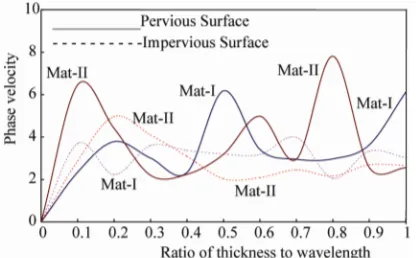
The phase velocity of axially symmetric vibrations of poroelastic cylindrical shells immersed in an acoustic medium is presented in Figures 1-3 for material- I and II each for a pervious and an impervious surface. Figure 1
shows the phase velocity for materials-I and II in case of pervious and impervious surfaces. From Figure 1 it is clear that the phase velocity for a pervious surface is higher than that of an impervious surface in 0 0.5
one is sandst and Jogi, [16] eters are given
sh
a
rated with aterial-II (Yew
e non-dim hysical param-
For a given poroelastic materia (24) and (26), when non-dimens
tions (40) and (41), constitute a relation between non- dimensional phase velocity and ratio of thickness to wavelength (= h/L) for fixed values of g. Different values of g, viz., 1.034, 3 and infinity are taken for nu- merical computation. These values of g represent thin poroelastic cylindrical shell,
ell and poroelastic solid cylinder respectively. The values of lie in [0, 1]. Non-dimensional phase velocity
is determined for different values of and for fixed values of g, each for a pervious and an impervious sur- face. For poroelastic cylindrical shells immersed in an acoustic medium, the values of m, m1, t and t1 are taken
as m = m1 = 1.5 and t = t1 = 0.4. To compute the fre-
quencies of radial vibrations of poroelastic cylindrical shells immersed in an acoustic medium, Equations (34) and (38) are non-dimensionalized using Equations (40) nd (41). Equations (34) and (38) constitute the relation between non-dimensional frequency and ratio of thick- ness to inner radius h/r1. For broad spectrum of values of
h/r1, frequency is computed for the considered poroe-
lastic materials-I and II. To compute the frequency of radial vibrations of poroelastic cylindrical shells im- mersed in an acoustic medium, the values of t, t1, m2, m3
are taken as t = t1 = 0.4, m2 = m3 = 1.5. The non-dimen-
[image:6.595.315.532.294.429.2]sional form of Equations (24), (26), (34), (38) are solved
[image:6.595.318.528.481.617.2]Figure 1. Phase velocity as a function of wavelength (Mat-I, Mat-II, Thin-Shell) axially symmetric vibrations of poroe-lastic cylindrical shells immersed in an acoustic medium.
[image:6.595.52.539.685.732.2]Figure 3. Phase velocity as a function of wavelength (Mat-I, Mat-II, Solid cylinder) axially symmetric vibrations of po- roelastic solid cylinders immersed in an acoustic medium.
for material-I while beyond = 0.5 it is less than or equal to the phase velocity of an impervious surface. The phase velocity of pervious and impervious surfaces is almost is same in case of material-II. The phase velocity for mate-rial-I, in general, is higher than that of material-II both for pervious and impervious surfaces. Thus it can be ferred that presence of mass-coupling parameter in-creases the phase velocity for thin poroelastic cylindri- cal shells immersed in an acoustic medium.
Figure 2 shows the phase velocity of thick poroelastic cylindrical shells immersed in an acoustic medium in case of materials-I and II each for a pervious and an im- pervious surface. It is seen from Figure 2 that the phase velocity of a pervious surface in case of material-I is -
nd 0.7 1. In 0.2 0.5 the phase velocity of a pervious surface is higher than that of an
surface while in 0.5 0.7 it is less than that of an
im . Ag as in case of a t poroelastic
cylindrical shell, the phase velocity is sa pe
nd impervious surfa hi oel ylin
ell. In general, the phase velocity for thick poroelastic cylindrical shell is higher in case of material-I than that of material-II. The phase velocity decreased with the increase of thickness for a pervious surface in case of material-I. In case of an impervious surface, in general, the phase velocity increases with the increase of thick- ness. Increase of thickness has no significant effect on phase velocity in case of material-II for pervious and impervious surfaces.
Figure 3 shows the phase velocity of poroelastic solid cylinders immersed in an acoustic medium each for a pervious and an impervious surface in case of materials-I
- locity of a pervious surface, in general, is higher than that
ic solid cylinder. Also the presence of mass-coupling pa- rameter increases the phase velocity of an impervious surface of the poroelastic solid cylinder. In general, the phase velocity is less in poroelastic solid cylinder than that of either a thin shell or a thick shell both for pervious and impervious surfaces and for both the considered ma- terials.
7. Concluding Remarks
The study of axially symmetric vibrations of poroelastic cylindrical shells immersed in an acoustic medium has lead to following conclusions:
ar vibrations is independent of nature of surface and pres- ence of fluid within and around the poroelastic cylindri- cal shell.
3) The phase velocity is same for pervious and im- pervious surfaces in case of material-II each for thin and thick poroelastic cylindrical shell.
4) In general, the phase velocity is higher for mate- rial-I than that of material-II each for a pervious and an impervious surface.
5) The frequency of radial vibrations of poroelastic cy- lindrical shell immersed in an acoustic medium for a per- vious surface is higher than that of an impervious surface in case of material-I.
uency of an impervious surface is higher pervious surface in case of material-II.
dgements
author thankful to the Editor-in-Chief, the review- ers, and particularly the Editorial Assistant Mr. Judy Liu,
Cylinders,” al
most same to that of an impervious surface in 0 0.2
that the absence of mass-coupling parameter increases the phase velocity of a pervious surface of a poroelast
a
impervious 6) The freq
than that of a
pervious surface ain hin
me for rvious
a ces for t ck por astic c drical
sh
and II. From Figure 3 it is clear that the phase velocity of pervious and impervious surfaces vary in a staggered way for material-I. In case of material-II, the phase ve
of an impervious surface unlike in case of poroelastic thin and thick cylindrical shells. Therefore it is inferred
for their suggestions and cooperation in improving the quality of this paper.
REFERENCES
[1] D. C. Gazis, “Three Dimensional Investigation of the Propagation of Waves in Hollow Circular
1) Radial vibrations and axially symmetric shear vibra- tions are uncoupled when the wavenumber is zero.
2) The frequency equation of axially symmetric she
8. Acknowle
The is
Journal of the Acoustical Society of America, Vol. 31, 1959, pp. 568-587. doi:10.1121/1.1907753
[2] L. Bjorno and R. Kumar, “Fluid Influenced Stress Wave Dispersion in Submerged Rods,” Acustica, Vol. 27, 1972, pp. 329-334.
[3] J. Chandra, R. Kumar and Y. K. Mehta, “Dispersion of Axially Symmetric Waves in Cylindrical Shells Im-mersed in an Acoustic Medium,” Acustica, Vol. 35, 1976, pp. 1-10.
Society of America, Vol. 28, No. 2, 1956, pp. 168-178.
doi:10.1121/1.1908239
[5] M. Tajuddin and K. S. Sarma, “Torsional Vibrations of Poroelastic Cylinders,” Journal of Applied Mechanics, Vol. 47, 1980, pp. 214-216.
[6] C. J. Wisse, D. M. J. Smeulders, M. E. H. van Dongen and G. Chao, “Guided Wave Modes in Porous Cylinders: Experimental Results,” Journal of the Acoustical Society of America, Vol. 112, No. 3, 2002, pp. 890-895.
doi:10.1121/1.1497621
[7] C. J. Wisse, D. M. J. Smeulders, G. Chao and M. E. H. van Dongen, “Guided Wave Modes in Porous Cylinders: Theory,” Journal of the Acoustical Society of America, Vol. 122, No. 4, 2007, pp. 2049-2056.
doi:10.1121/1.2767418
[8] G. Chao, D. M. J. Smeulders and M. E. H. van Dongen, “Shock-Induced Borehole Waves in Porous Formations: Theory and Experiments,” Journal of the Acoustical So-ciety of America, Vol. 116, No. 2, 2004, pp. 693-702.
doi:10.1121/1.1765197
[9] A. K. Vashishth and P. Khurana, “Wave Propagation along a Cylindrical Borehole in an Anistropic Poroelastic Solid,” Geophysical Journal International, Vol. 161, No. 3, 2005, pp. 295-302.
doi:10.1111/j.1365-246X.2005.02540.x
[10] H. Farhang, E. Esmaeil, N. S. Anthony and A. Mirnezami, “Wave Propagation in Transversely Isotropic Cylinders,”
International Journal of Solids and Structures, Vol. 44. No. 16, 2007, pp. 5236-5246.
doi:10.1016/j.ijsolstr.2006.12.029
[11] M. Tajuddin and S. Ahmed Shah, “Circumferential Waves of Infinite Hollow Poroelastic Cylinders,” Journal of Ap-plied Mechanics, Vol. 73, No. 4, 2006, pp. 705-708.
doi:10.1115/1.2164513
[12] M. Tajuddin a n Torsional
Vibra-tions of Infini linder,” Journal of
nd S. Ahmed Shah, “O te Hollow Poroelastic Cy
Mechanics of Materials and Structures, Vol. 2, No. 1, 2007, pp. 189-200. doi:10.2140/jomms.2007.2.189
[13] S. Ahmed Shah, “Axially Symmetric Vibrations of Fluid Filled Poroelastic Circular Cylindrical Shells,” Journal of Sound and Vibration, Vol. 318, No. 1-2, 2008, pp. 389- 405. doi:10.1016/j.jsv.2008.04.012
[14] S. Ahmed Shah and M. Tajuddin, “On Axially Symmetric Vibrations Fluid Filled Poroelastic Spherical Shells,”
Open Journal of Acoustics, Vol. 1, No. 2, 2011, pp. 15- 26. doi:10.4236/oja.2011.12003
[15] I. Fatt, “The Biot-Willis Elastic Coefficients for a
Sand-n cks,” Journal of the Acoustical
stone,” Journal of Applied Mechanics, Vol. 26, 1959, pp. 296-297.
[16] C. H. Yew and P. N. Jogi, “Study of Wave Motions i Fluid-Saturated Porous Ro
Society of America, Vol. 60, 1976, pp. 2-8.