© 2019, IRJET | Impact Factor value: 7.34 | ISO 9001:2008 Certified Journal | Page 1529
The Systematic Procedure to Sort Out Contractor in Construction Field
Pavan Kailas Bachhav
11
M.Tech, MITCOM, MIT Art, Design & Technology University, Pune, Maharashtra
---***---Abstract – The endemic uncertainty of the environment over a limited period tends to complicate the decision-making process. This study aims to analyze the selection of the optimal supplier that meets the necessary criteria, such as the characteristics of the product, the characteristics of the supplier and the delivery conditions. - The increasing market pressure in the construction sector forces companies to make quick and good decisions by conducting strategic analyzes. In this sense, information asymmetry is a crucial concept that requires managers to use different models during the decision-making process not only for their own benefit, but also for the good of all the parties involved. The analytical hierarchy process method is used to assess the characteristics of suppliers that tend to consist of numerous interdependent variables and complex relationships. Supplier A has relatively better product features and supplier characteristics. Tackling the fundamental problems in the selection of suppliers has gained more and more ground in the construction sector to maintain a competitive advantage in terms of cost and time efficiency, as well as sustainability. Companies operate in an environment where decisions need to be managed in a holistic way. When managers are about to make sound decisions, they are eventually required to feel responsible towards the company and the various stakeholder groups. In general, the decision-making process is of vital importance for companies both in a macro perspective due to existing ecological concerns and in a micro perspective in terms of sustainability.
Key Words: Analytical hierarchy process, strategy,
decision-making process, selection of suppliers, construction industry.
1. INTRODUCTION
The research conducted in this study aims to explore and subsequently overcome the problems and shortcomings associated with the multi-criteria nature of the corporate environment. Several methods can be used to evaluate multiple variables. In general terms, companies operate in an environment where mutual effects shape their strategies. Companies must evaluate concepts, strategies and progressive phases of growth.
1.1 INTEND
This article examines the application of the AHP method in terms of the supplier selection process in the Turkish construction sector. There seems to be a strong and complex competitive structure in the industry. The use of the AHP method common in the Turkish construction industry can also shorten and simplify this complicated and generally entangled process of choosing the right supplier. In addition
to this, this study also aims to provide an overview of the management structures of construction companies that have been examined in an empirical study based on the application of the AHP method in terms of the supplier selection process and favorable approaches to designing an ingenious scheme and precise in all decision-making mechanisms. The characteristics of the supplier capabilities were also analyzed in this comparative study. The studies conducted on modeling and simulation so far offer some useful tools for decision makers.
1.2 Scenario
Companies around the world are forced to evaluate and even evaluate all the criteria they often encounter. This has a great impact on the decision-making process in terms of defining the priorities of the variables, eliminating some possible alternatives. In general, financial parameters tend to be important determinants that can be seen in the comparison tables based on the supplier selection process. The needs of end users and owners on issues such as quality and technical performance seem to increase every day. And there are widespread improvements in the level of awareness regarding the environment, society and sustainability. Therefore, not only the decision-making process in the construction sector performs a demanding process both from a practical and systematic point of view, but also the achievement of these business objectives in the end seems to be a rather challenging task. The Fuzzy AHP method stands out as an application of a multiple criteria analysis (MCDA) which offers a solution to the challenges mentioned above in the decision-making process.
In summary, this article aims to provide a framework for the development of a strategic decision-making process based on the evaluation of supplier selection in the construction sector. To this end, bibliographic reviews are presented on the characteristics of the supplier. The third part focuses on the steps of the AHP method. And the calculations based on the indicated criteria can be found in the fourth part. Finally, the results are shown from a managerial perspective in the final part.
2. Procedure of Contractor Selection
© 2019, IRJET | Impact Factor value: 7.34 | ISO 9001:2008 Certified Journal | Page 1530
The supplier selection process has undergone many significant changes over the past two decades. One of the main reasons is the use of better computer-mediated media that not only encourage distant providers to connect to each other, but also allow them to compete more easily with their local rivals. Furthermore, they facilitate effective communication between companies and alternative suppliers, which in turn accelerates the entire decision-making process during which faster and more precise strategic decisions are taken. Having a variety of alternatives leads major contractors, end users and owners to have higher expectations that suppliers must meet. Ultimately, this affects the selection criteria of suppliers, as it imposes considerable requirements both in terms of quality and technical performance. With recent advances in information technology and networking, it is now much easier to improve technical performance. And due to the growing demand for cutting-edge quality, there have been difficulties with conventional methods in terms of the supplier selection process.
The criteria for selecting suppliers in the telecommunications sector are identified based on some critical aspects, such as financial, technical and operational attributes. Financial characteristics include capital expenditures, unit costs, operating expenses, maintenance fees and expenses of the Network Administration System (NMS). The technical attributes are technical characteristics, technical reliability, technical effectiveness, technical competence, updates, technical dismissals, imminent technological advances, keeping up with global measures, constituency with alternative structures. Operational attributes include error recognition, system protection, operating structures, performance assessments and flexible billing.
The purchasing division believes that the supplier selection process is a crucial step. Normally, suppliers tend to be chosen based on their capabilities in terms of necessary features, delivery conditions and proposed financial value. In addition to current needs, there are also some future expectations that a decent provider should be able to meet. These rather critical principles can be grouped into four main categories, namely self-governing, reliable, committed and guided. The interpretative structural model (ISM) is an approach that shows the interdependence of different factors, as well as their degrees of importance during the supplier selection process. It demonstrates that the "position and enthusiasm in the business world" together with "customer service" are equally essential elements, such as functionality,
delivery processes and application. The elements mentioned above are also interdependent. The study can generate a substantial systematic database in terms of the supplier selection process.
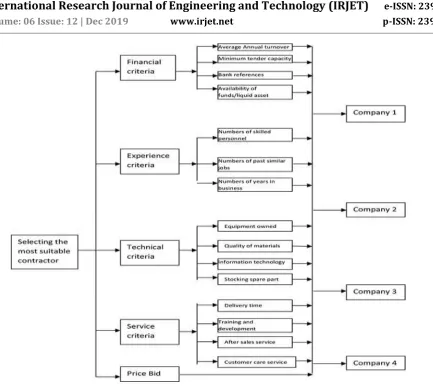
The initial phase involves the evaluation of the project configuration. The goal of design is to choose the best supplier. There must be a total of four suppliers (called suppliers A, B, C and D) along with eleven decision-making elements (characteristics, punctuality, costs, adaptability, delivery times, managerial capacity, employee performance, operational competition, economic potential and market share) to evaluate substitutes. The coherent elements should be grouped into two categories: supplier behavior and supplier capacity. Subsequently, four suppliers must be grouped in the substitute category. Therefore, we should have three categories in total in the design, namely the behavior of the supplier, the capacity of the supplier and the substitutes. It is a basic network system. Figure 1 shows the general image relating to the ANP design. Interconnections are shown with straight arrows between the categories.
3. Graphical Method
Several studies in the literature have so far been analyzed to select the most effective criteria. From there, several indicators have been consolidated to obtain the most effective evaluation.
The AHP is a technique that evaluates different levels of importance of the variables for decision-making. The ability, experience and intuition of decision makers are also applied to simplify the problem-solving process. Objective and subjective opinions tend to influence the variable selection process. There are three levels of this approach in terms of building a hierarchical level by comparing matrices of relative importance and measuring consistency in accepted values. The option with the highest value is preferred over the other alternatives. Scale 1-9 is implemented for measurement. The results may naturally differ in terms of different decision models with multiple criteria.
© 2019, IRJET | Impact Factor value: 7.34 | ISO 9001:2008 Certified Journal | Page 1531
Fig -1: Systematic way to select Contractor
The decision support system (DSS) is integrated into the analytical hierarchy process (AHP) to find the optimal location of the grocery store. The components determined are the following: (1) development of the hierarchical structure for widespread AHP, (2) determination of weights, (3) data collection and (4) decision-making process. Its goal is a precise and rapid decision-making process for senior managers.
A bidirectional comparison consists of criteria and alternatives, predefined vectorial results, score and classification of alternatives. Then the compliance index and the reasons are calculated.
Alternative comparisons are made for measurement, in which the numbers 1 to 9 are made in matrix form.
aii = 1, aij = k, a ji = 1/ k
The sums of the columns are found in the matrices. Each cell is normalized by dividing it by the sum of the column. The alternatives are evaluated by calculating the average of each row. This vector shows how far the alternatives meet your criteria. Comparisons of the criteria are made using the numbers 1-9. The numbers in the matrix are normalized by dividing by the sum of the columns. The priority of the criteria is determined by the search for linear averages. Each cell is normalized by dividing it by the sum of the column.
The alternatives are evaluated by calculating the average of each row. This vector shows how far the alternatives meet the criteria. The total scores of the alternatives are multiplied and their grades are ranked. The highest score shows the best alternative.
The meaning of the numbers 1-9 used in the qualification is the following:
The meaning of numbers 1-9 used in rating is below:
Preference level Numeric value
Equally important 1
Moderately more level important 3 Strongly more important 5 Very strongly more important 7 Extremely more important 9
Note: 2, 4, 6, 8 represent intermediate values.
4. METHODOLOGY
[image:3.595.89.523.50.436.2]© 2019, IRJET | Impact Factor value: 7.34 | ISO 9001:2008 Certified Journal | Page 1532
The decision was based on the main success factors in the sector. The characteristics of the product, the characteristics of the supplier and the conditions of delivery are included in this framework. Product features include strength, quality, compliance with international and sanitary standards and unit cost. The characteristics of the supplier include previous jobless satisfaction, the opportunity to work in the future, industry recognition and reliability. Delivery conditions include timely delivery, invoice flexibility, after-sales services and communication with the sales unit.
There are related determinants that offer a multi-criteria model for precise decisions in the selection of strategies, procedures and processes with respect to companies.
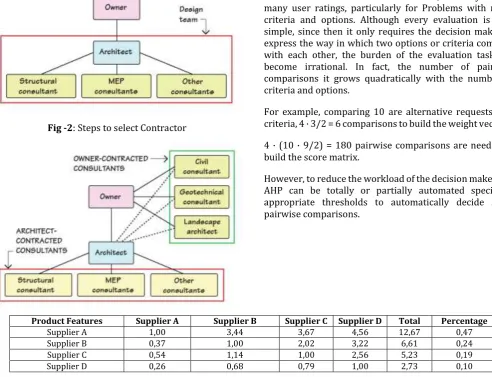
Fig -2: Steps to select Contractor
Fig -3: Steps to select Contractor
5. Analytic Hierarchy Process (AHP) Method
The AHP is a very flexible and powerful tool because the scores, and therefore the final classification, are obtained based on relative peer reviews of criteria and options provided by the user. The calculations made by the AHP are always guided by the decision the producer experience and the AHP can be considered as a tool able to translate
Evaluations (both qualitative and quantitative) carried out by the decision maker in a multiple criterion classification. Moreover, AHP is simple because it is not necessary to create a complex expert. System with the knowledge of the decision maker embedded in it. On the other hand, AHP may require many user ratings, particularly for Problems with many criteria and options. Although every evaluation is very simple, since then it only requires the decision maker to express the way in which two options or criteria compare with each other, the burden of the evaluation task can become irrational. In fact, the number of pairwise comparisons it grows quadratically with the number of criteria and options.
For example, comparing 10 are alternative requests in 4 criteria, 4 · 3/2 = 6 comparisons to build the weight vector, e
4 · (10 · 9/2) = 180 pairwise comparisons are needed to build the score matrix.
However, to reduce the workload of the decision maker, the AHP can be totally or partially automated specifying appropriate thresholds to automatically decide some pairwise comparisons.
Product Features Supplier A Supplier B Supplier C Supplier D Total Percentage
Supplier A 1,00 3,44 3,67 4,56 12,67 0,47
Supplier B 0,37 1,00 2,02 3,22 6,61 0,24
Supplier C 0,54 1,14 1,00 2,56 5,23 0,19
Supplier D 0,26 0,68 0,79 1,00 2,73 0,10
Table 1: Table for AHP Process Example
Supplier A is the most preferred in terms of product features. In each sector, product specifications are considered important elements. However, regulations in construction projects tend to be strictly defined, so it is necessary to provide the necessary conditions without risking people's lives. As quality is also one of the crucial factors in the construction sector, performance and flexibility (the ability to easily adapt the existing details / conditions to projects / current conditions) of materials are increasingly important. ,
since suppliers prefer to have complex state-of-the-art buildings / projects of the latest generation in this sense, these features could become more important than the price and other conditions sometimes.
6. Conclusion
[image:4.595.44.537.274.651.2]© 2019, IRJET | Impact Factor value: 7.34 | ISO 9001:2008 Certified Journal | Page 1533
last stage in which the final product is finalized and made available to the customer. It is true that the supply chain system is of vital importance at every stage of the process. Therefore, in some cases it becomes a valuable partner for companies. In a sense, it creates a mutually beneficial relationship in a highly competitive environment. This attaches great importance to the supplier selection and decision process.
There appear to be five very critical forces in this competitive environment, namely the supplier, the buyer, the potential participants and the substitute products. The implication of industry analysis examines not only the attractiveness but also the fundamentals of competition and profitability. The structure of the sector must be analyzed quantitatively and qualitatively. The bargaining power of buyers depends largely on the proportion of sensitivity to the buyer's price, the barriers to entry and the buyer's variable costs. All these problems must be analyzed closely and in a holistic view to determine the correct strategies indicate that the existence of substitute products tends to have serious repercussions on the power of the supplier. In fact, companies seem to have control of only some of the indicators add the Triple Bottom Line (profit, people and planet) approach to supplier selection metrics in terms of sustainability due to increasing pressure on stakeholders in the business environment.
All the criteria were assessed on equal terms. However, the weight of these criteria may also vary depending on the project. The product performance criterion is considered as another substantial element, especially in terms of architectural or specific projects / constructions where the priority of the product cost criteria is reduced. The supplier criteria also lose priority, together with the reduced cost of product selection. On the other hand, it can be said that the supplier criteria increase in weight in projects / constructions carried out in different geographical / market conditions. Design differences tend to influence the importance of weighting factors. For example, in some cases, the cost seems to be crucial in situations where the products are the same.
REFERENCES
[1] https://people.revoledu.com/kardi/tutorial/AHP/AHP-Example.htm
[2] https://www.pearsonhighered.com/assets/samplechap ter/0/1/3/4/0134454170.pdf
[3] https://www.projectengineer.net/contractor-selection-methods/
[4] https://www.projectengineer.net/contractor-selection-methods/