ESTIMATION OF SURFACE RUNOFF USING CURVE NUMBER METHOD- A
GEOSPATIAL APPROACH
Anjana S.R
1, Jinu A
21
PG Scholar, Department of Soil and water Conservetion Engineering, KCAET Tavanur, Malappuram, Kerala, India
2Assistant Professor, Department of Soil and water Conservetion Engineering, KCAET Tavanur, Malappuram,
Kerala, India
---***---Abstract –
The Natural Resources Consevation ServiceCurve Number (NRCS CN) is the widely used method for the estimation of surface runoff. The remote sensing and GIS techniques facilitate the estimate of surface runoff. This study mainly focused to estimate the runoff of KCAET Campus using the curve number method. The study was carried out in GIS environment using remote sensing data. The analysis was done for the year 2004 to 2007, 2018 and 2019 upto June. The land use map was digitized from Google earth of year 2006 and 2018. ArcGIS 10.2 was used for the analysis. About 28.5% of the total area belongs to high runoff potential class, 33.7% have medium runoff potential and 37.7% of the area has high runoff potential. The runoff percentage from the annual rainfall varied from 16% to 23% for the study period. The curve number values for normal conditions were 57.77 and 58.95 for the year 2006 and 2018 respectively. The integration of remote sensing and GIS along with NRCS curve number method was found to be a powerful tool in estimating runoff.
Key Words: Remote sensing, GIS, NRCS CN, Rainfall,
Runoff, Curve number
1. INTRODUCTION
Water is a vital factor for augmenting the growth of agriculture, industry and economic development, especially in the perspective of rapidly increasing population and urbanization. Various aspects of water which related to earth were represented in terms of hydrologic cycle [1]. Precipitation and runoff are the two important hydrologic variables and the main transportation components of the hydrologic cycle. In the coming decades, climate change, surface water pollution and population growth together may produce a severe decline in fresh water supply and there will be water stress all over the country. The quantification and conservation of available water resources is essential to ensure sustainability. Estimation of surface runoff is essential to assess the potential water yield of a watershed, to plan water conservation measures including recharging of the ground water zones and reduction of sedimentation. This also helps in reducing the flood hazards at the downstream and it is an essential prerequisite of integrated watershed management [2].
Natural Resources Conservation Services Curve Number (NRCS-CN) method is widely used, simple empirical model with few data requirements and clearly stated assumptions. The method was originally developed by Soil Conservation
Service, United States Department of Agriculture (USDA). The NRCS-CN method has been widely used for storm water modeling, water resource management and runoff estimation from rainfall events in urban or agricultural watersheds [3].
Generation of too many spatial input data is one of the major problems in the runoff estimation models. Conventional methods are too costly and tedious for the generation of input data. With the advent of Remote Sensing and Geographic Information System (GIS) technology, the derivation of such spatial information has become cost effective and easier. Remote sensing technology can enhance the conventional methods to a great extent in rainfall-runoff studies. Many researchers have been using the Geographic Information System along with remote sensing data to estimate runoff curve number value all over the world. There exists a good correlation between the estimated runoff depth and measured runoff depth using NRCS CN method along with GIS. The incorporation of remote sensing data and application of the NRCS CN model in a GIS platform provides a powerful tool in the assessment of runoff [4].
2. STUDY AREA AND DATA SOURCES
2.1 Study Area
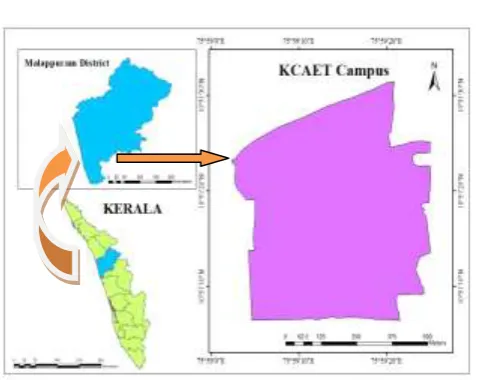
Fig -1: Location map of the study area
2.2 Data
The boundary of the KCAET Campus was demarcated using handheld GPS survey. The surveyed points were transferred into ArcGIS.
Sieve analysis was done using soil samples collected from 20 different locations in the study area to generate soil texture map. Land use map of the study area was digitized from Google earth imageries of 2006 and 2018. Daily rainfall measurements were collected from non recording type (Simon’s type) raingauge from the study area.
Table -1: Data types and sources
Sl
No. Type Source Description
1 Boundary Points GPS Handheld GPS survey 2 Soil Data Sieve analysis Soil types
3 Land use Google earth imageries of 2006 Google earth & 2018 4 Rainfall Simon’s rain gauge Non recording type rain gauge
3. METHODOLOGY
The NRCS CN method developed by NRCS (Natural Resource
The NRCS CN method based on water balance equation has two primary assumptions. First, the ratio of the actual amount of runoff (Q) to maximum potential runoff is equal to the ratio of the actual infiltration (F) to the potential maximum retention or infiltration (S).
Second assumption is the amount of initial abstraction (Ia) is
considered as some fraction of potential maximum retention (S).
Ia = λS (3.3)
where λ is the fraction of potential maximum retention and it was taken as 0.2 in this study.
The index of runoff potential before a storm event is the antecedent moisture condition (AMC). It is an indicator of availability of soil moisture before a storm and watershed wetness. The NRCS recommends to assign curve number values on the basis of AMC on the rainfall in 5 day period preceding a storm. AMC I is the dry condition of soils in the watershed and AMC II is the average moisture condition. AMC III is the condition which has heavy rainfall or light rainfall at low temperatures in the preceding five days of the storm.
The potential maximum retention (S) is the recharge capacity of the watershed. The potential soil water retention map was generated using raster calculator tool in arc gis based on the equation 3.4.
(3.4)
3.1 Soil type
The Natural Resource Conservation Service (NRCS) classified the soils into four classes A, B, C and D based on the soil characteristics.
Table -2: HSG for USDA textural classes
HSG Soil Texture
A Sand, loamy sand or sandy loam
B Silt or loam
C Sandy clay loam
D Clay loam, silt clay loam, sandy clay or clay
Different hydrologic soil groups and their characteristics given by USDA were described below.
Group D- These soils have high runoff potential and water transmission is restricted or very restricted through the soil. The clay content is greater than 40% and sand is less than 50%.
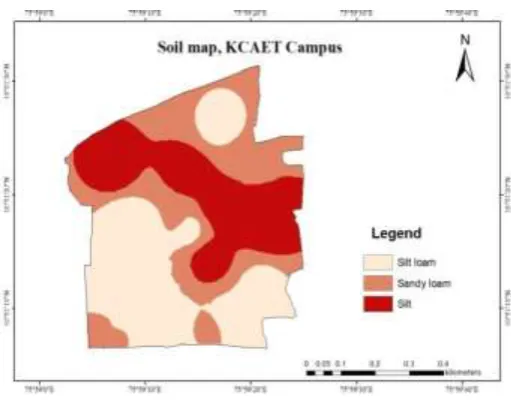
[image:3.595.304.562.52.307.2]Three textural groups like sandy loam, silt and silt loam were identified in the study area using texture calculator and USDA nomograph. The identified soil types are interpolated using Inverse Distance Weighting method in ArcGIS. A considerable of the area (around 44.4%) have sandy loam soil, whereas silt and silt loam soil together constitutes 55.6% of the study area. Sandy loam soil which have high infiltration rate as compared to silt and silt loam dominated in the study area.
Fig -2: Soil map of the study area
3.2 Hydrologic soil group
[image:3.595.36.292.246.449.2]Conditions for the classification of hydrological soil groups are applied in the ArcGIS interface and HSG map was prepared. Two hydrologic soil groups, A and B were identified in KCAET Campus from the soil texture map. The silt and silt loam belongs to hydrologic soil group B and sandy loam soil belongs to hydrologic soil group A. As stated by USDA, the HSG A and HSG B have good water transmission rate and low runoff potential.
Fig -3: HSG map of the study area
3.3 Land use
The land use is the utilization of land resources by human being. The land cover change reflects in the impact on environment which is due to excessive human interventions. The Google Earth tool was developed recently and is widely used in many sectors. The Google Earth which releases high spatial resolution images is a free and open data source. The Google Earth images will provide detailed land use/land cover mapping facilities with relatively satisfactory results [6].
Fig -4: Land use map (2006)
Fig -5: Land use map (2018)
3.4 Curve number
The runoff curve number is an empirical parameter which is used to predict the direct runoff which ranges from 0 to 100. A Lower value indicates the low runoff potential while the higher value indicates the high runoff potential. A CN of 100 represents a limiting condition of a perfectly impermeable catchment with zero retention, in which all rainfall becomes runoff. A CN of zero conceptually represents the other extreme, with the catchment abstracting all rainfall and with no runoff regardless of the rainfall amount [7]. The curve
Woods Woods with grass-Good condition. Litter and
shrubs covered the soil 30 73
Polyhouse Farmsteads-buildings 72 82
Open land Open space- Ground 79 72
Mango Orchard with understorey cover 39 53
Coconut Orchard without understorey cover 41 65
Banana Scrub 33 47
Agriculture With bush weed grass 35 56
Pond Water body 0 0
Pasture Good grass cover 39 61
4. RESULTS AND DISCUSSIONS
The Natural Resource Conservation Services Curve Number (NRCS CN) method was combined with ArcGIS 10.2 to estimate the runoff occurring from the study area. The NRCS CN equation is widely used due to its simplicity and flexibility in estimation of runoff. The thematic layers of potential maximum retention (S) and initial abstraction (Ia) were
created, stored and analyzed with ArcGIS 10.2 software.
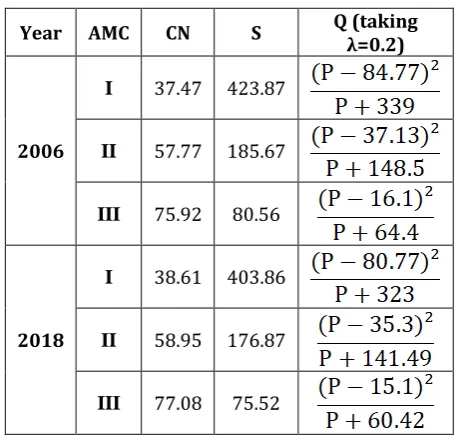
Table -4: Rainfall runoff correlation of the study area
Year AMC CN S Q (taking λ=0.2)
2006
I 37.47 423.87
II 57.77 185.67
III 75.92 80.56
2018
I 38.61 403.86
II 58.95 176.87
III 77.08 75.52
[image:4.595.319.549.390.610.2] [image:4.595.320.549.390.610.2]Chart -1: Rainfall - Runoff variation in Pre monsoon About 60% of the total rainfall depth in Kerala is received from south west monsoon. The maximum amount of rainfall and thereby runoff depth was observed during June and July and the runoff percentage was in the range of 18 to 23.
Chart -2: Rainfall - Runoff variation in south west monsoon The north east monsoon contributes about 30% of the total rainfall. The maximum rainfall was observed during October in the season. The runoff percentage in this season ranges from 9% to 20%.
Chart -3: Rainfall - Runoff variation in north east monsoon
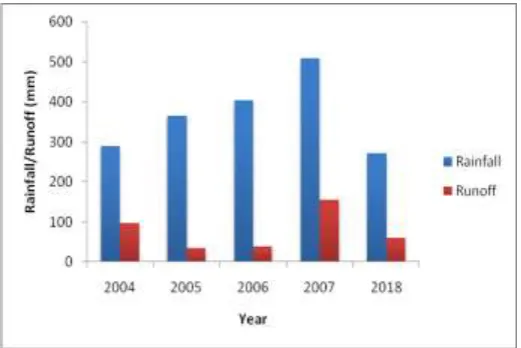
[image:5.595.37.295.338.498.2]Yearly rainfall and runoff values obtained from the study area using NRCS CN method is given in table 5, and runoff percentage values from the study area varied from 19% to 23%. Also it is showing an increasing trend from 2004 to 2018.
Table -5: Yearly rainfall - runoff
Year Rainfall (mm) Runoff (mm) Runoff (%) Volume (m3)
2004 2675.18 533.02 19.92 208030.956
2005 2819.1 472.48 16.76 184406.031
2006 3320.05 720.48 21.70 281194.947
2007 3971.8 950.13 23.92 370824.426
[image:5.595.36.297.584.758.2]2018 2919.8 672.68 23.04 262538.876
Fig -6:
Severity range of runoff (2018)
The runoff severity is categorized into three classes viz. low, medium and high. Areas which has vegetative cover with ground cover with litter or grass and which belongs to HSG A will have low and medium runoff potential compared to land use with impervious structures and which belongs to HSG B. About 28.5% of the area have high runoff potential, 33.7% have medium runoff potential and 37.7% of the total area have low runoff severity range. Major part of the area which belongs to high severity range of runoff have built up and open spaces. Since the water bodies in the study area are water storage structures it does not produced any surface runoff.
5. CONCLUSIONS
use maps were intersected in ArcGIS platform. CN values were assigned on the basis of HSG and land use. The composite curve number for the normal condition is 57.77, whereas for wet and dry conditions are 75.92 and 37.47 in 2006. In 2018, the composite curve number for normal condition is 58.95, whereas it is 77.08 and 3.61 for wet and dry conditions respectively. Analysis of the results showed that as the runoff percentage is increasing, the ground water recharge rate is reducing. This leads to the decline of water table resulting in water stress in terms of available fresh water. As the water demand is increasing due to population explosion and resource limitations, it is essential to recharge the ground water using the runoff generated.
REFERENCES
[1] Chow, V.T., Maidment, D.R. and Mays, L.W., “Applied Hydrology”, McGraw-Hill Book Company, New York, pp. 154. 2002.
[2] Patil, J.P., Sarangi, A., Singh, A.K and Ahmad, T. “Evaluation of modified CN methods for watershed runoff estimation using a GIS-based interface” Biosystems Engineering. Vol.100, pp.137-146, 2008.
[3] Lewis, D., Singer, M.J and Tate, K.W. “Applicability of SCS curve number method for a California Oak Woodlands Watershed”. Journal of Soil and Water Conservation Vol.55, Issue 2, pp.226–230, 2000.
[4] Bhuktar, V.S and Regulwar, D.G. “Computation of Runoff by SCS-CN Method and GIS”. International Journal of Engineering Studies and Technical Approach. Vol.1, Issue 6, pp.63-70. 2015.
[5] Amutha, R and Porchelvan, P. “Estimation of surface runoff in Malattar sub watershed using SCS-CN method” Journal Indian Society Remote Sensing, Vol.37, pp.291– 304. 2009.
[6] Hu, Q., Wu, W., Xia,T., Yu, Q., Yang, P., Li, Z and Song, Q. “Exploring the Use of Google Earth Imagery and Object-Based Methods in Land Use/Cover Mapping” Remote Sensing. Vol.5, pp.6026-6042. 2013.