For Peer Review
Mediated research encounters: methodological considerations in cross-language qualitative interviews
Journal: Qualitative Research
Manuscript ID QR-16-0132.R1
Manuscript Type: Standard Article
Keywords: Qualitative interviews, Interpreters, Cross-language, Global mental health, Research methods, Phenomenology, Cross-cultural
Abstract:
Given increasing globalisation, the continuing prevalence of emergencies, and the importance of conducting rigorous research to ensure the mental health needs of populations exposed to emergencies are effectively met, cross-language research will continue to arise. Drawing upon the lead author’s (AC) experience of conducting a cross-language qualitative study in three post-conflict settings in South Asia, this paper discusses
methodological considerations raised when interviewing with interpreters. These include considering interpreter positionality and matching; the approach to cross-language mediation during interviews; and assessing the quality of interpreter facilitated interviews. Drawing upon approaches taken in this study, the important choices researchers face about how these are managed are examined, considering the roles of researcher and interpreter positionality, the research context, and the epistemological underpinnings of the research. The discussion further illuminates the interrelated methodological, practical and ethical considerations for other researchers embarking upon similar research.
For Peer Review
ARTICLE TITLE: Mediated research encounters: methodological considerations in cross-language qualitative interviews
MAIN ARTICLE WORDS: 7,959 (inclusive of text boxes, figures and references)
Introduction
Acute and protracted humanitarian emergencies can have wide-ranging effects on mental health (Inter-Agency Standing Committee (IASC), 2007). To address these needs requires academic, operational, and policy oriented research. is required. Conducting research in emergencies affirms the right of populations to participate in research, ensuring services meet the founding principles of medical ethics: do no harm and do some good (Beauchamp and Childress, 2013; Council for International Organisations of Medical Sciences (CIOMS), 2015; The National Commission for the Protection of Human Subjects of Biomedical and Behavioural Research, 1979). Cross-language mental health research in emergencies arises for three primary reasons: first, technical research expertise is frequently found outside the settings where emergencies occur; second, emergencies are rarely contained to one country or population and more commonly traverse national borders, for example earthquakes or conflicts; and third, research is increasingly international in nature. Under all of these circumstances research is likely to necessitateoften needs multiple-language skills unlikely to be found in a single investigator, requiring interpreters to facilitate communication.
Recognising that a key principle of ethical research is to utilise sound research methods, this paper aims to extend methodological discussions, addressinges the critique that researchers fail to adequately consider the implications of interpreter facilitated qualitative interviews (Shimpuku and Norr, 2012; Squires, 2009; Williamson et al., 2011), by extending the methodological discussion. Drawing upon the lead authors’ (--AC) experience of conducting of a cross-language qualitative study in three post-conflict settings in South Asia, the first section of this paper introduces the study is outlined before raising; then methodological considerations raised when interviewing with interpreters. These are illustrated with examples and reflections from the study are discussed; before drawing conclusions about interrelated methodological, practical and ethical considerations for other researchers embarking upon similar research.
The study: researchers’ experiences of ethics in mental health research in post-conflict settings This qualitative multi-site case study (Yin, 2009) conducted by AC, involved interviews with researchers engaged in mental health research in three post-conflict settings in South Asia. Adopting a phenomenological orientation (Schutz, 1945), the research emphasised the lived-through quality of researchers’ experiences of ethics by empirically exploring how ethics is defined, understood, applied and managed in everyday research practice, focusing upon the interaction between constructions of procedural and in-practice ethics (Guillemin and Gillam, 2004). The aim is to produce findings relevant to policy and processes governing the conduct of ethical mental health research in post-conflict contexts.
Epistemologically, the researchers’ choice about where the researcher is placed to place themselves on the continuum between positivism and interpretivism/constructivism has implications for the interpreter’s role (see Temple and Young (2004) for a discussion). In this study the phenomenological orientation calls for interpreters to occupy an active role, viewed as co-producers of research where translation is central to knowledge production (Temple and Young, 2004). Given multiple research sites that necessitateing multiple interpreters, the interpreter was viewed as an 2
For Peer Review
extension of the researcher rather than joint-interviewer (Faller, 1985), with all interpreter-facilitated interviews led by AC--.
AC is a white British female in her early thirties. Being British and conducting research in South Asia brought connotations of British colonial histories. AC--’s positionality vis-a-vis research participants was one of a highly educated and privileged female with established professional relationships with senior staff at each organisation. Prior organisational narratives were inevitable in this context, with AC’s “expert” status frequently prioritised --’s “expert” status above other characterisations such as “student”.
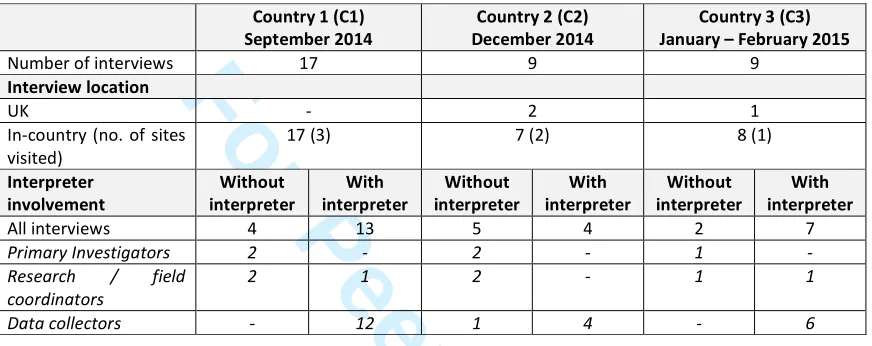
Thirty-five individual in-depth interviews were conducted at six field sites, including remote locations, across three South Asian countries; and in the UK (see table 1). A semi-structured topic guide was developed to steer interviews, exploring participant’s views of the construction and management of procedural and in-practice ethics from the participants’ perspective (Guillemin and Gillam, 2004),. This was complemented by remaining open to emerging meanings and the iterative evolution of interview topics to explore within and between case studies (Yin, 2009; Rapley, 2007). Only one of the 35 participants spoke English as a first language and the researcher did not speak the participants’ languages making the support of interpreters to facilitate researcher-participant communication essential. Consequently, 25 interviews were conducted with interpreters,; whilst the remaining participants choose to spokeeak in English.
Table 1: Interview overview
Country 1 (C1)
September 2014
Country 2 (C2)
December 2014
Country 3 (C3)
January – February 2015
Number of interviews 17 9 9
Interview location
UK - 2 1
In-country (no. of sites visited)
17 (3) 7 (2) 8 (1)
Interpreter involvement
Without interpreter
With interpreter
Without interpreter
With interpreter
Without interpreter
With interpreter
All interviews 4 13 5 4 2 7
Primary Investigators 2 - 2 - 1 -
Research / field coordinators
2 1 2 - 1 1
Data collectors - 12 1 4 - 6
Interpreters were hired in-country and, where possible, at the local field site. Selection interviews were conducted jointly with local organisations.with t Two interpreters were hired in each country, one to participate in interviews (“interview interpreter”) and the second to conduct a quality check (“quality check interpreter”). Attention was paid to the preferred national (C1ountry 1) or regional language of participants (C2 and C3ountry 2). Despite these efforts, in C2ountry 2 difficulties arose in one interview due to the participants’ use of a sub-dialect;, and in C3ountry 3 an interpreter who spoke the participants’ regional dialect could not be found meaning interviews were conducted in the national language shared by interpreters and participants.
Ethics
Ethical approval was obtained from the University of Liverpool and ethical review boards in each South Asian country. Voluntary written informed consent was provided by all participants. To 2
For Peer Review
protect confidentiality, all research sites and participant names have been anonymised. Interpreters were paid a local salary, provided certificates of participation in training, and a reference letter outlining their role in the research.
Cross-language interpreter mediated interviewing
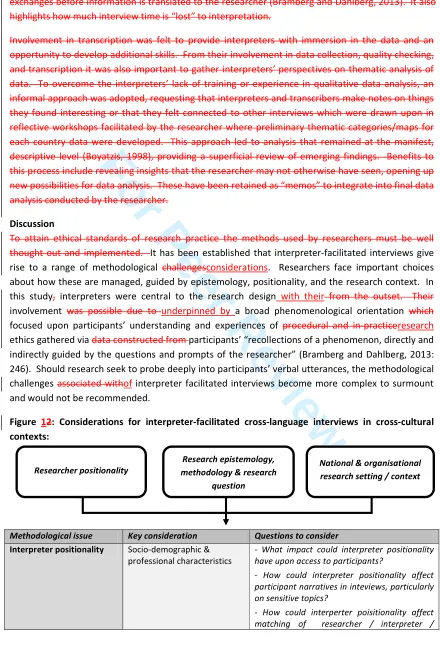
This paper defines an interpreter as someone who translates from a source to a target language, transferring meaning based upon vocabulary, grammar, expression, context, and culture (Eposito: 2010; Regmi: 2010). The interpreter is seen as an active co-constructor of data influenced by their intersubjectivites (Temple: 2002; Berger: 2013, occupying a role that involves “seeking, contributing to, eliciting, or limiting the attainment of data” (Caretta: 2010). Consequently, interpretation is understood as reconstruction rather than the discovery of meaning (Temple and Young, 2004) where participants’ words are not recreated but re-presented. This paper discusses how tThe interpreter role’swas approached in this study, charted through research stages of prior to, during, and post-interviews, aiming to critically engage with methodological discussions on cross-language qualitative research with interpreters. The discussion then considers the interconnected nature of epistemological, methodological, and practical considerations when conducting interpreter-facilitated qualitative interviews.role is considered from the following perspectives: (1) interpreter positionality and matching; (2) approach to cross-language mediation during interviews; and (3) assessing the quality of interpreter facilitated interviews. The discussion draws upon and extends the Briggs-Wengraf model of components of the interview situation (Wengraf, 2001), adding elements specific to interviewing with interpreters (Figure 1).
Figure 1: Cross-cultural qualitative interviewing with interpreters (adapted from Briggs-Wengraf model in Wengraf (2001))
Interpreter positionality and training
Ethical research requires researchers to undergo training and supervision to attain competency, and the same is true for interpreters. Considerations in this process include: the impact of the interpreter’s positionality incorporating professional credentials, and adequate training and supervision; and researcher/interpreter/participant matching.
Prior to interviews
Prior to commencing research, interpreters’ professional credentials and positionality, and the approach to training and supervision to ensure interpreter competency, must be considered.
Professional credentials and recruitment
Interpreters in this study were “lay” i.e. did not have interpreting qualifications or experience. All interpreters had a minimum of high school education (including English language), prior exposure to qualitative research methods, and a basic knowledge of and interest in mental health. In C2 whilst professional interpreters were available the remote research sites prevented their involvement. This reinforces that when conducting research in unstable settings the availability of professional interpreters can be limited, necessitating alternative approaches (Inhetveen, 2012). For this study conducted in countries with recent histories of conflict, being locally embedded was prioritised over formal interpreting qualifications (Ficklin and Jones, 2009; Inhetveen, 2012; Shimpuku and Norr, 2012; Wallin and Ahlstrom, 2006). A limitation to this approach is that the interpreter occupies a dual interpreter/gatekeeper role which carries methodological implications by actively or passively 2
For Peer Review
influencing the population research reaches, and potentially affecting narratives constructed in front of an interpreter perceived as a community “insider” or “outsider”(Hynes, 2003).
In C1 and C2 recruitment advertisements were placed on recruitment websites, and in all three countries partner organisations promoted the roles within their networks. Interviews were conducted with a partner organisation representative and involved an aural translation exercise, translating sections of an information sheet of an unrelated project from the source into the target language and vice versa. This provided a crude measure of each applicant’s aural translation competency. Interviews also involved discussions about applicant’s backgrounds, prior experience with qualitative research methods and the mental health field. Finally, availability for the study period (duration of employment, length of working days, and any required travel) were discussed. Decisions on who to hire for each interpreter role were made via consensus between the researcher and organisational representative.
Approach to equivalence across languages
A key consideration for interpreter mediated qualitative interviews is the approach to maintaining equivalence across the source and target languages (Squires, 2009; Sutrisno et al., 2014). It is important to specify the approach in advance of interviews to ensure the interpreter places the correct emphasis upon translation of individual words or overall meaning. Sutrisno et al. (2014) define three types of equivalence: (1) lexical equivalence concerned with individual words; (2) conceptual equivalence focussing upon ideas or concepts; and (3) dynamic equivalence emphasising reproduction of the message in the most natural manner for the target language user. As dynamic equivalence is prominent in written translation rather than aural interpretation, and lexical equivalence has acknowledged limitations (Croot et al., 2011; Sutrisno et al., 2014; Temple, 2002), these will not be discussed further.
Conceptual equivalence involves: “remaining as close as possible to participants’ words and being mindful not to embellish some points and/or omit others that are perceived by the interpreter as unimportant, irrelevant, or inappropriate” (Williamson et al., 2011: : 384). The interpreter moves beyond the ‘correct’ word towards the meaning embedded within language. Consequently, the mediation of participant narratives by interpreters is privileged over exact replication of words which are not recreated but re-presented in context (Ficklin and Jones, 2009). This highlights the importance of discussing the choices made to maintain conceptual equivalence (Croot et al., 2011) prior to, during, and post-interviews.
This study recognised that “all researchers in a sense ‘translate’ the experience of others and it is only possible to get as close to describing a phenomenon as language will allow” (Croot et al. (2011) - p.1009). This contrasts with the view that interpreter-facilitated research cannot follow a phenomenological epistemology due to interpretation disrupting a focus upon language used to describe experiences (Squires, 2009). This studies’ phenomenological orientation emphasised conceptual understanding of participants’ experiences of research ethics, analysing themes relating to experience and meaning rather than the use of language.
To enhance contextual understanding of organisational discourses reagrding research ethics AC undertook documentary analysis of research materials, and conducted preparatory visits. These supported training discussions about specific terms in each organisations context. For example in C1 the term “training” referred to accredited qualifications, whilst fieldwork training was termed 2
For Peer Review
“orientation”; and fieldworkers were given a “protocol” containing informed consent scripts and standardised questionnaires. These terms - “training” and “protocol” - were in the interview topic guide and their use could have distorted findings without this contextual understanding.
Whilst striving for conceptual equivalence, a challenge in the study was that translation of technical terms associated with mental health and research ethics central to the topic was impossible (Bolton and Weiss, 2001; Temple, 2002l Regmi et al: 2010), including the term “ethics”. Here the English terms “ethics” or “interview” meant more to participant’s than the closest local equivalent, with this reflected in their use of these English terms as a natural feature of speech.
Training
Borrowing from the “task-shifting” approach whereby lay people deliver mental healthcare in low resource environments (Murray et al., 2011), -- provided targeted training and ongoing supervision to lay interpreters. A three day experiential training covered topics identified for effectively preparing the researcher and interpreter for cross-language interviews (outlined in box 1) (Croot et al., 2011; Ficklin and Jones, 2009; Jentsch, 1998; Kapborg and Berterö, 2002; Williamson et al., 2011). Training emphasised that interpretation should minimise filtering or summarising, and introduced strategies for interpreters to negotiate the interview (Wengraf, 2001), such as requesting a pause to discussions whilst a segment of conversation was translated (Bolton and Weiss, 2001; Bramberg and Dahlberg, 2013).
Box 1: Outline of interpreter training:
To continue building competency peer supervision was conducted throughout interviews. This involved debriefings with the researcher and interview interpreter immediately after each interview, quality checks (discussed below), and informal discussions of research progress, all documented in field notes (Wallin and Ahlstrom, 2006; Williamson et al., 2011).
Interpreter positionality
Interpreter positionality was explored during training, interview conduct, and in a closing discussion that considered the interpreter’s backgrounds and views on the research topic prior to, during, and post-interviews. Drawing exercises during training included designing a flag with symbols to illustrate things of importance such as family, education, values, and religious beliefs; and illustrating
Researcher and interpreter introductions: games to get to know one another’s family / educational background and previous experiences of research;
Introduction to the research topic ;
Introduction to key principles of qualitative interviewing;
Guidance on the interpreter’s role in interviews or quality checks;
Guidelines on approach to interview interpreting, emphasising use of the third person, retaining conceptual equivalence, and reporting back to the researcher independent exchanges with participants;
Exercises to translate the topic guide, exploring foreseeable interpretation difficulties; Key principles of research ethics, stressing confidentiality, professional conduct, and
self-care. 2
For Peer Review
personal and professional backgrounds. Drawings were undertaken by the researcher as well as the interpreters’, and were used as a springboard for informal discussions about socio-demographic backgrounds and pathways to the study, including views on the research topic and qualitative interviewing. These activities provided cultural insights for the researcher, for example in C1 learning about the caste system and national dishes, and in C2 about subtle regional dialect differences and interpreter prejudices towards a specific religious minority and attitudes towards mental health. They also allowed interpreter’s to understand the researchers personal and professional background.
Interview debriefing and supervision, an exit discussion at the end of the study, and ongoing discussions about study progress and everyday lives throughout data collection all provided opportunities to capture evolving positionalities (Ficklin & Jones: 2019). Conducting these activities informally has the advantage of allowing in-situ responses to how interpreter and researcher positionalities influence the data produced (Ficklin & Jones: 2009). Furthermore, from the researchers’ perspective repeated conduct of these activities in each country over time facilitated self-reflection upon an evolving positionality when interviewing with interpreters (Caretta: 2015).
Whilst these efforts informed a sense of the various positionalities of each interpreter, when working with multiple interpreters across settings as short-term hires it remains impossible to gain a full understanding of each interpreter’s positionality to fully account for the impact upon data. This is founded upon recognition of the inherent difficulties to situating one’s own positionality as a researcher. Therefore whilst important to explore, efforts to understand the positionalities of interpreters can only ever be partial (MacKenzie: 2016).
Matching
Study participants were mental health researchers familiar with research interviews, many of whom regularly interacted with international researchers. Consequently, interviews were viewed as a domain in which all parties understood the norms governing the interaction (Wengraf, 2001). Participants’ backgrounds enabled researcher-interpreter socio-demographic matching to be prioritised over participant-interpreter matching beyond shared language. This approach has been found to enhance interpreter-researcher working relations, whilst influencing participants’ perceptions of the researcher’s role (Jentsch, 1998).
All interpreters were females aged between 20 and 29, with the exception of one male interview interpreter in C3. As experienced by Jentsch (1998), when working with female interpreters the researcher felt more at ease, whereas the relationship with the male interpreter was more formal, resulting in subtle differences in interviewing style. For example, the researcher found the male interview interpreter would challenge the researcher when an alternative approach to interpreting in interviews was requested, suggesting that researcher-interpreter gender matching can be important in settings with strong patriarchal norms.
Additionally, in C2, where active conflict had recently ended, interpreter-participant ethnic matching was prioritised alongside interpreter-researcher matching. This factor was not present in C1 or C3 where intra-ethnic tensions were less prevalent. This reinforces the importance of an awareness of setting specific socio-cultural norms which inform how an interpreter’s characteristics may affect access to participants and impact interview narratives (Ficklin and Jones, 2009).
For Peer Review
Professional credentials and trainingIn this study interpreters were “lay” i.e. they did not have professional interpreting qualifications or experience. All had a minimum of high school education (including English language), prior exposure to qualitative research methods, and basic knowledge of and an interest in mental health. This approach departs from an emphasis upon professional credentials (Squires, 2009), recognising that professional interpreters may use formal language unfamiliar to participants’ everyday lexicon that may create barriers to effective communication (Croot et al., 2011). Therefore, researchers face a choice about which interpreter credentials to prioritise: being locally embedded or formal interpreting qualifications. In this study, conducted in developing countries with recent histories of conflict, being locally embedded was recognised as more important (Ficklin and Jones, 2009; Inhetveen, 2012; Shimpuku and Norr, 2012; Wallin and Ahlstrom, 2006). However, limitations to working with locally embedded interpreters must be recognised, notably that the interpreter occupies a gatekeeper role. This dual interpreter/gatekeeper role has methodological implications, actively or passively influencing the population the research may reach, and potentially affecting how narratives are constructed in front of an interpreter perceived as a community “insider” or “outsider”(Hynes, 2003).
Considerations relating to resource limitations such as time, funding, and availability of language expertise (Sutrisno et al., 2014) should be mapped prior to the research starting. Specifically relating to language expertise, for research conducted in unstable settings the availability of professional interpreters can be limited, thereby necessitating the development of alternative approaches (Inhetveen, 2012). For example, in Country 2 where professional interpreters were available the remote research sites prevented their involvement. This barrier was overcome by working with lay interpreters recruited at the research site.
Borrowing from the “task-shifting” approach used with lay people delivering mental healthcare in low resource environments (Murray et al., 2011), the researcher provided targeted training and ongoing supervision to lay interpreters. A three day experiential training covered topics identified for effectively preparing the researcher and interpreter for cross-language interviews (Croot et al., 2011; Ficklin and Jones, 2009; Jentsch, 1998; Kapborg and Berterö, 2002; Williamson et al., 2011). This included: introducing the research topic and qualitative interviewing; the interpreter role in interviews or quality checks; translation of the topic guide, exploring foreseeable interpretation difficulties; and research ethics, stressing confidentiality, professional conduct, and self-care. Training emphasised that interpretation should minimise filtering or summarising, and introduced strategies for interpreters to negotiate the interview (Wengraf, 2001), such as requesting the participant or researcher to pause whilst a segment of conversation was translated (Bolton and Weiss, 2001; Bramberg and Dahlberg, 2013). Peer supervision included researcher and interview interpreter debriefings immediately after each interview, documented in field notes (Wallin and Ahlstrom, 2006; Williamson et al., 2011).
Matching
There is a variety of perspectives on researcher/interpreter/participant matching, often emphasising matching participant and interpreter socio-demographic characteristics to facilitate rapport building (Bramberg and Dahlberg, 2013; Wallin and Ahlstrom, 2006). However, it is important to be aware that this may lead to taken-for-granted assumptions (Murray and Wynne, 2001), and questions regarding which characteristics should be prioritised (Temple, 2008). For example, Ficklin and Jones 2
For Peer Review
(2009) report that in politicised contexts the interpreters’ gender, ethnic and cultural identity affected linguistic understanding and influenced what information participants revealed, particularly about sensitive topics.
In this study, participants were mental health researchers familiar with research interviews, many of whom regularly interacted with international researchers. Consequently, participant-interpreter socio-demographic matching to put participants at ease was not felt to be a priority. Instead, the interviews were viewed as a domain in which all parties understood the norms governing the interaction (Wengraf, 2001). Therefore, the participants’ backgrounds enabled researcher-interpreter socio-demographic matching to be prioritised. This approach of researcher-researcher-interpreter matching can enhance working relations, whilst also moderating or intensifying participants’ perceptions of the researcher’s social role (Jentsch, 1998). Therefore, decisions regarding matching interact with social roles negotiated against a backdrop of prior assumptions about professional and socio-demographic characteristic such as professional role, gender, ethnicity, and marital status (Goffman, 1959).
All interpreters were females aged between 20 and 29, with the exception of one male interpreter in Country 3. As experienced by Jentsch (1998), when working with female interpreters the researcher (AC) felt more at ease whereas the relationship with the male interpreter was more formal, resulting in subtle differences in interviewing style. This experience suggests that researcher-interpreter gender matching can be important, particularly in settings with strong patriarchal norms.
Additionally, in Country 2, where active conflict had only recently ended, interpreter-participant ethnic matching was also important. This factor was not present in the other settings where intra-ethnic tensions were less prevalent. Therefore, in Country 2, in addition to researcher-interpreter gender matching, interpreter-participant ethnic matching was also ensured. This reinforced the importance of awareness of socio-cultural norms specific to each setting which inform how an interpreter’s positionality may affect access to participants and subsequent narratives in interviews (Ficklin and Jones, 2009).
Cross-language mediation
When an interpreter mediates interactions between people who do not share a common language, methodological and practical decisions are made about the role they occupy. These include whether the interpreter is seen as a conduit or has an independent transmission role (Hsieh, 2008); the approach to equivalence across languages (Sutrisno et al., 2014); and the extent to which interviews and language mediation are part of a shared performance between researchers, interpreters and participants (Goffman, 1959; Wengraf, 2001).
During interviews:
When an interpreter mediates between people who do not share a common language, methodological and practical decisions must be made about the role they occupy during interviews. These are informed by the underpinning epistemological stance, and inform choices regarding recruitment and interpreter training.
Conduit or independent transmission role
Interpreters in this study occupied a conduit role as co-interviewer, and were requested to avoid filtering or evaluating responses prior to translation as far as this was possible. However, 2
For Peer Review
interpreters were given scope to clarify understanding and independently interact with participants: I: And I ask if they do it, ... here in {Sevit florin}or not? But they said they don’t....(C1I14). As this example illustrates, interpreter’s independently asked probing questions, but were requested to convey these interactions to the researcher to render transparent the interpreter’s role in shaping interviews. This balance prioritised the content of translation, whilst recognising the limits to lay interpreters’ topic knowledge and skills in qualitative interviewing.
During interviews there were instances that both raised concerns and built confidence in the lay interpreter’s skills. For example, despite training on not influencing participant responses, in the first interview in C2 the participant did not understand the term “ethics” and the interpreter asked if she could provide a definition. When discussed in the interview debriefing the interpreter immediately recognised her mistake. As this was the interpreter’s first interview this was attributed to nerves and a desire to be successful in the role, and was the only time this occurred. Similar difficulties in C1 led to discussing the strategies the interpreter used during an interview break:
R: Some of the questions he doesn’t seem to be understanding.
I: Mmm.
R: Is that, because they’re too complicated do you think?
I: No I, I tried to simplify. I tried to make him understand giving examples, but. (C1I8)i
As the interpreter’s investment in the study grew, their interpretation of what was heard evolved, indicated by the introduction of more technical or ‘insider’ language (Ballantyne et al., 2013). For example, in C1 the interpreter would initially clarify her understanding of technical terminology such as “focus group discussion” and “cohort” which later became a natural feature of her speech. Moreover, due to being present in all interviews and surrounded by local languages, the researcher developed recognition of cues to ‘understand’ conversations and pick up the essence of what was said prior to translation (Jentsch, 1998), particularly evident when English technical terms were used by participants:
R:What, what did he say about psychological?
(…)
I: Psychological, it has mentioned something like that. ((R and I Laugh))
R: It's just a, it's one [word that I understood.
I: [Oh yeah he says that... (C2I2)
These suggest that interpreters’ and researchers’ familiarity with technical and organisational terminology, local language, and cultural references evolves during the study. This reinforces the importance of monitoring evolving positionalities to consider the impact this may have upon data produced.
Interview as performance
In interviews the social roles of the researcher, interpreter and participant are negotiated in a setting in which impressions are managed by the various performers (Goffman, 1959). Whilst the researcher and interpreter roles can be pre-agreed, triple subjectivities (Temple: 2002), evolving competencies, and interactions with participants can lead to ruptures in role performance (Ficklin and Jones, 2009). Participant’s in this study utilised strategies to control or negotiate the interview, for example scrutinising the performance of the researcher-as-interviewer: “Yes it’s a good, good 2
For Peer Review
question” (C1I12); “Well I'm thinking now, ..., of course your questions ... make me think right...” (C1I1). Participants also commented on the interpreters’ performance:
R: Are you all right to continue for another, till 12 o'clock, is that okay?
P: Okay.
I: Yeah. ((All laugh)) I/P: #1:31:15-1:31:22#
R: Don't worry, she can cope. ((All laugh)) Umm.
P: Very skilful. ((I Laughs)).
R: It's a difficult job.
(C1I11)
Conversely, the interpreter role was established by the researcher during interview introductions:
R: {Interpreter} here, she will translate everything er, questions and answers and you can clarify anything with her. As before, if you understand and you want to respond after I've asked a question in English, feel free. It's up to you if you want to use {Florini}, English, a mix of the two, whatever feels comfortable.
(C1I11)
Consequently, the interpreter’s conduit role was established at the interview outset, defined as a static role whilst agency was conferred to participants. Reinforcing the agency of participants, Interpreters invited their comments, additions or corrections to translations:
I: ...if I miss anything please add, [or secondly
P: [Yes, I can add or I can correct if you say anything um, not, [not.
I: [That would be ( ), yeah. (C3I8)
Finally, in C2 the interpreter occasionally remarked on the performance of participant-as-respondent: “she is saying, she is saying good things” (C2I4). Whilst these comments could lead to concern for influencing participant responses, they are viewed as comparable to comments the researcher made showing interest in what participants’ said: “Okay, no that’s helpful, I like it a lot” (C1I9).
Conduit or independent transmission role
Empirical research indicates that interpreters utilise strategies that deviate from the conduit role emphasised for professional interpreting in which the interpreter is conceptualised as a robot (Hsieh, 2008). Strategies include independently investigating, filtering and evaluating information (Hsieh, 2008); reframing or offering examples to illustrate questions; summarising or truncating responses (Ballantyne et al., 2013; Inhetveen, 2012); and removing informal “rapport talk” to focus upon “report talk” (Wengraf, 2001).
Hsieh (2008) observed that interpreters initiate questions to clarify understanding prior to translation. When using lay interpreters, Jentsch (1998) concluded that checking understanding indicated potential interpretation distortions resulting from a lack of topic knowledge. Conversely, Ballantyne et al. (2013) felt that interpreter-led interruptions to check understanding contributed to an informal interview context. Thus, whilst revealing limits to knowledge, by checking 2
For Peer Review
understanding interpreters can be seen to be reinforcing their desire to avoid inaccurate understanding and therefore translation (Hsieh, 2008).
In this study, the interpreters occupied a conduit role as co-interviewer, requested to avoid filtering and evaluating responses prior to translation as far as this was possible. However, within this, interpreters had scope to clarify understanding and independently interact with participants, with the request that such interactions were conveyed to the researcher to ensure transparency in the interpreter’s role in shaping interviews. This balance prioritised the content of translation whilst recognising the limits to lay interpreters’ topic knowledge and confidence in interviews.
During interviews there were instances that both raised concerns and built confidence in the lay interpreter’s skills. For example, despite training on the importance of not influencing participant responses, in the first interview in Country 2 when a participant did not understand the term “ethics”, the interpreter asked if she could provide a definition. When discussed in the interview debriefing the interpreter immediately recognised her mistake. As this was the interpreter’s first interview this was attributed to nervousness and a desire to be successful in the role, and was the only time this issue occurred. Similar difficulties in participant understanding in Country 1 led to a discussion between the researcher and interpreter about strategies the interpreter was employing during a break in an interview:
R: Some of the questions he doesn’t seem to be understanding.
I: Mmm.
R: Is that, because they’re too complicated do you think?
I: No I, I tried to simplify. I tried to make him understand giving examples, but. (C1I8)ii
As an interpreter’s investment in a study grows, their interpretation of what is heard may evolve, potentially introducing more technical or ‘insider’ language as a natural feature of speech (Ballantyne et al., 2013). In this study, the lay interpreter’s language and knowledge developed as they became more familiar with the research topic and research context in each country. For example, in Country 1 initially the interpreter would clarify her understanding of technical terminology such as “focus group discussion” and “cohort” which later became a natural feature of her speech. Equally, in Country 2 the researcher asked a question about “academic publications” which the interpreter did not understand. This was discussed during interview debriefing, with understanding clarified for subsequent interviews. Additionally, the interpreters would also independently ask probing questions that were reported back to the researcher:
I: And I ask if they do it, ... here in {Sevit florin}or not? But they said they don’t.... (C1I14).
I: But I asked personally her that if, you give benefits to the participants, that gives any information that they will give more information to you, good information?
R: Yeah.
I: She said, we cannot expect that... (C2I4)
As these examples illustrate, the lay interpreters practised strategies similar to those observed in other studies, notably independently investigating, illustrating, and filtering information (Ballantyne 2
For Peer Review
et al., 2013; Hsieh, 2008; Inhetveen, 2012). As the interpreters’ technical knowledge and interviewing style evolved they retained an emphasis upon informing the researcher about independent interactions with participants to maintain the transparency of their role in the co-production of knowledge. This suggests that the interpreter role, whilst pre-defined and rehearsed during training, remains fluid, shifting as different interview situations arise and as the researcher and participant ascribe different roles to them (Croot et al., 2011; Ficklin and Jones, 2009; Goffman, 1959).
Alongside the interpreters developing competency, the researcher as a result of being present in all interviews and surrounded by local languages, developed recognition of cues to ‘understand’ conversations and pick up the essence of what was said prior to translation (Jentsch, 1998). This was particularly prevalent when conversation involved English technical terms as markers in speech, for example:
R:What, what did he say about psychological?
I: Sorry?
R: You haven’t mentioned. Don't worry.
I: Psychological, it has mentioned something like that. ((R and I Laugh))
R: It's just a, it's one [word that I understood.
I: [Oh yeah he says that... (C2I2)
Approach to equivalence across languages
Equivalence is a concept prioritised in cross-language qualitative research (Squires, 2009; Sutrisno et al., 2014), although its primacy in affirming translation quality is contested (Croot et al., 2011; Inhetveen, 2012). Sutrisno et al. (2014) define three types of equivalence: (1) lexical equivalence concerned with individual words; (2) conceptual equivalence concerned with ideas or concepts; and (3) dynamic equivalence which emphasises reproducing the message in the most natural manner for the target language user. As dynamic equivalence is more prominent in written translation rather than oral interpretation, and lexical equivalence has acknowledged limitations (Croot et al., 2011; Sutrisno et al., 2014; Temple, 2002) these will not be discussed further.
Conceptual equivalence involves: “remaining as close as possible to participants’ words and being mindful not to embellish some points and/or omit others that are perceived by the interpreter as unimportant, irrelevant, or inappropriate” (Williamson et al., 2011: : 384). The interpreter moves beyond the ‘correct’ word towards the meaning embedded within language, producing texts grounded in the interpreter’s individual lived experience that shapes their use of language (Temple, 2002). This reinforces the importance of examining interpreters’ views of the research topic (Temple, 1997) to facilitate discussion of the choices made to maintain conceptual equivalence (Croot et al., 2011). Consequently, the interpretation process is understood as reconstruction rather than discovery of meaning (Temple and Young, 2004) where participants’ words are not recreated but re-presented in a context where the mediation of participant narratives by interpreters is privileged over exact replication of words (Ficklin and Jones, 2009).
This study followed Croot et al. (2011) in recognising that “all researchers in a sense ‘translate’ the experience of others and it is only possible to get as close to describing a phenomenon as language will allow” (p.1009). This contrasts with the view that interpreter-facilitated research cannot follow 2
For Peer Review
a phenomenological epistemology due to the focus upon language to describe experiences that is disrupted by interpretation (Squires, 2009). In this study, the phenomenological orientation emphasised the conceptual meaning of participants’ experiences of the phenomena of research ethics, identifying themes relating to experience and meaning rather than analysing the fine-grained use of language.
To enhance contextual understanding of phenomenon, AC undertook documentary analysis of materials relating to each organisation’s research, and conducted preparatory visits that provided an opportunity to become familiar with organisational discourses regarding ethics and research. These activities supported the interpreter training where specific terms could be discussed with reference to the organisational context. For example in Country 1 the term “training” referred to accredited qualifications and not fieldwork training that was termed “orientation”; and data collectors were given a “protocol” containing informed consent scripts and standardised questionnaires. Both of these terms: “training” and “protocol” were included in the topic guide and their use could have distorted findings without this contextual understanding.
Whilst striving for conceptual equivalence, a challenge encountered was that translation of technical terms central to the topic was impossible (Bolton and Weiss, 2001; Temple, 2002), such as terminology associated with mental health and research ethics, including the term “ethics” itself. For such technical terms it often meant more to participants to use the English word “ethics” or “interview” than the closest local equivalent, with this reflected in participants’ use of these English terms as a natural feature of their speech. Participants’ degrees of comprehension of technical terminology was viewed as valuable learning rather than a study limitation (Sutrisno et al., 2014). This experience illustrates what can be learnt through examining the use of language beyond the search for equivalence, revealing the situated nature of organisational discourses and who are included/excluded from these. For example, this study found that organisations filtered or simplified technical research or ethical language for field data collectors which was justified in relation to the role they occupy in research. This learning opened up new avenues of investigation for the research, exploring categories of researchers and how and why technical research or ethical knowledge was imparted or withheld, demonstrating how exploring methodological questions of language can illuminate a research topic.
Interview as performance
In interviews, the social roles of the researcher, interpreter and participant are negotiated in a social setting in which impressions are managed by the various performers (Goffman, 1959). Whilst the researcher and interpreter roles can be pre-agreed, the impact of evolving competencies and interactions with participants can lead to ruptures in role performance (Ficklin and Jones, 2009).
All participants utilised strategies to control or negotiate the interview, interacting with power relations. For example, the performance of the researcher-as-interviewer was occasionally scrutinised by participants commenting on interviewing style or offering support, such as relating to the research questions: “Yes it’s a good, good question” (C1I12); or referring to interview depth: “Well I'm thinking now, ..., of course your questions ... make me think right...” (C1I1). Similarly relating to the research topic one participant appealed to philosophical insights, suggesting they sought to project themselves as an authority on the topic of ethics. Such interactions reinforced 2
For Peer Review
shared understanding of the interview interaction (Wengraf, 2001), whilst contributing to researcher-participant power relations.
Conversely, the interpreter role was established by the researcher when introducing the interview:
R: {Interpreter} here, she will translate everything er, questions and answers and you can clarify anything with her. As before, if you understand and you want to respond after I've asked a question in English, feel free. It's up to you if you want to use {Florini}, English a mix of the two, whatever feels comfortable.
(C1I11)
Consequently, the interpreter’s conduit role was established early in the interview interaction, defining aspects of the interview with which participants may be unfamiliar – namely the involvement of an interpreter. This role is established as static, with agency conferred onto participants who can choose their use of language. Taking this opportunity and having requested the support of an interpreter, participants directly responded to questions posed in English in their local language:
R: ...how you came to work at {Sevit} after the other things you have done?
I: #02:26-02:27# ((Stopped by participant interrupting to say he had understood the question in English))
P: #02:27-03:06#
I: Mmm (.3) So, regarding how he came to be a researcher, he says... (C1I10)
Participants also commented on the interpreters’ performance, expressing support and admiration:
R: Are you all right to continue for another, till 12 o'clock, is that okay?
P: Okay.
I: Yeah. ((All laugh)) I/P: #1:31:15-1:31:22#
R: Don't worry, she can cope. ((All laugh)) Umm.
P: Very skilful. ((I Laughs)).
R: It's a difficult job.
(C1I11)
Moreover, Interpreters invited participants to comment on, add to or correct their translations: I: That, that's most appropriate if I miss anything please add, [or secondly
P: [Yes, I can add or I can correct if you say anything um, not, [not.
I: [That would be ( ), yeah. (C3I8)
Finally, in Country 2 the interpreter occasionally remarked on the performance of participant-as-respondent, for example: “she is saying, she is saying good things” (C2I4). Whilst these remarks could lead to concern for the influence they may have had upon participant responses, they are viewed as no different to the remarks made by the researcher to show interest in and appreciation for information participants’ were providing, for example: “Okay, no that’s helpful, I like it a lot” (C1I9).
For Peer Review
As these examples demonstrate, the strategies available to researchers, participants and interpreters negotiating interviews are dependent upon interaction dynamics (Wallin and Ahlstrom, 2006), often challenging the projection of social roles within the interview setting (Wengraf, 2001). In this study, the interview interaction was viewed beyond language, seen as a social encounter in which layers of spoken and unspoken presentations are continually occurring and re-negotiated between performers (Ficklin and Jones, 2009; Goffman, 1959; Wengraf, 2001). However, for interpreters whose role was predetermined and outlined by the researcher, it remained primarily the participant and researcher who were active in projecting and re-constructing both their roles and the role of the interpreter. This is consistent with the interpreter’s position as an extension of the researcher rather than co-interviewer.
Quality assessments of interpreter-facilitated interviews
The methodological importance of assessing the quality of cross-language interviews is well established. The concept of trustworthiness is a central measure of qualitative research rigour (Lincoln and Guba, 1985), frequently linked to researcher competence which, in cross-language interviews, extends to interpreter competence. Interpreter competency can be assessed by a check on the quality of interpreted conversations, generally conducted by an independent interpreter, but also including participant checking of transcripts (Croot et al., 2011). Other considerations relating to research validity include interpreter involvement in data transcription and analysis (Croot et al., 2011; Squires, 2009).
Post-interviews
Methodological decisions regarding the interpreters’ role extend beyond data collection into data analysis and write-up, and flow from the research epistemological stance.
Quality check
The methodological importance of assessing the quality of cross-language interviews is well established as one aspect of qualitative research rigour (Lincoln and Guba, 1985). Interpreter competency can be assessed by an independent interpreter performing a check on interpretation quality (Croot et al., 2011; Jentsch, 1998; Shimpuku and Norr, 2012; Squires, 2009; Temple, 1997). Perspectives regarding the purpose of this check vary. Squires (2009) views it as an opportunity to validate the technical accuracy of translation, an approach critiqued for embodying a positivist notion of obtaining “truth” in translation (Croot et al., 2011). When following an interpretivist epistemology, Croot et al. (2011) recommend exploring the negotiation of meaning through discussion, proposing that those best positioned to undertake quality checks are interpreters with subject knowledge or involved in data generation, rather than with particular linguistic qualifications or skills.
Quality check interpreters for this study participated in training, thus were aware of expectations of the interview interpreter. The aim of the quality check was not to impose a positivist understanding of the “right” interpretation, but to transparently explore layers of interpretation of words and meaning in an effort to ensure faithful representation of underlying concepts intended by participants (Tsai et al., 2004), and to interrogate the impact of interpretation upon the data produced (Temple, 2008). Quality checks assessed how far interpretation followed training, namely: (a) use of the third person to render explicit the interpreter’s role and signal the mediated nature of interviews (Edwards: 1998); and (b) maintenance of conceptual equivalence. The quality 2
For Peer Review
check interpreter listened to recordings of each interpreted interview and answered “yes/no” for whether the interpreter used the third person, and whether conceptual equivalence was maintained. Additional free-text space were provided for examples of deviation from what had been requested; to note segments of conversation that had not been translated; or where meaning had been changed through interpretation. The quality check interpreter also subjectively rated the quality of interpretation of each interview on a scale of 1 (poor) to 10 (excellent). Each aspect of the quality check was assessed for each interview third to attempt to capture the impact of interpreter fatigue upon interpretation quality. Adopting a structured approach aimed to ensure consistency of the quality check across multiple-sites.
Envisaged as an independent check on interpretation, the quality check became a collaboration between either the two interpreters independently or collectively with the researcher listening to interviews and pausing to discuss interpretation. This approach facilitated reflexive discussion of translation choices (Temple and Young, 2004) and offered an opportunity for discussion of translations produced in-the-moment during interviews, allowing exploration of alternative possibilities for conveying meaning (Williamson et al., 2011), and fully integrating the quality-check interpreter into the co-production of knowledge. Whilst time consuming, conducting this reflective exercise alongside interviews was felt to enhance data rigour. For example, the quality check facilitated identification of additional lines of enquiry for subsequent interviews, offered opportunities to educate the researcher to refine questions for ease of interpretation, and to educate the interpreter on technical terminology. Findings from the quality check have been carried over into written transcripts, highlighting the mediation of interviews and the three-way construction of data. Consequently, the quality check evolved to encompass layers of (self-)reflection, peer-learning and capacity building alongside the intended methodological check on interpretation.
Despite these strengths, limitations are recognised, notably the subjectivity of the quality check. Attempts to objectively define what the 10 points on the rating scale corresponded to were ineffective, calling into question comparing interview quality across settings and quality check interpreters. Additionally, as with interview interpreters, the quality check interpreter’s subject knowledge and technical terminology evolved throughout the study, potentially affecting assessments of interpretation quality. Moreover, views of translation quality will be determined by the subjective experiences of the quality check interpreter, including their relationship with the interview interpreter and perceptions of the quality check role. For this study these limitations are considered acceptable and in line with the interpretivist epistemology which recognises that both method and data are embedded within the meaning of participants’ words filtered through social relationships. Rather than seeking an objectively verifiable “truth” for each interview, the quality check sought to ensure methodological transparency regarding the impact of interpretation upon the shared construction of interviews, viewing the quality check as a layer of interview co-production in a four-way construction of data.
Participant checking
Applying internal validity to interpretation, participant checking is one method of establishing that research is congruent with participants’ perspectives (Croot et al., 2011; Shimpuku and Norr, 2012). With this approach it should not be expected that participants and researchers share the same understanding of data (Green and Thorogood, 2014). However, for this study it offered an 2
For Peer Review
important opportunity to ensure confidentiality was addressed to participants’ satisfaction, and provided participants with an opportunity to supplement or refine what was reported in an interview (Green and Thorogood, 2014; Lincoln and Guba, 1985).
All study participants were offered copies of their transcripts which contained the English narrative. All except three participants took up this offer, and three were unreachable. Participants were invited to comment on aspects of the interview that they felt may have been misrepresented in English, and to share additional reflections that arose when reading transcripts. To date, a third of participants have responded to thank the researcher for their transcripts, some confirming their accuracy, and one requesting a follow-up Skype discussion to share additional insights.
Involvement in data transcription and analysis
Another aspect to qualitative research rigour is specifying the extent of interpreter involvement in data analysis (Shimpuku and Norr, 2012; Squires, 2009), whilst recognising that interpreters’ lack of technical qualitative research skills limit how far they may engage with this (Croot et al., 2011).
In this study all interpreters transcribed interviews and contributed to initial stages of analysis. An additional two transcribers were hired locally in C3. They participated in the interpreter training, received additional training on transcription, and were supervised by both the researcher and a local team leader with transcription experience (who also acted as the quality check interpreter in C3).
Transcription is a theory-laden process that should remain consistent with research epistemology and methodology (Lapadat: 1999). To remain in line with the phenomenological epistemology of this study it was considered important not to write-out the original language, losing spoken otherness in favour of textual sameness (Kohrt et al., 2014; Simon, 1996; Temple: 2002). Due to anonymity procedures participants’ words were not reproduced in written form (which would indicate the language of interviews), instead using a timestamp to identify when the participant or interpreter were speaking in their own language:
R: How did they, um, yeah preparing you for, for doing the qualitative assessment?
I: #26.07-26.12# P: #26.12-26.36# I: #26.37-26.43# P: #26.43-26.49# I: Okay, he said... (C3I4)
This format renders explicit the three-way construction of data by identifying interpreter-participant exchanges before translation to the researcher (Bramberg and Dahlberg, 2013), and also highlights the interview time “lost” to interpretation. These features emphasise the transcript as a contextual and theoretical construct designed for analysis purposes (Lapadat: 2000), and recognises that no transcript can objectively represent/re-present an aural interview (Chad: 2010).
Involvement in transcription provided interpreters with immersion in the data and an opportunity to develop additional skills. Following involvement in data collection, quality checks, and transcription, it was appropriate to gather interpreters’ perspectives on thematic analysis of data. To overcome the interpreters’ lack of training or experience in qualitative data analysis (Croot et al: YEAR) an informal approach was adopted, requesting that interpreters and transcribers note things of interest 2
For Peer Review
or that connected to other interviews. These were discussed in reflective workshops facilitated by the researcher where preliminary thematic categories/maps for each countries data were developed. This analysis remained at the manifest, descriptive level (Boyatzis, 1998), providing a superficial review of emerging findings. However, this process provided insights that the researcher may not otherwise have seen, opening up new possibilities captured as “memos” and integrated into final data analysis conducted by the researcher.
Quality check
An independent interpreter performing a check on interpretation quality is consistently recommended (Croot et al., 2011; Jentsch, 1998; Shimpuku and Norr, 2012; Squires, 2009; Temple, 1997). However, perspectives regarding the purpose of this check vary. Squires (2009) views it as an opportunity to validate the technical accuracy of translation, an approach critiqued for embodying a positivist notion of obtaining “truth” in translation (Croot et al., 2011). When following an interpretivist approach, Croot et al. (2011) recommend considering the negotiation of meaning through discussion, proposing that those best positioned to undertake quality checks are interpreters with subject knowledge or involved in data generation, rather than with particular linguistic qualifications or skills.
Researchers using similar approaches found that independent quality checks revealed where the interpreter had adjusted participant responses to fit perceived expectations (Williamson et al., 2011); where researchers’ questions were reframed or extended through examples that may have influenced participants; and where participants’ responses were summarised or truncated (Ballantyne et al., 2013). Whilst identifying potential limits to interpretation, Jentsch (1998) critiques quality checks for being conducted post-interview meaning it is not possible to rectify missed opportunities for probing or new lines of enquiry.
In this study, the quality check interpreter was recruited at each research site and participated fully in training, thus were aware of the expectations of the interview interpreter. The quality check aimed to explore how far interpretation followed training, namely: (a) use of the third person to render the role of the interpreter explicit, signalling the mediated nature of interviews; and (b) maintenance of conceptual equivalence. For each interview, the quality check interpreter listened back to recordings and for each third of the interview answered “yes/no” whether the interpreter used the third person, and whether conceptual equivalence was maintained. Additional free-text responses provided space to give detailed examples of deviation from what had been requested, or to note segments of conversation that had not been translated or where questions were considered to have had their meaning changed as a result of interpretation. Additionally, the interpreter subjectively rated the quality of interpretation of each third on a scale of 1 (poor) to 10 (excellent), with the decision to break the quality check down into interview thirds taken to identify if interpreter fatigue influenced interpretation quality. The aim of this check was not to impose a positivist understanding of identifying the “right” interpretation, but to transparently explore layers of interpretation of words and meaning in an effort to ensure faithful representation of underlying concepts intended by participants (Tsai et al., 2004), and to interrogate the consequences of interpretation upon the data produced (Temple, 2008). Adopting a structured approach aimed to ensure consistency of the quality check across multiple-sites.
For Peer Review
Envisaged as an independent check on interpretation, the quality check became a collaborative process with either the two interpreters independently or collectively with the researcher listening to interviews, pausing to discuss interpretation identified as ambiguous or confusing. This approach facilitated reflexive discussion of translation choices (Temple and Young, 2004) recognising that interpretation is “a truly associative process, an ongoing appeal to memory, and to a private thesaurus, a pingpong of potentially infinite rebounds” (Godard in Simon, 1996: 23). As others have noted, the check “illustrated how what we ‘heard’ in ... interviews was influence by not only what/how we asked, but also by how the interpreter ‘heard’ and conveyed dialogue to (and from) the study participants” (Ballantyne et al., 2013: 404, emphasis original).
The opportunity for the interview and quality check interpreters to discuss interpretations produced in-the-moment during interviews meant alternative possibilities for conveying meaning were explored (Williamson et al., 2011), fully integrating the quality-check interpreter into the co-production of knowledge. Whilst time consuming, the experience of this study would suggest conducting this alongside interviews enhances data rigour by viewing it as a reflective exercise. For example, the quality check facilitated identification of additional lines of enquiry for subsequent interviews and offered opportunities to educate the researcher to refine questions for ease of interpretation and to educate the interpreter on technical terminology, thereby enhancing the data beyond methodological checks of individual interviews. Findings from the quality check have been carried over into written transcripts, highlighting the mediated nature of interviews and role of interpretation in the three-way production of data. Consequently, the quality check evolved to contain multiple layers of (self-)reflection, peer-learning and capacity building alongside the intended methodological check on interpretation.
Despite these strengths, limitations to this approach must be recognised. One challenge was the subjectivity of the quality check Likert scale. Attempts to objectively define what each of the 10 points on the scale corresponded to were ineffective, calling into question comparing interview quality across settings/quality check raters. Moreover, it is inevitable that views of translation quality will be determined by the subjective experiences of the quality check interpreter, including their relationship with the interview interpreter and perceptions of what is expected of them when performing the quality check role. Additionally, as experienced with interview interpreters, the quality check interpreters’ levels of subject knowledge and technical terminology evolved throughout the course of the study, potentially affecting assessments of interpretation quality.
For this study, these limitations are considered acceptable and in line with the interpretivist epistemology that recognises that both method and data are embedded within the meaning of participants’ words filtered through social settings and relationships. Rather than seeking to establish an objectively verifiable “truth” in each interview, the quality check sought to ensure methodological transparency regarding the impact of interpretation upon the shared construction of interviews. Consequently, the quality check process can be viewed as a further layer of interview co-production in a four-way construction of data.
Participant checking
Applying internal validity to interpretation, participant checking is one method of establishing that the research is congruent with participants’ perspectives (Croot et al., 2011; Shimpuku and Norr, 2012). This approach has recognised limitations, chiefly that it should not be expected that 2