© 2019, IRJET | Impact Factor value: 7.211 | ISO 9001:2008 Certified Journal
| Page 188
Employee Management System
Mr.Pratik Udayshankar Singh
1, Mr. Hemant Singh Fartyal
2, Mr. Khan Abdul Ahad Zubair
3,
Prof. Akshata Laddha
41
Pratik Udayshankar Singh, Dept of Computer Engeering, D.R.I.E.M.S, Neral, India.
2
Hemant Singh Fartyal, Dept of Computer Engeering, D.R.I.E.M.S, Neral, India.
3
Khan Abdul Ahad Zubair, Dept of Computer Engeering, D.R.I.E.M.S, Neral, India.
4
Professor Akshata Laddha, Dept of Computer Engeering, D.R.I.E.M.S, Neral, India.
---***---Abstract - The objective of “Employee Management
System” is designing a scheduling system for a work centre. Scheduling is such a tool with which the process of intimating activities and notifications will be easy and even online in the organization where it is installed. But these task of scheduling the different activities if manually done whether they may be personal or official is time consuming and also may lead to confusion if not properly scheduled. Employee Management System is a distributed application, developed to maintain the details of employees working in any organization. It maintains the information about the personal details of their employees. The application is actually a suite of applications developed using PHP. It is simple to understand and can be used by anyone who is not even familiar with simple employee’s system. It is user friendly and just asks the user to follow step by step operations by giving him few options. It is fast and can perform many operations of a company or organization. This software project has been developed using the powerful coding tools of HTML, CSS and PHP at Front End and Microsoft Sql Server at Back End. The software is very user friendly. The project contains modules like Employee and Admin. This version of the software has multi-user approach. For further enhancement or development of the package, user’s feedback will be considered.
Keywords: employee management system, employees, staff, human resources, leave management, task management, dbms, php, html, css.
I. INTRODUCTION
The objective of “Employee Management System” is designing a scheduling system for a work centre. Scheduling is such a tool with which the process of intimating activities and notifications will be easy and even online in the organization where it is installed. But these task of scheduling the different activities if manually done whether they may be personal or official is time consuming and also may lead to confusion if not properly scheduled. Employee Management System is a distributed application, developed to maintain the details of employees working in any organization. It
maintains the information about the personal details of their employees. The application is actually a suite of applications developed using PHP. It is simple to understand and can be used by anyone who is not even familiar with simple employee’s system. It is user friendly and just asks the user to follow step by step operations by giving him few options. It is fast and can perform many operations of a company or organization. This software project has been developed using the powerful coding tools of HTML, CSS and PHP at Front End and Microsoft Sql Server at Back End. The software is very user friendly. The project contains modules like Employee and Admin. This version of the software has multi-user approach. For further enhancement or development of the package, user’s feedback will be considered.
I.A. Objectives
Paperless: To make existing system paperless and save lots of bunching logs of files on the shelf which makes the later on access of the record not at all easy task and overhead to peoples.
Automatic: Making the existing system fully automatic which will save lots of human resources work. As the current system is all human resource work is needed to maintain and keep the record and details of every employee under and organization to keep track of every employee in staff working in an organization.
II.EXISTING SYSTEM
© 2019, IRJET | Impact Factor value: 7.211 | ISO 9001:2008 Certified Journal
| Page 189
record are maintaining in records. It’s a manual process. Complicated to search the employee salary
Disadvantages:
Needs for extra manual effort.
In existing system is standalone process normal
employee cannot track their employee status.
Less Accuracy Danger of losing some files.
Certain required report is not available
Time-consuming process.
II. A. Problem Statement
Manual handling of employee information poses a number of challenges. This is evident in procedures such as leave management where an employee is required to fill in a form which may take several weeks or months to be approved. The use of paper work in handling some of these processes could lead to human error, papers may end up in the wrong hands and not forgetting the fact that this is time consuming. A number of current systems lack employee self-service meaning employees are not able to access and manage their personal information directly without having to go through their HR departments or their managers. Another challenge is that multi-national companies will have all the employee information stored at the headquarters of the company making it difficult to access the employee information from remote places when needed at short notice. The aforementioned problems can be tackled by designing and implementing a web-based HR management system. This system will maintain employee information in a database by fully privacy and authority access. The project is aimed at setting up employee information system about the status of the employee, the educational background and the work experience in order to help monitor the performance and achievement of the employee through a password protected system. This report’s documentation goes through the whole process of both application program and database development. It also comprises the development tools have been utilized for these purposes. This system should consist of an application program, on one hand, and a database (repository of data) on the other. The program should perform the basic operations upon the database as retrieving, inserting, updating and deleting data. Any additional functionality is a goal of a further module development. It is a kind of strategy to start the development from designing and constructing the database, as this structure will determine the further structure of the application program. The logical database model (tables, their content and the relationships between them) should respond to the
given task and cover the basic requirements. The Interface of the program should be user-friendly, and the program should be as easy for use as it is possible. Both controls and forms should logically and functionally be related within the program and fully respond to the structure of the database.
Another problem is establishing the connections with the database, every time, when a query is needed to be performed upon it. Exception-handling should also be taken into an account during the system’s development due to eventual exceptions that may occur.
III. PROPOSED SYSTEM
This chapter builds on the work done in the Analysis Chapter and gives documentation for the Design of the Employee Management System. The EMS is modelled in terms of objects and classes and their interactions with each other. Explanation of the proposed system is done as well structure of the Entity Relationship Diagram (ERD). Design of the User Interface is also discussed.
The proposed system is designed to eliminate all the drawbacks of the existing employee management software. The system shall be responsible for maintaining information about employees, thus their personal profile. The system shall incorporate leave management all the way from application to acceptance/rejection of leave requests as well as all employee projects with close monitoring of the projects from creation to completion and trainings to assist in monitoring active and inactive employees.
The main features to be added include:
Employee profiles
Leave management
Task management
Notifications
Employee Self-Service (ESS)
Consistent- The website should have a similar look and feel on every page. Every page should have the same header/logo, heading style, fonts, navigations etc.
Efficient and easy to maintain- This refers to the fact that there is need to separate content from layout, so that you can easily change your page design without editing every page on the site.
© 2019, IRJET | Impact Factor value: 7.211 | ISO 9001:2008 Certified Journal
| Page 190
read the text if it is almost the same color as the background. Monitor size should also be taken into consideration.
Easy to navigate and use- Users should not have a hard time trying to navigate the site. Navigation links should be consistent and clearly labelled. All navigation links should also be working properly and should point to the intended page/site.
Browser compatible- When designing the site consider different browser environments. Extensive testing should be done on each page in all the major browsers and the design changed appropriately to cater for all.
Visually appealing- The use of color, text, fonts and graphics should be carefully considered and used to ensure that the site is visually appealing to its visitors.
III. A. Features
Portability
Compatibility
Secure
User Friendly
Generosity
Runtime Compactness and Speed
III.B. Advantages
Transparency to all the user of system.
Less paper use and removal of redundancy.
Less prone to errors.
The whole system is interactive.
IV. IMPLEMENTED SYSTEM
All these features include the ability to add user, update (edit), and retrieve through search results. It also contains a report generation system that can be saved in a pdf file format. The system works in the following manner, Accessing the system Various companies and organizations may have different employee structures and hierarchy. Being generic, the developed System has four main access levels which are:
Employee
Head of Department (HOD)
Human Resource Manager (HR)
Administrator
All users are presented with the same login interface. User must login the system by means of valid username/password combination. After access is granted to the system, the admin can add a new user to the system by entering the basic information which are the full names and email address. The admin also assigns the new user a role which will determine the access level. During the process of user registration, the all users are issued with a unique username and password combination. Seeing that the system holds private employee information, the admin has the ability to monitor all activity logs into the system by date and time.
© 2019, IRJET | Impact Factor value: 7.211 | ISO 9001:2008 Certified Journal
| Page 191
IV.A. ScreenshotsFig. Admin Login Page
Fig. Employee Login
[image:4.595.310.563.95.611.2]Fig. Admin Dashboard
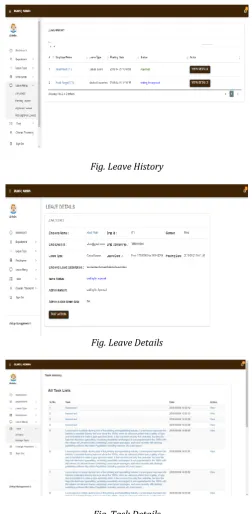
Fig. Leave History
Fig. Leave Details
Fig. Task Details
V. CONCLUSION
© 2019, IRJET | Impact Factor value: 7.211 | ISO 9001:2008 Certified Journal
| Page 192
allotted to them. It has been a great pleasure for me to work on this exciting and challenging project. This project proved good for us as it provided practical knowledge of not only programming in PHP, HTML, CSS and Oracle MySQL Server Developer working of web-based application, but also about all handling procedure related with Advance and new technology. It also provides knowledge about the latest technology used in developing web enabled application and client server technology that will be great demand in future. This will provide better opportunities and guidance in future in developing projects independently.
ACKNOWLEDGEMENT
We are the student of BE Computer. Here by we express our thanks to our project guide for allowing us to do the project on Dilkap Employee Management System. This project work has been the most exciting part of our learning experience which would be an asset for our future carrier. No system is created entirely by an individual. Proper organization of concept and analysis of the system. We would especially like to thank our guide and mentor Prof. Akshata Laddha, who constantly guided us in developing, pushing us to search for more answers to her numerous questions. This simulated many valuable thoughts and motivated us to constantly revise and reshape the report. We are grateful to many classmates who contributed their suggestions. Our close and daily colleagues have the greatest influence and our deepest appreciation. Their hard work and examples push us to limits of our capability and encourage us daily.
REFERENCES
[1] OrangeHRM Open Source, Retrieved: November 4, 2013. From: http://www.orangehrm.com/open-source-product-features-pim.shtml
[2] A.S.SyedNavaz, A.S.SyedFiaz, C.Prabhadevi,
V.Sangeetha, S.Gopalakrishnan, “Human Resource Management System”, IOSR Journal of Computer Engineering (IOSR-JCE), Volume 8, Issue 4 (Jan. – Feb. 2013) Page 62-71.
[3] Julie Bulmash, “Human Resource Management and Technology”, Chapter 3
[4] TECH HRM (Human Resource Management System),
Retrieved: November 4, 2013. From:
http://www.techjetsolutions.com/brochure/TECHHRM. pdf
[5] Renae Broderick, John W. Boudreau, “Human resource management, information technology, and the competitive edge”, Academy of Management Executive, 1992 Vol. 6 No. 2
[6] Centralized Employee Information, Retrieved: July 8th, 2014. From:
https://www.zoho.com/people/employee-management-system.html
[7] HR and Employee Mnagement Software, Retrieved: July 8th, 2014. From: http://www.getapp.com/hr-employee-management-software
[8] Ian Sommerville, “Software Engineering”, 9th Edition, Addison-Wesley, 2011.
[9] What is Enterprise Resource Planning (ERP)? Webopedia. Retrieved: January 17, 2014, from: http://www.webopedia.com
[10] Avison, D. and Fitzgerald, G. (2003).Information systems Development Methodologies, Techniques and Tools.3rd Edition. McGraw-Hill Education Limited Bershire
[11] Zhiming, L, July 2002 ,Object-Oriented Software Development with UML Retrieved: July 16th 2010. From: http://www.iist.unu.edu/www/docs/techreports/repor ts/report259.pdf 67
[12] Juan Manuel Munoz Palacio, Information systems development methodologies for Datadriven Decision Support Systems, 2010,
[13] Deitel, PJ & Deitel, HM, 2008, Internet & World Wide Web How To Program, Dorling Kindersley, India
[14] Web design best practices checklist 2009.
Retrieved: October 17, 2009, from:
http://terrymorris.net/bestpractices/
[16] Connolly, T, Begg, C, 2005, Database Systems A Practical Approach to Design Implementation and Management, 4th Edition, Dorling Kindersley, India
[17] Avison, D. and Fitzgerald, G, 2003. Information systems Development Methodologies, Techniques and Tools, 3rd Edition, McGraw-Hill Education Limited, Berkshire
[18] ASP.NET, 2010. Retrieved: July 9th 2010, from: http://www.startvbdotnet.com/aspsite/asp/
[19] Introducing JSON, Retrieved: June 21, 2014, from: http://www.json.org
[20] Employee Self Service, Retrieved: January 15, 2014,
from: