Abstract—A method to estimate a bridge mode shape, only by using data measured on a travelling vehicle, is proposed in this study. The vertical acceleration vibrations of the travelling vehicle can be converted to the vibration of the fixed points on the bridge. To estimate its mode shapes as an evaluation index for bridge health, SVD (Singular Value Decomposition) method is applied to the estimated bridge vibrations. While this method shows only low estimation accuracy, the high sensitivity of the evaluation index to the damage is confirmed numerically and experimentally.
Index Terms—structure health monitoring, vehicle vibration, bridge vibration, mode shapes, screening
I. INTRODUCTION
HILE an enormous number of civil structures have been constructed all over the world, it is still difficult to maintain them. The lack of maintenance finally becomes not only economic losses, but also fatal and injuring accidents. The difficulty on maintenance is caused by the lack of veteran engineers who can visually inspect structures, because visual check is subjective and its accuracy depends on the skill of each engineer.
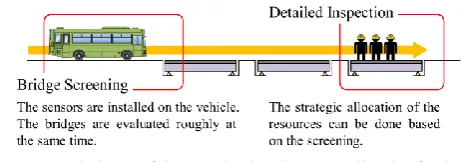
[image:1.595.51.282.613.694.2]Bridges are the most popular and aging civil structures. They are many and exist widely. The bridges’ aging problem is expected to cause demand increase for the inspections. The number of engineers, however, is not enough. To strategically allocate the limited human resources, it is necessary to realize screening technology, as shown in Fig. 1. The prerequisites of “a bridge screening method” are as follows: rapidity, low cost and objectivity. Because of a large number of the bridges, we cannot spend much time just for the primary screening. Secondly, the main part of bridge owners are the local governments; they are facing financial matters. As for the third prerequisite, a bridge screening should be based on measured data, not on the skills of veteran
Fig. 1 The image of the screening-based resource allocation for the bridge maintenance:
Manuscript received March 18, 2016. This work was supported in part by JSPS’s Grant-in-Aid for Young Scientists (B): 25820200.
Kyosuke Yamamoto is with University of Tsukuba, Ibaraki prefecture, Japan (corresponding author to provide phone: +81-29-853-5146; e-mail: [email protected]).
Mikio Ishikawa is a master student of University of Tsukuba, Ibaraki prefecture, Japan (e-mail: [email protected]).
engineers. In other words, the objectivity means “Everyone can do the same”. An instance is a vibration-based method.
As for the bridge screening, a method only using vehicle vibrations is conceivable. Generally, the sensors are installed on the bridge in the vibration-based SHM (Structure Health Monitoring) system. In the proposed method, however, the sensors are installed on the vehicle passing over the bridge. This idea is inspired by the studies done by Yang et al.[1] They proposed the method to extract the bridge natural frequency from the Fourier’s power spectrum of vehicle acceleration. It is verified numerically [1], [2], [3] and experimentally [4]. Their method is efficient to estimate bridge natural frequencies. However, it is not so accurate to detect the damage. The natural frequency of damaged bridge is just slightly different from that of intact one. Xiang et al.[5], who is inspired by this approach, proposed a tap-scan method. In this method, not only a sensor but also an excitation system is installed on the vehicle. In the VBI (Vehicle Bridge Interaction) system, the excitation frequency changes only when the vehicle passes above the damage position. It can be detected easily from the spectrogram available from the STFT (Short-Time Fourier’s Transform) of the vehicle vibration. The tap-scan method, however, shows low applicability to the cases considering road roughness. Nguen et al.[6] proposes the method to apply CWT (Continuous Wavelet Transform) to vehicle vibration. This method also can show the damage position by peaks, though it still cannot consider the effect of road roughness. The time-frequency domain analyses, such as STFT and CWT, can catch the sign of bridge defects. The time domain is converted to the spatial domain through vehicle position which is the time function. The spatial domain is sensitive to the bridge damage because the bridge damage is generally local. According to the previous studies, the spatial index is feasible for the bridge screening.
The most popular spatial index is mode shape. Assuming that a bridge vibration can be expressed in the product of spatial and time functions, the formers are called mode shapes while the latters are basis coordinates. The local damage changes the local amplitudes of mode shapes. To estimate the mode shapes discretely, two sensors or more should be set on the monitored bridge. As for the bridge screening based on vehicle vibrations, the several sensors should be installed on the vehicle at least. The author and Oshima et al.[7] proposed a method to estimate the bridge mode shapes from the vehicle vibrations measured by using several sensors. This method can eliminate the effect of road roughness, while it shows the low robustness. Besides, the process of estimation tends to become an ill-condition problem. A sensitive spatial index is the higher order of mode shape, while the increase of assumed measuring points on the bridge reduces the condition number of the process.
Numerical Verification of Bridge Screening
Technology based on Vehicle Vibration
Kyosuke Yamamoto and Mikio Ishikawa
The purpose of this study is to find a method independent from the ill-condition problem, based on the bridge mode shapes, and which is applicable with considering the road roughness. Its feasibility is verified numerically.
II. BASIS THEORY OF THE PROPOSED METHOD
A. Mode Shape Estimation of bridge vibrations
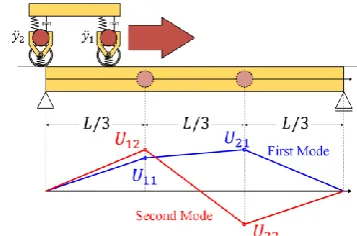
[image:2.595.77.267.204.335.2]In traditional methods, it is on the presumption that bridge mode shapes are estimated by using sensors fixed on the monitored bridge, as shown in Fig. 2. In this figure, the bridge is excited by a moving vehicle.
Fig. 2 The modal analysis for bridge vibration; mode shapes and basis coordinates
The bridge vibration can be expressed in a function of position 𝒙 and time 𝑡. In modal analysis, the bridge vibration
𝑦(𝒙, 𝑡) can be decomposed into the 𝑘-th order of mode shape
𝜙𝑘 𝒙 and the basis coordinate 𝑞𝑘 𝑡 as the following equation.
(1)
𝑦 𝒙, 𝑡 = 𝜙𝑘 𝒙 𝑞𝑘 𝑡
where 𝑘 is dummy index. When 𝑛 sensors are installed at the position 𝒙𝑖 on the bridge, the obtained vibrations can be written in the form of vector 𝒚(𝑡) as the following equation.
(2)
𝒚 𝑡 =
𝑦 𝒙1, 𝑡
⋮
𝑦 𝒙𝑛, 𝑡
=
𝜙1 𝒙1 ⋯ 𝜙𝑚 𝒙1
⋮ ⋱ ⋮
𝜙1 𝒙𝑛 ⋯ 𝜙𝑚 𝒙𝑛
𝑞1 𝑡
⋮
𝑞𝑚 𝑡
= 𝐀𝒒 𝑡
where 𝐀 is the mode shape matrix and 𝒒 𝑡 is the basis coordinate vector. 𝑚 is the maximum modal order to be considered. Assuming that 𝑚 = 𝑛, the mode shape matrix 𝐀
is an regular orthogonal matrix, namely 𝐀T𝐀 = 𝐀𝐀T = 𝐈, where I is the 𝑛 × 𝑛 unit matrix. The orthogonality of the mode shapes comes from the definition in which 𝑘-th mode shape 𝜙𝑘 𝑥 is an eigen vector of the beam system in the state of free vibration.
Usually, the available vibration data is acceleration 𝒚 𝑡 . (3)
𝒚 𝑡 = 𝐀𝒒 𝑡
where denotes the second order derivative with respect to time 𝑡. To estimate the mode matrix 𝐀, SVD (Singular Value Decomposition) can be applied.
An arbitrary matrix 𝐗 ∈ 𝑅𝑎×𝑏 can be decomposed into three matrix: An orthogonal matrix 𝐔 ∈ 𝑅𝑎×𝑎, a diagonal
matrix 𝚺 ∈ 𝑅𝑐×𝑐 and an orthogonal matrix 𝐕 ∈ 𝑅𝑏×𝑏, where
𝑐 = min 𝑎, 𝑏 .
(4)
𝐗 =
𝐔 𝚺 𝐎 𝐕T when 𝑎 ≤ 𝑏
𝐔 𝚺
𝐎 𝐕T when 𝑎 > 𝑏
where 𝐎 is a zero matrix, and T denotes transposition. As for the data matrix 𝐘 = 𝒚 𝑡1 ⋯ 𝒚 𝑡𝑁 , because the data length 𝑁 > 𝑛, the SVD can be given by
(5)
𝐘 = 𝐔 𝚺 𝑶 𝐕T
= 𝐔𝚺𝐕T
where 𝐕 ∈ 𝑅𝑁×𝑛 is the part of the matrix; 𝐕 = 𝐕 𝐎 . It satisfies that 𝐕T𝐕 = 𝐈. In this case, 𝐔 can be taken as the estimation for the mode shape matrix 𝐀, while 𝐐 ∈ 𝑅𝑛×𝑁 (= 𝚺𝐕T) denotes the estimated basis coordinates 𝒒 𝑡 in the form of data matrix.
SVD assumes that the basis coordinate is non-correlation, namely 𝐐𝐐T= 𝚺2; 𝚺2 is a diagonal matrix. It is known that this condition is exactly satisfied in three cases: free vibration state, stationary state and steady state due to white noise inputs. On the other hand, the traffic-induced vibration does not always satisfy the condition of non-correlation on 𝒒 𝑡 . While its applicability to the traffic-induced vibration should be examined, the accuracy of mode shape estimation can be expected to be enough for many cases; as the first and low modes are predominant comparing with the high modes, the cross correlation (= 𝑞𝑘 𝑡 𝑞𝑙 𝑡 𝑑𝑡) is relatively very small.
B. Mode Shape Estimation from vehicle vibrations
Whichever the applicability of SVD to the modal analysis, as for the bridge screening, it is impossible to apply it directly to the vehicle-vibration-based estimation for the bridge mode shapes. SVD method has an assumption in which the sensors are fixed on the structure. The sensors in the propose method, however, moves as the vehicle moves.
Assuming the moving observation points, Eq. (3) becomes
(6)
𝒚 𝑡 =
𝑦 𝒙𝟏 𝑡 , 𝑡
⋮
𝑦 𝒙𝒏 𝑡 , 𝑡
=
𝜙11 𝑡 ⋯ 𝜙1𝑛 𝑡
⋮ ⋱ ⋮
𝜙𝑛1 𝑡 ⋯ 𝜙𝑛𝑛 𝑡
𝑞 1 𝑡
⋮ 𝑞 𝑛 𝑡
= 𝚽 𝑡 𝒒 𝑡
Where 𝒙𝒊(𝑡) is the position of 𝑖-th moving sensor and the
𝜙𝑖𝑗 𝑡 is the 𝑗-th order of the mode shape at the position of
𝒙𝒊(𝑡). 𝒒 𝑡 in Eq. (6) is the same with that in Eq. (3).
To apply SVD to Eq. (6), it is necessary to replace the un-known function matrix 𝚽 𝑡 with a known function matrix 𝐍 𝑡 and the coefficient mixing matrix 𝐀.
(7)
𝒚 𝑡 = 𝐍 𝑡 𝐀𝒒 𝑡
where the known function matrix 𝐍 𝑡 consists in 𝑛-th shape functions;
(8)
𝐍 𝑡 =
𝑁1 𝒙𝟏 𝑡 ⋯ 𝑁𝑛 𝒙𝟏 𝑡
⋮ ⋱ ⋮
where 𝑁𝑗 𝑥 is the shape functions, and 𝑥𝑖 𝑡 is the position of 𝑗-th sensor. The shape functions are the functions which satisfy the following conditions:
(9)
𝑁𝑖 𝑥 𝑗 = 0 𝑖 ≠ 𝑗
1 𝑖 = 𝑗
𝑁𝑖 𝑥
𝑛
𝑖=1
= 1
where 𝑥 𝑗 is the position of 𝑗-th assumed fixed point on the bridge. Lagrange’s interpolations is one of the most popular shape function, to use for FEM (Finite Element Method).
Once 𝒚 𝑡 and 𝐍 𝑡 are obtained, Eq. (6) can be linearized. (10)
𝒅 𝑡 = 𝐍−1 𝑡 𝒚 𝑡 = 𝐀𝒒 𝑡
where 𝒅 𝑡 is the estimation of 𝒚 𝑡 . Assuming that 𝒚 𝑡 can be regarded as the vehicle vibrations, the SVD method can be applied to 𝒅 𝑡 . However, the vehicle vibrations are not same with 𝒚 𝑡 which denotes the bridge vibration vector observed at the moving points; they are affected by the road roughness and the vehicle body as well as the bridge vibrations.
In this study, assuming that the observed vehicle vibrations can be taken for 𝒚 𝑡 , the road roughness is ignored. Thus, the accuracy of mode shape estimation is expected to be low, while this proposed method can be still applicable. When considering its application to the bridge damage detection, it never lie in the estimation accuracy itself, but its sensitivity. In this aspect, it is possible to detect the bridge damage by comparing 𝐔0, which is the estimated mode shapes before the damage, with 𝐔1, which is that after.
C. Definition of SSMA
To avoid the ill-condition problem in Eq. (10), only two sensors are installed; each sensor is on each axel, front and rear. In this case, the shape function matrix 𝐍 𝑡 can be written in linear functions as the follow.
(11)
𝐍 𝑡 =
−3
𝐿 𝑥1 𝑡 −
2𝐿 3
3
𝐿 𝑥1 𝑡 −
𝐿 3
−3
𝐿 𝑥2 𝑡 −
2𝐿 3
3
𝐿 𝑥2 𝑡 −
𝐿 3
.
This equation satisfies Eq. (9).
The estimated mode shape matrix can be given by the following equation.
(12)
𝐔 = 𝑈𝑈11 𝑈12
21 𝑈22
where 𝑈𝑖𝑘 is the amplitude of 𝑘-th order mode shape at the position of 𝑥 𝑖; 𝑥 1= 𝐿 3 and 𝑥 2= 2𝐿 3. 𝐿 is the bridge span. To normalize 𝐔 so that its norm equals to one,
𝑈22= −𝑈11, 𝑈21= 𝑈12 and 𝑈𝑘12 + 𝑈
𝑘22 = 1. The number of independent elements of 𝐔 is two. SSMA (Spatial Singular Mode Angle) 𝜃 is defined by the following equation.
(13)
𝜃 = arctan𝑈21
𝑈11
[image:3.595.335.514.49.167.2]where 0 ≤ 𝜃 ≤ 𝜋 2. Fig. 3 shows the bridge mode shape estimated by using two sensors.
Fig. 3 The mode shape estimation for two discrete points on the bridge.
III. NUMERICAL VERIFICATION
A. Vehicle-Bridge Interaction system
The vehicle is modeled by rigid body and spring, shown in Fig.2. The spring denotes the suspension of the actual vehicle. The rigid body spring model of the vehicle can be given as the following equation.
(14)
𝐌V𝒛 𝑡 + 𝐂V𝒛 𝑡 + 𝐊V𝒛 𝑡 = 𝐂P𝒖 𝑡 + 𝐊P𝒖 𝑡
where 𝐌V, 𝐂V and 𝐊V are the mass, damping and stiffness matrices, respectively. 𝒛 𝑡 , 𝒛 𝑡 and 𝒛 𝑡 are the vertical displacement, velocity and acceleration responses of the vehicle. 𝐂P and 𝐊P are the damping and stiffness matrix for the forced velocity input 𝒖 𝑡 and the forced displacement input 𝒖 𝑡 .
On the other hand, the bridge is modeled by one-dimension beam elements of FEM. The equation of motion of the bridge can be expressed as
(15)
𝐌B𝒚 𝑡 + 𝐂B𝒚 𝑡 + 𝐊B𝒚 𝑡 = 𝑭 𝑡
where 𝐌B, 𝐂B and 𝐊B are the mass, damping and stiffness matrices, respectively. 𝒚 𝑡 is the vector of the displacement responses and the displacement angles of the bridge. 𝒚 𝑡
and 𝒚 𝑡 are the first and second derivative with respect to
time 𝑡. 𝑭 𝑡 is the external force.
Although both of the vehicle and bridge systems are linear systems respectively, the VBI (Vehicle Bridge Interaction) system is non-linear system. The input of the vehicle system is the output of the bridge system, while the input of the bridge system is the output of the vehicle system. The forced displacement of the vehicle system can be expressed by
(16)
𝒖 𝑡 = 𝒚 𝑡 + 𝒓 𝑡
where 𝒚 𝑡 and 𝒓 𝑡 are the bridge displacement and the road roughness at the vehicle position 𝒙𝑖 𝑡 , respectively. The 𝑖-th element of 𝒚 𝑡 can be given as
(17)
𝑦 𝑖 𝑡 = 𝐋 𝑡 𝒚 𝑡
where 𝐋 t is the allocation matrix of which (𝑖, 𝑗) element
𝐿𝑗 𝒙𝑖 𝑡 denotes the equivalent displacement/loading ratio from the position 𝒙𝑖 𝑡 to the 𝑗-th DOF (Degree Of Freedom). The shape functions of FEM are adopted in this simulation.
𝒚 𝑡 is the displacement vector of the bridge’s nodes for all DOF. The 𝑖-th element of 𝒓 𝑡 can be given as
(18)
𝑟𝑖 𝑡 = 𝑅 𝒙𝑖 𝑡
The external force acting on the bridge is the contact force of the vehicle as below;
(19)
𝑭 𝑡 = 𝐋 𝑡 𝐌P𝒛 𝑡 − 𝒈
where 𝐌P and 𝒈 are the vehicle mass matrix and the vector of gravity acceleration.
B. Numerical Model
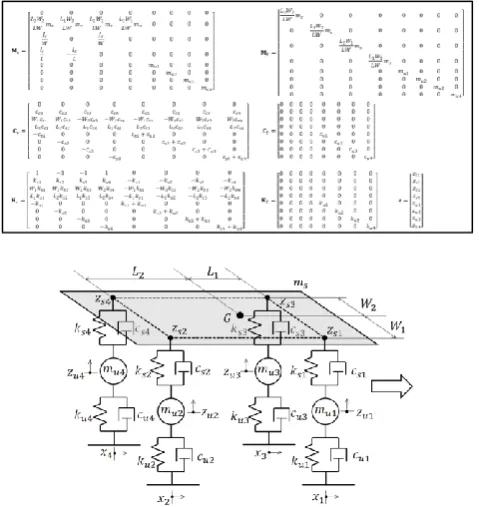
The vehicle system is modeled by using RBSM (Rigid Body Spring Model), as shown in Fig. 4. The parameters of the vehicle system 𝐌V, 𝐂V, 𝐊V, 𝐌V, 𝐂P and 𝐊P are also shown in Fig. 4 and the parameters are shown in TABLE I. The vehicle speed is varied from 5 to 20 [m/s], while it is 10 [m/s] if not otherwise specified.
Fig. 4 The RBSM for the vehicle system and the system parameter matrices: The first row in Eq. (14) is the compatibility condition about the angle of the vehicle body.
TABLE I
THE VEHICLE SYSTEM PARAMETERS
Mass: 𝑚𝑠 18000 [kg]
Inertia Moment (Pitch): 𝐼𝑠 65000 [kg∙m2] Inertia Moment (Roll): 𝐽𝑠 15000 [kg∙m2] Damping (Sprung-mass): 𝑐𝑠1~𝑐𝑠4 10000 [kg/s] Stiffness(Sprung-mass): 𝑘𝑠1~𝑘𝑠4 1000000 [kg/s2] Unsprung-Mass: 𝑚𝑢1~𝑚𝑢4 1100 [kg] Damping(Unsprung-mass): 𝑐𝑢1~𝑐𝑢4 30000 [kg/s] Stiffness(Unsprung-mass): 𝑘𝑢1~𝑘𝑢4 3500000 [kg/s2]
Length: 𝐿1, 𝐿2 1.875 [m]
Width: 𝑊1, 𝑊2 0.9 [m]
The objective bridge is a steel truss bridge. The bridge is modeled by finite element method. The figure of the bridge model is shown in Fig. 5. The coordinate of (𝑥,𝑦,𝑧) is also shown in this figure. The vehicle runs in the direction of 𝑥 on the line of 𝑦 =3.6[m] and 𝑦 =5.4[m]. The parameters of the bridge system 𝐌B, 𝐂B, 𝐊B should be calculated by the FEM theory. The elements of these matrices can be described by the density, the Young’s modulus and the shear modulus of
[image:4.595.50.290.239.493.2]rigidity of each material and the inertia moment of area, the inertia polar moment and the cross-section of each member, as shown in TABLE II. In this model, main truss members are made in steel while the deck is done in concrete. The road unevenness 𝑅 𝒙 is generated by using the actual data as a reference as shown in Fig. 6. In this study, two patterns of road unevenness are adopted. In each run case, the inputs to the right and left wheels are assumed to be same.
Fig. 5 The bridge model’s view: The vehicle runs from 𝑥 = 0 to 40 on the left side through the bridge span.
TABLE II
THE BRIDGE SYSTEM PARAMETERS
Truss member
Density 𝜌s 7800 [kg/m3]
Cross-Section 𝐴𝑡 0.02 [m2] Young’s modulus 𝐸𝑠 200×109 [Pa] Shear modulus of rigidity
𝐺𝑠 78×10
9
[Pa] Inertia Moment of Area 𝐼𝑡 1.0×10⁻⁴ [m4] Inertia Polar Moment 𝑃𝑡 1.0×10⁻⁶ [m4]
Deck
The division number of
nodes in the direction of 𝑥 20
The division number of
nodes in the direction of 𝑦 10
Density 𝜌𝑐 2400 [kg/m3]
Thickness 𝑏𝑑 0.4 [m]
Young’s modulus 𝐸𝑐 25×109 [Pa] Shear modulus of rigidity
𝐺𝑐 1.1×10
9
[Pa∙m] Inertia Moment of Area in
the axial direction 𝐼𝑑𝑥 0.03 [m
4
] Inertia Moment of Area in
the transverse direction 𝐼𝑑𝑦 0.2 [m
4
[image:4.595.301.550.299.682.2]]
Fig. 6 The road unevenness
Fig. 7 The element number of the cut diagonal member of the truss
C. The result of numerical simulation
Both of the vehicle and bridge vibrations are simulated. As examples, the vibrations of the vehicle unsprung-mass 𝑧1 𝑡
[image:5.595.74.259.63.95.2]in the intact case and damage one are shown in Fig. 8. The damage is modeled by cutting the 3rd diagonal member on the pathway side of the truss structure.
Fig. 8 The vibrations of the vehicle unsprung-mass 𝑧1 𝑡 in the
intact case and damage one
From this figure, the difference between the acceleration vibrations in both cases is very small. Of course, only based on numerical simulations, the vibrations must change after damage even if it is very small. Thus, it is found that the vibration index which emphasizes the difference only before and after bridge damage. The feasibility of the method should be examined not by its accuracy of the estimation for bridge system parameters, but in the sensitivity to the changes of the system.
D. The result of SSMA
[image:5.595.53.287.212.424.2]The SSMA which is calculated by SVD of Eq. (10), based on the unsprung-mass vibrations and positions for each case, is shown in Fig. 9. In these figures, each blue line indicates the SSMA for the intact case, while the each red/green dot does that for the damage cases in which the 𝑖-th diagonal member of the pathway/opposite side of the truss structure. Fig. 9 shows the results not only in the cases of the smooth road, but also the rough road; the tendency of SSMA on the smooth road unevenness is similar to that on the rough one. While the each value of SSMA depends on the damage position, it changes clearly after the damage. If the damage occurs on the pathway side, its differences between before and after the damage are larger. These tendencies of SSMA shows that the sensitivity of SSMA more affected by the
Fig. 9 The element number of the cut diagonal member of the truss
Fig. 10 The relationship between SSMA and vehicle speed
vehicle loadings is larger.
Varying the vehicle speed, the result is shown in Fig. 10. The value of SSMA changes as the speed changes. According to the definition of SSMA in Eq. (10), because SSMA is the estimated mode shape of the bridge, it should not change due to the speed. Thus, the change of SSMA due to the vehicle speed means the low estimation accuracy of SSMA. However, because it also clearly changes after the damage, it is efficient to use SSMA for the bridge damage detection.
IV. CONCLUSIONS
In this study, SSMA is proposed as the index for bridge damage detection. It can be calculated only from the vehicle vibrations and position data. The SSMA-based SHM can be applied to bridge screening. The feasibility and efficiency of SSMA is also verified numerically. VBI system is modeled by the RBSM vehicle and the FEM bridge. It is cleared that the efficiency of using SSMA for the bridge screening is high.
As the future work, the efficiency of SSMA should be experimentally examined. The damages considered in this study are only the critical ones, while we should check the sensitivity of SSMA to the other kinds of bridge damages. We also have to find the way how to consider the road roughness, because the influence of the road roughness is
5 10 15 20
30 40 50 60
Velocity[m/s]
S
S
M
A
[d
eg
]
[image:5.595.315.531.323.437.2]predominant. Generally, road pavements are degraded earlier and faster than the structure itself. It means that it is difficult to identify whether structural damage or pavement degrading when we apply this technology to actual bridges. Additionally, it is still a technical issue to prepare the data of intact case. The solving these technical issues must make this SSMA-based method more attractive.
REFERENCES
[1] Yang, Y.B., Lin, C.W., and Yau, J.D.: Extracting bridge frequency from the dynamic response of a passing vehicle, Journal of Sound and Vibration, Vol.272, pp.471-493, 2004.
[2] Yang, Y.B. and Chang, K.C.: Extracting the bridge frequencies indirectly from a passing vehicle, Parametric study, Engineering Structures, 31, pp.2448-2459, 2009.
[3] Y.B. Yang, K.C. Chang: Extraction of bridge frequencies from the dynamic response of a passing vehicle enhanced by the EMD technique, Journal of Sound and Vibration, 322, pp.718-739, 2009. [4] Ling, C.W. and Yang, Y.B.: Use of a passing vehicle to scan the
fundamental bridge frequencies: An experimental verification, Engineering Structures, Vol.27, pp.1865-1878, 2005.
[5] Xiang, Z., Dai, X., Zhang, Y. and Lu, Q.: The Tap-Scan Damage Detection Method for Beam Structures, Advances Interaction & Multiscale Mechanics, pp.541-553, 2010.
[6] Nguyen, K.V. and Tran, H.T.: Multi-cracks detection of a beam-like structure based on the on-vehicle vibration signal and wavelet analysis, Journal of Sound and Vibration, Vol.329, pp.4455-4465, 2010. [7] Oshima, Y., Yamamoto, K., Sugiura, K.; Damage assessment of a