Abstract— Discrete image processing using
two-dimensional (2D) transforms are well known in providing good capturing of image data. 2-D transforms used in several ways provide a better approaches to preserving texture and directional information from image. In texture and directional images the use of multiresolution with multidirectional transform has better performance and capturing its information. The Directional Filter Bank (DFB) is the base of the directionality property of these transforms. This paper provide a review on some of the popular multiresolution transform with additional directional filter banks. The multiresolution transform is the responsible to capture low frequency information. The popular transform reviewed in this work are wavelet, contourlet and non-uniform directional filter bank (nuDFB). Wavelet has been the popular transform for capturing image data while contourlet is popular in preserving directional information. The nuDFB on the other hand has the advantages over other both transform because of its non-redundant multiresolution transform and and fix directional filter. Directional filter bank that exist in the transform will be able to capture better image information for further processing such as compression and denoising.
Index Terms—: Texture and directional image, Directional
filter bank, Multiresolution, Multidirection, 2D transforms.
I. INTRODUCTION
The visual information has gained more importance in the science by image processing starting from drawing in the beginning of human life until now. With the ability of representing images digitally, image representations become more flexible for processing. There are several types of images and each type contains different data structure. Texture and directional images are one of the most sensitive images in image processing because they contain detailed data.
Representation of images in one dimensional (1-D) form for applications such as compression have been studied Manuscript received Dec 31 2014. This work was supported in part by the Malaysian High Education Ministry under 9003-00373
Yahya Naji is a student at University Malaysia Perlis, Perlis, Malaysia, B.Eng (Hons) Computer Engineering, University Malaysia Perlis,
Malaysia, phone +60175935837 e-mail: [email protected]).
nmRuzelita Ngadiran is a senior lecturer at University Malaysia Perlis, Ph.D in Communications, Sensors and Signal Processing, Newcastle University, UK, M.Sc (Computer), UKM, Malaysia, B.Eng (Hons) Communication and Computer Engineering, UKM, Malaysia.
mmPuteh Saad is a professional staff at University Malaysia Perlis, she got her Ph.D (Computer Science), UTM, Malaysia, M.Sc (Computer Science), University of Strathclyde, UK, B.Sc (Chemistry), UM, Malaysia.
base on wavelet transform because it has an optimal performance in some cases [1]. For example image can be represented in one dimensional (1-D) using wavelet for some applications such as compression and the result shown an optimal performance. Moreover, wavelet transform is a suitable for algorithms effectively especially it leads to fast transforms and convenient tree data structures, these are the core reasons of the succeeding of wavelet transform in many signal processing and communication applications. The two dimensional (2-D) wavelet transform is constructed by tensor products from 1-D wavelet transform. It is used for images applications such as image denoising based on gray relational threshold [2]. With all the efficiency of wavelet but it is not the right tool for capturing contours of natural images. Wavelet unable to efficiently represent the directional information in an image. It also does not have the ability of providing a different length elements of representation with directionality [3]. The directional filter banks (DFB) in work by Bamberger and Smith [4] decompose the image into multidirectional information and the DFB later used in contourlet transfrom. Contourlet create a revolution in image processing world because of its efficient decomposition and perfect reconstruction properties. The separable DFB is a decomposition tool that divides frequency directionally.
The directional frequency decomposition in the 2-D DFB. This filter bank has been used in many image processing tasks and it implemented with multiresolution property in many researches [5], [6], [7] and [8]. DFB has a decimated decomposition process but it has a weakness in the low frequency part of the image. The mutiscale or multiresolution helps in solving this problem in partitioning the frequency before applying the DFB. The multiscale and multi directional transforms varies in the multiscale part, but in most of them, the DFB is a common for the directionality with some modulation for each transform. For example Steerable pyramid(Manjunath & Ma, 1996) is a multiscale and multidirectional filter bank uses basic filters with translation and rotation of signal function without applying for the lowpass subband. It decimates the lowpass subband and a set of undecimated directional subbands which makes it a recursive pyramid. This is caused by the undecimated directional subband. It is a redundant transform with more coefficents than in the original image.
The modulations made suitable to the multiscale and have a better transform for preserving texture images that requires higher sensitivity so that it can captures the details of the image. In many tasks, texture images have the bigger challenge in image processing. Wavelet transform is one of the best transforms that provide a good capturing of pointed
Review on Directional Filter Bank for
Preserving Texture and Directional Information
in Images
singularities but not for line singularities. Wavelet weak in providing the NLA decay for the images that has regular regions[9]. Contourlet transform[10] was proposed as a multidirectional and multiresolution transform that has efficiency in capturing line singularities. Contourlet has a good denoising and compression results. In the other hand it has a redundancy which is not desired for some applications [11]. The research continued concerning contourlet transform as an efficient transform for tasks of image processing such as denoising, compression and enhancement. With the revolution that contourlet made in image processing, it still has some aliasing noise and redundancy. Contourlet also does not have the shift invariant properties that make the transform flexible in frequency domain. The non-uniform directional filter bank (nuDFB) [11] was proposed to overcome the aliasing problem in contourlet. nuDFB is an efficient development of contourlet using wavelet and directional filter bank for multiscale multidirectional property. For the shift invariant property nonsubsampled contourlet transform NSCT [12] was proposed it solves the shift invariant property in contourlet but it added much redundancy which is not desired in compression. NSCT also provide the frequency localization. The new contourlet transform in [6] also proposed a way to provide frequency localization in contourlet. The multiresolution multidirectional transforms efficiency depends on the multiscale and multidirection processes. Multiscale process
The mutiscale is the responsible of partitioning the frequencies to small blocks for better decomposition. In [10] the responsible of multiscale is the Laplacian Pyramids (LP) [13]. It does that by downsampling each level to produce a low pass region resulting bandpass region that remains. The improvement of LP used is just to add the remaining part that remain from the framing to the prediction [14]. The LP is been applied in the contourlet transform to overcome the weakness of DFB of capturing the low frequency. The LP will provide a property of capturing the low frequency that leak from the DFB to get a perfect reconstruction after decomposition. the localization of frequency and shift invariant property are not preserved well in the contourlet transform because of the up and down samplers of the LP and DFB as well [12]. The NonSubsampled Contourlet transform (NSCT) proposed to improve contourlet and provide the shift invariant property to the contourlet. The improvement is to delete the up and down samplers of the contourlet and upsampling in each state then take the remaining parts for each. Providing the shift invariant property make the NSCT a base for many researches such as image fusion [15] and retrieval application such as [16]. The NSCT has an efficient representation and it is suitable for many applications but its redundancy is much higher than contourlet. Non Uniform Directional Filter bank nuDFB [11] was proposed to overcome the redundancy and to alias-free of the contourlet. The mulitresolution part in nuDFB is modified in its tree structure of the DFB with combination of discrete wavelet filter bank. In [7] the multiscale process implemented by using improved circular symmetric filter bank (ICSFB) which provides a circular shape of multiscale decomposition. This property make it more suitable for iris of eye texture preserving. Circular Hough transform after
using the Canny edge detection to generate edge map is the base of the circular decomposition.
Multidirectional process
The multidirectional process is the process which the transform can decompose the image directionally in the frequency domain. DFB was the common base of this process because of the efficient provided in this filter bank. In the contourlet transform, the directionality of the transform has been perfectly applied using this filter bank. NSCT repeat the same development of contourlet that was used in LP of the transform. The DFB was also the core of the nuDFB which was modified as will be in detail in section II.
Multiscale and Multidirectional
Combining the both processes, multidirectional and multiresolution form a different transform that has different properties. We have in contourlet transform the combining both LP and DFB similar with the NSCT. The difference between each transform is the way they combined and modified. In contourlet transform, the combination process is by keeping the low frequency band in image and apply the DFB on the bandpass regions created by LP. In the NSCT the nonsubsampled Laplacian pyramid, (NSLP) and non-subsampled DFB (NSDFB) are applied. The modification that was made in both dimensions is removing the up and down sampling and upsampling each stage. This step will create a bandpass region that will be created. Both contourlet transform and NSCT are redundant. The redundancy in NSCT is higher than contourlet transform because of the modification made. Redundancy is necessary in some of improvements of image representation transforms. In the other hand it is not desirable in some application such as image compression. nuDFB is a transform which depends on DFB in majority of its parts.
The
decomposition process in nuDFB is unique compared to the previous multiresolution multidirectional transforms.II. THE NUDFB
The processing of image in nuDFB depends on the directionality of the transform. Discrete wavelet transform is used in the nuDFB to that makes it less redundant. In [17] the nuDFB with arbitrary frequency partitioning is proposed. In this work the decimation of frequency is ignored for providing nonsubsampled nuDFB. For providing the 2D the pseudopolar Fourier transform (PPFT) [18]. Nonsubsampled nuDFB provides a perfect capturing of directional information but with redundancy. Because of that the nuDFB in [11] will be more focused in this paper.
Let us assume we have the signal x(n) that is downsampled by M matrix, then the discrete Fourier transform of this signal y(n) is:
(M )
1
( ) 2
T
T T
k N
Y X M M k
M
TN M = The is the group of integer lattice that belong to the parallelepiped SPD [19] the resulted from the matrix and SPD( ) that is defined as {Mx, x }.
The upsampling for x(n) will result:
1
(M ), (n)
0,
x n Mk
y
otherwise
(2)
This can be written in Fourier transform as
( )
(M
T)
Y
X
(3)
If the up and down sampling applied for the signal then from (1) and (3) we will get
(M )
1
( )
(
2
k)
T
T
k N
Y
X
M
M
(4)In the multirate filter banks getting a diamond shape or fan shape by using the quincuncs filter bank (QFB). The lattice of QFB is the only non-separable 2-D filters. The diagonal filter bank also is used because it has the parallelogram for getting perfect reconstruction. An extension of nuDFB in [20] in which they add a permissibility to the nuDFB.
Assuming that the 2-D signal x(n) has decomposed by the discrete wavelet transform as a output with four channels analysis filterbank:
2
ij ij
x
n
h k x D n k
(5)i,j = ⋲ {0, 1}
ij
h
= The impulse response of the analysis filterbank.x(n) can be represented as 2-D discrete equation. The signal
x(n) is the projection of 2
l n In the space spanned by filter coefficients for the first impulse h for V1 as
2 1
ij
h n D k V and use the remaining3 h sub bands for the Was h nij
D k2
W1. From that we can get the equation as:
2
0 1 1
l
n
V
W
V
(6)Applying this formula will result the multiscale multidirectional transform. The low frequency band will be efficiently captured with directionality. W1 will be spanned with three sub bands so the formula will be:
2
0 1 2 3 m
l
n
V
W
W
W
V
(7)
The DFB and the DWT combination process forms the above frequency partitioning. Where V denotes the coarse region (low frequency region) and W represent the finer regions (the higher frequencies). The tree structure plays important role of the shift invariant property. In [21] shows that the tree structure can provide a shift multiscale multidirectional transform with a small redundancy. The tree structure used in the nuDFB is by using the diagonal filter bank at the first low pass band and then applying the quincunx filter bank for the remaining bands.
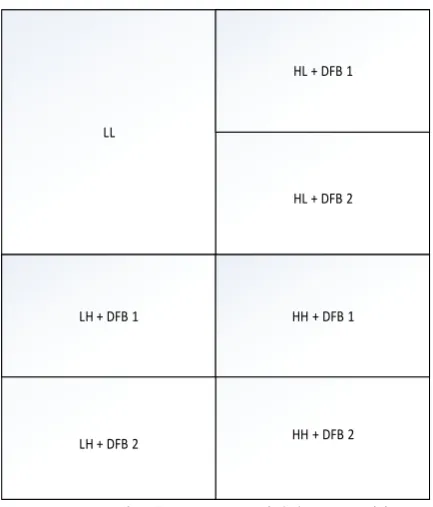
The diagonal filter banks add to the low frequency band, which is the same as in the DWT. The similarity of the nuDFB with the DWT is that they both have same low pass frequency support. In [22] the hidden Markove uses a new nuDFB structure by modifying the quincunx filter bank which has the name of nonuniform quincunx directional filter bank(nuqDFB). The DWT has vertical, horizontal and diagonal where the nuDFB has six directional subbands frequencies. This design will provide less computation complexity and efficient reconstruction design. The redundancy also will be removed which is an important property in many applications in the image processing tasks. With low bitrate thresholding values, the nuDFB will provide better NLA than in the DWT due of the line and point singularity properties in this transform.
HH + DFB 2 LH + DFB 2
HL + DFB 2 LL
LH + DFB 1 HH + DFB 1
[image:3.595.319.536.378.632.2]HL + DFB 1
Fig. 1. nuDFB spatial decomposition
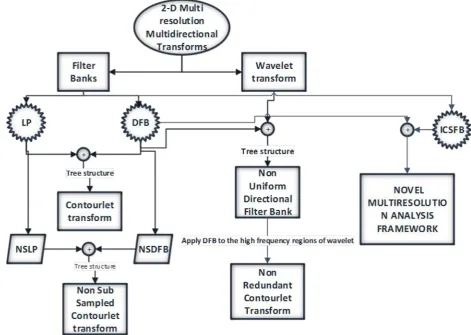
Fig. 2.Taxnomy of the multiresolution multidirectional transforms
III. NUDFB OVER MULTIRESOLUTION MULTIDIRECTIONAL TRANSFORMS
Fig. 2 shows the process of the development of the multiresolution multidirectional transforms in the image processing. It is clear that wavelet is one of the most used because its stability of processing images. The higher frequency subbands needs more development, which results the invention of the new transforms. The contourlet transform deals with the Laplacian transform as the multiscale base. LP provided better capturing of the low frequency bands, which will be a perfect if united with the DFB except that the LP results more redundancy. While DFB are deals with the higher frequency directionally. The nuDFB has non-redundant transform, which is an advantage over the contourlet transform. The localization of frequency and shift invariance that was a problem and solved by the NSCT added much more redundancy although it has a perfect reconstruction. The nuDFB provided the shift invariant with maximum decimated frequency. The non-redundant contourlet transform (NRCT) [23] has solved the redundancy problem but its features are not at the level of the nuDFB. NRCT is an extension of wavelet transform which applies the directional filter bank only in the high frequency band of the 2D wavelet transform. The improvement of the nuDFB of providing advanced decimation of frequency with free-aliasing transform.
nuDFB is a simple design which has a simple computation complexity. nuDFB has the property of preserving texture classification and preserves texture images. In image denoising algorithm by Bui, 2006 nuDFB was used with discrete wavelet transform (DWT). Markov tree was used in this work for accounting inter-scale, inter-direction and inter-location dependency. Because of the flexible structure of nuDFB over other transform from the same family which is the essential support of the lowpass band region
2/ 2, / 2
which make it able to have more multiresolution filterbank. Using Discrete Fourier Transform (DFT) for preserving texture of image like in [24] would provide an efficient texture preserving but without directionality. Using DFB in preserving texture in images guarantees better results because of multidirectionality that DFB provides.
levels for the first decomposition and eight directional levels for the second decomposition level. In the nuDFB there are 6 directional levels for both first and second levels. The cause of doing it this way is that contourlet uses the directional levels as which can’t be six as in the nuDFB.
Table. 1 nonlinear approximation PSNR for nuDFB, Contourlet and Wavelet
Bit rate 0.025 0.05 0.1 0.15 0.2 0.25 0.3
nuDFB 17.2 18.16 19.37 20.83 21.83 23.61 24.79
Contourlet 15.84 17.11 18.72 20.19 21.44 22.27 23.36
Wavelet 17.09 17.73 19.61 20.96 22.34 23.76 24.86
SSIM for nuDFB, Contourlet and Wavelet
Bit Rate 0.025 0.05 0.1 0.15 0.2 0.25 0.3
nuDFB 0.39 0.5 0.61 0.68 0.73 0.78 0.81
Contourlet 0.39 0.49 0.6 0.66 0.71 0.75 0.78
Wavelet 0.4 0.51 0.63 0.7 0.75 0.79 0.83
V. REDUNDANCY AND COMPUTATION COMPLEXITY
In the contourlet, transform the multiscale process uses the LP with complex computation process. In contourlet transform, the LP requires
L
p/ 2 1
operation per inputsample. For N pixels image the LP complexity will be defined as:
1 1
1
4
1
1
4
2
3
2
j
J p p
j
L
L
N
N
(operations)(8). And for DFB for l-level of full binary tree as:
1 1
1
4
max
4
3
j J
d j d j
j
N
L l
NL
l
(operations)(9)
p
L
andL
d = The number of taps of the pyramidal and directional filters LP and DFB in the contourlet transform.In the nuDFB the computation complexity is simple and less complexity. In the NSCT the nonsubsampled LP and DFB has a complexity, which equal to
B x N x L (10)
B = denotes the number of subbands. N = number of pixels.
L = number of operation per output sample.
The nuDFB has fully decimated frequency decomposition and has less computation complexity with perfect reconstruction, which is an advanced than some of multiresolution multidirectional transforms. nuDFB was used efficiently in denoising images and preserving texture in images. Using nuDFB in the application or extensions
provides less redundancy and higher efficiency as insured by [18, 19, 21 and 22] .
VI. CONCLUSION
In multiresolution multidirectional filter banks there are some of the matters that play an important role of the transform. The redundancy and computational complexity are some of the problem that was clearly appeared on some transforms. Each of the transform can perform well at certain condition. For preserving texture and directional information in images however, require more consideration whether to have more redundancy when using contourlet or reduce efficiency with nuDFB but maintain its directionality information with reduce complexity.
REFERENCES
[1] D. L. Donoho, M. Vetterli, R. A. Devore, I. Daubechies, and S. Member, “Data Compression and Harmonic Analysis,” vol. 44, no. 6, pp. 2435–2476, 1998.
[2] L. Hong-jun, H. Wei, X. Zheng-guang, and W. Wei, “Image denoising method based on grey relational threshold,” Grey Syst. Theory Appl., vol. 3, no. 2, pp. 191–200, 2013.
[3] M. N. Do and M. Vetterli, “The contourlet transform: an efficient directional multiresolution image representation.,” IEEE Trans. Image Process., vol. 14, no. 12, pp. 2091–106, Dec. 2005.
[4] R. H. Bamberger and M. J. T. Smith, “A filter bank for the directional decomposition of images: Theory and design,” Signal Process. IEEE …, vol. 40, 1992.
[5] S.-I. Park, M. J. T. Smith, and R. M. Mersereau, “Improved structures of maximally decimated directional filter banks for spatial image analysis.,” IEEE Trans. Image Process., vol. 13, no. 11, pp. 1424–31, Nov. 2004.
[6] Y. Lu and M. N. Do, “A NEW CONTOURLET TRANSFORM WITH SHARP FREQUENCY LOCALIZATION Yue Lu and Minh N. Do Department of Electrical and Computer Engineering University of Illinois at Urbana-Champaign, Urbana,” vol. 0237633, pp. 1629–1632, 2006.
[7] H. Kong, “IRIS RECOGNITION BASED ON A NOVEL MULTIRESOLUTION ANALYSIS FRAMEWORK,” vol. 1, pp. 4101–4104, 2010.
[8] X. Chen, “Texture Image Retrieval Based on Contourlet-2.3 and Generalized Gaussian Density Model,” no. Iccasm, pp. 199–203, 2010.
[9] R. Eslami and H. Radha, “A new family of nonredundant transforms using hybrid wavelets and directional filter banks.,” IEEE Trans. Image Process., vol. 16, no. 4, pp. 1152–67, Apr. 2007.
[10] M. N. Do and M. Vetterli, “The contourlet transform: an efficient directional multiresolution image representation.,” IEEE Trans. Image Process., vol. 14, no. 12, pp. 2091–106, Dec. 2005.
[11] T. T. Nguyen and S. Oraintara, “Multiresolution Direction Filterbanks :,” vol. 53, no. 10, pp. 3895–3905, 2005.
[12] A. L. da Cunha, J. Zhou, and M. N. Do, “The nonsubsampled contourlet transform: theory, design, and applications.,” IEEE Trans. Image Process., vol. 15, no. 10, pp. 3089–101, Oct. 2006.
[14] M. N. Do and M. Vetterli, “Framing pyramids,” IEEE Trans. Signal Process., vol. 51, no. 9, pp. 2329–2342, 2003.
[15] L. Lei and Q. ShiRu, “A novel approach of infrared small weak target detection based on an improved nonsubsampled contourlet transform,” 2011 IEEE Int. Conf. Signal Process. Commun. Comput., pp. 1–4, 2011.
[16] Z. Ma and X. Chen, “Non-subsampled contourlet texture image retrieval system utilizing three features,” … Softw. Networks (ICCSN), 2011 IEEE …, pp. 26–29, 2011.
[17] L. Liang, G. Shi, and X. Xie, “m = N m l = N m = N l l = N x n ; n m ; l m ; l m ; l m ; l m ; l m ; l m ; l N = m ; l k ; k m ; l N = m ; l k ; k ; ; N k N ; N ; ! k = N ! x n ; n n n k ; k k ; N k = N ; ; ; N N ; N,” vol. 20, no. 1, pp. 283–288, 2011.
[18] and M. I. A. Averbuch, R. Coifman, D. Donoho, M. Elad, “‘Fast and accurate polar Fourier transform,’” Appl. Comput. Harmon. Anal., vol. 21, pp. 145–167, 2006.
[19] N. P.-H. Vaidyanathan, P.(Englewood Cliffs, Multirate Systems and Filterbanks. 1993.
[20] T. T. Nguyen and S. Oraintara, “A Class of Directional Filter Banks,” 2005 IEEE Int. Symp. Circuits Syst., pp. 1110–1113, 2005.
[21] T. T. Nguyen and S. Oraintara, “The Shiftable Complex Directional Pyramid — Part I :,” vol. 56, no. 10, pp. 4651–4660, 2008.
[22] Y. Tian, J. Wang, J. Zhang, and Y. Ma, “Contextual Hidden Markov Tree Model Image Denoising using a new Nonuniform Quincunx Directional Filter Banks,” vol. 1, pp. 1–4.
[23] “THE NONREDUNDANT CONTOURLET TRANSFORM ( NRCT ): A MULTIRESOLUTION AND MULTIDIRECTION IMAGE REPRESENTATION Shenqiu Zhang and Cecilia Moloney Electrical and Computer Engineering , Memorial University of Newfoundland St . John ’ s , NL , A1B 3X5 , Canada,” vol. 2, pp. 1323–1326.
[24] F. Chen, X. Huang, W. Chen, and S. Member, “Texture-Preserving Image Deblurring,” vol. 17, no. 12, pp. 1018–1021, 2010.