fåíÉêçéÉê~Äáäáíó=ÄÉíïÉÉå=jìäíáãÉÇá~=`çääÉÅíáçåë=Ñçê=`çåíÉåí=~åÇ=
jÉí~Ç~í~J_~ëÉÇ=pÉ~êÅÜáåÖ=
P. Allen1, M. Boniface1, P. Lewis2, K. Martinez2
1 [pja,mjb]@it-innovation.soton.ac.uk. IT Innovation, University of Southampton, SO16 7NP, UK.
2 [km,phl]@ecs.soton.ac.uk. Department of Electronics and Computer Science, University of Southampton,
SO17 1BJ, UK.
^Äëíê~Åí=
Artiste is a European project developing a cross-collection search system for art galleries and
museums. It combines image content retrieval with text based retrieval and uses RDF mappings in order to integrate diverse databases. The test sites of the Louvre, Victoria and Albert Museum, Uffizi Gallery and National Gallery London provide their own database schema for existing metadata, avoiding the need for migration to a common schema. The system will accept a query based on one museum’s fields and convert them, through an RDF mapping into a form suitable for querying the other collections. The nature of some of the image processing algorithms means that the system can be slow for some
computations, so the system is session-based to allow the user to return to the results later. The system has been built within a J2EE/EJB framework, using the Jboss Enterprise Application Server.
Keywords: RDF, Interoperability, Multimedia, Content-based Retrieval
Word Count: 2672
fåíêçÇìÅíáçå=
The Artiste project is a European Commission funded collaboration, investigating the use of integrated content and metadata-based image retrieval across disparate databases in several major art galleries across Europe. Collaborating galleries include the Louvre in Paris, the Victoria and Albert Museum in London, the Uffizi Gallery in Florence and the National Gallery in London. A key aim is to make a unified retrieval system which is targeted to users’ real requirements and which is usable with integrated cross-collection searching. Museums and Galleries often have several digital collections ranging from public access images to specialised scientific images used for conservation purposes. Access from one gallery to another was not common in terms of textual data and not done at all in terms of image-based queries. However the value of cross-collection access is recognised as important for example in comparing treatments and conditions of paintings. While ARTISTE is primarily designed for inter-museum searching it could equally be applied to museum intranets. Within a Museum’s intranet there may be systems which are not interlinked due to local management issues.
Previous European research projects on Art such as Van Eyck [1] and Aquarelle [2] used a standard metadata format or Z39.50 [3] interface to integrate Art collections. In Artiste we maintain the
individual database schemas of the galleries but search across them by using an RDF mapping [4]. This mapping refers to common metadata schemas such as, but not limited to, Dublin Core. A key innovation in ARTISTE is using this approach to provide versatile content and metadata based retrieval and
literature from the early and pioneering IBM QBIC system [6] to the web based Webseek system from Columbia University[7]. Commercial systems offering content-based techniques are now available such as those from Virage Inc [8], but it is notable that the majority of web search engines offering image retrieval facilities still base them on text-based queries.
In our system, image content descriptors (feature vectors) are integrated with the text metadata for each object. Some of the descriptors have been developed to enable the system to answer specific types of query which were identified as of particular importance by the museum partners themselves.
póëíÉã=aÉÑáåáíáçå=
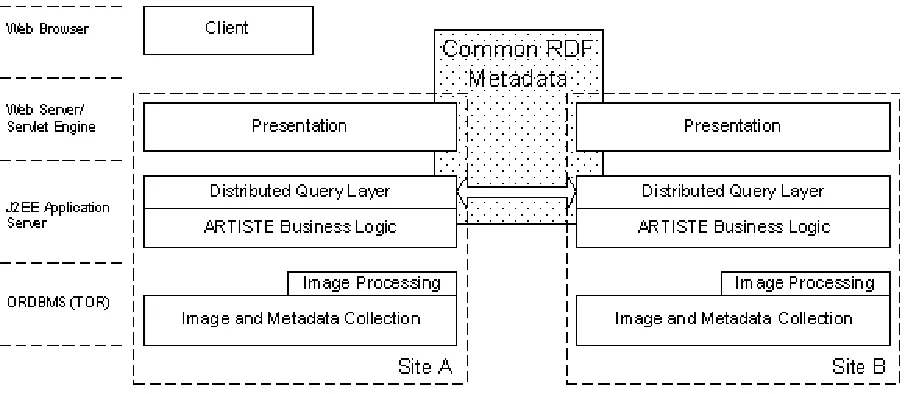
The ARTISTE architecture is illustrated in Figure 1. Each site has a complete instance of the ARTISTE system with its own images and metadata.
Images of the art objects from a collection are held in an object relational database from NCR (TOR: Teradata Object Relational) as Binary Large Objects (BLOBS). A number of user-defined modules (UDMs) define the image processing functions that can be applied to these representations. The UDMs are executed in the database, which has several benefits. The system uses parallelism automatically, which is important in this application where large volumes of data have to be processed by sometimes complex algorithms. Keeping the processing close to the data minimises data transfers, which is essential again due to the size of the data collections. The image processing functions can be called directly from SQL, allowing complex queries involving image processing and text metadata. The maintainability of the system is increased due to the DBMS functionality.Metadata is also stored in the database. This may be loaded from legacy systems or generated directly by the Artiste system,
according to the incumbent systems at the museum sites. For example the field "Ecole" in the Louvre database will still be called "Ecole" in the ARTISTE database.
The ARTISTE architecture follows a standard n-tier approach.The server has been implemented within a J2EE/EJB framework [9], using the JBoss [10] Enterprise Application Server. This provides a robust, portable and scalable framework which emphasises modularity resulting in a more maintainable system. The framework provides system services such as database connection pooling which reduces the development time.
=
Figure 1 Artiste Architecture
The ARTISTE Server accesses the image processing functions within the ORDMBS using the ARTISTE Image Processing API. The API is a SQL interface for user defined image processing functions that enables interoperability with ORDBMS other than TOR. The requirements for
interoperability are that the ORDBMS supports user defined functions that operate on complex objects such as images that can be invoked directly within SQL statements.
fåíÉêçéÉê~Äáäáíó=
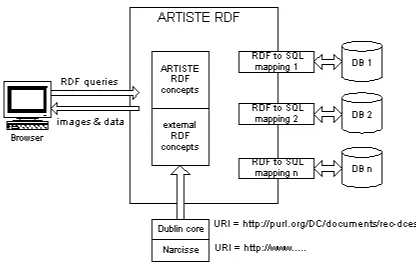
The ARTISTE system enables queries to be executed across multiple, distributed collections without requiring each collection to conform to a standard schema. This is achieved by using resource
Figure 2 Interoperable RDF approach
A example set of metadata terms used for describing documents is defined by the Dublin Core (DC) RDF schema [13]. Figure 3 shows how DC is used within the ARTISTE system to provide query interoperability between collections when querying using the DC Title standard metadata term. Each collection maps the DC Title metadata term to columns in metadata tables. In this case Collection A defines image title within the Caption column and Collection B defines image title within the TitleM column. A user can then execute a single query across both collections and at each collection the RDF URI for DC Title is translated to the SQL for selecting Caption or TitleM.
=
Figure 3 Dublin Core Schema Interoperabilty
[image:4.595.70.464.505.652.2]fëëìÉë=
Current digital library query representations and protocols, such as Z39.50, deal entirely with textual metadata. This is not sufficient for multimedia digital libraries such as ARTISTE, where searches can be made on image content as well as textual metadata. In particular, current protocols have the following restrictions:
• qÜÉêÉ=~êÉ=åç=ãÉíÜçÇë=Ñçê=ëéÉÅáÑóáåÖ=áã~ÖÉ=ÅçåíÉåí=~ë=~=ãÉí~Ç~í~=áíÉãK== • qÜÉêÉ=~êÉ=åç=çéÉê~íçêë=ÇÉÑáåÉÇ=êÉä~íáåÖ=íç=áã~ÖÉ=ÅçåíÉåíK==
• qÜÉêÉ=~êÉ=åç=ãÉíÜçÇë=Ñçê=Å~êêóáåÖ=çìí=ëÉ~êÅÜÉë=íÜ~í=êÉëìäí=áå=íÜÉ=ÉñÉÅìíáçå=çÑ=áã~ÖÉ=éêçÅÉëëáåÖ= ~äÖçêáíÜãëK==
These issues are addressed in the following sections.
péÉÅáÑóáåÖ=áã~ÖÉ=ÅçåíÉåí=
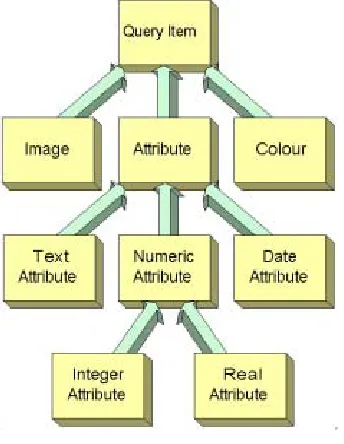
The ARTISTE approach provides a seamless way to query image collections. Firstly, we define a base term for all aspects that can be queried: a QueryItem. This can be the image itself, properties of the image (such as colour or shape), or attributes associated with the image (conventional metadata such as textual and numeric items). Figure 4 shows the current query item structure.
[image:5.595.57.229.380.602.2]=
Figure 4 ARTISTE Query Item structure
The RDF schema for the ARTISTE query items is defined in Appendix A1.
nìÉêó=léÉê~íçêë=
Figure 5 ARTISTE Query Operator structure
The RDF schema for the ARTISTE query operators is defined in Appendix A2.
nìÉêó=bñéêÉëëáçå=oìäÉë=
All operators must be instantiated to form rules – each rule describes a legal ARTISTE query expression and specifies which query items can be used with each query operator. Each query operator is assumed to take two objects: a subject and an object.
The following properties are defined:
• ^ääçïÉÇpìÄàÉÅí=Ó=íÜáë=éêçéÉêíó=áë=ìëÉÇ=Äó=íÜÉ=êìäÉë=íç=ÇÉÑáåÉ=íÜÉ=èìÉêó=áíÉãë=íÜ~í=~=é~êíáÅìä~ê= çéÉê~íçê=Å~å=í~âÉK=qÜÉ=éêçéÉêíó=Å~å=çåäó=ÄÉ=~ééäáÉÇ=íç=~=èìÉêó=ÉñéêÉëëáçå=êìäÉI=~åÇ=ãìëí=êÉÑÉê= íç=~=èìÉêó=áíÉãK==
[image:6.595.63.166.502.682.2]• ^ääçïÉÇlÄàÉÅí=Ó=íÜáë=éêçéÉêíó=ÇÉÑáåÉë=íÜÉ=~ääçïÉÇ=çÄàÉÅí=çÑ=~=èìÉêó=ÉñéêÉëëáçå=êìäÉI=áå=~= ëáãáä~ê=ï~ó=íç=íÜÉ=~ääçïÉÇ=ëìÄàÉÅí=éêçéÉêíóK==
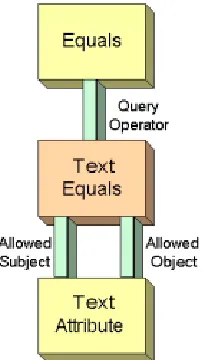
Figure 6 shows a diagrammatic representation of the "Text Equals" query expression rule. This rule defines "Text Equals" as an operation involving two text attributes and the equality operator.
=
Figure 6 Simple Query Expression Rule
Other rules can be defined as appropriate (DateEquals, TextContains etc.) Rules that contain fuzzy operators must further be qualified by relating an analyser, as described in the following section. The RDF schema for the ARTISTE query expression rules is defined in Appendix A3.
fã~ÖÉ=mêçÅÉëëáåÖ=
We define an algorithm as being a software module that operates on an image to generate or compare image feature vectors. An analyser is an algorithm together with the relevant metadata which describes how the algorithm interacts with the rest of the system. Analysers may be used in conjunction with fuzzy operators (e.g. similar to) or may be used to generate conventional metadata terms.
In ARTISTE our approach has been to develop a range of algorithms producing feature vectors, which are typically pre-computed from the images and stored in the database, augmenting their metadata. Some general content-based techniques based on texture, colour and spatial colour distributions have been implemented but the main thrust has been on additional novel retrieval algorithms addressing some specific needs of the galleries. There are two ways that the image
processing algorithms are used. One is to carry out a comparison of images in order to find for example images which have similar colour layout. The second is to run algorithms once in order to populate metadata, for example with a count of wooden supports or a shape classification.
Some of the images in the collection are very large (up to 800 Mbytes) and also very high resolution (20 pels/mm) demanding special purpose algorithms for effective handling. We use a Java applet viewer [14] to browse large images in the user interface. One new algorithm takes a query image which may be a sub-image of an image within the database and which may be recorded at a significantly different resolution from its parent. The requirement is to identify from which parent image the query is derived and to locate its position in the parent image. Since the query may have been captured at a different time, possibly in a different state of restoration, or simply under different lighting conditions, robust techniques are required. A multi-scale technique based on colour coherence vectors has been developed for the task, which is giving useful results [15].
Another algorithm has been designed to detect and classify image boundaries, which enables frame shape classification and another technique is targeted at low quality queries, in particular faxes, which often provide the means by which queries are submitted to galleries. A further algorithm detects features in the restoration framework as some images in the collection are of the backs of paintings showing how the framework has been restored. These techniques are typically combined with a metadata based search which limits the content based search to a sub-class of the total image collection. Development of these specialised algorithms is ongoing and a user group is able to access the emerging prototypes and provide feedback to the research teams.
The analysers which calculate the feature vectors must be applied to query expression rules for them to be used by the system. This is achieved by using the property AnalyserAppliesTo to map the analysers to the query expression rules to which they apply (e.g. it may be used to say that the Colour Histogram analyser is used to find similar images). Figure 7 shows the query expression rule using the fuzzy operator "Similar To" and qualified with the Colour Histogram analyser.
Figure 7 Fuzzy Query Expression Rule
The RDF schema for the ARTISTE analysers is defined in Appendix A4.
bñ~ãéäÉë=
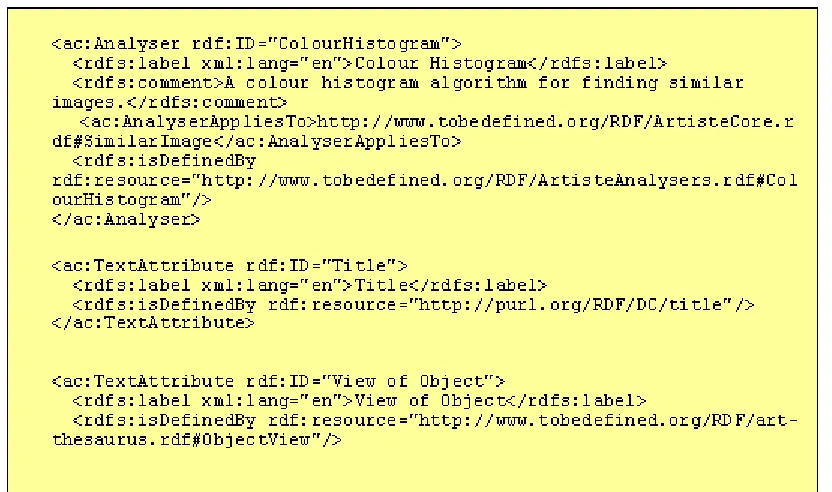
We now present an example set-up and query to show how the RDF schema used in ARTISTE can provide an interoperable framework across distributed sites. Figure 8 shows an extract from the RDF an application profile [17] which described the site. The site declares that it supports the ‘Colour
Histogram’ algorithm (as defined by the published ArtisteAnalysers RDF file), the title (as defined by Dublin Core) and the view of the object (as defined by a hypothetical art thesaurus).
=
Figure 8 Example: extract from site application profile
[image:8.595.57.473.418.664.2]=
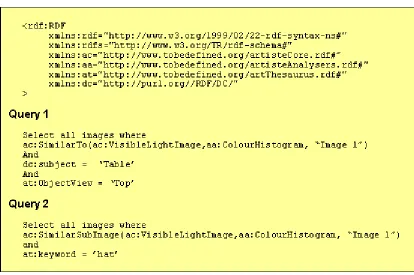
Figure 9 Example query pseudo code
Figure 10 shows the query image for ‘Query 2’, as described above. Note that the query image is a sub-image of the required result and that some of the images in the test collection were as large as 13 MBytes. This query was executed against a database of about 50000 images, of which 500 had the keyword ‘hat’. The execution time for this query was about one minute on a 4x450MHz Windows NT platform. No feature vector indexing has been implemented yet, which will significantly improve the speed of retrieval. The results can be seen in Figure 11. It can be seen that the system has correctly retrieved the corresponding image, and has found an extremely good match for a second image.
[image:9.595.60.143.496.568.2]=
Figure 11 Results of Query
`çåÅäìëáçåë=
The use of RDF mapping has provided a more flexible solution to cross-collection searching. Its flexibility has allowed us to design a system which also handles content based retrieval. The query language for this type of system is not yet standardised but we hope that an emerging standard will provide the session-based connectivity this application seems to require due to the possibility of long query times.
The content-based retrieval is fast enough to be usable even without multidimensional indexing, although that will speed up the system considerably when it is implemented. It was found that the targeted content-based algorithms provide more successful results than applying generic content-based algorithms in isolation.
The ARTISTE system provides a very flexible framework to provide content and metadata-based queries across multiple sites.
cìíìêÉ=tçêâ=
In the near future, the project will be introducing controlled vocabulary support for some of the metadata fields. This will not only make retrieval more robust but will also facilitate query expansion. The Louvre’s multilingual thesaurus will be used in order to ensure greater interoperability.
The system is easily extensible to other multimedia types such as audio and video (eg by adding additional query items such as "dialog" and "video sequence" with appropriate analysers). A follow-up project is scheduled to explore this further.
^ÅâåçïäÉÇÖÉãÉåíë=
^ééÉåÇáñ=^N=nìÉêó=fíÉã=oac=
^ééÉåÇáñ=^O=nìÉêó=léÉê~íçê=oac=
[image:13.595.61.475.96.586.2]=
=
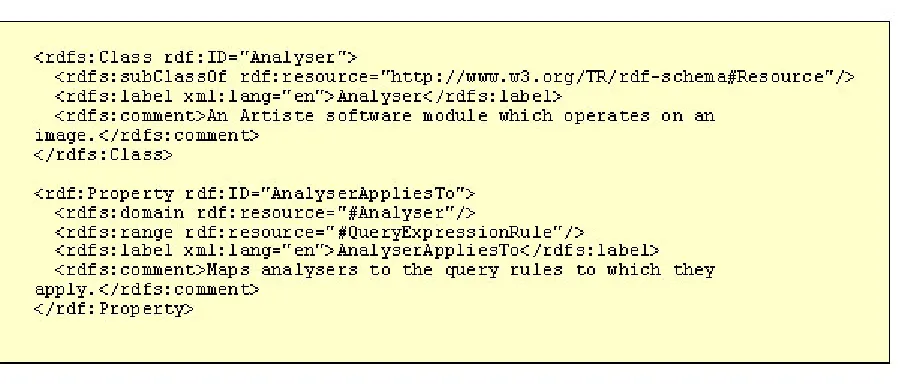
^ééÉåÇáñ=^Q=^å~äóëÉê=oac=
[image:15.595.65.515.91.285.2]=
Figure 15 Analyser RDF
oÉÑÉêÉåÅÉë=
[1] J. H. E. van der Starre, "Visual Arts Network for the exchange of cultural knowledge: Van Eyck Project", Information Services & Use, Vol.13, pp 347-355, 1993.
[2] A. Michard, V. Christophides, M. Scholl, M. Stapleton, D. Sutcliffe, A.M. Vercoustre, "The Aquarelle resource discovery system", Computer Networks and ISDN Systems, Vol. 30, 1185-1200, 1998.
[3] National Information Standards Organisation, Z39.50 Information Retrieval Protocol http://www.niso.org/z3950.html, 1998.
[4] J. Hunter, C. Lagoze, "Combining RDF and XML Schemas to Enhance Interoperability Between Metadata Application Profiles", Computer Networks, Proceedings of the tenth Web conference, 2000. [5] A.W.M. Smeulders, M. Worring, S. Santini, A. Gupta and R. Jain, "Content-Based Image Retrieval at the end of the Early Years", IEEE Transactions on Pattern Analysis and Machine Intelligence, Vol. 22, No. 12, pp.1349-1380, 2000
[6] M. Flickner, H. Sawhney, W. Niblack, W., Ashley, J., Huang, Q., Dom, B.,
Gorkani, M., Hafner, J., Lee, D., Petkovic, D., Steele, D. and Yanker, P., "Query by image and video content: The QBIC system", IEEE Computer Magazine, vol. 28, pp. 23-32, September 1995
[7] S. F. Chang, J. R. Smith, M. Beigi, and A. Benitez, "Visual Information Retrieval from Large Distributed On-Line Repositories", Communications of ACM, Special Issue on Visual Information Management, Vol. 40 No. 12, pp. 63-71, Dec. 1997.
[8] http://www.virage.com
[9] N. Kassem, "Designing Enterprise Applications with the Java(TM) 2 Platform, Enterprise Edition", Addison Wesley, 2000.
[10] www.jboss.org
[11] Resource Description Framework (RDF) Model and Syntax Specification, W3C Recommendation 22 February 1999, http://www.w3.org/TR/REC-rdf-syntax/
[12] Resource Description Framework (RDF) Schema Specification 1.0, W3C Candidate Recommendation 27 March 2000, http://www.w3.org/TR/rdf-schema/
[13] Dublin Core Metadata Initiative http://www.dublincore.org/ [14] K. Martinez, J. Cupitt, and S. Perry. "High resolution Colorimetric Image Browsing on the Web", Computer Networks and ISDN Systems. Vol. 30, 1998, pp. 399 - 405.
[15] S. Chan, K. Martinez, P. Lewis, C. Lahanier and J. Stevenson, "Handling Sub-Image Queries in Content-Based Retrieval of High Resolution Art Images", International Cultural Heritage Informatics Meeting pp.157-163, 2001.
[18] XQuery 1.0: An XML Query Language, W3C Working Draft 07 June 2001. http://www.w3.org/TR/xquery/