Abstract— Common Radio Resource Management (CRRM) is required to support the provision of Quality of Service (QoS) and the efficient utilization of radio resources in coexisting different Radio Access Technologies (RATs). In this paper, an Adaptive-Terminal Modality-Based Joint Call Admission Control (ATJCAC) algorithm is proposed to enhance connection-level QoS and reduce call blocking/dropping probability. The proposed ATJCAC algorithm makes call admission decisions based on mobile terminal modality (capability), network load, adaptive the bandwidth of ongoing call and radio access technology (RAT) terminal support index. Simulation results show that the proposed ATJCAC scheme reduces call blocking/dropping probability.
Index Terms— Call admission control; Call Blocking; Call Dropping; Next Generation Wireless Network (NGWN); RAT selection approaches
I. INTRODUCTION
ETWORK heterogeneity refers to a combination of multiple wireless networks based on different access technologies (e.g. UMTS, EV-DO, LTE, WiMAX, etc.) coexisting in the same geographical area. Due to the coexistence of different Radio Access Technologies (RATs), Next Generation Wireless Networks (NGWN) is predicted to be heterogeneous in nature. The coexistence of different RATs requires a need for Common Radio Resource Management (CRRM) to support the provision of Quality of Service (QoS) and the efficient utilization of radio resources. With joint radio resource management in NGWN, mobile users will be able to communicate through any of the available radio access technologies (RATs) and roam from one RAT to another, using multi-mode terminals (MTs) [1-3].
In wireless cellular networks, user’s QoS requirements can be quantitatively expressed in terms of probabilistic connec-tion-level QoS parameters such as new call blocking probability (NCBP) and handoff call dropping probability (HCDP) [4]. The NCBP is the probability of a new arriving call being rejected while the HCDP is the probability that an accepted call is terminated before the completion of its service, i.e., the probability that a handoff attempt fails [4-5]. In the 3G and beyond wireless systems, multimedia services such as voice, video, data, and audio are to be offered with various quality-of-service (QoS) profiles. Hence, more sophisticated call admission control (CAC) schemes are developed to cope with these changes. Traffic
Manuscript received June 02, 2014; revised July 09, 2014..
Mahmoud M. Badawy (corresponding author with phone:
00966505225172) and Salman A. AlQahtani are with the computer engineering department, King Saud University, Riyadh, Saudi Arabia (e-mail: [email protected], [email protected]).
of admitted calls is then controlled by other RRM techniques such as scheduling, handoff, power, and rate control schemes.
RAT selection algorithms are part of the CRRM algorithms. Simply, their role is to verify if an incoming call will be suit-able to fit into a heterogeneous wireless network, and to decide which of the available RATs is most suitable to fit the need of the incoming call and admit it. Guaranteeing the requirements of QoS for all accepted calls and at the same time being able to provide the most efficient utilization of the available radio resources is the goal of RAT selection algorithm. Call admission control is a key element in the provision of guaranteed quality of service in wireless networks. The design of call admission control algorithms for mobile cellular networks is especially challenging given the limited and highly variable resources, and the mobility of users en-countered in such networks.
Generally, CAC algorithms are triggered by any of the fol-lowing events: New call arrival and handoff call arrival. The normal call admission control algorithms do not provide a solution to fit a heterogeneous wireless network. Therefore, there is a need to develop RAT selection algorithm in addi-tion to Call admission control. This guarantee a term called Joint call admission control (JCAC) algorithm.
A number of RAT selection algorithms including initial RAT selection and vertical handover have been proposed in the literature for heterogeneous wireless networks [1-2, 6-17]. In [15] presented a Markovian approach to RAT selection in heterogeneous wireless networks. The proposed algorithm selects just one RAT for each call. In [16], a service-class based JCAC algorithm was proposed. It admits calls into a particular RAT based on the class of service, such as voice, video streaming, real-time video, web browsing, etc. In [17], a terminal-modality- based JCAC scheme was proposed. It consists of two main components: joint call admission controller and band-width reservation unit.
In this paper, an Adaptive-Terminal Modality-Based Joint Call Admission Control (ATJCAC) algorithm is proposed to enhance connection-level QoS and reduce call block-ing/dropping probability.
The rest of this paper is organized as follows. In Section II, system model is described. The proposed adaptive-TJCAC scheme is presented in section III. In section IV, result dis-cussions of proposed scheme are provided. Finally, the con-clusion of this research is presented in section V..
Adaptive Joint Call Admission Control for
Heterogeneous Mobile Networks
Mahmoud M. Badawy and Salman A. AlQahtani
II. SYSTEMMODELANDASSUMPTIONS We consider a heterogeneous cellular network which consists of J number of RATs with co-located cells. In the heterogeneous network, radio resources are jointly managed. Cellular networks such as GSM, UMTS (3G) and LTE can have the same and fully overlapped coverage, which is technically feasible, and may also save on installation costs [18, 19]. Let H denote the set of all available RATs in the heterogeneous wireless network. Then, H is given as follows:
H={ RAT1,RAT2,………RATj }
where J is the total number of RATs in the heterogeneous cellular network. The heterogeneous cellular network supports k-classes of calls, and each RAT in set H is optimized to support certain classes of calls. Let Hi (Hi⊆ H) denote the set of RATs which can support class-i calls in the heterogeneous cellular network, and let hi (hi⊆ h) denote the set of indices of all RATj which belong to Hi, where h= {1, 2, …., J}. Furthermore, let Ji (Ji ≤ J) denote the total number of RATs that can support class-i calls. Let Dj ( Dj ⊆ D ) denotes the set of call classes that can be supported by RATj (j=1, 2, …,J) where D= {class-1, class-2, …, class-k}. Note that the idea that different networks support different classes of calls is true in reality. For example, LTE and UMTS network can support video streaming whereas GSM network cannot support video streaming.
Each cell in RATj (j = 1, •••, J) has a total of Bj basic bandwidth units (bbu). The physical meaning of a unit of radio resources (such as time slots, code sequence, etc.) is dependent on the specific technological implementation of the radio interface. However, no matter which multiple access technology (FDMA, TDMA, WCDMA or OFDMA) is used, system capacity could be interpreted in terms of effective or equivalent bandwidth . Therefore, this research refers to the bandwidth of a call as the number of bbu that is adequate for guaranteeing the desired QoS for the call.
The heterogeneous network supports K classes of calls. Each class is characterized by bandwidth requirement, arrival distribution, and channel holding time. Each class-i call requires a discrete bandwidth value, bi,w where bi,w belongs to the set Bi={ bi,w } for i = 1, 2, . . . , K and w = 1, 2, . . . ,W
i. Wi is the number of different bandwidth values that a class-i call can be allocated. bi,1 (also denoted as bi,min ) and bi,Wi (also denoted as bi,max ) are, respectively, the minimum and maximum bandwidth that can be allocated to a class-i call. Note that bi,w < bi,(w+1) for i = 1, 2. . . K and w = 1, 2. . .( Wi − 1).
The requested bandwidth of class-i call is denoted by bi,req , where bi,req∈ Bi. Let mi,j and ni,j denote, respectively, the number of new call of class-i and handoff call of class-i, in RAT- j. with 1 ≤ c ≤ mi, j (for new calls) and 1 ≤ c ≤ ni, j
(for handoff calls). Let bi,assigned c denote the bandwidth assigned to call c of class-i in RAT- j in the group of co-located cells, where bi,assigned c ∈ Bi. A call c of class-i is
degraded if bi,assigned c < bi,req whereas the call is upgraded if bi,assigned c > bi,req . If a class of calls (i.e., class-i calls) requires a fixed number of bbu (i.e. constant bit-rate service), it becomes a special case in our model in which bi,min = bi,max and the set Bi has only one element. However,
However, it will not be possible to upgrade or degrade this class of calls.
Following are the general assumptions in the studied cellular networks. The New call arrival of class-i arrive is assumed to follow Poisson process with rate λni, n denoted to new call. Handoff call of class-i arrive according to Poisson process with rate λhi, h denoted to handoff call.
Call holding time (CHT) of class-i is assumed to exponential distribution with mean µci−1 . Cell residence time (CRT) is assumed to follow an exponential distribution with mean
1
− hi
µ , h denoted to handoff rate. Channel holding time for call of class-i is assumed to exponential distribution with mean µi−1 where µi=µci+µhi.
III. PROPOSEDADAPTIVETJCACSCHEME This section describes the proposed adaptive terminal-modality- based JCAC scheme. Fig. 1 illustrates the problem of unfairness in radio resource allocation in a three-RAT heterogeneous wireless network when terminal modality is not considered in making RAT selection decisions. Assume that 1) all the three RATs have equal capacity; 2) all the arriving calls belong to the same class; and 3) each RAT can support only two calls.
Fig. 1. Unfair allocation of radio resources among heterogeneous mobile
terminals.
Fig. 1shows six consecutively arriving calls (1 to 6) in the heterogeneous wireless network. A load-balancing JCAC scheme, for instance, will admit the first incoming call (call 1 from a triple-mode terminal) into RAT 1. It will admit call 2 (from a dual-mode terminal) into RAT 2, admit call 3 (from a triple-mode terminal) into RAT 3, and admit call 4 (from a dual-mode terminal into RAT1).
The JCAC scheme cannot admit the fifth incoming call (call 5) into RAT 2 or RAT 3 because call 5 is from a single-mode terminal that is sup-ported only by RAT 1. The JCAC scheme will then try to admit call 5 into RAT 1. Call 5 will be blocked in RAT 1 because it is already fully loaded (maximum of two calls). In a similar manner, the sixth incoming call (call 6) from a single-mode terminal that is supported by RAT 1 only, will be blocked.
components: joint call admission controller, band-width reservation unit and bandwidth adaptation controller.
The joint call admission controller implements the JCAC algorithm. The basic function of the JCAC algorithm is to make call admission decisions and guarantee fairness among the different heterogeneous terminals in the heterogeneous wireless network. The proposed JCAC algorithm makes RAT selection decisions based on the modality of the mobile terminal initiating a call, the terminal support index of each RAT that can support the call, and the current load in the available RATs.
Terminal support index of a RAT indicates the ratio of terminals supported by the RAT to the total terminals registered in the heterogeneous wireless network. Terminal support index of RATj (RJ) is defined as follows:
= ,0< j ≤1
J
j R
T T
R (1)
Where Tj is the number of mobile terminals that have an interface for RAT-j (i.e. that can be admitted into RAT-j), and T is the total number of mobile terminals registered in the network.
During a call setup, a mobile terminal initiating a call sends a service request to the joint call admission control which implements the JCAC algorithm. The JCAC algorithm is part of the joint resource management entity of the heterogeneous wireless network. The location of the joint resource management entity depends on the specific network architecture deployed by the network operator. The service request contains the call type, capability of terminal (number and types of network supported by the terminal), service class, and bandwidth requirements. Fig. 7is the flow chart of the proposed JCAC algorithm. As shown in Fig. 7, xij and yij represent the residual bbu available for new and handoff class-i calls, respectively, in RAT-j. Lj, and T
j
represent the current load and Terminal support index of RAT-j, respectively. Hi is the set of RATs that can support an incoming class-i call, and the mobile terminal (based on terminal modality) initiating the call. hi is the set of indexes of RATs that belong to set Hi .
Whenever a class-i call arrives from a y-mode terminal in the heterogeneous wireless network, the JCAC algorithm determines the set Hi of RAT-j that can support the class-i call and that can support the mobile terminal initiating the call (based on terminal modality). The JCAC algorithm then sorts the RATs in set Hi in increasing order of their terminal- support index (Rj). Starting from the RAT with the lowest terminal-support index, the JCAC algorithm attempts to allocate the maximum bbu for this call (i.e., set bi,min = bi,max ) provided that the available bbu in the selected RAT is greater than or equal to bi,max. If the available bbu in the selected RAT is less than bi,max but greater than or equal to bi,req, the call will be assigned a bandwidth between bi,req and bi,max . If the available bbu is less than bi,req but greater than or equal to bi,1 (bi,min ), the call will be assigned a bandwidth between bi,1 and bi,req .
If the available bbu in RATs with the lowest terminal-support index is less than bi,1, BA algorithm (BAA) will be invoked to reduce the bandwidth of some ongoing call(s) in
the chosen RAT. If the available bbu is still less than bi,1, the the next available RAT with the second-lowest terminal support index will be selected for the call, and so on. If two or more RATs that can support the incoming call have the same low terminal-support index, the least loaded of the two or more RATs will be selected for the incoming call.
The class-i call is rejected if none of the RATs in set Hi
has enough basic bandwidth units (bbu) to accommodate the call. By attempting to admit an incoming call into the RAT with the lowest terminal-support index that can support the class of the call, the proposed ATJCAC scheme reserves other RATs with a higher terminal-support index for calls from low-capability terminals, thereby reducing the blocking probability of such calls.
IV. RESULTS
In this section, the performance of the proposed Adaptive-terminal-modality based JCAC scheme is evaluated with respect to New Call Blocking Probability (NCBP) and Handoff Call Dropping Probability (HCDP), using a one-class three-RAT heterogeneous wireless network supporting heterogeneous mobile terminals. A new call from i-mode terminal is blocked in the group of co-located cells if none of the available RATs supported by i-mode terminal has enough bbu to accommodate the new call. NCBP is the average number of blocked new call over all arrived new call. A handoff call from i-mode terminal is dropped in the group of co-located cells if none of the available RATs supported by i-mode terminal has enough bbu to accommodate the handoff call. HCDP is the average number of dropped new call over all arrived handoff call is known as HCDP.
A numerical simulation is conducted using C++ program and MatLab. The following system parameters are used: C1=C2=C3=10, t01=t02=t03=5,b1={1,2,3},µ1=0.5,
n 1
λ =[1,5],
h 1
λ =0.5λ1n
. In order to investigate the performance of the
proposed ATJCAC scheme, two experiments with different combinations of heterogeneous terminals are examined.• First experiment (Terminals Dominated by 1-Mode Terminals) 1M: 2M: 3M = 50:25:25: is 1-mode = 50 terminal, 2-mode = 25 terminal, and 3-mode = 25 terminals.
• Second experiment (Terminals Dominated by 2-Mode Terminals) 1M: 2M: 3M = 25:50:25: 1-mode = 25 terminal, 2-mode = 50 terminal, and 3-mode = 25 terminals.
For each of the two experiments, the performance of the proposed ATJCAC scheme is compared with the performance of two other JCAC schemes namely, the Terminal modality-based JCAC scheme(“NATJCAC” scheme) and the service-class-based JCAC scheme (“SJCAC” scheme). Results obtained from the two experiment are discussed in the following subsections. In all figures we use letter “A” to indicate ATJCAC, “N” to indicated NATJCAC and letter “S” to indicate SJCAC.
A. First experiment
for SJCAC, NATJCAC and the proposed ATJCAC. As shown in Fig. 5, Pb for the three JCAC schemes and three classes of terminals increases with an increase in arrival rate for three JCAC schemes. This is expected. However, for 1-mode terminals, Pb of the NATJCAC scheme is lower than the corresponding Pb1 of the SJCAC schemes. The NATJCAC scheme is able to reduce the Pb by admitting most of the calls from 3-mode terminals into RAT 3, which has the lowest terminal support index, thereby reserving RAT 1 and RAT 2 for calls from 1-mode and 2-mode terminals, respectively. However, the reduction in 1-mode terminals Pb for NATJCAC scheme is at the expense of the Pb1 of calls from mode terminals. It can be seen that for 3-mode terminals, the Pb of the NATJCAC scheme is higher than the corresponding Pb of the SJCAC schemes.
.
0 0.5 1 1.5 2 2.5 3 3.5 4 4.5 5
0 0.1 0.2 0.3 0.4 0.5 0.6 0.7
Arrival traffic
N
C
B
P
[image:4.612.322.541.54.229.2]1M pb for S 1M pb for N 1M pb for A 2M pb for S 2M pb for N 2M pb for A 3M pb for S 3M pb for S N 3M pb for S A
Fig. 2. NCBP (Pb) for class-1 calls with 1M: 2M: 3M = 50:25:25
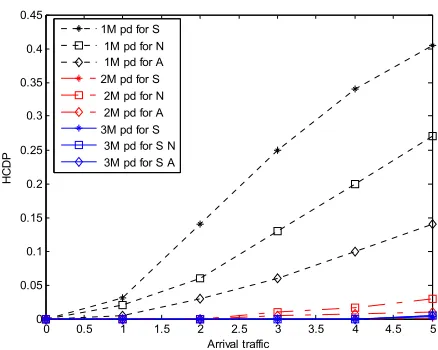
Fig. 3shows the effect of varying the call arrival rate on the HCDP (Pd) of 1-mode, 2-mode, and 3-mode terminals for SJCAC, NATJCAC and the proposed ATJCAC. As shown in Fig. 3, Pd for the three JCAC schemes and three classes of terminals increases with an increase in arrival rate for three JCAC schemes. This is expected. However, for 1-mode terminals, Pd of the NATJCAC scheme is lower than the corresponding Pd of the SJCAC schemes. The NATJCAC scheme is able to reduce the Pd by admitting most of the calls from 3-mode terminals into RAT 3, which has the lowest terminal support index, thereby reserving RAT 1 and RAT 2 for calls from 1-mode and 2-mode terminals, respectively. However, the reduction in 1-mode terminals Pd for NATJCAC scheme is at the expense of the Pd of calls from mode terminals. It can be seen that for 3-mode terminals, the Pd of the NATJCAC scheme is higher than the corresponding Pd of the SJCAC schemes.
0 0.5 1 1.5 2 2.5 3 3.5 4 4.5 5
0 0.05 0.1 0.15 0.2 0.25 0.3 0.35 0.4 0.45
Arrival traffic
H
C
D
P
1M pd for S 1M pd for N 1M pd for A 2M pd for S 2M pd for N 2M pd for A 3M pd for S 3M pd for S N 3M pd for S A
Fig. 3. HCDP (Pd) for class-1 calls with 1M: 2M: 3M = 50:25:25
B. Second experiment
Fig. 4 shows the effect of varying the call arrival rate on the NCBP (Pb) of 1-mode, 2-mode, and 3-mode terminals for SJCAC, NATJCAC and the proposed ATJCAC. As shown in Fig. 4, Pb for the three JCAC schemes and three classes of terminals increases with an increase in arrival rate for three JCAC schemes. This is expected. However, for 1-mode terminals, Pb of the NATJCAC scheme is lower than the corresponding Pb of the SJCAC schemes. The NATJCAC scheme is able to reduce the Pb by admitting most of the calls from 3-mode terminals into RAT 3, which has the lowest terminal support index, thereby reserving RAT 1 and RAT 2 for calls from 1-mode and 2-mode terminals, respectively. However, the reduction in 1-mode terminals Pb for NATJCAC scheme is at the expense of the Pb1 of calls from mode terminals. It can be seen that for 3-mode terminals, the Pb of the NATJCAC scheme is higher than the corresponding Pb of the SJCAC schemes.
0 0.5 1 1.5 2 2.5 3 3.5 4 4.5 5
0 0.1 0.2 0.3 0.4 0.5 0.6 0.7
Arrival traffic
N
C
B
P
1M pb for S 1M pb for N 1M pb for A 2M pb for S 2M pb for N 2M pb for A 3M pb for S 3M pb for S N 3M pb for S A
Fig. 4. NCBP (Pb) for class-1 calls with 1M: 2M: 3M = 25:50:25
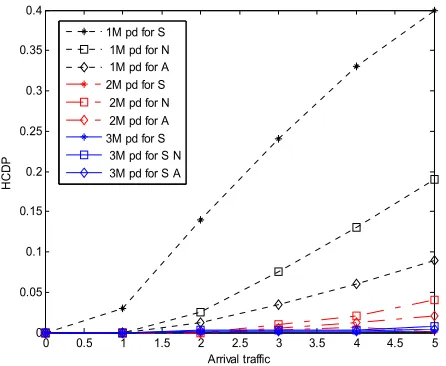
[image:4.612.81.298.240.409.2] [image:4.612.326.550.481.670.2]shown in Fig. 5, Pd for the three JCAC schemes and three classes of terminals increases with an increase in arrival rate for three JCAC schemes. This is expected.
0 0.5 1 1.5 2 2.5 3 3.5 4 4.5 5
0 0.05 0.1 0.15 0.2 0.25 0.3 0.35 0.4
Arrival traffic
H
C
D
P
[image:5.612.80.303.92.275.2]1M pd for S 1M pd for N 1M pd for A 2M pd for S 2M pd for N 2M pd for A 3M pd for S 3M pd for S N 3M pd for S A
Fig. 5. HCDP (Pd) for class-1 calls with 1M: 2M: 3M = 25:50:25
However, for 1-mode terminals, Pd of the NATJCAC scheme is lower than the corresponding Pd of the SJCAC schemes. The NATJCAC scheme is able to reduce the Pd by admitting most of the calls from 3-mode terminals into RAT 3, which has the lowest terminal support index, thereby reserving RAT 1 and RAT 2 for calls from 1-mode and 2-mode terminals, respectively. However, the reduction in 1-mode terminals Pd for NATJCAC scheme is at the expense of the Pd1 of calls from 3-mode terminals. It can be seen that for 3-mode terminals, the Pd of the NATJCAC scheme is higher than the corresponding Pd of the SJCAC schemes.
V. CONCLUSION
In heterogeneous wireless network, it is needed to make RAT selection decision in addition to call admission decision. In future wireless networks multimedia, traffic will have differ-ent QoS requirements. The proposed ATJCAC algorithm makes call admission decisions based on mobile terminal modality (capability), network load, adaptive the bandwidth of ongoing call and radio access technology (RAT) terminal support index. Performance of the adaptive-TJCAC scheme is compared with non-adaptive adaptive-TJCAC scheme and SJCAC scheme. Simulation results show that the proposed ATJCAC scheme reduces call blocking/dropping probability.
REFERENCES
[1] O. E. Falowo and H. A. Chan, “Joint Call Admission Control Algorithms: Requirements, Approaches, and Design Considerations,” Computer Communications, Vol. 31, No. 6, 2008, pp. 1200-1217. [2] O. E. Falowo, H. A. Chan, “Joint call admission control for next
generation wireless network,” IEEE Conference on Electrical and Computer Engineering, May 2006, pp.1151 – 1154.
[3] S. Lee, K. Sriram, K. Kim, Y. Kim and N. Golmie, “Vertical Handoff Decision Algorithms for Providing Opti-mized Performance in Heterogeneous Wireless Networks,” IEEE Transactions on Vehicular Technology, Vol. 58, No. 2, 2009, pp. 865-881.
[4] S. S. Rappaport, “The Multiple-Call Hand-off Problem in High-Capacity Cellular Communications Systems”, IEEE Trans. Veh. Tech., vol. 40, no.3, Aug. 1991, pp. 546-557
[5] Naghshineh, M. and Schwartz, M., “Distributed call admission control in mobile/wireless networks”, IEEE Journal on SAC, vol. 14 no. 4, May1996, pp. 711-717.
[6] Yu. Fei and V. Krishnamurthy, “Optimal joint session admission control in integrated WLAN and CDMA cellular networks with vertical handoff,” IEEE Transactions on Mobile Computing, vol. 6, no. 1, Jan. 2007, pp. 126 – 139.
[7] X. G. Wang, G. Min, and J. E. Mellor Adaptive QoS control in cellular and WLAN interworking networks, Second International Working Conference on the Performance Modeling and Evaluation of Heterogeneous Networks (HET-NETs ’04), July 2004.
[8] D. Karabudak, C. Hung, and B. Bing, A call admission control scheme using genetic algorithms, Symposium on Applied Computing (SAC 04), March 2004 , pp.1151 1158.
[9] K. Murray and D. Pesch, “Policy based access management and handover control in heterogeneous wireless networks,” The IEEE Vehicular Technology Conference, vol.5, Sep. 2004, pp.3319- 3323. [10] K. Murray and D. Pesch,“Intelligent network access and inter-system
handover control in heterogeneous wireless networks for smart space environments,” 1st International Symposium on Wireless Communication Systems, 2004, pp. 66-70.
[11] D. Qiang, H. Bo, S. Yan, and C. Shan-zhi,“Joint admission control through vertical handoffs in heterogeneous wireless network,” Global Mobile Congress (GMC), 2010, Nov. 2010, pp. 1-5.
[12] X. Li, H. Ji, P. Si, and L. Zhang, “Joint session admission control scheme in integrated WLAN and 3G networks,” 5th International ICST Conference on Communications and Networking in China (CHINACOM 2010), Aug. 2010, pp.1-5.
[13] M. Khabazian, O. Kubbar, H. Hassanein, “Call Admission Control with Resource Reservation for Multi-service OFDM Networks,” 2012 Inter-national Conference on Computing, Networking and Communications (ICNC), Feb. 2012, pp.781-785.
[14] Zong-Hua Liu, Jyh-Cheng Chen, “Design and Analysis of the Gateway Relocation and Admission Control Algorithm in Mobile WiMAX Net-works,” IEEE Transactions on Mobile Computing, Jan. 2012, pp.5-18.
[15] X. Gelabert, J. Perez-Romero, O. Sallent, R. Agustı, A Markovian approach to radio access technology selection in heterogeneous multiaccess/multiservice wireless networks. IEEE Transactions on Mobile Computing, Vol. 7, No. 10, 2008, pp. 1257-1270.
[16] Olabisi E. Falowo, “Terminal-Modality-Based Joint Call Admission Control Algorithm for Fair Radio Resource Allocation in Heterogeneous Cellular Networks”, Int. J. Communications, Network and System Sciences, 2012, 5, 392-404.
[17] O. E. Falowo and H. A. Chan, “Joint Call Admission Control Algorithm for Fair Radio Resource Allocation in Heterogeneous Wireless Networks Supporting Heterogeneous Mobile Terminals,” 7th Annual IEEE Consumer and Communication & Networking Conference (IEEE CCNC), Las Vegas, 9-12 January 2010, pp. 1-5. [18] W. Zhang, “Performance of Real-Time and Data Traffic in
Heterogeneous Overlay Wireless Networks,” Proceed-ings of the 19th International Teletraffic Congress, 29 August-2 September 2005. [19] H. Holma and A. Toskala, “WCDMA for UMTS,” 2nd edition, John