Abstract—The payments ecosystem has grown increasingly crowded over the past several years with new technologies seeking to leverage the popularity of smartcards and other sophisticated payment devices. Emerging payment applications such as ApplePay and Google Wallet amongst others have created a big shift in retail, telecommunications, banking and finance industries. These shifts have the added incentive of optimising real-time transactions whenever and wherever possible, whilst also mitigating risks around data security and liability loss. As appealing as these innovations may seem, there are many questions challenging the integrity, safety and their overall functionalities in the real world. While smartcard certification laboratories around the globe serve as credible entities which can help prevent unwanted outcomes before smartcard products become available in the global market for consumer utilisation, it takes the incorporation of a well-structured Quality Management System (QMS) into the integral philosophy of certification exercises to ensure consumers experience a higher degree of reassurance that such products have passed through credible processes. Time after time, a lot of systems and methodologies have been established to enhance the reliability of emerging payment technologies; few barely thrived, some arguably failed, and many others are still a long work in progress. Of all the approaches put forward to address the foreseeable problems associated with the evolution of smartcards and emerging payments technologies, a well-structured and properly implemented QMS seems to be the answer that is working right now. This paper examines a triad of important approaches to the application of QMS in modern day certification laboratories, presenting illustrative highlights as to what each approach underlines, why it is crucial and how it could be achieved.
Index Terms—Certification, Payments, QMS, Smartcards
I. INTRODUCTION
MARTcards and Emerging Payment Technologies (EPTs) have become one of the most popular inventions of the 21st century. Their flexible nature, security, and compactness are some of the reasons why they have been welcomed with great confidence by many. Like most existing inventions, smartcards and EPTs have positively changed our businesses and personal lives; however they do come with their own problems.
Manuscript received March 6, 2017; revised 29 March, 2017. N. Udoh is with Underwriters Laboratories, Basingstoke, UK (e-mail: [email protected]).
O. T. Eluwole was with Underwriters Laboratories, Basingstoke, UK and EY LLP, London, UK. He is now with BDO LLP, Southampton, UK (e-mail: [email protected]).
The issue of data and personal information security breaches, identity theft, and cost of implementations are just few of the associated setbacks that come with these technologies. Without being too critical, it is safe to say that the amount of benefits surrounding its evolutions is what displays its weaknesses; and as a result, emphatic demands to deliver reliable products and services have been on an all-time high.
Many payment regulatory schemes such as Visa Inc., MasterCard, Discover, Union Pay and American Express, have in several ways put forward stringent principles to ensure that certification laboratories abide to rules that can help end users benefit from a properly designed product; however, we have seen various certified products undergoing serious field issues due to failure to conform to set standards. Occasionally, quite a number of individuals and organisations have had to deal with severe consequences due to personal ignorance, incompetence and non-adherences to regulated guidelines, as a lot of these problems have been seen to have a direct link to a non-existent or poor QMS in certification laboratories.
Subsequent sections of the paper are structured as follows: Section II gives an overview and definition of a QMS. Section III discusses smartcards and EPTs with key features, applications and associated issues. Section IV elaborates the effects of QMS in certification laboratories while Section V sums up the paper.
II. QUALITY MANAGEMENT SYSTEM
A. Overview
Historically, quality management dates back to the medieval periods. Those times, work completed by trainees and apprentices were reviewed by the experienced workers to make sure that quality standards were adhered to in all aspects of the final product. Quality management became increasingly important when the industrial revolution came; quality was determined through inspections which involved measuring and examining the products, processes and services against detailed requirements to ensure that each element is compliant to set principles. This model worked for quite some time; however businesses began to expand and grow, organisations started to experience difficulties in following through with quality control standards. It became apparent that there was an immediate need for change and development.
The Impact of Quality Management System in
Laboratory Certification of Smartcards and
Emerging Payment Technologies
Nsima Udoh and Opeoluwa Tosin Eluwole,
Member, IAENG
By the 1970s, industrial sectors especially in the United States and Japan responded to this industrial revolution with the birth of “total quality management” (TQM), a method for quality management that emphasised not only qualitative statistics but also, approaches that embraced the entire organisation. This brought about a shift in focus from inspection and measuring, to improving all organisation processes through the people who used them [1]. Towards the end of the 20th century, independent organisations started introducing standards to define the implementation of quality management which phased out the term TQM and introduced the term “Quality Management System” or “QMS” as it is widely known nowadays [2].
B. Definition
There are numerous definitions for a QMS, with many of these emphasising the use of some sort of system that is repeatable, measurable and regularly improving. According to the International Organisation for Standardisation (ISO), a quality management system can be defined as “coordinated activities to direct and control an organisation with regard to quality”. ISO 9001 is the international standard that specifies requirements for a QMS. Organisations use this standard to demonstrate their ability to consistently provide products and services that meet customer and regulatory requirements [3]. The concept of QMS requires that standards be set to proffer guidance and techniques to organisations who want to ensure that their products and services are in line with clients’ requirements. For example, ISO 17025 addresses general testing competence requirements in laboratories in two distinct sections; management requirements and technical requirements. Activities such as product testing, result analysis and reporting are covered under these requirements. Certification laboratories provide vital services to customers who expect accurate results to be produced at an appropriate time, at a reasonable cost and in the finest form [4].
Today QMS has merged sustainability and transparency as parts of its essential elements, which creates a platform for continuous improvement. While the history of quality management system has gone through a number of changes over time, the purpose however, which focuses on customer’s satisfaction whilst supporting the organisation’s goal has remained the same.
III. SMARTCARDS AND EMERGING PAYMENT
TECHNOLOGIES
Smartcard– Definition, Features, Applications and Issues
A smartcard is a small computer with a central processing unit, non-volatile storage, and an embedded microchip that can be loaded with data to perform specific functions across a number of supported applications and systems. Smartcards currently come in two forms, contact and contactless. Contact smartcards as the name implies would normally require a bidirectional connection whereby a card is inserted into a reader to make a physical connection and facilitate communication. Contactless cards use proximity couplers rooted within a radio frequency antenna for communication; physical connection is not required in this case [5]. The
architecture of smartcards conforms to international standards such as ISO/IEC 7816 and ISO/IEC 14443, and is available in a variety of form factors such as fobs, plastic cards, subscriber identity modules used in mobiles, e-Passports and USB-based tokens [6]. There are a lot of new payment technologies that are continuously evolving because of the breakthrough in smartcards and as a result, many technology adopters have sought-after all types of smart cards as an indispensable tool of the present day [7].
One of the principal characteristics of smartcards is that they can securely store and process large amount of data, and provide an environment for the secure execution of programs. Embedded hardware security, among other embedded security techniques can prevent unauthorised tampering and protect the privacy and security of the vast amount of data in smartcards. A principle behind the security of smart chips is that they do not only control how the devices perform under normal conditions, but also control how the devices react when they are attacked or tampered with in any way, including self-destruction.
Another area where smartcards are useful is in Internet of Things (IoT) applications. From connected homes to cities to universal industrial applications; the IoT has changed the way businesses and consumers interact. It has been predicted that fifty billion connected devices will be available in the market by 2020. One of the main impacts of this great stride will be on financial services. Whether it is to make a customer’s banking experience easier through the usage of smart devices, or by using a digital token to authenticate a transaction, IoT has definitely expanded the usability range of smartcards technologies [8]. For companies who offer secure and seamless payment solutions, the advent of IoT has been a great platform in eliminating payment associated risks encountered on previous infrastructures. Smartcards have instigated a flood of many other alternative payment techniques driven mostly by the consumers need for mobility, simplicity, privacy and security. Although many of these new payment products have the potential to become big-time industry changers, they are still fraught with uncertainties relating to meeting compliance, security and privacy requirements.
EPT– Definition, Features, Applications and Issues
EPTs have created a worldwide spike in financial transactions which is anticipated to continue for a long while. However, there is still no simplified sense of how this term could be defined in a common phrase. What is clear today is that, for a payment system to be an EPT there needs to be some kind of acceleration taking place. This acceleration could arise from a new or an existing knowledge or technology such as the rapid advancement of new capabilities and a projected significant long-lasting invention to create opportunities. Such inventions often entail the resolution of technological or scientific uncertainty before they become feasible and widely deployed.
Communication (NFC) is the underlying principle that enables mobile devices to communicate with each other within a payment system environment when brought into proximity. Mobile payments using NFC technology requires a third party “trusted service manager” to bring service together and manage transactions securely [9]. More recently, a vast number of payments supported applications have been rolled out to support a variety of payment services. Applications such “Google Wallets” have the ability to store credit/debit card details, hold payment information, and at the same time pay for products and services by simply waving or presenting a mobile phone over a proximity payment terminal. Mobile payments are taking an increasingly leading role in the payment space and it is expected that it will remain like that for quite some time. Apple Inc. and Samsung are already incorporating fingerprint compatible applications to eliminate pin entering process when completing a transaction, and Google is now contemplating facial recognition to confirm individual’s identity at point of payments [10].
Today, it is evident that advancements in smartcard systems and mobile technologies are blooming rapidly and will continue to do so, playing a vital role in the present and future payments landscape. With these enormous growths, we can expect that EPTs will never cease to flourish in a world of endless possibilities; in fact they have the potential to become more solidly entrenched in every society [11].
However, as the payment technology landscape has come a long way through the devotion of erudite individuals and experts in the field, it is hard to defy the overwhelming effects and impacts within the society at large. As with all innovations that drive every era of technological advancement, there are associated challenges and the EPT evolution is no exception. Security and privacy challenges, business changes, the regulatory environment and the impact of everyone’s daily lives are barriers that will surely accompany smartcards and associated emerging technologies. Other vulnerabilities not mentioned do obviously exist; however, the most critical problems by far are those ones that exploit vulnerabilities caused by a poorly designed and implemented system. [12], asserts that due to the competitive market demands to deliver new products, there is a high risk to deliver potentially immature systems which have not gone through robust and efficient quality checks. This was further corroborated by [13] that these vulnerabilities tend to allow perpetrators more room to attack such systems as they can be easily manipulated, abused, replicated and exploited. Although several measures have consistently been put in place to react to the advanced persistent attacks on smartcards and associated emerging technologies; majority are unable to completely resolve these problems.
IV. APPLYING QMS IN A CERTIFICATION LABORATORY
Quality in a smartcard certification laboratory is guided by the accreditation requirements for ISO 17025. These requirements are accepted as an optimal approach during testing and certifications to help catch error and assure quality before they become very costly to fix; the adoption
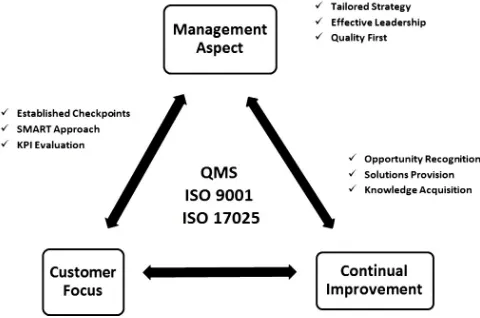
[image:3.595.307.547.301.460.2]of the QMS would facilitate achieving these goals. Payment technologies are emerging at top speed, hence the prospects of design and implementation errors. Compliance with the ISO 17025 provides a unique focus for assuring implementation of the QMS and technical competence of a laboratory which can help respond swiftly to rapid changes and at the same time bringing risk to the barest minimum. Several empirical studies and expert knowledge indicates that some key components of a QMS are crucial in facilitating the delivery of quality products and services in a certification laboratory at all levels [14]. William A. Foster had posited that, “Quality is never an accident; it is always the result of high intention, sincere effort, intelligent direction, and skillful execution; it represents the wise choice of many alternatives”. While there are several elements of a QMS, this section elaborates three key aspects that can help drive efficiencies towards fewer errors in every aspect of smartcards certification. Fig. 1 below summaries the three key areas in applying QMS as accentuated in the paper.
Fig. 1 Three essential approaches in examining the impacts of a QMS
A. Management Aspect
Management is an essential element of any QMS. It involves a systematic approach to process improvement. Company leaders must create and support quality assurance initiatives aimed at achieving flawless services. According to [7], leadership requires more than just stating a vision, but also communicating it effectively, mobilising others to follow, guiding the collective progress and being aware of the business obstacles. Incorporating high quality requirements into the organisation’s policy and periodically providing appropriate skill development programs for employees when and where necessary are crucial for excellence to be achieved. Many people have argued that adhering to QMS leadership principles will help to ensure that strategies, ideas, values and goals are transmitted down throughout the organisation to provide focus, clarity and direction. Lack of transparent leadership can lead to severe problems not just for the consumers but also, the entire organisation and employees.
recalls in the smartphone industry do happen, the nature of the problem for the Galaxy Note 7 is a serious blow to Samsung's reputation; they were trying to create a statement by beating their biggest rival Apple Inc. to the market [16]. No wonder Jeff Fieldhack, Counterpoint Analyst, asserted that, “very often, laboratory times and testing periods are shrunk to expedite approval and release-to-market of key devices; it is possible all charging scenarios were not thoroughly tested”.
Conversely, Apple Inc. former CEO, Steve Jobs would “hit the pause button” and go back to the drawing board just to make sure that everything regarding a product is perfect before release. The launching of the Apple Store was remarkably delayed by a month in order to get things to the right standard, required specification and precise quality. Even when Tim Cook took over the company’s management, he was commended for his effort in fostering a unique flat-management structure that prioritises product safety, customer satisfaction and employee welfare. This is not to say that Apple Inc. have not had their periods of setbacks or Samsung does not have several positive breakthroughs. However, Samsung on its own regularly get into the picture of corruption and mismanagement, and prosecutors are constantly raiding the company’s headquarters, often questioning their management practices and leadership styles. Samsung mobile payment devices are gaining momentum in the payments industry and this could mean that they are improving things; nevertheless, the general lack of trust notion towards their management culture remains a serious point of concern [15].
According to [17], several studies have shown that effective leadership will inspire and create a working atmosphere that delivers products to requirements; hence, quality should never be delegated but assumed by everyone during laboratory certification exercise. Irrespective of any organisation’s strategic direction, quality must never be compromised so as to retain attractiveness in today’s radically proactive and fiercely competitive marketplace. Either as an individual or a corporate entity, there is no considerable wisdom in trying to deliver exceptional service if there are no well-defined operating processes guaranteeing the realisation of QMS ethics in line with global standards, particularly ISO 9001 and 17025.
B. Customer Focus
Arguably, the “Customer First” concept promotes good interaction with clients. Most often, these interactions lead to the development of new concepts and business opportunities as newer insights are obtained. In practice, the real aim of putting the customer first may be enhancing the long-term gains of the organisation; however, some analysts have argued against the notion suggesting that the concept fails to synchronise strategies and tactics that are likely to increase quality levels. Despite the latter perspective, there is an increasingly widespread acceptance of the idea that the customer is perhaps the most important element of a QMS strategy. A QMS with customer focus as its heart is the core foundation for a business striving to attain distinction irrespective of technology, commercial strategy or organisational philosophy. QMS should not separate quality
assurance and customer satisfaction; in fact both should occur concurrently in order for a business to reach the pinnacle of success.
Some organisations have successfully developed models that reflect customer values and quality assurance. Underwriters Laboratories (UL) enjoys a stellar reputation among consumers who depend on its products testing and certification provisions. UL’s CEO, Keith Williams, asserts that, “More than anything was the impetus for a change in culture, to realise that if we want to be a successful company, we have to have happy clients”. Besides a great reputation for delivering excellent services in testing, inspection and certification, greater focus on customers is just one of the sweeping changes that have occurred in the company. Impressively, the company has invested more than $1 billion on about thirty acquisitions to broaden the scope of its customer services, whilst spending 2% of its revenue on training for its nearly 11,000 employees, with about two-thirds of that dedicated to technical development [18]. The tremendous progress at UL is not a coincidence because if a company is able to satisfy the customers’ needs without compromising quality, then it will attain its goal of becoming a global leader on every possible business fronts.
Contrariwise, it is old news that Nokia has been out of the mobile technology scene with its latest mobile phones. Nokia may have been the hottest in the market when the mobile industry was still fresh, but it has lost its differentiating factor that once made it the most sought-after. With the likes of Apple Inc. and Samsung incorporating features such as 4K video recording and wireless charger amongst other features into their handsets, Nokia is still battling with getting the most basic applications right. In [19], complacency and lack of foresight to anticipate radical innovations in the technology space have been considered to be the major reason behind Nokia’s loss of dominance. Nokia continues to put its customers into the corridor of uncertainty by offering phones that manages performance in bits and pieces rather than boasting of perfection. Nokia has failed to come to grips with the emerging mobile environment which explains the 27% shares drop in their small technologies unit [20]. Majority of their customers have abandoned their products to embrace the intriguing features available in the mobile products developed by Apple, Samsung and Sony. On a positive note, Nokia’s recent Lumia 920 seems impressive and could be a turning point for the company. Even if a nonstop decline appears to be the obvious, Nokia via a strategic proactive customer focus may be able to leverage on the prospects of its glorious past to inspire a brilliant comeback.
would help achieve the set objectives as well as appraising the established KPIs so that revisions can be made accordingly in order to meet the goals if actual results deviate from the expected outcomes.
In every business, focusing on the customer should not place restriction on achieving quality objectives, but rather suggest practical means that advocate quality assurance. Smartcard certification laboratories may not survive without their clients irrespective of the quality of service they offer. The customer focus concept is an undeniable key to successful business and acknowledging this would by no means relegate quality, it would essentially help to integrate two key QMS elements seeking to achieve the same goal. In other words, achieving a product or service-centric QMS must not override the need to equally attain a customer-centric QMS, as each one is as significant as the other. At the end of the day, the quality of a product will be determined by whether or not it fulfils customer requirements.
C. Continual Improvement
The rapid developments in payments technology requires a QMS that aims to increase the likelihoods of satisfying customers by effectively recognising areas that need further development. Customers increasingly demand better products, improved services and optimal costs. They tend to go to a different place if an organisation cannot keep up to speed with their demands and requirements. Businesses that remain stagnant and less innovative usually lose their competitive advantage and eventually become restrictive in fulfilling organisational goals. According to [21], [22], ISO 9001’s requirement for continual improvement states that an organisation shall continually improve the effectiveness of the QMS through the use of the quality policy, quality objectives, audit results, analysis of data, corrective and preventive action, and management review. Continual improvement consists of essential processes that recognise opportunities for improvement; generates solutions for the identified opportunities; integrate the solutions, and sustain the improvements.
LG Electronics’ relentless pursuit of excellence is a major factor that drives the company to deliver sophisticated entertainment in ways that creates unique cultures and experiences. The company’s unlimited passion to deliver technology content and services are inspired by a burning desire to improve quality, reduce costs and identify techniques that eliminate sub-optimal processes. LG Electronics adopted the “Kaizen” approach to anticipate, identify and implement changes as a result of customers’ wants and needs. Kaizen is a Japanese word which means “change for better” or “continuous improvements”. On the presupposition that employees are best placed in identifying improvement opportunities, the approach advocates a constant introduction of small incremental changes in a business in order to achieve enhanced quality and efficiency [23], [24]. According to Juno Cho, president of LG Electronics, during a press conference, “the response to the LG G6 narrow bezels and harmonious design from aluminum and glass has been sensational; our commitment to Kaizen approach revealed that consumers love big
screens, but they also love using their phones comfortably with one hand. The LG G6 was created with this consumer need in mind, ushering in the next generation of smartphone design and user experience”.
Certification laboratories would perform better by adopting the Kaizen approach in their established QMS strategies. This will facilitate functional operations, management of activities and processes, continuity in the flow of information, timely decision making and mitigation of risk, which are indispensable elements of a successful and compliant laboratory. In addition, the approach ensures there is no room for complacency within the organisation, especially when outcomes are entirely acceptable.
Technological advancement will continue to accelerate and certification laboratories would be under constant pressure to deliver, nevertheless fundamental processes should never be subdued for market commitments. There is no shame in been behind sometimes when improving a product or process. When Samsung's smartphone sales started waning, the company took some time off to brilliantly transform its entire product line. Similarly, Microsoft reinstated its authority by launching the Surface Pro and the Surface Book after several months of trying to improve the efficiency of their windows computers [25]. If the QMS guidelines and practices which accentuate continual improvements are painstakingly and passably followed during product development, then perhaps some of the best ever innovations can be attained.
V. CONCLUSION
implemented QMS would by no means guarantee a perfect positive result at all times. The implementation of QMS principles and capabilities in certification laboratories does not promise to resolve or prevent every problem arising from smartcard and EPT systems; however, applying QMS competencies during certification activities will help to standardise operations and achieve a greater degree of internal control, errors prevention and a better traceability for all the past, present and future laboratory processes.
REFERENCES
[1] H. Pasi and L. Yang, “Development of Quality Management Systems: How Have Disruptive Technological Innovations in Quality Management Affected Organizations,” Quality Innovation Prosperity
Journal, vol. 17, no. 1, pp. 104–119, 2013.
[2] World Meteorological Organization, “Guide to the Implementation of a Quality Management System for National Meteorological and Hydrological Services,”WMO-No 1100, ISBN 978-92-63-11100-8,
WMO, 2013.
[3] World Health Organization, Laboratory Quality Management System
Handbook. WHO Library Cataloguing-in-Publication Data, ISBN
978 92 4 154827 4, version 1.1, 2011.
[4] G. P. S. Jadaun, H. Kasana, V. Saklani, R. Jain, and S. Singh, “Quality Management System in Testing Laboratories,” Journal of
PharmaceuticalQuality Assurance, vol. 1, iss. 1, May-July 2015.
[5] K. E. Kumar, A. K. Yadav, and T. Srinivasulu, “Smart Card based Robust Security System,” International Journal of Engineering
Inventions, vol. 2, iss. 5, March 2013, pp. 29–35
[6] W. Rankl and W. Effing, Smart Card Handbook (Third Edition).
John Wiley & Sons Ltd, UK, 2003.
[7] N. S. Udoh, O. T. Eluwole and A. O. Ologunde, “Ethical Responsibilities: The Smart Card Engineer,” IEEE International
Symposium on Ethics in Science, Technology and Engineering May
2014.
[8] Secure Technology Alliance (2017, January). About Smart Cards: Applications: Internet of Things. [Online]. Available:
https://www.securetechalliance.org/smart-card-applications-internet-of-things-iot/
[9] E. Y. Wallischeck, T. Weisenberger, A. Berthaume, M. G. Dinning and J. A. Volpe, “Preliminary Strategic Analysis of Next Generation Fare Payment Systems for Public Transportation,” TCRP Report 177, National Academy of Sciences, 2015.
[10] J. Rampton (2017, February). The evolution of the mobile payment. [Online]. Available: https://techcrunch.com/2016/06/17/the-evolution-of-the-mobile-payment/
[11] O. T. Eluwole, N. S. Udoh and O. D. Ojo, “The Impact of Internet on African Education and Culture,” International Journal of Business,
Humanities and Technology, vol. 4, no. 3, May 2014, pp. 69–77.
[12] European Union Agency for Network and Information Security (ENISA) (2016, December 19). Security of Mobile Payments and Digital Wallets. [Online]. Available:
https://www.enisa.europa.eu/publications/mobile-payments-security
[13] J. Abott, “Smart Cards: How Secure Are They?,” SANS Institute,
GSEC Practical v1.3, 2002.
[14] C. Duke. Quality Assurance in the Laboratory. [Online]. Available:
http://www.contentextra.com/lifesciences/files/topicguides/LS_TG4_ 4.pdf
[15] F. Haentjens (2016, November 9). SAMSUNG Note 7: Management failure? [Online]. Available:
https://www.linkedin.com/pulse/samsung-note-7-product-
management-failure-fred-haentjens-[16] FORTUNE (2016, September 6). How Samsung Tripped on Quality Control in Its Rush to Beat Apple. [Online]. Available:
http://fortune.com/2016/09/06/samsung-apple-galaxy-note-quality/
[17] J. H. Khan, “Impact of total quality management on productivity,”
The TQM Magazine, vol. 15 iss. 6, pp. 374–380, December 2003.
[18] S. Minter (2016, April 26). Customers Increasingly Give UL Seal of Approval. IndustryWeek. [Online]. Available:
http://www.industryweek.com/companies-executives/customers-increasingly-give-ul-seal-approval
[19] H. Bhasin (2016, December 4). Why Nokia lost its market share? Marketing91. [Online]. Available:
http://www.marketing91.com/nokia-lost-market-share/
[20] FORTUNE (2016, May 10). Here’s Why Nokia Shares Are Dropping. [Online]. Available: http://fortune.com/2016/05/10/nokia-shares-dropping/
[21] J. DiMaria (2015, July 27). The New ISO 9001:2015: Why It’s Still Relevant and What are the Changes. Quality Magazine. [Online]. Available: http://www.qualitymag.com/articles/92754-the-new-iso-90012015-why-its-still-relevant-and-what-are-the-changes
[22] Clinical and Laboratory Standards Institute (CLSI) Guideline Supports Continual Improvement in the Laboratory, Lab Medicine Journal, November 2011, Oxford University Press, vol. 42, iss. 11, pp. 699–700
[23] Case Study (LG Electronics). Simulation solutions help manufacturer thrive as a market leader. SIEMENS [Online]. Available:
https://www.plm.automation.siemens.com/en/about_us/success/case_ study.cfm?Component=110589&ComponentTemplate=1481 [24] J. Bradbury (2015, May 20). What is Kaizen? Graphic Products
[Online]. Available: https://www.graphicproducts.com/articles/what-is-kaizen/
[25] V. Savov (2016, May 23). Apple and Google are playing catch-up – and that's a good thing. The Verge. [Online]. Available: