Retinal Vessel Segmentation Techniques: A Review
Mishal Bansal, Navdeep Singh
Abstract - Image Segmentation is a process of partitioning a digital image into multiple segments. Retinal Vessel segmentation is a procedure to extract the various blood vessels to diagnose various diseases such as diabetic retinopathy. Most of the diabetic patients generally have retinopathy disorders that can be seen by vessel segmentation. In this paper, various techniques have been evaluated and it has been observed that retinal vessel segmentation using hybrid filters is the best technique in terms of accuracy.
Keywords: Gabor filter, median filter, AHE Clustering.
I. INTRODUCTION
The Segmentation of an image is necessary to evaluate each and every feature of an image which is required for the accurate medical diagnosis and for various other applications such as weather forecasting.
Retinal vessel segmentation is a technique which is used to identify the eye disorders. The Ophthalmologists mainly use two ways to examine the retina. One is the use of opthalmoscope instrument and other is use of fundus camera which is low power microscope with attached camera.
Eye disorder is very common in patients with diabetic retinopathy. Diabetic retinopathy causes weakness in the eye vision and even causes blindness. Diabetic retinopathy is classified into two stages: proliferative stage in which exudates are called hard exudates and non-proliferative stage in which exudates are called soft exudates[3]. Hard exudates are found in the macular region and can cause severe damage to the eye vision. Soft exudates are cotton wool spots that are caused by damage to nerve fibers.
Manual segmentation is time consuming and it requires an expert person to carry out the segmentation but in automatic segmentation even a person who is not expert can also perform segmentation. In automatic segmentation, computer
Mishal Bansal is with Punjabi university Patiala,Punjab,India ([email protected])
Navdeep Singh is with Punjabi university Patiala,Punjab,India ([email protected])
aided tools are used which requires less effort and less time. The ophthalmologists may also discover the illness by analyzing the segmented vessels with assistance from the development of additional vessels on the retinal surface, and also from their form and size[9].
II. LITERATURE SURVEY
In this paper, we have done analysis of various automatic segmentation techniques such as:
A. RETINAL VESSEL SEGMENTATION USING HYBRID FILTERS[3]
In the method proposed by Qin Li, et al.[6] in which only gabor filter was used, noise in the image was the major problem. Noise disrupts the quality of the image.
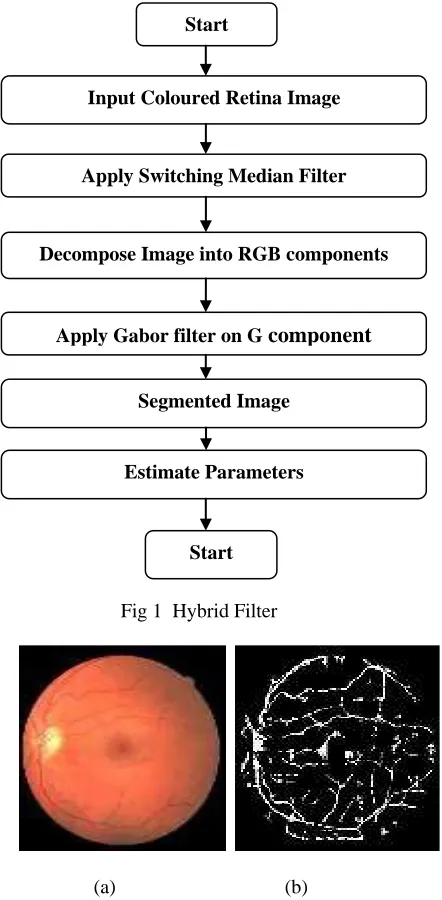
The method proposed by Neha Gupta,et al.[3] is used for noisy images because noise degrades the quality of the image while transmission from one device to another on network[14]. A hybrid combination of two filters is used one is Gabor filter and other is switching median filter.
Gabor filter enables a particular band of wavelengths to go through it and rejects all other frequencies.
Switching Median Filter[10-11] is mainly used to remove the impulse noise present in the image. The Switching Median Filter works in two steps, Noise detection and Noise removal.
Noise detection stage is the one in which the pixels are checked for if they are corrupted with noise or not and in the noise removal stage the value of the corrupted pixels is changed with the value of the neighbouring pixels and the pixels which are not affected by noise are left unchanged.
Algorithm
1) Take the coloured image as input.
3) After de-noising , decompose the image into RGB components.
4) Green coloured component is used for vessel extraction.
5) Gabor filter is applied on it to extract the features.
6) Finally,the segmented image is obtained.
Fig 1 Hybrid Filter
(a) (b)
Fig 2 (a)Noiseless image (b) Segmented image using hybrid filters
Where P is precision and R is recall.
This metric computes average of information retrieval precision and recall metrics. Higher the F-measure, higher the classification quality.
B. ROBUST RETINAL VESSEL SEGMENTATION VIA
CLUSTERING BASED MATCH MAPPING
FUNCTIONS[2]
This method is used for discriminating the tiny vessels and noisy background. The method filters the image which highlights the vessel information by Gaussian filter. In the first step, the clusters are made of similar sized patches. Then mapping function is applied. The technique maps the training images with the ground truth images.
This method uses Gaussian filter which filters the image to highlight the vessel information in green channels. To reduce the noise, patches are divided in such a way that limited overlap occurs.
One image generates large number of patches and forms cluster of similar patches. The patches are clustered using the k-means clustering algorithm.
Parameters used in patch mapping functions are:
…………(2.1)
where is matrices, and have the size of
, k is the size of the patch and n is the number of patches in cluster i.
After clustering, clusters of similar patches are obtained and then mapping functions can be used to segment the vessels in the test fundus image.
(a) (b)
Fig 3 (a)Original image (b)Segmented image
C. A NOVEL VESSEL SEGMENTATION BASED ON LOCAL ADAPTIVE HISTOGRAM EQUALIZATION
Intensity is the most important attribute of image. There are several ways of improving the contrast of the images but histogram equalization is more effective and common in contrast problem[15]. In retinal images, vessel identification is most important to diagnose the diseases but difference between the intensity levels of vessels and non-vessels in retinal images is insignificant hence vessel identification
Start
Input Coloured Retina Image
Apply Switching Median Filter
Decompose Image into RGB components
Apply Gabor filter on G component
Segmented Image
Estimate Parameters
[image:2.612.39.260.159.609.2]becomes difficult. So to overcome this problem and to increase the intensity levels of vessels, Histogram equalization is used.
Histogram equalization uses histogram of an original image, equalize the histogram and converts the image to an image corresponding to the equalized histogram. In HE, the peaks that describes the gray levels are widened while width of valley is reduced.
Adaptive Histogram equalization is an algorithm that uses local mappings using local histograms. For each pixel in the image, a region centered about the image is assigned. The intensity values in that region are used to calculate a histogram mapping which is then applied to the pixel. The next step after adaptive histogram equalization is the application matched filter on the image.
Matched Filter – The matched filter is one of the template matching algorithms that are used in the detection of the blood vessels in retinal images. The MF was first proposed in [12] to detect vessels. Matched filter takes samples for a cross section of retinal blood vessels; the gray level of these samples is then estimated by a Gaussian curve.
Matched filter also has a strong response to some non-vessel parts. In order to overcome this problem, instead of Gaussian function, first derivative of Gaussian (MF-FDOG) is used [13]. Based on the fact that the vessel cross-section is a symmetric Gaussian function while the step edge is asymmetric, simple scheme is proposed. A scheme(MF-FDOG) uses a pair of filters, instead of only one filter, to distinguish Gaussian vessel structures from non-vessel edges. Unfortunately, the magnitude around Gaussian peak and step edges changes rapidly. Therefore, directly using the FDOG response is not robust to differentiate the two types of structures[13].
Thresholding scheme using MF-FDOG is used for retinal vessel extraction. In it, the threshold is applied to images and is adjusted by its response to FDOG.
D. RETINAL VESSEL SEGMENTATION USING
PARALLEL GRAY SCALE SKELETONIZATION AND MATHEMATICAL MORPHOLOGY[4]
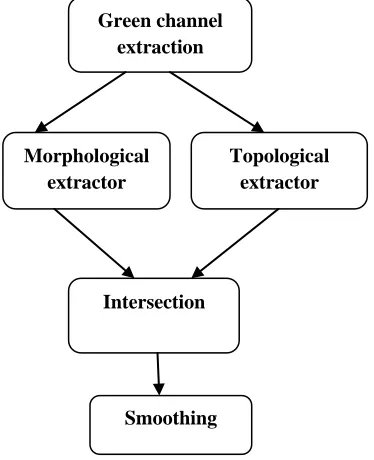
This is an automated retinal vessel segmentation technique based on the combination of morphological and topological vessel extractors .Each of these detectors is based on different blood vessel features to increase the robustness. The final segmentation is obtained by intersecting the two resulting images, smoothing the vessel borders and removing spurious objects remaining. The topological extractor focuses on
connectivity and the morphological extractor focuses on vessel segmented length.
The obtained vessel networks from each extractor are combined in order to form a single network. The combined network is smoothed and spurious objects are removed to improve the segmentation result.
Fig 4 (a) Original image (b) Segmented image
Fig 5 (a)Smoothing vessel segmentation
Algorithm
1) Initially, the green channel is extracted from the RGB image I in order to get the maximum contrast between the vessels and the background to compose initial image Ig[8].
2) The Morphological extractor is used to extract the blood vessels, making an initial vessel tree.
3) Topological extractor-Thee skeletonization algorithm presented by Couprie et al.[7] is an alternative to traditional
Green channel extraction
Morphological extractor
Topological extractor
Intersection
[image:3.612.318.505.304.534.2]skeletonization following a binarization. It allows reducing the blood vessels to thin lines in gray level space. This is important because retinal images are noisy, which makes finding a global thresholding for binarization a difficult task. The topological vessel extraction focuses on connectivity features to obtain a vessel network.
4) Intersection-The fourth step of method consists of the intersection of the two images: morphological and topological vessel networks. The resulting intersection of these two images composes a preliminary vessel tree.
5) Smoothing-The final step consist of two main operations. The first operation is the vessel border smoothing. The second operation is the spurious object elimination.
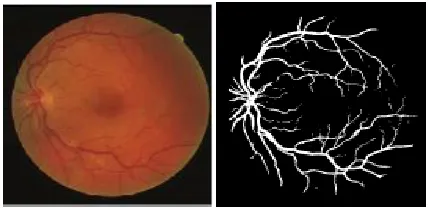
Fig 6 (a)Original Image (b)Segmented Image
E. RETINAL VESSEL SEGMENTATION VIA DEEP LEARNING METHOD AND FULLY CONNECTED CONDITIONAL RANDOM FIELDS[5]
This method increases the performance of retinal vessel segmentation. In this method, deep learning architecture generates the vessel probability map[17] which distinguishes the vessels and the background in adequate contrast region. Fully-connected conditional random fields is employed to combine the vessel probability map and long-range interactions among pixels [16]. Fully-connected CRF’s produce binary vessel segmentation as output.Deep learning method and fully-connected CRF’s treats vessel segmentation as a boundary detection problem. This method is
generally used to distinguish the vessels from the background in pathological regions in retinal fundus images.
Fig 7 (a)Original Image (b)Segmented Image
III. RESULTS AND DISCUSSION
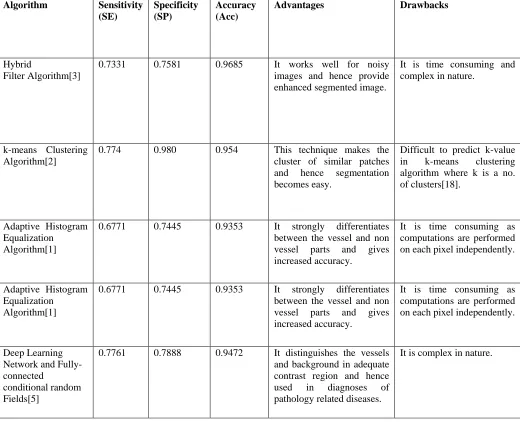
The performance of all the five techniques is evaluated on the basis of Specificity, Sensitivity and Accuracy. The Accuracy indicates the degree of conformity of the segmented retinal image to the ground truth.
It has been observed that the accuracy of local adaptive histogram equalization technique is low because this technique uses local adaptive histogram equalization(AHE) which is used for contrast enhancement and it strongly discriminates between vessel and non-vessel parts.
Accuracy of parallel grayscale skeletonization algorithm is also high as it smoothens the vessel borders.
Deep neural networks distinguishes between the vessel and background. Its accuracy is also good and hence used to distinguish the vessels in pathological regions of fundus images.
Accuracy of Clustering-Based patch mapping functions technique is very high as compared to Local Adaptive Histogram Equalization Technique because this technique maps the training images with the ground truth images and generates the cluster of similar patches which discriminates the tiny vessels from the noisy background.
Accuracy of retinal vessel segmentation using hybrid filters is the highest among the other techniques because this technique uses hybrid filters which eliminate the noise from the images and extract vessels efficiently.
IV. CONCLUSION
In this paper, various vessel segmentation techniques are analysed. It has been observed that mapping functions are simple and fast but does not work well for noisy images and hence their accuracy is medium. Local adaptive histogram equalization technique strongly discriminates between vessels and non-vessels and its accuracy is 2% more as compared to histogram equalization method[1].Hybrid filter works well for noisy images and provides enhanced image and high accuracy. Skeletonization algorithm smoothens the vessel boundaries and deep learning method and fully conditional random fields distinguishes between the vessels and background.
[image:4.612.47.254.260.365.2] [image:4.612.47.263.593.697.2]Table I. COMPARATIVE ANALYSIS OF VARIOUS RETINAL VESSEL SEGMENTATION TECHNIQUES
REFERENCES
[1] Saeid Fazli,Sevin Samadi,Parisa Nadirkhanlou et al,”Anovel retinal vessel segmentation based on local adaptive histogram equalization”,8th Iranian conference on machine vision and image processing(MVIP),2013.
[2] Haiying Xia,Shuaifei Deng,Minqi Li and Frank Jiang et al,”Robust Retinal Vessel Segmentation via Clustering-Based Patch mapping functions,”IEEE international conference on Bioinformatics and Biomedicine(BIBM),2016.
[3] Neha gupta,Aarti et al.” Performance Evaluation of retinal vessel segmentation using Combination of filters”, IEEE 2nd
international conference on Next generation computing technologies dehradun,2016.
[4] Jardel Rodrigues, Nivando Bezerra,”Retinal vessel segmentation using parallel grayscale skeletonization algorithm and mathematical morphology”,29th
SIBGRAPI Conference on Graphics,Patterns and Images,2016.
[5] Huazhu Fu, Yanwu Xu, Damon Wing Kee Wong, Jiang Liu,” Retinal vessel segmentation via deep learning network and fully- connected conditional random fields”,13th
International Symposium on Biomedical Imaging(ISBI),2016.
Algorithm Sensitivity (SE)
Specificity (SP)
Accuracy (Acc)
Advantages Drawbacks
Hybrid
Filter Algorithm[3]
0.7331 0.7581 0.9685 It works well for noisy images and hence provide enhanced segmented image.
It is time consuming and complex in nature.
k-means Clustering Algorithm[2]
0.774 0.980 0.954 This technique makes the
cluster of similar patches and hence segmentation becomes easy.
Difficult to predict k-value in k-means clustering algorithm where k is a no. of clusters[18].
Adaptive Histogram Equalization
Algorithm[1]
0.6771 0.7445 0.9353 It strongly differentiates between the vessel and non vessel parts and gives increased accuracy.
It is time consuming as computations are performed on each pixel independently.
Adaptive Histogram Equalization
Algorithm[1]
0.6771 0.7445 0.9353 It strongly differentiates between the vessel and non vessel parts and gives increased accuracy.
It is time consuming as computations are performed on each pixel independently.
Deep Learning Network and Fully-connected
conditional random Fields[5]
0.7761 0.7888 0.9472 It distinguishes the vessels and background in adequate contrast region and hence used in diagnoses of pathology related diseases.
[image:5.612.50.570.113.535.2][6] Qin Li, Jane You, Lei Zhang,”Automatic Retinal Segmentation using Gabor filters and Scale multiplication”,IEEE International Conference on Systems,Man and Cybernetics,2006.
[7] M. Couprie, N. Bezerra, and G. Bertrand, “A parallel thinning algorithm for grayscale images,” in Discrete Geometry for Computer Imagery.Springer, 2013, pp. 71–82.
[8] S.Xie and Z.Tu,”Holistically nested edge detection,”in ICCV,2015.
[9] Kaur Ishmeet and Singh Mann Lalit ,” A Method of Disease Detection and Segmentation of Retinal Blood Vessels using Fuzzy-C Means and Neutrosophic Approach” in Imperial Journal Of Interdisciplinary Research( IJIR), Vol. 2, Issue 6.
[10] Varade R. Rohini, Dhotre M. R. and Pahurkar B. Archana,” A Survey on Various Median Filtering Techniques for Removal of Impulse Noise from Digital Images” in International Journal of Advanced Research in Computer Engineering & Technology(IJARCET) , Vol. 2, issue 2, 2013.
[11] Mittal Ashima and tayal Akash,” Impulse Noise Detection and Filtering in Switching Median Filters” in International Journal of Computer Applications, Vol.45 No. 13, 2012.
[12] A. Hoover, V. Kouzntesova, M. Goldbaum, “ Locating blood vessels in retinal images by piecewise threshold probing of a matched filter responses,” IEEE Trans. Med. Imaging 19 (3) (2000) 203–210.
[13] Bob Zhang, Lin Zhang, Lei Zhang , Fakhri Karray, “ Retinal vessel extraction by matched filter with first-order derivative of Gaussian,” ELSEVIER, Computers in Biology and Medicine 40 (2010) 438–445.
[14] Kenny Kal Vin Toh,Haidi Ibrahim,Muhammad Nasirrudin Mahyuddin,”Salt-and-pepper noise detection and reduction using fuzzy switching median filter”,IEEE transaction on consumer electronics(Vol:54,Issue:4,2008).
[15] K. Zuiderveld: Contrast Limited Adaptive Histogram Equalization.In: P. Heckbert: Graphics Gems IV, Academic Press 1994.
[16] P Kr¨ahenb¨uhl and Vladlen Koltun, “Efficient Inference in Fully Connected CRFs with Gaussian Edge Potentials,”in NIPS, 2011.
[17] Qiaolian Li, Linpei Xie, Qian Zhang, SuwenQi, Ping Liang, Huisheng Zhang, Tianfu Wang, ”A supervised method using convolutional neural networks for retinal vessel delineation”,8th International Conference on Image and Signal processing(CISP),2015.
[18] Lei Gu,”A novel locality sensitive k-means clustering algorithm based on subtractive clustering”,7th