Abstract—Cognitive impairment in patients with mild Alzheimer’s disease often times require medication management to prevent forgetfulness due to the diversity of medication involved in the treatment. Traditional interventions to mitigate non-adherence to medication have been largely unsuccessful. However, the programmability and intelligibility of modern electronic systems and Information and Communication Technology (ICT) can be exploited to solve this problem. In this paper, we designed and developed an intelligent assistive mHealth system to facilitate medication adherence in elderly patients with Alzheimer’s disease. This system achieve medication adherence by creating an audiovisual alert for the user with ‘memory loss’ disability to take the right doses of medication at required frequency. The drug prescriptions are keyed in by the physician and the medication schedule is stored in the non-volatile memory of the system. At the set time, the Liquid Crystal Display (LCD) unit shows the drug to be taken in the right dosage. The buzzer in the electronic device provides a sound effect to get the attention of the patient. In any case of non-adherence, the system automatically sends a text message to the physician via SMS using the integrated GSM modem and Subscriber Identity Module (SIM) in the system. This system can be miniaturized into a wearable device for optimal performance.
Index Terms—medication adherence, mobile health, Alzheimer’s disease, assistive technology, patients.
I. INTRODUCTION
ON-adherence to medication is a common challenge among patients and can contribute to poor treatment outcomes and waste health care resources [1]. Medication adherence in elderly patients is subject to frequent changes due a number of factors that require proper monitoring before the desired health improvement can be achieved [2]. The level of a patient‟s adherence to treatment can be measured by compliance with the size or frequency of a dose of a medicine or drug prescribed the physician. In most cases, non-adherence occur as a result of omitted medication by the patient [3]. Older people are more susceptible to different chronic diseases which usually demand adequate control and supervision of medication intake to avoid serious health implications that can lead to repeated hospitalizations and further health complications [4, 5].
Manuscript Received: February 10, 2017; Revised: March 28, 2017.
T. O. Takpor, J. Ademola, S. I. Popoola, J. A. Badejo, and AAA. Atayero Department of Electrical and Information Engineering, Covenant University, Ota, Nigeria
temitope.takpor, joke.badejo, atayero {@covenantuniversity.edu.ng} [email protected], [email protected]
Functional disabilities in people aged 65 years and above limits their ability to properly comply with medication [6]. Alzheimer's disease is a progressive age-related neurodegenerative disease that involves insidiously progressive memory impairment [7]. Although the Alzheimer's disease is not a normal part of aging, the greatest known risk factor is increasing age, and the majority of people with Alzheimer's are 65 and older [8]. Cognitive impairment is the major symptom of Alzheimer's at the early stage. As the dementia symptoms continue to worsen over years, patients lose the ability to carry on a conversation and respond to their environment. Research studies [4, 6] also proved that illiteracy, negative cultural beliefs, and poor patient-physician relationship also contribute to non-adherence to medication.
Brady and Weinman [9] opined that mild Alzheimer‟s disease may be attributed to the ageing process and not recognized as the first stage of a chronic disease. Cognitive impairment in patients with mild Alzheimer‟s disease often times require medication management [10] to prevent forgetfulness due to the diversity of medication involved in the treatment. Professional health workers have devised several means of encouraging medication adherence in patients with Alzheimer‟s disease. Drug prescriptions were integrated into the daily activities of the patients [11]; patient-physician relationships were strengthened; patients were periodically visited and supervised; and useful information related to the disease were disseminated [9]. However, these solutions are subject to human factors and interventions to mitigate non-adherence to medication have been largely unsuccessful [1].
However, the programmability and intelligibility of modern electronic systems and Information and Communication Technology (ICT) can be exploited to assist older people in maintaining healthy and independent living. Based on this, different assistive technologies have been developed to enhance elderly care [12, 13]. Assistive technology refers to "any item, piece of equipment, or product system, whether acquired commercially, modified, or customized, that is used to increase, maintain, or improve functional capabilities of individuals with disabilities" [14]. Assistive Technology for Cognition (ATC) [15] focuses on augmenting cognitive processes including memory and planning. In addition, mobile technology is increasingly being integrated into health care system for disease surveillance, appointment reminders, disease outbreak alerts, health education, and remote access to patient records. This is mostly referred to as mobile Health (mHealth).
Smart Assistive
mHealth
System for Medication
Adherence in Patients with Alzheimer‟s Disease
Temitope O. Takpor, Jimmy Ademola, Segun I. Popoola, Joke A. Badejo, Aderemi A. Atayero,
Members, IAENG
In this paper, we designed and developed an intelligent assistive mHealth system to facilitate medication adherence in elderly patients with Alzheimer‟s disease. This system achieves medication adherence by creating an audiovisual alert for the user with „memory loss‟ disability to take the right doses of medication at required frequency. The drug prescriptions are keyed in by the physician and the medication schedule is stored in the non-volatile memory of the system. At the set time, the Liquid Crystal Display (LCD) unit shows the drug to be taken in the right dosage. The buzzer in the electronic device produces a sound effect to get the attention of the patient. In any case of non-adherence, the system automatically sends a text message to the physician via the Short Messaging Service (SMS) using the integrated Global System for Mobile Communications (GSM) module and Subscriber Identity Module (SIM) in the system. This system can be miniaturized into a wearable device for optimal performance.
II. DESIGN METHODOLOGY FOR THE SMART ASSISTIVE MHEALTH SYSTEM
The complete system design comprises of different units including: the microcontroller; the LCD; the real-time clock chip; the communication protocol; the alarm sounder; and the GSM module.
A. The Microcontroller (PIC16F877A)
A microcontroller is a microcomputer built on a single integrated circuit. It is regarded as „System on Chip‟ because of its ability to perform useful tasks and routines according to predetermined procedures. A microcontroller is made up of processor cores, program memory unit (Read Only Memory and Random Access Memory), and programmable input/output peripherals. Compared to a design that utilizes discrete microprocessor, memory, and input/output devices, microcontroller-based system design significantly help in reducing the size and cost of device. This design approach is considered economical for digital control of devices and processes. The use of discrete integrated circuits such as timers, ROMs, RAMS, shift registers, logic gates, flip-flops, comparators, etc. will not be efficient for such a complex design. This is because devices like the LCD will be difficult to control using discrete components. The microcontroller employed in this system design is the PIC16F877A based on the system requirements.
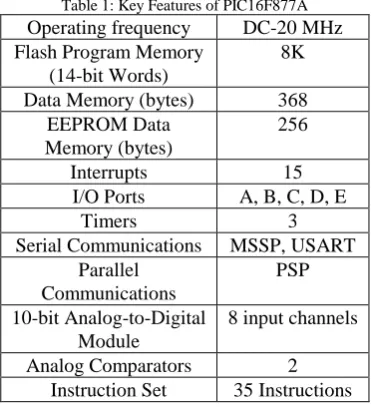
PIC microcontrollers are versatile, inexpensive device capable of speeds up to 64 million instructions per second using the internal oscillator block, about 16 times faster than most comparable AVR microcontrollers [16]. PIC16F877A is a powerful and easy-to-program CMOS (Complementary Metal Oxide Semiconductor) FLASH-based 8-bit microcontroller with 200 nanosecond instruction execution and only 35 single word instructions. It is usually available in 40 or 44-pin package with upward compatibility with the PIC16C5X, PIC12CXXX and PIC16C7X devices. The features of PIC16F877A include 256 bytes of EEPROM data memory, self-programming, an ICD, 2 Comparators, 8 channels of 10-bit Analog-to-Digital (A/D) converter, 2 capture/compare/PWM functions, the synchronous serial
[image:2.595.315.532.122.325.2]port can be configured as either 3-wire Serial Peripheral Interface (SPI) or the 2-wire Inter-Integrated Circuit (I²C) bus and a Universal Asynchronous Receiver Transmitter (USART) [17].
Figure 1: 40-Pin Dual In-Line Package PIC16F877A
Table 1: Key Features of PIC16F877A Operating frequency DC-20 MHz Flash Program Memory
(14-bit Words)
8K Data Memory (bytes) 368
EEPROM Data Memory (bytes)
256
Interrupts 15
I/O Ports A, B, C, D, E
Timers 3
Serial Communications MSSP, USART Parallel
Communications
PSP 10-bit Analog-to-Digital
Module
8 input channels
Analog Comparators 2
Instruction Set 35 Instructions
[image:2.595.334.520.372.576.2]B. Interfacing LCD with PIC16F877A
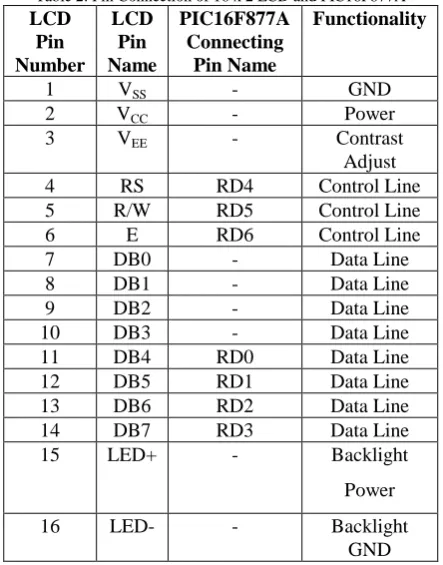
[image:3.595.58.280.225.508.2]LCD exploits the light-modulating properties of liquid crystals to display characters and symbols on its flat panel. Images are produced using the backlight or reflector. Interfacing an alphanumeric LCD module with PIC16F877A requires a common controller chip, HD44780. The HD44780 controller chip is used to generate pixel patterns and drive each of the pixels of the LCD to display required characters and symbols. Thus, the generation of the pixel patterns is not handled by the microcontroller itself. A basic 16 x 2 LCD shows 16 characters in 2 lines, printing black text on green background. This LCD unit has 16 connecting pins as shown in Table 2.
Table 2: Pin Connection of 16 x 2 LCD and PIC16F877A LCD
Pin Number
LCD Pin Name
PIC16F877A Connecting
Pin Name
Functionality
1 VSS - GND
2 VCC - Power
3 VEE - Contrast
Adjust
4 RS RD4 Control Line
5 R/W RD5 Control Line
6 E RD6 Control Line
7 DB0 - Data Line
8 DB1 - Data Line
9 DB2 - Data Line
10 DB3 - Data Line
11 DB4 RD0 Data Line
12 DB5 RD1 Data Line
13 DB6 RD2 Data Line
14 DB7 RD3 Data Line
15 LED+ - Backlight
Power
16 LED- - Backlight
GND
The LCD module is powered by +5 V DC supply. The visibility of the LCD display depends on the correct connection of the „Contrast Adjust‟ pin to the microcontroller. The VEE pin is fed with the output voltage of a 10 k preset voltage divider circuit. The RS, the R/W and the E terminals are connected to the input-output line of PIC16F877A; likewise the data lines DB0 to DB7 in 8-bit transfer mode. Meanwhile, DB0 to DB3 are left unconnected in 4-bit transfer mode.
C. Interfacing GSM Modem with PIC16F877A
Various sectors of the society, are currently harnessing the high penetration of mobile connectivity to improve service delivery. mHealth, a concept which uses mobile communication devices to support healthcare delivery, is an emerging approach in developing countries owing to the current increasing mobile phone penetration in low- and medium-income countries. Mobile communication networks provide enabling platforms for easy access to larger percentage of population living in remote areas, particularly the underserved population. The second generation (2G) technology, GSM, currently has the highest penetration in
developing countries, compared to latter technologies whose coverage is still limited.
A GSM modem is a wireless device which is used for data transmission and reception using radio link. The data can be in form of voice, text, image, or video. GSM/GPRS technology offers Short Messaging Service (SMS) for text messaging. The operation of a GSM modem requires a SIM on which user‟s information are stored. One of the area of application of GSM modem in embedded systems is remote monitoring and control. Events and processes can be monitored and regulated from a distant location via mobile communication networks.
PIC microcontroller has the capability to connect with GSM modem through the serial interface. The USART serial input pin of RX and TX of the microcontroller are connected to the TXD and RXD of the pins of the GSM modem respectively. A voltage level translator circuit is used to transform the microcontroller USART voltage level (5 volts) to GSM/GPRS USART voltage level (2.8 V to 3 V). AT commands are used to execute communication between the PIC controller and the GSM modem.
D. Real-Time Clock Chip (DS1307)
[image:3.595.318.537.467.593.2]The DS1307 serial real-time clock is a low-power, full binary-coded decimal (BCD) clock/calendar [18]. The DS1307 transfers address and data using the bidirectional I2C serial communication bus. Time information is available in seconds, minutes, hours, day, date, month, and year. The clock has an automatic leap year correction capability of up to 2100. It has a 56-byte, battery-backed, general-purpose RAM with unlimited writes. In addition, it consumes not up to 500nA while running in battery-backup mode with oscillator running. This low power advantage increases the battery backup run time.
[image:3.595.315.539.619.775.2]Figure 2: Operating Circuit of DS1307
III. SYSTEM IMPLEMENTATION AND TESTING This system achieves medication adherence by creating an audiovisual alert for the user with „memory loss‟ disability to take the right doses of medication at required frequency. The design of the smart assistive mHealth system takes advantage of the programmability of microcontrollers in embedded systems.
The PIC16F877A microcontroller is clocked with a 12 MHz crystal oscillator for the generation of the pulses that determines the rate at which information is processed. The crystal oscillator is the heart of the microcontroller because without it the microcontroller will not be able to function properly. When the microcontroller is in operation, the downloaded instruction in its ROM memory is read and executed one at a time.
Also, the design incorporates DS1307, a real time clock chip, for accurate timing. The DS1307 chip is connected to the microcontroller as an I2C device and communicates via two wires. The microcontroller is programmed to query the chip every 30 millisecond of the correct timing. This chip is the dedicated „timekeeper‟ of the system. It has a backup battery that keeps it working even when the device is shutdown. This is to ensure that the time is always correct. The backup battery can sustain the real time chip for a period of about 10 years. This is because the real time chip is a CMOS IC (Complementary Metal Oxide Semiconductor Integrated Circuit). They are highly power efficient because they draw very little amount of current for their activities. The only time the real time clock may require reset is if the battery fails or is removed from the circuit while the device is shutdown [19].
The drug prescription and dosage and time intervals are entered into the device via the matrix keypad. This information is displayed via the LCD display while a copy of it is stored in an Electronically Erasable Programmable Memory (EEPROM), a non-volatile memory (i.e. does not lose its contents when power goes off). The memory chip used for this project is of the 24CXX series. This class of computer memory uses the I2C communication protocol instead of the SPI (Serial Peripheral Interface). Hence, it can be integrated to the same data bus of the DS1307 because I2C protocol supports maximum of eight devices on a single pair of data bus. This keeps the hardware simple and the program is more efficient. In addition, conflict in communication is avoided since every I2C device has its identification code; and if the code is not matched when data is sent, the data is ignored [18].
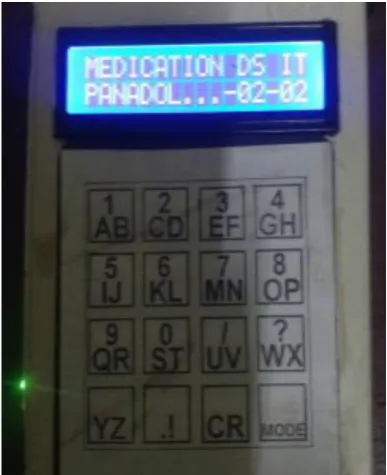
When the set time is reached, the alarm buzz and the drug prescription information is displayed via the LCD with the correct dosage as retrieved from the 24CXX memory chip. The capacity of the chip employed for this work is 4 kilobit, but can be upgraded if considered necessary. The device is powered with rechargeable Lithium cell batteries. The batteries can be charged using a 12 volt, 2A power adapter. Each of the two batteries has capacity to hold 3.9 V, 2000 mAh of energy when fully charged. The batteries are connected in series to make the line voltage to be 7.8V. However, only 5 volts out of the 7.8 volts is used for power supply on the board.
The direct current (DC) voltage output is filtered using capacitors. The final regulated output voltage is then sent to the PIC16F877A microcontroller so as to initiate its operation. The control buttons are strategically arranged for ease of use. The portability of the system is to guarantee mobility.
The drug prescriptions are keyed in by the physician and the medication schedule is stored in a non-volatile memory of the system. At the set time, the Liquid Crystal Display (LCD) unit shows the drug to be taken in the right dosage. The buzzer in the electronic device provides a sound effect to get the attention of the patient.
[image:4.595.326.528.270.495.2]In case of non-adherence, the system automatically send a text message to the physician via the Short Messaging Service (SMS) using the integrated Global System for Mobile Communications (GSM) module and Subscriber Identity Module (SIM) in the system.
Figure 4: Internal Circuitry of System Implementation
[image:4.595.330.524.517.755.2]IV. CONCLUSION
Since traditional interventions have failed to address the challenge of non-adherence to medication caused by cognitive impairment in elderly patients with Alzheimer‟s disease, the programmability and intelligibility of modern electronic systems and Information and Communication Technology (ICT) was exploited to solve this problem. An intelligent assistive mHealth system was designed and implemented to achieve medication management by preventing forgetfulness due to the diversity of medication involved in the treatment of Alzheimer‟s disease.
The system allowed drug prescriptions to be entered by the physician and the medication schedule is stored in the non-volatile memory of the system. At the set time, the LCD unit showed the drug to be taken in the right dosage. The alarm sounder in the electronic device produced an audio effect to get the attention of the patient. In any case of non-adherence, the system automatically sent a text message to the physician via SMS using the integrated GSM modem and Subscriber Identity Module (SIM) available in the system.
Existing system used in handling this challenge are either unaffordable or too complex for elderly patients to operate. The developed system provides a cost-effective solution for patients with minimum literacy to conveniently manage their medications, taking the right dosage of medicine at the prescribed time as automated by the system. In future work, we plan to miniaturize this system into a wearable device for optimal performance.
REFERENCES
[1] L. Dayer, S. Heldenbrand, and B. C. Martin, “Smartphone Medication Adherence Apps: Potential Benefits to Patients and Providers”, Journal of the American Pharmacists Association, 53 (2), Mar-April, 2013, pp. 172-181.
[2] World Health Organization, “The World Health Report 2003: Shaping the Future”, 2003.
[3] L. Osterberg, T. Blaschke, “Adherence to Medication”, New England Journal of Medicine, 353 (5) (2005), pp. 487–497
[4] W.F. Gellad, J.L. Grenard, Z.A. Marcum, “Systematic Review of Barriers to Medication Adherence in the Elderly: Looking Beyond Cost and Regimen Complexity”, American Journal of Geriatric Pharmacotherapy, 9 (1) (2011), pp. 11–23.
[5] R.L. Ownby, C. Hertzog, E. Crocco, R. Duara, “Factors Related to Medication Adherence in Memory Disorder Clinic Patients”, Aging & Mental Health, 10 (4) (2006), pp. 378–385.
[6] C. Cooper, I. Carpenter, C. Katona, M. Schroll, C. Wagner, D. Fialova, G. Livingstone, “The ADHOC Study of Older Adults‟ Adherences to Medication in 11 Countries”, American Journal of Geriatric Psychiatry, 13 (12) (2005), pp. 1067–1076.
[7] G. M. McKhann, D. S. Knopman, H. Chertkow, B. T. Hyman, C. R. Jack Jr., C. H. Kawas, “The diagnosis of Dementia due to Alzheimer's Disease: Recommendations from the National Institute on Aging-Alzheimer's Association Workgroups on Diagnostic Guidelines for Alzheimer's Disease”, Alzheimer's & Dementia, 7 (3) (2011), pp. 263–269.
[8] Alzheimer‟s Association. Available at: http://www.alz.org/alzheimers_disease_what_is_alzheimers.asp [9] R. Brady, J. Weinman, “Adherence to Cholinesterase Inhibitors in
Alzheimer‟s Disease: A Review”, Dementia and Geriatric Cognitive Disorders, 35 (2013), pp. 351–363.
[10] C. While, F. Duane, C. Beanland, S. Koch, “Medication Management: the Perspectives of People with Dementia and Family Carers”, Dementia, 12 (6) (2013), pp. 734–750.
[11] S. Arlt, R. Lindner, A. Rösler, W. von Renteln-Kruse, “Adherence to Medication in Patients with Dementia Predictors and Strategies for Improvement”, Drugs & Aging, 25 (12) (2008), pp. 1033–1047.
[12] P. Chaurasia, S. I. McClean, C. D. Nugent, I. Cleland, S. Zhang, M. P. Donnelly, B. W. Scotney, C. Sanders, K. Smith, M. C. Norton, J. Tschanz, “Modelling Assistive Technology Adoption for People with Dementia”, Journal of Biomedical Informatics, Volume 63, October 2016, Pages 235-248.
[13] A. A. Atayero, R. Ozara, S. I. Popoola, and V. O. Matthews, "Development of Smart Assistive DTMF Home Automation System for Ageing Population," Lecture Notes in Engineering and Computer Science: Proceedings of The World Congress on Engineering and Computer Science 2016, 19-21 October, 2016, San Francisco, USA, pp33-37.
[14] "Assistive Technology Act of 1998 | Section508.gov". section508.gov. Retrieved April 04, 2016.
[15] E. F. LoPresti, A. Mihailidis and N. Kirsch “Assistive Technology for Cognitive Rehabilitation: State of the Art. Neuropsychological Rehabilitation, 14, 2004, 5-39.
[16] Instructables, “Programming PIC Microcontrollers”. Available at:
http://www.instructables.com/id/Programming-PIC-Microcontrollers/
[17] Microchip Technology, “PIC16F877A”. Available at:
http://www.microchip.com/wwwproducts/en/PIC16F877A
[18] Maxim Integrated, DS1307. Available at:
https://www.maximintegrated.com/en/products/digital/real-time-clocks/DS1307.html