2 March 1984
1glish EditiQn
European Communities
EUROPEAN PARLIAMENT
Working Documents
19R3 - 1984DOCUMENT 1-1517/83
REPORT
drawn up on behalf of the Committee on External Economic Relations
!
on the functioning of the Multifibre Arrangement with particular reference to the situation of the European textile industry
Rapporteur: Mr R. FILIPPI
At its sittings of 14 December 1981 and 12 March 1982, the European Parliament referred the motions for resolutions tabled by Mr Couste and Mr de la Mal~ne (Doc •. 1-15/82) and by Mr Couste, Mr de la Mal~ne, Mr Ansquer and others (Doc. 1-856/81), pursuant to Rule 47 of the Rules of Procedure, to the Committee on External Economic Relations as the committee responsible and to the Committee on Social Affairs and Employment and the Committee on Economic and Monetary Affairs for opinions.
At its meeting of 19 January 1983, the Committee on External Economic Relations decided to draw up a report and appointed Mr FILIPPI rapporteur.
It considered the draft report at its meetings of 18 October 1982,
2 December 1982, 18 October 1983, 24 and 25 January 1984 and 22 February 1984 and unanimously adopted the motion for a resolution as a whole on 22 February 1984.
The following took part in the vote: Sir Fred CATHERWOOD, chairman; Mr van AERSSEN, second vice-chairman; Mr BORD, Lord HARMAR-NICHOLLS
(deputizing for Miss HOOPER), Mr MOMMERSTEEG, Mr PELIKAN, Mr PESMAZOGLOU, Mr RIEGER, Mr RIVIEREZ, Mr SPENCER, Mr STELLA and Sir Jack STEWART-CLARK. The Committee on Economic· and Monetary Affairs and the Committee on Social Affairs and Employment will not be delivering opinions.
The report was tabled on 1 March 1984.
The deadline for, tabling amendments to the report will be indicated in .. the draft agenda for the part-session at which it will be debated.
C 0 N T E N T S
A. MOTION FOR A RESOLUTION
···•·
5 B. EXPLANATORY STATEMENT •••••••••••••••••••••••••••••••••••••••••••• 7ANNEXES: Motion for a re-solut'ion Doc. 1-15/82 Motion for a resolution Doc. 1-856/81
A
The Committee on External Economic Relations hereby submits to the
European Parliament the following motion for a resolution, together with explanatory statement:
"OTION FOR A RESOLUTION
on the functioning of the "ultifibre Arrangement with particular reference to the situation of the European textile industry
The European Parliament
A. having regard to the serious employment situation existing in the
Community today which particularly affects female workers who constitute a large part of the textile industry workforce (about 70X>,
a.
having regard to the "ultifibre Arrangement of 1982 and the contents of the 26 voluntary restraint agreements,c.
having regard to the motions for resolutions by "r Coust' and"r de La Mal6ne on behalf of the Group of European Progressive Democrats (Doc. 1-15/82> and by Mr Couste, Mr de La Mal.ne, Mr Ansquer and others <Doc. 1-856/81>,
D. having regard to the report by Mr Welsh drawn up on behalf of the Committee on External Economic Relations (Doc. 1-61/81>,
E. having regard to the report by the Committee on External Economic Relations <Doc. 1-1517/83>,
1. Notes that the contents of the Multifibre Arrangement currently in force and the bilateral voluntary restraint agreements concluded by the Community correspond broadly to the negotiating mandate, which stipulated that the Community should obtain the necessary reductions in levels of access to EEC markets and the inclusion of adequate voluntary restraint provisions to cope with sudden and substantial increases in imports of textile products into the Community;
2. Regrets that oont'tnued pressure on the COMtnunity textile and clothing industry from itll~rts from low-cost producers has made it necessary to extend the Multif.ibre Arrangetlfnt for a ·further four-year period, and considers that this offers a last opportunity for the industry to adapt itself to modtrn market conditions;
3. Recognizes that, although the interests of the textile and clothing industry tllt.IS't •be given due weight, the overall objective of COMunity policy must ·be to ·eMpend world trade and bring the recession to an end; 4. Acknowledges that the textile and clothing industry continues to provide
employment for thoutulnds of Collllllunity c-itizens and calls on the Co.issi·on to act vigorously to secure preferential access for Co111111unity products to the dOMestic markets of its trading partners;
5. Points out that the future of the COMmunity textile industry cannot rely merely on a ·policy of restriction and protection against imports, but must also and above all be based on initiatives at Community level in the field of industrial policy and adequate Measures involving regional and social policy;
6. RecOIRIIIends that the voluntary restraint provisions be strictly enforced, particularly the anti-surge clause and the provisions designed to cotlb•t fraud;
7. Welcomes the conclusion of the accession negotiations with Portugal as regards trade in textiles and clothing, and considers that the voluntary agreetnents with Mediterranean preferential countries should be reviewed in the light of pending enlargement;
8. Calls on the COMMission to review and update its proposals as regards outward processing traffic·;
·9. WelcOMes ·the accession of China to the MFA and considers that the terms of the Council's mandate extend to the renewal of the EC-China Agreement and to negotiations with Turkey;
10. Concludes that the general aim of the new Multifibre Arrangement is to bring about a situation in which free trade in the textile sector can be restored by the time the arrangement expires;
11. Instructs its President to forward this resolution to the Council and the COIIImission.
e
EXPLANATORY STATEMENT
I. INTRODUCTION
Following the negotiations held within the GATT Textile Committee during the second half of 1981, the Protocol extending the Multifibre Arrangement for the period 1 January 1982 to 31 July 1986 was adopted in Geneva on
22 December 1981 1•
The Protocol adopted 'in Geneva complied with the negotiating guidelines which had called on the Community to reduce the levels of access granted previously to certain member states of the MFA which are economically more advanced and particularly competitive. The negotiating guidelines were
intended to allow for the inclusion in the bilateral voluntary restraint agreements of a mechanism capable of dealing with sudden and substantial increases in imports within the quotas.
When accepting the new Protocol renewing the Multifibre Arrangement, the Community announced that its continued adherence to the arrangement would be conditional on the conclusion of satisfactory bilateral voluntary restraint agreements with the third countries by 31 December 1982.
Negotiations on the conclusion of these bilateral agreements ended on 31 December 1982. It proved possible to renew 26 of the 27 scheduled
~oluntary
restraint agreements for the period 1983-19862•1
2
The European Parliament expressed its opin~on on the renewal of the lllultifibre Arrangement in the WELSH reportr (Doc. 1-61/81)
'
The agreement with A~gentina was not concluded for political reasons.
The 26 agreelltents if'\ qUestion conta.in prov·hions f.und8MtUal tot"
slil'tefu&rdino the COIIIIIUnit)f. These include a clause to. tMWeht iiiPQt't
swr...,_
a: elaose to cOtibat frauEi and a basket extractor claus&-. Yoltmtaf.')f J!'4!-&tflatntag_ree~Rnts were also concluded fo.r the tW'O'"'YHr J,Wri:od· 'P>12*1''983· w-ith
p.rete-rentiat countries C-a-in.,. Portugal, lltalta-, Cyp.rus.,. •~co-, 1\ltti,s.ia aNl Turkey>. l'he ne.., IIIIUltitibt-e Arrantemetrt h&s introdueed fle'lci:bil!ity o-f
treat11ent for certain cotintries or g.roups of countries.
For the ASEAN countries, provision is Made for a systett of ex-ternal
flex\&Hity wht~h can be sUMIIed up as fellow'S: for a single- f"e9ion of
'"*
EW.,.
a quantity equivalent to S·l of the reg.ionat quotw-s-haf'e- fotot.t'OUft
I11 atW1011
for troutPS It and· III, JWay be transferred betveen the ASEAN countries. TJ\e ~t.ication of this transf'er is conditional on notificati~ b."i·nct th1en to the EEC tha·t a partie uta,- ASfM. country is ace-tint a reduction in
its ~ant; ha~ive l illi t. A transfer of this type caft only be- caf'ri"M· out
durim§ the year in wnien'the notification is submitted. H • • GOtlA.TIOttS. 1M PROGUSS: China and Turkey·
It should be noted that negotiations are in progress for the rene~t
of the contracts with China. These two countries have very
eoosiderable production potential and the Collllilunity should therefere b&ar in l'itind thf- o·verall situation during these negotiations, takin§ account of the
absorption capacity of the COMMUnity market given the e~it.ents alre~ ent~ed into with atl its trading partners.
The current bilaterat ag.f!'eaent with China· is due to expire at the etW of 1'983. DeSJ).iU the fact that Article 22 of the: EEC-China Ag.reetient ~rovides.
for its renNai for a period of five years, the COMission ha$ b.gutll
n~tiations aitted at fhing new quotas. China is one of the countrie<S ~se
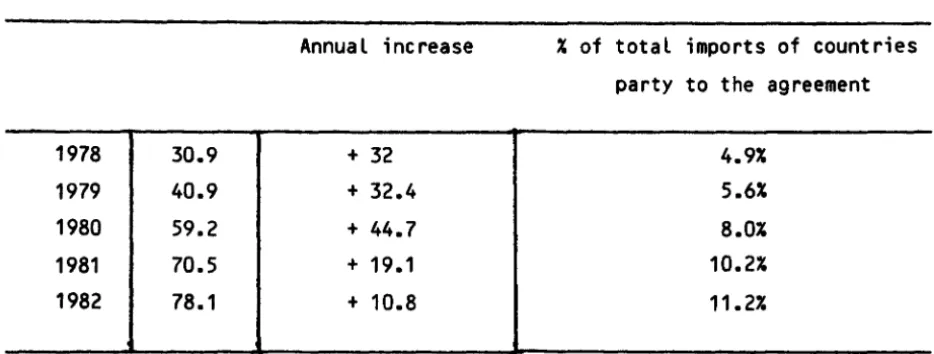
elq)Orts to the EEt hav. tm:reased substantiaHy in recent ~:ars, as tt*
f()t lowi'nt tabte show:
-1978 30.9 1979 40.9 1980 59.2 1981 70.5 1982 78.1
TABLE No. 1 Imports from China
Annual increase
+ 32 + 32.4 + 44.7 + 19.1 + 10.8
in 1000 tonnes
X of total imports of countries party to the agreement
4.9% 5.6% 8.0% 10.2% 11.2%
Source: Coordination Committee for the Textile Industries in the EEC {COMITEXTIL) July 1983
It should be borne in mind that although China has an agreement with the EEC, it is not a member country of the MFA. It seems very probable that China will apply for membership of the agreement in the near future. Membership by China could prove complex, given that it is considered a developing country.
This could be a step on the way to membership of GATT, an agreement which has always been ignored by the Soviet Union and most Eastern European countries <only Czechoslovakia, Romania and Yugoslavia belong to GATT). If China does join GATT, .it will of course have to abide by the rules of the agreement and although the West seems prepared to accept, within
certain Limits, the country's desire to be considered a developing country, on the other hand, the Western countries are not prepared to accept that China should join the agreement as a Communist country and as such opposed to free trade.
The Commission is currently involved in negotiations to renew the EEC-China textile agreement which, as was mentioned above, is due to expire at the end of this year.
[image:9.570.12.479.83.260.2]China• s requirements could be taken into consideration, however, if jt
...
granted ·rErci'procal conditions by allo\tling Community textile exports i·nt:o~China
and ·giving supply guarantees to European p·rocessors for certain rare products succh as silk and cashmere.
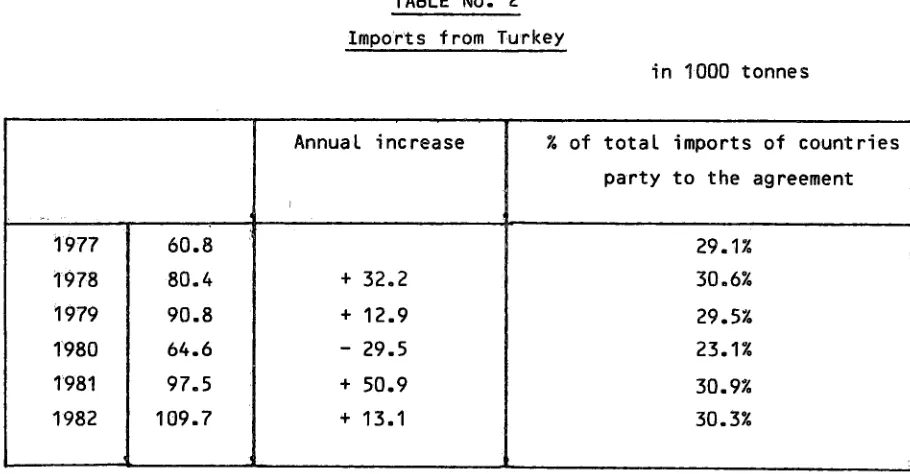
Turkey is the only country in the Mediterranean basin which did not wish to cone lude an agreement with the EEC <excep.t on cotton yarn).
Turkey adopted a non-committal approach to the negotiations on the textile agreement. No conclusion was reached and, as a result, the Community has been obliged
to
resort to unilateral protection measures.TABLE No. 2 Imports from Turkey
in 1000 tonnes
Annual increase % of total imports of countries party to the agreement
'
> .
1977 60.8 29.1%
1978 80.4 + 32.2 30.6%
1979 90.8 + 12.9 29.5%
1980 64.6 - 29.5 23.1%
1981 97.5 + 50.9 30.9%
1982 109.7 + 13.1 30.3%
Source: Coordination Committee for the Textile Industries in the EEC (COMITEXTIL) July 1983
*
*
*
In order to make an assessment of the EEC's textile policy, it is
necessary to await the outcome of the conclusion of agreements with these two countries. They represent two potential sources of low-cost production and exports which could have a considerable impact on the textile market, with consequences which could ~ell be decisive for the future of the European industry.
lli. THE SITUATION OF TH'E COMMUNITY TEXTILE INDUSTRY
Community textile policy must clearly be geared to the development and requirements of the Community's own textile industry. It is clear that any concessions which can be or have been made to third countries in the context of the MFA are dependent on the absorption capacity of the Community market and the development of the Member States• textile industries.
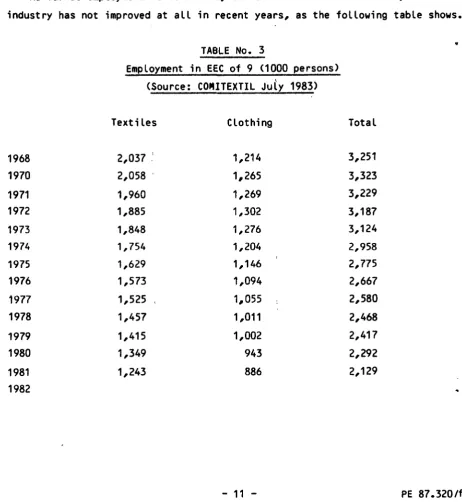
As far as employment is concerned, the situation in the Community textile industry has not improved at all in recent years, as the following table shows •
1968 1970 1971 1972 1973 1974 1975 1976 1977 1978 1979 1980 1981 1982
TABLE No. 3
Employment in EEC of 9 <1000 persons> (Source: COMITEXTIL July 1983)
Textiles Clothing
2,037 1,214
2,058 1,265
1,960 1,269
1,885 1,302
1,848 1,276
1,754 1,204
1,629 1,146
1,573 1,094
1,525 ' 1,055
1,457 1,011
1,415 1,002
1,349 943
1,243 886
11
-..
Total 3,251 3,323 3,229 3,187 3,124 2,958 2,775 2,667 2,580 2,468 2,417 2,292 2,129 [image:11.565.29.491.287.788.2]The above tibte shows th-at ei!Ployttent in tM textile and clot hint se<etGr has fallen st\a·rpty in r-ecent years.
The basic factor affecting the •vetop~~ent of the eMPloywaent situation, and therefore the " l icy which the COINDUnity sl'lould follow in the textile sector, is the developMent of consuaption.
TMJL£ Ho. 4
Evol-ution of ccm.su.U on of ttx tile p rodvc:t s 1981/82
In cu·rrent values Conswaer prices of
textile lmd dothin.g e~ts
G£"R + 1.6 + 4.5
fR + 12.4 + 9.7
IT + 1~.7 + 16.1
UK '+ 3.9 + 1.2
Ouri~ the per;od in question the volume of imports rose sharply,
particularly those frotll low-cost countries. Voluae increased by 5.51 between 1981 and 19·82.
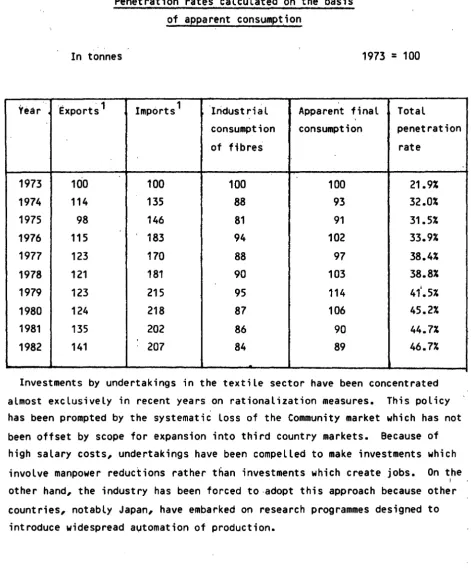
To COMPlete the picture of the situation of the textile industry, ve sn~uld also examine the penetration ·of textile itnpOrts in the CoiiiiM.mity ..
The fotlowing tabte shows the rate of penetration, calculated on the basis of apparent consumption.
Year
1973 1974 1975 1976 1977 1978 1979 1980 1981 1982
TABLE No. 5
Penetration rates calculated on the basis of apparent consumption
In tonnes 1973
=
100Export~ 1 Imp6rts 1 Industrial Apparent final Total
consumption consumption penetration
of fibres rate
100 100 100 100 21.9%
114 135 88 93 32.0%
98 146 81 91 31.5%
115 183 94 102 33.9%
123 170 88 97 38.4%
121 181 90 103 38.8%
123 215 95 114 41'.5x
124 218 87 106 45.2%
135 202 86 90 44.7%
141 207 84 89 46.7%
Investments by undertakings in the textile sector have been concentrated almost exclusively in recent years on rationalization measures. This policy has been prompted by the systematic loss of the Community market which has not been offset by scope for expansion into third country markets. Because of high salary costs, undertakings have been compelled to make investments which involve manpower reductions rather than investments which create jobs. On the other hand, the industry has been forced to.adopt this approach because other countries, notably Japan, have embarked on research programmes designed to
introduce widespread automation of production.
1 Excluding continuous and discontinuous chemical fibres and worsteds.
[image:13.570.38.510.44.624.2]Lt s~•s c~ear. t.~{lt ther~ is su~plus l)ro9ucticm ca.R~ci~Y. ~t ~pr.~,q: ~-)(~~·.
T~*r.~ i.s n9 t:r,~n~ tow~rqs an inH~~~~ in cons!J~Pti~o io th~ ll,l~r~~~~
qf! 1;thl
iORH~tri~l iz~d co~n~ries ~l)P ttl~ IIJ~rk!!t~ else~herE; in the ~9r,lq qf.t~f, IJ9
pro~~t:ts tqr s~~~tifptial 11~~ ou~l~U·
Qx ~~r of. core L~sion and cq,,ua~n~ oq th~. above rE;I!\ftf~s, i.t c"n ~!' ~lq tn~ all tn~ Europe~n C()~l')tries hC!ve sutf~r~q. t.rom the effects of this sil~~l;iR.n~
In tht: Upiteq ~in~d.R!" 12S,OPP jobs ~~re lo~t in the t~o:-ye~r p~ri.qq f,r;q'
1.1lJO,
to 1-'~&1 and imports acco~nteq f,or Jll()re th~!'l ·h~l f qf the couo~ry' s qQtMI.§.t i.~ c;gn~~I,QP~ ion. In France th~re have btt~n subst~~t i al lop Loss~s, ~hH~ in 1~Qifllp,Qt;ts CJ~CQ\-!flt~q fqr op~-thi rd of cops!J~pt ior •
In ~r,many i.t is fqr:ecast that the coun~ry's texti.L~ industr:Y ~HL ~0~9{
aijqu~ ap~"':'fiHh
qt
its'~orkf.orce durin~
the nextd~c.,p~
1•
In "' situati.on ~n~re th~ Co~munity's do111estic con~.IJJI'P,tio!') is I')P,~ i1)1fre~~inQ,
anp third cauo~ry ma.r~ets offer no possible outl~ts, th~ cru~ial ~ro~~e~
r~~ain~ th~ cqp~rol of imp9rts, w~ich mu$t b~ aq~p,t~q to q~~~Lopm"~t~ i~
ctomestic consuiDPtion. ' . . '"! "~
•
Th~ cur.r,ert ~~ltifib~e Arran~Fm~nt ~as certain~y t~~en ~~co~pt of ~~~ r;~qtJir:e.m~nts of t;t~e Co~!Durity ind!JstrY,, but gi\(~n t~a:t t~ere is C! cerl;C!in
~~~r.e~. of flexi,bilitY 'in the ~Pp,Licatian of 'its Provision~, it is vit'l ~h~t
tq~~~ sno!Jld be geare.d1 to the rea.l needs Of· the Co~JUP.HI')ity li)Q!J~tr:y.
lt sho!Jld atso b~ ~~1'-ne in rni.nd tl)at an excessive q~~.r~~ qf ~r.o~~~ti:qnl~ i,!i
QQ~ q~sir~le. fro!JI t~e ind"'.$t;ry's o.~n point of vie~, sin~e it \fl?~lq r:~f\IPV~ t~"
~~i~u.llJ~ CJrd i.ncentiv~' n~.e~d to restore it$ comq~:titivl,'!l')~ss or ~prLd IQ;,r.~~-ts.
~.~ n~ p~en
saidb~for.~
3,
'P.arliall!ent IJ!.I,Ist~ttempt
to recom;ileth~~~
coqfli.ctin~ con~i.d~rations intoan
objective set of guidelines tofpic;ll tor'l! cr.~d,iqle J?~goti~tiog oplectiv~s·.--i-:---.)pl,lrce: CO~ITE.XTll i 1.9.83
~i~SH:
re,pQrt <Doc.1·~~1/81
> p. 9In principle, it can be said that, in view of the unfavourable situation of the Community and world markets, the job losses in the textile and clothing sector, the difficulty of switching textile workers to other industrial sectors and the need to transform the industrial structures of the textile industry towards greater automation, it is vital for the Community textile industry to be protected from an increase in import penetration, with the main 'aim of limiting further job losses.
IV. CONCLUSIONS
The renewal of the Multifibre Arrangement and the new clauses introduced in the bilateral agreements have broadly complied with the need to protect the' Community textile industry. In fact, the Protocol extending the MFA, which was adopted in Geneva and came into force on 1 January 1982, corresponded to the negotiating guidelines, which had stipulated that the Community should reduce levels of access to its market and incorporate in the bilateral
voluntary restraint agreements a mechanism capable of dealing with sudden and substantial increases within quotas.
It is still too early to give a reliable assessment of the functioning of the arrangement and the various clauses. Nevertheless, it is already possible to make a number of observations and general remarks which may prove useful in the near future for the application of the arrangement and the clauses it contains.
The first of these remarks is that the Community textile industry is and must remain one of the:basic industries. The number of workers employed in this sector is considerable (about 2,129,000 workers in 1981 in the EEC of Nine). This figure illustrates the importance of the textile and clothing sector. In view of the long-standing crisis and unemployment situation existing in the Communjty, it is highly unlikely that textile workers can be transferred to other industrial sectors. Job losses in this sector will inevitably mean an increase in unemployment~
In view of the stagnatioii in domestic consUIIIptiGn and th·e at>setld df
~rbsp,cti\1e outlets for exports of Community textile l)roducts on third ttmhti-' 'arkets, the only remaining course open to the EEC's te~tile industry,
it
it is tCi ~urvive, isto
go ah~ad \lith resttucturingand
r~novation usint tl'l@ latest techhi~u~s suchas
automation, ne~ storage techniques, etc. i~ I N~1lhich is already b~ihg don~ in some indUstrialited countries like th~
Uhit@U
states and Japan.
This n~ed means that the Communities textile industries will have to invest ih sectors which will not produce new jobs. This is vital if the CoMMunity te*tile industry is to re~ain sufficiently competitive.
tt this is to be achieved, the Community will have to continue to ~rotect
it~elf during the period of restructuring, as any fUrther job losses
would
be
unacc~ptable.
lt must certainly be·borne in mind that an exaggerated degree of
protectionism would not be desirable, because it would not only run counter to the free trade principles which underly the community rules, but it ~auld al~o
fail to serve the industry's own interests, since it would remove the stimulus and ihcentives needed to restore the competitiveness of the EEC textile
industry on world markets.
The
community is therefore placed in a dilemma in which it is obliged to pursue a protectionist policy while at the same time respecting the fre~ trade principles which are the basis of Community rules and the Treaty of RoMe.It must therefore attempt to reconcile these two conflicting nee~s into a
set of coherent guidelintos forming a Community approach that is credible :md
etfecti~e in respect of its own industry and its trading partners.
Sy ~~Y of an overall assessment of the new MFA and the bilateral agreeMents~
it tah ~nerally be sajd that they have met the needs of the co~munity te•ti~e
ihdustry in that, by comparison with the first agreement <which guaranteed those countries with the lowest production costs an annual growth rate of not
les~ than 6~ for imports of certain sensitive textile products), guarahteed
ffoith rates for quotas have been reduced, in some cases to as low as 0.5%.
This restriction is really vital and is an important factor for the
Community industry•s chances of survival. Nevertheless, it is clear that the future of the Community textile industry cannot be guaranteed merely through
restrictive policies. If the industry is to remain sufficiently competitive and to survive at least on its present scale, it is vital for a series of economic and financial measures to be taken at national and Community level.
Community measures to assist the textile industry also need to be stepped up in the context of the Community•s industrial policy.
I
It is essential that the negotiations with China and Turkey consolidate the results achieved in the bilateral restraint agreements concluded in 1982. It is therefore necessary for the Community to take a constant line, consistent with the approach adopted in the conclusion of these agreements, by
maintaining an overall view and basing its approach to the negotiations with these two countries on the one established and followed for the conclusion of the 26 bilateral agreements.
There will also have to be a rigorous application of the anti-surge claus~, which allows a temporary reduction in the event of sudden and substantial increases in imports (~urge effect> followi~g a long period during which these have remained well within the levels fixed by the quotas themselves.
Efforts to combat fraud and forgeries need to be stepped up. This is very important since Europe•s wealth also depends to a large extent on its ability to react to these practices. In recent years a series of frauds and forgeries concerning trade marks, designs and models has occurred which European
undertakings have been unable to counter effectively.
Finally, the following are general principles which should be respected in the application of the current MFA, and also and above all for its future renewal:
- consolidation and strengthening of the co~ditions for reciprocity at world .. level;
- 1ntroductioh of new arrd
mor·e
effectiVe instruments to co·unter dUmp~ng,·ahd
.'·
subsidies;
- wni
hi retaining the ultirilcitl! airii of protectingand
strengthening free trade,it
is
flecessary to consolidate the temporary l)roted:ive measures to enable thetolilmUnity
as a lilfiole~ and a i'\ui'ilber Ofits
regiOns irl particular;. to restructure the textiLe in'dustry s'O as td make it more competitive.MOTION FOR A RESOLUTION <DOCUMENT 1-15/82) tabled by Mr COUSTE and Mr de La MALENE
on behalf of the Group of European Progressive Democrats pursuant to Rule 47 of the Rules of Procedure
ANNEX
on the extension of the Multifibre Arrangement and the renegotiation of bilateral agreements
The Europ~~n Parliament,
- having regard to the Treaty of Rome, and in particular Article 113 thereof, -having regard to its resolution of 7 April 19811,
2 having regard to the motion for a resolution tabled by Mr Welsh and others ,
~ having regard to the protocol extending the Multifibre Arrangement signed in Geneva on 22 December 1981,
-having regard to the decisions taken by the Council of Ministers on textile trade policy at its meeting on 25 February 1982,
- pointing out that during 1981 there was a further deterioration in the situation of the Community's clothing and textiles industries: decline in production, stagnation of consumption and substantial losses of jobs, at a time when the unfavourable economic situation in the Community does not permit the losses
in this industry to be offset by the creation .of jobs in other sectors,
-stressing, furthermore, the need to safeguard the textile/clothing industry as a whole, which still occupies an important position in the industrial life of the Community, employing as it does 9.6% of all workers in the manufacturing industries and accounting for 6.4% of the value added of these industries~ 1. Regrets that the internal overall ceilings defined by the Council for the
eight categories of most sensitive products do not represent maximum annual import capacities for the Community, because of the possibility of quantita-tive adjustment of the OPT component included therein;
2. Regrets that the Council has not reviewed the quota concept, by defining the
3.
1
~
annual quota on the basis of the levels reached by imports during the previous year;
Fears that the Council's extremely vague and arbitrary interpretation of the anti-surge clause as provided in MFA III might lead to serious difficulties of implementation;
OJ No.
c
101, 4.5.1981, pages 29 to 314. ~egrets that no soluti~ has been found for the ptoble~ of 'reciprocity' of a~cess t'O the tnarhts of t~ttain third countries undergoing rapid industrializa-t~on 1n Latin Ametitt and A~ia. which impos~ prohibitive customs dutie' of up
to
100
to200%;
5. Also regrets that no solution has yet been faund to flt&k~ the pri'Ce clause ~l i cable 'in the &gr~ts with stat!-ttadifig c·ountries;
6. Urges the C~uncil to ensure that the provisions laid down in MfA III are
applied scrupulously and ~ff~ctive'ly b0th during th~ renegotiation of bilateral
a~~eements and in the adMinistration of those agreements•
7. Instructs its Presiflent 'te forlll<kd this resolution to the Council and Commission of the european Co~nities and to the Director-General of GAlT.
ANNEX
MOTION FOR A RESOLUTION (DOCUMENT 1-856/81)
tabled by Mr COUSTE, Mr de La MALENE, Mr ANSQUER, Mr CLEMENT, Mr DELEAU, Mr DENIAU, Mr DE LIPKOWSKI, Mr FANTON, Mr GERONIMI, Mrs EWING, Mr CRONIN, Mr DAVERN, Mr ISRAEL, Mr JUNOT, Mr MEO, Mr FLANAGAN, Mr REMILLY, Mr VIE, Mrs WEISS, Miss de VALERA,
Mr LALOR and Mr NYBORG
pursuant to Rule 47 of the Rules of Procedure
on the renewal of the Multifibre Arrangement and strengthening the Community's textile trade policy
The European Parliament,
- having regard to the Treaty of Rome and, in particular, Article 113 thereof, -having regard to its resolution of 7 April 1981,
whereas the situation in the Community's textile and clothing industry is
characterized by declining employment, falling consumption, stagnating production and an increasing deficit on the balance of trade,
-whereas between 1973 and 1979 the textile and clothing industry shed almost 800,000 jobs - an accumulated loss of more than 24% of the workforce - and whereas workers are still being made redundant,
- whereas the favourable economic situation in the Community further aggravates these difficulties, notably by accentuating the imbalances in regions where the textile industry is concentrated and where job losses in this industry can no longer be offset by providing alternative employment,
-whereas the textile and clothing industry still occupies an important place·in the industrial sector of the Community, employing 9.6% of the workforce in manufacturing industries. and accounting for 6.4% of the added value of these
industries,
-whereas there is therefore a need to maintain intact the backbone of the textile industry in the Community,
- whereas the industry finds it difficult under present circumstances to cope with the growth of imports of textile products from countries covered by the textile policy,
- having regard to the motion for a resolution by Mrs FOCKE and others (Doc. 1-614/81>, the ~otion for a resolution by Mr BOCKLET and others <Doc. 1-594/81> and the motion for a resolution by Mr WELSH and others <adopted on 19.11.1981),
1. Strongly urges the Council to adopt as soon as possible the Commission's proposals for renewing the MFA and for the renegotiation of bilateral agree-ments expiring at the end of 1982;
2. ReqU,~sts the Council to introduce from 1982 onwards a stricter trade policy on textiles that is more effective and better adapted to the difficulties curr~ntly
facing the textile industry by providing it with comprehensive protection against cheap imports;:
3. Requests the Council to ensure that the global internal ceilings for Group I prcducts (very sensitive) are respected without exception and to resist in future any measure which might grant exemptions from these ceilings;
4. Calls on the Council to adopt the Community rules on outward proc~ssing arrange-mepts proposed by the Commission, which have been under discussion for three years, given the importance of improving the competitiveness of the textile and clothing industry;
5. Deplores the fact that· the Community is incapable of taking effective and timely action to correct disruptions of the market and, in particular, to curb the excessive imports from other industrialized countries, notably the United
St~tes, which is the main supplier of textile products to the Community; 6. Calls on the Commission to reconsider the price clause in agreements with
state-trading countries with a view to making it applicable;
7. Requests that a requirement be introduced making it compulsory for items of clothing from all third countries to carry an indication of origin;
8. Ca~ls on the Commission to give serious consideration to the problem of reciprocal access to markets, as a number of rapidly industrializing third countries (Latin America or Asia) impose on Community textile exports tariff barriers - prohibitive customs duties ranging from 100 to 200% - and non-tariff barriers, thus preventing normal trade flows;
9. Proposes the following measures:
- revising the concept of quotas - quotas have ~-to now implied a right of access to the Community market - so as to introduce machinery for adjusting quotas each year on the basis of the actual level of imports; -aligning the growth rate of quotas -for all low-price products- on the
rate of growth of demand for textiles in the Community;
- reviewing certain major concessions made to countries benefiting from preferences in the framework of voluntary restraint agreements negotiated by the Community, notably reducing the present rate of increase of quotas and the rates applied in the case of flexibility clauses;
-stricter and more vigilant application to textile products not subject to quotas of the basket extraction machinery by initiating the procedure more rapidly and by introducing Community basket extraction measures more
frequently;
- strengthening existing provisions or creating additional machinery for detecting d~flections of trade and frauds concerning the origin of imported textile products as rapidly as possible and taking effective remedial
action;
-providing for changes to the list of very sensitive products during the course of the year to include a product which has become very sensitive in terms of trade flows;
10. Stresses that any solution to the textile crisis would be incomplete without a thorough and lasting restructuring of the industry to meet the new demands of international competition and calls on the Council to seek the approval of the Member States for common guidelines on an industrial strategy;
11. Instructs its President to forward this resolution to the Council, the Commission, the official representatives of all the signatories of the MFA and the Director-General of GATT.