Impact of different fallow durations on soil aggregate
structure and humus status parameters
Maksim Burdukovskii*, Irina Kiseleva,
Polina Perepelkina, Yuliya Kosheleva
Federal Scientific Center of the East Asia Terrestrial Biodiversity,
Far Eastern Branch of Russian Academy of Sciences, Vladivostok, Russia *Corresponding author: [email protected]
Citation: Burdukovskii M., Kiseleva I., Perepelkina P., Kosheleva Y. (2020): Impact of different fallow durations on soil aggre-gate structure and humus status parameters. Soil & Water Res., 15: 1−8.
Abstract: Soil aggregate structure and soil organic matter are closely interrelated and commonly considered as key indicators of soil quality. The aim of this study was to evaluate the effects of different fallow durations on indices of soil structure and humus status indicators. Studies were conducted on abandoned agricultural fields (15, 20 and, 35 years after abandonment). As a reference site, we used a cultivated field in the area. The experimental soil fields are classified as Gleyic Cambisols. Soil macroaggregates were separated with the sieve (dry sieve) to seven aggregate size fractions, i.e.> 10, 10–5, 5–2, 2–1, 1–0.5, 0.5–0.25 and < 0.25 mm. The humus status parameters of soils
inclu-ded the following indicators: soil organic carbon (Corg), humus reserves (QH), the degree of humification of organic
matter (SOMdh), fractions of humic acids (HA) (free and bound with monovalent cations and Al2O3, Fe2O3, bound
with Са2+ which forms humates, bound with clay minerals), fulvic acids (FA) (free aggressive) and ratio of HA to FA
(CHA : CFA). After a fallow period of more than 20 years on the surface formation of a sod layer. A long-term fallow
period had an impact on the mean weight diameter of the aggregates (MWD) and agronomically valuable aggregates (AVA). Fallow soils have a significantly better structure than soils under a cultivated field. Long-term cultivation
leads to the deterioration of soil structure and the formation of large aggregates (>10 mm). The Corg content remains
at the level of the background content when the soils are left fallow for less than 15 years and increases over time.
The Corg in the upper 0–20 cm soil layer has been shown to increase from 3.55 to 8.74% on arable land that has been
fallow for 35 years and has been largely associated with significant accumulation of organic matter within the plant root mass. Mature sites are characterized by an increase of fulvic acids in the humus composition in comparison with their arable analogues. The abandonment of soil agricultural use and the cessation of mechanical tillage results in the restoration of the natural structure of soils and the improvement of their agrophysical properties. Such studies have not been previously conducted in the Primorsky region of the Russian Far East.
Keywords: dry-sieved macroaggregates; fallow land; soil quality; soil structure
Supported by the Russian Science Foundation, Project No. 17-76-10011.
The aggregate structure of soils and soil organic matter (SOM) are closely interrelated and commonly considered as key indicators of soil quality (Bronick & Lal 2005; Liao et al. 2006; Dexter et. al. 2008; Wiesmeier et al. 2012). Soil organic matter is a com-plex system and composed of organic compounds,
Gif-ford 2002; Laganiere et al. 2010). The results of numerous studies have enabled the characterisation of changes in the composition of SOM as a result of ploughing forest soils (Gajic et al. 2010; Ciric et al. 2012). However, data referring to changes in the composition of SOM with the transition from arable land into forest are still scarce. The cessation of anthropogenic impact on soils (soil cultivation, harvest, fertiliser use, etc.) as well as successional changes in vegetation lead not only to carbon stock changes but also to changes in the composition of SOM. According to some sources, the soil organic carbon (Corg) content of cultivated soil decreases with agricultural use (Bronick & Lal 2005; Litvi-novich & Pavlova 2007; Ciric et al. 2012). Other sources have indicated that the fractions of fulvic acids increase in overgrowing arable land while the proportion of humic acids decreases (Chalaya 2012).
The aggregate structure of soils also undergoes significant changes during revegetation, both because of the inherent characteristics of the soil and the influence of natural biocoenoses formed in fallow soils (Baeva et al. 2017). The aggregate structure of soils is usually expressed as the degree of aggregate stability in water (Tisdall & Oades 1982). Numer-ous studies have been conducted on the effects of land use change on aggregate stability, but notably less attention has been devoted to dry aggregate size distribution and the factors affecting it (Elliot 1986; Ciric et al. 2012). However, aggregate size distribu-tion is one of the major physical characteristics of soil and strongly affects soil fertility and its resistance to erosion and degradation (Shein 2005; Gajic et al. 2010; Laganiere et al. 2010; Wiesmeier et al. 2012). Soil aggregation conserves and protects SOM, which functions as a plant nutrient and energy reservoir (Bronick & Lal 2005; Liao et al. 2006), and usually deteriorates together with Corg (Ciric et al. 2012). The soil structure affects a wide range of soil properties, including soil porosity, compactability and water retention (Regelink et al. 2015; Cheng et al. 2015).
At the same time, many factors affect the posta-grogenic dynamics of soil properties during reveg-etation. The abandonment of soil agricultural use leads to improved aggregate stability since it reduces physical disruption and contributes to the organic matter accumulation, especially in the upper horizons (Gajic et al. 2010; Baeva et al. 2017).
Land withdrawal from the fallow state to arable land is becoming a worldwide trend and also significant in Russia (Lyuri et al. 2010). The issues of fallow soil transformation with a return to agricultural use in the Far-Eastern region of Russia remain poorly studied, as there are practically no studies concern-ing the changes in the level of fertility and basic soil properties. We hypothesised that the soil quality is higher in long-term fallow soils compared to crop-lands subjected to long-term, intensive tilling. In this context, the objective of this study is to evaluate the effects of different fallow durations on indices of soil structure and humus status indicators.
MATERIAL AND METHODS
Studies were conducted from July to September 2017 on the former arable land in the Primorsky region of the Russian Far East (Table 1). These fields were abandoned in different years. Site age after abandonment was 15, 20 and 35 years. Soil samples were also selected from a reference site (unfertilised) of a long-term field experiment which started in 1941 on the territory of the Primorsky Scientific Research Institute of Agriculture of the Russian Academy of Sciences. This field was cultivated with soybean.
The experimental soil fields are classified as Gleyic Cambisols according to IUSS Working Group WBR (2006). These are the soils which cover the largest proportion in the Primorsky region and are intensively used in agriculture (more than 50% of the cropland) (Ivanov 1976; Burdukovskii et al. 2016).
[image:2.595.63.534.660.745.2]Gleyic Cambisol soils are characterised by the clayey texture (the content of clay and silt particles
Table 1. Description of the studied sites
Fallow ages (years)
Geographic coordinates
Soil type Vegetation type
latitude N longitude Е
0 43.859 189 131.945 269 Gleyic Cambisols soybean
15 43.837 730 132.093 442 Gleyic Cambisols graminoids/sagebrush
20 43.751 206 132.020 417 Gleyic Cambisols graminoids/sagebrush/grasses
35 43.842 654 131.917 306 Gleyic Cambisols sedges/graminoids
in the top horizon is 80–85%), and the bulk density varied from 0.82 to 1.22 g/cm3 in the plow layer and
1.09–1.05 in the subsoil. These parameters specify the low water permeability of the soils. The soils were slightly acidic, with levels of pH (H2O) and pH (KCl) ranging from 5.46 to 6.12 and from 4.48 to 5.12, respectively.
The climate of the study area is influenced by the monsoon. In January, north, north-west, and west winds dominate whereas, in July, the winds are from the south, south-east, and east. The winter climate is arid and frosty, with an average air temperature in January −13°C and a humidity of 26 to 48%. The summer monsoon climate is cloudy and rainy with an average air temperature in August of 19°C and a humidity of less than 80%. Most precipitation occurs from August to September when the typhoons bring in significant rains. The hydrology is characterised by desiccation in spring and humidification in sum-mer and at the beginning of autumn (Timofeeva et al. 2014).
Soil samples were taken randomly at different loca-tions within the same plot, in triplicate. The soil pits were dug by hand. The soils were sampled from the humus-accumulative horizons at 0–20 and 20–30 cm depth. After a fallow period of more than 20 years, the arable horizon had divided into subhorizons with differing morphological properties, so we selected samples at 0–12 and 12–30 cm depths. All samples from the same layer within each plot were carefully mixed to obtain a composite sample and air-dried at room temperature.
Aggregate soil analysis was performed via dry sieving of mixed samples. We obtained seven aggre-gate size fractions, i.e.> 10, 10–5, 5–2, 2–1, 1–0.5, 0.5–0 and < 0.25 mm. The weight of these fractions we used for the determination of mean weight di-ameter (MWD) (Hillel 2004), structure coeffi-cient (Ks) and agronomically valuable aggregates (AVA) (Shein 2005).
The content of Corg was determined using the Ty-urin method. The fractional composition of humus was determined according to the Tyurin method as modified by Ponomareva and Plotnikova, humus reserves (QH) in the 0–20-cm layer and the degree of humification of organic matter (SOMdh) was de-termined by Orlov et al. (1981). The humus status parameters of soils (Corg, QH, SOMdh), humic acids (HA) (free and bound with monovalent cations and Al2O3, Fe2O3, bound with Са2+ which forms humates,
bound with clay minerals), fulvic acids (FA) (free
aggressive) and ratio of HA to FA (CHA : CFA ) were characterised according to Orlov et al. (2004).
The data were analysed using the software packages Microsoft Excel and SPSS software (Ver. 22, 2013). Relationships between soil structure indices and humus status indicators were estimated using the mean values, standard errors, analysis of variance (two-way ANOVA) and Pearson’s correlation coef-ficients; significant differences between treatments were determined at P ≤ 0.05 and P ≤ 0.01.
RESULTS AND DISCUSSIONS
The cessation of anthropogenic impacts and the colonisation of former agricultural soils by natural vegetation leads to changes in the structural organisa-tion. The nature and direction of such post-agricul-tural transformation, along with the soil development history and initial soil properties, significantly de-pends on biological factors. For example, the root system of herbaceous plants penetrates the soil and loosens the soil mass, thereby creating aggregates of a certain shape (Tisdall & Oades 1982). In addition, the products of organic matter decomposition serve as glue, binding microaggregates into macroaggre-gates (Elliot 1986).
According to various authors (Gajic et al. 2010; Ciric et al. 2012), Cambisols have an increased con-tent of non-desirable large aggregates (> 5 mm). An analysis of the aggregate structure of former arable soils has shown that the content of macroaggregates in the surface layer > 5 mm decreases in the follow-ing order (Figure 1): ploughland (39%) > fallow soil 15 years (20%) > fallow soil 20 years (6%) > fallow soil 35 years (1–2%). In general, 1–5-mm fractions predominate in the aggregate structure of Gleyic Cambisols.
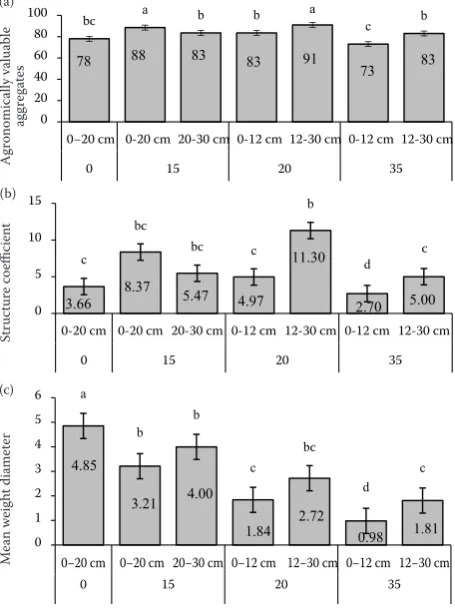
The highest content of aggregates with a size > 10 mm was noted in the ploughed field (16.8%), probably because the root system of herbaceous plants promotes better loosening of the soil mass in the course of succession compared with the annual physical disturbance of the soil structure during cul-tivation (Ciric et al. 2012; Wiesmeier et al. 2012). Agronomically valuable aggregates with a size of 10 to 0.25 mm determine the structure of the soil. Lumpy aggregates (> 10 mm) and dusty aggregates (< 0.25 mm) are undesirable and may adversely af-fect the agrophysical properties of the soil (Shein 2005). The optimum aggregate structure in soils of loamy and clay granulometric composition is formed with an AVA content of 70–80%. In the upper hori-zon of the studied soils, AVAs accounted for more than 70%, which indicates their excellent aggregate state (Figure 2). The AVA content in the former arable horizon of the 15-year-old fallow soils was 10% higher compared to that of the cultivated soil. Similar results were also obtained by Gajic et al. (2010) and Baeva et al. (2017) who found that the content of the AVA in long term arable soil is lower than in fallow and forests soils.
Soil structure is an important and characteristic feature in determining the agro-production char-acteristics of soils. It is considered favourable if Ks ranges between 0.67 and 1.50 and unfavourable at Ks < 0.67 (Shein 2005). The observed soil structure in fallow and arable soils of the current use stage is rated as favourable (Ks > 1.50). The highest Ks value was found for the 15-year-old fallow site (8.37). In
[image:4.595.64.293.97.251.2]more mature soils, Ks values are lower, probably as a result of stratification of the arable horizon and the formation of a sod layer on the surface. The dis-tribution of aggregate size by fractions is complex and difficult to describe by a single mathematical dependence; it is, therefore, common to use the MWD index. Our results showed that MWD was clearly dependent on the age of the fallow period and tillage management, and the most significant effect on reducing the diameter of the aggregates was for soil that had been fallow for 35 years (Figure 2). As a result of compaction by agricultural machinery with long term tillage, the soil has more large ag-gregates (>10 mm) (Wiesmeier et al. 2012). Soils under native vegetation have a substantially higher amount of AVA compared to croplands. Mean weight diameter of the aggregates in the former arable layer of the 20-year-old site (1.84 mm) was 2.5 times less
Figure 2. Effects of the fallow period on (a) agronomi-cally valuable aggregates (%); (b) structure coefficient and (c) mean weight diameter (mm)
[image:4.595.306.534.347.652.2]The numbers 15, 20 and 35 indicate years after abandonment; 0 – ploughland (a cultivated field); vertical bars in each column indicate standard error of the mean; different lowercase letters indicate significant differences at P < 0.05
Figure 1. Soil aggregate size fractions distribution in fallow soils of different ages
The numbers 15, 20 and 35 indicate years after abandonment; 0 – ploughland (a cultivated field); different lowercase letters indicate significant differences at P < 0.05
bc a b b a c b
0 20 40 60 80 100
0−20 cm 0-20 cm 20-30 cm 0-12 cm 12-30 cm 0-12 cm 12-30 cm
0 15 20 35
Agronomically
valuable
aggregates
78 88 83 83 91
73 83
c bc
bc c b d c 0 5 10 15
0-20 cm 0-20 cm 20-30 cm 0-12 cm 12-30 cm 0-12 cm 12-30 cm
0 15 20 35
Structure
coefficie
nt
3.66 8.37 5.47 4.97
11.30 2.70 5.00 a b b c bc d c 0 1 2 3 4 5 6
0−20 cm 0−20 cm 20−30 cm 0−12 cm 12−30 cm 0−12 cm 12−30 cm
0 15 20 35
Mean
weight
diameter 4.85
3.21 4.00
1.84 2.72 0.98 1.81
bc a b b a c b
0 20 40 60 80 100
0−20 cm 0-20 cm 20-30 cm 0-12 cm 12-30 cm 0-12 cm 12-30 cm
0 15 20 35
Agronomically
valuable
aggregates
78 88 83 83 91 73 83
c bc
bc c b d c 0 5 10 15
0-20 cm 0-20 cm 20-30 cm 0-12 cm 12-30 cm 0-12 cm 12-30 cm
0 15 20 35
Structure
coefficie
nt
3.66 8.37 5.47 4.97
11.30 2.70 5.00 a b b c bc d c 0 1 2 3 4 5 6
0−20 cm 0−20 cm 20−30 cm 0−12 cm 12−30 cm 0−12 cm 12−30 cm
0 15 20 35
Mean
weight
diameter 4.85
3.21 4.00
1.84 2.72 0.98 1.81
bc a b b a c b
0 20 40 60 80 100
0−20 cm 0-20 cm 20-30 cm 0-12 cm 12-30 cm 0-12 cm 12-30 cm
0 15 20 35
Agronomically
valuable
aggregates
78 88 83 83 91
73 83
c bc
bc c b d c 0 5 10 15
0-20 cm 0-20 cm 20-30 cm 0-12 cm 12-30 cm 0-12 cm 12-30 cm
0 15 20 35
Structure
coefficie
nt
3.66 8.37 5.47 4.97
11.30 2.70 5.00 a b b c bc d c 0 1 2 3 4 5 6
0−20 cm 0−20 cm 20−30 cm 0−12 cm 12−30 cm 0−12 cm 12−30 cm
0 15 20 35
Mean
weight
diameter 4.85
3.21 4.00
1.84 2.72 0.98 1.81
Str uc tur e c oeffic ien t Ag ronomic ally v alu able ag gre ga te s (a) M ean weig ht di ame ter (b) (c)
a c b
c a
a a
b ab c c
a a a b a c b b b b b b b a c b c a b a a
b b b
b b
a b
b b b
ab b a ab 0 10 20 30 40 50 60 70 80 90 100
0−20 cm 0−20 c 20−30 cm 0−12 c 12−30 cm 0−12 cm 12−30 cm
0 15 20 35
Mass
propotion
of
aggregates (%)
>10 10−5 5−2 2−1 1−0.5 0.5−0.25 <0.25
Ma
ss pr
op
or
tion of agg
re
ga
te
than that in the cultivate site (4.85 mm). This may be because the systematic ploughing involves the involvement and redistribution of the soil from the underlying horizons to the arable one. This soil mass can be well structured but is less resistant to me-chanical tillage (Bronick & Lal 2005; Ciric et al. 2012). Evidence suggests that The abandonment of soil agricultural use and the cessation of mechanical tillage use results in the restoration of their natu-ral structure and the improvement of agrophysical properties, as has been confirmed by other research-ers (Post & Kwon 2000; Litvinovich et.al. 2009; Gajic et al. 2010; Cheng et al. 2015; Baeva et al. 2017). We found no significant correlation between humus characteristics and soil structure parameters; however, we observed positive correlations between fraction sizes and MWD (Table 2). A highly
signifi-cant correlation (P < 0.01) between the aggregate fractions < 5 mm and AVA was observed, and close correlations (P < 0.05) between aggregate fractions > 1 mm and MWD. Our results are consistent with data from other researchers (Ciric et al. 2012.
A division of the arable horizon into subhorizons, both in terms of morphological properties and organic matter, was observed for soils which had been abandoned for more than 20 years. Based on evaluative indicators (Orlov et al. 2004), the Corg content in the abandoned sites was low and below average.
[image:5.595.70.532.110.298.2]The high Corg content in the 35-year-old fallow soil compared to the other sites (Table 3) was largely associated with significant accumulation of organic matter with the plant root mass. The upper part of the former arable horizon was transformed into the
Table 2. Correlation coefficients between soil structure indices and humus status indicators
Size fractions in mm (mass %) MWD
(mm) AVA (%)
> 10 10–5 5–2 2–1 1–0.5 0.5–0.25 > 0.25
> 10 ns 0.891** 0.915** 0.893** 0.764* ns ns 0.764* ns
10–5 ns ns 0.823** 0.979** ns ns ns 0.823* ns
5–2 ns ns ns 0.854** ns ns ns 0.816* ns
2–1 ns ns ns ns 0.806* ns ns 0.639* ns
1–0.5 ns ns ns ns ns ns ns ns ns
0.5–0.25 ns ns ns ns ns ns 0.894** ns 0.977**
>0.25 ns ns ns ns ns ns ns ns 0.852**
Corg –0.632* –0.724* –0.791* –0.564* ns ns ns –0.968** ns
QH ns ns ns ns ns ns ns ns ns
CHA1 ns ns ns ns ns ns ns ns ns
CHA2 ns ns ns ns ns –0.872* –0.83 ns ns
MWD – mean weight diameter; AVA – agronomically valuable aggregates; Corg – soil organic carbon; QH – humus reserves; CHA1 – HA free and bound with monovalent cations and Al2O3, Fe2O3; CHA2 – HA bound with Са2+ which forms humates; *P ≤ 0.05%; **P ≤ 0.01%; ns – not significant
Table 3. Changes in the humus status parameters in fallow soils of different ages (tested soil depth 0–20 cm)
Fallow ages
(years) C(%)org (t/ha)QH
CHA1 CHA2 CHA3 SOMdh CFA1a
CHA : CFA (%)
0 3.55 ± 0.14a 115.52 ± 9.57b 24.34 ± 1.05a 64.33 ± 4.12c 11.32 ± 0.74b 34.52 ± 2.37a 3.27 ± 0.23b 1.74 ± 0.02a
15 3.36 ± 0.03a 62.07 ± 6.09a 34.17 ± 2.11b 32.47 ± 2.34b 30.42 ± 2.97a 31.61 ± 2.25a 5.33 ± 0.21c 0.95 ± 0.07b
20 5.53 ± 0.10b 122.46 ± 8.75b 34.12 ± 2.66a 33.14 ± 2.18b 32.78 ± 2.24a 38.27 ± 3.09b 4.64 ± 0.66a 1.35 ± 0.09a
35 8.74 ± 0.22c 102.92 ± 7.33b 56.11 ± 1.28c 12.12 ± 1.14a 31.43 ± 3.26a 32.83 ± 2.48a 4.36 ± 0.43a 0.97 ± 0.03b
[image:5.595.65.532.606.692.2]sod layer, which was most distinct in the mature sites under sedge-graminoid vegetation. The upper horizon on these fields was densely penetrated by intertwined living and dead plant roots. The formation of a sod layer on the surface also affected soil temperature and water content, which in turn affected the rate of decomposition of plant residues and the soil or-ganic matter (Litvinovich et al. 2007; Wright et al. 2007; Yu et al. 2015).
According to various previous studies (Havkina 2004; Purtova et al. 2016), the humus contents in the study site vary from 3.30 to 4.30% in arable soils. Based on these data, the humus content in the soil remains at the level of the background content when the soils are left fallow for less than 15 years. An increase in the Corg content was observed in more mature fallow soils. In addition, based on archive data for defined fields (archival materials of agrochemical surveys, Federal Scientific Center of the East Asia Terrestrial Biodiversity FEB RAS), the humus content increased in the course of secondary succession (from 3.72 to 5.53% in the 20-year-old site), probably as a result of organic matter accumulation, which confirmed the results of Liao et al. (2006), Bin and Xin-Hua (2006), Wright et al. (2007).
The QH in the 0–20-cm layer the 15-year-old fallow Gleyic Cambisol were characterised as low (62.07 t/ha), while in more mature soils, they were average. The SOMdh, i.e. the amount of humus substances in the SOM, of all abandoned soils was relatively high.
The contents of CHA1 (brown humic acids) and CHA2 (grey humic acids) were almost in equal proportions. The proportion of brown humic acids of the total content of humic acids was mostly low (34.12–36.81%) and, in rare cases, mean (56.11%). The proportion of grey humic acids of the total content of humic acids was very low and low (12.12–33.57%) in all examined soils.
The CHA : CFA ratio has been used as an index of the de-gree of humification (Stevenson 1994). Arable soils are characterised by humic type of humus (CHA : CFA = 1.74). Fallow soil humus had a humate-fulvate composition and fulvate-humate composition. In our opinion, this was due to the water-air regime of Gleyic Cambisols. This soil is subject to surface overwetting, whereby the organic matter transformation process is somewhat decelerated, and the preservation and slowing down of humification of plant residues occurs (Wolf & Snyder 2003; Havkina 2004).
Grey humic acids predominate in the humus com-position of arable soils in the study area, accounting
for more than 60% of the total content of humic acids (Havkina 2004), which is a characteristic feature of well-cultivated soils saturated with exchangeable bases. Site abandonment results in negative changes in the fraction-group composition of humus. We also observed a reduction in the proportion of CHA2 bound to Са2+ in abandoned sites, probably as a
result of the cessation of mineral and organic fer-tiliser application (Litvinovich & Pavlova 2007; Lapa et al. 2011). Mature sites are characterised by an increase of fulvic acids in the humus composi-tion, which can be easily observed in their CHA : CFA ratios in comparison with their arable analogues. The proportion of CHA3 bound to clay minerals was high in all examined soils, while the proportion of CFA1a of total Corg was mainly low and, in rare cases, mean (5.33%).
CONCLUSIONS
The abandonment of soil agricultural use and the cessation of mechanical tillage results in the restoration of the natural structure of soils and the improvement of their agrophysical properties. Fal-low soils have a significantly better structure than soils under a cultivated field. The humus content of the Gleyic Cambisols remained at the level of the background content in sites abandoned for less than 15 years and increased over time when the arable horizon was divided into subhorizons both in terms of morphological properties SOM. Long-term cultiva-tion leads to the deterioracultiva-tion of soil structure and the formation of large aggregates (> 10 mm). After a fallow period of more than 20 years, a significant decrease in MWD and a small increase in AVA was observed. The SOMdh, i.e. the amount of humus substances in the SOM, was generally high in all abandoned sites. The humus had a humate-fulvate composition and, albeit less often, a fulvate-humate composition. In the abandoned sites, a reduction in the proportion of CHA2 bound to Са2+ in comparison
with their arable analogues was noted. The value of these findings is highly significant because no such studies have been conducted before in the Primorsky region of the Russian Far East.
Acknowledgements. The analyses described in this work
References
Baeva Yu. I., Kurganova I.N., Lopes de Gerenyub V.O., Pochikalovc A.V., Kudeyarovb V.N. (2017): Changes in physical properties and carbon stocks of gray forest soils in the southern part of Moscow region during posta-grogenic evolution. Eurasian Soil Science, 3: 327–334. Bin Z., Xin-Hua P. (2006): Organic matter enrichment and
aggregate stabilization in a severely degraded Ultisol after reforestation. Pedosphere, 6: 699–706.
Bronick C.J., Lal R. (2005): Soil structure and management: a review. Geoderma, 124: 3–22.
Burdukovskii M.L., Golov V.I., Kovshik I.G. (2016): Changes in the agrochemical properties of major arable soils in the south of the Far East of Russia under the impact of their long-term agricultural use. Eurasian Soil Science, 10: 1174–1179.
Chalaya T.A. (2012): Carbon Stocks in Soils and Vegetation of the Postagenogenic Landscapes of the Southern Taiga. [Ph.D. Thesis.] Institute of Geography, Russian Academy of Sciences. (in Russian)
Cheng M., Xiang Y., Xue Z.J., An S.S., Darboux F. (2015): Soil aggregation and intra-aggregate carbon fractions in relation to vegetation succession on the Loess Plateau, China. Catena, 124: 77–84.
Ciric V., Manojlovic M., Nesic Lj., Belic M. (2012): Soil dry aggregate size distribution: effects of soil type and land use. Journal of Soil Science and Plant Nutrition, 12: 689–703.
Dexter A.R., Richard G., Arrouays D., Czyz E.A., Jolivet C., Duval O. (2008): Complexed organic matter controls soil physical properties. Geoderma, 144: 620–627.
Elliot E.T. (1986): Aggregate structure and carbon, nitrogen, and phosphorus in native and cultivated soils. Soil Science Society of America Journal, 50: 627–633.
Gajic B., Durovic N., Dugalic G. (2010): Composition and stability of soil aggregates in Fluvisols under forest, mead-ows, and 100 years of conventional tillage. Journal of Plant Nutrition and Soil Science, 173: 502–509.
Guo L.B., Gifford R.M. (2002): Soil carbon stocks and land use change: a meta analysis. Global Change Biology, 8: 345–360. Havkina N.V. (2004): Humification and Transformation of
Organic Matter in Conditions of Variable Gley Soil For-mation. Ussuriysk, Primorye State Agricultural Academy Press. (in Russian)
Hillel D. (2004): Introduction to Environmental Soil Physic. Amsterdam, Elsevier.
IUSS Working Group WBR (2006): World Reference Base for Soil Resources 2006. A Framework for International Classification, Correlation and Communication. World Soil Resources Reports 103. Rome, FAO.
Ivanov G.I. (1976): Soil Formation in the South of the Far East. Moscow, Nauka. (in Russian)
Laganiere J., Angers D.A., Pare D. (2010): Carbon accu-mulation in agricultural soils after afforestation: a meta analysis. Global Change Biology, 16: 439–453.
Lapa V.V., Seraya T.M., Bogatyreva E.N., Biryukova O.M. (2011): The effect of long-term fertilizer application on the group and fractional composition of humus in a soddy-podzolic light loamy soil. Eurasian Soil Science, 44: 100–104. Liao J.D., Boutton T.W., Jastrow J.D. (2006): Storage and
dynamics of carbon and nitrogen in soil physical fractions following woody plant invasion of grassland. Soil Biology and Biochemistry, 11: 3148–3196.
Litvinovich A.V., Pavlova O.Yu. (2007): Changes in the humus status of a layland sandy gleyic soddy-podzolic soil. Eurasian Soil Science, 11: 1323–1329.
Litvinovich A.V., Drichko V.F., Pavlova O.Yu., Chernov D.V., Shabanov M.V. (2009): Changes in the acid-base proper-ties of cultivated light-textured soddy-podzolic soils in the course of postagrogenic transformation. Eurasian Soil Science, 6: 629–635.
Lyuri D.I., Goryachkin S.V., Karavaeva N.A., Denisenko E.A., Nefedova T.G. (2010): Dynamics of Agricultural Land in Russia and Postagrogenic Restoration of Plants and Soils. Moscow, GEOS. (in Russian)
Orlov D.S., Grisina L.A. (1981): Practical Work in the Chem-istry of Humus. Moscow, MGU. (in Russian)
Orlov D.S., Biryukova O.N., Rozanova M.S. (2004): Revised system of the humus status parameters of soils and their genetic horizons. Eurasian Soil Science, 8: 798–805. Post W.M., Kwon K.C. (2000): Soil carbon sequestration and
land use change: processes and potential. Global Change Biology, 6: 317–328.
Purtova L.N., Schapova L.N., Emelyanov A.N., Timoshinov R.V., Kiseleva I.V. (2016): Influence of long-term use of fertilizers on fertility of agro-dark-humus bleached soil Primorye. Advances in Current Natural Sciences, 9: 77–81.
Regelink I.C., Stoof C.R., Rousseva S., Weng L., Lair G.J., Kram P., Nikolaidis N.P., Kercheva M.,Banwart S., Co-mans, R.N.J. (2015): Linkages between aggregate forma-tion, porosity and soilchemical properties. Geoderma, 247: 24–37.
Shein E.V. (2005): Course of Soil Physics. Moscow, MGU. (in Russian)
Stevenson F.J. (1994): Humus Chemistry, Genesis, Com-position, Reactions. 2nd Ed., New York, John Wiley and Sons, Inc.
elements on nodule size. Soil Science Society of America Journal, 78: 767–778.
Tisdall J.M., Oades J.M. (1982): Organic matter and water-stable aggregates in soils. Journal of Soil Science, 33: 141–163.
Wiesmeier M., Steffens M., Mueller C.W., Kolbl A., Ag-nieszka R., Peth S., Horn R., Kogel-Knabner I. (2012): Aggregate stability and physical protection of soil organic carbon in semi-arid steppe soils. European Journal of Soil Science, 63: 22–31.
Wolf B., Snyder G. (2003): Sustainable Soils: the Place of Organic Matter in Sustaining Soils and Their Productiv-ity. New York, Haworth Press.
Wright A.L., Dou F., Hons F.M. (2007): Soil organic C and N distribution for wheat cropping systems after 20 years of conservation tillage in central Texas. Agriculture, Ecosystems and Environment, 121: 376–382.
Yu M., Zhang L., Xu X., Feger K.H., Wang Y., Liu W., Schwärzel K. (2015): Impact of land-use changes on soil hydraulic properties of Calcaric Regosols on the Loess Plateau, NW China. Journal of Plant Nutrition and Soil Science, 178: 486–498.