Abstract—Since the inception of telephony, the public switch telephone network (PSTN) has had major impact in everyday life. The widespread adoption of VoIP has totally revolutionized the telephony industry. With many free services for the users, VoIP is favored over the traditional PSTN. A major concern for VoIP is voice quality, as it is a network-based packet switching technology. VoIP will come in handy in enterprise networks, where voice and data service are often separated networks. With the provisioning of multiple service type in a single network with a common IP network infrastructure, this will reduce the operational cost as it is easier to run, maintain and manage such networks. With all the nifty features of VoIP a major concern for service providers is bandwidth availability. VoIP requires high-bandwidth, with minimum delay and if possible, no packet loss. Ethernet passive optical network (EPON) is regarded as the best solution in access networks in providing the high bandwidth requirements for VoIP Services, and other multimedia application. In this paper, we propose a new architecture that incorporates a VoIP server in the Optical Line Terminal (OLT). A fully functioning VoIP telephony system will be implemented in the OLT that will be able to handle all the telephony services for users. Our simulation results show that the VoIP Server can be implemented in the EPON and the constraints of VoIP such as delay jitter and packet loss is improved, and hence a better Quality of Service (QoS).
Index Terms—PSTN, SIP, VoIP, EPON, Service Providers,
QoS.
I. INTRODUCTION
The current number of telephone line has exceeded over 1 billion users and about 6.8 billion mobile-cellular subscriptions in the world [1]. The Public Switch Telephone Network (PSTN) is still where the majority of voice calls are carried. The well-engineered PSTN uses circuit switching technology, which reserves resources along the entire communication channel for the duration of a given call. This has brought about the quality that it provided for the past 100years. In recent years, we have seen many developments and new services coming to market, services that the PSTN cannot fully handle. Services like voice email, soon, telephony service providers will move to networks, based on
Manuscript received January 03, 2014; revised January 28, 2014 Lamarana Jallow is (email:[email protected]) with Department of Computer Science and Engineering, Yuan-Ze University, Chung-Li, 32003, Taiwan.
I-Shyan Hwang (e-mail:[email protected]) is with Department of Information Communication, Yuan-Ze University, Chung-Li, 32003, Taiwan.
AliAkbar Nikoukar is (email:[email protected]) with Department of Computer Science and Engineering, Yuan-Ze University, Chung-Li, 32003, Taiwan.
Andrew Tanny Liem (email:[email protected]) is with Department of Computer Science and Engineering, Yuan-Ze University, Chung-Li, 32003, Taiwan.
open protocols known as voice over Internet protocol (VoIP) [2]. Operational cost will be reduced, with the provisioning of multiple service types in a single network with a common IP network infrastructure. As voice and data are in the same network, this will be easier to run, maintain and manage [3]. VoIP also known as Internet telephony, is the ability to transmit voice communication over the packet-switched IP networks. VoIP has revolutionized telephone communication, as it is cheaper for the end users. Other additional features which the users previously had to pay for are offered for free, features like caller ID, call waiting, call forwarding and call conferencing. Moreover, extended services also come up with establishment of VoIP, which includes emailed voicemail and easy management of phone contacts.
Service providers can offer some added services by including VoIP telephony for the users, with which they can manage the network that can comprise of voice, video and data.
The integration of all traffic types onto a single network may seem nifty, but a few problems are realized. While cost reduction, new functionality and increased mobility are realized. With the introduction of VoIP to the existing networks, this will result in bad voice quality for VoIP when compared to PSTN. VoIP requires packets to be delivered with strict timing; low latency, jitter, packet loss and sufficient bandwidth.
To set up and tear down calls, Signaling Protocols are needed to establish the telephone calls over the internet. The role of signaling protocols can be broken down into four functions - User Location, Session Establishment, Session Management and Call Participant Management. H.323, Session Initiation Protocol (SIP), Media Gateway Control Protocol (MGCP), SKYPE are some protocols architectures that can be used as signaling protocols. The debate is adopting a protocol that has quality as close to as the PSTN and deployment might differ from market to market. Due to simplicity, scalability and low overhead, SIP can be implemented in networks of any size. SIP is more flexible in the sense that it covers intentionally only subsets of functionality needed for VoIP Telephony and is characterized with the ability to be used with different transport and other protocols [4]. SIP performed better when compared with H.323 under extreme traffic congestion and different queuing policies. And a higher percentage of successful call establishments were achieved with SIP when compared to H.323 [5].
The Session Initiation Protocol (SIP) is the IETF protocol for VOIP and other text and multimedia sessions, widely used for controlling multimedia communication sessions such as voice and video calls over Internet Protocol (IP). SIP is used
A SIP-based VoIP Application in Enhanced
Ethernet Passive Optical Network Architecture
for creating, modifying and terminating of sessions and also how a call is established, how voice data is transferred during call with one or more participants, and also the termination of the session. SIP is similar to how HyperText Transfer Protocol (HTTP) functions, and shares some of its design principles. It typically adopts a client-server architecture (request/response). Client generates requests and sends to the server. After the request is processed, the response is then sent to the server. Similar to HTTP, SIP is based on text-based messages. The messages are exchanged between clients and the servers as either requests or responses. The INVITE request is the most important type of request and is used to invite a user to a call. The ACK request which the caller sends to the callee to simply acknowledge the receipt of the latter’s response. The BYE request is used to terminate the session between two users Figure 1 explains the basic component of SIP calling mechanism.
There are a number of available SIP based Open Source VoIP soft-switch platforms, providing rich telephony services [6]. It offers a wide range of features to end users (call forwards, voicemail, conferencing, call blocking, click-to-dial, call-lists showing near-real-time accounting information, etc.), which can be configured by them using the customer-self-care web interface. A web-based administrative panel is provided for operators, allowing them to configure users, peering, billing profiles, etc., and also the possibility of viewing real-time statistics of the system.
Deploying passive optical networks (PON) from the service providers to be as close as possible to the customers will give the required bandwidth for customers various multimedia service need, at a very cost efficient and flexible infrastructure from both parties. A PON is a form of fiber optic access network. Access networks provide end-user connectivity. They are placed in close proximity to end users and deployed in large volumes. Access networks exist in
many different forms for various practical reasons. In an environment where legacy systems already exist, carriers tend to minimize their capital investment by retrofitting existing infrastructure with incremental changes. Compared to traditional copper-based access loops, optical fiber has virtually unlimited bandwidth (in the range of tera-hertz or THz of usable bandwidth). Deploying fiber all the way to the home therefore serves the purpose of future proofing capital investment.
PON offers many system architectures, the EPON is regarded as the best solution for access networks due to its
simplicity, high data rate, and low cost compared to the other PONs [7]. EPON is based on Ethernet standard, which makes it easy to deploy from the central office to customer premises. EPON is generally deployed in a tree like topology, using passive (non-active electronics within the access network) 1:N splitter. The optical line terminal (OLT) is located at the central office and N number of optical network units (ONUs) is close to the customer premises. In EPON, multi-point control protocol (MPCP) is used to control the P2MP fiber networks. The MPCP is implemented at the medium access to control layer to perform the bandwidth allocation, auto-discovery process, and ranging. Two control messages - Gate message, which carries the granted bandwidth information from the OLT to ONU in the downward direction; and REPORT message, which is used by ONU to report its bandwidth request (local queue length) to the OLT in upstream direction [7]. Due to the many traffic types the ONU is capable of supporting up to eight priority queues. After each ONU sends there report message based on queue state information, to the OLT. The OLT executes the Dynamic Bandwidth Allocation (DBA), which calculates and allocates the transmission timeslot for each ONU based on their queue state information. The DBA plays a major role in providing an efficient bandwidth allocation scheme for the ONUs to share the network resources accordingly, and also to provide better Quality of Service (QoS) for the end users.
In this paper, we propose an OLT architecture that contains the VoIP server (VoS) by using the Field-programmable gate array (FPGA). The rest of the paper is organized as follows. Section II talks about the related work, the proposed architecture is introduced in section III. The performance evaluation is explained in section IV, followed by the conclusion in Section V.
II. RELATED WORK
If the VoIP is to be adopted in every organization there should be a mechanism in place to handle as many calls at a time. Bandwidth and architecture is a major concern for network operators and carriers. [8] shows a maximum of 12 calls can be achieved in wireless Local Area Networks. As to lease line traffic, circuit emulation servicer over packets (CESoP) is a simple and cost effective solution for “tunneling” TDM circuits through a packet-switched network. Although CESoP also supports voice application, it is more costly and complex compared to the cost of implementing a VoIP based solution [9].
The token bucket (TB) is used as policing unit, which monitors the traffic entering the network. Being between a VoIP host and an ingress node, it ensures that the generated traffic conforms to a certain pre-determined profile. In case the traffic violates this profile, the TB policer drops incoming packets in a way to make the outgoing traffic fit the given profile [10]. In this case it will be observed a significant amount of packets will be dropped causing impossible voice communication, when there is a number of simultaneous calls. With VoIP servers typically located outside our reach, Skype in particular, which is also proprietary. Having the VoIP server closer to the users will decrease some of the packet delays usually caused by the long distance calls.
SIP client
SIP client
SIP Proxy Server
1. Registered SIP Clients
2. User calls destination number and the SIP Proxy server receives its request
4. Proxy server informs the destination client:
phone rings
5.When call is answered, SIP clients opens RTP session
3. Destination URL looked up by Proxy server, and invite message is sent to
client
RTP Session Network
With all the pretty features of VoIP, there are so many problems that arise. VoIP promised so many fancy features which are offered for free of service to consumers. Bandwidth has been a major concern ever since the inception of the internet. Applications like IPTV, video on demand, VoIP, online gaming and so on are huge consumers of bandwidth.
For the past 100 years, the quality of the call service provided by the PSTN has always been on point. A tremendous amount of work has to be done for VoIP to equate its quality with the PSTN. Service providers should come up with services that have quality equal to the PSTN. Delays of less than 150ms is acceptable by most people; when the delays get to 250ms then speech is annoying but comprehensible; when delay reaches 600ms then speech becomes unintelligible and incoherent [8]. Packet loss is a major concern for VoIP systems, as a delivery ratio of more than 99% is required for VoIP. A VoIP voice call is considered acceptable only when packet loss rate is less than 2% [11].
Delay jitter can also be a major problem in voice communication. At the sending side, voice packets are usually transmitted at the constant rate, while at the other end packets may arrive or received at uneven rat. When the jitter becomes large, that will cause the delay packets to be cast aside, which will result in audible gaps in the communication. If a number of sequential packets are dropped, then voice becomes unintelligible. With all the problems stated above, broadband access network is the best solution to provide the required bandwidth, minimum delays and avoid packet losses.
III. PROPOSEDARCHITECTURE
In the proposed architecture, a fully functioning telephony system is built in the OLT using the FPGA. The in-built VoS will be able to perform the calling needs for any of the registered users within the EPON from here on called VoIP-OLT. Usually the VoS are located outside the system in this case we have it inside the EPON architecture. In most cases, VoIP servers are usually located somewhere in the Internet, and that adds the delays to the packets traveling as every hop that it passes, adds to the delay. In this architecture, the VoS component in the OLT is called SIP-VoIP.
A. Architecture and Operation of ONU
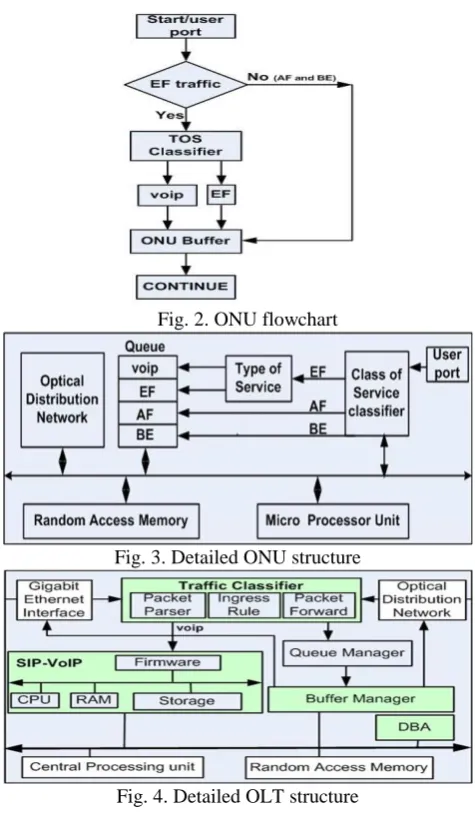
The first place where major effects happen is at the ONU. When the ONU receives all the packet types from the users, it passes all the packets to the Class of Service (COS) classifier, which separates the assured forwarding (AF) and best effort (BE) from the expedited forwarding (EF) traffic type. The COS then passes the EF to the Type of Service (TOS) classifier using the Diffserv mechanism. The TOS will identify the different services if they are ordinary EF traffic or they are from VoIP originating devices (voip) traffic type, and then separate them accordingly to EF queue and voip queue. The TOS then sends the two queues to the ONU buffer which now contains voip, EF, AF and BE queues. Figure 2 explains the flowchart of the ONA and Figure 3 shows us the ONU structure.
B. Architecture and Operation of OLT
After the ONU receives its grant message, it sends its buffer to the OLT. The packets are first sent to the COS for
identifications and separations. The COS will be able to identify the voip packets as they have already been separated by the ONU as shown in Figure 2.
The COS then sends the voip packets to the SIP-VoIP in the OLT as shown in Figure 4. All voip packet processing are done in the SIP-VoIP. The SIP-VoIP function is one of the added components of the OLT. It uses the FPGA mechanism to have the VoS server in built. The firmware in the SIP-VoIP will host the functions and algorithms necessary for the operation of the VoS. The central process unit (CPU) is for processing of voip packets and it uses the functions of the firmware to do the operation. The random access memory (RAM) will be used for buffering, and the storage will be used to store the databases and as well the registered users.
[image:3.595.305.543.91.498.2]The operation of the SIP-VoIP component is given in Figure 5. It is separated into two parts, where the public part can be accessed by the public users, and the private part which can only be accessed by the authorized users. The SIP Load-Balancer is used for protecting the underlying elements of the SIP server. As the name implies is can also be used as a load balancer if the system is scaled to more than just one pair of servers. SIP Proxy/Registrar is the busy bee of the SIP server. It handles user registrations, the authentication of end points. The Proxy Server also knows the location of Callee if a call is made to certain number, and check if it is in the same domain or else send it to the right proxy Server. SIP Back to
Fig. 2. ONU flowchart
Fig. 3. Detailed ONU structure
Back User Agent (B2BUA) uncouples the call-leg 1 (i.e. from the caller to the SIP Server) from call-leg 2 (which is from the SIP server to the callee). It also does topology hiding; it hides caller information where necessary, and outbound authentication. The SIP App-Server will be used for other voice applications like voicemail, and can also be used for reminder calls. The Media Relay is controlled by the SIP proxy. After the calls are authenticated and connected the media relay is called on for packet relay.
C. VoIP Dynamic Bandwidth Allocation (VoIP-DBA)
A new DBA is proposed called VoIP-DBA, which is designed to handle traffic allocation. When the OLT receives the REPORT message, it identifies the four different queues. The VoIP-DBA first checks its available bandwidth and the required bandwidth for the voip request and allocates all the requested bandwidth by the voip traffic. The VoIP-DBA then checks its remaining bandwidth and allocates bandwidth to the EF traffic as indicated by the report. After the voip and EF traffic has been allocated bandwidth it checks its remaining bandwidth and allocates the bandwidth to the requested AF traffic, and if there is any remaining bandwidth, then the BE traffic will also be allocated. In this case, priority is given to Voip then EF then AF and last is BE. The buffer manager which usually uses FIFO by the OLT for downstream transmission is redesigned to a priority queuing mechanism, and the highest priority is always given to the VoIP packets, followed by EF then AF and BE.
D. VoIP call handling.
One of the most important functions in VoIP is the INVITE function. The INVITE is a SIP method that specifies the action that the requester (Calling Party) wants the server (Called Party) to take. The INVITE request contains a number of header fields. Header fields are named attributes that provide additional information about a message. The ones present in an INVITE include a unique identifier for the call, the destination address, Calling Party Address, and information about the type of session that the requester wishes to establish with the server.
Figure 6 shows the flowchart of the voip call handling in the EPON. The caller initiates an INVITE function, which is received by the ONU. The COS in the ONU will handle the packet as EF traffic and send it to the TOS for further classification. The TOS will then separate it accordingly to voip or EF. Then the voip packet is sent to the buffer. After the ONU has been granted time for transmission, the voip packet is then sent to the OLT, which will separate the voip
packet from the other packets by using the COS and is sent to the SIP-VoIP for processing.
When SIP-VoIP receives the invite packet, the message first passes through the load balance the to the SIP proxy server, which will check if the user is authorized in the callers authentication credentials. The SIP proxy confirms if the called party is a local user or in another domain; in this case, all calls are in the same EPON architecture. If it is a registered user, the Proxy will replace the Request URI with the URI of the registered contact. When the proxy has completed the necessary calling features, and the destination of the called party is determined, it invokes the Media Relay and the copy of the INVITE message is sent to the SIP B2BUA. The function of the SIP B2BUA will be to copy only explicitly allowed headers to a new INVITE message another function can be to force audio calls to use specific codec. The new message is then sent to the callee through the SIP load-balancer. The callee sends its replies through the same elements. The media relay is called on again to prepare the recommended ports for media stream. Once the message has been sent from the callee to the caller, and all other features are negotiated, the end points can now send traffic to each other either through the media relay or end-to-end. When the call ends, either of the parties can end call by sending a BYE message, the SIP proxy will inform the media relay to close the ports. After the processing, the packet is then sent to the buffer, where it is then sent to the right destination in the PON.
IV. PERFORMANCEEVALUATION
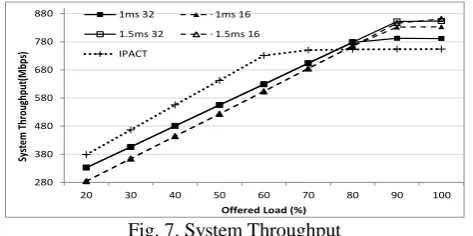
[image:4.595.363.490.83.259.2]The proposed architecture is analyzed in terms of packet delay, system throughputs, and packet loss. The simulation scenario is shown in Table I. The system model is set up in the OPNET simulator with one OLT and 16 and 32 ONUs. The downstream/upstream channel rate is 1Gbps between OLT and ONU. The distance from the OLT to ONUs is uniform in the range from 10 to 20km. The ONU buffer size is set to 10Mb. The self-similarity and long-range dependence is used as the network traffic model for AF and BE. This model generates highly bursty AF and BE traffics with Hurst parameter of 0.7. The packet size is uniformly distributed between 64 to 1518 Bytes.
Fig. 6. Operation of the SIP-VoIP
[image:4.595.51.292.178.301.2]Table I. Simulation Parameters
The high-priority traffic i.e., voip and EF traffic is modeled using Poisson distribution with constant packet size 169Bytes and 70Bytes respectively. The EF packet inter-arrival time is fixed 125µs. The EF traffic is fixed at 4.48Mbps (~14%) and the remaining shared according to the following portion; voip, BE and AF is set to 30%, 35% and 35% of total traffic respectively. The simulation result is compared with the original Interleave Polling with Adaptive Cycle Time (IPACT) DBA [11].
A. System Throughput
The system throughput in the proposed architecture is sum of the traffic between the OLT and ONUs. Figure 7 shows the system throughput in the different scenarios versus the offered load with 32 and 16 ONUs. The result shows the system throughput of the proposed architecture which is the VoIP-DBA performs better than the original IPACT DBA at 1ms cycle time. When the voip packets are included, the total system throughput is increased, because of the usage of the unused remainder, guard time, of every cycle by the voip packets. And it is observed that 1.5ms cycle time is the best option when considering the throughput.
B. Jitter
If the jitter is too large, this can cause delayed packets to be put aside, which will result in audible gaps. As discussed earlier, voice becomes unintelligible when a number of sequential packets are dropped. Jitter should be kept to a minimum. The delay variance
2, jitter, is calculated as
d
D
N
N EF
i
/
2
1
2
, where
d
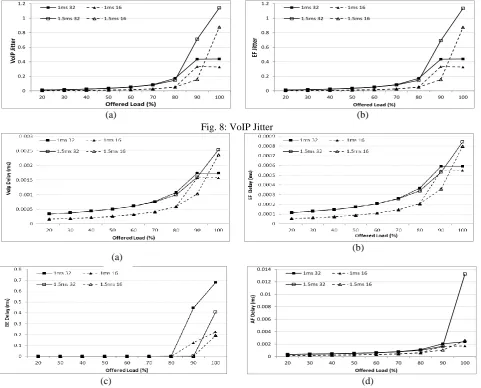
iEF is the delay time of EF packet i and N is thetotal number of received EF packets. The same was also done voip packets. Figure 8 shows the jitter for the different traffic types in the different scenarios versus the offered load with 16 and 32 ONUs. In both figures we can observe a slight rise of jitter when load is increased from 80% to 100%, and in both cases we can see that the jitter was quite acceptable as it was lower than the threshold of voip jitter as explained earlier. And due to the similarities and related features of the EF and voip packet types the pattern of the graphs is seen to look the same, but with different values.
C. Packet Delay
The mean packet delay is when the packets arrive at the ONU at random times. Each packet has to wait for the time slots in order to transmit in the upstream direction. This waiting time is referred as the packet delay which consists of the polling delay, granting delay and queuing delay. Figure 9 shows the mean packet delays for the different traffic types in the different scenarios versus the offered load with 16 and 32 ONUs. The voip delay as shown in figure 9(a) increased a bit when the offered load is increased from 80% to 100%. The delay is still quite small; when compared to the accepted delay for voip packets. Figure 9(b),(c),(d) which is EF Delay, AF Delay and BE Delays respectively were also recorded, and the results show us the values attained were very small and can be accepted in all cases. And due to the similarities and related
features of the
EF and voip packet types the pattern of the graphs is seen to look the same, but with different values.
Packet loss will occur because of the limitation of ONU buffer size. Due to queue length some packets should wait for multiple cycle times. The longer the packets wait in the queue causes the queue to get full and lower priority packets are dropped. There was few recordings of BE packet drops. As mentioned earlier voip packets droppings can only be accepted if the dropping is less than 2%. Our simulation results showed no packet drop for voip in all the different scenarios.
Simulation Environment Value
Number of OLT 1
Number of ONUs 16, 32
Up/Down link capacity 1 Gbps OLT-ONU distance (uniform) 10-20 Km
Max cycle time 1ms, 1.5ms
Guard time 5 µs
DBA Computation 10 µs
Control message length 0.512 µs
ONU buffer size 10 Mb
AF and BE packet size (Byte) Uniform (64, 1518) EF packet size(Byte) Constant (70) VoIP packet size(Byte) Constant (160)
280 380 480 580 680 780 880
20 30 40 50 60 70 80 90 100
Sy
ste
m
Th
ro
ug
hp
ut(
M
bp
s)
Offered Load (%)
[image:5.595.53.290.527.645.2]1ms 32 1ms 16 1.5ms 32 1.5ms 16 IPACT
V. CONCLUSION
With the introduction of the VoIP Server in the OLT, the packet voip packet processing will be done in the OTL. The proposed VoIP-DBA will handle the voip packets, and make sure that the required bandwidth for VoIP service is satisfied. This will eliminate the usual delay that occurs when VoIP servers are located outside the EPON. The recorded for delay for voip packets is less than 1ms. The simulation results show that there were no packet losses for voip and there is the sufficient amount of bandwidth to handle all VOIP calls. To decrease cost, network and service providers can incorporate the SIP-VoIP component in the OLT. This architecture can be further implemented with multiple PONs. Where in each VoIP-OLT will act as a proxy server for handling call redirecting if the called party is not in the same EPON architecture.
REFERENCES
[1] Available online: http://www.itu.int/en/ITU-D/Statistics/Pages/stat/ default.aspx.
[2] P.V. Mockapetris, “Telephony's next act,” IEEE Spectrum, vol. 43, issue. 4, pp. 28-32, April 2006.
[3] K. Salah, “On the deployment of VoIP in Ethernet networks: methodology and case study,” Computer Communications, vol. 29, issue 8, pp. 1039-1054, May 2006.
[4] I. Basicevic, M. Popovic and D. Kukolj, “Comparison of SIP and H.323 Protocols,” in The Third International Conference on Digital Telecommunications, pp.162-167, 2008.
[5] B.S. De, P.P. Joshi, V. Sahdev and D. Callahan, “End-to-end voice over IP testing and the effects of QoS on signaling”, in Proceedings of the 35th Southeastern Symposium on System Theory Morgantown, pp. 142–147, 2003.
[6] Available online: http://www.sipwise.com/doc/2.8/handbook-ce.pdf.
[7] I.S. Hwang, A. Nikoukar, C.H. Teng and K.R. Lai, “Scalable Architecture for VOD Service Enhancement Based on a Cache Scheme in an Ethernet Passive Optical Network,” Journal of Optical Communication and Networking, vol. 5, issue. 4, pp. 271-282, 2013. [8] J.S. Li, H.C. Kao and W.H. Lin, “Achieving maximal VoIP calls in
802.11 wireless networks,” Computer Communications, vol. 33, issue. 11, pp. 1296-1303, July 2010.
[9] G. Wu, D. Liu, Y. Chang, and C. Zhang “The implementation of TDM service in EPON system,” in SPIE 6784 Network Architectures, Management, and Applications V, 67843J, 2007, doi:10.1117/ 12.743418.
[10] S. Sharafeddine, A. Riedl, J. Glasmann and J. Totzke, “On traffic characteristics and bandwidth requirements of voice over IP applications,” in Eighth IEEE International Symposium on Computers and Communication, pp.1324-1330, 2003.
[11] L. Cai, Y. Xiao, X. Shen and J.W. Mark, “VoIP over WLAN: Voice capacity, admission control, QoS, and MAC,” International Journal of Communication Systems, Vol. 19, issue. 15, pp. 491-508, 2006. [12] G. Kramer, B. Mukherjee; G. Pesavento, “IPACT a dynamic protocol
for an Ethernet PON (EPON),” IEEE Communications Magazine, vol. 40, issue. 2, pp. 74-80, 2002.
0 0.2 0.4 0.6 0.8 1 1.2
20 30 40 50 60 70 80 90 100
VoI
P
Jit
te
r
Offered Load (%)
1ms 32 1ms 16 1.5ms 32 1.5ms 16
0 0.2 0.4 0.6 0.8 1 1.2
20 30 40 50 60 70 80 90 100
EF
Jit
te
r
Offered Load (%)
1ms 32 1ms 16 1.5ms 32 1.5ms 16
[image:6.595.60.542.62.450.2](a) (b) Fig. 8: VoIP Jitter
(b)
0 0.002 0.004 0.006 0.008 0.01 0.012 0.014
20 30 40 50 60 70 80 90 100
AF
D
el
ay
(m
s)
Offered Load (%)
1ms 32 1ms 16 1.5ms 32 1.5ms 16
(c) (d)