JOURNAL OF FOREST SCIENCE, 61, 2015 (12): 526–534 doi: 10.17221/50/2015-JFS
Residual damage in different ground logging methods
alongside skid trails and winching strips
N. Badraghi
1, J. Erler
2, S.A.O. Hosseini
31Global Change Research Centre, Academy of Sciences of the Czech Republic, Brno, Czech Republic
2Department of Forest Technology, TU Dresden University, Tharandt, Germany
3Department of Forestry and Forest Economics, University of Tehran, Iran
ABSTRACT:To assess the residual damage a 100% inventory method was employed in pre-hauling and post-hauling, alongside skid trails and winching strips. Inventory was executed within 6 m from each side of the skid trail or winching strip centreline (12 m width). Besides the data analysis to choose the best alternative depending on residual damage the Analysis of Multiple-criteria Approval (MA) was applied. In the winching strip, our results demonstrated that de-pending on the density of standing residual trees the most unfriendly alternative to standing trees was a short-length method (SLM) which damaged 27.9% of the total standing trees and the best alternative was a tree-length method (TLM) (11.89%). The most unfriendly alternative to regeneration in winching and skidding operations was SLM with damaged 21% and 9% of all seedlings, respectively. In the winching strip TLM is the best alternative depending on the number of damage trees but 72% damage degree was deep. Alongside the skid trails the highest number of damaged trees occurred in TLM (44 stems) and the lowest was in the long-length method (LLM) (10 stems); according to the density of trees also the greatest damage to trees occurred in TLM (16.73%) and the lowest was in LLM (3.13%). In addition (in winching and skidding operations), 14.31, 8.79 and 18.19% of residual trees and 9, 11 and 16% of individu-als of regeneration were damaged in TLM, LLM and SLM, respectively. The results of data analysis (by SPSS and MA) indicated that the friendly alternative to residual stand in the north of Iran is a long-length method.
Keywords: long-length method (LLM); short-length method (SLM); skidding and winching operations; tree-length method (TLM)
When developing a feasible harvesting system, the mechanized harvesting machines should be as-sessed based on their production rates, unit costs and also on their impacts on a forest ecosystem, be-cause mechanized harvesting operations can have a long-lasting effect on a residual stand in the forest. So logging managers need to understand the capa-bilities of harvesting machines and know how to re-duce their damage to the remaining stand (Akay et al. 2006). Today, there is an interest in using alter-native silvicultural systems like selection and two-aged management, because the public finds these systems more acceptable than clear cutting. How-ever, repeated entries into a forest stand to remove timber increase the risk of residual stand damage (Ficklin et al. 1997). Ficklin et al. (1997) reported that 22% of the residual trees were damaged by the
skidder system while the reported amount by Ez-zati and Najafi (2010) was 18.83%, Tavankar et al. (2011) 14.1% of damaged trees and 0.63% of destroyed trees, Tavankar et al. (2010) 13.2% damaged and 2.3% destroyed, Nikooy et al. (2010) reported 19.7%, Naghdi et al. (2009) 19.04%, and Tavankar (2000) 8.1% of trees.
that the most common type of damage was uproot-ing and damage to trees alongside skid trails was significantly more severe than damage in logging gaps and winching strips (Solgi, Najafi 2007; Ez-zati, Najafi 2010; Tavankar 2010). In contrast, some researchers collected data showing that a winching operation is the main cause of destroying the standing residual trees (Jajson et al. 2002; Mo-savi 2008; Stanczykiewicz 2010; Tavankar et al. 2012). On average, 9.8 trees were damaged per each tree extracted in the Caspian forest (Behjou, Ghafarzade 2012), when the observed amount in India was 2.6 trees per acre while skidding caused 71% and felling 29% of these injuries (Reisinger, Pope 1991). In the research area of Jakson et al. (2002), on average 44 trees were damaged per each tree extracted, which included 22 trees killed or se-verely damaged when 6 of them being commercial species. In the study by Tavankar et al. (2010) per each hectare of harvested area, 30 stems of residual trees were damaged and 1.3 stems were destroyed by logging operation. Most of the wounds on the bole of trees occurred below 1 meter height (Sol-gi, Najafi 2007; Tavankar et al. 2010). Most of deep wounds occurred on the stump area (Han, Kellogg 2000a; Tavankar et al. 2010). Also, the results of their studies showed that per each hect-are of harvested hect-areas, 160 stems of stand regenera-tion were damaged and 227 stems were destroyed by logging operation. About 6% of stand regenera-tion were damaged and 8% of them were destroyed. Their recent studies demonstrated that the per-centage of destroyed and injured residual trees was 5.2 and 11.1%, respectively (Tavankar et al. 2013) and 16.9% of regeneration was damaged by logging operation (Tavankar et al. 2012).
Although several studies about standing tree and regeneration damage by ground systems have been done in Iran until now (as mentioned above), few studies compared these objectives between harvesting alternatives. For instance Mosavi (2008) compared the residual damage caused by LLM and SLM in northern Iran; research results showed that in winching strips, the percentage of damage to residual stand was 32.2 and 37.7% and in skid trails the percentage of damage was 25.7 and 34.9% in short-log and long-log method, respec-tively. With regard to damage to residual stand, the short-log method was more environmental friendly than the long-log method. Also, Han and Kellogg (2000b) compared damage caused by four common harvesting systems in western Or-egon: tractor, cut-to-length (forwarder and har-vester), skyline, and helicopter. Scarring was the
most typical damage to crop trees, accounting for 90% of the total damage in most cases. Dam-age levels greatly decreased as the minimum scar size that defines damage was increased. Scarring by ground-based systems was more severe: scars were larger, and gouge and root damage were more prevalent than in skyline and helicopter sys-tems. Damaged trees were concentrated within 4.6 m of skid trails or skyline corridor centrelines. In the cut-to-length system, the harvester caused more wounding (70%) to crop trees than did the forwarder (30%), but forwarder scars were larger and sustained severe gouging. Also, their study in-dicated that helicopter logging caused scars high-est above the ground, followed by skyline, cut-to-length, and tractor logging. On average, scarring from tractor thinning was significantly lower on the bole than for any other logging system. The amount of scarring below 61 cm was 2% in heli-copter, 17.5% in skyline, 29.3% in cut-to-length, and 64% in tractor units. In the cut-to-length sys-tem, scars caused by the harvester were slightly lower on average than those from the forwarder; 63% of the harvester-created scars were lower than 1.2 m, versus 57% from the forwarder. In the case of the harvesting by a processor, the level of damage to trees was 1.0–5.2% while with the use of winches it was 1.2–5.4%. In the regeneration layer, the level of damage when the processor was used ranged from 5.9 to 17.9% whereas harvest-ing with the winches caused damage between 11.8 and 17.1% (Stanczykiewicz 2010).
Forest harvesting is composed of four key com-ponents including tree felling, primary transpor-tation, loading, and secondary transportation. Primary wood transportation is one of the most important and most expensive parts of forest uti-lization. Before the 20th century, wood
MATERIAL AND METHODS
Site description. This study was conducted in three compartments of the Wood Industry of Farim which belong to Caspian forests. Tree-length method (TLM) was carried out in compartment 46; long-length method (LLM) and short-length meth-od (SLM) were carried out in compartment 107 and 41, respectively (Table 1). Elevation is approxi-mately 445–2,250 m a.s.l. with a north and north-western aspect. The original vegetation of this area is an uneven-aged mixed forest dominated by Fa-gus orientalis and Carpinus betulus, with the com-panion species Alnus subcordata, Acer platanoides,
Acer cappadocicum, Ulmus glabra and Tilia rubra. The soil type is forest brown soil and the soil tex-ture varies between clay-loam and silty-clay. The average annual rainfall recorded at the closest na-tional weather station is 845.5 mm and the mean annual temperature is 11.5°C. At the study site, the silvicultural system was applied as a combination of group selection and single tree selection. The to-tal volume of primary transportation was carried out by skidders to landing areas that were prepared at the border of the road in the lower part of all compartments (46, 107 and 41). Timberjack 450C rubber-tired skidder used in this study was a nor-mal articulated, four-wheel-drive vehicle weighing 10.3 t (55% on the front and 45% on the rear axle) with engine power of 177 hp (132 kW) and engine model of 6BTA5.9. It is equipped with a blade for light pushing of obstacles and stacking of logs. The skidder was fitted with tires of the size 24.5–32 in-flated to 220 kPa on both front and rear axles, it had a ground clearance of approximately 0.6 m. Timber bunching was carried out by the winch that was installed in the near part of the skidder from the stump to the skidder and one end of the dragged round wood was in touch with the ground (Jourg-holami, Majnounian 2013). Height, length and width of the machine were 3 m, 6.28 m and 3.1 m, respectively.
Data collection. To assess damage to residual standing trees a 100% inventory method was em-ployed in pre-hauling and post-hauling, alongside
the skid trails and winching strips. Inventory was executed within 6 m from each side of skid trails or winching strip centreline (width 12 m). Roadbeds of skid trails were clear of regeneration and trees but the ground of winching strips was a part of forest land with regeneration and trees. Therefore seedlings and trees in the skid trails and winching strips were inventoried and evaluated separately.
Prior to carry out a pre-harvesting 100% invento-ry, skidding operations, landing locations and ma-jor extraction and winching routes were identified by the skidder operator or chaser man and marked. The skidding and winching distances were mea-sured by a tape and recorded on paper. For counting the total trees alongside the skid trails, we started walking on the skid trails from the start point of the skid trails (it was close to the landing area) to the end point of the skid trails and also on the winch-ing strips, all trees greater than 12 cm in diameter at breast height (DBH) within 6 m from each side of the centreline of skid trails and winching strips were counted. Total seedlings and regeneration (diameter less than 12 cm) alongside the skid trails and on the winching strips were surveyed.
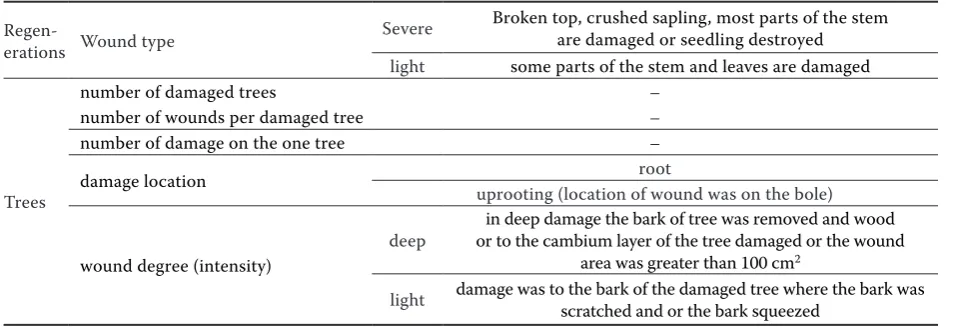
[image:3.595.63.533.671.736.2]After finishing the logging operation, a field study was carried out again to analyse the residual trees and stand regeneration. The total number of dam-aged trees and seedlings was counted alongside the skid trails and winching strips. The wound type of damaged regeneration was classified in two classes: (i) severe (broken top, crushed sapling, most parts of the stem are damaged or seedling destroyed), and (ii) light (some parts of the stem and leaves are damaged). The damage to standing trees was re-corded by the number of damaged trees, number of wounds per damaged tree, number of injuries on one tree, damage location (root and uprooting) and wound degree (intensity) which was classified in two classes: (i) light, in light injury damage was caused to the bark of the damaged tree where the bark was scratched or the bark was squeezed, and (ii) Deep, in deep damage the bark of the tree was removed and wood or the cambium layer of the tree was damaged or the wound area was larger than 100 cm2 (Table 2).
Table 1.Characteristics of study compartments
Compartment
(alternative) Compartment area (ha) Protected area (ha) Stand density (trees·ha–1) (mVolume 3·ha–1) extracted wood (mTotal volume of 3)
46 (TLM) 66 3 205 252 307
107 (LLM) 39 2 153 170 292
41 (SLM) 85 34 260 220 311
Statistical analysis. Statistical analyses were performed by SPSS software (SPSS, Tulsa, USA), paired t-test was employed to test the pre- and post-harvesting number of healthy residual trees in winching strips and alongside the skid trails with a 95% confidence level.
Multiple-criteria approval (MA). Also, to choose the best alternative depending on residual damage, multiple-criterial approval (1 – analysis of MA, 2 – sensitivity analysis of MA) was used as described by Palander and Laukkanen (2006), and Lauk-kanen et al. (2004, 2005). Multicriteria approval (MA) is an application of approval voting specifical-ly developed for multicriteria decision support. The basic version of MA is a decision support system for one decision-maker (Lankkanen et al. 2004). In MA, in the first step the criteria values for the al-ternatives were determined and in the next step ap-proval limits were defined for each criterion. Based on the limits, alternatives are defined to be approved (+) or disapproved (–) with respect to each criterion. The limit between approval (+) and disapproval (–) for each criterion is the mean value, but the median of the criteria values can be used (Palander, Lauk-kanen 2006). In this study, both limits, i.e. median values and mean values were used. The composite criteria for standing tree damage were: C1 – dam-age to standing tree by skidding (%), C2 – damdam-age to standing tree by winching (%), C3 – damage to regeneration by skidding (%), C4 – damage to regen-eration by winching (%), C5 – total tree damage (%), C6 – total seedling damage (%), C7 – one damaged tree per productivity rate (m3), C8 – one damaged
individual of regeneration per productivity rate (m3),
C9 – degree of damage (tree) (%), C10 – degree of damage (regeneration) (%).
Analysis of MA. To analyse MA, the approval limit was the median for each criterion. In this study, in order to define the approval (+) and
dis-approval (–) at quantity criteria, for each criterion the value was marked as approved (+) if the value was above the median value or equalled it while it was marked as disapproved (–) if the value was less than the median. At the value which was expressed in percentages (%), the mark was (+) if the value of the criterion was less than the median value or equalled it and above it was (–). To choose the best alternative, approvals (+) for each alternative were added up. That alternative with the highest number was regarded as the optimal alternative.
Sensitivity analysis of MA. In the case of sensi-tivity analysis of MA, the approval borderline was the mean; if the value of the criterion was above the mean value or equalled it, the mark was set to (+), which means approval, and if it was less than the mean, it was marked as disapproval (–). At the per-centage value of criteria, if the value of the criterion was less than the mean value or equalled it, it was (+) and above it was (–).
To choose the best alternative in the analysis of MA and sensitivity analysis of MA with respect to all criteria the alternative that received higher approv-als (+) is acceptable between all alternatives. The al-ternative that was dominant in approval was the best alternative in the sensitivity analysis of MA.
RESULTS
Pre-harvesting and post-harvesting tree inventory on winching strips and skid trails
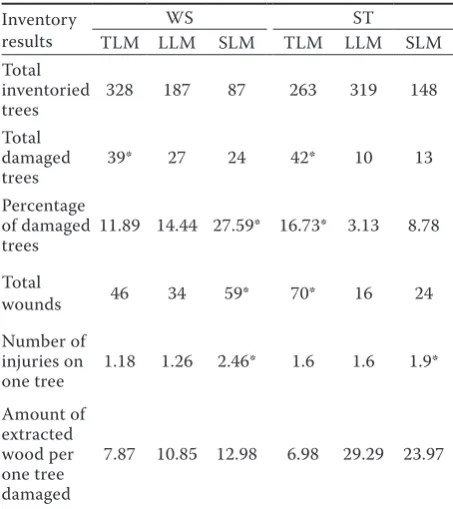
[image:4.595.62.539.73.237.2]In the winching area, Table 3 shows the amount of inventoried trees, whole damaged trees, per-centage of damaged trees to inventoried trees (%), total wounds on damaged trees and the amount of extracted wood per one tree damage in TLM, LLM and SLM. Table 3 also demonstrates that the worst
Table 2. Damage classification for individuals of regeneration and trees
Regen-erations Wound type Severe
Broken top, crushed sapling, most parts of the stem are damaged or seedling destroyed
light some parts of the stem and leaves are damaged
Trees
number of damaged trees –
number of wounds per damaged tree –
number of damage on the one tree –
damage location uprooting (location of wound was on the bole) root
wound degree (intensity)
deep or to the cambium layer of the tree damaged or the wound in deep damage the bark of tree was removed and wood area was greater than 100 cm2
alternative depending on the percentage of dam-aged trees, number of injuries on one tree and the amount of wounds on the bole of damaged trees is SLM and the best alternative is TLM in the winch-ing area. But dependwinch-ing on the amount of extracted wood due to damage to one tree SLM is the best alternative and TLM is the worst alternative.
Alongside the skid trails, presented values in Ta-ble 3 indicated that the worst alternative depending on the percentage of damaged trees to total trees, amount of wounds on damaged trees and the amount
of extracted wood due to one damaged tree is TLM and depending on results of this Table, the best al-ternative could be LLM in skidding operations.
Location and degree of damage
Table 4 shows the results of the location and de-gree of injury in TLM, LLM and SLM. About 40, 68 and 71% of injuries occurred in the winching strip while 60, 32 and 29% of injuries occurred during skidding operations; 21, 28 and 32.5 % of injuries were located on the roots whilst about 79, 72 and 66.5% of injuries were located on the bole of trees (uprooting); about 77, 18, 34 of injuries were deep and severe while 23, 82, 66% of the injuries were light in TLM, LLM and SLM, respectively. In total, the statistical analysis showed no significant dif-ference between the numbers of healthy standing trees in pre-harvesting and post-harvesting in the winching strip (P = 0.071) and alongside the skid trails (P = 0.176). As can be seen, the p-value along-side the skid trails is higher than in the winching strip; it shows that the number of damaged trees during skidding operations was lower than in winching operations.
Pre-harvesting and post-harvesting seedling inventory on winching strips and skid trails
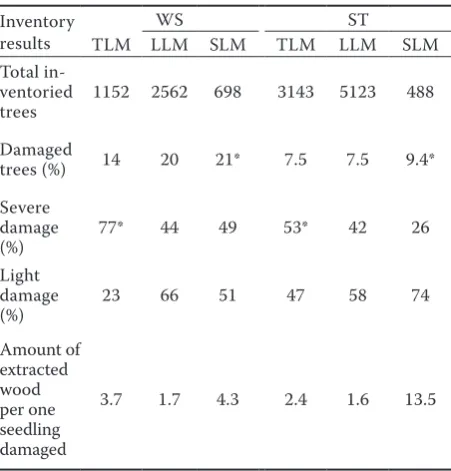
[image:5.595.63.290.98.353.2]The results of pre- and post-harvesting seedling survey alongside the skid trails and winching strip are presented in Table 5. As you can see in Table 5, the highest amount of damage was caused by SLM in the winching strip (21%) and alongside the skid trails (9.4%). Due to winching operations 3.7, 1.7, and 4.3 m3 of wood and due to skidding operations
Table 3. Results of pre-harvesting and post-harvesting of trees on the winching strip (WS) and alongside the skid trails (ST)
Inventory
results TLM LLM SLMWS TLM LLM SLMST Total
inventoried
trees 328 187 87 263 319 148
Total damaged
trees 39* 27 24 42* 10 13
Percentage of damaged
trees 11.89 14.44 27.59* 16.73* 3.13 8.78 Total
wounds 46 34 59* 70* 16 24
Number of injuries on
one tree 1.18 1.26 2.46* 1.6 1.6 1.9* Amount of
extracted wood per one tree damaged
7.87 10.85 12.98 6.98 29.29 23.97
[image:5.595.64.534.580.734.2]TLM – tree-length method, LLM – long-length method, SLM – short-length method, *indicates the highest amount of damage between alternatives in WS and ST
Table 4. Location and degree of damage in TLM, LLM and SLM
Alternative Operation area Total damage in operation area (%)
Location and degree of damage (%)
root uprooting (bole)
damage severe light damage severe light
TLM winching skidding 4060 2419 10069 310 7681 10054 460
total 100 21 83 17 79 72 28
LLM winching skidding 6832 2925 200 10080 70.575 299 7191
total 100 28 14 86 72 22 88
SLM winching skidding 7129 3917 430 10067 6183 406 6094
total 100 33 37 63 67 30 70
2.4, 1.6and 13.5 m3 one seedling were damaged in
TLM, LLM and SLM, respectively. In the winching strip, about 77, 44 and 49% of the seedling dam-age was so severe that most parts of the stem were damaged while it was about 53, 42 and 26% along-side the skid trails in TLM, LLM and SLM, respec-tively (Table 5). The statistical analysis showed that the number of healthy individuals of regeneration in pre-harvesting and post-harvesting in skidding operations (P = 0.149) and winching operations (P = 0.081) was insignificant.
Multiple criteria approval (MA)
Table 6 shows the determined values of criteria for the timber harvesting alternatives and the val-ues of the mean and median.
Analysis of MA and sensitivity analysis of MA
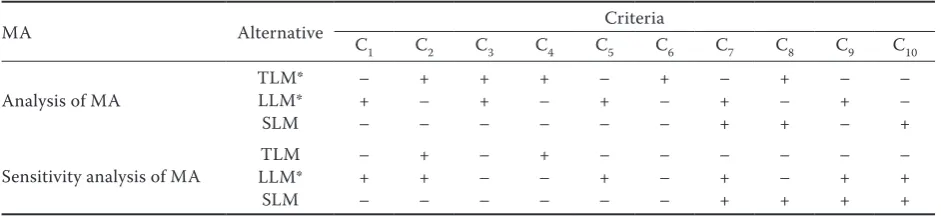
[image:6.595.64.290.97.333.2]The results of the analysis by MA indicated that if the approval borderline was median, TLM and LLM were dominant in approval (+) and SLM was dominant in disapproval (–). Therefore, the best alternatives are TLM and LLM and the most un-friendly alternative to residual damage is SLM
Table 5. Results of pre-harvesting and post-harvesting of seedlings on the winching strip (WS) and alongside the skid trails (ST)
Inventory
results TLM LLM SLMWS TLM LLMST SLM Total
in-ventoried
trees 1152 2562 698 3143 5123 488 Damaged
trees (%) 14 20 21* 7.5 7.5 9.4* Severe
damage
(%) 77* 44 49 53* 42 26
Light damage
(%) 23 66 51 47 58 74
Amount of extracted wood per one seedling damaged
3.7 1.7 4.3 2.4 1.6 13.5
[image:6.595.304.533.473.635.2]TLM – tree-length method, LLM – long-length method, SLM – short-length method, *indicates the highest amount of damage between alternatives in WS and ST
Table 6. Criteria values, mean and median values
Cri-teria TLM AlternativeLLM SLM Mean Median
C1 16.73 3.13 8.78 7.16 8.78
C2 11.89 14.44 27.59 18 14.44
C3 7.5 7.5 9.4 8.1 7.5
C4 14 20 21 18.33 20
C5 14.31 8.79 18.19 13.76 14.31
C6 9 11 16 8.66 11
C7 7.43 20.1 18.48 15.31 18.48
C8 1.45 0.84 3.25 2.36 1.45
C9 72 20 30 40.66 30
C10 65 43 37.5 48.5 43
C1 – damage to standing trees-skidding (%), C2 – damage to standing trees-winching (%), C3 – damage to regeneration-skidding (%), C4 – damage to regeneration-winching (%), C5 – total tree damage (%), C6 – total seedling damage (%), C7 – one damaged tree per productivity rate (m3), C
8 – one damaged individual of regeneration per productivity rate (m3), C9 – degree of damage (tree) (%), C10 – degree of damage (regeneration) (%),TLM – tree-length method, LLM – long-length method, SLM – short-long-length method
(Table 7). The results of the sensitivity analysis of MA showed that by using the mean as a borderline, LLM was dominant in approval (+), thus the best alternative is LLM, and the most unfriendly alter-native to residual damage is TLM (Table 7).
DISCUSSION
Mechanized harvesting operations can have a long-lasting effect on residual trees in the forest stand while the long-term effect of residual stand damage on site productivity is still unclear. There-fore logging managers need to understand the ca-pabilities of harvesting machines and know how to reduce the amount of the residual damage caused by them (Ficklin et al. 1997; Akay et al. 2006).
of residual trees were damaged. However, the re-sults of the analysis of the significance showed no significant differences (P = 0.071 and P = 0.176). The statistical analysis showed that the number of healthy individuals of regeneration in pre-harvest-ing to post-harvestpre-harvest-ing alongside the skid trails and winching strips (P = 0.149 and 0.081, respectively) is not significant but the p-value of the winching strip is close to 0.05, which shows that the greatest damage to regeneration occurred in the winching strip. Therefore, in all logging operations residual damage (seedling and tree damage) in the winch-ing operation was greater than in skiddwinch-ing opera-tions. It is similar to the results of other researchers who reported that the greatest damage was caused by winching operations (Jakson 2002; Mosavi 2008; Stanczykiewicz 2010). In contrast, a few researchers reported that skid trails were an impor-tant contributing factor to residual stand damage (Ezzati, Najafi 2010; Tavankar 2010; Behjou, Ghafarzade 2012).
In addition, 14.31, 8.79 and 18.19% of residual trees were damaged and 9, 11 and 16% of regenera-tion were damaged by TLM, LLM and SLM in log-ging operations (in winching and skidding opera-tions), respectively. This range of residual damage is similar to results of Ficklin et al. (1997); Ta-vankar (2000); Mousavi (2008); Naghdi et al. (2009); Tavankar et al. (2010, 2011, 2012, 2013); Ezzati and Najafi (2010); Nikooy et al. (2010) when they reported that the amount of damage was between 8.1 and 37.7% of the total of trees. In other words, the lowest damage reported by these researchers was 8.1% and the highest damage re-ported by these researchers was 37.7% of the total of trees. Researchers who have written that for the Forest Resources Association (formerly the Amer-ican Pulpwood Association) believe that 10%
dam-age is a worthy goal and that damdam-age exceeding 25% in any partial harvest operation is unaccept-able in northeastern hardwood stands (Gillespie 2001). In addition, in all operational treatment areas (winching and skidding operations) SLM was the worst alternative and LLM was the best alternative to standing residual trees depending on density (density of standing residual trees). In the winching strip, the best alternative was TLM and the worst alternative was SLM and alongside the skid trail the best alternative was LLM and the most unfriendly alternative was TLM, which is the only alternative that causes greater damage in skidding operations than in the winching area. These results indicated that with a reduction of log length, the environmental impact would not decrease because damage in LLM is lower than in SLM. The analysis of MA and sensitivity analysis of MA indicated that best alternative depend-ing on residual damage is LLM. This result is in contrast with Mousavi (2008) reports, who pre-sented that the best alternative is SLM. Depend-ing on the author’s observations, we can execute TLM in the north of Iran, at least for trees whose diameter is less than 40 cm, because much of the skidding damage was caused by carelessness, and could have been avoided (Reisinger, Pope 1991). Residual damage should not be considered based only on the amount of residual damage and density but also the amount of residual damage relative to the amount of production rates should be consid-ered. In our research one tree damaged to extrac-tion 7.43, 20. and 18.48 m³ in logging operaextrac-tion and for every damaged regeneration 1.45, 0.84 and 3.25 m³ in TLM, LLM and SLM, respectively, also some researchers such as Reisinger and Pope (1991); Jakson et al. (2002); Behjou and Gha-farzade (2012), reported that the standing
dam-Table 7. Results of analysis of MA and sensitivity analysis of MA
MA Alternative C Criteria
1 C2 C3 C4 C5 C6 C7 C8 C9 C10
Analysis of MA TLM*LLM* –+ +– ++ –+ +– –+ +– –+ +– ––
SLM – – – – – – + + – +
Sensitivity analysis of MA LLM*TLM –+ ++ –– –+ +– –– +– –– +– –+
SLM – – – – – – + + + +
*the winning alternative, – indicatesdisapproval, + indicates approval, C1 – damage to standing trees–skidding (%), C2 – dam-age to standing trees–winching (%), C3 – damage to regeneration–skidding (%), C4 – damage to regeneration–winching (%), C5 – total tree damage (%), C6 – total seedling damage (%), C7 – one damaged tree per productivity rate (m3), C
8 – one damaged individual of regeneration per productivity rate (m3), C
[image:7.595.63.534.73.181.2]age amount for every tree extracted. Regarding the production rate, the most unfriendly alternative to environment was TLM and the best alternative was LLM but in regard to damage to regeneration (due to the production rate) the best alternative is SLM and the most unfriendly alternative is LLM. Eroglu et al. (2009) reported that timber harvest-ing techniques resulted in damage to residual trees, seedlings, and timber products, but the degree of damage caused by the harvesting techniques was significantly different. The highest level of damage was caused by manpower; they suggested that the damage caused by logging can be minimized by the use of proper timber harvesting techniques. Most of tree damage in TLM was deep (72%) whilst in LLM and SLM 20 and 30% of injuries were deep, respectively. In TLM and SLM severe damage was caused to the roots but in LLM it was caused to the tree’s bole (we do not know the reason), also in Han, Kellogg (2000b) research the most se-vere damage occurred to the roots. The major portion of damage occurred on the tree’s bole (up-rooting) which is similar to other researchers’ ob-servations (Han, Kellogg 2000a; Jakson et al. 2002; Tavankar et al. 2010; Behjou, Ghafar-zade 2012; Tavankar et al. 2013). On the other hand, the highest number of wounds to the bole of each damaged tree was observed in SLM: about 1.85 wounds/to the bole of one damaged tree in the skidding operation and 2.46 wounds/to the bole of one damaged tree in the winching opera-tion whilst the lowest number of wounds was in TLM, about 1.6 wounds per one damaged tree in the area alongside the skid trail and 1.18 wounds per damaged tree in the winching operation. For the extraction of one tree in TLM only one winch-ing operation is done while in SLM to extract one tree several winching operations are done. Prob-ably, it can be the reason for the highest residual damage in SLM in the winching strip.
References
Akay A.,Yilmaz M., Tongue F. (2006): Impact of mechanized harvesting machines on forest ecosystem: Residual stand damage. Journal of Applied Sciences, 11: 2414–2419. Barari K., Sotoudeh Foumani B., Nobakht A., Moafi M.,
Ashrafi S.B. (2011): Time study and efficiency (production and costs) of wheeled skidder HSM 904 in Caspian forests. Word Applied Sciences Journal, 14: 726–730.
Behjou F.K., Ghafarzade O. (2012): Selective logging and damage to unharvest trees in Hyrcanian forest of Iran. Journal of BioResource, 7: 4867–4874.
Eroglu H., Oztürk U.O., Sonmez T., Tilki T., Akkuzu E. (2009): The impacts of timber harvesting techniques on residual trees, seedlings, and timber products in natural oriental spruce forests. African Journal of Agricultural Research, 4: 220–224. Ezzati S., Najafi A. (2010): Long-term impact evaluation of
ground-based skidding on residual damaged trees in the Hyrcanian Forest, Iran. International Journal of Forestry Research, 2010: 1–8.
Ficklin R., Dwyer P.J., Cutter B.E., Drapper T. (1997): Residual tree damage during selection cuts using two skidding systems in the Missouri Ozarks. In: 11th Central Hardwood Confer-ence, Columbia, March 23–26, 1997: 36–46.
Gillespie W.H. (2001): Residual stand damage can be a serious logging problem. Available at http://www.wvfa.org/pdf/ factsheets/FACT%20SHEET%20No.%2031.pdf
Han H.S., Kellogg L.D. (2000a): Damage characteristics in young Douglas-Fir stands from commercial thinning with four timber harvesting systems. Western Journal of Applied Forestry, 15: 27–33.
Han H.S., Kellogg L.D. (2000b): A comparison of sampling method and a proposed quick survey for measuring residual stand damage from commercial thinning. Journal of Forest Engineering, 11: 63–69.
Han H.S. (2006): Impacts on Soils from Cut-to-length and Whole Tree Harvesting. [Master Thesis.] Moscow, University of Idaho: 43.
Jakson S.M., Fredericksenb T.S., Malcolmc J.R. (2002): Area disturbed and residual stand damage following logging in a Bolivian tropical forest. Forest Ecology and Management, 166: 271–283.
Jourgholami M., Majnounian. B. (2013): Effects of rubber-tired cable skidder on soil compaction in Hyrcanian forest. Croatian Journal of Forrest Engineering, 34: 123–135.
Laukkanen S., Palander T., Kangas J. (2004): Applying voting theory in participatory decision support for sustainable timber harvesting. Canadian Journal of Forest Research, 34: 1511–1524.
Laukkanen S., Palander T., Kangas J. (2005): Evaluation of the multi criteria approval method for timber-harvesting group decision support. Silva Fennica, 39: 249–264.
Lotfalian M. (2012): Logging. Tehran, Ieij: 467. (in Persian) Marvie Mohadjer M.R. (2006): Silviculture. Tehran, University
of Tehran: 387. (in Persian)
Mosavi R. (2008): Comparison of Productivity, Cost and Envi-ronmental Impact of Two Harvesting Methods in Northern Iran: Short-log and Long-log. [PhD Thesis.] Joensuu, Univer-sity of Joensuu: 84.
Naghdi R., Bagheri I., Taheri K., Akef M. (2009): Residual stand damage during cut to length harvesting method in Shafaroud forest of Guilan province. Journal of Environmental Sciences, 60: 931–947.
Palander T., Laukkanen S. (2006): A vote-based computer system for stand management planning. International Journal of Forest Engineering, 17: 13–20.
Reisinger W.T., Pope P. E. (1991): Impact of timber harvesting on residual trees in a central hardwood forest in Indiana. In: 8th Central Hardwood Conference. University Park, March 4–6, 1991: 81–92.
Solgi A., Najafi A. (2007): Investigating of residual tree dam-age during ground based skidding. Pakistan Journal of Biological Science, 10: 1755–1758.
Sarikhani N.O. (2001): Forest Utilization. Tehran, University of Tehran Press: 700. (in Persian)
Stanczykiewicz A. (2010): Damage to trees and regenera-tion layer resulting from timber harvesting with the use of equipment aggregated with farm tractor in thinned mountain stands. In: FORMEC (Forest Engineering Meet-ing Conference), Padova, July 11–14, 2010: 1–9.
Tavankar F., Majnounian B., Bonyad A.E. (2013): Felling and skidding damage to residual trees following selection
cut-ting in Caspian forests of Iran. Journal of Forest Science, 59: 196–203.
Tavankar F., Majnounian B., Bonyad A.E. (2012): Felling and winching damages to natural regeneration in the Hyrcan-ian forests of Iran. International Journal of Agronomy and Plant Production, 3: 300–305.
Tavankar F., Bonyad A.E., Majnounian B. (2011): Investiga-tion of damages to stand caused by selecInvestiga-tion cutting using skidding system in the Asalem-Nav forest, Iran. Journal of Environmental Sciences, 37: 89–98.
Tavankar F., Bonyad A.E., Majnounian B. (2010): Investiga-tion of damages to stand caused by selecInvestiga-tion cutting using skidding system in the Asalem-Nav Forest, Iran. Journal of Environmental Studies, 37: 10.
Tavankar F. (2000): Logging Damages on Stand and Soil. [PhD Thesis.] Tehran, Islamic Azad University: 185. (in Persian)
Received for publication May 20, 2015 Accepted after corrections November 11, 2015
Corresponding author: