Abstract— Wireless sensor network is composed of low cost small sensors nodes that are spatially distributed and are linked through a wireless network which gathers data and transmits to the sink node. WSN enables the monitoring of different environmental conditions for both military and civil purposes. WSN is application specific as it is a subset of ad-hoc networks. WSNs are generally assumed to be energy restrained Clustering algorithms are used to conquer the problem of energy efficiency. In this paper we propose an improved O-LEACH technique which selects the cluster head according to natural selection technique. The simulation results shows that the proposed algorithm brings out better results and improves the network lifetime by decreasing the energy consumption.
Index Terms— Wireless Sensor Network, Clustering algorithms, cluster head, residual energy, threshold energy.
1- INTRODUCTION
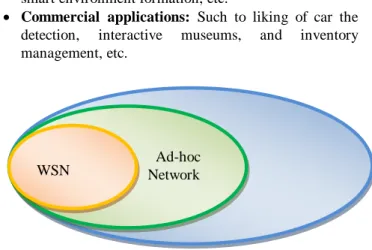
The recent development in ad-hoc networks and wireless networks has enabled the advancement of wireless sensor network. Wireless sensor network, a subset of wireless networks and ad-hoc networks as shown in Fig 1 are specific for every application. WSN is a set of spatially distributed sensor nodes along with a sink node or base station. These multi functional nodes have sensing circuitry along with data processing and communication circuitry. These sensor nodes senses the physical signals like temperature, pressure etc and send to a particular node from where the useful information is extracted and removes the uncorrelated noise. WSNs may comprised of diverse types of nodes such as infrared, acoustic, seismic, visual, radar, thermal and others; which extends their application scope. Some applications of WSNs are as follows [1].
Military applications: Such as monitoring friendly forces, battle field surveillance, nuclear attacks, battle damage estimation, etc.
Environmental applications: This includes forest fire recognition, bio intricacy mapping, flood detection, etc.
Health applications: For example tele-monitoring of human physiological data, patient monitoring, doctor tracking, drug administration in hospitals, etc.
Manuscript received June, 2014.
Pooja, Department of Electronics and Communication Engineering, A.K.G
Engineering College, Ghaziabad, U.P, India.
Surendra Singh, Depart Department of Electronics and Communication Engineering, A.K.G Engineering College, Ghaziabad, U.P, India.
Home applications: Like home appliance automation,
smart environment formation, etc.
Commercial applications: Such to liking of car the
detection, interactive museums, and inventory
management, etc.
Fig 1 WSN as a subset of Wireless and Ad-hoc Networks The consumption of energy is ranked one among the major problems of research in sensor networks; the majority of research has been focused on the study protocol and algorithms that addresses these issues to resolve. Clustering algorithms are extensively use to overcome the major problem in WSN i.e. energy consumption. The ultimate objective of clustering is to suggest a solution that keeps stability between the sensors throughout the network operation.
The foremost reason in sensor network for node failure is discharge of batteries. Energy efficiency or network lifetime is a critical problem in wireless sensor network [2] [3]; consequently energy efficient protocols and algorithms are built to make the sensor network more efficient in terms of energy. In sensor network, generally the organization of nodes is the major problem. Clustering algorithms are used to reduce the problem of nodes organization. According to clustering algorithm the entire network is divided into multiple clusters and these clusters are changed after every time instant. LEACH is a technique lies under hierarchical protocols to minimize the energy consumption in the sensor network. According to LEACH protocol, the network is divided into multiple clusters. Every cluster has its cluster head which is selected according to natural selection of cluster head technique; each node in a particular cluster sends data to the cluster head and it is the responsibility of the cluster head to compress the data into one signal and removes the uncorrelated noise and then transmits to
ENERGY EFFICIENCY IN WIRELESS
SENSOR NETWORK USING IMPROVED
O-LEACH PROTCOL
POOJA, ASST. PROF SURENDRA SINGH
Wirelesss System Ad-hoc Network WSN
the base station. The flow chart of LEACH protocol [4] is shown in Fig 2.
Fig. 2 Flow chart of LEACH protocol 1.1- ENERGY CONSUMPTION MODEL
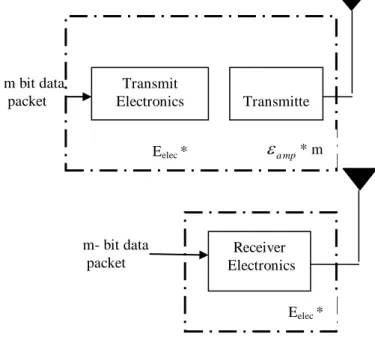
We use the similar energy consumption radio model as described by W. R Heinzelman in [5]. To run the radio electronics and power amplifier transmitter dissipates the energy and receiver dissipates the energy to run the radio electronics only as shown in Fig 3. Depending upon the distance between transmitter and receiver both the free space (d2) and multipath fading (d4) channels are used. Power amplifier is used to properly invert the loss due to multipath fading and free space loss. If the distance is less than the reference do free space (fs) model is used, inversely multipath fading (mp) model is used. To transmit the m-bit message to a distance d, the radio uses:
( , )
( )
( , )
T T elec T ampE m d
E
m
E
m d
(1) 2 4 elec fs elec mpmE
m
d
mE
m
d
To receive the message the radio uses:
( )
( )
R R elec elec
E m
E
m
mE
(2)elec
E
depends on filtering, spreading of signal, coding and modulation. While
fsd
2and4
mp
d
depends on the receiver‘sdistance and bit error rate.
We assume that there are N numbers of nodes that are randomly dispersed in M × M field. If there are k clusters in the field then on average there is N/k nodes per cluster. According to the hypothesis that if base station is far we use multipath fading channel then the energy used in cluster head node in single time frame is:
4
(
1)
CH elec DA elec mp toBS
N
N
E
mE
mE
mE
m
d
k
k
(3)
Where m is the number of bits in single data packet,
d
toBS is the distance from cluster head to the base station.Every non cluster head node transmits the data to cluster head once in a single epoch. As the distance to the cluster head is less therefore free space channel is used. So the energy dissipated in all non cluster nodes is:
2
non CH elec fs toCH
E
mE
m
d
(4)where
d
toCH is the distance from one node to the cluster head.m bit data packet
m- bit data packet
Fig 3 Radio Model
A simple radio model is assumed in which the radio uses 50nJ/bit to run the transmitter and receiver circuitry and to achieve a satisfactory Eb
No
for transmitter amplifier the value of
amp= 100pJ/bit/m2 is set. In Table 1 all the values of radio parameters with their symbols are given.Transmit Electronics Transmitte r Amplifier Receiver Electronics ET(d) Eelec * m
a mp* m * d2 Eelec * m Initial Network Compute energy consumption of each nodeOutput Selection of CH
Lifetime Close Divide into clusters
Table 1 Radio Parameters
OPERATION ENERGY
DISSIPATED Transmitter Electronics (
E
T elec ) 50nJ/bitReceiver Electronics (
E
R elec ) 50nJ/bitTransmitter amplifier (
a mp) 100pj/bit/m21.2- PROBLEMS IN LEACH PROTOCOL
There are two energy-consumption inefficiencies for cluster heads and these are as follows:
Hotspot problem- It is due to extra duties of cluster heads that enhance energy usage. But LEACH protocol offers a solution for this problem i.e. stochastic rotation of the cluster head which distributes the load evenly to every single node.
Redundant data transmission- This occurs when two
nodes in a cluster have almost same data and both the nodes transmits information to the cluster head which increases the redundant load on the cluster head because of the overlapping sensing information. But LEACH protocol proposes no solution for this problem.
In this paper, we suggest a new technique for the selection of cluster head based on the minimum energy remains in the node after each epoch [6]. This technique is based on the natural selection of cluster head. The minimum percentage of the energy is determined in advance for the selection of head. The new hierarchical protocol is based on the threshold value of energy and the least energy required for the creation of head, to ensure the consistent performance of the network.
This article is organised as follows: In the next section, we briefly review the related work. Subsequently in section 3 we present the details of our algorithm. In section 4, the performance of improved LEACH is shown by means of simulations and compares it with O-LEACH and LEACH. At the end we conclude the paper in section 5.
2- RELATED WORK
A distributed clustering algorithm for homogeneous networks called LEACH (Low Energy Adaptive Clustering hierarchy) was proposed by W. Heinzelman [6]. According to LEACH protocol, the cluster head is randomly selected from the distributed nodes and this role is assigned to other nodes according to the round robin management technique to ensure the uniform load. The node collects the data from the environment and transmits to the head and in order to reduce the congestion in the network, cluster head aggregates the data
and compresses it to form one signal and sends to base station. LEACH protocol consists of two stages:
(1) Set up stage (2) Steady state stage
In the set up stage, the whole network is divided into multiple clusters and from each cluster the election of cluster head process is occurred. After the election of cluster head, the cluster head selection process takes place. A random number is generated between 0 and 1 and if the generated random number is less than the threshold value only then the node can become the cluster head for that round otherwise the nodes are selected as the normal nodes. The threshold value is given by:
1 1 ( mod ) 0 S T p r T p (5)
Where p is the probability of the nodes to become cluster head, r is the current round value; G is the set of nodes that have not
been cluster head in the recent rounds. The optimal number
of cluster head is recommended to be 10% of the total nodes. S.D Muruganathan et.al in [7] proposed LEACH-C routing protocol for homogeneous network. In this the clusters are formed at the beginning of each round. In LEACH-C, the base station performs a centralized algorithm to select the cluster head as an alternative of randomly selecting the nodes. The base station gathers the data of each node‘s location from the nodes and then broadcasts its verdict which node is chosen as the cluster head. LEACH-C offers improved results than LEACH. The objective of the proposed algorithm SEP described by G. Smaragdakis in [8] is to take the full advantage of node‘s heterogeneity. SEP algorithm considers two energy levels and according to them the nodes are categorized in normal nodes and advanced nodes. Nodes which have not been selected for the cluster head are called normal nodes and nodes having a times greater energy are the advanced nodes. Advanced nodes are more preferable for the selection of head due to their assigned probability weights.
3-.PROPOSED WORK
In this segment we depict the network model of our proposed algorithm. We are assuming that there are N sensor nodes which are randomly deployed within M×M square area. These nodes constantly broadcast the data to the base station which is assumed to be distant from the sensing area [9]. We assumed the base station location is (100m, 100m) as shown in Fig 3. The proposed algorithm is considered in terms of rounds and each round is divided into four phases; (1) Network Configuration, (2) Election of CH, (3) Selection of CH, (4) Data transmission.
if n ∈ G
Fig 3 Hello message format (1) Network Configuration
At the start of each round the initializing phase begins with the goal of upgrading the network configuration. When all the nodes have information about their co-ordinates, received signal strength, node i.ds then organizing the nodes becomes easy. We use a HELLO message to begin the mechanism to notify all the nodes about the clusters, base station location and the received signal strength as shown in Fig 3.
(2) Election of CH
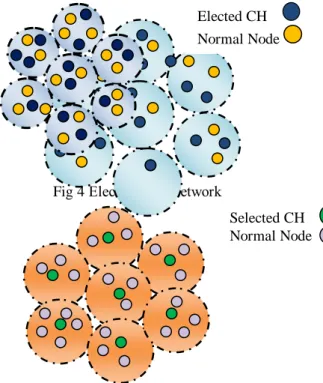
When all the nodes are deployed in the sensor network the election process begins shown in Fig 4. A random number rand is generated by a node and compares it with the threshold value TS. There are two possible cases:
If (rand < TS): Nodes can‘t be elected for the selection of CH and marked as normal node ‘N‘.
If (rand > TS): If the nodes are not CH for the recent (1/p) rounds then they belongs to a candidate set for the selection of CH and marked as ‗C‘.
The base station calculates average residual energy of the whole network and then compares it with the residual energy of the elected CH nodes. The nodes are expelled from the candidate set if its energy is less than the average residual energy of the nodes. (3) Selection of CH
After the random election of the cluster head the optimal numbers of cluster head are required. In order to fulfill the requirement of optimal number of CH use or disuse of nodes takes place to maintain the uniform load (see Fig 5). Natural selection refers to select the optimum number of CH as a function of spatial density. To find the actual number we use same energy model used in [5].
(4) Data Transmission
After the selection process, data transmission process begins. The node transmits data to the nearby CH and the CH receives data from all the nodes and compresses it to make one signal. Similarly, base station receives data from the CHs. The cluster head assigns TDMA technique to their respective cluster nodes and the
4- SIMULATION AND ANALYSIS 4.1- Simulation Background
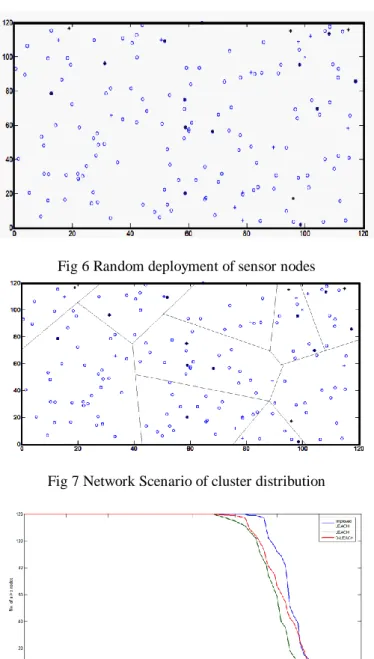
In this section, we evaluate the performance of improved LEACH protocol using MATLAB and compare its performance O-LEACH [10] and LEACH using the same initial values and similar energy model [4]. This experiment is performed with various number of nodes placed in 120m × 120m simulation area as shown in Fig 6 and Fig 7.
Fig 4 Elected CH‘s network
Fig 5 Selected CH‘s network
The initial energy provided to every node is 0.5 joules and a node is considered dead if its energy reaches from 20 joules to 0 joules. The simulation parameters are given in Table 2.
Table 2 Simulation Parameters PARAMETERS VALUES
Simulation Area 120m × 120m
No. of nodes 120
Base Station Location (60m, 60m)
Initial Energy 0.5 J Transmitter/ Receiver Electronics 50nJ/bit
εfs
10pJ/bit/mεmp
0.0013pJ/bit/m 4.2- ResultsThe results are shown in Fig 8. We figure out that the proposed algorithm improves the network‘s lifetime. This plots describes the number of nodes remain alive over number of rounds in 120 × 120 network scenario. With our approach all the nodes Received Signal Strength Node I.Ds Status Of Link Node‘s Location Base station Location HELLO message Selected CH Normal Node Elected CH Normal Node
remain alive for 1040 rounds while the corresponding number for O-LEACH is 1004 and for LEACH its 949. Because with our approach we treat all the nodes according to their residual energy while LEACH treats all nodes fairly.
Fig 6 Random deployment of sensor nodes
Fig 7 Network Scenario of cluster distribution
Fig 8 System lifetime using LEACH, O-LEACH and improved LEACH
5- CONCLUSION
In the paper, energy efficient clustering protocol for wireless sensors network has been introduced. According to our perspective improved LEACH will work in static networks as well as in dynamic networks. Exhaustive simulations of wireless sensors network environment shows that our approach is better to increase the energy efficiency, and lifetime of the entire network. We calculated improved LEACH only on static networks. This algorithm should be tested on dynamic networks.
REFERENCES
[1] K. Akkaya and M. Younis, ―A survey on routing protocols for wireless sensor networks,‖ Ad Hoc Netw., vol. 3, no. 3, pp. 325–349, 2005.
[2] J. Elson, K.Rmer ‖A New Regime for Time
Synchronization,‖ ACM Computer Communication Review (CCR) 33(1), pp. 149-154, 2003
[3] N. Sepideh, N. Aras, A. Fairouz‖SLTP: Scalable Lightweight Time Synchronization Protocol for Wireless Sensor Network‖, Springer-Verlag Berlin Heidelberg 2007. [4] F. Xiangning and S. Yulin ―Improvement on LEACH Protocol of Wireless Sensor Network,‖ International
Conference on Sensor Technologies and Applications, pp.
260-264, 2007.
[5] W. R. Heinzelman, A. Chandrakasan, and H. Balakrishnan, ―Energy-Efficient Communication Protocol for Wireless Microsensor Networks,‖ Proceedings of the 33rd Hawaii
International Conference on System Sciences, pp. 1-10,
2000.
[6] W. R. Heinzelman, and H. Balakrishnan, ‖An application specific protocol architecture for wireless microsensors networks,‖ IEEE transaction on Wireless Communication, vol. 1, no. 4, pp. 660-670, Oct 2002.
[7] S. D. Muruganathan, D. C. F. Ma, R. I. Bhasin, and A. O. Fapojuwo, ―A Centralized Energy-Efficient Routing Protocol for Wireless Sensor Networks,” IEEE Radio
Communications, vol. , pp. S8-S13, Mar 2005
[8] G. Smaragdakis, Ibrahim Matta and A Bestavros, ―SEP: A Stable Election Protocol for clustered heterogeneous wireless sensor networks,‖ , vol. , pp. 1-11,
[9] A. Ahmad, N. Javaid, Z. A. Khan, U. Qasim, and T.A. Alghamdi, ―(ACH)2: Routing Scheme to Maximize Lifetime and Throughput of Wireless Sensor Networks,”
IEEE Sensors Journal, vol. 14, no. 10, pp. 3516-3532, Oct
2014
[10] S. el KhedirI, N. Nasri, A. Wei and A. Kachouri, ―A New Approach for Clustering in Wireless Sensors Networks Based on LEACH,‖ Elsevier Proc. Computer
Pooja received the B.Tech degree in
Electronics and Instrumentation
Engineering from Greater Noida
Institute of technology, GBTU, in 2013. She is pursuing M.Tech in Electronics and Communication Engineering from Ajay Kumar Garg Engineering College, UPTU, from 2013. She completed Engineering and her area of interest is Wireless Sensor Network.
Currently she is working on project, energy efficiency in wireless sensor network using clustering algorithms.
Surendra Singh earned his B.Tech
degree in Electronics and
Communication Engineering from G.L.A University Mathura, GBTU, in 2008 and Masters in Technology from MITS Gwalior in the year of 2013.
Presently he is Asst. Prof in
Electronics & Communication
Engineering department and. His areas of specialization are Cognitive radios. He has presented a paper in a National Conference held at Ajay Kumar Garg Engineering College, Ghaziabad in February 2013.