Implementation of MIP for Capacitor Placement to DT’s
for Mitigating Power Loss in Radial Distribution Systems
T. Hemanth Kumar Chetty1
,
V.C.Veera Reddy21
P.G Scholar, Annamacharya Institute of Technology & Sciences, Tirupati.
2Professor & Principal, Annamacharya Institute of Technology & Sciences, Tirupati.
Abstract:
The operation of distribution power system is inevitably accompanied with power loss. These losses are account for 13% of the total power generation. Therefore, there have been strong incentives for utilities to try to reduce the power loss. To reduce these losses in distribution systems in recent years many approaches have been introduced. For that in this paper work proposed a method of the reduction of branch current which came from root buses to customers as a common practice which is achieving by deploying shunt capacitor banks in the network is proposed. This also offers other benefits such as improving voltage profile, power factor and providing reactive power reserve etc.So the main focus of this paper work is on optimal capacitor placement to distribution transformer in distribution networks for the power loss reduction. To realistically appraise the cost benefit of the capacitor deployment project few works are done already as solution algorithm, benders decomposition, genetic algorithms, tabu search and fuzzy expert systems etc. But in this project work Net Present Value criterion is applied with high performance Mixed Integer Linear Programming [MIP] package GUROBI.IndexTerms: Capacitor placement, distribution
transformer (DT), mixed-integer programming (MIP), net present value (NPV), and radial distribution system.
NOMENCLATURE
𝑏𝑡 Annual saving due to capacitor deployment ($). 𝐵𝑡 Net annualprofit ($).
𝐶𝑡 Annual loss cost before capacitor deployment ($). 𝐶𝑡′ Annual loss cost after capacitor deployment ($). 𝑑 Discount rate % 𝑦𝑒𝑎𝑟 .
𝐹𝑙𝑜𝑠𝑠 Power loss factor.
𝐼 Current magnitude that circulate through the line (A). 𝐼𝑅 Real component of current 𝐼(A).
𝐼𝑋 Reactive component of current 𝐼(A). 𝐼𝑂 Initial investment outlay of cash ($). 𝐼𝐶 Capacitor deployment cost ($).
𝐾
𝐸 Energy cost $ 𝑘𝑊ℎ .𝐾
𝐼 Capacitor deployment cost for each DT ($).𝐾𝑂 Annual O&M cost of capacitor banks for each DT ($).
𝑙 Load growth rate.
𝐿𝑖 Number of the capacitor modules in a capacitor Bank (integer decision variable).
𝑁 Total number of DTs in the network.
𝑂&𝑀 Operation and maintenance.
𝑂𝑀𝑡 Annual operation and maintenance cost of year t ($)
𝑃𝐶 Capacitor purchase cost ($). 𝑝 Energy cost growth rate.
𝑃𝐿𝑖 Real power demand at DT i (kW). 𝑃𝑙𝑜𝑠𝑠 Power loss (kW).
𝑃𝑙𝑜𝑠𝑠𝐷𝑇 Power loss at DT (kW). 𝑃𝑙𝑜𝑠𝑠𝐿𝑖𝑛𝑒 Power loss at line section (kW).
𝑃𝑙𝑜𝑠𝑠 ,𝑅 Power loss caused by real current IR(kW). 𝑃𝑙𝑜𝑠𝑠 ,𝑋 Power loss caused by reactive current IX(kW). 𝑃 𝑙𝑜𝑠𝑠 ,𝑋 Average power loss (kW).
𝑃 𝑙𝑜𝑠𝑠 ,𝑋 Power loss at peak load (kW).
𝑄𝐶 Capacitor capacity of per unit size (kvar). 𝑄𝑖 Total reactive powers flowing out of node i
(kvar).
𝑄𝐿𝑖 Reactive power demand at DT i (kvar). 𝑅𝑖 Resistance of DT i (Ω).
𝑅𝑖,𝑖+1 Resistance of line section between nodes i and i+1(Ω).
𝑡 Year.
𝑇 Project’s expected life (year). 𝐷𝑇 Distribution transformer.
𝑉1𝑖 Voltage magnitude of high side of DT i (V). 𝑉2𝑖 Voltage magnitude of low side of DT i (V). 𝑋𝑖 Binary decision variable (0, 1), indicating whether to place a capacitor bank at DT i. ∅ Power factor angle (degree).
$ Dollar (per unit value). I INTRODUCTION
Due to the joule effect the operation of a power distribution system is associated with an unpreventable power loss. This I2R loss can be very large since it occurs throughout the conductors of the distribution system. As indicated in [1], it can be accounted for 13% of the total power generation .therefore, there have been strong motivation for utilities to try to mitigate the power loss.
To reduce the I2R loss in a distribution system several approaches are available among of them one approach is to reduce the branch current that comes from root buses to customers. which can be achieved by deploying shunt capacitor banks in the network to compensate a portion of reactive power demand of the loads[6]-[17].in addition to saving power loss ,capacitor placements can offer additional benefits, such as improving voltage profile, releasing network capacity &providing reactive power reserve. This paper focuses on
optimal capacitor placement in distribution networks for the interest of power loss mitigation.
Froma mathematical view, the optimal capacitor placement is a mixed-integer programming [MIP] problem, where capacitor location and sizes are to be optimized.
Interms of objective function, most of the literature minimizes the total cost of capacitor placements minus the energy loss savings [6]–[13]. However, very few works appraise the investment project on a more realistic cost-benefit assessment basis. Interms of solution algorithms, heuristic search [6], specifically tailored numerical programming techniques [9],Benders decomposition [7], [8], modified differential evolution (DE) algorithm [12], genetic algorithms (GAs) [10], [11], [14], tabu search [13], and fuzzy expert systems [16] have been reported to solve the problem with success of varying degree. In addition, some works with more realistic problem modelling have also been reported, such as considering unbalanced system [9], uncertain and varying load [11], andharmonics [15]. A comprehensive review and discussion on previous works could be found in [14] and [17].
The power loss on theDTs makes up an appreciable portion of a utility’s overall loss. According to [3], the DTs account for 26% of transmission and distribution losses and 41% of distribution and sub transmission losses [4]. In [5], it was estimated that the DTs occupy 55% of total distribution losses.
The power loss on a DT consists of Copper loss and Iron loss. Copper loss corresponds to the 𝐼2𝑅 loss, while Iron loss is caused by the eddy current and hysteresis occurring at the core material of the transformer. In this paper, only Copper loss is considered since Iron loss mainly depends on the manufacturing and materials. To reduce the Copper loss of a DT, one has to reduce the current passing through its windings. By placing capacitor banks at the low-side of the DT, a portion of the reactive power. Demand can be directly compensated, thereby reducing the current.
The decreased current passing through the DT windings can also reduce the overall power loss of the distribution network since it can diminish the branch current coming from the root bus. The deployment of capacitor banks to DTs provide additional advantages, which are given here
.
Utilities can choose DT’s of smaller size, incidentally decreasing the iron loss. It can effectively free up a large portion of capacity of the distribution system. Simple operational control of the capacitor banks
where the control can be local automatic switching of taps according to the varying reactive power load. Provides local voltage boost to customer
loads.Which can also cancel part of the drop caused by the varying loads
It will also be shown in this paper that the problem can be formulated as an explicit mixed-integer quadratic programming (MIQP) model without much assumption and approximation and suitable for being solved by commercial MIP packages.
In this paper, proposeda method for optimal placement of capacitor bank to DTs in radial distribution networks for power loss reduction. The net present value
benefit of the capacitor placement project. The objective is to maximize the NPV of the capacitor installation project considering the energy-saving benefits and various costs (capacitor purchase and installation cost, operating and maintenance cost) over the project lifecycle. Capacitor banks locations are considered at the low-side of the transformers to directly compensate the reactive power demand of the customer load. Based on an explicit formula to directly calculate the power loss of radial distribution systems, the optimal capacitor bank placement is formulated as a MIQP model, which can be readily solved by high-performance commercial MIP packages. The voltage constraint is satisfied through an iterative process. The proposed methodology has been applied in the Macau distribution system, and simulation results have demonstrated its effectiveness.
The remainder of this paper is organized as follows. Section II presents a formula for directly calculating the power loss in radial distribution systems. Section III introduces the NPV criterion for appraising the cost benefit of the project. Section IV presents the mathematical model and its solution process. Section V presents a practical operational control strategy of the capacitor banks. SectionVI presents the simulation results. Section VII concludes the whole paper.
II. DIRECT CALCULATION OF POWER LOSS IN RADIAL DISTRIBUTION SYSTEMS
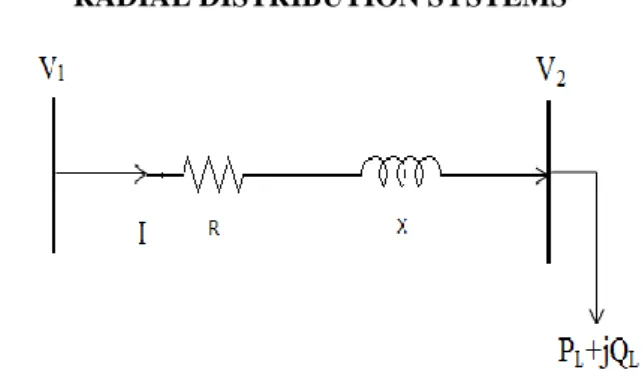
Fig. 1. Electrical equivalent model of a DT A DT can be electrically modelled as Fig. 1, where I is the current passing through the DT, R and X are resistance and reactance of the DT, respectively, and V1and V2are voltage magnitudes at high- and low-side of the DT, respectively. The power loss on a conductor can be separated into two parts, one due to real current, and the other by reactive current, and shown as
𝑃
𝑙𝑜𝑠𝑠= 𝐼
𝑅2+ 𝐼
𝑋2. 𝑅
= 𝐼
𝑅2𝑅 + 𝐼
𝑋2𝑅
= 𝑃
𝑙𝑜𝑠𝑠 ,𝑅+ 𝑃
𝑙𝑜𝑠𝑠 ,𝑋.(1)
For the DT shown in Fig. 1, the power loss is
𝑃
𝑙𝑜𝑠𝑠= 𝑃
𝑙𝑜𝑠𝑠 ,𝑅𝐷𝑇𝑖 + 𝑃
𝑙𝑜𝑠𝑠 ,𝑥𝐷𝑇𝑖
=
𝑃
𝐿𝑖𝑉
𝑖2 2. 𝑅
𝑖+
𝑄
𝐿𝑖𝑉
𝑖2 2. 𝑅
𝑖(2)
The capacitor bank, when placed at the low-side of the DT, can directly compensate the reactive powerdemand, thereby reducing𝑃𝑙𝑜𝑠𝑠 ,𝑋.
.
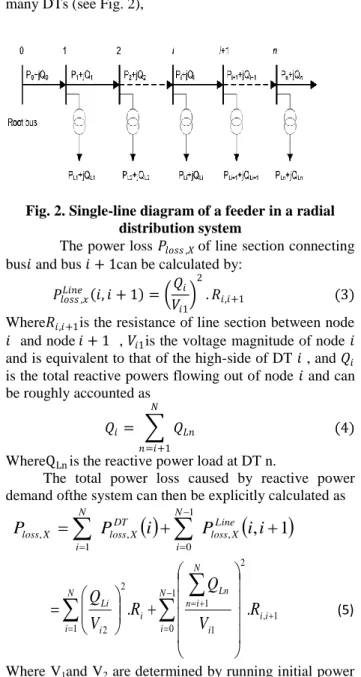
In this paper, the distribution network is assumed to be three-balanced, and current harmonics are not considered. Given a feeder with many DTs (see Fig. 2),Fig. 2. Single-line diagram of a feeder in a radial distribution system
The power loss 𝑃𝑙𝑜𝑠𝑠 ,𝑋 of line section connecting bus𝑖 and bus 𝑖 + 1can be calculated by:
𝑃𝑙𝑜𝑠𝑠 ,𝑥𝐿𝑖𝑛𝑒 𝑖, 𝑖 + 1 = 𝑄𝑖 𝑉𝑖1
2
. 𝑅𝑖,𝑖+1 (3) Where𝑅𝑖,𝑖+1is the resistance of line section between node 𝑖 and node 𝑖 + 1 , 𝑉𝑖1is the voltage magnitude of node 𝑖 and is equivalent to that of the high-side of DT 𝑖 , and 𝑄𝑖 is the total reactive powers flowing out of node 𝑖 and can be roughly accounted as
𝑄𝑖 = 𝑄𝐿𝑛 𝑁
𝑛=𝑖+1
(4) WhereQLnis the reactive power load at DT n.
The total power loss caused by reactive power demand ofthe system can then be explicitly calculated as
,
1
1 0 , 1 , ,
i
i
P
i
P
P
N i Line X loss N i DT X loss X loss 1 , 2 1 0 1 1 2 1 2.
.
N ii i i N i n Ln i N i i LiR
V
Q
R
V
Q
(5)Where V1and V2 are determined by running initial power flow. The annual cost ($) due to the power loss iscalculated by
𝐶𝑡 = 𝑃 𝑙𝑜𝑠𝑠 ,𝑋. 𝐹𝑙𝑜𝑠𝑠. 𝐾𝐸. 8760
(6)
Where 𝐾𝐸 is the energy cost ($/kWh) and 𝐹𝑙𝑜𝑠𝑠 is the power loss factor which is the ratio between the average power loss and the peak power loss and is given as𝐹𝑙𝑜𝑠𝑠= 𝑃 𝑙𝑜𝑠𝑠 ,𝑋
𝑃 𝑙𝑜𝑠𝑠 ,𝑋 (7) To calculate Floss, a segment of historical load profile over a certain period (e.g., last one year) is obtained from the metering database, and the power loss at each time point is calculated by running power flow. The peak power loss 𝑃 𝑙𝑜𝑠𝑠 ,𝑋is the power loss at the peak load point and the average power loss𝑃 𝑙𝑜𝑠𝑠 ,𝑋 is the average value of all of the time points.
As Fig. 3 illustrates, when installing capacitor bank at the low-side of the DT, the reactive power passing through the DT windings can be reduced by the capacitor capacity.
Fig. 3. Reactive power balance after capacitor placement to a DT
The power loss after capacitor bank placement becomes 𝑃𝑙𝑜𝑠𝑠 ,𝑋′ = 𝑄𝐿𝑖− 𝐿𝑖. 𝑄𝐶. 𝑋𝑖 𝑉𝑖2 2 𝑁 𝑖=1 . 𝑅𝑖 + 𝑄𝐿𝑛− 𝐿𝑛. 𝑄𝐶. 𝑋𝑛 𝑁 𝑛=𝑖+1 𝐿𝑖 𝑉𝑖1 2 𝑁−1 𝑖=0 . 𝑅𝑖,𝑖+1 (8)
Where𝑄𝐶 is the capacity of capacitor per unit size,𝐿𝑖 is the integer variable representing the number of the capacitor modules in a bank, and 𝑋𝑖 is the binary decision variable indicating whether to install the capacitor bank at DT i (1: yes; 0: no).The product of𝐿𝑖, 𝑄𝐶, and 𝑋𝑖 equals the reactive power compensation capacity to the DT.
III NPV ANALYSIS
To practically evaluate the economic value of the capacitor placement project, one needs to compare the expected revenue and investment costs over the whole project lifecycle. In this paper, the NPV criterion is adopted for cost-benefit analysis of the project. The NPV discounts each year’s cash flow back to the present and then deducts the initial investment, giving a net value of the project in today’s dollars. The acceptance criteria for NPV evaluations are quite simple whenever theproject’s NPV is greater than zero, the project can be accepted since it means the project can add value to the utility; otherwise, the project should be rejected because it will subtract the value to the utility.
NPV≥ 0 Accept
NPV<0 Reject
The NPV criterion can appraise a long-term project with the following advantages [18].
• It deals with cash flows rather than accounting profits. • The accepted project will increase the value of the utility, since only the projects with positive NPV are accepted.
• It recognizes the time value of money and allows for comparison of the benefits and costs in a logical manner.
• It can incorporate risk into the assessment of a project, either by adjusting the expected cash flows or by adjusting the discount rate. With those advantages the NPV has become the most popular method for investment evaluation.
After the capacitor banks placement, the new annual cost in dollars is
𝐶𝑡′= 𝑃 ′𝑙𝑜𝑠𝑠 ,𝑋. 𝐹
𝑙𝑜𝑠𝑠. 𝐾𝐸. 8760
(9)
The annual savings by applying capacitor bank to DTs is𝑏𝑡 = 𝐶𝑡− 𝐶𝑡′ (10) It is worth mentioning that other savings such as those produced by released network capacity can also be added in (10), but this paper only considers the power loss reduction. Considering the O&M costs 𝑂𝑀𝑡 of the capacitor banks, the net annual profit should be
𝐵𝑡 = 𝑏𝑡− 𝑂𝑀𝑡 (11)
𝑂𝑀𝑡 = 𝑋𝑖. 𝐾𝑂 𝑁
𝑖=1
(12)
Where𝐾𝑂 is the annual O&M cost of capacitor banks for each DT in dollars. For the capacitor placement project, the NPV can be calculated as follows:
𝑁𝑃𝑉 = 𝐵𝑡
1 + 𝑑 𝑡 𝑇
𝑡=1
− 𝐼𝑂 (13)
Where𝐵𝑡 is the annual net cash flow in year t, d is the discount rate, T is the project’s expected life, and IO is the total initial investment outlay of cash including capacitor purchase cost and installation cost and is given as 𝐼𝑂 = 𝐼𝐶 + 𝑃𝐶 (14) Where 𝐼𝐶 = 𝑋𝑖. 𝐾𝐼 𝑁 𝑖=1 (15) 𝑃𝐶 = 𝐿𝑖. 𝑋𝑖. 𝐾𝑝 𝑁 𝑖=1 (16)
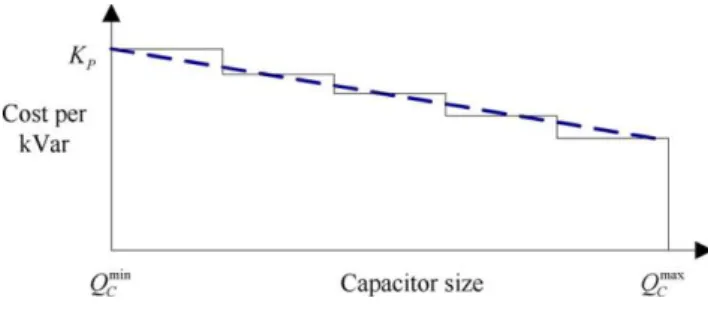
Where 𝐾𝑝and𝐾𝐼 stand for the purchase cost of the capacitors per unit size and installation cost for each DT, respectively. Equation (16) is applied when only a fixed capacitor bank unit size is adopted. In practice, capacitor banks of larger unit size can have lower per kVar price. Hence, capacitor banks with different unit sizes may be combined during placement. Generally, the capacitor cost function is a piecewise function as the real line shows in Fig. 4.
Fig. 4. Cost function of Capacitor
To consider the varying purchase cost of the capacitor depending on the capacitor unit size, the piecewise cost function can be approximated by a linear function as the dash line shows in Fig. 4. 𝑃𝐶Can then be calculated by
𝑃𝐶 = 𝐿𝑖. 𝑋𝑖. 𝑁
𝑖=1
𝐾𝑃− 𝛾𝐿𝑖 (17)
Where𝛾 is the equivalent slope of the linearized cost function, and𝐾𝑃 here corresponds to the minimum capacitor unit size𝑄𝐶𝑚𝑖𝑛.
IV MODEL FORMULATION AND SOLUTION The mathematical model of the capacitor placement project is to maximize the NPV subject to certain constraints so as to obtain the maximum economic benefits in terms of investment and revenue. The mathematical model is presented as follows:
𝑚𝑎𝑥𝑁𝑃𝑉 = 𝐶𝑡− 𝐶𝑡 ′ − 𝑂𝑀 𝑡 1 + 𝑑 𝑡 𝑇 𝑡=1 − 𝐼𝐶 + 𝑃𝐶 (18)
Subject to the following. •For fixed capacitor:
0 ≤ 𝐿𝑖. 𝑄𝐶. 𝑋𝑖 ≤ 𝑄𝐿𝑖𝑚𝑖𝑛 (19) • For controlled capacitor:
𝑄𝐿𝑖𝑚𝑖𝑛 ≤ 𝐿
𝑖. 𝑄𝐶. 𝑋𝑖 ≤ 𝑄𝐿𝑖𝑚𝑎𝑥 (20) The NPV is the sum of the cash flow of each year in the expected project lifetime; thus, the growths of load demand and energy cost should also be considered in calculating the term for each year. The constraint (19) means that, if the capacitor size is fixed, the capacity should be less than the minimum reactive power demand at the DT, and (20) means that, if the capacitor size is adjustable, e.g., automatically switched by the controller, the capacity should be between the minimum and maximum reactive power load of the DT. It can be seen that due to the multiplying of the decision variables L and X in (8), (16), (17), (19), and (20), the problem constitutes a mixed-integer nonlinear programming (MINLP) model which is difficult to solve. We then rewrite the model to be a MIQP formulation, which is much easier to solve. To this end, the binary decision variable X in (8), and (16), and (17) is removed and constraints (19) and (20) are rewritten as
0 ≤ 𝐿𝑖. 𝑄𝐶 ≤ 𝑄𝐿𝑖𝑚𝑖𝑛. 𝑋𝑖 21 𝑋𝑖. 𝑄𝐿𝑖𝑚𝑖𝑛 ≤ 𝐿𝑖. 𝑄𝐶≤ 𝑄𝐿𝑖𝑚𝑎𝑥. 𝑋𝑖 (22)
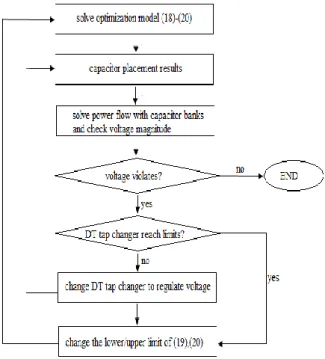
In such a way, the model becomes a MIQP one while the same mathematical characteristic is maintained. It is worth mentioning that, although the quadratic terms can be further linearized to yield a mixed-integer linear programming (MILP) model that is further easier to solve, we retain the quadratic formulations since high-performance MIQP solvers are currently available in most commercial packages. It should be noted that the voltage constraint is not directly included in the optimization model. Rather, the voltage is satisfied through an iterative process shown in Fig. 5.
Fig. 5. Flowchart for satisfying voltage constraints Before capacitor deployments, the bus voltage should be already regulated at a normal level. After capacitor banks are placed, the voltage magnitude of the low-side of DT is generally improved rather than degraded since a portion of reactive power load is compensated. Hence, it is usually needed to examine only the overvoltage case after capacitor installed. Actually, the voltage boosting is rather limited since the size of capacitor bank is constrained by (19) and (20). According to Fig. 5,once the optimization results are obtained, power flow simulations are then performed to examine if overvoltage appears (notethat both peak and bottom load conditions can be examined, for automatically switched capacitor banks, their output in bottom load condition should be accordingly decreased to avoid inversereactive power injection). If the overvoltage occurs for some load buses, the voltage can be regulated to normal level by adjusting the local customer DT tap changers—this can be implemented during capacitor installation stage. Generally, a DT tap changer has a broad range to adjust, however, when the DT tap changer reaches limits and can no longer regulate the voltage, it is then needed to modify constraints (19) and (20) by a smaller upper limit and resolve the optimization model. This process iterates until all of the voltage constraints are satisfied.
V OPERATIONAL CONTROL OF CAPACITOR BANKS
As already mentioned, the placement of capacitor banks to DTs can simplify the operational control of the capacitor banks. Unlike complicated coordination of switching actions of the capacitors in a distribution system [9], the control of the DT capacitor banks to maximize the reduction of the power loss can be approximated by locally switching the capacitor series according to the reactive power load sensed by the capacitor controller [3]. A simple switching strategy can be as follows.
Operational control rule:
For 𝑄𝐶𝑖<𝑄𝐿𝑖 :
Switch up to a tap that minimizes│ 𝑄𝐶𝑖 ─ 𝑄𝐿𝑖│. For 𝑄𝐶𝑖>𝑄𝐿𝑖 :
Switch up to a tap that minimizes│ 𝑄𝐿𝑖 ─ 𝑄𝐶𝑖│. Here,𝑄𝐿𝑖 is the reactive power demand at DTi,sensedbythe controller, and𝑄𝐶𝑖 is the output of the capacitor bank.
The above control strategy can locally minimize the reactive current of each DT and, thus, can almost minimize the reactive current of line sections which is the sum of the reactive currents of the individual DTs. This control strategy can also contribute to voltage regulation as it avoids inverse reactive power injection during light load conditions.
VI SIMULATION RESULTS
The proposed methodology has been practically implemented for power loss reduction of Macau medium voltage (MV) distribution network. MV herein means the voltage level from the 11 kV side of a 66/11 kV transformer to 400 V side at an 11-kV distribution transformer of the Macau distribution system.The commercial MIP packageis used to solve the optimization model. To illustrate the effectiveness of the proposed method, its application to a portion of the network with five feeders/laterals and 34 DTs is presented here. This network can be viewed as a 69-bus system; its one-line diagram is shown in Fig. 6.
and its parameters are given as The base MW is 100 MW, the base voltage is 11 kV, and the voltage set-point of bus #1 is 1.01 p.u. Other relevant parameters involved in the optimization are given in Table III. Stated otherwise, the values in Table III do not necessarily reflect the reality of the Macau distribution system.
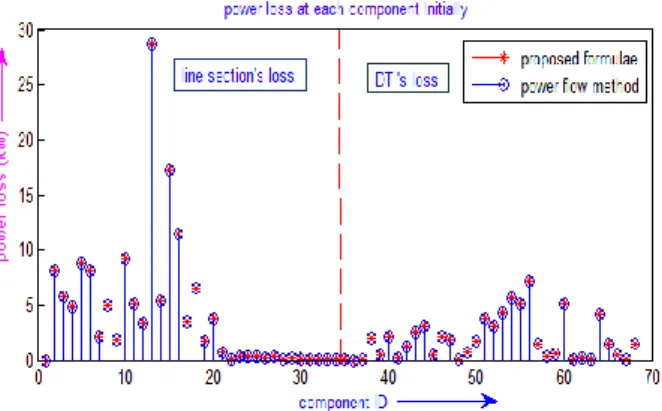
First, the proposed formula for direct calculation of power loss of radial distribution systems is verified. The initial overall power loss of the studied network is respectively calculated by power flowmethod and the proposed formula, and the results are 129.9 and 130.5 kW, respectively, yielding a very small overall percentage error of 0.46%.and the parameters of the test system are given in Tables I and II.And calculated loss of each component of the studied network shown in Fig. 6 by using the values from Tables I and II and Table III .
TABLE I:PARAMETERS OF LINE SECTIONS OF THE STUDIED NETWORK
TABLE II: PARAMETERS OF DTS OF THE STUDIED NETWORK
DT Bus
Peak load Bottom load R (p.u.) X (p.u.) P(KW) Q(KVAR) P(KW) Q(KVAR) 2 19 11.7 8.0 2.6 0.71875 0.06 3 409.1 254.2 50.8 37.2 1.28 0.06 4 260.9 203 82.2 56.2 0.71875 0.06 5 547.7 243.3 37.7 30.2 0.71875 0.06 6 185.4 153.4 14.2 12.6 0.71875 0.06 7 260.1 146.1 19.7 15.6 1.83925 0.04 8 445.1 157.4 183.7 99.5 1.28 0.06 9 493.1 203 190.2 83.7 1.28 0.06 10 186.3 67.7 68.0 26.9 1.28 0.06 11 342.8 149.3 114.8 55.4 1.83925 0.04 12 319.8 113.1 93.2 24.2 1.83925 0.04 13 68.2 21.9 31.5 9.9 1.28 0.06 DT Bus
Peak load Bottom load R (p.u.) X (p.u.) P(KW) Q(KVAR) P(KW) Q(KVAR) 15 499.4 196.5 445.8 168.9 0.71875 0.06 16 717.5 406.1 439.6 212.2 0.71875 0.06 17 659.5 431.7 389.8 345.0 0.71875 0.06 18 765.6 348.4 304.7 158.7 0.71875 0.06 19 873.5 551.9 306.2 214.9 0.71875 0.06 20 830.6 253 456.2 154.1 0.71875 0.06 21 988 280.5 410.2 119.5 0.71875 0.06 22 346.6 163 101.3 64.7 1.28 0.06 23 138.8 45.9 62.9 20.3 1.83925 0.04 24 183 41.2 55.7 11.1 1.83925 0.04 25 839.6 190.7 267.9 64.2 0.71875 0.06 26 13.9 4.3 5.1 1.2 0.71875 0.06 27 112.5 14 62.6 5.6 1.28 0.06 28 86.1 16.2 8.5 3.0 1.28 0.06 29 774.6 358.1 81.5 44.9 0.71875 0.06 30 461.1 175.8 53.1 11.2 0.71875 0.06 31 242.2 59.5 125.7 40.6 0.71875 0.06 32 48.1 0.1 66.3 3.0 1.83925 0.04 33 348.2 106.7 140.3 52.4 1.28 0.06 34 0.7 0.8 0.5 0.6 1.28 0.06 35 394.8 126.6 111.7 65.5 1.28 0.06 total 13106 5582.1 4906.0 2257.8
TABLE III: PARAMETERS IN CALCULATION
Parameter sign Value
Minimum unit size of capacitor (KVAR)
𝑄𝑐𝑚𝑖𝑛 25
Purchase cost of capacitor per unit size(𝑄𝑐𝑚𝑖𝑛)($)
𝐾𝑝 5000
Slope of the linearized capacitor purchase cost function
ϒ 30
Capacitor installation cost for each DT($)
𝐾𝑡 7500
O&M cost of capacitor for each DT($/year)
𝑂𝑀𝑡 800
Energy cost($/kwh) 𝐾𝐸 1.136
Project lifetime(year) T 10
Loss factor Floss 0.554
Inflation rate P 5.0%
Discount rate D 7.0%
Load growth rate L 6.7%
The calculated loss of each component of the studied network is shown in Fig. 7.
Fig. 7 Initial power loss at each component of the studied network.
Where ID 1–34 for line sections and ID 35–68 for DTs. It can be seen that the calculation error of the proposed formula only occurs at line sections, and the accuracy is sufficiently high for practical use. It is also worth mentioning that the power loss on DTs accounts for a significant portion of the whole power loss in this
Line section R (p.u.) X (p.u.) B (p.u.) Sending end Receiving end 1 2 0.009686 0.015187 0.000184 2 3 0.006954 0.010904 0.000132 3 4 0.006209 0.009736 0.000118 4 5 0.011672 0.018303 0.000222 5 6 0.011672 0.018303 0.000222 6 7 0.003229 0.005060 0.00006150 7 8 0.007699 0.012072 0.000147 8 9 0.003229 0.005060 0.00006150 9 10 0.017136 0.02687 0.000326 10 11 0.009686 0.015187 0.000184 11 12 0.006954 0.010904 0.000132 12 13 0.006209 0.009736 0.000118 13 14 0.011672 0.018303 0.000222 14 15 0.040977 0.068543 0.000822 15 16 0.029802 0.04985 0.000598 16 17 0.010927 0.018278 0.000219 17 18 0.023593 0.039464 0.000473 18 19 0.007947 0.013293 0.000159 19 20 0.0226 0.037803 0.000453 20 21 0.00596 0.00997 0.00012 21 22 0.000993 0.001558 0.0000189 22 23 0.004222 0.00662 0.0000804 23 24 0.006209 0.009736 0.000118 24 25 0.006954 0.010904 0.000132 25 26 0.00447 0.00701 0.0000851 26 27 0.009934 0.015577 0.000189 27 28 0.00298 0.004673 0.0000567 28 29 0.009934 0.015577 0.000189 29 30 0.005464 0.008567 0.000104 30 31 0.011424 0.017913 0.000217 31 32 0.001987 0.003115 0.0000378 32 33 0.006457 0.010125 0.000123 33 34 0.00298 0.004673 0.0000567 34 35 0.00298 0.004673 0.0000567
capacitor placement scheme for the studied network is calculated. The optimization results are given in Table IV. A total of 13 DTs are installed with capacitor banks and the total capacity is 3320 kVar.
TABLE IV: CAPACITOR PLACEMENT OPTIMIZATION RESULTS
DT bus X Capacity(KVAR) 3 1 199.768 5 1 175.003 7 1 123.421 9 1 149.845 11 1 125.001 16 1 374.951 17 1 400.288 18 1 325.866 19 1 525.236 20 1 225.464 21 1 273.718 22 1 150.000 29 1 271.963 Others 0 0 Total 13 3320.524
TABLE V: SUMMARY OF OPTIMIZATION RESULTS
Before After
𝒑𝒍𝒐𝒔𝒔,𝒙 [kw] 21 2
Power factor 0.906 0.943 Total initial invest ($) 718,350
Total benefit($) 1,892,377.282
NPV($) 1,186,409.420
Computation time(s) 0.087493
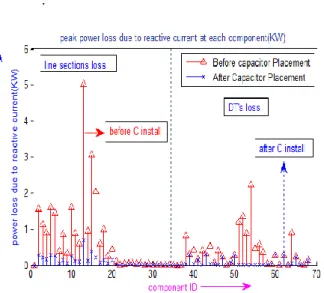
Table V summarizes the optimization results. It can be seen that, after the capacitor placements, the peak power loss insignificantly reduced, and the power factor is improved in the meantime. Fig. 8 shows the power loss caused by reactive current before and after the capacitor installations for each component. It can be seen that the capacitor banks have not only reduced the loss on DTs but also line sections. In the economic aspect, the initial investment (IO) of the project is $718,350, and the total benefit is $1,892,377.282 yielding a positive NPV of$1,186,409.420, which means that the project can add a net value of $1,186,409.420 to the utility over ten years
.
Fig. 8.Peak power loss of each component before and after capacitor placements.
Fig. 9. Load bus voltage magnitudes in different conditions.
The load bus voltage magnitudes are also examined, and the results are shown in Fig. 9. It can be seen that, after the capacitor deployment, the system voltage level is improved, especially for the buses where a capacitor is installed, and no over voltage appears. In addition, it is worth mentioning that the proposed method is quite computationally efficient, as the solution time of the model using for the studied network is only0.087493 s.
VII CONCLUSION
Power loss due to the Joule effect in a distribution system can be very large, where the loss on DTs can account for a considerable portion. This paper proposes a method for optimal placement of capacitor banks to DTs for power loss reduction in radial distribution systems. The problem is modelled as maximizing the NPV of the capacitor installation project subject to certain constraints and is formulated as an MIP model based on an explicit formula for direct calculation of the power loss of the radial distribution system. The model can be solved by commercial MIP packages very efficiently. The proposed methodology has been practically implemented in Macau MV distribution system. Its application to a portion of Macau system is illustrated in this paper, and the results show that by installing capacitor banks at optimized locations, the power loss of the network can be significantly reduced, the voltage level can be improved, and a positive large NPV can be obtained, which adds values to the utility.
REFERENCES
[1] J. B. Bunch, R. D. Miller, and J. E. Wheeler, ―Distribution system integrated voltage and reactive power control,‖ IEEE Trans. Power App. Syst., vol. PAS-101, no. 2, pp. 284–289, Feb. 1982.
[2] M. E. Baran and F. F. Wu, ―Network reconfiguration in distribution systems for loss reduction and load balancing,‖ IEEE Trans. Power Del., vol. 4, no. 2, pp. 1401–1407, Apr. 1989.
[3] T.A.Short, Electric Power Distribution Equipment and Systems. Boca Raton, FL, USA: CRC/Taylor & Francis, 2006.
[4] R.Barnes, J.W.VanDyke, B.W.McConnell,S.M.Cohn and S.L. Purucker, ―The feasibility of upgrading utility distribution transformers during routine maintenance,‖ Tech. Rep. ORNL-6804/R1, Feb. 1995.
[5]J. J. Grainger and T. J. Kendrew, ―Evaluation of technical losses on electric distribution systems,‖ in Proc.10thInt.Conf.ElectricityDistrib. May 1989, pp. 483– 493.
[6]M. Chis, M. M. A. Salama, and S. Jayaram, ―Capacitor placement in distribution systems using heuristic search strategies,‖ IET Gen. Trans.Dist., vol. 144, no. 2, pp. 225–230, May 1997.
[7]M.E.BaranandF.F.Wu,―Optimalsizingofcapacitorsplac edona radial distribution system,‖ IEEE Trans. Power Del., vol. 4, no. 1, pp.735–743, Jan. 1989.
[8] M.E.BaranandF.F.Wu,―Optimalcapacitor placement on radial distribution systems,‖ IEEE Trans. Power Del., vol. 4, no. 1, pp. 725–733, Jan. 1989.
[9] J.-C. Wang, H.-D. Chiang, K. N. Miu, and G. Darling, ―Capacitor placement and real time control in large-scale unbalanced distribution systems: Loss reduction formula, problem formulation, solution methodology and mathematical justification,‖ IEEE Trans. Power Del., vol. 12, no. 2, pp. 953–958, Apr. 1997.
[10] K. N. Miu, H. D. Chiang, and G. Darling, ―Capacitor placement, replacement and control in large-scale distribution systems by a GA-based two-stage algorithm,‖ IEEE Trans. Power Syst., vol. 12, no. 3, pp. 1160–1166, Aug. 1997.
[11] M.-R. Haghifam and O. P. Malik, ―Genetic algorithm-based approach for fixed and switchable capacitors placement in distribution systems with uncertainty and time varying loads,IETGen.Trans.Dist‖ vol. 1, pp. 244–252, 2007.
[12] J.-P.Chiou,C.-F.Chang,andC.-T.Su,―Ant direction hybrid differential evolution for solving large capacitor placement problems,‖ IEEE Trans. Power Syst., vol. 19, no. 4, pp. 1794–1800, Nov. 2004.
[13] R. A. Gallego, A. J. Monticelli, and R. Romero, ―Optimal capacitor placement in radial distribution networks,‖ IEEE Trans. Power Syst., vol. 16, no. 4, pp. 630–637, Nov. 2001.
[14] D. Das, ―Optimal placement of capacitors in radial distribution system using a fuzzy-GA method,‖ Int. J. Electr. Power Energy Syst., vol. 30, pp. 361–367, 2008. [15] M. A. S. Masoum, A. Jafarian, M. Ladjevardi, E. F. Fuchs, and W. M. Grady, ―Fuzzy approach for optimal placement and sizing of capacitor banks in the presence of harmonics,‖ IEEE Trans. Power Del.,vol.19, no. 2, pp. 822–829, Apr. 2004.
[16]H.N.Ng, M. M. A. Salama, and A. Y. Chikhani, ―Capacitor allocationby approximate reasoning: Fuzzy capacitor placement,‖ IEEE Trans.Power Del., vol. 15, no. 1, pp. 393–398, Jan. 2000.
[17] H. N. Ng, M. M. A. Salama, and A. Y. Chikhani, ―Classification of capacitor allocation techniques,‖ IEEE Trans. Power Del., vol. 15, no.1, pp. 387–392, Jan. 2000. [18] Z. Lu, A. Liebman, and Z. Y. Dong, ―Power generation investment opportunities evaluation: a comparison between net present value and real options approach,‖ in Proc. IEEE PES General Meeting, 2006, pp. 1–8.
Acknowledgement
T.Hemanth Kumar Chetty received B.Tech degree in electrical and electronics engineering from AITS, Tirupathi in 2013. Presently pursuing M.Tech, specialization in power systems in AITS, Tirupathi.
Dr. V.C. Veera reddy received B.Tech from JNTU, Hyderabad in Electrical Engineering. M.Tech and PhD., degrees specializing in power system operation and control and power systems from S.V. University, Tirupathi. He has 34 years of teaching experience. Ten students have obtained their PhD degree under his guidance. He published over 58 papers in national and international journals and presented over 16 papers in national and international conferences. Presently working as principal in AITS, Tirupathi.