Envision of I-RS (I-Railway System) - based on
Cloud Computing
Rushabh Patel
1-
UG Scholar, Dept. of Computer Science, Symbiosis Institute of Technology, Pune, India, E-mail: [email protected]Rahul Raghvendra Joshi
2-
Assistant Professor, Dept. of Computer Science, Symbiosis Institute of Technology, Pune, India, E-mail: [email protected]78
Abstract: - Cloud computing is typically defined as a type of computing that relies on sharing of computing resources rather than having local servers. Cloud computing has brought new changes and opportunities to IT industry. It is a new emerging technology, the years of research in virtualization, distributed and utility computing, and more recently networking, web and software services created base for the term "Cloud" in Cloud Computing. It offers a service oriented architecture, reduced information technology overhead for the end-user, greater for flexibility, reduced total cost of ownership, on-demand services and many other things. The railway department will use the cloud computing to achieve sharing of railway information resources and to improve the capacity of information processing. The recent move; Indian Railways have given few contracts to IT companies to enhance train services by installing Wi-Fi in selected train. The Indian railway is the world’s fourth largest railway network which carries near about 30 million passengers daily and near about 2.8 million tons of freight daily [12]
.
But in spite of that, the railways usually under goes loss and main reason behind this is that a large number of passengers every day travelled without ticket which results in overloading of compartments and in turn creating problem for reserved train ticket holders. Thus, by implementing cloud computing for Indian railways we can develop a system which can improve its facilities. The organization of this paper is like section I gives introductory details, section II and III discuss details about why to use cloud computing? and different cloud service models, section IV and V throws light on cloud deployment models and role of IT in railway respectively, in section VI improvement in railway using cloud computing, in section VII techniques used in I-RS, in section VIII advantages and in section IX challenges of proposed system are discussed. In section X concluding remarks and at the last references are mentioned.Index Terms — virtualization, flexibility, Wi-Fi, IT
Industry, I-RS, cloud computing, GPS
I. II. INTRODUCTION
Indian Railways is the largest rail network in Asia and the world's second largest rail network which is governed by Central Railway Ministry of India [12]. It connects over 6000 stations in the country which in turn carries 17 million passengers every day [12]. From these 17 million passengers, only 1 million passenger’s travels with confirmed ticket and 16 million passengers don't bother about confirmed tickets for travel, which causes a heavy monetary loss to Central Railways [12]
.
Therefore, in this paper, we will discuss how cloud computing may help Central Railways to avoid this loss by implementing some techniques and tools. Transforming Railway system to I-Railway System is difficult but not impossible. IRCTC (Indian Railway Catering and Tourism Corporation) is already using a next generation cloud based e-ticketing system which brings a phenomenal shift in internet rail ticketing by significantly improving the end user experience in terms of ease of use, flexibility, security, cost and convenience. The system uses advanced fraud control and security management tools. IBM assisted China Railway to migrate towards cloud computing based technology using its cloud Infrastructure-as–a-Service (IaaS) software [14]. An Indian IT firm TCS has already engaged in large-scale partnerships with Indian Railways by developing an ERP (Enterprise Resource Planning) system for the IRCTC in the year 2006-2007[14].Therefore, in this paper we have proposed some
cloud computing methods by using which railway reservation system may get improvised.
III. WHY CLOUD COMPUTING?
In cloud computing, the word cloud (also termed as "the cloud") is used as a metaphor for "the Internet," so the phrase cloud computing means "a type of Internet-based computing," where different services — such as servers, storage and applications are delivered to an organization's computers and devices through internet. Therefore Cloud computing may help I-RS in following ways:
A. Cost Reduction
Cloud computing technology can greatly help in reducing the costs as resources are acquired on a demand basis and charged accordingly.
B. Better usage of Personnel
Since, most of the interaction and work happens through cloud itself and once the cloud is set up, manual interaction requirement is very minimal. Hence, employed personnel can focus on other things and that will deliver value in spite of spending time on maintenance of hardware and software.
C. Scalability
Cloud computing technology can scale itself up or down in terms of resources. It can scale up, when there is more resource requirement and scale down, when the resources are no longer required. This way resource can be effectively managed across the cloud and also, the user is charged based on the used resources.
IV. CLOUDSERVICEMODELS
A. Infrastructure-as-a-Service (IaaS)
Infrastructure-as-a-Service is the first layer and foundation for cloud computing. Using this service model, we can manage our applications, data, operating system, middleware and runtime environment. This service provider manages virtualization, servers, networking and storage. This allows to avoid expenditure on hardware and human capital; reduce ROI (Return of Investment) risk, streamline and automate scaling and users only have to pay for the used resources. This means that the extra data processing space is available to us whenever we need it, and when we don't need it, we are not paying for it which saves money and in turn that will fulfill Central Railways existing needs.
B. Platform-as-a-Service (PaaS)
This cloud service model could be considered as the second layer. Applications and data are to be managed by user and cloud vendor manages everything else. The benefits of using PaaS include streamlined version of deployment and ability to change or upgrade with minimized expenses.
The services of Central Railways in application testing or development might find PaaS as beneficial to eliminate cost for upkeep of hardware. In this model, Central Railways may also be benefited as there is no need to hire people for maintenance of these systems. A scalable processing centre is available at your disposal and that can be used as per needs (here also, we have to pay only for what we use).
C. Software-as-a-Service (SaaS)
This is the final layer of cloud services model. This can be used by Central Railways to run programs in the cloud where all portions are managed by the cloud vendor. The users will be assured with compatibility and ease of collaboration as software will be used by everyone. Central Railways won't have to pay for extra licensing fees and new users can be added easily. By using SaaS users will be able to access the software from a variety of devices, in their office or on go, which in turn develops easy collaboration among all users.
Fig 1:Basic Architecture of Cloud Service Models [8]
Fig 2: Working of Cloud Service Models [9]
V. CLOUDDEPLOYMENTMODELS A. Public Cloud
A public cloud is a cloud computing model in which services, such as applications and storage, are available for general use over the internet. Public cloud services may be offered on a pay-per-usage mode or on other purchasing models.
B. Private Cloud
A private cloud is virtualized as data center that operates within a firewall. Private clouds are joined together by mass quantities of IT infrastructure into resource pools, and are privately owned and managed.
C. Hybrid Cloud
A hybrid cloud is a mix of public and private clouds.
D. Community Cloud
A community cloud is an infrastructure shared by several organizations which supports a specific community.
Fig 3: Cloud Deployment Models [11]
VI. ROLEOFINFORMATIONTECHNOLOGYIN RAILWAY
In today's world everything is dependent on Information Technology (IT), therefore, Central Railways of India has also taken initiative to use Hi-Tech technology like Online Booking, Instant PNR Status, Tracking of Train's Location and many more. But, Central Railways was unable to give accurate results for waiting ticket holders and position of train regardless of its station checkpoints. We can overcome these issues to some extant which will help Central Railways to give proper services to passengers. Today, government is also introducing Wi-Fi services in trains which will help common people in many ways [6].
VII. IMPROVEMENTINRAILWAYSUSING
CLOUDCOMPUTING
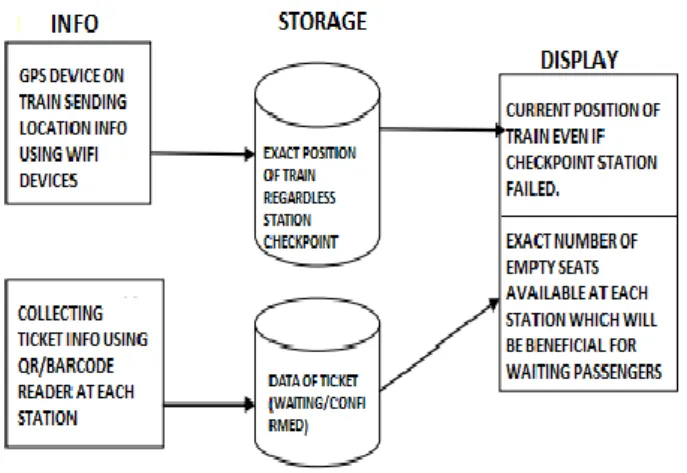
The IT technology needs a vast and immediate improvement according to the new scenario. Some new IT equipments and techniques should be introduced like Tickets with unique QR (Quick Response) - Code and ticket checking with QR Scanner. Also, Wi-Fi enabled GPS (Global Positioning System) devices should be set up on each train, so that exact location can be tracked without worrying about station checkpoints. So, everything is dependent on two main tasks viz. checking of tickets and allotting confirmed seats to waiting holder according to priority and this can be done using cloud storage with cloud computing concepts as shown in following figure.
Fig 4:Mechanism to be used in proposed I-RS VIII. TECHNIQUESUSEDINI-RS A. Use of QR-Scanner
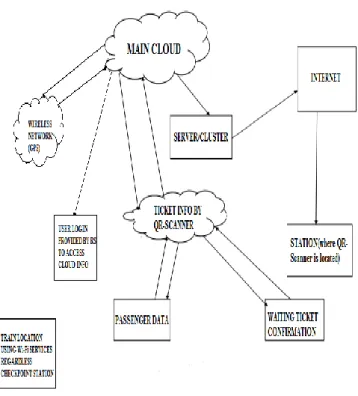
The implementation of cloud computing will help a lot in introducing new concept like use of QR-Scanner and GPS technique. By implementing QR-Scanner on each station entrance will help Central Railways to keep count of passengers entering in a particular train. So, empty seats status will be updated on cloud storage which will enable TTE (Travelling Ticket Examiner) to allot empty seats to waiting passengers according to priority.
For example, if 5 passengers are travelling from Mumbai to Manmad, then passengers who will be travelling from this train should scan their tickets on entrance on QR-scanner and when these tickets are scanned the details about the entered passengers are shared on cloud which is accessible by TTE travelling in train through the E-Device like PDA, Tablet, Laptop provided to him by the government. If in this case one passenger didn't come, then TTE can see this empty seat on his device instantly when train arrives on Mumbai and TTE can allot this seat to waiting passenger from Mumbai. Similar Process is repeated at each and every station which will prioritize the waiting seat allotment to some extent. This should be done as TTE come to check the tickets of passengers after much time of train travel and which results in improper allotment of seats by TTE. Therefore, by using QR-coded Tickets and QR-Scanner implemented by cloud computing techniques will make waiting system to do properly prioritization.
B. Use of GPS Device
GPS Technique can be introduced in the train which are using Wi-Fi devices. These Wi-Fi devices are setup on each train by Wi-Fi service providers so that the exact position of the train, speed, duration of time left, duration of time needed to reach the next destination, if chain pulled or caught in disaster at any point can be bring into notice. For this, a GPS system is to be installed in train and data of this system will be sent to database located on cloud which can be accessible to all of its users. This system will get rid of station checkpoints used in today's existing system. This system don't give passenger exact location or updated location of train, if train is stopped between two checkpoint stations, therefore by using GPS device on
train, we can keep track of train if train is stopped between two checkpoint stations also. This data of GPS is updated at regular intervals to the cloud database.
Fig 5: WORKING MODEL OF I-RS CLOUD
IX. ADVANTAGES OF USING CLOUD COMPUTING IN I-RS A. Achieves economies of scale – increases output or
productivity.
B. Reduces expenditure on technological infrastructure
- Maintains easy access to information with minimal upfront expenditure.
C. Globalization of proposed system - People across the
globe can access the cloud, provided they have an Internet connection.
D. Streamlined processing - More work will be getting done
in less time with minimal employees.
E. Reduced capital costs - There’s no need to spend more
money on hardware, software or licensing.
F. Improved accessibility- System can be accessed at
anytime, anywhere, making it easier to operate.
G. Effective Monitoring - System remains within budget and
ahead of completion cycle times.
H. Less personnel training requirement - It requires fewer
people to do operations on a cloud, with a minimal learning curve on hardware and software related issues.
X. CHALLENGES FOR USING CLOUD COMPUTING IN I-RS A. Possible downtime - Cloud computing makes business
dependent on the reliability of available internet connection. Here, in our proposed system, it totally depends on the quality of Wi-Fi services to be used by Central Railway. If they use services of quality service providers then this issue won't harm our proposed cloud computing technology on I - RS.
B. Security issues – As discussed earlier, cloud computing
means internet based computing. So, you are not supposed to use cloud computing applications that involve using or storing of data that may harm proposed system or affects its security. So by doing filtering of data using different type’s security filters can resolve this issue.
X. CONCLUSION
While planning use of cloud computing initiatives in future, Central Railways should choose service and delivery models that will match with requirements for operational flexibility, cost savings, and efficiency. Central Railways should adopt a gradual evolutionary approach towards cloud computing services. We can envision that I-RS will have an application portfolio with mix of cloud-based services delivered across a combination of private, hybrid, and public cloud-based deployment models with the share of cloud services gradually increasing in this services mix. Private clouds are expected to become increasingly deployment model for cloud services among Railways, giving Central Railways full control through ownership and operations of their cloud systems. Hence, using cloud computing technology in Railway System is the efficient, cost deterrent and serializable technique for waiting ticket holders. Therefore, implementing this service will help government as well as passengers in terms of fiscal aspect.
REFERENCES [1] http://www.sybase.com/detail?id=1063530 [2]http://blogs.nasscom.in/rail-budget-2013-what-does-it-me an-for-the-indian-it-industry/ [3]http://predeveloper.att.com/home/learn/enablingtechnolo gies/The_NIST_Definition_of_Cloud_Computing.pdf [4] Subashini S., and Kavitha V., A survey on security issues in service delivery models of cloud computing. Journal of Network and Computer Applications, July 2010
[5] Grance T., and Mell P., NIST definition of cloud computing, National Institute of Standards and Technology, January 2011
[6]http://tech2.in.com/news/web-services/rail-budget-2013-f aster-irctc-website-free-wifi-promised/786192
[7] Lizhe Wang, Gregor von Laszewski, Andrew Younge, Xi He, Marcel Kunze, Jie Tao and Cheng Fu, ―Cloud Computing: a perspective Study‖, New Generation computing, Volume 28, Number 2010, 137-146, Ohmsha Ltd and Springer 2010.
[8]en.wikipedia.org/wiki/Cloud_computing [9]https://www.spkaa.com/plm-in-the-cloud-computer-syste m-validation-in-fda-regulated-industries [10]cloud.cio.gov/topics/cloud-computing-deployment-mod els [11] http://www.edureka.co/blog/what-is-cloud-computing/ [12]http://www.indianrailways.gov.in/railwayboard/view_se ction.jsp?id=0,1,304,366,554 [13] www.ipcsit.com/vol37/016-ICINT2012-I095.pdf [14]http://www-01.ibm.com/common/ssi/cgi-bin/ssialias?inf otype=PM&subtype=AB&htmlfid=POC03104USEN [15]http://connection.ebscohost.com/c/articles/83376596/im plementation-cloud-computing-technology-indian-railway
![Fig 1:Basic Architecture of Cloud Service Models [8]](https://thumb-us.123doks.com/thumbv2/123dok_us/8222400.2179922/2.892.485.819.321.594/fig-basic-architecture-cloud-service-models.webp)