Model for “Positive Gentrification”
Without Displacement
By Belinda Ear
A Master’s Paper submitted to the faculty of the University of North Carolina at Chapel Hill
in partial fulfillment of the requirements for the degree of Master of Public Health in
the Public Health Leadership Program
Chapel Hill Summer 2018 Date Date
1 ABSTRACT
By critically evaluating the ‘double-edged sword’ (potential positive and negative impacts) of the controversial issue of gentrification, this paper provides insight and practical guidance for other communities regarding methods and tools to creatively and collaboratively address one of the many problems that public health faces. These multifactorial adaptive issues must be addressed in order for Public Health to fulfill its mission of “assuring the conditions in which people can be healthy” and happy, its vision of “’healthy people, together in healthy communities,’ and fulfill its primary ethical mandate, that is to be personally and professionally ‘responsible’ for the health of her community.”
The paper progresses as follows:
First, I define the issue of positive and negative “gentrification” from a Public Health perspective, emphasizing the critical sub-issue of displacement and the inherent opportunity for both harm and health.
Second, using this definition of gentrification, I outline the relevant literature-
emphasizing and comparing and contrasting communities’ experiences- and provide a critical review of the implications of their findings.
Third, based on the implications of gentrification on Public Health, share the
conceptualization, and development of a model for addressing this wicked issue. A pilot study to determine the in-vivo, real-world application of the model in the city of Durham, NC is proposed and outlined.
Finally, a brief discussion of the city-specific modifications to the processes and tools in the base model that may be necessary is discussed.
The paper emphasizes relationships, politics, and leadership throughout. From inception to completion, leadership- and in particular, objective, inclusive, bridge-building and change management leadership- will be key. The proposed model for gentrification, along with how this topic is related to public health, is delineated. This model could be used in a variety of contexts and with a public health lens, could be used for improving the social determinants of health and the impact of the life course model so that equivalent opportunities are presented to community members to then make their own choices based on common community assets. This approach is guided by Public Health values and goals, the Public Health Code of Ethics, the Healthy People Year 2020 Health Objectives for the Nation, Health in all Policies, A Culture of Health, and ultimately Collective Impact and healthy communities.
This paper grows the important evidence-based thought and action process around the social determinants/contributors to health, and argues that the available research on gentrification justifies the addition of this topic to the constellation of “wicked” issues that require a public health systems approach for amelioration.
Furthermore, a practical starting point and initial steps regarding how to address the impact of gentrification in Durham from a public health perspective are offered. This includes creating a concept of positive gentrification, detailing what leadership roles must be fulfilled in order to achieve positive gentrification, and finally recommendations for, North Carolina as a pilot initiative. Durham has recently undergone the gentrification process and has the capacity to achieve positive health outcomes. This paper is intended to provide ideal steps for any city, but particularly for Durham to consider in order to proactively and creatively address all areas of
2 concern and take advantage of all opportunities that the gentrification process will intrinsically and inevitably present.
3 TABLE OF CONTENTS
Page
Abstract ……….. 1
List of Figures and Tables ……… 4
List of Abbreviations ……….. 5
Introduction ……… 6
Review of Literature ……….. 8
Background of Gentrification ………. 9
Gentrification Outcomes ……… 10
Two Forms of Gentrification-induced Displacement ……… 12
Model for Positive Gentrification ……….. 14
Case Studies of Two Cities ………. 17
Leadership Considerations ………. 19
Application of Adaptive Leadership ……….. 20
Recommendations ………. 22
For Any City ………. 22
First Steps for the City of Durham, North Carolina ………... 24
Conclusion ……….. 29
4 LIST OF FIGURES
Page Figure 1. Model of the Social Determinants of Health ………..
Figure 2. Model of the Life Course Model on Health Development………….
15 17 Figure 3: Evaluation of two cities based on qualitative interviews ……… 19
LIST OF TABLES
Page Table 1. Arguments from both sides of gentrification………
Table 2. Demographics of Durham County, NC ………
7 25 Table 2a. Demographics of Durham County, NC in Comparison to NC Overall... 26 Table 2b. County Health Rankings in Durham County, NC Compared to NC
5 LIST OF ABBREVIATIONS
CDC Centers for Disease Control and Prevention DHHS Department of Health and Human Services DPH Division of Public Health
NC North Carolina
NYCHVS New York City Housing and Vacancy Survey ODPHP Office of Disease Prevention and Health Promotion SDOH Social Determinants of Health
SES Socioeconomic Status TIF Tax increment financing UCL University College London UNC University of North Carolina U.S. United States
6
INTRODUCTION
“If I can look at your zip code and I can tell whether you’re going to get a good education, we’ve got a real problem.”
Condoleeza Rice, former U.S. Secretary of State.
“Gentrification” is a term commonly heard in local government and urban planning. However, there is also controversy that accompanies the word “gentrification.” The controversy involves whether gentrification is a positive change or if it contributes to adverse outcomes such as displacement.
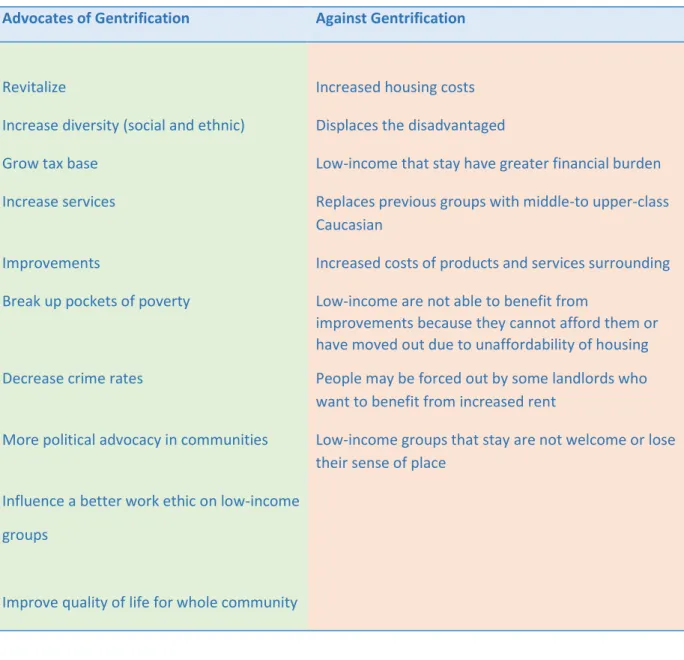
Advocates view gentrification as an opportunity to revitalize and diversify
neighborhoods. These opportunities are realized by growing the tax base, which may result in: increased services and improvements in an area, breaking up pockets of poverty that had high statistics of crime, and an increase in diversity of social and ethnic classes. Additionally, promoters of gentrification argue that the growth in middle- and upper- classes in a community will generate more political advocacy for the community as well as potentially encourage a better work ethic by being an example for low-income groups (Shaw & Hagemans, 2015). This theory of ‘social-mix’ suggests that mixing social classes would improve the quality of life for the whole community, specifically that lower-income individuals may benefit along with a middle-class neighborhood without moving (Newman & Wyly, 2006).
On the flip side, social justice advocates proclaim that in actuality the gentrification process leads to increased housing costs that, in turn, displaces low-income groups that may already be in desperate situations and therefore is unethical. Moreover, the increased housing
7 costs results in low-income residents having to deal with a greater financial burden compared to others in the community. Additionally, an argument exists that perhaps higher income groups are not pushing out the lower income groups but rather are filling the vacancies and increasing housing density (Shaw & Hagemans, 2015). Also, rather than incorporating social and ethnic diversity the gentrification process actually replaces previous groups with middle-to upper-class Caucasian people (Maciag, 2015).
Table 1. Arguments from both sides of gentrification
Advocates of Gentrification Against Gentrification
Revitalize Increased housing costs
Increase diversity (social and ethnic) Displaces the disadvantaged
Grow tax base Low-income that stay have greater financial burden Increase services Replaces previous groups with middle-to upper-class
Caucasian
Improvements Increased costs of products and services surrounding Break up pockets of poverty Low-income are not able to benefit from
improvements because they cannot afford them or have moved out due to unaffordability of housing Decrease crime rates People may be forced out by some landlords who
want to benefit from increased rent
More political advocacy in communities Low-income groups that stay are not welcome or lose their sense of place
Influence a better work ethic on low-income groups
8 Gentrification is going to happen, and public health leaders need to do something about it. This paper explores the outcomes of gentrification, identifies a concept of positive
gentrification, provides the scope of leadership involved in the gentrification process, and examines a case of two cities to inform recommendations for policy makers and urban planners addressing urbanization in the city of Durham in North Carolina.
REVIEW OF LITERATURE
My methods of conducting the literature review included contacting and meeting with a Public Health library research technician at the University of North Carolina (UNC)-Chapel Hill Health Sciences Library. We conducted a brief search to find peer-reviewed journal articles using the key terms “gentrification without displacement” and “positive gentrification” through the database Scopus. Other professional domain databases of interest were Web of Science and Academic Search Premier. Other peer-reviewed journal articles were found by way of ‘snowball sampling’ in which references cited or used in the articles previously found were examined. Additionally, internet Google searches for grey literature was found to supplement key ideas and supported further research on uncommon terms, provide definitions, “how to determine
gentrification statistics”, perceived successful gentrified cities, economic concepts, specific statistical information, and the first example of gentrification in order to understand the gentrification processes and timeline. I also used the general UNC library search for articles using the key term “gentrification in (a specific city)” in which specific cities indicated that they successfully gentrified, as found in the grey literature search. These articles were also scanned for referenced articles that could possibly contribute useful information and were included in the snowball sampling. Additional articles were provided and recommended by my advisors. For my
9 research on Durham, I used newspaper articles, community forums, the Durham city planning website, US Census Bureau statistics, and County Health Rankings by the Robert Wood Johnson Foundation.
Background of Gentrification
As documented by the Urban Studies website at University College London (UCL), the urban phenomenon of gentrification was a term first introduced by the urban sociologist Ruth Glass in her book London: Aspects of Change that was published in 1964 (UCL, 2015). During the 1950’s, Glass noted that London was undergoing change and individuals were
acknowledging the social and economic shifts of “shabby dwellings” and “quaint cottages” to upscale living resulting in the working class becoming displaced by high-income residents moving into the newly built villas (UCL, 2015). Dictionary.com (n.d.) defines gentrification as “the buying and renovation of houses and stores in deteriorated urban neighborhoods by upper- or middle- income families or individuals, raising property values but often displacing low-income families and small businesses”. As summarized by DeVerteuil (2012), when addressing gentrification, it is acknowledged in scholarly literature that there is an associated change in landscape, an in-migration of high-income groups, a displacement of low-income groups, and a reinvestment in inner-city neighborhoods.
It is important to examine the term “displacement”. Arguments posed that the impact of displacement reveals itself in two ways. First, there is the traditional concept of physical
displacement where individuals or families must uproot their lives and move elsewhere whether forced or unforced, and secondly, the concept of social displacement where an individual who
10 may not be physically displaced may feel socially displaced due to the widespread changes. In this paper, I will address gentrification along with both concepts of displacement because both are important considerations to population groups and have an impact on health and well-being.
Gentrification Outcomes
It is hard to determine whether gentrification caused the exodus of residents or if this movement was due to natural ‘succession’ (Freeman & Braconi, 2004). Displacement is a difficult phenomenon to measure; however, it can occur in two different ways. There is direct displacement and indirect displacement. Direct displacement can occur when the tenant is forced out by landlord eviction, landlord harassment, or unregulated rent increase (Shaw & Hagemans, 2015). Marcuse suggested, as referenced by Shaw and Hagemans, that there is an indirect
displacement that he terms “exclusionary displacement” which is the intentional shrinking of the pool of low-rent housing (Shaw & Hagemans, 2015). As also seen in Newman and Wyly (2006) there is a limited extent of evidence for displacement. Freeman and Braconi (2004) propose that it may be due to differences in the definition of displacement, which may be restrictive or inclusive. Additionally, motives for moving is difficult to determine and more than one factor may apply also the New York City Housing and Vacancy Survey (NYCHVS) (used in their study) did not identify the location of the individual’s former residence. Furthermore, it is difficult to determine the differentiation between normal housing turnover and actual
displacement. Finally, I observed the weakness in using only quantitative data since the data could not fully reflect each individual case. Even if displacement rates are modest, those that become displaced may be disadvantaged, and every individual impacts a community and all individuals matter whether or not they are the minority.
11 Social displacement may result due to changing neighborhood services, an increasing feeling from existing residents of being ‘out-of-place’, changes in community identity, and changes in neighborhood governance (Shaw & Hagemans, 2015). Social displacement can have an impact on collective efficacy (social cohesion and informal social control), crime rates, perception of safety, perceived physical health, perceived mental health, and satisfaction with life (Shaw & Hagemans, 2015). Additionally, studies have linked gentrification to food insecurity, pre-term birth, and lower self-reported health in minorities (Steinmetz-Wood et al., 2017). However, collective efficacy after gentrification is associated with lower rates of cardiovascular disease, obesity, sexually transmitted disease, and perceptions of self-health including mental health according to Steinmetz-Wood et al (2017). They found that
gentrification had a positive association with perceptions of overall collective efficacy, thereby disagreeing with some theories (Steinmetz-Wood et al., 2017); although, perceptions of social cohesion were higher in the gentrifiers than the longtime residents (Steinmetz-Wood et al., 2017). This finding of Shaw and Hagemans coincides with Dabbs (2010) whose case studies displayed increasing social displacement and lack of social cohesion between the gentrifiers and longtime residents (Dabbs, 2010; Shaw & Hagemans. 2015).
Freeman and Braconi (2004) discovered through their study that in actuality, on average, disadvantaged households (characterized by low-income and without a college degree) were less likely to move out of a gentrifying neighborhood. They posited that this might be due to
individuals wanting to benefit from the incoming changes of the community (Freeman & Braconi, 2004). However, Shaw and Hagemans suggest that tenants may not move due to their inability to easily pick up their lives and plant somewhere else (Shaw & Hagemans. 2015).
12 Although, in his study, Freeman found that residents of subsidized housing were less likely to be physically displaced (Freeman, 2005).
Two Forms of Gentrification-induced Displacement
After my review of the literature, I conclude that there are two forms of gentrification-induced displacement, physical displacement and social displacement. In order to decrease the result of gentrification-induced physical displacement, it is necessary to prevent the shrinking pool of low cost housing. This housing issue can be achieved in four different ways (1)
increasing the availability of affordable housing such as through supporting non-profit housing developments like HAND (https://www.handhousing.org/), (2) increasing rent regulations, (3) providing housing vouchers or tax abatements, and (4) providing more subsidized housing.
Additionally, in order to decrease the effect of social displacement, it is vital for the original occupant’s community and culture to be respected and supported. For example, by creating the new services while retaining some of the current services and spaces rather than complete transformation so that the two groups (the gentrifiers and current residents) would have a place in the community since both groups would have buildings and spaces to relate to. Both groups must feel valued, respected, and heard to keep the original residents from feeling isolated socially or a sense of not belonging. Besides, I argue that by keeping the original culture of a community, rather than replacing it, makes a newly gentrified area more interesting by
combating homogeneity while adding to marketability. Therefore, ‘positive’ gentrification that will prevent social displacement includes preservation of the original community, resources, and business while integrating improvements and changes that will attract gentrifiers while at the same time the two groups are accepting and supporting the other.
13 In addition, attributes that would also result in a ‘positive’ gentrification process would be a decrease in crime rates, an increase in collective efficacy, and an increase in resources. An increase in resources can encompass but are not limited to, quality schools, transportation options, affordable yet healthy housing, green spaces, bicycle and walking paths; and
exercise/recreational facilities. Additionally, the motivation for a positive gentrification process should aim to result in healthier communities. Ashby and Pharr in their publication (2012) define health as “a state of complete physical, mental and social wellbeing and not merely the absence of disease or infirmity” (p.2) and a healthy community as “one in which all residents have access to a quality education, safe and healthy homes, adequate employment, transportation, physical activity, and nutrition, in addition to quality health care.” (Ashby & Pharr, 2012, p.2) The Office of Disease Prevention and Health Promotion (ODPHP) of the United States (U.S.) Department of Health and Human Services quotes the Centers for Disease Control and Prevention (CDC) in describing a health community as “a community that is continuously creating and improving those physical and social environments and expanding those community resources that enable people to mutually support each other in performing all the functions of life and in developing to their maximum potential.” (CDC, 2010, para.2) Therefore, characteristics of a healthy
community include lower health disparities, lower life expectancy disparities, fewer adverse childhood events, lower obesity rates, improved employment rates, fewer high school dropout rates, low levels of crime, and a decrease in poverty. These are vital characteristics to track rather than simply considering the economic impacts or aesthetic appeal of a community. An unhealthy community would be the opposite, but not limited to, large health disparity gaps, low life expectancy, high adverse childhood events, high obesity rates, high unemployment rates, poor self-perceived mental health, a high percent of high school dropout rates, poor
14 environmental factors, a lack of social support for individuals, high levels of crime, and high rates of poverty.
MODEL FOR POSITIVE GENTRIFICATION
We know from the publication titled Commission of the Social Determinants of Health by the World Health Organization (WHO) that these are “(t)he conditions in which people live and work can help to create or destroy their health – lack of income, inappropriate housing, unsafe workplaces, and lack of access to health systems are some of the social determinants of health leading to inequalities within and between countries” (WHO, 2006, p.3). The Healthypeople.gov website provides a good summary of the social determinants of health (SODH) model that shows the interrelatedness of these factors. Taking this model with the five categories of determinants and the subset of measures, we can see how many factors to consider in the development of a program, appropriate to a specific community that would promote positive gentrification (see Figure 1).
15 Figure 1. Model of the Social Determinants of Health
SOURCE: Adapted from https://www.healthypeople.gov/2020/topics-objectives/topic/social-determinants-of-health
Using the SODH model along with the work of those who have researched theories of cumulative advantage/disadvantage in relation to inequalities in life course development, as described by Angela O’Rand (2009), provides a strong basis for the importance of positive gentrification and an opportunity to reduce inequalities. The cumulative process theory is based on the concept that early advantages/disadvantages and those extended over a period of time, coupled with an accumulation of stress over time are strong predictors of advantages and disadvantages later in life. We also know that food, housing, water, safety (Maslow’s Hierarchy
Neighborhood & Built Environment
• Access to Foods that Support Healthy Eating Patterns
• Quality of Housing • Crime and Violence • Environmental Conditions Economic Stability • Poverty • Employment • Food Insecurity • Housing Instability
Health & Health Care
• Access to Health Care • Access to Primary Care • Health Literacy
Education
• High School Graduation • Enrollment in Higher Education • Language and Literacy • Early Childhood Education and
Development
Social & Community Context
• Social Cohesion • Civic Participation • Discrimination • Incarceration
16 of needs, 1943) have a positive interdependency and could be required characteristics for
positive gentrification.
Characteristics are inter-related and will influence an individual’s relationships with themselves and those around them and vice versa. The Life Course Model tells us that the
trajectory of an individual’s life is determined by where you live, what you can afford, and where you feel socially accepted, which is directly correlated with your life expectancy. It is impossible to avoid all measures of stress or trial and actually an appropriate amount stimulates growth and maturity however an overabundance can negatively affect an organism (David Steffen, personal communication, 2018). Therefore, to best support the community, leaders must be able to identify weak areas in a community and address the collective needs so that all groups have the means to succeed.
It is important to promote as many individuals as possible to stay during the gentrification process rather than succumbing to the traditional definition of gentrification where previous groups are replaced with middle-to-upper-class individuals in order to not perpetuate cycles of poverty or inadequate resources that thus increase the gap in health disparities. Steffen et al. (2010), state that the most powerful social determinant of health is poverty and that income level is strongly associated with toxic stress; exposed children thus develop more physical and mental health problems. These poor health outcomes while in childhood may progress into adulthood and may result in a disproportionate risk in health disparities. Figure 2 provides a model of the impact of the Social Determinants of Health on health trajectories.
17 Figure 2. Model of the Life Course Model on Health Development
SOURCE: Halfon, N., Larson, K., Lu, M., Tullis, E., Ross, S. (2013). Lifecourse Health
Development: Past, Present and Future. Maternal Child Health Journal. 18:344–365. doi:10.1007/s10995-013-1346-2
CASE STUDIES OF TWO CITIES
A qualitative case study by Shaw and Hagemans (2015) was conducted in two
neighborhoods in Melbourne, Australia. One neighborhood was in central St Kilda and the other in South-west Fitzroy. Even though both were gentrified, the results of the social displacement
18 differed. Central St Kilda residents experienced more social displacement and the community was not consulted or engaged before or during the gentrification process. This resulted in a lack of trust and a lack of social cohesion between the original residents and the new residents. Whereas South-west Fitzroy experienced less social displacement, as community
recommendations were sought, and residents felt that the government appropriately oversaw the process. This resulted in relationships being built between the original residents and the new residents and an increase in social cohesion. See Figure 2 for a Venn diagram of the two neighborhoods’ intersecting characteristics.
19 Figure 3: Evaluation of two cities based on qualitative interviews
SOURCE: Adapted from Shaw, K.S. & Hagemans, I.W. (2015)
LEADERSHIP CONSIDERATIONS
Public health is important. Revitalization is necessary. Improvement is good and change will happen. Now we need to determine how to manage displacement for our public’s health. “The purpose of leadership is to separate the sacred from the profane” (David Steffen, personal
Central St Kilda
Intersecting
Characteristics
South-west Fitzroy
Before "Seaside playground" Inner-suburbs Active drug trades,Implied homelessness, Left-wing progressive govt. homelessness, and
drug activity, and High services for homeless prostitution
prostitution and drug & alcohol Working class, industrial
programs area
Gentrification During 1990s During 1970s
Outcomes Less access to affordable Increase in pubs, clubs, Low income
foods and cafes represented
Loss sense of place Supermarket managers
Loss of social contact, alert to and open to
old places replaced needs of low-income
"too formal" style residents
businesses Persistence of facilities
"more affluent" close to housing to cater
Lack of trust of to needs
marginalized groups Local govt. support of drug
felt that people just came & alcohol abuse services
and removed/changed and community housing
everything program
No complaints from upscale market, they raise funds for homeless
20 communication referencing leadership literature, 2018). Leaders, therefore, need to act as
moderators or facilitators to identify what the community needs are and what is not negotiable. Leaders can drive the process to get the community’s idea of what is precious and crucial to maintain and what could be negotiated. In order to do so they must identify the core values as well as the underlying issues of the various stakeholders. Additionally, they must understand the standard requirements and facilitate concessions in order to assist the community to move from surviving to thriving.
The three core principles of public health are applicable to the process that leadership should take. The three core principles being assessment, policy development, and assurance. (CDC, n.d.) The principle of assessment consists of monitor and diagnose. In this case, leadership would monitor the community and assess the needs by asking the community. The principle of policy development consists of informing, educating, empowering, mobilizing partnerships, and developing policies. In this case, leadership would then notify and provide the needed elements per requested by the community while doing so in a way that empowers the community to be at its best and collaborating. The principle of assurance consists of enforce, provide care, assure competent workers, and evaluate. In this case, leadership would ensure sustainability of the provided resources and evaluate the process. In order for leaders to stay motivated there must be steps in place for accountability between stakeholders and
responsibilities.
Application of Adaptive Leadership
For positive gentrification to occur, leadership must adopt an adaptive leadership style to serve the varying needs throughout the process. Adaptive leadership is “about change that
21 enables the capacity to thrive” through the “practice of mobilizing people to tackle tough
challenges and thrive,” (Heifetz, Grashow & Linsky, 2009, p.2). In describing the approach of what leadership will do, I will divide the process into three periods and describe how leadership can best serve their community: pre-gentrification, during gentrification, and post-gentrification.
Before any changes have been made, leadership should notify current residents of the impending changes by hosting public sessions in order for residents to have a voice and feel that their opinions matter. Also, policies and resources should be set in place to ensure housing stability for residents who are interested; and collaborating with organizations to provide information and services to residents about housing rights and opportunities. Additionally, leadership should increase subsidized housing i.e. co-operative housing, rent supplements or vouchers, and public housing (Hulchanski, 1995) whichever the community sees most fit. This will decrease changes of the shrinking pool of affordable housing that Shaw and Hagemans (2015) noted. Additionally, leadership should provide resources and opportunities for the communities such as workshops and opportunities for more education in order to allow lower income groups to be able to adjust with the changes in the community. These efforts are required to allow people to stay if they want to stay.
During the gentrification process, leadership should continue to monitor the housing needs and meet those needs along with regular communication about progress as well as
impediments. Subsidized housing should be created along with the creation of “luxury” housing. Resources and opportunities established during the pre-gentrification phase should continue to be available to residents. In addition, city planning officials need to be integrating resources within the community to promote quality of life and reduce disparities such as creating biking paths, adding sidewalks, improving lighting, adding bus stops, improving schools, increasing green
22 space, and increasing recreational or exercise facilities. Leadership should promote community advocacy for social cohesion to avoid current residents and gentrifiers from creating an ‘us’ versus ‘them’ mentality. Public sessions should continue to occur to address any issues that may occur as well as continually moderate changes in which the two groups (current residents and gentrifiers) may disagree such as the removal of a historical relic.
Post-gentrification leadership would need to develop a plan and process to evaluate progress toward intended outcomes and surveillance to collect data about any unintended results. This data will enable all to see how a community changed demographically, if residents’ needs were met, and this evaluation plan will be able to answer the following key questions: Was it a positive gentrification? Have health disparities decreased? Have the social determinants of health been addressed?
Leadership among all stakeholder groups, including public health leaders, is vital to involve and build relationships within the community. Without effective leaders, a vision cannot be established and accomplished. Consequently, there is a risk that without leaders nothing would be done; nothing could be organized because individuals would not know their roles and the roles of others. Therefore, leaders need to undertake scenario planning with the community in order to be successful, effective, and efficient throughout each of these three phases to promote positive gentrification.
RECOMMENDATIONS
For Any City
As concluded by Freeman (2005), gentrification is possible without widespread displacement. Furthermore, it is difficult to determine whether an individual’s motives for
23 leaving a neighborhood is due to gentrification or other external factors. Therefore, it is critical to use a mixed methods approach when assessing any city. The quantitative aspect would determine the breadth of issues while the qualitative aspect would determine the depth. Quantitative studies such as Freeman & Braconi (2004) and Freeman (2005) concluded that displacement is modest in gentrified areas; however, they are unable to assess the depth of social displacement.
A more comprehensive criteria for displacement should be created in order to
appropriately identify displacement. Other methods of surveillance need to be developed in order to assess and analyze data since individuals that had to double-up, moved out of state, or became homeless are not recorded (Newman & Wyly, 2006). Additionally, surveillance should identify potential racial disparities. The gentrified neighborhoods experienced a change in demographics of educational attainment and poverty rate (The Guardian website: Baltimore Gentrification Maps and Data, n.d.; Maciag, 2015). However, this poses the question if the uneducated poor moved out into another area that contained other uneducated poor thus exacerbating health disparities would this create newer the zip code lines that Condoleeza Rice observed. Are the poor getting poorer? Or are we simply redirecting those pockets of poverty elsewhere? Therefore, it is critical to include this characteristic in surveillance methods to determine if ungentrified areas had worse outcomes than prior. We need to see how big the impact of gentrification is on a city and the rate of physical and/or social displacement. We should
participate in action learning by being reflective and assessing change and the impact of change. Therefore, we need to create and improve evaluation methods in order to determine if prior efforts relieved the issue of displacement.
24 Per the example in Shaw and Hagemans (2015), local government support was noticed and vital for decreasing feelings of social displacement in the longtime residents. Local
government support was characterized by supporting necessary services (such as drug and alcohol services or homelessness services) despite the bad stigma as well as making the longtime residents feel heard. Therefore, leadership should provide representation, promote self-advocacy, and allow opportunities for groups to speak out. However, needs should be met that the
community voices such as sustaining the pool of affordable housing.
In order to promote growth and opportunity, resources should be provided for
professional and personal development as the market changes. Personal development workshops could include cultural competency or racism training in order to not fall into preconceived ideas of racial groups since gentrification tends to lead to an increase in white groups. Also, by creating spaces where people could meet and interact could increase social cohesion in the community. However, all of this can only be possible by extending our stakeholder map and utilizing all the available resources and services. Lastly, we need to aim to reduce stigma for both groups (gentrifiers and longtime residents) to promote collective efficacy.
First Steps for the City of Durham, North Carolina
As the city of Durham in North Carolina (NC) crosses the line from revitalization to gentrification, Durham serves as the perfect pilot city for my conclusions and recommendations for future cities that undergo the gentrification process to have a “positive” outcome.
Below are the current demographics for Durham County in which the city of Durham resides, according to U.S. Census Bureau and the nationwide County Health Rankings statistics. Data are provided at the county level rather than the city level due to data availability in the
25 sought surveillance measures. However, data at the county level is still reflective of the city level since the city of Durham covers a large portion of the county with a population of 254,620 in the city of Durham in 2016 (The City of Durham, n.d.) . The demographics portray a diverse
community with a high number of racial and ethnic minorities; particularly uncommon is the high percent of foreign born individuals. (See Table 1)
Table 2. Demographics of Durham County, NC
Population 311,640 (2017 estimate)
White alone, not Hispanic or Latino 42.5% Black alone 37.8% Hispanic or Latino 13.7% Asian alone 5.2% 2 or more races 2.5% American Indian or Alaskan Native 0.9% Foreign born (2012-2016) 13.7% SOURCE: U.S. Census Bureau
https://www.census.gov/quickfacts/fact/table/nc,durhamcountynorthcarolina/PST045217
Additionally, there is a higher than the NC state average of people with a higher education and in the labor force, however, the percent in poverty is higher than the NC average. (See Table 2) The City of Durahm also has higher median gross rent and value of housing units that is greater than NC overall.
26 Table 2a. Demographics of Durham County, NC in Comparison to NC Overall
Category Durham County North Carolina
High school graduate 87.4% 86.3%
Bachelor’s degree or higher 46.9% 29%
Median gross rent (2012-2016) $921 $816
Median value of owner-occupied housing units
$186,800 $157,100
Percent in labor force 67.9% 61.5%
Percent in poverty 16.1% 15.4%
SOURCE: U.S. Census Bureau
https://www.census.gov/quickfacts/fact/table/nc,durhamcountynorthcarolina/PST045217
An objective set by Healthy People 2020 to achieve by the year 2020 is for the percent of individuals with severe housing problems to be down to 4.2%. However, Durham is currently at 18% (The County Health Rankings & Roadmaps program, 2018). Three objectives of North Carolina Healthy People 2020 are to have the percent of individuals in poverty at 12.5 percent, high school graduates at 94.6 percent, and those uninsured at 8 percent by the year 2020 (NC Division of Public Health, n.d.). All of which, Durham County is not on track to achieve these rates by 2020, as the most current rates for individuals in poverty, high school graduates, and those uninsured in Durham are respectively at 16.1%, 87.4%, and 14%. (See Table 3.) This signifies that Durham is not at the ideal population health standards set by the NC Department of Health and Human Services (NC DHHS), the North Carolina Department of Public Health (NC DPH), nor ODPHP.
27 Table 2b. County Health Rankings in Durham County, NC Compared to NC Overall and
the “Top U.S. Performer”
Health Rankings Measure Durham County NC Overall “Top U.S. Performer” Low birthweight 9% 9% 6% Physical inactivity 20% 24% 20% Uninsured 14% 13% 6% Unemployment 4.5% 5.1% 3.2% Children in poverty 24% 22% 12% Children in single-parent households 43% 36% 20% Violent Crime 613 342 62
Air pollution-particulate matter 9.4 9.1 6.7
Severe housing problems
(overcrowding, high housing costs, lack of kitchen or plumbing
facilities)
18% 17% 9%
SOURCE: The County Health Rankings & Roadmaps program
http://www.countyhealthrankings.org/app/north-carolina/2018/rankings/durham/county/outcomes/overall/snapshot
In the Durham city planning 2017 annual report, planners have developed policies addressing economic development, the environment, government services & facilities, historic preservation, housing, land use, open space, transportation, and safety (The City of Durham 2017 Annual Report, n.d.). With Apple considering creating a campus in the Raleigh-Durham area as well as a potential location for Amazon’s second headquarters these events could create at least 50,000 jobs from Amazon alone (Leslie, 2018; Jarvis, Specht & Eanes, 2018). Not only would these businesses create more jobs, but also this would increase the rate of gentrification in Durham and increase the burden on the already congested housing market. Therefore, I would
28 propose assessing the current availability of affordable housing and the need for this housing, as well as increasing the pool of affordable housing and subsidized housing so that young
gentrifiers may not push out preexisting residents. Additionally, with Kroger stores expected to shut down and Harris Teeter replacing most of them, food costs may increase for nearby communities (Bowen, 2018). Before all these changes take place, it is necessary to address the underlying issues at hand before they become exacerbated and out of control. Lastly, I would propose that Durham consider affordable housing tax increment financing (TIF). TIF districts define a tax base by property values before improvements to designate tax revenue towards affordable housing and other improvements and investments. This is an evidence-based strategy proposed by experts to have all the benefits of increased economic development, improvements, and reduce blighted areas while decreasing disparities. This is currently in place in areas like Portland, Oregon and Chicago, Illinois ("Affordable housing tax increment financing (TIF)", 2016).
Common threads stated by people on the community forum “The Story of My Street: Gentrification in Durham” a forum created by the Durham Herald Sun, were concerns over housing costs and a rise in homelessness, pre-existing communities being displaced, and black businesses being replaced. Current residents should be involved in the changes and join community panels, attend city council meetings, and stay up-to-date with city planner’s
forecasts. Leaders should address those concerns and promote communication with residents to determine which type of housing assistance is needed. Mapping and data visualization should be conducted to observe trends and prospective gentrifying neighborhoods in order to determine where to increase outreach efforts and address the severe housing problems (Bousquet, 2017). Promote furthering education as well as personal and professional development workshop
29 opportunities by collaborating with education stakeholders. Stakeholders additionally would advocate efforts earlier with children in the importance of education and addressing needs such as scholarships so children with a low socioeconomic status (SES) have equitable opportunities. Additionally, city planning officials should partner with public health and medical organizations with the aim to reducing the percent of individuals that are uninsured and physically inactive. City planning officials should also reach out to key stakeholders to address the issue of children in poverty and meeting needs with the help of non-profit organizations like TABLE, Inc. Finally, planners should be communicating with communities with high poverty rates to determine the root causes and asking communities what could best help them.
CONCLUSION
The gentrification process is a modern issue that public health professionals should be playing an active role. By addressing these issues in the process, we can mitigate urban health disparities early on. With the increase in understanding on the social “contributors” to health, it is evident that public health professionals need a place at the table. Public health professionals have the stakeholders at hand and coalitions available to offset barriers for minority populations. Positive gentrification is possible with leadership within and among the various stakeholder groups. A vital aspect of this model is community engagement, listening, and problem-solving in order to build the social cohesion within the gentrified area thus avoiding both types of displacement of long-time community members.
30 REFERENCES
Affordable housing tax increment financing (TIF). (2016). Retrieved from
http://www.countyhealthrankings.org/take-action-to-improve-health/what-works-for-health/policies/affordable-housing-tax-increment-financing-tif
Ashby, D.T. & Pharr, J. What is a Healthy Community? University of Las Vegas, Nevada, The Lincy Institute. Retrieved from https://www.unlv.edu/sites/default/files/24/Health-Community-January2012.pdf
Bousquet, C. (June 5, 2017). Where is Gentrification Happening in Your City? Data Smart City Solutions. Retrieved from https://datasmart.ash.harvard.edu/news/article/where-is-gentrification-happening-in-your-city-1055
Bowen, J. (Writer). (2018, June 16). Consumer [Television broadcast]. In Consumers 1,500 expected to lose jobs as Kroger closes all stores in Triangle. NC: WRAL. Retrieved from
https://www.wral.com/1-500-expected-to-lose-jobs-as-kroger-closes-all-stores-in-raleigh-durham/17624454/
Centers for Disease Control and Prevention (n.d.). Retrieved from
https://www.cdc.gov/nceh/ehs/ephli/core_ess.htm
Centers for Disease Control and Prevention (2010). Retrieved from https://health.gov/news/blog-bayw/2010/10/healthy-communities-means-healthy-opportunities/
Dabbs, B. (2010, September 11). A Different Face of Gentrification. Afro - American Red Star, 119, A.1. Retrieved from
http://libproxy.lib.unc.edu/login?url=https://search.proquest.com/docview/7571324 52?accountid=14244
Davidson, M. Spoiled mixture: Where does state-led 'positive' gentrification end? (2008) Urban Studies, 45 (12), pp. 2385-2405. https://www.scopus.com/inward/record.uri?eid=2-s2.0-54049110025&doi=10.1177%2f0042098008097105&partnerID=40&md5=218a341afd9 a562863c198cc21c2cdb7
DeVerteuil, G. (2011). Resisting gentrification‐induced displacement: Advantages and disadvantages to ‘staying put’ among non‐profit social services in London and Los Angeles. Area, 44(2), pp. 208-216. https://doi.org/10.1111/j.1475-4762.2011.01061.x
Facebook Group. (2018, July 14). The Story of My Street Gentrification in Durham. Retrieved from https://www.facebook.com/groups/545975165778466/
Freeman, L. (2005). Displacement or succession? residential mobility in gentrifying neighborhoods. Urban Affairs Review, 40(4), 463-491. Retrieved from
31
http://libproxy.lib.unc.edu/login?url=https://search-proquest-com.libproxy.lib.unc.edu/docview/225911413?accountid=14244
Freeman, L., & Braconi, F. (2004). Gentrification and displacement: New york city in the 1990s. Journal of the American Planning Association, 70(1), 39. Retrieved from
http://libproxy.lib.unc.edu/login?url=https://search-proquest-com.libproxy.lib.unc.edu/docview/14685708?accountid=14244 Gentrification. (n.d.) In Dictionary.com. Retrieved March 24, 2018 from
http://www.dictionary.com/browse/gentrification?s=t
Halfon, N., Larson, K., Lu, M., Tullis, E., Ross, S. (2013). Lifecourse Health Development: Past, Present and Future. Maternal Child Health Journal. 18:344–365. doi:10.1007/s10995-013-1346-2
Healthy People 2020 [Internet]. Washington, DC: U.S. Department of Health and Human Services, Office of Disease Prevention and Health Promotion [cited July 14, 2018]. Available from: https://www.healthypeople.gov/2020/topics-objectives/topic/social-determinants-of-health/objectives
Heifetz, R., Grashow, A., Linsky, M. (2009). The Theory Behind the Practice: A Brief Introduction to the Adaptive Leadership Framework. Harvard Business Press.
Hulchanski, J. D. (10/1995). The concept of housing affordability: Six contemporary uses of the housing expenditure‐to‐income ratio Taylor & Francis. doi:10.1080/02673039508720833 Jarvis, C., Specht, P., & Eanes, Z. (2018, May 17). As Apple considers the Triangle, NC leaders
propose incentives for a 'game-changing' employer. News and Observer. Retrieved from As Apple considers the Triangle, NC leaders propose incentives for a 'game-changing' employer Retrieved from
https://www.newsobserver.com/news/business/article211319204.html#storylink=cpy Leslie, L. (Writer). (2018, April 5). @NCCapital [Television broadcast]. Lawmakers say Apple
better bet for NC than Amazon. NC: WRAL. Retrieved from
https://www.wral.com/lawmakers-say-apple-better-bet-for-nc-than-amazon/17467388/ Maciag, M. (September, 2015). Gentrification in America Report. Governing the State and
Localities. Retrieved from http://www.governing.com/gov-data/gentrification-in-cities-governing-report.html
Maslow, A. H. (1943). A theory of human motivation. Psychological Review, 50(4), 370-396.
http://dx.doi.org/10.1037/h0054346
Newman, K., & Wyly, E. K. (2006). The right to stay put, revisited: Gentrification and resistance to displacement in New York City. Urban Studies, 43(1), 23-57.
32 North Carolina Healthy People (n.d.). Retrieved from
https://publichealth.nc.gov/hnc2020/foesummary.htm
O’Rand, A.M. (2009). Cumulative Processes in the Life Course. In G.H. Elder & J.Z. Giele (Eds.), The craft of life course research (121-140). The Guilford Press. Retrieved from
http://ebookcentral.proquest.com Created from UNC on 2018-05-24 12:18:21.
Rose, D. (2010). Local state policy and 'new-build gentrification' in montreal: The role of the 'population factor' in a fragmented governance context. Population Space and
Place, 16(5), 413-428. doi:10.1002/psp.592
Shaw, K.S. & Hagemans, I.W. (2015) Gentrification Without Displacement' and the Consequent Loss of Place: The Effects of Class Transition on Low-income Residents of Secure Housing in Gentrifying Areas. International Journal of Urban and Regional Research, 39(2), pp. 323-341.
Steffen, D., Kerr, J., Kotch, J., (2010). Promoting the Mental Health of Young Children. American Academy of Pediatrics Task Force on Mental Health Pediatrics, 125(3), S69-S74. doi:10.1542/peds.2010-0788C
Steinmetz-Wood, M., Wasfi, R., Parker, G., Bornstein, L., Caron, J., & Kestens, Y. (2017). Is gentrification all bad? Positive association between gentrification and individuals perceived neighborhood collective efficacy in Montreal, Canada. Journal of Health Geographics, (16). Retrieved from
doi:http://dx.doi.org.libproxy.lib.unc.edu/10.1186/s12942-017-0096-6 The City of Durham. (n.d.). Retrieved from https://durhamnc.gov/386/Demographics
The City of Durham 2017 Annual Report. (n.d.). Retrieved from
https://durhamnc.gov/DocumentCenter/View/20896/2017-Annual-Report?bidId= The County Health Rankings & Roadmaps program. (2018). Retrieved July 15, 2018 from
http://www.countyhealthrankings.org/app/north-carolina/2018/rankings/durham/county/outcomes/overall/snapshot The Guardian website. (n.d.). Retrieved from
https://www.theguardian.com/cities/series/gentrified-world?page=2
The Guardian website: Baltimore Gentrification Maps and Data. (n.d.) Retrieved from
http://www.governing.com/gov-data/baltimore-gentrification-maps-demographic-data.html
University College London Urban Laboratory (n.d.) Retrieved March 24, 2018 from
33 U.S. Census Bureau. (n.d.). Retrieved from
https://www.census.gov/quickfacts/fact/table/nc,durhamcountynorthcarolina/PST045217 Wainwright, O. (September 29, 2016) Gentrification is a global problem. It's time we found a
better solution. The Guardian of States and Localities. Retrieved from
https://www.theguardian.com/cities/2016/sep/29/gentrification-global-problem-better-solution-oliver-wainwright