Abstract— Noise reduction in ECG signal is an important task for the biomedical field. Different Adaptive filtering algorithms are evolving rapidly in biomedical science to remove the noise by an appreciable amount. The main objective of this paper is to develop Some of the feasible solutions to develop an adaptive algorithm to remove the contaminating signal and to obtain original ECG .We propose RLS Method (Recursive Least Square) to remove noise from ECG Signal Based on three modulation technique BPSK(Binary Phase Shift Keying),QPSK(Quadrature Phase Shift Keying),8-QAM(Quadrature Amplitude Modulation) ,Since RLS system simulation shows best result on noise reduction with BPSK modulation technique in terms of the signal to noise ratio(SNR) and bit error rate(BER) on MATLAB .
Index Terms— Digital signal, Noise Removal, RLS (Recursive Least Square),SNR(signal to noise ratio),BER( bit error rate) BPSK(Binary Phase Shift Keying),QPSK(Quadrature Phase Shift Keying),8-QAM(Quadrature Amplitude Modulation).
I. INTRODUCTION
The ECG signal, measured with an electrocardiograph, is a biomedical electrical signal occurring on the surface of the body due to the contraction and relaxation of the heart.
ECG Waves and Intervals
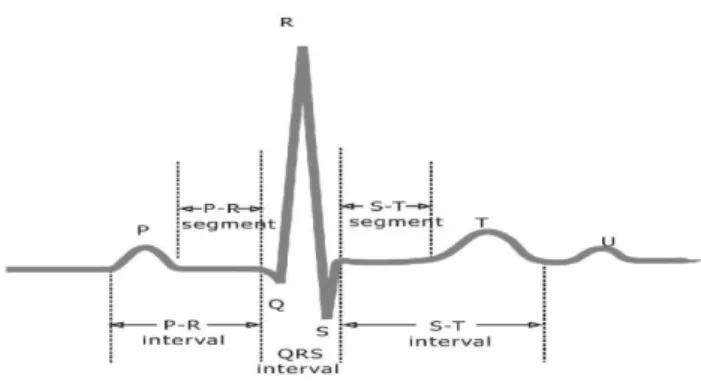
A typical ECG tracing of the cardiac cycle (heartbeat) consists of a P wave, a QRS complex, a T wave, and a U wave, which is normally invisible in 50 to 75% of ECGs because it is hidden by the T wave and upcoming new P wave. The baseline of the electrocardiogram (the flat horizontal segments) is measured as the portion of the tracing following the T wave and preceding the next P wave and the segment between the P wave and the following QRS complex (PR segment). In a normal healthy heart, the baseline is equivalent to the isoelectric line (0mV) and represents the periods in the cardiac cycle when there are no currents flowing towards either the positive or
negative ends of the ECG leads. However, in a diseased heart the baseline may be elevated (e.g. cardiac ischemia) or epressed (e.g. myocardial infarction) relative to the isoelectric line due to injury currents flowing during the TP and PR intervals when the ventricles are at rest. The ST segment typically remains close to the isoelectric line as this is the period when the ventricles are fully depolarised and thus no currents can flow in the ECG leads. Since most ECG recordings do not indicate where the 0mV line is, baseline depression often gives the appearance of an elevation of the ST segment and conversely baseline elevation gives the appearance of depression of the ST segment.
Fig 1: Normal ECG Signal
This signal represents an extremely important measure for doctors, as it provides vital information about a patient’s cardiac condition and general health. Generally, the frequency band of the ECG signal is 0.05 to 100Hz. inside the heart there is a specialized electrical conducting system that ensures the heart to expand and contract. ECG is commonly recorded with a noise caused by power line interference, electrode noise, Muscle Artifacts (MA), high frequency noise, random body movements and respiration. Different types of digital filters are used to remove signal components from unwanted frequency ranges. It is difficult to apply filters with fixed coefficients to reduce Biomedical Signal noises, because human behavior is not exact known depending on the time.
Noise Removal of ECG Signals using RLS
Adaptive Algorithm
Aditya Kumar Verma,Sagar Singh Rathore
Department of Electronics and Telecommunications Engineering, Shri Shankarachary Group of Institutions,Bhilai ,Chhattisgarh, India.
The Noises in ECG Signal
The common noise sources are:
Baseline wander and ECG amplitude modulation with respiration
Power line interference Muscle contraction noise Electrosurgical noise Motion artifacts
Noise due to variation of electrode skin contact impedance
Noise generated by electronic devices used in signal processing circuits
Adaptive filter technique is required to overcome this problem. Adaptive filters are considered to reduce the ECG signal noises like PLI and, high frequency noise, electrode noise, body noise (muscle artefact), Base Line Interference. Adaptive filters are designed using different algorithms like least mean square (LMS), recursive least mean square (RLS), normalized least mean squares (NLMS), etc. Least-squares algorithms aim at the minimization of the sum of the squares of the difference between the desired signal and the model filter output when new samples of the incoming signals are received at every iteration, the solution for the least-squares problem can be computed in recursive form resulting in the recursive least-squares (RLS) algorithms.
The goal for ECG signal enhancement is to separate the valid signal components from the undesired artifacts, so as to present an ECG that facilitates easy and accurate interpretation. The basic idea for the adaptive filter is to predict the amount of noise in the primary signal and then subtract that noise from it. The prediction is based on filtering the reference signal, which contains a solid reference of the noise present in the primary signal.
The noise in the reference signal is filtered to compensate for the amplitude, phase and time delay and then subtracted from the primary signal. This filtered noise is the system’s prediction of the noise portion of the primary signal. The resulting signal is called error signal and it presents the output of the system. Ideally, the resulting error signal would be only the desired portion of the primary signal. In this paper we present a RLS algorithm to remove
The artefacts from ECG using channel estimation with different modulation technique namely BPS, QPSK and 8-QAM. This algorithm enjoys less computational complexity and good filtering capability. To study the performance of the proposed algorithm effectively remove the noise from the ECG signal, we carried out simulations on MIT-BIH database for different artifacts.
OFDM (Orthogonal Frequency Division Multiplexing) system has been recognized as one of the most popular and competitive
technique in a wireless environment nowadays. The performance is calculated in terms of Bit Error Rate (BER) versus the Signal to Noise Ratio (SNR).
The Recursive least squares (RLS) adaptive filter is an algorithm which recursively finds the filter coefficients that minimize a weighted linear least squarescost function relating to the input signals. This is in contrast to other algorithms such as the least mean squares (LMS) that aim to reduce the mean square error. In the derivation of the RLS, the input signals are considered deterministic, while for the LMS and similar algorithm they are considered stochastic. Compared to most of its competitors, the RLS exhibits extremely fast convergence. However, this benefit comes at the cost of high computational complexity. Suppose that a signal d (n) is transmitted over an echoes, noisy channel that causes it to be received as
……….. (1)
Where represents additive noise. We will attempt to recover the desired signal by use of a
:
………(2) where
is the vector containing the most recent samples of . We estimate the parameters of the filter , and at each time n we refer to the new least squares estimate by
. As time evolves, we would like to avoid completely redoing the least squares algorithm to find the new estimate for , in terms of .
The benefit of the RLS algorithm is that there is no need to invert matrices, thereby saving computational power. Another advantage is that it provides intuition behind such results as the Kalman filter.
Fig 2. RLS adaptive filtering
The error implicitly depends on the filter coefficients through the estimate :
The weighted least squares error function —the cost function we desire to minimize—being a function of e(n) is therefore also dependent on the filter coefficients:
………..(3)
Where is the "forgetting factor" which gives exponentially less weight to older error samples?
The RLS algorithm for a p-th order RLS filter can be summarized as
Parameters: filter order forgetting factor value to initialize Initialization: ,
,
where is the identity matrix of rank Computation : For ………..(4) II. IMPLEMENTATION
This system is divided into two phases first is the training phase and the second is the testing phase. The training phase is as follows. Firstly the channel estimator (CE) is created using LMS technique or the RMS technique. The CE is inputted with the original signal and the noisy signal then the coefficient is
calculated that is the weight by which the denoised signal will be produced. The following figure shows the training phase.
Figure 3. Training Phase of the CE
The testing phase is as follows. The analog signal is taken as the input. The signal is then converted to the binary form. The binary signal is then inputted to the OFDM block where the high bit rate signal is normalized and a low bit rate signal is generated. The low rate signal is then passed over a channel (Tx is the signal which is given as the input to the channel). The channel can use AWGN (Additive white Gaussian noise), Rayleigh, Rician or AWCN + Raylein. The output is termed as Tx|. All these processes were at the senders end.
The signal received Tx|is then again send to the OFDM block and again the high bit rate signal is generated from the low bits which were send to minimize the noise effect like power line interference, electrode noise,muscluer noise,high frequency noise. on the signal. The signals are then send to the Channel Estimator (CE). Here the channel estimator estimates the error by plotting BER to SNR ratio. Where SNR stands for signal to noise ratio and BER is ((T-R)/T)*100. Now the plots are multiplied with the weights and a plot is created. If there is distance between the resulting steps the plots are changed and thus we get the resulting output. This output is again sent to the decimal to analog converter and the resulting output is found. The following figure shows the block diagram of the testing phase.
Figure 4. The Testing Phase of Channel Estimator In this methodology we use three different modulation technique namely binary phase shift keying, quadrature phase shift keying and 8- quadrature amplitude modulation
Result shows that binary phase shift keying method is most efficient in parameter of SNR Vs BER execution of performance process the ECG signal is acquired from MIT BIH Arrhythmia data base.Ressult shown in table is taken as
average result of bit error rate of signal in which SNR ranges from 10 to 15.then finally showing result in parameter of bit error rate with SNR for the noises present in ECG signal like power line interference, electrode noise, Muscle Artefacts (body noise),,high frequency noise.
III. RESULTS
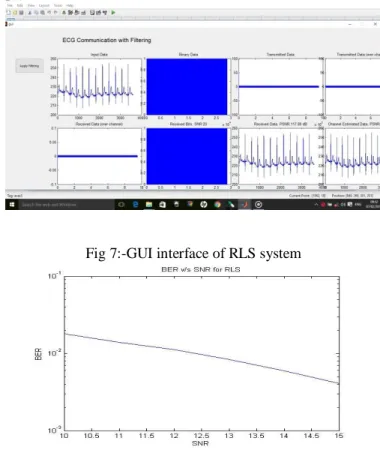
In this paper different noise removal from the ECG signals have been performed... Table 1 shows the result of different noise removal from ECG signal using BPSK, QPSK and 8-QAM. We have simulated the noises in terms of signal to noise ratio(SNR) versus bit error rate(BER).Fig 5 and 6 shows the performance of the BPSK,QPSK and 8-QAM modulation scheme. Figure 7 shows GUI of the RLS system .In figure 5 and 6 the graph is plotted among different modulation scheme, BPSK shows lower BER means it is the most efficient method comparing other method.
Fig .5:- SNR VS BER for PLI in RLS Algorithm
Fig 6:-SNR VS BER for High Frequency Noise in RLS Algorithm
Fig 7:-GUI interface of RLS system
Fig 8:- Plot for SNR vs. BER of RLS algorithm for BPSK
Fig 9:- Plot for SNR vs. BER of RLS algorithm for QPSK
Table: - SNR VS BER Calculation for RLS Algorithm
MIT-BIH SAMPLE 230
SNR BER SNR BER SNR BER SNR BER
BPSK 10-15 0.00436644 10-15 0.000000647 10-15 0.000000647 10-15 0.004376466
QPSK 10-15 0.009376297 10-15 0.000000647 10-15 0.000000647 10-15 0.009364951
8-QAM 10-15 0.023864566 10-15 0.000000647 10-15 0.000000647 10-15 0.024308011
MIT-BIH SAMPLE 228
SNR BER SNR BER SNR BER SNR BER
BPSK 10-15 0.005855887 10-15 0.00000064 10-15 0.00000064 10-15 0.006387841
QPSK 10-15 0.009603609 10-15 0.00000064 10-15 0.00000064 10-15 0.009533291
8-QAM 10-15 0.009422553 10-15 0.00000064 10-15 0.00000064 10-15 0.024004074
MIT-BIH SAMPLE 124
SNR BER SNR BER SNR BER SNR BER
BPSK 10-15 0.00448062 10-15 0.00000064 10-15 0.00000064 10-15 0.004019616
QPSK 10-15 0.009673099 10-15 0.00000064 10-15 0.00000064 10-15 0.009966645
8-QAM 10-15 0.023887116 10-15 0.00000064 10-15 0.00000064 10-15 0.024126646
MIT-BIH SAMPLE 122
SNR BER SNR BER SNR BER SNR BER
BPSK 10-15 0.004165385 10-15 0.000000638 10-15 0.000000638 10-15 0.004213678
QPSK 10-15 0.009943056 10-15 0.000000638 10-15 0.000000638 10-15 0.009867134
8-QAM 10-15 0.023599809 10-15 0.000000638 10-15 0.000000638 10-15 0.02292241
MIT-BIH SAMPLE100
SNR BER SNR BER SNR BER SNR BER
10-15 0.00533703 10-15 0.000000651 10-15 0.000000651 10-15 0.005397642
10-15 0.010117819 10-15 0.000000651 10-15 0.000000651 10-15 0.010179086
10-15 0.023659091 10-15 0.000000651 10-15 0.000000651 10-15 0.010179086
MIT-BIH SAMPLE 101
SNR BER SNR BER SNR BER SNR BER
BPSK 10-15 0.004226465 10-15 0.00000063 10-15 0.00000063 10-15 0.004391263
QPSK 10-15 0.009909173 10-15 0.00000063 10-15 0.00000063 10-15 0.010274364
8-QAM 10-15 0.024386636 10-15 0.00000063 10-15 0.00000063 10-15 0.024071457
MIT-BIH SAMPLE 210
SNR BER SNR BER SNR BER SNR BER
BPSK 10-15 0.005865318 10-15 0.000000621 10-15 0.000000621 10-15 0.005852011
QPSK 10-15 0.009914543 10-15 0.000000621 10-15 0.000000621 10-15 0.010283705
8-QAM 10-15 0.023978091 10-15 0.000000621 10-15 0.000000621 10-15 0.024179085
MIT-BIH SAMPLE 213
SNR BER SNR BER SNR BER SNR BER
BPSK 10-15 0.00419267 10-15 0.000000645 10-15 0.000000645 10-15 0.004102089
QPSK 10-15 0.009947278 10-15 0.000000645 10-15 0.000000645 10-15 0.00989913
8-QAM 10-15 0.023860021 10-15 0.000000645 10-15 0.000000645 10-15 0.023321786
MIT-BIH SAMPLE 215
SNR BER SNR BER SNR BER SNR BER
BPSK 10-15 0.006195973 10-15 0.000000626 10-15 0.000000626 10-15 0.005924053
QPSK 10-15 0.009480754 10-15 0.000000626 10-15 0.000000626 10-15 0.009542907
8-QAM 10-15 0.024109582 10-15 0.000000626 10-15 0.000000626 10-15 0.024230988
MIT-BIH SAMPLE 219
SNR BER SNR BER SNR BER SNR BER
BPSK 10-15 0.004383921 10-15 0.00000062 10-15 0.00000062 10-15 0.004526977
QPSK 10-15 0.009719469 10-15 0.00000062 10-15 0.00000062 10-15 0.009806563
8-QAM 10-15 0.023439525 10-15 0.00000062 10-15 0.00000062 10-15 0.024319594
PLI HEART BEAT ELECTROD NOISE HIGH REQUENCY
PLI HEART BEAT ELECTROD NOISE HIGH REQUENCY
PLI HEART BEAT ELECTROD NOISE HIGH REQUENCY
PLI HEART BEAT ELECTROD NOISE HIGH REQUENCY
PLI HEART BEAT ELECTROD NOISE HIGH REQUENCY
PLI HEART BEAT ELECTROD NOISE HIGH REQUENCY
PLI HEART BEAT ELECTROD NOISE HIGH REQUENCY
PLI HEART BEAT ELECTROD NOISE HIGH REQUENCY
PLI HEART BEAT ELECTROD NOISE HIGH REQUENCY
IV. CONCLUSION
According to the simulation parameters, we can conclude that RLS Method(Recursive Least Square) to remove noise from ECG Signal Based on three modulation technique BPSK(Binary Phase Shift Keying),QPSK(Quadrature Phase Shift Keying),8-QAM( Quadrature Amplitude Modulation) shows best result on noise reduction with BPSK modulation technique in terms of the signal to noise ratio(SNR) versus bit error rate(BER) because bit error rate is low for BPSK ,noises present in ECG signal like power line interference, electrode noise, Muscle Artifacts (MA),,high frequency noise.
REFERENCES
1. Mohd. Abuzer Khan, Sonu Pal, Ankita Jose,” BER Performance of BPSK, QPSK & 16 QAM with and without using OFDM over AWGN, Rayleigh and Rician Fading Channel ”IJARCCE Vol. 4, Issue 7, July
2015
2. Madan Lal,Hamneet Arora” BER Performance of Different Modulation Schemes for MIMO Systems ” IJCSNS International Journal of Computer Science and Network Security, VOL.11 No.3, March 2011 3. RS.Koteeshwari1,Suhanya Performance Enhancement
of Adaptive Filters Using Preprocessing Technique by Wavelet Transform” IJAREEIE Vol. 3, Issue 6, June 2014
4. Titus Eneh,Predrag Rapajic and Kwashie Anang ʺAdaptive MMSE Multiuser Receivers In MIMO OFDM Wireless Communicationʺ2010 IEEE.
5. Syed Zahurul Islam, Syed Zahidul Islam, Razali Jidin, Mohd. Alauddin Mohd. Ali, “Performance Study of Adaptive Filtering Algorithms for Noise Cancellation of ECG Signal”, IEEE 2009.
6. Md. Zia Ur Rahman, Rafi Ahamed Shaik, D V Rama Koti Reddy, “Noise Cancellation in ECG Signals using Computationally Simplified Adaptive Filtering Techniques: Application to Biotelemetry’’, International Journal (SPIJ)
.
7. Mohd. Abuzer Khan, Sonu Pal, Ankita Jose,” BER Performance of BPSK, QPSK & 16 QAM with and without using OFDM over AWGN, Rayleigh and Rician Fading Channel ”IJARCCE Vol. 4, Issue 7, July
2015
8. van asleJ. ,schilder T.,1985 “Removal of baseline wander and power line interference from the ECG by an efficient fir filter with a reduced number of tap” IEEE Transaction on biomedical engineering, VOL(32):1052-1060
9. Ferdjallah M., Barr.E.,1990 OCT “Frequency-Domain Digital Filtering Techniques for the Removal Powerline Noise with Application to the Electro
Cadiogram” ” IEEE Engineering in Medicine & Biology Society Annual International Conference, VOL 23(5): 475-489
10. Raimon j., Laguna p.,Thakor and Caminal P.,1992 “Adaptive Baseline Wander Removal in the ECG: Comparative Analysis With Cubic Spline Technique” IEEE proceeding Computers in Cardiology, VOL(1):143-146
11. .Sander A, Voss A, Griessbach G,1995 ,“An Optimized Filter System For Eliminating 50 Hz Interference from High Resolution ECG” IEEE conference of Engg. In Medicine and Biology , VOL 40(4) : 76-82
12. Hejjel L,2004 “Suppression of Power Line Interfrence by Analog Notch Filtering in the ECG signal for Heart Rate Variability Analysis : to do or not to do” med. Science ,VOL 10(1): 6-13
13. BaiY.,Yang Chu W.,Chien-Y., Ting Y. , 2004“Adjustable 60 HZ Noise Reduction by a Notch Filter for ECG signal” International and Measurement Technology conference comoItly
14. Lisette P. ,HartingNikolay M. ,FedotovCornies H.,2004 “On Baseline Drift Suppressing in ECG Recording” IEEE Benelux Signal Processing Symposium.
15. Abdul AwalMd., Sheikh S. & Ahmed M., 2004“Perfomance Analysis of Savitzky-Golay Smoothing Filter Using ECG signal”,Vol(1)
16. .Markovsky I,, Van H., 2008 “Application of Filtering methods for Removal of Resuscitation Artifacts from ECG signals” IEEE conference of Engg. In Medicine and Biology : 13-16
17. .HongLiu S., “Motion Antifact Reduction in Electrocardiogram using adaptive Filter” Journal of Medical & Biological Engg.,VOL 31(1): 67-72. 18. .Avendano D., Avendano L., Ferrero M., CastellaFilter
Power Line Interfrence suppressor for ECG Signal” Journal of convergence Information Technology
Mr. Aditya Kumar Verma,He is currently pursuing his ME with specialization in communication engineering from Chhattisgarh Swami Vivekananda Technical University Bhilai.He has received his Bachelor of Engineering from Bhilai institute of technology ,Durg in ET&T on year 2010 Mr. Sagar Singh Rathor, awarded Master of Technology with specialization in Instrumentation & control system from Chhattisgarh Swami Vivekananda Technical University Bhilai on year 2013,and received his Bachelor of Engineering from Rungta college of engineering and technology, Bhilai in Applied electronics & Instrumentation on year 2008.He is currently working as an Assistant Professor at SSGI,SSTC Bhilai since 2011.