NODE LOCALIZATION USING RANGE-FREE MODEL IN
MOBILE SENSOR NETWORKS
Abstract-Presently, the developments made in Wireless Sensor Networks are increasing the popularity in several applications like military applications etc. Sensor node localization is a highly desirable capability for wireless sensor network applications. Localization issue is very important, when positions of nodes are not known. In this paper, we make an attempt in localization issue. An efficient and novel range-free approachis introduced. This work is initiated by analyzing a range-free localization algorithm for mobile sensor networks. The mobile sensor networks consist of normal nodes, anchor nodes and sensor nodes. Anchor nodes are assumed to be mobile whereas the sensor nodes are stationary. Each anchor node broadcasts beacon signals to its neighbour node and they are received by the one hop distanced nodes. And the mobile node which receives this beacon signal has different Received Signal Strength because of variation in distances. The location of nodes can be approximately found using a detailed analysis on the beacon signals. A possible region of node a location is a region which covers node a location.The smaller possible region provides high localization accuracy. An experimental result proves the efficiency of the proposed algorithm.
Keywords- Mobile sensor networks, Anchor nodes, Range-free model, Beacon signal and Localization.
I. INTRODUCTION
The rapid development in highly dynamic sensor networks like mobile sensor networkshas been widely used. The advent of mobile sensor networks are used in hazardous areas, remote areas and massive amount of sensor nodes are to be deployed. Network coverage is a significant field of the mobile sensor networks. The quality of the sensor networks are measured by the coverage of the networks.Relied upon different application scenarios, the network parameters design are used for understanding the coverage of sensor networks. The node capabilitieswill be enhanced by the placement of
mobile nodes. It also assists us to indemnify the static nodes in the network.The deployment of nodes should satisfy both local and global constraints.
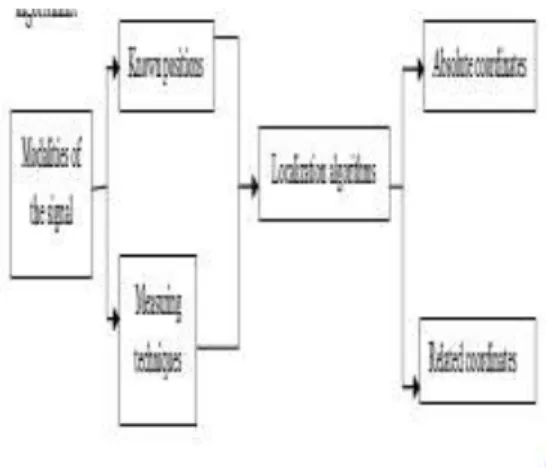
A promising feature of WSN application is the location awareness. Sample instances like position tracking, mapping, location oriented routing etc.All the mobile nodes don’thold its location information due to its cost and energy constraints. Anchor nodes are the nodes that contain position information. Localization is the major issue prevails in estimating the position of nodes. Though, several approaches exist for resolving the localization issue, but, fail to solve this issue. An efficient localization needs to be designed that predicts the accurate position information.The localization algorithm individually runs on the nodes in order to predict the position with restricted resources. The functioning of this efficient algorithm is determined by the radio range, density of nodes, and ratio of anchor to nodes. These parameters should also calculate in worst environmental settings.The fig.1 depicts the process of localization algorithms.
Fig. 1. Process of localization algorithm
Anant Harshalal Sharma1, and Prashil M. Jungare2 1
ME Student, Department of Computer Science Engineering, G.H. Raisoni College of Engineering, Nagpur
2
Several parameters dictate the importance of localization algorithms. Consider the instance, military applications, tagging the sensed data is an important part of this applications. Depends on its network coverage, the sensor node location is predicted. Sensor location information can also be used to perform efficient spatial querying or tasking, e.g., scoping the query or task propagation to sensor nodes in specific locations or geographic regions without the need to flood the whole network, significantly reducing the network overhead and minimize consumption of energy and resources in the network. In this paper, we present a improved localization algorithm, named, Range- Free Localization (RFL), for network of mobile sensors.The algorithm effectively predicts the node’s position in two methods, hop distance calculation and particle filtering. The proposed localization method will immediatly converges with small location estimation error. The rest of the paper is created as follows: Section II depicts the existing works carried out by other researchers; Section III depicts the working flow of proposed algorithm; Section IV presents the experimental analysis of the proposed algorithm and atlast concluded in Section V.
II. RELATED WORK
Since the arrival of Wireless Sensor Networks, Localization has been an intensive research domain. Several literatures are available in localization field that covers both dynamic and static mobile sensor networks.This section presents the prior work related to our research proposal. Moneto Carlo method (MCM) is designed for mobile sensor networks. It works on the basis of range-free and range-based localization algorithm. It’s intestinally designed to reduce the estimation error. The MCM was further improved by Baggio et al, which reduced the prediction area. Their method reduced the computational overhead but failed to operate on the dynamic parameters.The same study was done by
Hsieh et al. His localization algorithm, dynamically
updates the reference information. The study was extended to discover the cooperation between nodes. By estimating the position of neighborhood nodes, the current node’s position is determined.
The fundamental techniques of localization are the Multidimensional scaling (MDS) and Proximity based map (PM). It yields high accuracy in low communication and computation cost. These techniques are less concentrated by the researchers.Due to the channel fading and error propagation model has been proposed in many literatures. CAB is the range-free approach that
makes use of anchor nodes.Every anchor nodes emits beacons packets in variant power levels. The beacon packet’s carries details like position, power level and distance.Y. Sabri et al proposed devised localization algorithms which on basis of Graham’s scan, slsng. Their method effectively determines the sensor’s accuracy. Tree structure based access networks are used for mobile propagation model.P. Wanet et al proposed an event which is triggered distributed algorithm.In his method, each agent broadcast the error message to its nodes, if any misbehave signal is found. This method was further extended by the Z.
Baoli et al, which defined by Infra- Red(IR)
fingerprint and Received Signal Strength Indicator (RSSI). By doing so, it is distributed and low-cost algorithm with higher accuracy.
III. PROPOSED ALGORITHM
This section presents the proposed, Range-free localization algorithms. The proposed algorithm works in three steps. First, a simple backoff based flooding algorithm introduces to enhance the broadcasts processes and lessening the communication overhead. Further, a novel error correction scheme devises the error measurement over multiple hops for the mean hop distance. Secondly,MCB model is devised to effectively make use of prediction area. The position of anchor nodes calculates from the cooperatives nodes and its neighbors.Lastly, the sensed information used for lessening the prediction area by reducing the estimation error of non-anchor nodes. The proposed algorithm contains 5 phases, namely,
a) Creation of topology b) Static anchor nodes c) Anchor node density d) Hit ball algorithm e) RSS-constrained regions
a) Creation of topology
Let us assume networks consist of group of nodes.The nodes are deployed in square blocks of 1000 * 800m. The transmission range of nodes is set to 250m. The transfer speed is 5m/ms among the anchor points. The maximum queue length per node is set to 50 packets. The system architecture is given in Fig.2.
Fig.2. System Architecture
b) Static anchor nodes
The mobile sensor network consists of eight anchor nodes, five sensor nodes, and forty four normal nodes. The radius of communication nodes are at 250m.
c) Anchor node density
The density of anchor node is estimated to improve the localization accuracy. It density ranges from 1% to 15%.The one-hop beacon broadcasting contains lessened localization error. Similarly, the two-hop beacon broadcasting contains MCL+ Hitball and IMCL+ Hitball that reduces 28% and 38% of the localization of the error.
d) Hitball algorithm
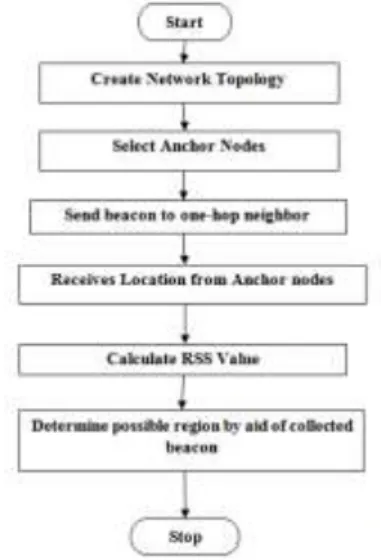
Hitball algorithm estimates the possible area of the node location by finding the intersection of the one hop and two hop beacon broadcasting regions. Let bt, idenotes the beacon interval of the normal node from anchor node at time slot t; Lt(p) be the location of the node p at time t. let Lt(b t,i ) be the location of the anchor node i when it sent out bt,i , and let Lj (bt,i) = null if j≠ t. The MCL algorithm consist of three phases, namely, sample generating phases, sample filtering phase and location estimation phase. The generating phase consists of one-hop anchor constrained regions and historical anchor constrained regions. In filtering phases, the invalid samples are filtered out by the RSS constrained regions. The location estimation phase determines the centroid of all valid samples. The fig. 3 presents the workflow of proposed algorithm.
Fig.3. Workflow of proposed algorithm
IV. EXPERIMENTAL ANALYSIS
This section presents the experimental analysis of the proposed Range-Free localization algorithms. The simulation parameters are defined in Table 1.
Table 1: Simulation parameters
Parameters Range
Square blocks 1000m * 800m Node transmission 250m
Transfer speed 5ms Queue length per
packets
50
Fig.5. Anchor node 11 is sending Beacon signal packet to neighbor node
Fig.6. Anchor nodes send the beacon signal packet to its neighbour nodes at variant time slots
Fig. 7All the anchor nodes and normal nodes are correlated to its neighboring nodes at different slots.
Fig. 8. Normal nodes determine the possible regions.
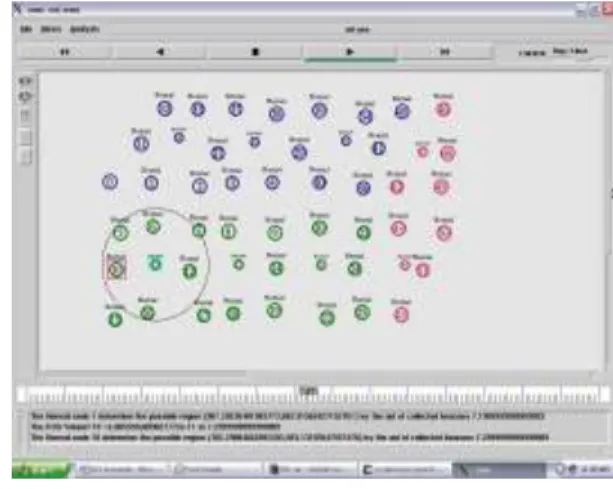
Fig.9. Normal node 25 determines the possible regions and estimates the RSS values. The same process is repeated for all
normal nodes.
Fig.11. Communication cost between existing and proposed work.
V. CONCLUSION
As wireless sensor networks play a significant role in the Industrial environments, an effective localization scheme became an important task.In this paper, we propose novel localization algorithm which efficiently works in range-free approaches. The use of range-free approach is to reduce the high communication cost. The proposed Range-Free Localization algorithm works in three steps. First, a simple backoff based flooding algorithm introduces to enhance the broadcasts processes and lessening the communication overhead. Further, a novel error correction scheme devises the error measurement over multiple hops for the mean hop distance. Secondly, MCB model is devised to effectively make use of prediction area. The position of anchor nodes calculates from the cooperatives nodes and its neighbors. Lastly, the sensed information used for lessening the prediction area by reducing the estimation error of non-anchor nodes.Experimental results prove the efficiency of proposed algorithm in terms of lessened error estimation and communication costs.
REFERENCES
[1] A. Baggio and K. Langendoen, “Monte Carlo localization for mobile wireless sensor networks”, Ad Hoc Netw., 6(5): pp. 718–733, 2008.
[2] S. Biswas and R. Morris, “ExOR: opportunistic multi-hop routing for wireless networks”, SIGCOMM Computer Communication Rev., 35(4): pp. 133–144, 2005.
[3] T. Camp, J. Boleng, and V. Davies, ”A survey of mobility models for ad hoc network research”, Wireless Communications & Mobile Computing (WCMC): Special
Issue on Mobile Ad Hoc Networking: Research, Trends and Applications, 2: pp. 483–502, 2002.
[4] H. Chen, K. Sezaki, P. Deng, and H. C. So, “An improved dv-hop localization algorithm with reduced location error for WSNS”, IEICE Transactions on Fundamentals, E91-A: pp.2232– 2236, Aug. 2008.
[5] B. Dil, S. Dulman, and P. Havinga, “Range-based localization in mobile sensor networks”,Computer Science, 3868: pp.164–179, 2006.
[6] A. Doucet, N. Defreitas, and N. Gordon,”Sequential Monte Carlo Methods in Practice”, Springer, 2001. [7] T. He, C. Huang, B. M. Blum, J. A. Stankovic, and T. Ab-delzaher, “Range-free localization schemes for large scale sensor networks, InProc. of ACM MobiCom, pp. 81– 95, New York, NY, USA, 2003.
[8] M. Heissenb¨ uttel, T. Braun, T. Bernoulli, and M. W¨alchli, “BLR: beacon-less routing algorithm for mobile ad-hoc networks”, Elsevier’s Computer Communications Journal (Special Issue), 27: pp. 1076–1086, 2004.
[9] Y.-L. Hsieh and K. Wang, “Efficient localization in mobile wireless sensor networks”, InSUTC ’06: Proc. of IEEE International Conference on Sensor Networks, Ubiquitous, and Trustworthy Computing, pp. 292–297, Washington, DC, USA, 2006.
[10] L. Hu and D. Evans, “Localization for mobile sensor networks”, InProc. of ACM MobiCom, pp. 45–57, New York, NY, USA, 2004.
[11] V. Vivekanandan, V. W.S.Wong,“Concentric anchor beacon localization algorithm for wireless sensor networks”, IEEE Transactions on vehicular technology, Vol. 56, No. 5, 2007
[12] Y. Sabri, N. E. Kamoun, STIC Laboratory,“ADistributed method for localization in large scale sensor networks based on graham’s can”, JSAT , January, 2012
[13] L. Hong, Y.Wu, S. H. Son,“Event triggered location aware data services in mobile WSNs”, 2008.
[14] P. Wan, M. D. Lemmon,“Event triggered distributed optimization in sensor networks”,Department of electrical engineering, Univ. of Notre Dame, IN 46556
[15] B. Zhang, F. Yu,“An event triggered localization algorithm for mobile wireless sensor networks”, IEEE 2010.