3514
All Rights Reserved © 2016 IJSETR
Efficient Heterogeneous Wireless Sensor Network
Using Improved Energy Optimization Approach
Anupam ChandrayanI, Nitin RathoreII Abstract- Wireless Sensor Network is
collection of Sensors. Sensor nodes gather the sensory information and communicating with other nodes in networks. Key Challenges in Wireless Sensor Network is saving energy and extend the network life time. Many routing protocol are used to manage the data transference in Wireless Sensor Network. Routing protocols are used in two types of network: Homogenous and Heterogeneous. Heterogeneous Wireless Sensor Network (WSN) comprises of sensor nodes with distinctive capability, for example, diverse computing power and sensing range. Contrasted with homogeneous WSN, arrangement and topology control are more perplexing in heterogeneous WSN. Although, many protocols evolve to optimize enery but is not appropriate for heterogeneous WSNs. In this paper, we test Stable Election Protocol (SEP) and Firefly algorithm based cluster-head election under a few distinctive situations holding high level heterogeneity to low level heterogeneity.
Index Terms: Heterogeneous Wireless Sensor Network, Clustering Protocol, Fireflies Algorithm, Stable Election Protocol.
I. INTRODUCTION
The key concern in setting up the legitimate operation of WSN is expanding the lifetime of the system by minimizing the consumption of energy. Wireless sensor network is a set of tiny, resource constrained sensors interconnected with each other to gather data about physical or environmental objects [1]. The sensing gadgets measure surrounding condition
identified with nature's domain encompassing the sensor and changes them into an electric indicator. Handling such an indicator uncovers a few properties about items found and/or events happening in the region of the sensor. A sensor system comprises of a few sensing gadgets conveyed in a given topographical territory for collaboratively assembling/sensing particular data in the environment relating to later on assessment in a center base station. The sensor nodes self-organize right after deployment to ascertain radio communication paths towards the sink. The sensing gadgets are low power gadgets comprising of a microcontroller for data transforming, a microchip and receiving wire for radio correspondence and a sensor for sensing ecological components like heat range, dampness, and light quality and so on. Some of the applications of sensor networks are disaster relief operations, biodiversity mapping, precision agriculture, habitat monitoring applications, Security purposes, Military services programs [2].
1.1 Clustering in Heterogeneous WSN Model
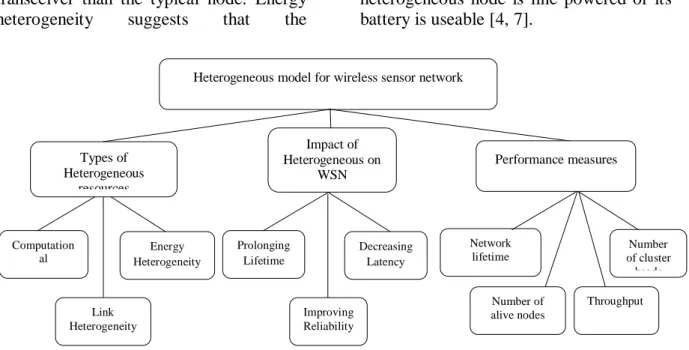
1.1.1 Types of Heterogeneous Resources There are three common forms of resource heterogeneity in sensor nodes computational heterogeneity, Link heterogeneity Energy heterogeneity [3]. Computational heterogeneity implies that the heterogeneous node has a more capable chip and more memory than the typical node. Link heterogeneity implies that the heterogeneous node has high-data transmission and long-separation system
3515
All Rights Reserved © 2016 IJSETR transceiver than the typical node. Energy
heterogeneity suggests that the
heterogeneous node is line powered or its battery is useable [4, 7].
Figure 1.1: Heterogeneous model for wireless sensor network 1.2 Impact of Heterogeneity on Wireless
Sensor Networks
It Decreases latency of information transportation such as Computational heterogeneity can diminish the processing latency in quick nodes and link heterogeneity can diminish the waiting time in the transmitting line. Prolonging network lifetime and improving dependability of information transmission. 1.3 Performance Measures
Some execution measures that are used to ascertain the execution of clustering conventions are recorded underneath. network lifetime, number of cluster heads for every round, number of dynamic nodes for every round, throughput.
1.4 Clustering
Figure 4.3.1 shows the cluster based data communication model. The process of communication is logically divided in cluster based wireless sensor network. Here, the sensor nodes are divided into small groups, which are called clusters. Each cluster will be having a cluster head(CH), which will monitor the remaining nodes(SN). Nodes in a cluster do not communicate with the base station
(BS) directly. SN senses the data and send that to the CH. The CH will aggregate sensed data, remove the redundant data and transmit it to the BS. So the energy consumption and number of messages transmitted to the BS will be reduced and number of active nodes in communication is also reduced. In this way the network lifetime is increased [5, 6].
Figure 1.2: Data communication in a clustering network
Cluster
Cluster Head Sensor node
Heterogeneous model for wireless sensor network
Computation al Heterogeneit y Energy Heterogeneity Link Heterogeneity Prolonging Lifetime Improving Reliability Decreasing Latency Network lifetime Throughput Number of cluster heads Number of alive nodes Types of Heterogeneous resources Impact of Heterogeneous on WSN Performance measures
3516
All Rights Reserved © 2016 IJSETR II. PROPOSED SOLUTION
2.1 Cluster-Heads Election Using Firefly Algorithm
Selection of cluster-heads plays an important role while simulation and analysis of network model. The proposed work shows the optimal selection of cluster-heads based on weight values and considering various parameters like residual energy, average energy and shortest path. As the optimal probability is function of spatial density when nodes are distributed uniformly over the field, optimality will be achieved when energy consumption of nodes will be uniform over the area and overall energy consumption is minimum resulting in enhance network lifetime.
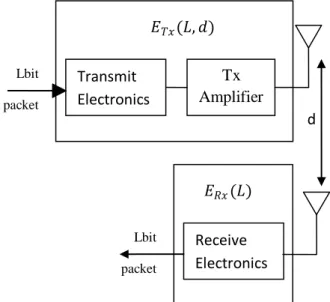
Figure 2.1: Radio Energy Dissipation Model
Consider the radio energy dissipation model as shown in Fig. 1, the energy spend by the radio to achieve satisfactory Signal-to-Noise Ratio while transmitting L-data bits over a distance d is given by:
𝐸𝑇𝑥 𝑙, 𝑑 =
𝐿. 𝐸𝑒𝑙𝑒𝑐𝑡 + 𝐿. 𝜖𝑓𝑠. 𝑑2 𝑖𝑓 𝑑 < 𝑑0
𝐿. 𝐸𝑒𝑙𝑒𝑐𝑡 + 𝐿. 𝜖𝑚𝑝. 𝑑4 𝑖𝑓 𝑑 ≥ 𝑑0
……..(1)
Hence the energy expended by the receiver to receive L-bit message is given by:
𝐸𝑅𝑥 = 𝐿. 𝐸𝑒𝑙𝑒𝑐𝑡 ………(2)
Assuming the field area to be 100×100 square meters and 100 nodes are uniformly distributed over the field. Therefore the energy dissipation of clusterhead node during a round in is given by: 𝐸𝐶𝐻 = 𝐿. 𝐸𝑒𝑙𝑒𝑐𝑡 100 ∗ 𝑘 − 1 + 𝐿. 𝐸𝐷𝐴 100 ∗ 𝑘 + 𝐿. 𝐸𝑒𝑙𝑒𝑐𝑡 + 𝐿. 𝜖𝑓𝑠. 𝑑𝑡𝑜𝐵𝑆2 ……. (3)
Here k is number of clusters, 𝐸𝐷𝐴 is data
aggregation cost.
Energy dissipation of a normal node (non-CH) is given by:
𝐸𝑛𝑜𝑛𝐶𝐻 = 𝐿. 𝐸𝑒𝑙𝑒𝑐𝑡 + 𝐿. 𝜖𝑓𝑠. 𝑑𝑡𝑜𝐶𝐻2 .…. (4)
Where 𝑑𝑡𝑜𝐶𝐻 is distance between normal
node and its clusterhead.
The energy dissipation of a cluster can be given as:
𝐸𝑐𝑙𝑢𝑠𝑡𝑒𝑟 ≈ 𝐸𝐶𝐻+100 ∗
𝑘 𝐸𝑛𝑜𝑛𝐶𝐻 ... (5)
And total Energy dissipation of network is given by: 𝐸𝑇𝑑 = 𝐿. 2𝑛𝐸𝑒𝑙𝑒𝑐𝑡 + 𝑛𝐸𝐷𝐴 + 𝜖𝑓𝑠 𝑘. 𝑑𝑡𝑜𝐵𝑆2 + 𝑛 𝑀2 2. 𝜋. 𝑘 ………(6) The optimal number of cluster can be found by differentiating equation (6) with respect to k and equating it to 0 and it is given by:
𝑘𝑜𝑝𝑡 = 𝑛 2𝜋
𝑀 𝑑𝑡𝑜𝐵𝑆
And also the optimal probability of a node to be elected as clusterhead is given by: 𝑝𝑜𝑝𝑡 =𝑘𝑜𝑝𝑡
𝑛
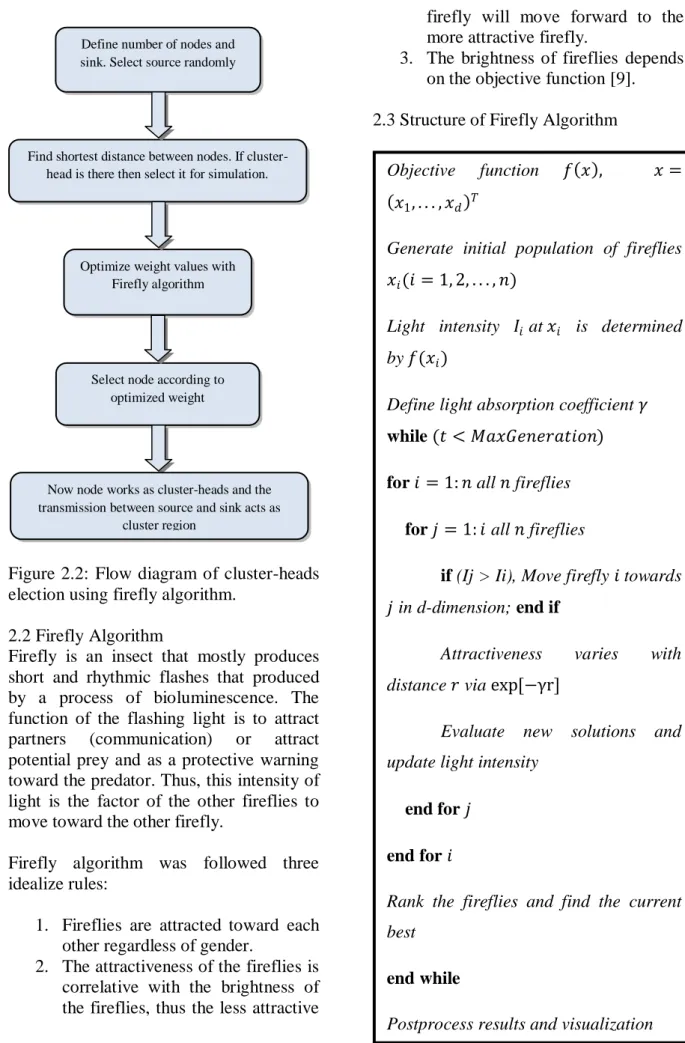
This probability 𝑝𝑜𝑝𝑡 is further optimized by
Firefly Algorithm. . Flow diagram is shown below for cluster-heads election.
Receive Electronics 𝐸𝑅𝑥(𝐿) Lbit packet Transmit Electronics Tx Amplifier 𝐸𝑇𝑥(𝐿, 𝑑) Lbit packet d
3517
All Rights Reserved © 2016 IJSETR Figure 2.2: Flow diagram of cluster-heads
election using firefly algorithm. 2.2 Firefly Algorithm
Firefly is an insect that mostly produces short and rhythmic flashes that produced by a process of bioluminescence. The function of the flashing light is to attract partners (communication) or attract potential prey and as a protective warning toward the predator. Thus, this intensity of light is the factor of the other fireflies to move toward the other firefly.
Firefly algorithm was followed three idealize rules:
1. Fireflies are attracted toward each other regardless of gender.
2. The attractiveness of the fireflies is correlative with the brightness of the fireflies, thus the less attractive
firefly will move forward to the more attractive firefly.
3. The brightness of fireflies depends on the objective function [9]. 2.3 Structure of Firefly Algorithm
Objective function 𝑓 𝑥 , 𝑥 = 𝑥1, . . . , 𝑥𝑑 𝑇
Generate initial population of fireflies
𝑥𝑖(𝑖 = 1, 2, . . . , 𝑛)
Light intensity 𝐼𝑖 at 𝑥𝑖 is determined by 𝑓(𝑥𝑖)
Define light absorption coefficient 𝛾
while (𝑡 < 𝑀𝑎𝑥𝐺𝑒𝑛𝑒𝑟𝑎𝑡𝑖𝑜𝑛)
for 𝑖 = 1: 𝑛 all 𝑛 fireflies
for 𝑗 = 1: 𝑖 all 𝑛 fireflies
if (Ij > Ii), Move firefly 𝑖 towards 𝑗 in d-dimension; end if
Attractiveness varies with distance 𝑟 via exp[−γr]
Evaluate new solutions and update light intensity
end for 𝑗
end for 𝑖
Rank the fireflies and find the current best
end while
Postprocess results and visualization
Define number of nodes and sink. Select source randomly
Find shortest distance between nodes. If cluster-head is there then select it for simulation.
Optimize weight values with Firefly algorithm
Select node according to optimized weight
Now node works as cluster-heads and the transmission between source and sink acts as
3518
All Rights Reserved © 2016 IJSETR III. Result Analysis
3.1 Simulation Parameters Table 3 Parameters table
Field area 100×100 meter squares Number of nodes in the field 100 Optimal Election Probability 0.1 Initial Energy of nodes 0.5 J Energy consumption of transmit and receive amplifiers 500 Nano Joules Per Round Maximum number of rounds 6000 3.2 Evaluation Parameters 3.2.1 Throughput
It is the ratio of the total number of successful packets in bits received at destination in a specified amount of time.
TH = Transmission of Routing Packets
3.2.2 Network Lifetime
The lifetime in a WSN is the time period throughout which the system ceaselessly fulfils the provision necessity.
3.2.3 Cluster Head Selection
Number of cluster heads selected in each round.
3.3 Simulation Results
Simulation is carried out using MATLAB 2010a
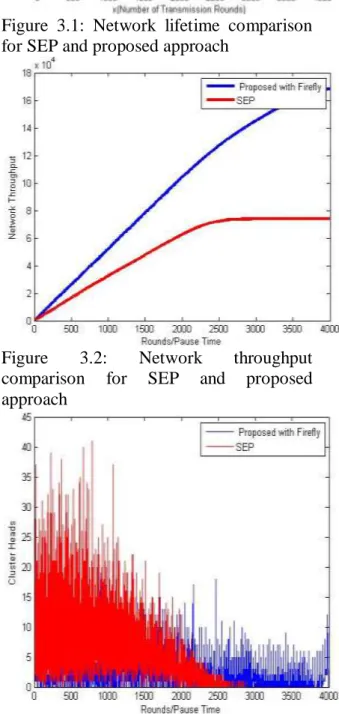
Figure 3.1: Network lifetime comparison for SEP and proposed approach
Figure 3.2: Network throughput comparison for SEP and proposed approach
Figure 3.3: Cluster head selection for SEP and proposed approach
3519
All Rights Reserved © 2016 IJSETR VI. CONCLUSION
In this paper, we have inspected the existing state of proposed clustering algorithm, particularly concerning their power and reliability quality necessities. In wireless sensor networks, the energy limits of nodes assume an essential part in planning any protocol for execution. We have examined Stable Election Protocol (SEP) [10] and Firefly algorithm based cluster-head election for heterogeneous WSNs containing different level of heterogeneity. Simulations prove that Firefly algorithm based cluster-head election performs well in all scenarios. It has best performance in terms of Network Throughput and Lifetime.
REFERENCES
[1] Yick, J.; Mukherjee, B.; Ghosal, D. Wireless Sensor Network Survey. Comput. Netw. 2008, 52, 2292–2330
[2] I. F. Akyildiz et al., “Wireless Sensor Networks: A Survey”, Elsevier Sci. B.V. Comp.Networks, vol. 38, no. 4, Mar. 2002, pp. 393–422.
[3] V. Katiyar, N. Chand, S. Soni, “A Survey on Clustering lgorithms for Heterogeneous Wireless Sensor Networks” Int. J. Advanced Networking and Applications Vol. 02, Issue: 04, pp. 745-754, 2011.
[4] D. Kumar, T. C. Aseri and R. B. Patel, “EEHC: Energy efficient heterogeneous clustered scheme for wireless sensor networks,” Computer Communications, Vol. 32, 2009, pp. 662–667 [5] Abbasi, A.A. and Younis, M., “A survey on clustering algorithms for wireless sensor networks”. Computer Communications. 30: pp 2826–2841, 2003.
[6] D. J. Dechene, A. El Jardali, M. Luccini, and A. Sauer, “A Survey of Clustering Algorithms for Wireless Sensor Networks”, 2004.
[7] Eiko Yoneki, Jean Bacon,”A survey of Wireless Sensor Network technologies: research trends and
middleware’s role,” Technical Report, no: 646, UCAM ¡CL¡TR¡646.
[8] Seema Bandyopadhyay and Edward J. Coyle, “An Energy Efficient Hierarchical Clustering Algorithm for Wireless Sensor Networks”, IEEE, 2003
[9]Yang,Xin-She, “Nature-inspired Metaheuristic Algorithms”, Luniver press, 2010.
[10] G. Smaragdakis, I. Matta, A. Bestavros, “SEP: A Stable Election Protocol for clustered heterogeneous wireless sensor network”, in: Second International Workshop on Sensor and Actor Network Protocols and Applications (SANPA 2004), 2004.
AUTHORS
First Author – Mr. Anupam Chandrayan, M.E. (Research Scholar), Department of Computer Science and Engineering, Indore Institute of Science and Technology, Indore. Second Author – Mr. Nitin Rathore, Asst. Professor, Department of Computer Science and Engineering, Indore Institute of Science and Technology, Indore.