VI Jornadas de Cloud Computing & Big Data (JCC&BD 2018)
Implementing cloud-based parallel metaheuristics: an
overview
Patricia González
1, Xoán C. Pardo
1, Ramon Doallo
1, and Julio R. Banga
2 1C o m p u te r A rc h ite c tu re G roup, U n iv ersid a d e d a C oruña, S p a in{patricia.gonzalez, xoan.pardo, doallo}@ udc.es
2B io P ro c e s s E n g in e e r in g G roup, IIM -C S IC , S p a in
julio@ iim .csic.es
Abstract
Metaheuristics are among the most popular methods for solving hard global optimization problems in many areas of science and engineering. Their parallel im plementation applying HPC techniques is a common approach for efficiently using available resources to re duce the time needed to get a good enough solution to hard-to-solve problems. Paradigms like MPI or OMP are the usual choice when executing them in clusters or supercomputers. Moreover, the pervasive presence of cloud computing and the emergence of programming models like MapReduce or Spark have given rise to an increasing interest in porting HPC workloads to the cloud, as is the case with parallel metaheuristics. In this paper we give an overview of our experience with different alternatives for porting parallel metaheuris tics to the cloud, providing some useful insights to the interested reader that we have acquired through extensive experimentation.
Keywords: parallel metaheuristics, cloud computing, MPI, MapReduce, Spark
1 Introduction
Optimization is concerned with finding the ”best avail able” solution for a given problem. Many key prob lems in different areas of science, economics and engi neering can be formulated and solved using different optimization techniques [1, 2, 3]. For example, opti mization problems are playing an increasing role in computational biology, bioinformatics and chemistry, helping in the development of novel therapies and drugs for different diseases such as cancer or auto immune diseases. Most of these optimization prob lems are, in practice, NP-hard, complex, and time
consuming. Stochastic global optimization methods are robust alternatives to solve these problems. And among them, metaheuristics are gaining increased at tention as an efficient way of solving hard global opti mization problems. However, in most realistic appli cations, metaheuristics still require large computation time to obtain an acceptable result.
Thus, the parallelization of optimization methods in general, and of metaheuristics in particular, and the use of HPC resources, like clusters or supercomput ers, have been a common approach to speed-up the computations, increase the size of the problems that can be handled or attempt a more thorough exploration of the solution space. Furthermore, the technological developments of the last decades, continuously reduc ing the cost/performance ratio of HPC resources, have made accessing to them more feasible. However, when considering very challenging problems, the provision of a large number of resources, which is not always practicable, is essential for the success of the parallel solution. The emergence in the last years of cloud computing [4] as a new model for the effortless pro vision of a large number of computing resources has attracted the attention of the HPC community.
Cloud computing has some specific characteristics that make it an interesting alternative for the provision and management of computing resources. Public cloud providers offer self-service interfaces to external users for the on-demand provision of virtualized comput ing resources. Users share the provider infrastructure while having exclusive zero-queue-time access to their own isolated virtual resources, configured to their ap plications’ needs. Resource consumption is charged using a pay-as-you-go model at very appealing prices. Additionally, collaborators can be provided with con trolled access to resources and environments be shared with third-parties using virtual machine images.
But despite these appealing features, its adoption by the HPC community has been limited. The main reason is the performance obtained when using tra ditional parallel programming models, like MPI, on virtual clusters. Several evaluations [5, 6] have shown that although computationally-intensive applications present little overhead, communication-intensive ones
VI Jornadas de Cloud Computing & Big Data (JCC&BD 2018)
have poor performance thus limiting their scalability. On the other hand, to facilitate the development of large-scale distributed applications, new program ming models like MapReduce [7] or Spark [8] have been proposed. These models combine high-level programming abstractions and distributed execution frameworks with implicit support for deployment, data distribution, parallel processing and run-time features like fault tolerance or load balancing. But, although their many advantages, these proposals also have some shortcomings that could discourage their use for HPC workloads. They are designed with the analytics of big amounts of data in mind, preferring availability to per formance and providing lower speedup and distributed efficiency than traditional parallel frameworks.
In this paper we give an overview of our experience with the different alternatives we have studied for port ing some representative parallel metaheuristics to the cloud. By means of extensive experimentation, using both synthetic and real-world benchmarks on different traditional and cloud testbeds, we have analyzed the pros and cons of the different options. Considering the demanding and dynamic nature of the implementation of these methods, we think that they are exemplary of the many applications that could benefit from being ported to the cloud, and that the conclusions drawn could be useful in many other scenarios.
The rest of the paper is structured as follows. Sec tion 2 describes the alternatives for writing parallel programs for the cloud that we have analyzed. Section 3 introduces the Differential Evolution metaheuristic and the parallel versions we have implemented. In sec tion 4 the main lessons learned from experimental re sults are overviewed and justified. Section 5 references some related work. Finally, Section 6 summarizes the conclusions of the paper.
2 Parallel programming in the cloud
Nowadays there are different alternatives that could be used to implement parallel programs for the cloud. Examples include “traditional” message-passing or many-task computing approaches, using actors or us ing data-oriented models and abstractions like MapRe duce (MR) or Resilient Distributed Datasets (RDD). From these alternatives, we have evaluated and com pared three different approaches. Each of them is based on different programming abstractions, imple mented using different programming languages and executed using different platforms:
1. A C implementation using MPI in a virtual clus ter.
2. A Java implementation using MR in a Hadoop cluster.
3. A Scala implementation using the RDD abstrac tion in a Spark cluster.
The Message Passing Interface (MPI) is the de facto standard for HPC distributed computing. It is a standard interface that allows developers to write par allel applications in C, C++ or FORTRAN using the message-passing model. In this model, parallel pro grams consist of a set of processes that communicate with each other by sending and receiving messages. Processes have separate address spaces and the pro grammer has explicit control over the memory used by each process and how the communication occurs.
MapReduce (MR) [7] is a programming model and associated distributed execution framework originally proposed for processing large datasets in commodity clusters. For many years it has been the de-facto stan dard for cloud programming. A program in MR is composed of a pair of user-provided map and reduce functions, generally written in Java, that are executed in parallel over a distributed network of worker pro cesses. Executions can be described as a directed acyclic data flow where a network of stateless map pers and reducers process data in single batches, using a distributed filesystem (typically HDFS) to take the input and store the output. The execution framework has a master-worker architecture with implicit sup port for data distribution, parallel processing and fault tolerance.
Resilient Distributed Datasets (RDD) [8] is the main abstraction provided by Spark for supporting fault-tolerant and efficient distributed in-memory com putations. An RDD is a read-only fault-tolerant parti tioned collection of records that is created from other RDDs or from data in stable storage by means of coarse-grained transformations (e.g., map, filter or join) that apply the same operation to many data items at once. RDDs are used in actions (e.g. count, collect or save) to return a value to the application or export data to a storage system. Spark provides a program ming interface to RDDs for Scala, Java or Python, and a distributed execution framework composed of a single driver program and multiple workers, that are long-lived processes that persist RDD partitions across operations. Developers write the driver program in which they can manipulate RDDs using a rich set of operators, control their partitioning to optimize data placement and explicitly persist intermediate results to memory or disk.
Each of the selected approaches has its pros and cons. The MPI approach is HPC oriented and its main advantage is the high communications performance combined with the use of a compiled programming language. The other two approaches are HTC oriented, having JVM-based distributed execution frameworks and using interpreted or JVM languages, which a priori will provide worst performance. On the other hand, compared with the other two, the MPI approach is too low level, requiring that the programmer deals with details like the data distribution, the ordering of communications or the fault-tolerance support.
VI Jornadas de Cloud Computing & Big Data (JCC&BD 2018)
Both MR and Spark provide high-level data abstrac tions, interfaces to object and/or functional languages and distributed execution frameworks with implicit support for data distribution and fault tolerance, so programming is easier and less error-prone. The main difference between them is how they support iterative algorithms. MR has been designed to execute pro grams in batches, taking input, and storing output and intermediate data in the file system. Executing iterative algorithms has considerable overhead because there is no way of efficiently reusing data or computation from previous batches. On the contrary, Spark has been designed with iterative algorithms in mind, providing efficient in-memory processing between iterations.
3 Parallel implementation of the Differ
ential Evolution metaheuristic
For our study we have selected one representative population-based metaheuristic that will be used as a test case, the Differential Evolution (DE) [9]. DE is very popular and has been successfully applied to many problems [10]. It is an stochastic iterative method (see algorithm 1) that starting from an initial population matrix composed of NP D-dimensional so lution vectors (individuals), tries to achieve the optimal solution iteratively using vector differences to create new candidate solutions. In each iteration, new individ uals are generated by means of operations (crossover - CR; mutation - F) performed among individuals in the population matrix. New solutions will replace old ones when its fitness value was better. A population matrix with optimized individuals is obtained as out put of the algorithm. The best of which is selected as the solution close to optimal for the objective function of the model.
Different models have been proposed for the paral lelization of metaheuristics [11]. We have considered two of the most popular:
1. The master-slave model, that preserves the be
haviour of the sequential algorithm parallelizing the inner-loop of the DE. In this model a mas ter processor distributes computation operations between the slave processors.
Algorithm 1 Differential Evolution algorithm
Input: A population m atrix P o f size D x NP
Output: A m atrix P w hose individuals w ere optim ized 1 2 3 4 5 6 7 8 9 10 11 12 13 14 15 16 17 18 19 20 repeat
for each elem ent i o f the P m atrix do
choose random ly different r1, r2, r3 e [1, NP]
choose random ly an integer j re [1, D] for j ^ 1, D do
choose a random ly real r e [0,1] if r < CR or j = j rthen uG+1 (j ) ^ xG (j ) + F• ( x £(j) - x £ (j) ) else uG+1( j) ^ xG( j) end if end for evaluate ( u f+ 1)
if fitness(uf+1) < f it ness( xf)then
XP+1 ^ uG+ 1 else xG+1 ,_xG xi ^ xi end if end for
until S top conditions
For the mutation of each individual, three random dif ferent individuals have to be selected from the whole population but, unlike MPI, communication among workers is not allowed in Spark. Each worker only have access to individuals of its partition and the driver is the only that has access to the complete population.
From the alternatives we tried to deal with this prob lem, broadcasting a read-only copy of the whole popu lation to every worker in each iteration was the option that has shown best benchmarking results. But even so, the communications overhead introduced by this solution was unfeasible. So we concluded that the master-slave model did not fit well with the distributed programming model of Spark and decided to discard it in favour of the island-based model. A complete discussion of the implementation of the master-slave model and the other alternatives we tried to deal with this issue can be found in [12].
3.1 Island-based DE implementations
2. The island-based model, that divides the popu
lation in subpopulations (islands) where the DE
algorithm is executed isolated. To preserve diver sity and avoid getting stuck in local optima spo radic individual exchanges are performed among islands.
Our first approach was to parallelize the DE using the master-slave model. But when we were imple menting it with Spark, we found an issue with the parallelization of the generation of new individuals. In the implementation of this model with Spark, the pop ulation is partitioned and distributed among workers.
Dividing the population into subpopulations reduces interprocessor communications and leads to more loosely coupled parallel applications. Therefore, at least theoretically, the island model should be more suitable for implementing parallel metaheuristics with programming abstractions like MR or RDDs. In this section we explain the basics of the three island-based implementations of the DE that we have studied and compared.
Figure 1 shows the schematic diagram of the imple mentation with MPI of an asynchronous island-based DE (asynPDE) first presented in [13]. Each process
ex-Generate in i tia I Scatter random population population
Evolve islands
population Migration Algorithm 3 Island evolution of the MPI impl.
Figure 1: Island-based DE implementation with MPI
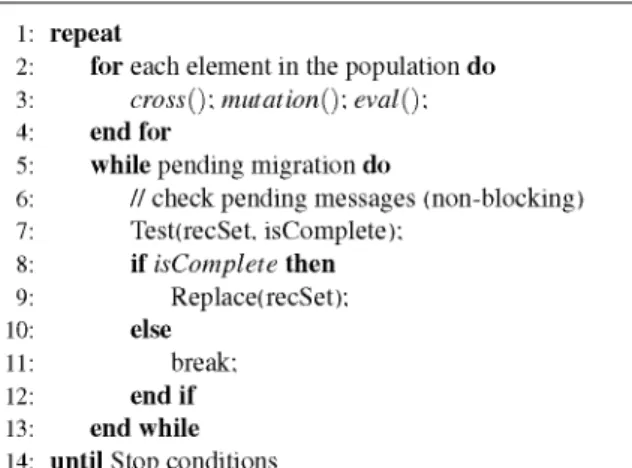
ecutes the same inner-loop of the sequential DE, doing mutation and crossover operations within the subpopu lation of its island. A migration step is performed once every few iterations to migrate individuals among is lands in order to preserve diversity. MPI asynchronous communications have been used to avoid having idle processes waiting for migrants arriving from other pro cesses. The arriving of new individuals is examined at the end of the migration step (algorithm 2), proceeding with the next island evolution if new solutions have not yet arrived. Missed migrations will be checked again later, after each evolution of the island (algo rithm 3). Asynchronous communications are also used for checking the stopping criteria of the algorithm. Whenever a process reaches a stopping condition, it
sends a message to the rest so they can all stop almost at the same time.
As every MR program, our implementation of the island-based DE with MR (mrPDE) presented in [14]
has two components: the main program (driver) that
will be executed by the master and the map and re
duce functions that will be executed by the workers.
In the driver (algorithm 4) the outer-loop of the DE is executed to evolve a randomly-generated population until the stopping criterion is met. In every iteration, the population is partitioned into islands that are writ ten to HDFS, a batch MR job is launched to evolve the islands in parallel and the resulting global popu lation is read from HDFS once the job finished. To introduce diversity individuals are randomly shuffled during the partition of the population. The inner-loop of the DE algorithm is executed in the map function (algorithm 5) of the MR job. Each map instance reads an island population from HDFS and applies the
muta-1: r e p e a t
2: f o r each element in the population d o 3: c ro ssQ : m u ta tio n Q : e v a lQ :
4: e n d fo r
5: w h ile pending migration d o
6: // check pending messages (non-blocking) 7: Test(recSet, isComplete); 8: i f is C o m p le te th e n 9: Replace(recSet); 10: else 11: break; 12: e n d i f 13: e n d w h ile 14: u n til Stop conditions
Algorithm 4 Driver of the MR implementation
Input: DE configuration parameters
Output: A population P of optimized individuals
1: P 4— initial random population 2: # i 4— number of islands
3: repeat
4: // partition and shuffle the population 5: Is la n d s •= PartitionPopulation(P. # i)
6: P •= EvolveIslands(/s/¡77?ds) // the MR job
7: until Stop conditions
tion strategy during a predefined number of evolutions, taking random individuals from its island only. Finally, an output record is emitted for each individual of the evolved island using its fitness value as key. The MR job is completed with a single identity reducer that writes all the population to HDFS ordered by fitness.
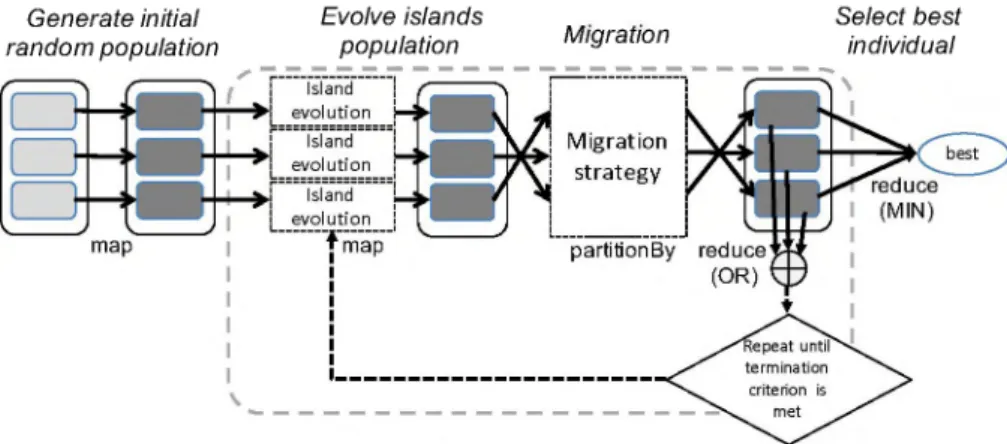
The schematic diagram of our island-based DE im plementation with Spark (SiPDE) presented in [12] is shown in figure 2. The population has been repre sented as a key-value pair RDD (solid outlined boxes in the figure). Each partition of the population RDD is considered to be an island (shaded rectangles in the figure, darker if they are persisted in memory). The algorithm starts generating in parallel an initial ran
dom population using a map transformation. Then, an
evolution-migration loop is repeated until the stopping
criterion, implemented as a reduce action (a distributed
Algorithm 2 Migration step of the MPI impl.
1: select(migSet); 2: // asynchronous send 3: ISend(migSet, remoteDest);
4: // asynchronous reception (non-blocking) 5: IRecv(recSet, remoteDest);
6: TesfirecSet, isComplete); 7: i f is C o m p le te th e n
8: Replace(recSet);
9: e n d i f
Algorithm 5 Map function of the MR implementation
Input: An island I: DE configuration parameters
Output: An island I of optimized individuals
1: repeat
2: // apply the DE mutation strategy 3: I -= Evolvelsland(I)
4: until number of evolutions
5: for each individual I n d of the island I do
6: Emit(fitness(/;?d). bid)
Generate initial Evolve islands Select best random population population Migration individual
Figure 2: Island-based DE implementation with Spark OR), is met. Finally, the best individual is selected
using a reduceaction (a distributed MIN). During each
iteration of the evolution-migrationloop islands evolve
isolated for a predefined number of evolutions. After which, and to introduce diversity, the same random shuffling as in the MR implementation is perfonned
using a custom random partitioner.
The three prograimning models have unique inher ent features that have conditioned the implementations, modifying the systemic properties of the original algo rithm, and resulting in different searches. As we will see later, this will influence the benchmarking results. The parts of the algorithm that have been implemented differently are:
•
The migration strategy.While in MPI it is used an strategy with replacement (i.e. best individ uals in one island replace worst individuals in the neighbour), in MR and Spark, as messaging between worker processes is not possible, the mi gration is a random shuffling of the population without replacement.•
The evolution-migration synchronization. In MPI individuals are migrated using asynchronous mes saging between processes, so each island can pro ceed with a new evolution without waiting for the others. For the same reason as before, in MR and Spark that is not possible, so migrations introduce a synchronization step between island evolutions.•
The stopping criterion checking. In MPI when ever a process reaches a stopping condition sends an asynchronous message to the rest and all stop almost at the same time. Again that is not possi ble in MR and Spark, that have to wait until all the islands conclude their evolutions to check if any of them reached the stopping condition. It must be noted that, although the migration steps in MR and Spark appear to be very similar, their im plementations and overheads are very different. In MRthe migration is perfonned in the driver,reading the
population from HDFS, shuffling the individuals and
writing back the islands to HDFS, while in Spark a cus
tom random partitioneris used (no HDFS overhead).
4 Lessons learned from experimental re
sults
In our previous works [14, 15, 16], we have conducted extensive testing of the three proposed island-based DE implementations using different benchmarks and execution platfonns. In this section we overview the main lessons that we have learned, using the exper imental results obtained for a challenging problem from the domain of computational systems biology, the Circadian model [17], as example. It is a pa rameter estimation problem in a nonlinear dynamic
model of the circadian clock in the plant Arabidopsis
Thaliana,that is known to be particularly hard due to its ill-conditioning and non-convexity.
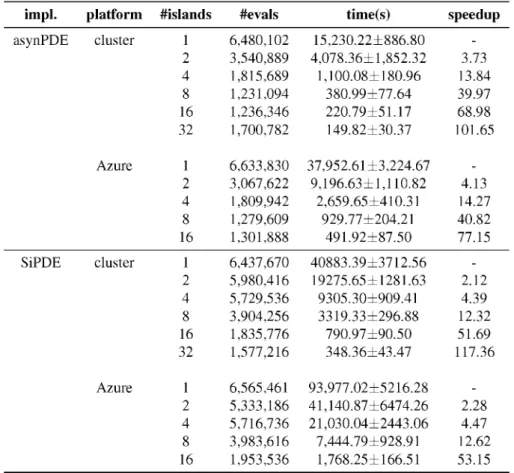
Table 1 summarizes the results of the experiments with the MPI (asynPDE) and Spark (SiPDE) imple
mentations. In the columns the number of cores
(Ms-lands)used, the mean number of evaluations required
(#evals),the mean and deviation of the execution times
(time(s)),and the speedup achieved versus the sequen tial execution are shown. Two different platforms have been tested varying the number of cores from 2 to 16/32 and calculating the mean of 20 independent runs for each configuration. The first platform was a cluster (named Pluton) with 16 nodes powered by two octa- core Intel Xeon E5-2660 @2.20GHz with 64GB and an InfiniBand FDR network. The second platfonn was a virtual cluster fonned by A3 instances (4 cores, 7GB) in the Microsoft Azure cloud. The quality of the solution has been used as tennination condition
with a value-to-reach (VTR)of le-5 and, for the mi
gration frequency, 50 evolutions between migrations have been used for asynPDE and 200 for SiPDE. Refer to [16] for the detailed experimental setting.
From table 1 we can conclude the following:
•
All the parallel implementations (including MRconver-VI Jornadas de Cloud Computing & Big Data (JCC&BD 2018)
Table 1: MPI and Spark results (DE params: NP=256, D=13, CR=0.8, F=0.9, VTR=1e-5)
impl. platform #islands #evals time(s) speedup
asynPDE cluster 1 6,480,102 15,230.22±886.80 -2 3,540,889 4,078.36±1,852.32 3.73 4 1,815,689 1,100.08±180.96 13.84 8 1,231,094 380.99±77.64 39.97 16 1,236,346 220.79±51.17 68.98 32 1,700,782 149.82±30.37 101.65 Azure 1 6,633,830 37,952.61 ±3,224.67 -2 3,067,622 9,196.63± 1,110.82 4.13 4 1,809,942 2,659.65±410.31 14.27 8 1,279,609 929.77±204.21 40.82 16 1,301,888 491.92±87.50 77.15 SiPDE cluster 1 6,437,670 40883.39±3712.56 -2 5,980,416 19275.65±1281.63 2.12 4 5,729,536 9305.30±909.41 4.39 8 3,904,256 3319.33±296.88 12.32 16 1,835,776 790.97±90.50 51.69 32 1,577,216 348.36±43.47 117.36 Azure 1 6,565,461 93,977.02±5216.28 -2 5,333,186 41,140.87±6474.26 2.28 4 5,716,736 21,030.04±2443.06 4.47 8 3,983,616 7,444.79±928.91 12.62 16 1,953,536 1,768.25±166.51 53.15
gence time of the sequential algorithm. This was an expected result, given that, the evaluation of the population is performed in parallel. Moreover, superlinear speedups are obtained because, in the island model, the cooperation between islands improves the convergence rate.
• The MPI implementation has the lower conver gence rate (i.e. required number o f evaluations), specially when using few cores. This is due to the inherent features of each programming model explained in Section 3.1.
• The convergence rate o f the Spark implementa tion improves with the number o f islands, while the MPI implementation stagnates for more than 8. The reason is that the shuffling of the popu lation, used as migration strategy in the Spark implementation, maintains the diversity when the number of islands increases.
• The convergence rate has similar results in Azure, but execution time worsens and speedup improves.
The execution times are between 2x and 3x times worse in Azure than in the cluster due to the over head of virtualization and using non-dedicated re sources. By the contrary, the speedups are larger due to the computation-to-communication ratio, that is, the ratio between the time spent comput ing and communicating.
Figure 3: Evals/s/core of the MPI and Spark impl. We have also calculated the number of evaluations
per second and per core (eval/s/core) for both imple
mentations and platforms (Figure 3). This is a good metric for evaluating the implementations because it includes not only the CPU time of evaluations, but also the communications and overhead time. From the figure we can conclude that:
• The MPI implementation has a value o f eval/s/core between 2.1x and 2.5x times better than the Spark implementation.
• The number o f eval/s/core o f the MPI implemen tation in the cluster drops with the growth o f the number o f cores. This is because as the number of cores increases, so does the communications overhead. Besides, the computation of each
VI Jornadas de Cloud Computing & Big Data (JCC&BD 2018)
Itime in A l l ^ t im e in A 3 ^ t i m e in Pluton ■eval/s/core in A l l "A-eval/s/core in A3 H -eval/s/core in Pluton
2 4 8 16
# cores
Figure 4: Comparison of MPI results in a physical cluster and in ordinary and HPC virtual clusters
land decreases, degrading the trade-off between computation and communication. Conversely, in the Spark implementation, the migration commu nication overhead is always the same, spreading the data movement among the available cores, and thus, having better scalability.
In order to evaluate the suitability of virtual clusters composed of HPC instances for running MPI appli cations, we have repeated the experiments with the MPI implementation in Azure, but now using a virtual cluster of A11 instances (16 cores, 112GB, Intel Xeon E5-2670 @2.6GHz). Figure 4 shows the results com pared with those of table 1. From the figure we can conclude that:
• The MPI implementation running in an HPC vir tual cluster shows competitive execution times and better scalability.
Figures 5 and 6 summarize the results of the ex periments with the MR (mrPDE) and Spark (SiPDE) implementations in the cluster. Bean plots are used to show the execution times and the dispersion of the results. From the figures we can conclude that:
• The MR implementation has larger execution times and dispersion than the Spark implementa tion.
• The MR implementation also reduces the conver gence rate but with a limited speedup.
To evaluate the overhead that is limiting the speedup of MR, we have measured, for a total of 8 iterations,
the overhead of each evolution-migration iteration sep
arately. These experiments were performed with ver sions of our implementations with the evolution of the population removed. Figure 7 shows the aver age and standard deviation of 10 independent runs of each experiment in two different platforms: the clus ter we used before, and a virtual cluster formed by m3.medium instances (1 core, 3.75GB) in the AWS cloud. Refer to [14] for the detailed experimental set ting. From the figure we can conclude that:
• MR has significant higher overhead and larger dispersion than Spark. It must be noted that,
Figure 5: MR and Spark results in the cluster
(D E p aram s: N P=640, D =13, C R =0.8, F=0.9, V TR =1e-5)
Figure 6: MR and Spark speedup in the cluster although at first this would advise against using it in favour of Spark, for problems where the computation time significantly dominates over the overhead introduced by the iterations, MR would be competitive with Spark though with worst scalability.
• Spark has better support for iterative algorithms than MR. This was an expected result, given that, Spark persists results in-memory between itera tions. That explains why the first iteration (the outliers in the box plots) is the most time con suming in Spark, while there is no significant difference between iterations in MR.
• The overhead o f MR and Spark is larger in AWS than in the cluster. Spark is between 4x and 5x times worst in AWS, and MR around 2,8x. Also it must be noted that, in tune with what was expected, the Spark overhead slightly increases
VI Jornadas de Cloud Computing & Big Data (JCC&BD 2018)
MR overhead in Pluton Spark overhead in Pluton
#Islands #Islands
MR overhead in AWS Spark overhead in AWS
#Islands #Islands
Figure 7: MR and Spark overhead per evolution-migration iteration when the number of nodes grows.
5 Related work
Many works have been published analyzing the per formance of HPC applications in the cloud. In [5, 6] extensive analysis to detect the more critical issues and bottlenecks are presented. These works conclude that the lack of high-bandwidth low-latency networks and the virtualization overhead has a great impact on the performance of tightly-coupled HPC workloads, as is the case of MPI applications.
There are also many works on the parallelization of metaheuristics. Nice reviews using traditional HPC approaches can be found in [11, 18]. With regard to the parallelization of DE, a distributed implementation using an island-model with asynchronous communica tions is proposed in [19].
Some works have studied the use of cloud program ming models for the parallelization of metaheuristics. Most of these references are based on the use of MR, since not so long ago it was the de-facto standard for cloud programming. MRPSO, a parallelization of the Particle Swarm Optimization (PSO) metaheuristic is proposed in [20]. Different approaches to the imple mentation of parallel Genetic Algorithms (GA) are proposed in [21, 22]. In [23] different algorithmic patterns of distributed Simulated Annealing (SA) are
designed and evaluated on Azure. In [24], a practi cal framework to infer large gene networks using a parallel hybrid GA-PSO is proposed.
There are also some references proposing paral lelizations of the DE algorithm with MR. In [25] the fitness evaluation is performed in parallel, but experi mental results show that the HDFS overhead reduces the benefits of the parallelization. In [26], a concurrent implementation of the DE steady-state model is pro posed, but its applicability is limited to shared-memory architectures. In [27] it is proposed a parallel imple mentation of a DE-based clustering algorithm.
As Spark replaces MR as the new de-facto standard for cloud programming, the number of references us ing it is gradually increasing. A PSO proposal for data clustering in learning analytics can be found in [28]. PSO is also used in [29] to test the proposal of a parallel metaheuristic data clustering framework. In [30] a GA is parallelized for pairwise test genera tion. A MAX-MIN Ant System algorithm (MMAS) is presented in [31] to solve the Traveling Salesman Problem (TSP). A coral reef (CR) algorithm is applied to the job shop scheduling problem (JSP) in [32]. A Binary Cuckoo Search algorithm is applied to the crew scheduling problem (CrSP) in [33].
The first parallelization of the DE algorithm using Spark was proposed in [34]. However, only the fit ness evaluation is performed in parallel following a
VI Jornadas de Cloud Computing & Big Data (JCC&BD 2018)
master-slave approach. An entire parallelization of the algorithm was first explored in [12]. In that paper we propose and evaluate implementations of the master- slave and the island-based models. Results showed that the island-based model is by far the best suited to be implemented using Spark. A thorough evaluation of the island-based implementation can be found in [15] and extensive comparatives of the implementations overviewed in this paper in [14, 16].
6 Conclusions
In this paper we overview the insights we have learned, through extensive experimentation, about some ap proaches to implement parallel metaheuristics in the cloud. Using the Differential Evolution metaheuristic and the Circadian model, a difficult parameter esti mation problem from computational systems biology, as test case, three different programming paradigms: MPI, MapReduce and RDDs, have been evaluated on three different platforms: a cluster, the Azure cloud and the AWS cloud. Results show that, as it was ex pected, MPI outperforms the other approaches in terms of execution time, due to its reduced overhead and low level programming interface. Nevertheless, Spark should be positively consider when looking for bet ter scalability, easier programmability and implicit support for data distribution and fault-tolerance. In our experience, to get efficient implementations using cloud programming models it is necessary to reshape the existing algorithms or to propose new ones.
The source code of the MPI and Spark
implementations are publicly available at
h t t p s ://b itb u c k e t.o r g /x c p a r d o /s ip d e
and h t tp s ://b itb u c k e t.o r g /p g le z /a s y n p d e ,
respectively.
Acknowledgements
This research received financial support from the Span ish Government through the projects DPI2017-82896- C2-2-R, and TIN2016-75845-P (AEI/FEDER, UE), and from the Galician Government under the Con solidation Program of Competitive Research Units (Network Ref. R2016/045 and Project Ref. ED431C 2017/04), all of them co-funded by FEDER funds of the EU. We also acknowledge Microsoft Research for being awarded with a sponsored Azure account.
Competing interests
The authors have declared that no competing interests exist.
References
[1] C. A. Floudas and P. M. Pardalos, Optimization
in computational chemistry and molecular bi
ology: local and global approaches, vol. 40. Springer Science & Business Media, 2013. [2] J. R. Banga, “Optimization in computational
systems biology,” BMC systems biology, vol. 2,
no. 1, p. 47, 2008.
[3] I. E. Grossmann, Global optimization in engi
neering design, vol. 9. Springer Science & Busi ness Media, 2013.
[4] I. Foster and D. B. Gannon, Cloud Computing
for Science And Engineering. The MIT Press, 2017.
[5] R. R. Expósito, G. L. Taboada, S. Ramos, J. Tourifio, and R. Doallo, “Performance anal
ysis of HPC applications in the cloud,” Future
Generation Computer Systems, vol. 29, no. 1, pp. 218-229, 2013.
[6] I. Sadooghi, J. H. Martin, T. Li, K. Brandstat- ter, K. Maheshwari, T. P. P. de Lacerda Ruivo, G. Garzoglio, S. Timm, Y. Zhao, and I. Raicu, “Understanding the performance and potential of cloud computing for scientific applications,”
IEEE Transactions on Cloud Computing, vol. 5, no. 2, pp. 358-371, 2017.
[7] J. Dean and S. Ghemawat, “MapReduce: sim
plified data processing on large clusters,” in The
6th USENIX Symposium on Operating Systems Design and Implementation, 2004.
[8] M. Zaharia, M. Chowdhury, T. Das, A. Dave, J. Ma, M. McCauley, M. J. Franklin, S. Shenker, and I. Stoica, “Resilient distributed datasets: A fault-tolerant abstraction for in-memory clus
ter computing,” in USENIX Symposium on Net
worked Systems Design and Implementation (NSDI), 2012.
[9] K. V. Price, R. M. Storn, and J. Lampinen, Differ
ential Evolution - a practical approach to global optimization, vol. 141. 01 2005.
[10] S. Das and P. Suganthan, “Differential evolution:
A survey of the state-of-the-art,” IEEE Trans
actions on Evolutionary Computation, vol. 15, no. 1,pp. 4-31, 2011.
[11] E. Alba, G. Luque, and S. Nesmachnow, “Parallel metaheuristics: recent advances and new trends,”
International Transactions in Operational Re search, vol. 20, no. 1, pp. 1-48, 2013.
[12] D. Teijeiro, X. C. Pardo, P. González, J. R.
Banga, and R. Doallo, Applications of Evolu
tionary Computation: 19th European Confer ence, EvoApplications 2016, Proceedings, Part
II, ch. Implementing Parallel Differential Evolu
VI Jornadas de Cloud Computing & Big Data (JCC&BD 2018)
[13] D. R. Penas, J. R. Banga, P. González, and R. Doallo, “Enhanced parallel differential evolu tion algorithm for problems in computational sys
tems biology,” Applied Soft Computing, vol. 33,
pp. 8 6 -9 9 , 2015.
[14] D. Teijeiro, X. C. Pardo, D. R. Penas, P Gonzalez, J. R. Banga, and R. Doallo, “Evalu ation of parallel differential evolution implemen
tations on mapreduce and spark,” in Euro-Par
2016: Parallel Processing Workshops, pp. 397 408, Springer International Publishing, 2017. [15] D. Teijeiro, X. C. Pardo, P. Gonzalez, J. R. Banga,
and R. Doallo, “Towards cloud-based parallel metaheuristics: A case study in computational biology with differential evolution and spark,”
The International Journal o f High Performance Computing Applications, 2016.
[16] P. Gonzalez, X. C. Pardo, D. R. Penas, D. Tei jeiro, J. R. Banga, and R. Doallo, “Using the cloud for parameter estimation problems: Com paring spark vs mpi with a case-study,” in
IEEE/ACM International Symposium on Clus ter, Cloud and Grid Computing (CCGrid ’17),
pp. 197-206, 2017.
[17] J. Locke, A. Millar, and M. Turner, “Modelling genetic networks with noisy and varied exper imental data: the circadian clock in arabidop-
sis thaliana,” Journal o f Theoretical Biology,
vol. 234, no. 3, pp. 383-393, 2005.
[18] T. G. Crainic, “Parallel meta-heuristics and coop
erative search,” CIRRELT, vol. 58, 2017.
[19] J. Apolloni, J. Garca-Nieto, E. Alba, and G. Leguizamn, “Empirical evaluation of dis tributed differential evolution on standard bench
marks,” Applied Mathematics and Computation,
vol. 236, pp. 351-366, 2014.
[20] A. W. McNabb, C. K. Monson, and K. D. Seppi, “Parallel PSO using MapReduce,” in
IEEE Congress on Evolutionary Computation, CEC2007, pp. 7-14, IEEE, 2007.
[21] C. Jin, C. Vecchiola, and R. Buyya, “MRPGA: an extension of MapReduce for parallelizing genetic
algorithms,” in IEEE Fourth International Con
ference on eScience, eScience’08, pp. 214-221, IEEE, 2008.
[22] A. Verma, X. Llora, D. E. Goldberg, and R. H. Campbell, “Scaling genetic algorithms using
MapReduce,” in Ninth International Conference
on Intelligent Systems Design and Applications, ISDA’09, pp. 13-18, IEEE, 2009.
[23] A. Radenski, “Distributed simulated annealing
with MapReduce,” in Applications o f Evolution
ary Computation, pp. 466-476, Springer, 2012.
[24] W.-P. Lee, Y.-T. Hsiao, and W.-C. Hwang, “De signing a parallel evolutionary algorithm for in ferring gene networks on the cloud computing en
vironment,” BMC systems biology, vol. 8, no. 1,
p. 5, 2014.
[25] C. Zhou, “Fast parallelization of differential evo
lution algorithm using MapReduce,” in Proceed
ings o f the 12th Annual Conference on Genetic and Evolutionary Computation, pp. 1113-1114, ACM, 2010.
[26] K. Tagawa and T. Ishimizu, “Concurrent differ
ential evolution based on MapReduce,” Inter
national Journal o f Computers, vol. 4, no. 4, pp. 161-168, 2010.
[27] M. Daoudi, S. Hamena, Z. Benmounah, and M. Batouche, “Parallel differential evolution clustering algorithm based on MapReduce,” in
6th International Conference o f Soft Computing and Pattern Recognition (SoCPaR), pp. 337-341, IEEE, 2014.
[28] K. Govindarajan, D. Boulanger, V. S. Kumar, and Kinshuk, “Parallel particle swarm optimization
(ppso) clustering for learning analytics,” in 2015
IEEE International Conference on Big Data (Big Data), pp. 1461-1465, Oct 2015.
[29] C.-W. Tsai, S.-J. Liu, and Y.-C. Wang, “A paral lel metaheuristic data clustering framework for
cloud,” Journal of Parallel and Distributed Com
puting, vol. 116, pp. 39-49, 2018.
[30] R. Qi, Z. Wang, and S. Li, “Pairwise test gen eration based on parallel genetic algorithm with
spark,” in Proceedings o f the International Con
ference on Computer Information Systems and Industrial Applications, pp. 67-70, 2015. [31] L. Wang, Y. Wang, and Y. Xie, “Implementation
of a parallel algorithm based on a spark cloud
computing platform,” Algorithms, vol. 8, no. 3,
pp. 407-414, 2015.
[32] C.-W. Tsai, H.-C. Chang, K.-C. Hu, and M.-C. Chiang, “Parallel coral reef algorithm for solv
ing jsp on spark,” in 2016 IEEE International
Conference on Systems, Man, and Cybernetics (SMC), pp. 001872-001877, Oct 2016.
[33] J. Garcia Conejeros, F. Altimiras, A. Pena Fritz, G. Astorga, and O. Peredo, “A binary cuckoo search big data algorithm applied to large-
scale crew scheduling problems,” Complexity, 05
2018.
[34] C. Deng, X. Tan, X. Dong, and Y. Tan, “A parallel version of differential evolution based
on resilient distributed datasets model,” in Bio
Inspired Computing-Theories and Applications,
pp. 84-93, Springer, 2015.