HOLISTIC ERP SELECTION METHODOLOGY
Ottar Bakås1, Anita Romsdal2 and Erlend Alfnes2
1 SINTEF Technology & Society, Operations Management, N-7465 Trondheim, Norway 2 Norwegian University of Science and Technology, Department of Production & Quality
Engineering, N-7491 Trondheim, Norway
ABSTRACT
Empirical research has shown that selecting an inappropriate system is a major reason for ERP implementation failures. Review of literature has identified a need for methodologies that assist organisations in the ERP system and vendor selection process. This paper therefore proposes a methodology that differs from existing models in that it that has a broader, more holistic focus by simultaneously developing, defining and aligning the organisation’s strategies, and business and IT infrastructure and processes with the ERP evaluation and selection process. The methodology consists of a conceptual framework, and a process model and guidelines for the ERP selection process. The final output for the organisation is a choice of ERP system and vendor that ensures strategic fit and functional integration in the organisation. The methodology was successfully developed and implemented in a Norwegian case company.
Keywords: ERP, selection methodology, acquisition
INTRODUCTION
Enterprise Resource Planning (ERP) systems are integrated sets of programs that provide support for core organisational activities such as manufacturing and logistics, finance and accounting, sales and marketing, and human resources (Aladwani, 2001). These integrated, customised information technology (IT) systems facilitate the flow of information across all functional areas of an enterprise (Kumar et al., 2002), and have the potential to streamline business processes, increase efficiency, reduce costs and improve customer service (Akkermans et al., 2003). However, the acquisition of ERP systems is a costly and critical investment that affects future competitiveness and performance. Empirical research shows that outcomes from IT investment initiatives to a very large extent fail to deliver the promised business value (Henderson and Venkatraman, 1999; McDonagh and Coghlan, 2006). Many companies have implemented ERP systems over the past decade. However, success has been limited due to factors like technical challenges, implementation time, resource constraints, scalability limitations and upgrade problems (Hamerman and Miller, 2004). Simultaneously, economic focus on return on investment (ROI) has tended to drive IT acquisition initiatives, while little attention has been paid to aligning the selection of the ERP system with the organisation’s strategies, processes and infrastructure. Today there is therefore growing consensus among ERP implementers that selecting an inappropriate system is a major reason for ERP implementation failures (Verville and Halingten, 2003).
ERP is a huge business and the global ERP market is expected to grow to over US$21 billion in 2007 (Hamerman and Miller, 2004), with a vast jungle of vendors offering a broad range of products. Having made the decision to invest in ERP, organisations are faced with a complex decision-problem regarding which system to buy, what vendor to buy from, choosing between standard and customised solutions etc.
Based on the developments described above, the purpose of this paper is to develop a holistic methodology for ERP selection. In this context, the ERP selection process encompasses the
activities from when the ERP investment decision has been taken, through identification, evaluation and selection of both an ERP system and an ERP vendor. The methodology differs from existing methodologies by clearly linking the selection process with the overall business and IT strategies of the organisation, as well as both business and IT processes and infrastructure.
The paper begins with an overview of previous research within the field of ERP evaluation and selection, identifying a number of important gaps and weaknesses. Next, the research methodology is described, followed by a description of the proposed ERP selection methodology which was developed, implemented and revised in cooperation with a Norwegian company. Finally, some conclusions and recommendations are presented along with suggestions for further research.
STATE-OF-THE-ART ON ERP EVALUATION AND SELECTION ERP evaluation and selection
Advances in IT have changed the ways companies are doing business. Comparisons between failed and successful IT investments indicate that business process design issues are important in IT investment projects, and over the past couple of decades the growing proliferation of ERP systems has been used to facilitate business process reengineering (BPR) (Lee, 2004) – and vice versa. Previous empirical investigation has found that “perceiving ERP as a technological initiative does not allow harnessing the full potential of ERP, which takes effect through reengineering and improving the business processes in organizations” (Hallikainen et al., 2004).
ERP acquisition processes are complex, demanding and intensive (Verville and Halingten, 2003), and failures in ERP implementation have been linked to the selection of ineffective ERP systems (Lall and Teyarachakul, 2006). As such, the selection of the ERP system is the first and one of the most important steps in an ERP implementation (Nah and Delgado, 2006). Meanwhile, previous studies have focused mainly on implementation, post-implementation, business impact implementation failures, and little on the acquisition process (Hedman and Borell, 2004; Verville and Halingten, 2003). For instance, a search of scholarly journals on ProQuest for the terms “ERP” AND “selection” OR “evaluation, resulted in no more than 83 documents found (search conducted 26.04.2007, searching citation and abstract in all available databases, with an all dates date range). Of these, a mere 12 referred to both ERP AND evaluation OR selection in the title. For comparison, a similar search for “ERP” and “implementation” returned 339 documents.
Only a modest number of tools and methodologies have been developed to support organisations in the evaluation and selection of ERP solutions and in some cases also vendors. Some of these methods have their theoretical foundation in mathematic programming and decision theory, for instance analytic network process (ANP), analytic hierarchy process (AHP), data envelopment analysis (DEA), multi attribute decision making (MADM), and utility ranking methods (URM). These methods are used to prioritise alternatives and calculate the relative efficiencies of ERP systems. Other methods have focused on identifying critical success factors in evaluation and selection, without providing any real advice to organisations on how to perform the actual evaluation or selection process. Yet, a limited number of works have proposed frameworks and step-by-step models providing practical guidance for the selection process.
Literature review on ERP evaluation and selection
For the purpose of the research project described in this paper, a literature scan was conducted, identifying 16 articles on selection, and/or evaluation and ERP/IT systems as particularly relevant for the topic. All articles were published in peer-reviewed journals in the period 1999-2006. Out of the 16 reviewed articles, nine in some way acknowledge the importance of business processes in the evaluation and selection process (Bernroider and Koch, 2001; Hallikainen et al., 2004; Henderson and Venkatraman, 1999; Lee, 2004; Nah and Delgado, 2006; Presley, 2006; Rao, 2000; Skok and Legge, 2002; Verville and Halingten, 2003; Wei and Wang, 2004). However, only four of these
(Nah and Delgado, 2006; Skok and Legge, 2002; Verville and Halingten, 2003; Wei and Wang, 2004) specifically link business process re-engineering with system selection either before, during or following the acquisition or implementation process, and of these, only one (Nah and Delgado, 2006) considers engineering of existing or future processes as a continuous process in all phases of the ERP project. Only another three articles emphasised the importance of achieving an alignment between the organisation’s strategies and the functionality of the ERP system (Henderson and Venkatraman, 1999; Presley, 2006; Wei et al., 2005).
Previous research has recognised the need for the evaluation process to go beyond the limited traditional investment analysis (e.g. ROI, NPV, payback period etc.) and also include the softer, non-financial, non-quantitative effects of ERP systems (e.g. support for organisational strategies productivity dips and resistance to change) (Hedman and Borell, 2004; Henderson and Venkatraman, 1999; Irani, 2002; Presley, 2006; Skok and Legge, 2002). Further, studies have found that in practice companies fail to use the available techniques for evaluation of investments like ERP because the methods are considered unable to accurately capture the full benefits of information systems investments (Bernroider and Stix, 2006). This is particularly true for SMEs (Bernroider and Stix, 2006).
The review found that only five of the articles proposed methodologies or step-by-step models to support the ERP system evaluation or selection process. Out of these, three included a focus on business processes, two recognised the importance of strategic fit, and four had have been tested in real-life cases.
Out of the 16 reviewed articles, seven were based on quantitative methods like surveys and mathematical models for evaluation and/or selection of ERP systems (Bernroider and Stix, 2006; Fisher et al., 2004; Lall and Teyarachakul, 2006; Lee, 2004; Presley, 2006; Wei et al., 2005; Wei and Wang, 2004). All of these were published in the period 2004-2006, possibly indicating that researchers are currently regarding the topic as becoming more and more suitable for quantitative research methods. However, all of the reviewed quantitative models in our opinion fail to incorporate the focus on alignment of business processes and functional integration in the selection process. These methods also rely on simplification of the decision-problem, and require skills and resources generally unavailable to many companies. It is our argument that the ERP selection process is still so complex and dynamic, with multiple stakeholders, perspectives and variables, that the need for more qualitative selection methodologies is still very strong. Methodologies of this type are better able to capture a balanced multi-perspective view of contextual factors and issues (Skok and Legge, 2002), as well as the complex inter-relationships and financial, non-quantitative benefits of ERP.
An essential part of the ERP selection process is the selection of the vendor who will supply the ERP system. Some critical factors related to vendors include their skills and knowledge of their system, understanding of the requirements, constraints and concerns of the organisation and its industry, vendors’ longevity and ability to meet future needs, and to support and assist in the implementation process (Verville and Halingten, 2003). Despite this, only five of the reviewed articles specifically recognised the importance of vendor evaluation in the ERP selection process. Summary
The review of the state-of-the-art on ERP selection and evaluation revealed the following gaps:
• There is a need for more intuitive, simple and cost-effective methods and methodologies that do not require expert skills and large amounts of time and resources
• There is a lack of methodologies that simultaneously focus on vendor evaluation and selection in addition to the evaluation of the ERP system itself
• Current methods and methodologies for ERP selection largely fail to: o Capture aspects of business processes and organisational strategy o Emphasise the importance of strategic fit and functional integration
Based on these findings, the research challenge for the project described in this paper was to develop a methodology that has a broader, more holistic focus than the existing methodologies for ERP selection - emphasising the importance of linking the acquisition process with the organisation’s strategies, processes and infrastructure throughout the evaluation process. Also, the methodology incorporates evaluation and selection of both an ERP system and an ERP vendor.
RESEARCH METHODOLOGY
Based on the research objectives of the project described in this paper, the characteristics of the challenges facing the case company, and a long-standing relationship between the company and the researchers, action research was assessed to be the most appropriate research methodology. Action research is not so much one methodology as a collection of approaches that aim to “contribute both to the practical concerns of people in an immediate problematic situation and to the goals of science by joint collaboration through a mutually acceptable ethical framework” (Rapoport, 1970, in Middel et al., 2006). The project was initiated by the company, where the help of the researchers was solicited to assist in the selection of the most suitable ERP system and vendor, as well as redesigning business strategies and processes. The project was conducted with high involvement from both researchers and company – thus fitting what Schein (2006) labels process consulting and clinical inquiry. The focus of the project was driven by the company’s agenda and company representatives were closely involved in the inquiry process and collaborated fully with the researchers in all phases of the project. In terms of the research objectives this resulted in deeper and more valid data than data gathered in researcher-initiated projects (Schein, 2006). The company-initiation also highly increased the practicality and workability of the implemented solutions, and ultimately the quality of the final methodology.
Based on a literature review and the previous experience of the researchers, an initial framework for the ERP selection methodology was developed at the start of the project. In collaboration between the researchers and the company project team, a project plan was developed to implement and refine the methodology in the company, resulting in the methodology described in this paper.
Data collection was conducted over a period of two and a half years (2004-2006). The data analysis was a continuous, iterative process (Miles and Huberman, 1994), which meant that analysis was carried out during the data collection, data reduction, data display and conclusion drawing phases of the project. Data collection was performed through four main types of categories: people contact methods, written documents, investigative methods and numerical techniques. Table 1 gives an overview of the types of data used for each category.
Table 1: Sources used in data collection (based on Towill, 1996) People contact methods Interviews
Brainstorming
Cross-functional groups
Investigative methods Activity sampling Questionnaires Walking the processes Written documents Minutes and drawings
Publications
Web based information
Numerical techniques IT system data analysis Statistical analysis
People contact methods were potentially the most rewarding of all sources although also likely to provoke frustration and information bias (Towill, 1996). Written documents are often very important in ERP selection processes, and during the mapping of the ERP market, information available from vendors on the Internet was central. However, because this information can be biased it can be difficult to identify potential weaknesses of the alternative systems. To alleviate this problem, direct talks with reference customers of the ERP systems on the short-list were essential. Investigative methods were employed for mapping of company processes, skills and infrastructure, while numerical methods were used in the analysis phase.
ERP SELECTION METHODOLOGY A company-initiated research project
The proposed ERP selection methodology was developed as part of a user-controlled innovation research project carried out in collaboration between the Norwegian R&D institution SINTEF and the small Norwegian staircase manufacturer Hagen Treindustri. In 2004, the company faced a situation of growing international competition, long distances to main markets, a high degree of customised products, complex manufacturing processes, time-consuming administrative processes and an outdated IT system. Hagen Treindustri solicited the help of the researchers at SINTEF, and the objectives of the resulting project included design of new manufacturing and market strategies, redesign of administrative processes and development of an effective IT infrastructure. At the heart of this was the selection of an ERP system and ERP vendor. Together with the company project team, the researchers decided to develop a holistic ERP selection methodology that would achieve these objectives.
The remainder of the paper describes the resulting methodology. First, the conceptual framework of the methodology is outlined, before the process model and associated guidelines for implementation of the model are presented.
Conceptual framework for ERP system selection
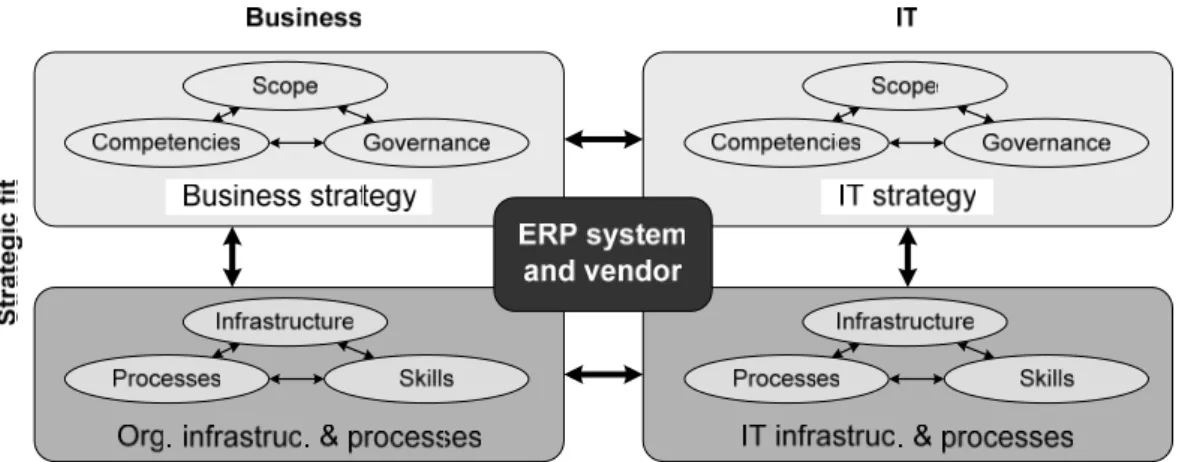
It has been argued that the failure to realise the value of IT investments in part has been due to a lack of alignment between the business and IT strategies of organisations (Henderson and Venkatraman, 1999). This assumption forms the backbone of the proposed ERP selection methodology. The methodology’s theoretic foundations is therefore built on the Strategic Alignment Model (SAM) of Henderson and Venktraman (1999), who argue that to succeed in exploiting IT’s strategic role in supporting and shaping new business strategies, organisations must achieve:
1) Strategic fit in terms of the interrelationship between the external and internal components of strategy and infrastructure and processes (both business and IT)
2) Functional integration between the business and functional domains
Thus, the four main components of the model are: 1) business strategy, 2) IT strategy, 3) Organisational infrastructure and processes, and 4) IT infrastructure and processes. An adapted version of the SAM for the purpose of the ERP selection methodology is described in Figure 1.
Figure 1: Strategic Alignment Model for ERP selection (adapted from Henderson & Venkatraman, 1999) Because the components of the model are interrelated, the decisions made within one domain will affect the other domains - a fact that underlines the importance of achieving both strategic fit and functional integration between the four components and the selected ERP solution.
Process model for ERP selection
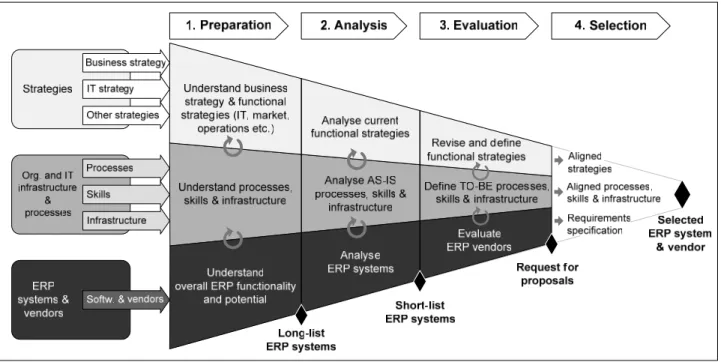
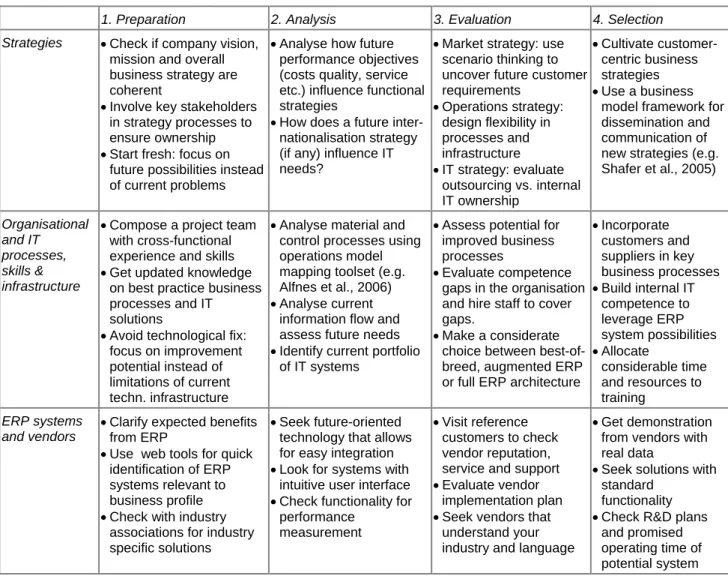
The corner stone of the ERP selection methodology is a process model that describes four steps towards selection of an ERP system and vendor. The four steps of the model are preparation, analysis, evaluation and selection, illustrated in Figure 2. Each step includes interrelated activities that integrate the dimensions of strategies, processes and infrastructure, and ERP system and vendor selection. Each phase is described in more detail in the sections below, together with an overview of key outputs from each step. Examples of guidelines and recommendations are given in Table 2.
Figure 2: EPR selection process model
The preparation phase is used to prepare the organisation for the challenging project of selecting and implementing a new ERP system. This activity involves developing a thorough understanding of the key strategies of the company in terms of the overall business strategy, and how functional strategies, such as IT, market and operations strategies, are defined. Further, the key businesses processes of the company should be identified in this stage. In many organisations, in-depth knowledge about functionality and potential benefits of ERP systems are limited. Hence, the company needs to acquire an appropriate level of knowledge and skills in this area. Based on a cross- functional understanding of strategies, processes and systems, more informed decisions can be made in this initial phase. Next, a business profile (size, industry, product types etc.) is used to produce a long-list of potential ERP systems that match this profile. In practice, this activity can be organised as an interactive workshop facilitated by experienced researchers or consultants.
The key outputs from the preparation phase will be:
• Business profile and characteristics
• Long-list of potential ERP systems
The purpose of the analysis phase is to identify potential misalignments between current strategies, and business and IT processes and infrastructure. This is done using established methods for mapping and analysis (e.g. process flow charts, data flow diagrams, value steam mapping and organisational charts outlining responsibilities). This process will develop a deeper understanding of the future needs of the organisation. In order to increase alignment of strategies, processes and infrastructure, a breakdown of the core business strategy is used to reduce the long-list into a short-list of alternative ERP systems and vendors. As a supporting tool for the company, a structured set
of general ERP system criteria should be produced (see e.g. Wei et al., 2004; Baki & Cakar, 2005). For instance, the Norwegian case company identified mass customisation as their future business strategy. Based on this, a need to re-engineer the ordering and production processes was identified. Consequently, the key ERP needs were identified to include CRM functionality, product configuration, and visual production planning. In addition, based on literature, a set of structured system criteria were developed. The ERP requirements, combined with the set of general ERP system criteria, enabled the company to reduce its long-list of 20 EPR systems to four systems for further in-depth analysis.
The key outputs from the analysis phase will be:
• Draft version of functional requirements for ERP system
• A short-list of prospective ERP systems and vendors
The evaluation phase is a cyclic activity where functional strategies, and business and IT needs are revised and defined in terms of processes, skills and infrastructure. This is done concurrently with in-depth analysis of the short-list of ERP systems and their vendors. A mismatch between company and ERP vendor has been indicated to contribute to failures in implementation (Xue et al., 2005), and an in-depth analysis of ERP vendors is therefore essential. In practice, this can be done efficiently by visiting relevant reference customers. Although there is a risk of bias from the existing user associated with such company visits, experiences from the case showed that other companies were willing to share both positive and negative experiences and information about their ERP systems and vendors. Based on the functional requirements, a Request For Proposal (RFP) is produced and distributed to vendors.
The key outputs from the evaluation phase will be:
• Aligned strategies, processes and infrastructure
• Functional requirements for ERP system
• Request for proposals to vendors
In the selection phase ERP vendors should be invited to present their response to the RFP. In order to facilitate the evaluation of the system’s ability to support company requirements, vendors should be asked to demonstrate the system using real company data. Sufficient time should be allocated for dialogue with vendors to evaluate if they are able to capture the real needs of the company. An important step in this final stage is to negotiate a contract with the selected ERP vendor. In order to provide predictability for the coming implementation phase, it is critical to assess the pricing system for training, support, licences and upgrades.
The key outputs from the selection phase will be:
• Selected ERP system
• Contractual agreement with ERP vendor Guidelines for the ERP selection process
The guidelines to the ERP selection methodology present advise with regards to the specific content of each phase of the process model. The guide was developed from three main sources of information. Firstly, the experiences from the case company were essential in defining the specific activities of each phase. Secondly, insight from the state-of-the-art analysis gave important input to important pitfalls, critical success factors and relevant system and vendor selection criteria in all phases of the project. Thirdly, the researchers drew on experiences from previous ERP selection projects in other Norwegian organisations.
Table 2 outlines some examples of the specific content in each phase of the case company project.
Table 2: Guidelines for ERP selection – examples from Hagen Treindustri
1. Preparation 2. Analysis 3. Evaluation 4. Selection
Strategies • Check if company vision, mission and overall business strategy are coherent
• Involve key stakeholders in strategy processes to ensure ownership • Start fresh: focus on
future possibilities instead of current problems
• Analyse how future performance objectives (costs quality, service etc.) influence functional strategies
• How does a future inter-nationalisation strategy (if any) influence IT needs?
• Market strategy: use scenario thinking to uncover future customer requirements • Operations strategy: design flexibility in processes and infrastructure • IT strategy: evaluate outsourcing vs. internal IT ownership • Cultivate customer-centric business strategies • Use a business
model framework for dissemination and communication of new strategies (e.g. Shafer et al., 2005) Organisational and IT processes, skills & infrastructure
• Compose a project team with cross-functional experience and skills • Get updated knowledge
on best practice business processes and IT solutions
• Avoid technological fix: focus on improvement potential instead of limitations of current techn. infrastructure
• Analyse material and control processes using operations model mapping toolset (e.g. Alfnes et al., 2006) • Analyse current
information flow and assess future needs • Identify current portfolio
of IT systems
• Assess potential for improved business processes
• Evaluate competence gaps in the organisation and hire staff to cover gaps.
• Make a considerate choice between best-of-breed, augmented ERP or full ERP architecture
• Incorporate customers and suppliers in key business processes • Build internal IT competence to leverage ERP system possibilities • Allocate considerable time and resources to training ERP systems and vendors
• Clarify expected benefits from ERP
• Use web tools for quick identification of ERP systems relevant to business profile • Check with industry
associations for industry specific solutions
• Seek future-oriented technology that allows for easy integration • Look for systems with
intuitive user interface • Check functionality for
performance measurement
• Visit reference customers to check vendor reputation, service and support • Evaluate vendor
implementation plan • Seek vendors that
understand your industry and language
• Get demonstration from vendors with real data
• Seek solutions with standard
functionality • Check R&D plans
and promised operating time of potential system
Discussion
The proposed ERP selection methodology aims to be suitable for all organisations facing an ERP selection process. However, the size of the organisation is likely to have an impact on the selection process, as smaller companies have different business and technology needs, are exposed to different business conditions, and have fewer resources and skills available in the selection process. With the ERP market reaching a high level of maturity (Hamerman and Miller, 2004), vendors are currently turning towards the SME market and since the late 1990s the availability of systems for smaller and midsized organisations has increased (Bernroider and Koch, 2001; Piturro, 1999), leaving SMEs to navigate a jungle of different system solutions and ERP vendors. And while failure rates for ERP implementations in general are high, these are even greater for SMEs (Fisher et al., 2004). In addition, the existing mathematical and other quantitative methods for ERP evaluation tend to require skills unavailable to most SMEs. Although the methodology proposed in this paper aims to be intuitive, simple and cost-effective, it does also include some methods for analysis of the AS-IS situation and definition of TO-BE that will probably require some assistance from consultants, researchers or other experts. On the other hand, the fact that the methodology was successfully implemented in a small case company still proves the practicality and workability of the methodology.
The described methodology was developed as part of a project where the ERP acquisition decision was mainly driven by business reasons. However, the most important feature of the methodology is its emphasis on strategic fit and functional integration in the ERP selection process.
This, combined with the dynamic nature of the process model, should make the methodology equally useful for organisations where the ERP investment is mainly driven by technical reasons.
CONCLUSION
The main features of the proposed ERP selection methodology have been described in terms of the underlying theoretical framework, a step-by-step process model and associated guidelines. The methodology specifically addresses the gaps identified in the review of the state-of-the-art and as such it contributes to advancing the knowledge on the ERP selection process, while also providing specific advice to organisations in an ERP selection process.
An important characteristic of the methodology is its emphasis on the evaluation process as an iterative process of continuous adaptation, change and alignment. The final output for the organisation is a choice of ERP system and vendor that is appropriately aligned with clearly defined business and IT strategies, and defined and aligned business and IT processes and infrastructure. In summary, the methodology has the following advantages:
1) The methodology is fairly intuitive, simple and cost-effective, and requires few specialist skills to plan and carry out the process from preparation to selection.
2) The methodology addresses the evaluation and selection of ERP vendors as an integrated part of the process, and thereby helps the organisation avoid the risk of choosing an ERP system that does not have the required vendor support.
3) The fact that the methodology aims to incorporate the dynamic complexity of the decision-problem through its iterative and flexible nature supports our argument that the methodology provides a more holistic perspective on the ERP selection process. By continuously focusing on capturing the interrelationship of how the different components of the Strategic Alignment Model influence each other, the process model is able to capture the dynamics of the entire organisational system – thus achieving the required strategic fit and functional integration. 4) The process model and guidelines are generic enough and have a dynamic and flexible nature,
which make them useful for a wide range of industries and organisations of practically all sizes, while also being applicable to both business and technology driven ERP investments.
It is our argument that the proposed methodology represents a useful tool for organisations with regards to the evaluation and selection of ERP systems and vendors. The methodology was successfully applied in the case company, which is now in the final stages of implementing the selected system.
In terms of future research, due to the limited number of existing methodologies for ERP selection, more research is still needed to investigate the correlation between the ERP selection process and the failure or success of the following implementation. Also, the generalisability of the methodology described in this paper to other industries, other SMEs, larger organisations, and technology driven ERP investments should be investigated.
REFERENCES
Akkermans, H. A., Bogerd, P., Yücesan, E. & van Wassenhove, L. N. (2003) "The impact of ERP on supply chain management: Exploratory findings from a European Delphi Study", European Journal of Operational Research, Vol.146, pp. 284-301.
Aladwani, A. M. (2001) "Change management strategies for successful ERP implementation", Business Process Management Journal, Vol.7, pp. 266-275.
Alfnes, E., Strandhagen, J. O. & Dreyer, H. C. (2006) An enterprise mapping tool: the operations model. 13th International EurOMA Conference "Moving up the Value Chain. Glasgow, UK.
Bernroider, E. W. N. & Koch, S. (2001) "ERP selection process in midsized and large organizations", Business Process Management Journal, Vol.7, pp. 251-257.
Bernroider, E. W. N. & Stix, V. (2006) "Profile distance method - a multi-attribute decision making approach for information system investment", Decision Support Systems, Vol.42, pp. 988-998.
Fisher, D. M., Fisher, S. A., Kiang, M. Y. & Chi, R. T. (2004) "Evaluating Mid-level ERP software", The Journal of Computer Information Systems, Vol.45, pp. 38-46.
Hallikainen, P., Laukkanen, S. & Sarpola, S. (2004) Reasons for ERP acquisition. International Conference on Enterprise Information Systems. Porto, Portugal.
Hamerman, P. & Miller, B. (2004) ERP Applications - Market Maturity, Consolidation, and the Next Generation. Department of Justice, Antitrust Division.
Hedman, J. & Borell, A. (2004) "Narratives in ERP systems evaluation", Journal of Enterprise Information Management, Vol.17, pp. 283-290.
Henderson, J. C. & Venkatraman, N. (1999) "Strategic alignment: Leveraging information technology for transforming organizations", IBM Systems Journal, Vol.38, pp. 472-484.
Irani, Z. (2002) "Invited viewpoint: Critical evaluation and integration of information systems", Business Process Management Journal, Vol.4, pp. 314-317.
Kumar, V., Maheshwari, B. & Kumar, U. (2002) "Enterprise resource planning systems adoption process: a survey of Canadian organizations", International Journal of Production Research, Vol.40, pp. 509-523.
Lall, V. & Teyarachakul, S. (2006) "Enteprise resource planning (ERP) system selection: a data envelopment analysis (DEA) approach", The Journal of Computer Information Systems, Vol.47, pp. 123-127.
Lee, I. (2004) "Evaluating business process-integrated information technology investment", Business Process Management Journal, Vol.10, pp. 214-233.
McDonagh, J. & Coghlan, D. (2006), "The Art of Clinical Inquiry in Information Technology-related Change," in Reason, P. & Bradbury, H. (Eds.) Handbook of Action Research. Concise paperback ed., Sage Publications,London. Middel, R., Coghlan, D., Coughlan, P., Brennan, L. & McNichols, T. (2006) "Action Research in Collaborative Improvement", International Journal of Technology Management, Vol.33, pp. 67-91.
Miles, M. B. & Huberman, A. M. (1994) Qualitative data analysis: an expanded sourcebook, Sage Publications, Thousand Oaks, CA.
Nah, F. F.-H. & Delgado, S. (2006) "Critical success factors for enterprise resource planning implementation and upgrade", The Journal of Computer Information Systems, Vol.46, pp. 99-113.
Piturro, M. (1999) "How midsize companies are buying ERP", Journal of Accountancy, Vol.188, pp. 41-48.
Presley, A. (2006) "ERP investment analysis using the strategic alignment model", Management Research News, Vol.29, pp. 273-284.
Rao, S. S. (2000) "Enterprise resource planning: business needs and technologies", Industrial Management + Data Systems, Vol.100.
Schein, E. H. (2006), "Clinical Inquiry/Research," in Reason, P. & Bradbury, H. (Eds.) Handbook of Action Research. Concise paperback ed., Sage Publications,London.
Shafer, S. M., Smith, H. J. & Linder, J. C. (2005) "The power of business models", Business horizons, Vol.48.
Skok, W. & Legge, M. (2002) "Evaluating Enterprise Resource Planning (ERP) Systems using an Interpretive Approach", Knowledge and Process Management, Vol.9, pp. 72-82.
Towill, D. R. (1996) "Industrial dynamics modelling of supply chains", International Journal of Physical distribution & logistics management, Vol.26, pp. 23-42.
Verville, J. & Halingten, A. (2003) "A six-stage model of the buying process for ERP software", Industrial Marketing Management, Vol.32, pp. 585-594.
Wei, C.-C., Chien, C.-F. & Wang, M.-J. J. (2005) "An AHP-based approach to ERP system selection", International Journal of Production Economics, Vol.96, pp. 47-62.
Wei, C.-C. & Wang, M.-J. J. (2004) "A comprehensive framework for selecting an ERP system", International Journal of Project Management, Vol.22, pp. 161-169.
Xue, Y., Liang, H., Boulton, W. R. & Snyder, C. A. (2005) "ERP implementation failures in China: Case studies with implications for ERP vendors", International Journal of Production Economics, Vol.97.