Riphah_M.Sc. Electrical Engineering 1
RIPHAH INTERNATIONAL UNIVERSITY
ISLAMABAD
SELF ASSESSMENT REPORT
M.Sc. (Electrical Engineering)
Faculty of Engineering & Applied Sciences (FEAS)
30 June 2015
Prepared by: Faculty of Engineering & Applied Sciences Reviewed and Edited by: Quality Enhancement Cell
Riphah_M.Sc. Electrical Engineering 2
Table of Contents
1.0 Executive Summary ... 5 1.1 Objectives ... 5 1.2 Execution ... 5 2.0 Introduction ... 72.1 University Mission Statement ... 7
2.2 Faculty of Engineering & Applied Sciences (FEAS) ... 7
2.3 Program Selected ... 7
2.4 Program Evaluation ... 8
3.0 Criterion 1: Program Mission, Objectives and Outcomes ... 8
3.1 Standard 1-1 ... 8
3.1.1 Program Mission Statement ... 8
3.1.2 Program Objectives ... 8
3.1.3 Alignment of Program Objectives with Program & University Mission Statements ... 9
3.1.4 Main Elements of Strategic Plan... 9
3.1.5 Program Objectives Assessment ... 10
3.2 Standard 1-2 ... 10
3.2.1 Program Outcomes... 11
3.2.2 Program Objectives and Outcomes Matching ... 11
3.3 Standard 1-3 ... 12
3.3.1 Course Evaluation ... 12
3.3.2 Teachers Evaluation ... 14
3.4 MSc Electrical Engineering Program Strong and Weak Points... 16
3.5 Significant Future Development Plans ... 17
3.6 Standard 1-4 ... 17
3.6.1 Graduates/Undergraduates enrolled in last three years ... 18
3.6.2 Student Faculty Ratio:... 18
3.6.3 Average GPA per semester: ... 18
3.6.4 Average Completion time ... 18
3.6.5 Employer Satisfaction ... 18
3.6.6 Students Course Evaluation Rate ... 18
3.6.7 Students Faculty Evaluation ... 18
3.6.8 Research ... 18
3.6.9 Community Service ... 18
3.6.10 Students/Teachers Satisfaction ... 19
4.0 Criterion 2: Curriculum Design and Organization... 19
4.1 Title of Degree Program ... 19
4.2 Definition of credit hour: ... 19
4.3 Degree plan ... 19
4.4 Courses Information... 20
4.4.1 Course Groups and Program Objectives ... 20
4.5 Standard 2-2 ... 21
Riphah_M.Sc. Electrical Engineering 3
4.7 Standard 2-4 ... 22
4.8 Standard 2-5 ... 22
4.9 Standard 2-6 ... 22
4.10 Standard 2-7 ... 22
5.0 Criterion 3: Laboratories and Computing Facilities ... 22
5.1 Standard 3-1 ... 23
5.2 Standard 3-2 ... 24
5.3 Standard 3-3 ... 24
6.0 Criterion 4: Student Support and Advising ... 24
6.1 Standard 4-1 ... 24
6.2 Standard 4-2 ... 25
6.3 Standard 4-3 ... 25
7.0 Criterion 5: Process Control... 26
7.1 Standard 5-1 ... 26 7.2 Standard 5-2 ... 27 7.3 Standard 5-3 ... 27 7.4 Standard 5-4 ... 28 7.5 Standard 5-5 ... 29 8.0 Criterion 6: Faculty ... 30 8.1 Standard 6-1 ... 30 8.2 Standard 6-2 ... 31 8.3 Standard 6-3 ... 32
Criterion 7: Institutional Facilities ... 33
8.4 Standard 7-1 ... 33
8.5 Standard 7-2 ... 34
8.6 Standard 7-3 ... 34
9.0 Criterion 8: Institutional Support ... 34
9.1 Standard 8-1 ... 34
9.2 Standard 8-2 ... 35
9.3 Standard 8-3 ... 35
10.0 Conclusion ... 36
10.1 MSc Electrical Engineering Program Strong and Weak Points... 37
10.2 MSc Electrical Engineering Program Strong Points:... 38
Riphah_M.Sc. Electrical Engineering 4
List of Annexure
Annexure A: Alumni Survey
Annexure B: Employer Survey
Annexure C: Students Course Evaluation
Annexure D: Students Teacher Evaluation
Annexure E: Research Papers List
Annexure F: Graduating Students
Annexure G: Faculty Survey
Annexure H: Faculty Resume
Annexure I: Lab Safety Precautions
Annexure J: AT Findings
Annexure K: Implementation Plan
Annexure L: Faculty Course Review
Riphah_M.Sc. Electrical Engineering 5
1.0 Executive Summary
This report is being prepared almost at the end of the assessment cycle for 5 selected faculties of Riphah International University, as per requirements of Higher Education Commission (HEC). Quality Enhancement Cell (QEC) was formed in Riphah International University in Oct 2009. Program Team Members of all five faculties, notified by University, worked with Dir QEC to pursue the application of Self-Assessment Manual in their respective departments. From each faculty one program was selected.
In Faculty of Engineering and Applied Sciences (FEAS), M.Sc. (Electrical Engineering) was selected for self-assessment, evaluation and improvements. A strong commitment of Respected Vice Chancellor to support QEC made the difference and resultantly, a cycle of assessment is about to complete.
1.1 Objectives
Following are the two main objectives of the self-assessment report:- a To implement Self-Assessment Manual in selected program with a
view to improve quality in higher education.
b To identify the areas requiring improvements in order to achieve objectives through desired outcomes.
1.2 Execution
A soft copy of self-assessment manual was given to all faculty members. Quality Awareness Lecture and Workshop on preparation of Self-Assessment Report (SAR) were arranged (15 Oct 2014) for the Deans/In-charge Programs and Program Team (PT) Members of the selected program. Hard copies of HEC issued 10 proformas, 8 criterion and 31 standards were provided to PT members to evaluate their respected
Riphah_M.Sc. Electrical Engineering 6 program against defined standards. The PT members with an intimate
support and follow up of QEC, completed the SAR and forwarded to QEC in given time frame.
After reviewing SAR, QEC arranged visit of Assessment Team to the selected program on 10, April 2015. Dir QEC accompanied the AT Team and participated in discussions with In-charge Program / Program Team members and available faculty members. Date for exit presentation was fixed as 5 May 2015, as per availability of Respected VC. Dean, In-charge Program, PT and AT members were invited.
The AT during visits, indicated salient points of the SAR, account of its discussions with the faculty members, improvements required in the infrastructure, syllabi and training of the faculty and support staff.
The implementation plan (Annex-K) basing on the discussions in exit meeting have been made by In-charge Programs.
The implementation plan indicates the resources required to improve the infrastructure, environment in the classes and E-Learning. The tasks have been completed on fast track by the combined efforts of Head of Department, QEC and Registrar’s Office.
At the completion of Self-Assessment cycle, QEC is going to submit the hard and soft copy of SAR to HEC on 25 June 2015.
Director Quality Enhancement Cell
Riphah_M.Sc. Electrical Engineering 7
Self-Assessment Report
2.0 Introduction
Riphah International University is a private university, chartered by the Federal Government of Pakistan in 2002. The university was established with a view to produce professionals with Islamic moral and ethical values. The Riphah International University is committed to promote and impart quality education with character building of the new generation in the light of Islamic principles and values. Riphah International University is committed to a value based integrated educational philosophy. It is running 10 faculties in 3 different campuses.
2.1 University Mission Statement
Establishment of state of the art educational institutions with a focus on inculcation of Islamic ethical values.
2.2 Faculty of Engineering & Applied Sciences (FEAS)
Faculty of Engineering & Applied Sciences (FEAS) is running following programs:
BS. Electrical Engineering (Communication) - Accredited by PEC BS. Electrical Engineering (Electronics) - Accredited by PEC BS. Bio-Medical Engineering - Accredited by PEC
MSc. Electrical Engineering
2.3 Program Selected
Riphah International University selected the B.Sc. Electrical Engineering (Communication) as first model program for Self-Assessment Report (SAR) for the year 2010-11 and Master of Science (MSc.) Electrical
Riphah_M.Sc. Electrical Engineering 8
Engineering as second model program for Self-Assessment Report (SAR) for the year 2014-15 under the directives of HEC.
The selected program is accredited by Higher Education Commission (HEC) of Pakistan. The program has got inbuilt mechanism for the revision of syllabi, has competent faculty and adequate infrastructure. New and modern tools have been introduced in the program to conduct research and quality teaching.
2.4 Program Evaluation
The program is being evaluated based on 8 criterion and 31 standards as given in the Self-Assessment Manual provided by Higher Education Commission (HEC).
3.0 Criterion 1: Program Mission, Objectives and Outcomes
3.1 Standard 1-1
The program must have documented measurable objectives that support institution mission statements.
3.1.1 Program Mission Statement
MSc Electrical Engineering program aims to impart engineering, IT and communication knowledge and skills to students along with sense of ethical and moral obligations.
3.1.2 Program Objectives
The MSc Electrical Engineering aims to accomplish following objectives: 1. Produce competent engineers with the true spirit of dedication and
professional ethics in conformity with the tenets of Islam to work within ethical values and betterment of the society at large.
2. Act as a nursery for the provision of engineers for the developing countries.
Riphah_M.Sc. Electrical Engineering 9 3. Establish a common platform for research, development and technical
collaboration globally.
4. Create facilities for post studies leading to the award of PhD degrees. 5. Provide cross fertilization of knowledge in advance studies and
research amongst students of the engineering and medical faculties. 6. To impart technical skills (designing, solution definition,
implementation) to the students.
3.1.3 Alignment of Program Objectives with Program & University Mission Statements
Program objectives intend to impart not only technical information to students but moral and ethical information as well. Riphah International University provides a platform to students to get knowledge of their desired field and learn the Islamic ways in order to carry out their duties.
3.1.4 Main Elements of Strategic Plan
Strategic plan for MSc Electrical Engineering defines the overall layout of the areas/elements that are included in the program to educate students to master’s level. These elements prepare students through theory and research work. These elements are Program Contents, Program Delivery Methodology and Program Output Evaluation.
3.1.4.1 Program Contents
MSc Electrical Engineering program is comprised of 30 credit hours. 24 credit hours are for theoretical subjects, whereas, 6 credit hours are for research work/dissertation.
3.1.4.2 Program Delivery Methodology
Program delivery methodology includes lectures, presentations, tutorials, assignments, and research.
Riphah_M.Sc. Electrical Engineering 10
3.1.4.3 Program Output Evaluation
Program output is measured through regular examinations, assignment’s results and final thesis results.
3.1.5 Program Objectives Assessment
Objective How Measured When Measured
Improvement Identified
Improvement Made
1 Alumni Survey March 2014 Need to have
more case
studies
Under Review in Board of Faculties
2 Employer Survey April 2014 Tutorials and report writing skills Under Review in Board of Studies 3 Alumni Survey, Employer Survey March 2014 April 2014 Emphasis on Laboratory work Under Review in Board of Faculties 4 Alumni Survey, Employer Survey March 2014 April 2014 Need More emphasis on deign components Under Review in Board of Faculties
5 Alumni Survey, March 2014
April 2014 Research aptitude building Under Review in Board of Faculty
6 Employer Survey April 2014 Not Applicable Not Applicable Table 1: Program Objectives Assessment
Alumni and Employer Surveys were conducted to get their feedback. See Annexure A for cumulative results of Alumni Survey and See Annexure B for cumulative results of Employer Survey under different feedback categories.
3.2 Standard 1-2
The program must have documented outcomes for graduating students. It must be demonstrated that the outcome support the
Riphah_M.Sc. Electrical Engineering 11
program objectives and that graduating students are capable of performing these outcomes.
3.2.1 Program Outcomes
The MSc Electrical Engineering program is designed to produce following Outcomes:
1. Students shall be able to go for higher education (Ph.D.). 2. Students shall be able to lead, motivate and manage teams.
3. Students will be able to perform technical and non-technical jobs in electrical engineering field.
4. Students shall be able to demonstrate specific knowledge, attitudes, skills and behavior for the welfare of the society.
5. Students shall be able to display the capability of objective advice on medicines and their use to the public and provide technical advice to other health professional, drug regulatory bodies, health planners and policy makers.
6. Students will be able to perform jobs in related field. 7. Students shall be able to perform research in related field.
8. Students shall be able to perform tasks individually as well as in teams.
9. Students shall be able to execute tasks in positive and constructive manner.
10. Students shall be able to publish research papers in their area of research.
3.2.2 Program Objectives and Outcomes Matching
Program Objectives
Program Outcomes
1 2 3 4 5 6 7 8 9 10
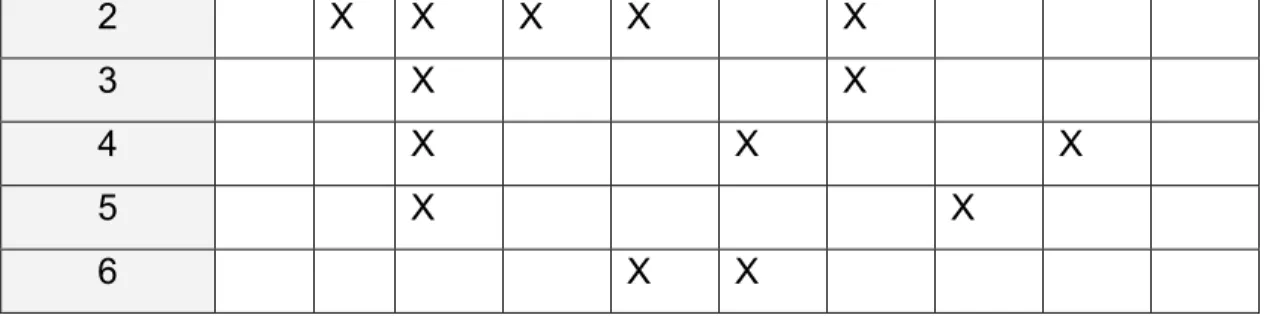
Riphah_M.Sc. Electrical Engineering 12 4.82 3.91 4.34 4.23 3.76 3.99 4.27 4.62 3.49 4.36 4.34 4.44 4.05 4.6 4.49 4.57 4.35 4.37 3.66 4.36 4.1 4.69 4.91 4.02 3.97 4.03 4.42 4.31 3.81 4.19 0 1 2 3 4 5 6 1 2 3 4 5 6 7 8 9 10 11 12 13 14 15 16 17 18 19 20 21 22 23 24 25 26 27 28 29 30 2 X X X X X 3 X X 4 X X X 5 X X 6 X X
Table 2: Outcomes versus Objectives 3.3 Standard 1-3
The results of Program’s assessment and the extent to which they are used to improve the program must be documented.
The result of the program assessment is shown below in graphical charts for courses evaluation and teachers’ evaluations.
3.3.1 Course Evaluation
Courses evaluation is shown in the following graphical chart:
Figure 1: Course Evaluation Bar Chart
Through this evaluation, students have graded the courses against the structure, method of teaching, learning outcomes, objectives and practical implementation of theory. The total graded marks are 5.
Riphah_M.Sc. Electrical Engineering 13 See Annexure C (Course Evaluation Survey) for sample course evaluation
results. The sample shows the results for one course only while same has been done for all courses listed below. The results of all other courses have been kept in a separate file for record purposes. Following is the list of courses that are being evaluated by the students along with their course code and graded scores.
Following is the list of courses that have been evaluated by the students along with their course code and graded scores.
Sr. No Course Marks
1 Antenna and Wave Propagation Theory (A) 4.82
2 Applied Calculus - I 3.91
3 Applied Calculus-II (A) 4.34
4 Applied Calculus-II (B) 4.23
5 Basic Mechanical Engineering (A) 3.76
6 Basic Mechanical Engineering (B) 3.99
7 Communication skills (A) 4.27
8 Communication skills (B) 4.62
9 Digital Communication Systems Theory (A) 3.49 10 Digital Signal Processing Theory (A) 4.36 11 Digital Signal Processing Theory (B) 4.34
12 Electrical Machines Theory (A) 4.44
13 Electrical Machines Theory (B) 4.05 14 Electrical Network Analysis Theory(A) 4.60 15 Electrical Network Analysis Theory(B) 4.49
16 Electronic Devices Theory (A) 4.57
17 Electronic Devices Theory (B) 4.35
18 FPGA Based System Design (B) 4.37
19 Instrumentation and Measurement Theory (A) 3.66 20 Instrumentation and Measurement Theory (B) 4.36
21 Introduction to Computing Theory 4.10
22 Islamic Studies (A) 4.69
23 Islamic Studies (B) 4.91
24 Microprocessor Based Systems Theory (A) 4.02 25 Microprocessor Based Systems Theory (B) 3.97
26 Numerical Analysis (A) 4.03
27 Numerical Analysis (B) 4.42
28 Power Electronics Theory (B) 4.31
Riphah_M.Sc. Electrical Engineering 14 4.25 4.38 4 4.23 4.03 3.45 4.88 4.57 4.65 4.56 4.56 4.41 4.7 4.84 4.284.45 4.3 4.63 4.154.41 4.64 4.39 4.08 4.284.05 4.39 4.68 4.24 3.95 4.41 0 1 2 3 4 5 6 1 2 3 4 5 6 7 8 9 10 11 12 13 14 15 16 17 18 19 20 21 22 23 24 25 26 27 28 29 30
30 Signal and System Theory (B) 4.19
3.3.2 Teachers Evaluation
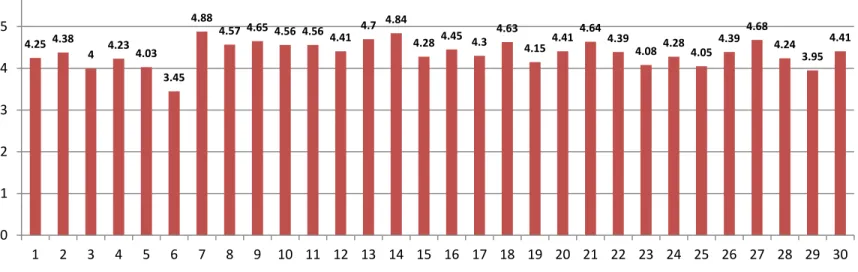
Teacher’s evaluation is shown in the following graphical chart:
Figure 2: Teachers Evaluation Graph
Through this evaluation, students have graded the teachers against lecture preparation, punctuality, general behavior, subject knowledge and teaching method. The total graded marks are 5. See Annexure D (Teachers Evaluation Survey) for sample teacher evaluation results. The sample shows the results for one teacher only while same has been done for all teachers listed below. The results of all other teachers have been kept in a separate file for record purposes.
Following is the list of teachers that are being evaluated by the students along with the serial number and graded scores.
Sr. No Teacher Name Course Name Marks
1 Abu Bakr Khitran Digital Signal Processing Theory (A) 4.25
2 Abu Bakr Khitran 2 Digital Signal Processing Theory (B) 4.38
Riphah_M.Sc. Electrical Engineering 15
4 Ahsan Sohail 2 Signal and System Theory (B) 4.23
5 Ambreen Arshad Applied Calculus-I 4.03
6 Col M. Anwar Digital Communication Systems Theory (A) 3.45
7 Dr. Sohail Khalid Antenna and Wave Propagation Theory (A) 4.88
8 Dr. Usman Zabit . FPGA Based System Design (B) 4.57
9 Dr. Zeeshan Hameed Khan Electrical Network Analysis Theory (A) 4.65
10 Dr. Zeeshan Hameed Khan 2 Electrical Network Analysis Theory (B) 4.56
11 Engr. Jhanzeb Applied Calculus-II (A) 4.56
12 Engr. Jhanzeb 2 Applied Calculus II B 4.41
13 Hafiz Waqas Khan Islamic Studies (A) 4.70
14 Hafiz Waqas Khan 2 Islamic Studies (B) 4.84
15 Hammad Nafees Numerical Analysis (A) 4.28
16 Hammad Nafees 2 Numerical Analysis (B) 4.45
17 Ilyas Babar Awan Communication skills (A) 4.30
18 Ilyas Babar Awan 2 Communication skills (B) 4.63
19 Imran Iqbal Introduction to Computing Theory 4.15
20 Imran Iqbal 2 Power Electronics Theory (B) 4.41
21 Malik Tariq Awan Electrical Machines Theory (A) 4.64
22 Malik Tariq Awan 2 Electrical Machines Theory (B) 4.39
23 Muhammad Akmal Microprocessor Based Systems Theory (A) 4.08
24 Muhammad Akmal2 Microprocessor Based Systems Theory (B) 4.28
25 Muhammad Faisal Basic Mechanical Engineering (A) 4.05
26 Muhammad Faisal 2 Basic Mechanical Engineering (B) 4.39
27 Muhammad Sadiq Orakzai Electronic Devices Theory (A) 4.68
28 Muhammad Sadiq Orakzai 2 Electronic Devices Theory (B) 4.24
29 Sajid Ali Instrumentation and Measurement Theory (A) 3.95
30 Sajid Ali2 Instrumentation and Measurement Theory (B) 4.41
Faculty carried out in house discussion and analyzed the feedback and identified the areas of improvement. A discussion with In charge undergraduate stream was also held. They decided to go through the identified areas in Board of Studies to finalize the recommendations for improvement to be presented in Board of Faculty and Academic Council.
The Dean and In-charge Program also discussed the teachers evaluation results and decided to carry out counseling of teacher who are below par. It was also decided to conduct training sessions for teachers who are not performing at expected level.
Riphah_M.Sc. Electrical Engineering 16 Significant future development plans for the program are categorized as short
and long term arrangements which are as under:
a. Short term arrangements include improvement of existing infrastructure to run the program in much better environment by replacing or adding curtains in classrooms, changing of white boards, and performance enhancement of the cooling system in classes. Prepare handouts, brochures and pamphlets for advisory services.
While the long term arrangements include procurement of high value items like multimedia, additional air conditioners, improvement in sound systems and up gradation of lab equipment. On the academic side, the future development plans for the programs include training programs for junior faculty members to enhance their teaching capabilities, revision of course syllabi and overall enhancement of knowledge and skills of all faculty members in relation to the latest global advancements in communication engineering through exchange program, short trainings and collaborative research projects within and outside Pakistan
3.4 MSc Electrical Engineering Program Strong and Weak Points
MSc Electrical Engineering program is designed to educate students to meet the challenges of the modern world and present market needs. During the execution of the program several observations were made that can be categorized as strong and weak points of the program. These points are listed below:
MSc Electrical Engineering Program Strong Points:
The number of courses along with their titles and credit hours for each semester, course contents for degree program are fully planned
Transparent admission, registration and recruiting policy
Riphah_M.Sc. Electrical Engineering 17
Pre-requisites fully observed
Examinations on schedule
Academic Schemes fully prepared in advance
Excellent Students-Teacher Ratio
MSc Electrical Engineering program Weak Points:
Refresher Courses for Teachers
Need to improve the research papers published by students/faculty.
Need to improve Canteen facility for faculty and students
Inadequate space in the research lab for students.
Inadequate chemicals and equipment in the labs for students.
New & State of the art equipment for Labs.
Need to improve the computer facilities to all the research students.
3.5 Significant Future Development Plans
Significant future development plan for the program includes rectification of weaknesses and improvement in overall performance of the program. As per agreed views, lack of learning resources will be rectified by the induction of more learning material including books, CDs and related magazines and journals in the library. The research lab will be extended to accommodate maximum number of students. Sufficient funds will be allocated to buy chemical/equipment. While, classroom facilities will be improved over a period of time during the next financial year. On the basis of self-assessment, faculty management has decided to look into the improvement areas for course syllabi in the light of observations listed in section 3.1.5, that would help achieve program objectives more efficiently.
3.6 Standard 1-4
The department must assess its overall performance periodically using quantifiable measures.
Riphah_M.Sc. Electrical Engineering 18
3.6.1 Graduates/Undergraduates enrolled in last three years
30 MSc Electrical Engineering students were enrolled during the sessions 2011-14 (three years).
3.6.2 Student Faculty Ratio:
MSc Electrical Engineering has 6-1 ratio.
3.6.3 Average GPA per semester:
The average GPA is 3.0.
3.6.4 Average Completion time
So far three students have been passed out.
3.6.5 Employer Satisfaction
The employer survey was conducted by institute with the help of QEC which resulted in 85% satisfaction level. See Annexure B for details.
3.6.6 Students Course Evaluation Rate
Student’s course evaluation rate for all courses is 9.
3.6.7 Students Faculty Evaluation
QEC staff conducted the teachers’ evaluation to ensure unbiased feedback. The results showed that 28 out of 30 teachers (93%) scored more than 80% marks as graded by students while, rest of the faculty scored plus minus 75%.
3.6.8 Research
The program faculty published research papers in different journals list is attached in Annexure E.
3.6.9 Community Service
The Faculty of Engineering and Applied Sciences launched a campaign to provide books to needy students in a nearby school. Faculty members and students were assigned different tasks regarding this campaign. Students were responsible to advertise and market the campaign in all campuses while faculty member were responsible to gather books and donations.
Riphah_M.Sc. Electrical Engineering 19
3.6.10 Students/Teachers Satisfaction
As per HEC defined standard, a ratio of 4:1 for the academic and administrative non-technical staff is maintained by the Faculty of Engineering and Applied Sciences.
Students and teachers satisfaction is judged in different ways. For students this is done by faculty as well as QEC staff by conducting in-class discussions to know students views and through feedback provided by them on HEC Performa number 1 & 10. While, teachers satisfaction is judged using the HEC defined Performa number 5 and their views during in-person discussion with QEC staff.
4.0 Criterion 2: Curriculum Design and Organization
4.1 Title of Degree Program
MSc Electrical Engineering
4.2 Definition of credit hour:
1 credit hour is 1 hour of theory lecture in a week.
4.3 Degree plan
4.3.1 Following is the list of core courses taught in the selected program. Section Electrical Engineering (Specialization in Signal Processing)
Basic Compulsory
EE-500 Linear Systems
EE-501 Random Signals & Systems
EE-504 Fundamentals of Digital Signal Processing
Core Compulsory
EE-513 Digital Image and Video Processing EE-517 Adaptive Signal Processing
EE- 519 Real-Time and Multirate Systems Core Electives
EE-505 Wavelets & Transform Methods EE-514 Speech Processing and Coding
Riphah_M.Sc. Electrical Engineering 20
EE-541 Biomedical Signal Processing
EE-545 Neural Systems and Networks
EE-586 Engineering Operations
Electrical Engineering (Specialization in Navigation & Control) Core Compulsory
EE-500 Linear Systems
EE-501 Random Signals and Systems
EE-503 Modeling and Simulation of Dynamic Systems Core Electives
EE-551 Advanced Feedback systems EE-552 Digital Control Systems EE-553 Embedded Control Systems EE-554 Linear Multivariable Systems EE-555 Non-Linear Systems
EE-561 Stochastic Estimation and Control EE-563 Adaptive Control
EE-564 Optimal Control EE-565 Intelligent Control
EE-566 Special Topics in Control
EE-571 Basics of Inertial Navigation EE-572 Integrated Navigation Systems
EE-586 Engineering Operations
4.4 Courses Information
4.4.1 Course Groups and Program Objectives
Courses Groups Objectives 1 2 3 4 5 6 1 x 2 x x 3 x x
Riphah_M.Sc. Electrical Engineering 21 Table 4: Courses versus Program Objectives (table 4.4)
4.5 Standard 2-2
Theoretical backgrounds, problem analysis and solution design must be stressed within the program’s core material.
Elements Courses
Basic
Compulsory
EE- 500, EE- 501, EE- 503, EE-504
Core
Compulsory
EE- 505, EE- 517, EE- 519,
Core Electives
EE- 513, EE- 514, EE- 541, EE- 545, EE-551, EE-552, EE-553, EE-554, EE-555, EE-561, EE-563, EE-564, EE-565, EE-566 , EE-571, EE-572.
Table 5: Standard 2-2 Requirement (table 4.5)
4.6 Standard 2-3
The Curriculum must satisfy the core requirements for the program as specified by the respective accreditation body.
MSc Electrical Engineering program is recognized by Higher Education Commission (HEC) and accredited by the Engineering Council of the Pakistan (PEC). Minimum Requirements for each program (Program Semester Credit Hours):
Program Theory
Courses Research Thesis
MSc Electrical Engineering 24 6
Table 6: Program Credit Hours (appendix A table)
4 x x x
Riphah_M.Sc. Electrical Engineering 22
4.7 Standard 2-4
The curriculum must satisfy the major requirements for the program as specified by the respective accreditation body.
Same as Standard 2-3.
4.8 Standard 2-5
The curriculum must satisfy general education, arts and professional and other discipline requirements for the program as specified by the respective accreditation body.
Same as standard 2-3 and Standard 2-1 (table 4.4) as defined above.
4.9 Standard 2-6
Information technology component of the curriculum must be integrated throughout the program
Not applicable
4.10 Standard 2-7
Oral and written communication skills of the student must be developed and applied in the program.
Students go through course presentations and Research methodology course in 2nd semester, which develop the oral and written communication skills of the students. Students have to write a thesis and present their work in thesis defense in 4th semester.
5.0 Criterion 3: Laboratories and Computing Facilities
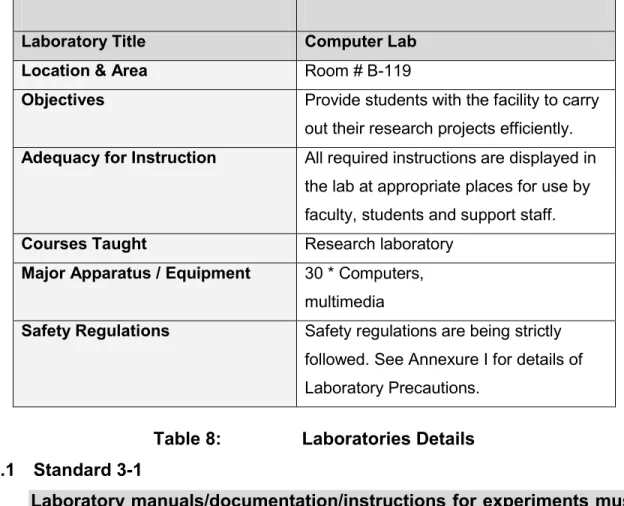
Riphah has established Research laboratories for students to practice their learning outcomes. Following is the list of available laboratories available to PG students:
Riphah_M.Sc. Electrical Engineering 23 The details about these laboratories are provided as follows
Laboratory Title Computer Lab
Location & Area Room # B-119
Objectives Provide students with the facility to carry out their research projects efficiently. Adequacy for Instruction All required instructions are displayed in
the lab at appropriate places for use by faculty, students and support staff.
Courses Taught Research laboratory
Major Apparatus / Equipment 30 * Computers, multimedia
Safety Regulations Safety regulations are being strictly followed. See Annexure I for details of Laboratory Precautions.
Table 8: Laboratories Details 5.1 Standard 3-1
Laboratory manuals/documentation/instructions for experiments must be available and easily accessible to faculty and students.
Laboratory In-charge is the custodian of all the manuals and instructions concerning his laboratory. Its copies are also available with the Program Coordinator to be used by the faculty and students. These manuals and instructions are issued to desired entity through a defined process and proper record is maintained. The laboratory in-charge keeps the manuals and instructions in laboratory for immediate access to students and faculty members during the laboratory work.
Laboratory equipment and facilities in Faculty of Engineering & Applied Sciences (FEAS) are equally good and comparable to any high reputed university of the country.
Riphah_M.Sc. Electrical Engineering 24
5.2 Standard 3-2
There must be support personal for instruction and maintaining the laboratories.
Each laboratory is authorized two staff members, and Laboratory Attendant. Laboratory in-charge / HOD is responsible for overall maintenance of laboratory while laboratory Attendant is responsible to maintain the laboratory equipment and general duties within the lab.
5.3 Standard 3-3
The University computing infrastructure and facilities must be adequate to support program’s objectives.
The computing facilities in FEAS are adequate with latest computers & software that support students to fulfill their education requirements. The facilities can be compared with any high reputed university of the country.
Riphah is running a comprehensive Campus Management System. It facilitates the faculty members in maintaining the attendance record, examination schedules, time tables and student’s data.
6.0 Criterion 4: Student Support and Advising
Since the launch of Riphah in year 2002, all its programs have started and finished on schedule. The culture in Riphah is that teachers and students have facility of frequent interaction, even after classes, for any professional and academic advice. This aspect is even highlighted and indicated by the students in the feedback on HEC Performa number 10, taken by the Quality Enhancement Cell (QEC) in the university.
6.1 Standard 4-1
Courses must be offered with sufficient frequency and number for students to complete the program in a timely manner.
Riphah_M.Sc. Electrical Engineering 25 The courses are offered in a logical sequence that grooms the students to
obtain the program’s defined objectives and outcomes.
6.2 Standard 4-2
Courses in the major area of study must be structured to ensure effective interaction between students, faculty and teaching assistants.
All courses in the program are taught by the single faculty member. Courses are structured in the board of studies before commencement of each semester. Faculty members interact frequently among themselves and with students. Students are encouraged to participate in providing feedback and their views about course contents during and after the classes.
6.3 Standard 4-3
Guidance on how to complete the program must be available to all students and access to qualified advising must be available to make course decisions and career choices.
Students are informed about the program requirements at the start of the session during orientation week by in-charge program and QEC staff. In-Charge Program acts as advisor to guide students to choose appropriate courses and also provide guidance on different issues. He also maintains a list of guidance points provided to students during the semester and program, which is being evaluated at the end of the program to take necessary improvement.
In-charge student’s affair provides professional counseling to students when needed. Students can get in touch directly with him/her for any advice.
In charge Industrial Liaison arranges industrial tours for students to improve their subject vision and technical know-how. He/She also invites
Riphah_M.Sc. Electrical Engineering 26 professionals from different business entities to conduct interactive
sessions with students for advice on professional matters/future career planning.
Program coordinator maintains a list of professional societies and technical bodies, that is provided to students on demand and students can get membership of such organizations on individual basis.
7.0 Criterion 5: Process Control
7.1 Standard 5-1
The process by which students are admitted to the program must be based on quantitative and qualitative criteria and clearly documented. This process must be periodically evaluated to ensure that it is meeting its objectives.
The program has a well-defined admission criterion, which include evaluation of student’s marks at different levels and admission test results. The admission is done twice a year, in spring and fall semester.
Students who have completed the 16 years of education are eligible to appear in the admission test of the program. Admission is granted strictly on the basis of academic record, admission test and interview.
Students from accredited universities are eligible to transfer their credits to RIPHAH. Students have to submit complete course curriculum and internal evaluation certificate of each subject from his/her previous institution duly signed by head of department/principal. Student’s applications in this regard are dealt on case to case basis. Such applications are discussed in Board of Studies to evaluate them and make decision. Dean of the faculty is the final authority to make decision regarding credit transfers.
Riphah_M.Sc. Electrical Engineering 27 This admission criterion is evaluated every 2 years by the board of faculties
and academic council in the light of instructions issued by HEC. Minor internal adjustments regarding admission test result weightages or test contents are made.
7.2 Standard 5-2
The process by which students are registered in the program and monitoring of students’ progress to ensure timely completion of the program must be documented. This process must be periodically evaluated to ensure that it is meeting its objectives.
The student’s name, after completion of the admission process, is forwarded to the Registrar office for registration in the specific program and the registration number is issued.
Students are evaluated through assignments, sessional, mid-term tests, course presentations and final examinations at the end of each semester. The Research work is done in 3rd and 4th semester and contributes significantly towards the student’s evaluation for the program. Only qualified students in each semester are allowed to join the next semester.
7.3 Standard 5-3
The process of recruiting and retaining highly qualified faculty members must be in place and clearly documented. Also processes and procedures for faculty evaluation, promotion must be consistent with institution mission statement. These processes must be periodically evaluated to ensure that it is meeting with its objectives.
Vacant and newly created positions are advertised in the national newspapers, applications are received by the Registrar office, scrutinized
Riphah_M.Sc. Electrical Engineering 28 by the respective Deans, and call letters are issued to the short-listed
candidates on the basis of experience, qualification, publications and other qualities/activities as determined by the University in the light of HEC guidelines.
The candidates are interviewed by the University Selection Board. Selection of candidates is approved by the BOG. Induction of new candidates depends upon the number of approved vacancies. HEC also helps RIPHAH in enrolling the foreign faculty.
Faculty members are retained by giving them good remuneration, favorable teaching environment, research facilities and management support.
On yearly basis faculty performance is evaluated basing on HEC Performa number 10 by the students, Deans recommendations and with the counter signature of vice chancellor and pro chancellor. The annual increment is based on the recommendations of the Dean and the vice chancellor.
7.4 Standard 5-4
The process and procedures used to ensure that teaching and delivery of course material to the students emphasizes active learning and that course learning outcomes are met. The process must be periodically evaluated to ensure that it is meeting its objectives.
Students are the recipient of the delivery of course material, through their teachers. The program is actively evaluated by Dean, In Charge program and QEC. The feedback of the taught is best instrument to measure that the course learning outcomes are met. The students give feedback on Performa number 1 regarding course contents and how it was delivered. Through Performa number 10, students evaluate and comment on teacher’s efforts, put in to deliver the course contents, his general conduct
Riphah_M.Sc. Electrical Engineering 29 in the class, the environment, he, maintains and extra efforts, he makes to
satisfy students, thirst for knowledge.
Faculty feedback is also taken on HEC Performa number 2 (Faculty Course Review Report – (Annexure L)) and Performa number 5 (Faculty Survey – (Annexure-G)) which is a very useful activity to evaluate the course contents, learning and teaching environments and overall teachers satisfaction level. Course evaluation by teachers also indicates what percentage of desired outcome has been achieved by the course contents and what needs to be improved or changed.
This exercise is done once a year. The feedback is discussed with Dean and In-charge program, who focus on making improvements in the weak areas, identified by the students. Teacher’s evaluation performs are fed to the computer and bar charts are made. Each teacher is graded out of 5 marks. The comparative bar charts indicate level of performance of teachers, as visualized by the students. QEC formally submits these bar charts to Dean and Vice Chancellor for their information and taking of necessary corrective actions.
7.5 Standard 5-5
The process that ensures that graduates have completed the requirements of the program must be based on standards, effective and clearly documented procedures. This process must be periodically evaluated to ensure that it is meeting its objectives.
The program is run on semester basis and at the end of each semester examinations are held to evaluate the students progress in that semester. Qualified students are allowed to join next semester and this cycle continues till the end of 4th semester which is the final semester. At the end of 4th semester all students are required to submit their respective Thesis
Riphah_M.Sc. Electrical Engineering 30 and clear their viva voce examination. Student’s final results are announced
on the basis of viva voce results and examination results.
Requirements of this standard are met through 3 Performas issued by HEC. The feedback is documented and its evaluation indicates degree of satisfaction of the graduates. Three forms (Performa 3, Survey of Graduating Students (Annexure-F), Performs 7, Alumni Survey (Annexure-A) and Performa 8, Employer Survey (Annexure-B)) are extremely good instruments to measure the program outcomes.
The feedback is taken on yearly basis. The suggestions given by the graduating students and graduates working in the industry are given due weightage. For example a few graduates through Alumni survey indicated that communication and proposal writing skills, in program, may be increased. The proposal is being evaluated by Board of Faculty of Engineering and Applied Sciences and recommendations are being made to Academic Council to grant approval for change in syllabi.
The feedback of employers has been achieved. Generally, they are satisfied; however, they have recommended that graduates be given more practice in business communication and proposal writing skills. This is also being processed to make changes in syllabi.
8.0 Criterion 6: Faculty 8.1 Standard 6-1
There must be enough full time faculties who are committed to the program to provide adequate coverage of the program areas/courses with continuity and stability. The interests and qualifications of all faculty members must be sufficient to teach all courses, plan, modify and update courses and curricula. All faculty members must have a level of competence that would normally be obtained through
Riphah_M.Sc. Electrical Engineering 31
graduate work in the discipline. The majority of the faculty must hold a Ph.D. in the discipline.
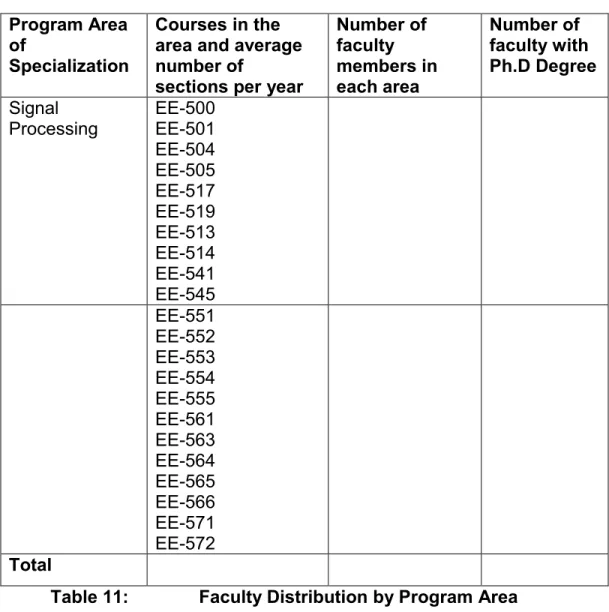
Program Area of
Specialization
Courses in the area and average number of
sections per year
Number of faculty members in each area Number of faculty with Ph.D Degree Signal Processing EE-500 EE-501 EE-504 EE-505 EE-517 EE-519 EE-513 EE-514 EE-541 EE-545 EE-551 EE-552 EE-553 EE-554 EE-555 EE-561 EE-563 EE-564 EE-565 EE-566 EE-571 EE-572 Total
Table 11: Faculty Distribution by Program Area
8.2 Standard 6-2
All faculty members must remain current in the discipline and sufficient time must be provided for scholarly activities and professional development. Also, effective programs for faculty development must be in place. Effective Programs for Faculty Development
Riphah_M.Sc. Electrical Engineering 32 Faculty concurrency in the discipline is determined based on the criterion
set by the University in the light of HEC guidelines. All faculty members submit their professional resumes on HEC Performa number 9 (Faculty Resume, Annexure-H) once a year. This information is compared with the existing criterion set by university for the concurrency of the post.
All full time faculty members are allocated teaching hours as per HEC defined limit which enables the faculty to have enough spare time to perform scholarly activities and improve their knowledge and skills.
Faculty members are provided with adequate resources for research and academic activities. Every faculty members has been provided with computer system and access to internet. Faculty members have also access to library materials for academic and research activities. Professional training is also provided to faculty if required to enhance their capabilities.
University has defined the development programs for faculty members under the arrangement of RARE (Riphah Academy of Research and Education). RARE holds frequent interactive sessions of junior and senior faculty to discuss teaching methodology with a view to train the young faculty members. This practice is done on yearly basis during the summer vacations. After every 2 year the development program is analyzed in Deans Council for its effectiveness and necessary improvements.
The university encourages the faculty to participate in research activities by providing them sufficient financial support within or outside university.
8.3 Standard 6-3
All faculty members should be motivated and have job satisfaction to excel in their profession.
Riphah_M.Sc. Electrical Engineering 33 Faculty members are motivated through public appreciation and
documented appreciation (annual performance evaluation report) by the In-Charge Program and Dean on regular basis.
The faculty survey of the program using HEC Performa number 5 indicates the mix reactions of the faculty, which indicates that teaching load be distributed evenly and more relaxed environment be generated. Cumulative results of faculty surveys are attached in Annexure G.
Criterion 7: Institutional Facilities
8.4 Standard 7-1
The institution must have the infrastructure to support new trends in learning such as e-learning.
The university has provided e-learning facilities to faculty members and students. Each faculty member has a computer system with access to internet and e-learning library section.
Students have been provided a number of computer systems in the library to access e-learning section. Every student has been provided with user ID to access the e-learning resources from within the university library. The university library is linked with foreign universities libraries through internet.
The support staff to look after the e-learning resources is sufficient in number, trained and responsive. The university has provided enough funding to support the e-learning.
Riphah_M.Sc. Electrical Engineering 34
8.5 Standard 7-2
The library must possess an up-to-date technical collection relevant to the program and must be adequately staffed with professional personnel.
The university library has enough program related technical books in hard copies to support the program learning. The internet access to the external universities libraries provides opportunities to the students and faculty to obtain knowledge from their technical resources.
The library is staffed with more than 8 professionals to help students and faculty members to get access to required book or learning material efficiently.
8.6 Standard 7-3
Class-rooms must be adequately equipped and offices must be adequate to enable faculty to carry out their responsibilities.
Enough class rooms are available to run the program as per desired schedule. In few class rooms, there is a need of up-gradation of multimedia and other resources. The work orders have been initiated and procurement process is in progress.
9.0 Criterion 8: Institutional Support
9.1 Standard 8-1
There must be sufficient support and financial resources to attract and retain high quality faculty and provide the means for them to maintain competence as teachers and scholars.
University allocates enough financial resources each year to hire competent faculty as required.
Riphah_M.Sc. Electrical Engineering 35 As already listed in standard 5-3, Faculty members are retained by giving
them good remuneration, favorable teaching environment, research facilities and management support.
As listed in standard 6-2, Faculty members are provided with adequate resources for research and academic activities to maintain their competence. Every faculty members has been provided with computer system and access to internet. Faculty members have also access to library materials for academic and research activities. Professional training is also provided to faculty if required to enhance their capabilities.
9.2 Standard 8-2
There must be an adequate number of high quality graduate students, research assistants and Ph.D. students.
The university follows the guidelines of HEC for admission in this program. The number of graduate students during the last three years is 1 with no research assistants in the faculty.
Faculty to graduate student’s ratio for the last three years remained in the range of 5:1 to 10:1.
9.3 Standard 8-3
Financial resources must be provided to acquire and maintain Library holdings, laboratories and computing facilities.
Library at RIPHAH holds more than 50000 books for all programs. Sufficient number of computers is available to be used by the students. Library is organized to accommodate 50 students (male, female) in research cubicles as well as in the common places. Separate common rooms for male and female students are available with internet facility.
Riphah_M.Sc. Electrical Engineering 36 Laboratories at RIPHAH holds adequate equipment to be used by the
students to carry out desired experiments and laboratory work. Each year a handful of budget is allocated for laboratories to maintain and upgrade the equipment and other facilities.
Computing facilities at RIPHAH provide excellent platform to students to enhance their learning capabilities. There are 2 computer laboratories in Faculty of computing, which are accessible to all students for their use.
10.0 Conclusion
The self-assessment report of MS (Electrical Engg-FEAS), Riphah International University, I-14 Campus Islamabad is an important document, which gives strengths and weaknesses of the program. The management is striving hard to improve infrastructure for establishment of conducive environments for studies. The faculty is focused on imparting quality education, introduction of new and innovative techniques and conduct of quality research to produce competent engineers. The report has been prepared after evaluating the program in the light of 8 criterion and 31 standards given in HEC’s Self-Assessment Manual. The program mission objectives and outcomes are assessed and strategic plans are presented to achieve the goal, which are again measurable through definite standards. Teachers’ evaluation revealed satisfactory standards, the score of 30 teachers of the program ranged from 3.45 to 4.88. Students’ course evaluation score ranged between 3.49 and 4.91 with a mean of 4.20 points in 0-5 scale. Alumni surveys revealed variable results with regards to knowledge, interpersonal skills, management and leadership skill. Weaknesses are identified which are related to space, laboratories and equipment. Improvements in curriculum design and infrastructure are suggested which are based upon set, well defined and approved criteria. Examinations are held on schedules, academic schemes are prepared well in advance, transparent admission,
Riphah_M.Sc. Electrical Engineering 37 registration and recruiting policy, excellent student teacher ratio are some
of the strong areas of this program. The number of courses along with titles and credit hours for each semester, course contents for degree program, is thoroughly planned. Their efficacy was measured through different standards and it was found to be satisfactory.
The facilities and shortcomings in the laboratory have been discussed. It was concluded that laboratory facilities and class rooms need further improvement. The need of refresher courses for the fresh faculty on method of teaching cannot be over emphasized.
Proper steps are taken to guide the students for program requirements, communication, meetings, tutorial system, tours, students-teacher interaction etc. Some improvements have been suggested. As regards the process control covering admission, registration, recruiting policy, courses and delivery of material, academic requirements, performance and grading, university, PEC as well as Higher Education Commission have set forth proper rules, which are properly followed.
Institutional facilities were measured through Criterion 3; infrastructure, library, class room and faculty offices and in each case, short comings and limitation are highlighted. Institutional facilities need to be strengthened. Accordingly, institutional support will greatly promote and strengthen academic, research, management and leadership capabilities.
In conclusion, the strong and weak areas of the program are as under:-
10.1 MSc Electrical Engineering Program Strong and Weak Points
MSc Electrical Engineering program is designed to educate students to meet the challenges of the modern world and present market needs. During the execution of the program several observations were made that can be
Riphah_M.Sc. Electrical Engineering 38 categorized as strong and weak points of the program. These points are
listed below:
10.2 MSc Electrical Engineering Program Strong Points:
The number of courses along with their titles and credit hours for each semester, course contents for degree program are fully planned
Transparent admission, registration and recruiting policy
Pakistan Engineering Council & HEC rules fully followed
Pre-requisites fully observed
Examinations on schedule
Academic Schemes fully prepared in advance
Excellent Students-Teacher Ratio
10.3 MSc Electrical Engineering program Weak Points:
Refresher Courses for Teachers
Need to improve the research papers published by students/faculty.
Need to improve Canteen facility for faculty and students
Inadequate space in the research lab for students.
Inadequate chemicals and equipment in the labs for students.
New & State of the art equipment for Labs.
Need to improve the computer facilities to all the research students. **************
Riphah_M.Sc. Electrical Engineering 39
Riphah_M.Sc. Electrical Engineering 40
Annexure – B: Employer Survey Results
Strongly Agree 13% Agree 36% Uncertain 33% Disagree 10% Strongly Disagree 8% Management Skills Strongly Agree 19% Agree 46% Uncertain 24% Disagree 7% Strongly Disagree 4% Interpersonal Skills Strongly Agree 15% Agree 32% Uncertain 39% Disagree 12% Strongly Disagree 2% Communication Skills Strongly Agree 17% Agree 43% Uncertain 29% Disagree 8% Strongly Disagree 3% Knowledge
Riphah_M.Sc. Electrical Engineering 41
Annexure – C: Students Course Evaluation Course:
Riphah_M.Sc. Electrical Engineering 43
Annexure – D: Students Teachers Evaluation Teacher:
Riphah_M.Sc. Electrical Engineering 46
Annexure – E: Research Papers List
JOURNAL PAPERS
No. Year Authorship Article Journal
2014.
Khalid, W. P. Wen, L. Y. Cheong,
Optimum filter synthesis procedure for ultra-wide band pass filter using step-impedance resonator",
Journal of Electromagnetic Waves and Applications, Vol. 28, No. 8, 943 - 955,
2013
Khan, Salman; Khan, Zeashan Hameed,
"Can Signature Biometrics Address both Identification and Verification Problems?
12th IEEE International Conference on Document Analysis and Recognition ICDAR 2013, Washington DC, USA
2013 Khan Zeashan; Khan Arsalan, “Distributed Diagnosis of a Networked mini UAV” Arabian Journal for Science and Engineering (ISSN 1319-8025), 2013,Springer
June 24-26 2013, (2013) U. Zabit, O. Bernal, and T. Bosch “Real-time self-mixing interferometric laser sensor for embedded applications”,
International Conference on Sensing for Industry, Control, Communications, & Security Technologies ICSICCST 2013 Karachi, IOP Conf. Ser.: Mater. Sci. Eng. 51 012016 doi:10.1088/1757-899X/51/1/012016, 1.August 2013 O. D. Bernal, U. Zabit, T. Bosch
Study of laser feedback phase under
self-mixing leading to improved phase unwrapping for vibration sensing
IEEE sensors journal, vol., no. , pp., doi:10.1109/jsen.2013.2276106 2.March 2013 Usman Zabit, O. D. Bernal T. Bosch
Design and analysis of an embedded
accelerometer coupled self-mixing laser
displacement sensor
IEEE sensors journal, vol. 13, no. 6, pp. 2200-2207 3.Nov 2012 Usman Zabit, O. D. Bernal T. Bosch Self-mixing laser sensor for large displacement: signal recovery in the presence of speckle”
(doi:0.1109/JSEN.2012.2227718), IEEE Sensors Journal, issue 99, vol. 2012, pp. 1-
Impact factor 1.520 4. 2012 Zabit, u. ; bony, f. ; bosch, t. ; rakic, a.d. A self-mixing
displacement sensor with fringe-loss compensation for harmonic vibrations
photonics technology letters, IEEE page(s): 410 – 412, 5. 2012 Khan, Salman Hameed; Rehan, Ahmed; Sohail, Muhammad; "Blind Deconvolution of Blurred Images with Fuzzy Size Detection of Point Spread Function”,
International multi topic conference, IMTIC 2012,CCIS, Springer
Riphah_M.Sc. Electrical Engineering 47 Khan, Arsalan H.; Khan, Zeashan H., 6. 2012 Khan, Arsalan H., Zhang Weiguo, Zeashan Khan, Jingping, Shi; ", Evolutionary Computing Based Modular Control Design for Aircraft with Redundant Effectors
, Procedia Engineering, 29,,110-117,2012,Elsevier
7.2013
S. Khalid, W. P. Wen, L. Y. Cheong,
A novel synthesis procedure for ultra wideband (UWB) band pass filters",
Progress in electromagnetic research, PIER vol. 141, 249-266,
8.June 2012.
S. Khalid, W. P. Wen, and L. Y. Cheong,
Synthesis and design of four pole Ultra-Wide Band (UWB) bandpass filter (BPF) employing multi- mode resonators (MMR)",
International Microwave Symposium Digest, Montreal, QC, Canada, 9. 2011 U Zabit, od bernal, t bosch, f bony MEMS accelerometer embedded in a self-mixing displacement sensor for parasitic vibration compensation
Optics Letters (Optical Society of America), issue 5, vol. 36, 2011, pp. 612-614, Impact Factor 3.399 10.2011 R atashkhooei, s royo, f azcona, u Zabit
Analysis and control of speckle effects in self-mixing interferometry Sensors, 2011 IEEE, 1390-1393 11.2011 R atashkhooei, u Zabit, s royo, t bosch, f bony
Adaptive optical head for industrial vibrometry applications
Spie optical metrology, 80821w-80821w-7
12.2011 U Zabit, t bosch
Envelope extraction technique for a self-mixing centimetric displacement laser sensor
Sensors, 2011 IEEE, 343 -346 13.2011 U Zabit, od bernal, t bosch A self-mixing displacement sensor compensating parasitic vibration with a MEMS accelerometer Sensors, 2011 IEEE, 1386-1389 14.2012 M Shafique, pa kyriacou, sk pal Investigation of photoplethysmographic signals and blood oxygen saturation values on healthy volunteers during cuff-induced hypo
perfusion using a
Medical & biological engineering & computing 50 (6), 575-583
Riphah_M.Sc. Electrical Engineering 48 multimode ppg/spo2 sensor 15. M Shafique, pa kyriacou Photoplethysmographic signals and blood oxygen saturation values during artificial hypothermia in healthy volunteers Physiological measurement 33 (12), 2065 16.2011 M Shafique Investigation of photoplethysmography and arterial blood oxygen saturation during artificially induced peripheral hypoperfusion utilizing multimode photometric sensors City university 17.2013 AM akhtar, m nakhai, a aghvami
On the use of cooperative physical layer network coding for energy efficient routing
IEEE transactions on communications 61 (4), 1498-1509 14 2012 AM akhtar, mr nakhai, ah aghvami Power aware cooperative routing in wireless mesh networks
Communications letters, IEEE 16 (5), 670-673 15. 2012 Muhammad j. Mirza nadeem anjum Association of moving objects across visual sensor networks
Journal of multimedia (connected multimedia), volume 7. Issue 1, 2012
16. 2010
N. Anjum
and
a. Cavallaro.
Trajectory clustering for scene context learning and outlier
detection
Springer-verlag series on studies in computational intelligence 17. 2011 Nadeem anjum, “camera localization in distributed networks using trajectory estimation
Journal of electrical and computer engineering, July 2011 18. July 2010 N. Anjum and a. Cavallaro Automated localization
of a camera network IEEE intelligent systems, 2010
19 2012 Z. Iqbal, I. Hussain, A. Rauf, M. Zakaullah, S. Tajammul Hussain A ul Haq Corrosion Protection of Commercial Steel using Stainless Steel Coatings deposited by Cathodic Arc Plasma Technique
Protection of Metals and Physics Chemistry of Surfaces 48(3) (2012), 371-375
Riphah_M.Sc. Electrical Engineering 49 20 2012 Z. Ahmad, A. ul Haqand Mi Yan Evaluation of phase, texture, microstructure and magnetic properties of Fe-Cr-Co-Mo-Ti permanent magnets JMMM 324(15) (2012), 2355-2359 21 2011 Z. Ahmad, S. Akbar, M. Farooque and A. ul Haq Microstructural and magnetic properties of Fe-Co-Ni-Al-Ti-Cu magnetic alloy
Phil. Mag. Letters. 91(3), (2011) 173-181
22 2011 Z. Iqbal, A. Ali, A. Rauf, A. ul Haq, S. Tajammul Hussain M.H. Asghar Sub-micron Synthesis of di-titanium nitride Coatings by Cathodic Arc Plasma Deposition Technique
Protection of Metals and Physics Chemistry of Surfaces 47 (2011), 512-516 23 2011 Aamir Minhas Khan, Arif Mumtaz, S.K. Hasnain A. ul Haq Low Temperature Magnetoresistive Effects and coulomb blokade in La0.7Ca0.3MnO3 Nanoparticles synthesis by auto ignition method Natural Science 3 (2011) 496-501 24 2011 Qaiser hussain Alvi, Gulistan Raja Performance evaluation of LTE Mobile broadband standards physical layer
IEEEP New Horizon Vol # 70-71, 2011 pages # 13-17 (www.ieeep.org.pk/publications/NewHorizons) 25 2013 Ahsan Sohail Zeeshan Ahmed Iftikhar Ali ANALYSIS AND MEASUREMENT OF WI-FI SIGNALS IN INDOOR ENVIRONMENT
International Journal of Advances in Engineering &Technology May 2013., Vol. 6, Issue 2, pp. 678-687
Riphah_M.Sc. Electrical Engineering 50 PATENT 1. 2013 O bernal, f bony, t bosch, u Zabit
Device for the optical measurement of a physical parameter Us patent 20,130,063,718 2. 2011 O bernal, f bony, t bosch, u Zabit
Device for the optical measurement of a physical parameter
Wo patent 2,011,141,482
Book/Chapters
1.2008 U. Zabit, F. Bony and T. Bosch
“Optimization of the Nelder-Mead Simplex Method for Its Implementation in A Self-Mixing Laser Displacement Sensor”
Smart Sensors and Sensing Technology, ISBN: 978-3-540-79589-6 Vol. 20, Springer, pp. 381-400,
2. 2014 Khan, Arsalan; Khan, Zeashan
“Multi-objective optimization for error compensation in intelligent micro-factory CPS (Book Chapter)”,
Computational Intelligence for decision support in cyber physical systems (To appear), 2014, Springer
2014 Kanwal Naveed; Khan, Zeashan
“Adaptive trajectory tracking of wheeled mobile robot (Book Chapter)”,
Computational Intelligence for decision support in cyber physical systems (To appear), 2014, Springer
2014 Khan, Arsalan; Khan, Zeashan
“Optimized Reconfigurable Autopilot Design for an Aerospace CPS (Book Chapter)”,
Computational Intelligence for decision support in cyber physical systems (To appear), 2014, Springer
Riphah_M.Sc. Electrical Engineering 51
CONFERENCE PAPERS
No. Year Authorship Article Conference
1 June 24-26 2013 U. Zabit, O. Bernal, and T. Bosch Real-time self-mixing interferometric laser sensor for embedded applications
International Conference on Sensing for Industry, Control,
Communications, & Security Technologies ICSICCST 2013 Karachi, IOP Conf. Ser.: Mater. Sci. Eng. 51 012016 doi:10.1088/1757-899X/51/1/012016, 2 , October 2012 U. Zabit, O. D. Bernal, A. Chamorrocoloma and T. Bosch, "Real-time accelerometer coupled self-mixing laser displacement sensor for embedded applications"
IEEE International SENSORS Conference, Taipei, Taiwan, 28-31
3 28-31 October 2012 U. Zabit,