Open Research Online
The Open University’s repository of research publications
and other research outputs
Modeling Quantum Entanglements in Quantum
Language Models
Conference or Workshop Item
How to cite:
Xie, Mengjiao; Hou, YueXian; Zhang, Peng; Li, Jingfei; Li, Wenjie and Song, Dawei (2015). Modeling Quantum
Entanglements in Quantum Language Models. In: 24th International Joint Conference on Artificial Intelligence (IJCAI
2015), 25-31 Jul 2015, Buenos Aires, Argentina, AAAI Press, pp. 1362–1368.
For guidance on citations see FAQs.
c
2015 Association for the Advancement of Artificial Intelligence
Version: Version of Record
Copyright and Moral Rights for the articles on this site are retained by the individual authors and/or other copyright
owners. For more information on Open Research Online’s data policy on reuse of materials please consult the policies
page.
Modeling Quantum Entanglements in Quantum Language Models
∗Mengjiao Xie
1, Yuexian Hou
1, Peng Zhang
1, Jingfei Li
1, Wenjie Li
2, Dawei Song
1,3 1School of Computer Science and Technology, Tianjin University, China
2
Department of Computing, The Hong Kong Polytechnic University, Hong Kong
3Department of Computing and Communications, The Open University, UK
{
mjxie, yxhou, pzhang, jingfeili, dwsong
}
@tju.edu.cn, [email protected]
Abstract
Recently, a Quantum Language Model (QLM) was proposed to model term dependencies upon Quan-tum Theory (QT) framework and successively ap-plied in Information Retrieval (IR). Nevertheless, QLM’s dependency is based on co-occurrences of terms and has not yet taken into account the Quan-tum Entanglement (QE), which is a key quanQuan-tum concept and has a significant cognitive implica-tion. In QT, an entangled state can provide a more complete description for the nature of realities, and determine intrinsic correlations of considered ob-jects globally, rather than those co-occurrences on the surface. It is, however, a real challenge to decide and measure QE using the classical statis-tics of texts in a post-measurement configuration. In order to circumvent this problem, we theoret-ically prove the connection between QE and sta-tistically Unconditional Pure Dependence (UPD). Since UPD has an implementable deciding algo-rithm, we can in turn characterize QE by extract-ing the UPD patterns from texts. This leads to a measurable QE, based on which we further advance the existing QLM framework. We empirically com-pare our model with related models, and the results demonstrate the effectiveness of our model.
1
Introduction
Quantum theory (QT) has a profound impact on multidisci-plinary studies, such as Physics, Philosophy, Psychology and Information Retrieval (IR) [Heisenberg and Northrop, 1958; Busemeyer and Bruza, 2012; Melucci and van Rijsbergen, 2011; Song et al., 2010; Sordoniet al., 2014]. In a sem-inal book [van Rijsbergen, 2004], quantum theory was for the first time regarded as “a kind of formal language that can be used for describing objects and processes in IR”. Follow-ing this pioneerFollow-ing work, the Quantum Probability RankFollow-ing Principle (QPRP) was proposed to rank interdependent doc-uments based on the quantum interference [Zuccon and Az-zopardi, 2010]. Inspired by the photon polarization, a Quan-tum Measurement inspired Ranking model (QMR) was
in-∗
Corresponding authors: Yuexian Hou and Peng Zhang.
troduced [Zhaoet al., 2011]. Although the QPRP and the QMR achieved better performances, the probabilities in both methods are not actually calculated according to the QT for-mulations.
Piwowarski et al. [2010] explored to express queries as density matrices and documents as subspaces. However, this method did not bring about the excellent performance as ex-pected. Later, a Quantum Language Model (QLM) was pro-posed to model term dependencies based on the quantum the-ory and outperformed the conventional IR model [Sordoniet al., 2013]. However, QLM models the term dependency us-ing traditional statistics correspondus-ing to co-occurrences of terms, thus lacks of an explicit modeling of the Quantum En-tanglement (QE), which is a key quantum concept and has a significant cognitive implication.
As a quantum model, e.g., QLM, it is inconsistent if it can-not express the quantum entanglement in itself. An entan-gled state can give a more complete description for the nature of global realities, in which the intrinsic correlations among objects are globally determined [Atmanspacher, 2012]. The quantum entanglement is relevant to cognition since it is nat-ural to model the holistic and instantaneous interaction in a cognitive subject [Atmanspacher, 2012]. Technically speak-ing, a system is entangled, if and only if its state cannot be expressed as a tensor product of its sub-systems. However, in IR practice, it is challenging to measure QE using the clas-sical statistics of texts in a post-measurement configuration, where the state of an object (e.g., the mind of a man) has col-lapsed to certain observables (e.g., texts).
We resort to the recently proposed Unconditional Pure De-pendence (UPD) [Houet al., 2013] to deal with the above-mentioned problem. It is proved that in a post-measurement configuration, the statistical dependence is equivalent to en-tanglements [Hou and Song, 2009]. In this paper, we re-formulate the above statistical dependence as the so-called UPD. Hence we can indeed prove the equivalence relation-ship between UPD and QE in a post-measurement configu-ration. Since Hou et al. [2013] have proposed an efficient algorithm to decide, in a sufficient sense, whether a set of variables is UPD, it turns out that we can characterize QE by extracting the UPD patterns from textual datasets.
Moreover, Hou et al. [2013] emphasized that a UPD pat-tern is not formed by accidental co-occurrences of the words in the sense that its joint distribution cannot be
ally factorized. This is coincident with what Ludwig Wittgen-stein said: “For a large class of cases of the employment of the word ‘meaning’ . . . the meaning of a word is its use in the language” [Wittgenstein, 1953]. Wittgenstein defined the word’s meaning as the use of the word. Here, the “use” can be characterized by the relationship of the non-accidental co-occurrences of words to a large extent. Since the non-accidental co-occurrence relationship can be characterized by UPD, which is different from the dependence modeled by QLM, those UPD patterns can further help QLM to model meaningful patterns of words, unlike the unprincipled setting in QLM where accidental co-occurrences of terms are also considered. Through integrating UPD into the QLM’s train-ing algorithm, QLM thus naturally takes into account QE, leading to a more consistent quantum IR model.
The rest of this paper is laid out as follows. We first intro-duce the preliminaries of QT in Section 2. In Section 3, we discuss QE. Then we illustrate the relationship between QE and UPD in Section 4, where we also provide the equivalence proof between QE and UPD for the sake of understandabil-ity. We propose to advance QLM with UPD in Section 5. In Section 6, we present the experimental results of our model. Section 7 concludes this work and points out future research directions.
2
Preliminaries of Quantum Theory
In quantum theory [Nielsen and Chuang, 2010], a probabilis-tic space is defined as a Hilbert space Hn, which is an
ab-stract vector space possessing the structure of the inner prod-uct. For convenience, we restrict ourselves to a real space
Rn. With the Dirac’s notation, a unit column vectorϕ∈Rn
corresponding to a quantum state can be expressed as the ket |ϕiand its transposeϕT is the brahϕ|. The inner product of ϕ andφis expressed ashϕ|φi. Onto the direction|ϕi, the corresponding measurement projector is|ϕihϕ|=ϕϕT. |ϕihϕ|can also represent a quantum state, and hence becomes the density matrix. According to the measurement postulate, the expectation value of the measurement on a density ma-trixρcan be calculated byE(H) =P
m
mp(m) = tr(ρH), whereHis a measurement Hermitian with a spectral decom-position. That is,H is equal to its own conjugate transpose and H = P
m
mHm, where Hm is the projector onto the
eigenspace ofH with eigenvaluem. In this paper,H is sim-ply defined as a single projector (See Formula (6)). It turns out thattr(ρH)gives the probability that the measurement result corresponding to this projector occurs. All these prob-ability terms can form a quantum probprob-ability measure on all possible projectors since Gleason’s Theorem [Gleason, 1957] proves a bijective relationship between the density matrixρ
and the quantum probability measureµ, which is determined byµρ(|ϕihϕ|) = tr(ρ|ϕihϕ|).
3
Quantum Entanglement and Its Cognitive
Implications
In quantum theory, a qubit can be completely described by a state vector. Importantly, a qubit can be in a superposition
state, i.e.,a|0i+b|1i, where|a|2+|b|2 = 1. The special states|0iand|1iforming an orthonomal basis are computa-tional basis states. When a qubit is be measured, the super-position state will collapse into one of the base states with certain probability, i.e., the squared norm of the correspond-ing coefficient of the base. Specially, the entangled state is a special case of the superposition state involving multiple qubits.
The Quantum Entanglement (QE) can be formally defined as follows:
Definition 1. (QE): LetA be an n-qubit system in a state |φAi and{A1, A2} be a partition of A, where two disjoint parts A1 and A2 have 0 < k < n qubits and n − k qubits, respectively. A is entangled iff. there does NOT exist any tensor product decomposition of |φAi such that
|φAi=|φA1i ⊗ |φA2i, where|φA1iand|φA2iare the states
ofA1andA2, respectively.
As an illumination of quantum entanglement, we give an example here. Suppose a state with two qubits is written asp1/2(|00i+|11i), which is the well-known Bell entan-gled state, also called the EPR pair [Rieffel and Polak, 2000]. From the perspective of the quantum measurement, it is obvi-ous that any qubit in EPR pair will be completely determined by the measurement result of the other qubit in this pair.
In the following, we describe the cognitive implications of quantum entanglement from its philosophical background and a specific example, i.e., the surprise examination para-dox [Chow, 1998; Kritchman and Raz, 2010]. From a philo-sophical point of view, Pauli and Jung made an analogy that “the change from the unconscious state to a conscious state can be seen as the converting from an entangled state of a system to a measured state” [Atmanspacher, 2012]. They argued that the recognition of the unconscious state is akin to the quantum measurement on the entangled state. At-manspacher [2012] stated that “measurements can be viewed as an intervention decomposing a system constituting an in-separable whole into locally separate parts”. Therefore, in the light of measurement results, we may speculate the knowl-edge about the holistic state before the measurement.
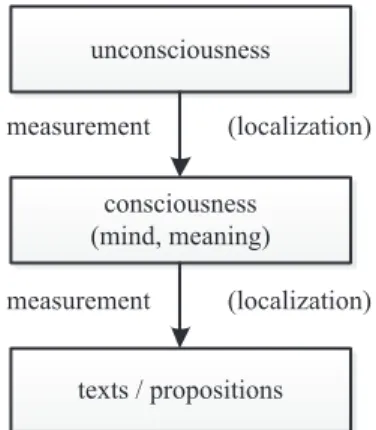
As we usually directly get the sematic knowledge from texts or propositions in our life, we develop the idea of Pauli and Jung as illustrated in Figure 1. That is, the consciousness, such as the mind and the meaning, is mostly manifested in the form of texts or propositions by thinking logically. After the quantum-like measurement, the consciousness collapses to texts or propositions, which we observe in reality. As il-luminated by the above analogies, we can conclude that the conversion of a meaning system from an entangled state to a measured state corresponds with the transformation of a meaning system from a global and implicit state to a local and explicit state due to measurements. Here the measure-ment results are often texts or propositions.
To further clarify the meaning of the quantum entangle-ment, we turn to discuss a notable paradox, namely the sur-prise examination paradox. Here, we give a simplified ver-sion: a teacher says to students that there will be an exami-nation in the class on Monday or Wednesday next week and you will not infer the specific date for the examination. If the
unconsciousness consciousness (mind, meaning) texts / propositions measurement measurement (localization) (localization)
Figure 1: Transformations among the unconsciousness, the consciousness, texts and propositions. The localization rep-resents that the globally implicit meaning is explicitly ex-pressed by texts or propositions.
teacher’s claims are formulated under the framework of the Classical Propositional Logic (CPL) system, it can deduce a contradiction. But interestingly, the paradox happens since the examination could be actually held in a class and no stu-dent knows the specific date before it happens, which indeed meets the teacher’s claims.
This reminds us of Wittgenstein’s statement: there are truths of silence, when spoken, no longer true any-more [Wittgenstein, 1961]. Following Wittgenstein’s point, the phenomenon of the examination paradox can be under-stood intuitively. That is, once compatible facts are formal-ized as propositions and regarded as the premises of the rea-soning in the CPL system, conflicts may happen. Actually, G¨odel’s second incompleteness theorem [G¨odel, 1931] theo-retically explains this phenomenon. That is, the system ex-plicitly introduces a meta proposition on the unprovability of the system, which claims that students cannot infer the spe-cific date for the examination, so that the consistency of the system is broken. We note that the above observations can also be understood under the framework of quantum theory. Specifically, in quantum cognition, there exist holistic truths in the form of entangled states, which cannot be explicitly expressed by propositions or texts. The way to express these holistic truths in a (formal or natural) language can be viewed as the quantum measurement. Although the results of quan-tum measurements locally reflect holistic truths, a localiza-tion (i.e., explicit expressions via proposilocaliza-tions or texts) may break the consistency of the expression system.
The examination paradox reveals the limitations of the CPL system. It is thus necessary to seek for a formal and re-placeable system to describe the states of entangled objects. In quantum theory, the examination paradox can be simply and completely described with two entangled qubits. For-mally, for the first qubit, 0 and 1 represent the examination is held on Monday or Wednesday, respectively. For the second qubit, 0 and 1 represent the students cannot or can infer the specific date for the examination, respectively. Now, the stu-dent’s cognitive state before the examination can be modeled
asa|00i+b|11i, an entangled state, where|a|2+|b|2 = 1. The class on Monday can be seen as a measurement on the first qubit, which makes the resulting state become localized propositions. Specifically, if the examination is on Monday, the entangled state collapses to|00i, which means that the examination is held on Monday and students cannot infer the date for the examination. Otherwise, the student’s cognitive state collapses to|11i. No matter what the outcome is, the student’s cognitive state changes substantially owing to the quantum measurement. This is in sharp contrast with the CPL system, in which the procedures of the reasoning do not pro-duce any new knowledge in nature, since all logical conclu-sions are actually implied by the logical premises. Therefore, the state of the CPL system is essentially static. On the other hand, the quantum state can characterize not only whether the proposition comes into being or not, but also the probability of the occurrence of the proposition in principle. In this sense, the quantum state may give a more complete description than the CPL system. Main differences between the formalizations of the CPL and the quantum state representation are listed in Table 1.
The above analysis indicates that the quantum state may be more useful and powerful than the CPL system in some con-texts. In particular, the quantum entanglement reflects the in-trinsic correlations among the potential propositions we con-cern about. It is these correlations that globally determine the whole student’s cognitive state and the state collapsing in-duced by measurements. Furthermore, a quantum state may also evolve in accordance with the unitary matrix. Therefore, we can define the QT model as a model that describes the states of objects by, in general, entangled state vectors, and characterizes the localization and evolution of the states by quantum measurements and unitary evolutions, respectively. It is worth emphasizing that, in this framework, the quantum entanglement is a key component since it rules the holistic behaviors of the quantum state.
In IR, our task is to retrieve documents that are relevant to a query topic. The underlying meaning of a document globally determine which topic it belongs to. To a large extent, we can capture the underlying meaning through the high-level meaningful entities/blocks. It is natural that this kind of enti-ties is constituted by a set of intrinsically correlated compo-nents in an entangled (meaning) state. In a post-measurement configuration, in which the meaning is fixed by the measure-ment results, i.e., texts, an entangled state manifests itself as the special statistical dependence among words (see Section 4 for details). For example, a text pattern “Seattle World fair”, in which the words are significantly dependent, implies the whole concept of “world’s fair in Seattle”, i.e., a high-level meaningful entity. As a conclusion, it is important to charac-terize the quantum entanglement in an IR model.
4
The Relationship between QE and UPD
We expect to model QE in QLM. However, it is usually im-possible for us to directly measure a quantum-like system, e.g., the mind of a man, where the quantum measurement oc-curs in the generation process of texts. In common applica-tions, we have only these texts or statistical data, which
corre-Formulation of CPL system Formulation of Quantum system Representation of system state Localized propositions Quantum superposition states
Reasoning of system Reasoning rules of CPL Quantum measurements Temporal property of system Static Dynamic
Table 1: Main differences between a CPL system and a Quantum system.
spond to the measurement results of the underlying quantum-like system. While, the statistics of texts comply with clas-sical logic and probability, which are incompatible with pure quantum approaches. Hence we need a criterion to decide the existence of quantum entanglement from the measurement re-sults of a quantum system. To this end, Hou and Song [2009] described that the entanglement corresponds to the statisti-cal dependence between measurement results. In the fol-lowing, we reformulate the above statistical dependence as the unconditional pure dependence. Hence we can indeed prove the equivalence relationship between the unconditional pure dependence and the quantum entanglement in a post-measurement configuration.
In a post-measurement configuration, the counterpart of QE is Unconditional Pure Dependence (UPD) defined as below. Formally, given a set of binary random variables,
A={W1, W2,· · · , Wn}, whereWi denotes the occurrence
(Wi= 1) or absence (Wi= 0) of theithword. Letwi∈ {0,1}
stand for the value ofWiandp(a),a= [w1, w2,· · ·wn]T be
the joint distribution overA. Then we have:
Definition 2. (UPD): A pattern A = {W1, W2,· · ·, Wn}
forms the UPD pattern iff. the joint probability distribution overAcannot be unconditionally factorized, i.e., there does NOT exist any m-partition {A1, A2,· · ·, Am;m > 1} of
A, so that p(a) = p(a1)·p(a2)· · ·p(am), where p(ai),
i= 1,2,· · · , m, is the joint distribution overAi.
Based on Definition 1 and Definition 2, a set of objects in an entangled system or a UPD pattern are both recognized as a whole, which cannot be decomposed by the individual counterparts in the sense that the states of any part are intrin-sically correlated with the states of the rest. This intuitive similarity between QE and UPD implies a possible logical connection between them. In the following, we will formally clarify this connection.
To uncover the relation between QE and UPD, we first de-fine the characterizing distribution of a quantum state. Given a quantum state|φi, the characterizing distribution of|φiis the (classical) joint probability distribution indicating the oc-currence probability of all possible measurement results on all qubits of|φi. For example, if|φi=p1/2(|00i+|11i), then the characterizing distribution of |φi is just a discrete joint distribution withp00 = 1/2, p01 = 0, p10 = 0and
p11= 1/2.
Proposition 1. LetAbe ann-qubit system in a state|φAi.
Ais entangled iff. the characterizing distribution of|φAiis
unconditional pure dependent.
Proof. To prove the sufficiency, we assume thatAis not en-tangled, i.e.,|φAihas a tensor product composition|φAi =
|φA1i ⊗ |φA2i, where |φA1i and|φA2i corresponds to the
states of two disjoint parts of A, i.e., A1 and A2, respec-tively. Note that{A1, A2}should be a partition ofA. Without loss of generality, we suppose that|φA1iincludes the firstk
qubits of|φAiand|φA2iincludes the last(n−k)qubits of
|φAi. Denote|φAi = z0···0|0· · ·0i+· · ·+z1···1|1· · ·1i, |φA1i = x0···0|0· · ·0i+· · · +x1···1|1· · ·1iand |φA2i =
y0···0|0· · ·0i+· · ·+y1···1|1· · ·1i. Note that the dimension-alities of|φAi,|φA1iand|φA2iare different. Substitute these
representations into the tensor product composition of|φAi,
it is easy to check that the following relations holds:
zi1···in =xi1···ikyi(k+1)···in, (1)
for anyi1· · ·in, where∀ij ∈ {0,1}. The Formula (1)
ex-actly implies that the characterizing distribution of|φAiis not
unconditional pure dependent. The sufficiency follows. To prove the necessity, we assume that the characterizing distribution of|φAiis not unconditional pure dependent. That
is, the characterizing distribution of|φAihas a factorization.
It is easy to check that a factorization of the characterizing distribution of |φAientails a tensor product composition of
|φAias depicted in Formula (1). It turns out that the|φAiis
not entangled. The necessity follows.
Based on Proposition 1, QE is equivalent to UPD in a post-measurement configuration. Hence we can decide the exis-tence of QE via UPD, and furthermore use the measure of UPD as a quantitative index of QE.
5
A Quantum IR model with Quantum
Entanglements
Quantum Language Model (QLM) is a recently proposed quantum-like method to retrieve documents given query top-ics. To make QLM with more quantum properties, we pro-pose to enhance QLM by characterizing the quantum entan-glement in QLM. Based on Proposition 1, the issue of char-acterizing the quantum entanglement converts to identify the UPD patterns from texts. Since deciding the UPD is NP-hard in general, Hou [2013] developed a UPD pattern extrac-tion method based on Informaextrac-tion Geometry (IG), which can efficiently decide the UPD in a sufficient sense. With this method, an enriched Quantum IR model with Quantum En-tanglements (QQE) can be naturally realized.
Similar to QLM, we represent documents by a series of projectors. However, the way to build projectors is different from the original QLM since we use a different procedure to choose dependence patterns, which thereby results in differ-ent actual represdiffer-entations of documdiffer-ents and queries. In our QQE model, the procedures of building the sequence of pro-jectors for the document are as follows.
Firstly, for a specific query, we extract UPD patterns using a Log Likelihood Ratio Test (LLRT), which is designed under
a principled IG framework [Houet al., 2013]. The testing statisticρ[Nakahara and Amari, 2002] of LLRT is derived as follows:
ρ≈N gddθˆ122···n, (2)
whereN is the sample numbers, the values of gdd andθ
-coordinate can be calculated by the method given in [Houet al., 2013]. The degree that a pattern is unconditional pure dependent in terms of the statisticρof LLRT is estimated by the confidence levelπ.
π= cdfχ2(1)(ρ), (3)
where cdf denotes the cumulative distribution function of
χ2(1). For instance, given a query Qwithnwords, Q =
{wj;j = 1,· · ·, n} and a pattern{w1, w2} with computed
ρ=5.024, we can guarantee that this pattern is a UPD pat-tern with probability 0.95. For more details of the extracting method, please refer to Section 5 in [Houet al., 2013].
Secondly, we represent uni-terms and UPD patterns as projectors based on the method proposed in [Sordoniet al., 2013]. For the queryQ, suppose the set {|ewji} forms an
orthonormal basis. The projector for a uni-termwjis below:
m(wj) =|ewjihewj|, wj ∈Q. (4)
The projector for a UPD patternK ={wi;i= 1,· · · , h}is
as follows: m(K) =|ekihek|, |eki= h X i=1 σi|ewii, h X i=1 σ2i = 1, (5)
whereσican be assigned to the uniform (σi= p
1/n) weight or the normalized inverse document frequency (idf) weight.
Thirdly, for each occurrence of uni-terms and UPD pat-terns in unordered fixed windows (with lengthL) of a docu-ment, we add their projectors to the sequence of projectors for the document. Specifically, we design Algorithm 1 to build the sequence of projectors for a document D. Note that #uwL(wj, D)or #uwL(K, D)is an Indri expression
which returns the occurrence times ofwjorKin unordered
windows (with lengthL) ofD.
Algorithm 1Build the sequence of projectorsSDforD.
Require: Q={wj;j = 1,· · ·, n};D;U: the UPD patterns
forQ. 1: InitializeSD← ∅; 2: foreachwjinQdo 3: fori= 1to#uwL(wj, D)do 4: addm(wj)toSD; 5: end for 6: end for
7: foreach patternKin the power setP(Q)− {∅}do
8: ifK⊂Uthen 9: fori= 1to#uwL(K, D)do 10: addm(K)toSD; 11: end for 12: end if 13: end for 14: returnSD
After obtaining the sequence of projectors for documents, we follow the same training method as QLM [Sordoniet al., 2013] to estimate density matrices. Specifically, given a se-quence of projectorsSD=m1,· · · , mN for a documentD,
in QLM, density matrices are estimated by:
max ρ log N Y i=1 tr(ρmi). (6)
The RρR algorithm [Lvovsky, 2004] is used for solving the above maximization problem. The Dirichlet smoothing method is used to smooth the density matrices. In Formula (6), the projectors consist of the mappings of uni-terms and UPD patterns. This is different from QLM, in which the uni-terms and all possible combinations of uni-uni-terms are modeled as projectors. In this sense, our model can reduce the time complexity when we train the density matrix.
Finally, the negative quantum relative entropy of the query density matrixρQto the document density matrixρDis
con-sidered as the scoring function:
−S(ρQkρD) =−tr(ρQ(logρQ−logρD)) rank
= tr(ρQlogρD). (7)
6
Experimental Results and Analyses
To verify the effectiveness of our model, we conduct experi-ments on five collections in the docuexperi-ments re-ranking task. Table 2 describes the collections in detail. Only the title queries are considered in the experiments. The collections have been stemmed with the Porter stemmer and processed with the standard stop word list when using the Lemur4.12
for building index. For all the models, we apply the Dirichlet smoothing method [Zhai, 2008] in which the parameterµis set to be a typical value2500. A pool ofN(N=80,100) docu-ments retrieved by the unigram model is used for re-ranking, while we obtain similar observations for otherN’s settings. Mean Average Precision (MAP) is adopted as the metric to evaluate the retrieval performance. We ignore the queries whose relevant documents are not given in the standard re-sults. The Student’s test is used as the statistical significance test method, where the level is0.05. The unconditional pure dependence patterns with at most three orders are taken into account, in order to reduce the computational cost. The length of the unordered fixed window in Algorithm 1 is set to be:
L= 4· |K|, where|K|is the numbers of terms appearing in the UPD patternK[Metzler and Croft, 2005].
Name #docs Topic FR 25960 151-200 ZIFF 75180 151-200 SJM 90257 101-150 DOE 226087 151-200 WT10G 1692096 501-550 Table 2: A summary of collections and topics.
topN=80 topN=100 MAP%
(+chg%) FR ZIFF SJM DOE WT10G FR ZIFF SJM DOE WT10G
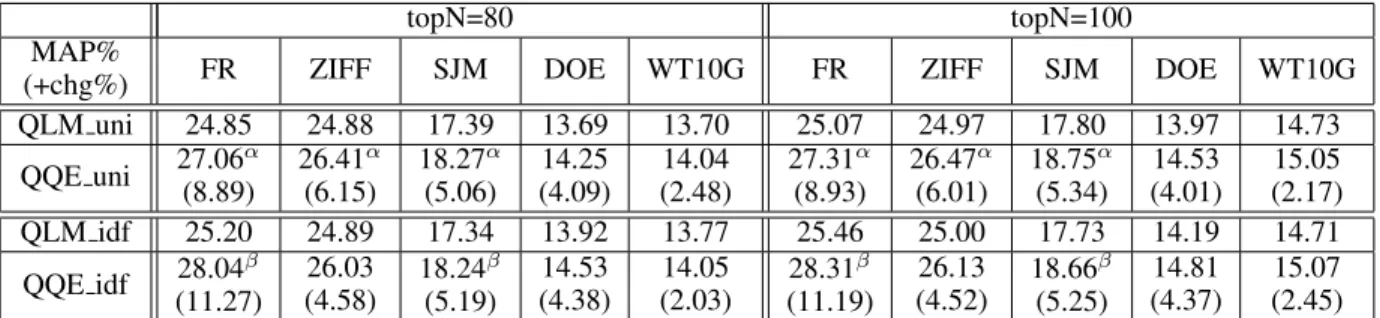
QLM uni 24.85 24.88 17.39 13.69 13.70 25.07 24.97 17.80 13.97 14.73 QQE uni 27.06 α (8.89) 26.41α (6.15) 18.27α (5.06) 14.25 (4.09) 14.04 (2.48) 27.31α (8.93) 26.47α (6.01) 18.75α (5.34) 14.53 (4.01) 15.05 (2.17) QLM idf 25.20 24.89 17.34 13.92 13.77 25.46 25.00 17.73 14.19 14.71 QQE idf 28.04 β (11.27) 26.03 (4.58) 18.24β (5.19) 14.53 (4.38) 14.05 (2.03) 28.31β (11.19) 26.13 (4.52) 18.66β (5.25) 14.81 (4.37) 15.07 (2.45) Table 3: Results for QQE and QLM assigned unifrom (uni) and idf weights respectively. The statistical significant improve-ments over QLM uni and QLM idf are marked withαandβrespectively. The values in parentheses in the fourth and the last lines indicate the relative improvements (+%) over QLM uni and QLM idf, respectively.
topN=80 topN=100
MAP%
(+chg%) FR ZIFF SJM DOE WT10G FR ZIFF SJM DOE WT10G
unigram 24.26 21.44 16.96 12.92 12.19 24.57 21.63 17.55 13.25 13.01 MRF T U 24.56 21.91 17.16 12.81 13.43 24.85 22.22 17.79 13.14 14.34 MRF T UPD 26.11 21.84 17.28 13.78 13.44 26.43 22.13 17.91 14.14 14.39 QQE idf 28.04 γ (7.39) 26.03γ (19.18) 18.24γ (5.56) 14.53 (5.44) 14.05 (4.54) 28.31γ (7.11) 26.13γ (18.08) 18.66γ (4.19) 14.81 (4.74) 15.07 (4.73) Table 4: Results for unigram, MRF T U, QQE and MRF T UPD. The statistical significant improvements over MRF T UPD are marked byγ. The values in parentheses in the last line indicate relative improvements (+%) over MRF T UPD.
6.1
Our Model (QQE) vs. QLM
As discussed previously, a main advantage of our model QQE described in Section 5 over the original QLM is that QQE characterizes the quantum entanglement by retaining UPD patterns while removing non-UPD ones in choosing projec-tors of QLM. We report the experimental results in Table 3.
From Table 3, we can see that our model achieves stable improvements over QLM on all the five collections. From the results of the statistical significant test, QQE is significantly effective on FR, ZIFF and SJM collections, in comparison with QLM. We then investigate the lengths of queries in these collections. An observation is that QQE is more effective for the relatively long queries. This is possibly because that there are more possible combinations of uni-terms as dependence patterns for the longer query in the original QLM, but some dependence patterns (especially the non-UPD ones) could in-troduce noises and may be irrelevant to certain queries. Dif-ferent weight parameters σi (the uniform weight or the idf
weight) in Formula (5) also influence the retrieval perfor-mance. The results show that QQE idf outperforms QQE uni slightly on FR, DOE and WT10G collections. It indicates that idf weights seem to be more reasonable than uniform weights.
6.2
Our Model (QQE) vs. MRF T UPD
The Markov Random Field (MRF) retrieval model [Metzler and Croft, 2005] makes use of three features, i.e., uni-terms, sequential terms and unordered terms. The UPD [Houet al., 2013] was once adopted in the MRF model, for the purpose of refining the sets of sequential terms and unordered terms. Therefore, it is necessary to compare the performance of UPD patterns used in the traditional retrieval model (e.g., MRF)
and the quantum retrieval model (e.g., QLM), respectively. In order for a fair comparison, we only use UPD to refine the sets of unordered terms. In our experiments, the unigram model [Song and Croft, 1999] and the MRF T U model are involved. The capital T, U and UPD represent that the model uses uni-terms, unordered terms (#uw) and UPD patterns, respectively. The detailed results are presented in Table 4.
Table 4 shows that QQE outperforms the unigram model substantially in the five collections. In comparison with MRF T UPD, QQE still achieves better performances. Par-ticularly, MRF T UPD is slightly worse than MRF T U on ZIFF collection, but QQE idf achieves larger improvements over MRF T U on this collection. These results indicates that it seems to be more useful to apply UPD patterns in a quan-tum IR model (e.g., QLM). This is possibly because the UPD patterns, which have proved connections with the quantum entanglements, can be naturally modeled in building projec-tors in QLM.
In summary, two groups of experiments show similar ob-servations on the effectiveness of the proposed QQE. Specifi-cally, the results show that QQE achieves better performances than QLM (a quantum IR model) and MRF T UPD model (a traditional IR model with UPD patterns).
7
Conclusions and Future Works
In this paper, we introduce the quantum entanglement in the field of information retrieval. In order to measure and decide QE, we theoretically prove the equivalence between QE and UPD in a post-measurement configuration. This help us infer the occurrence of QE by extracting UPD patterns. We then enhance a Quantum IR model (i.e., QLM) with Quantum
En-tanglements (QQE) by reserving the UPD patterns in build-ing projectors in QLM. The experimental results show that our model QQE is more effective than the quantum language model and a traditional IR model namely MRF.
Our future work will be focused on analysing the proposed methodology and specific models on some other IR/NLP tasks (e.g., the session search) and investigating the resulted new problems and observations. We will also analyse how to effectively set the value of σi (in Formula 5) in a more
principled manner. Furthermore, we will develop some other effective representations for documents and queries, using the concept of QE and UPD.
Acknowledgments
This work is funded in part by the Chinese 863 Program (grant No. 2015AA015403), the Chinese 973 Program (grant No. 2013CB329304 and 2014CB744604), the Chi-nese NSF Project (grant No. 61272291, 61402324 and 61272265), the Key NSF Project of Chinese Tianjin (grant No. 15JCZDJC31100) and the Major Project of Chinese Na-tional Social Science Fund (grant No. 14ZDB153).
References
[Atmanspacher, 2012] H. Atmanspacher. Dual-aspect monism `a la Pauli and Jung.Journal of Consciousness Studies, 19(9-10):96–120, 2012.
[Busemeyer and Bruza, 2012] J. R. Busemeyer and P. D. Bruza. Quantum models of cognition and decision. Cam-bridge University Press, 2012.
[Chow, 1998] T. Y. Chow. The surprise examination or unex-pected hanging paradox. American Mathematical Monthly, pages 41–51, 1998.
[Gleason, 1957] A. M. Gleason. Measures on the closed sub-spaces of a hilbert space. Journal of Mathematics and Me-chanics, 6(6):885–893, 1957.
[G¨odel, 1931] K. G¨odel. ¨Uber formal unentscheidbare S¨atze der Principia Mathematica und verwandter Systeme I.
Monatshefte f¨ur Mathematik und Physik, 38(1):173–198, 1931.
[Heisenberg and Northrop, 1958] W. Heisenberg and F. S. C. Northrop. Physics and philosophy: The revolution in mod-ern science. New York: Harper, 1958.
[Hou and Song, 2009] Y. Hou and D. Song. Characterizing pure high-order entanglements in lexical semantic spaces via information geometry. InQI, pages 237–250. Springer, 2009.
[Houet al., 2013] Y. Hou, X. Zhao, D. Song, and W. Li. Min-ing pure high-order word associations via information ge-ometry for information retrieval. TOIS, 31(3):12:1–12:32, 2013.
[Kritchman and Raz, 2010] S. Kritchman and R. Raz. The sur-prise examination paradox and the second incompleteness theorem.Notices of the AMS, 57(11):1454–1458, 2010. [Lvovsky, 2004] A. I. Lvovsky. Iterative maximum-likelihood
reconstruction in quantum homodyne tomography. J. Opt. B, 6(6):S556–S559, 2004.
[Melucci and van Rijsbergen, 2011] M. Melucci and K. van Rijsbergen. Quantum mechanics and information retrieval. In Advanced Topics in Information Retrieval, pages 125– 155. Springer, 2011.
[Metzler and Croft, 2005] D. Metzler and W. B. Croft. A markov random field model for term dependencies. In SI-GIR, pages 472–479. ACM, 2005.
[Nakahara and Amari, 2002] H. Nakahara and S. Amari. Information-geometric measure for neural spikes. Neural Computation, 14(10):2269–2316, 2002.
[Nielsen and Chuang, 2010] M. A. Nielsen and I. L. Chuang.
Quantum computation and quantum information. Cam-bridge University Press, 2010.
[Piwowarskiet al., 2010] B. Piwowarski, I. Frommholz, M. Lalmas, and K. van Rijsbergen. What can quantum theory bring to information retrieval. In CIKM, pages 59–68. ACM, 2010.
[Rieffel and Polak, 2000] E. Rieffel and W. Polak. An intro-duction to quantum computing for non-physicists. ACM Computing Surveys, 32(3):300–335, 2000.
[Song and Croft, 1999] F. Song and W. B. Croft. A general language model for information retrieval. InCIKM, pages 316–321. ACM, 1999.
[Songet al., 2010] D. Song, M. Lalmas, C. J. van Rijsbergen, and et al. How quantum theory is developing the field of information retrieval. InAAAI Fall Symposium, pages 105– 108, 2010.
[Sordoniet al., 2013] A. Sordoni, J.-Y. Nie, and Y. Bengio. Modeling term dependencies with quantum language mod-els for IR. InSIGIR, pages 653–662. ACM, 2013.
[Sordoniet al., 2014] A. Sordoni, Y. Bengio, and J.-Y. Nie. Learning concept embeddings for query expansion by quan-tum entropy minimization. In AAAI, pages 1586–1592, 2014.
[van Rijsbergen, 2004] C. J. van Rijsbergen. The geometry of information retrieval. Cambridge University Press, 2004. [Wittgenstein, 1953] L. Wittgenstein. Philosophical
investiga-tions.London, Basic Blackw, 1953.
[Wittgenstein, 1961] L. Wittgenstein. Tractatus logico-philosophicus, the German text of Logisch-philosophische Abhandlung, with a new translation by DF Pears and BF McGuinness, and with the introd. by Bertrand Russell. Lon-don, Routledge, 1961.
[Zhai, 2008] C. Zhai. Statistical language models for informa-tion retrieval a critical review. Foundations and Trends in Information Retrieval, 2(3):137–213, 2008.
[Zhaoet al., 2011] X. Zhao, P. Zhang, D. Song, and Y. Hou. A novel re-ranking approach inspired by quantum measure-ment. InECIR, pages 721–724. Springer, 2011.
[Zuccon and Azzopardi, 2010] G. Zuccon and L. Azzopardi. Using the quantum probability ranking principle to rank in-terdependent documents. InECIR, pages 357–369. Springer, 2010.