EFetch: Optimizing Instruction Fetch for Event-Driven
Web Applications
Gaurav Chadha
Scott Mahlke
Satish Narayanasamy
University of Michigan, Ann Arbor
{gauravc, mahlke, nsatish}@umich.edu
ABSTRACT
Web 2.0 applications written in JavaScript are increasingly popular as they are easy to use, easy to update and maintain, and portable across a wide variety of computing platforms. Web applications receive frequent input from a rich array of sensors, network, and user input modalities. To handle the resulting asynchrony due to these inputs, web appli-cations are developed using an event-driven programming model. These event-driven web applications have dramati-cally different characteristics, which provides an opportunity to create a customized processor core to improve the respon-siveness of web applications.
In this paper, we take one step towards creating a core customized to event-driven applications. We observe that instruction cache misses of web applications are substan-tially higher than conventional server and desktop workloads due to large working sets caused by distant re-use. To mit-igate this bottleneck, we propose an instruction prefetcher
(EFetch) that is tuned to exploit the characteristics of web
applications. We find that an event signature, which
cap-tures the current event and function calling context, is a good predictor of the control flow inside a function of an
event-driven program. It allows us to accurately predict
a function’s callees and their function bodies and prefetch them in a timely manner. For a set of real-world web appli-cations, we show that the proposed prefetcher outperforms commonly implemented next-2-line prefetcher by 17%. Also, it consumes 5.2 times less area than a recently proposed prefetcher, while outperforming it.
Categories and Subject Descriptors
B.3.2 [Memory Structures]: Design Styles—cache
mem-ories
Keywords
Event-driven web applications; JavaScript; Instruction Prefetching
Permission to make digital or hard copies of all or part of this work for personal or classroom use is granted without fee provided that copies are not made or distributed for profit or commercial advantage and that copies bear this notice and the full citation on the first page. Copyrights for components of this work owned by others than the author(s) must be honored. Abstracting with credit is permitted. To copy otherwise, or republish, to post on servers or to redistribute to lists, requires prior specific permission and/or a fee. Request permissions from [email protected].
PACT’14,August 24–27, 2014, Edmonton, AB, Canada.
Copyright is held by the owner/author(s). Publication rights licensed to ACM. ACM 978-1-4503-2809-8/14/08 ...$15.00.
http://dx.doi.org/10.1145/2628071.2628103.
1.
INTRODUCTION
Web 2.0 has revolutionized the way we use personal com-puters today. Modern websites are extremely dynamic, feed-ing personalized contents to the users accordfeed-ing to their pref-erences. Web 2.0 has also enabled a new class of client-side web applications such as web emails, interactive maps, and social networks. A web application is essentially a program that runs within a web browser. Web applications are in-creasingly popular today due to the ease with which users can run these applications within their web browsers without having to download and install them on their personal com-puters. Web applications also allow developers to instantly update and maintain them. Furthermore, as they can run within almost any web browser, they are highly portable across diverse systems ranging from servers and desktops to tablets and smart phones.
A large fraction of the Web 2.0 content are being pro-grammed using JavaScript today, as it is commonly sup-ported in most popular web browsers in use. Web appli-cations written in scripting languages receive input from diverse sources such as user clicks, accelerometers, micro-phones, and other sensors. These rich array of input sources provide large asynchronicity to the input stream of web
ap-plications. As a result, event-drivenprogramming models
naturally arise among popular web development platforms. An event-driven model makes it easy to integrate input from a rich array of sensors and user input modalities.
Event-driven web applications typically execute thousands of events in a second. Runtime characteristics of the event-driven web applications developed using scripts are dramat-ically different from the conventional server or desktop ap-plications, which have been the primary focus for most pro-cessor optimizations studied till today.
As Moore’s Law continues to hold true, we may be able to continue to increase the number of processor cores in a chip. However, due to the end of Dennard scaling, it is also likely that we may not be able to power-up and operate all the processor cores at the same time. Heterogeneous pro-cessors are a likely solution to mitigate this “dark silicon” problem [9]. Given that web applications constitute a domi-nant use for consumer devices, we envision that one or more of the cores in a heterogeneous multi-core processor could be “Web Cores” that are customized for executing web ap-plications.
In this paper, we take the first step towards designing a WebCore by identifying an important performance bottle-neck in event-driven web applications, namely, instruction
or EFetch, to mitigate it. We studied several Web 2.0 ap-plications and discovered that L1 instruction cache misses to be a critical performance bottleneck. Instruction fetch is a more severe problem for web applications than it is for certain server applications that have been used in the past instruction fetch optimization studies [10, 11]. While the L1 instruction cache misses per kilo-instructions (mpki) is on the order of 1-3 for conventional applications, it is nearly 25 on average for popular web applications, e.g., Facebook, Gmail, Amazon, CNN, Google maps.
Event-driven web applications experience poor instruction
cache performance for several reasons. First, the size of
JavaScript code associated with most web sites is very large, ranging from 200 KB to several megabytes [19]. Second, not only is their instruction footprint larger than conventional programs, but they also do not exhibit much temporal local-ity for instruction addresses. The reason is that, diverse set of events are invoked in response to external inputs, result-ing in too many hot functions. Also, each of those events is designed such that it executes for a fairly short period of time (thousands of instructions on average, millions in the worst case) to ensure responsiveness. In a conventional application, iteration counts of hot loops could be in hun-dreds of thousands, which causes them to exhibit much more temporal locality. But, loops in web applications rarely ever iterate for a long time. Finally, only about a tenth of a func-tion body gets accessed when a funcfunc-tion is invoked. This combined with rich control flow within a function, results in poor spatial locality.
L1 instruction cache misses significantly degrade perfor-mance. On average, across the web applications studied, performance can be increased by 53% if all L1-I cache misses are eliminated. Unlike data cache misses, out-of-order exe-cution cannot hide the latency of an instruction cache miss that stalls the pipeline. While there is a rich literature on designing instruction prefetchers to address this problem [12, 18, 27, 22], past prefetcher designs have significant limita-tions when applied to event-driven programs. They either rely on spatial locality [12, 22], address access patterns [27], predictability of branches [8], or require fairly large hard-ware structures [10].
In this paper, we defineevent signaturesto design a
cus-tom prefetcher for web applications. An event signature is a hash of current event-identifier and function call context signature (a hash of call addresses of functions at the top of call stack). The web browser is responsible for constructing an identifier for an event and initializing a special hardware event registerbefore beginning to process an event’s handler. We observe that the event signature is a good predictor of the control flow inside a function, which in turn allows us to predict a function’s callees and their function bodies.
In addition to the event register, our WebCore
architec-ture has a hardwarecallee predictor tablethat keeps track
of the set of callees invoked from a function under an event signature context. On encountering a previously seen event signature, WebCore issues prefetch requests to its callees. A prefetcher is effective only if it can prefetch the cache blocks ahead of their use. In our design, we prefetch the next function to be called, going down the program call graph in a depth-first manner, staying one function ahead
of the program execution. Apredictor stack keeps track of
the predicted call graph and validates as the trailing pro-gram makes progress. In the case of a mispredicted call, a
Parsing CSS Layout Paint
JavaScript Engine + Execute DOM Display Non-‐JS (Renderer) Internal Events Renderer User-‐ generated events Web Page
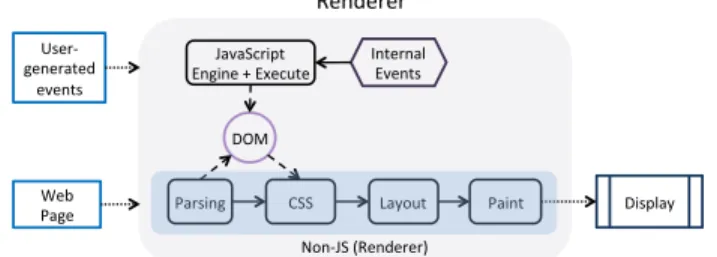
Figure 1: Software components of a renderer process in a browser.
recovery is initiated to start the prefetch from the correct functional call context.
We study a representative website from each class of web
applications: e-commerce (amazon), interactive maps
(google maps), search (bing), social networking (facebook),
news (cnn), utilities (google docs), and data-intensive
ap-plications (pixlr). We show that WebCore’s prefetcher
(EFetch) outperforms commercially implemented next-2-line
prefetcher by 17%. It also outperforms a recently proposed prefetcher, PIF [10], while consuming 5.2 times less area.
2.
BACKGROUND AND MOTIVATION
In this section, we briefly describe a web browser system and the event-driven programming model used to write Web 2.0 applications.
2.1
Web Browser Software Architecture
A web browser consists of several processes. For each user session (“tab”), the browser spawns off a renderer process, which performs the critical tasks of a browser. A main pro-cess in the web browser receives events from the external system and delivers them to the appropriate renderer pro-cess.
The software components of a renderer process are shown in Figure 1. They are responsible for tasks such as parsing
HTMLcontent, layout, and paint. When it encounters events
that need to be processed by executing a JavaScript (JS) program, it invokes the JavaScript engine. The JavaScript engine starts executing the source code in the interpreted mode first, and then dynamically compiles hot functions into native code.
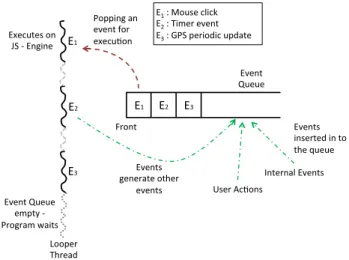
Web applications are written in JavaScript using an event-driven programming model. Figure 3 shows an example exe-cution of a web application. A looper thread in the renderer process constantly polls an event-queue. It dequeues one event at a time and invokes the necessary JavaScript handler function to process the event. The events may be generated internally or in response to an external input. A critical rule that web developers adhere to is that durations of events are short. This is necessary to ensure that a web applica-tion is responsive to the user. If an event has to wait for any long-latency operation (e.g., downloading a web page), instead of stalling, the event handler would register an event callback to be invoked when the long-latency operation has completed, and then return.
2.2
Motivation for WebCore
Characteristics of event-driven programs are significantly different from the conventional programs. We studied sev-eral microarchitectural characteristics of web applications
Renderer P L Paint CSS JavaScript Events Current Systems Our Proposal Interconnec;on Network Interconnec;on Network JS Core 0 Core 1 Core 0 Core 1 Renderer P L Paint CSS
P : Parse L : Layout JS: JavaScript
(a) 0 5 10 15 20 25 30 35 Same C ore Separ ate Co re L1 -‐I m pki (b) Figure 2: (a) Isolating JavaScript Events, (b) L1-I mpki when executing JS events along with the entire Renderer (Same Core) or Isolated (Separate Core) and discovered that instruction cache misses and branch mis-predictions are significantly higher than most conventional programs studied in the past.
Web applications suffer from an instruction fetch bot-tleneck due to the event-driven nature of these programs. These applications execute a wide range of functions in re-sponse to different events initiated by the user and the ternal system. Furthermore, each function in JavaScript ex-ecutes for only a few hundreds of instructions to ensure re-sponsiveness. As a result, event-driven JavaScript programs exhibit little temporal locality. They also tend to expose relatively less spatial locality due to rich control flow within the body of a function, which is written to handle a variety of control states within the web application. Finally, the in-struction footprint of web applications on average is about
200 KB but could be as high as 2 MB (e.g.,google maps).
As the processor industry moves towards heterogeneous multi-core processors, we envision that one or more cores could be customized to exploit the characteristics of web applications. In such a scenario, the JS component of the web browser would execute on a dedicated processor core (“Web Core”) different from the one used for executing the other parts of the renderer process as shown in Figure 2(a). Figure 2(b) shows the L1 instruction cache (I-cache) mpki when we execute the JS events along with all the renderer process. On average, L1 I-cache mpki could be as high as 29. I-cache mpki reduces to about 24 when we execute the native code produced by the JS engine on a separate core. Though, by executing the JS events on a separate core, L1 data cache suffers from coherence misses. However, the im-pact of this is very small, mitigated, in part, by the addi-tional L1 cache capacity on the separate core. There is a loss of 2.1% in performance compared to running the JS events with the renderer process. In our study, we seek to optimize the I-cache performance of a “Web Core” that is dedicated to execute the instructions corresponding to the JS events.
Figure 4 shows the I-cache mpki for the several web ap-plications we studied. For reference, it also shows the
av-Looper Thread Event Queue User Ac5ons Internal Events E1 E2 E3 Front E1 : Mouse click E2 : Timer event E3 : GPS periodic update Popping an event for execu5on Events inserted in to the queue Events generate other events Executes on JS -‐ Engine E1 E2 E3 Event Queue empty -‐ Program waits
Figure 3: Event-Driven Programming Model
0 5 10 15 20 25 30 amazo n bing cnn faceb ook gmap s gdocs pixlr PARS EC SPEC int 20 06 L1 -‐I m pki
Figure 4: Comparison of L1-I cache mpki erage mpki we observed for conventional PARSEC [6] and SPECint 2006 [2] workloads. I-cache mpki for web
applica-tions could be as high as 26 (bing), where for SPECint 2006
it is about 2.
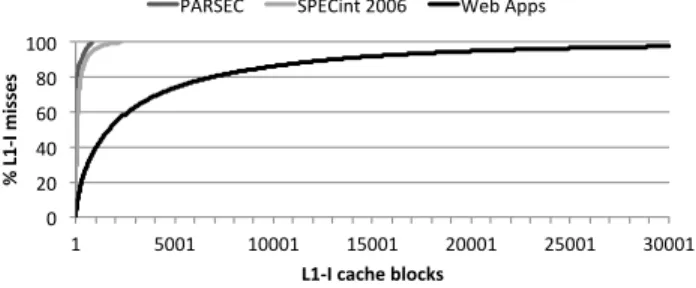
Figure 5 shows the cumulative I-cache L1 miss rates ob-served due to different cache blocks accessed. As the figure shows, we need over 10,000 cache blocks to cover 80% of misses for web applications. However, a few hundred cache blocks can cover almost all the I-cache misses for the conven-tional PARSEC programs, or a couple thousand for SPECint 2006 programs. These results indicate the need for an in-struction prefetcher that is customized to exploit the char-acteristics of the event-driven JavaScript web applications.
3.
DESIGN
In this section we first discuss the key insights, an overview,
and the architecture design ofEFetch, an instruction cache
prefetcher for event-driven Web applications.
3.1
Observations and Insights
Our design for prefetching the instruction stream ahead of its use, banks on our observation that the event signature is highly correlated with the stream of instructions executed in event-driven applications. In other words, event signature is a good predictor of the control flow inside a function, which in turn allows us to predict a function’s callees and their function bodies. In fact, we can accurately predict the order
0 20 40 60 80 100 1 5001 10001 15001 20001 25001 30001 % L1 -‐I m is se s
L1-‐I cache blocks
PARSEC SPECint 2006 Web Apps
Figure 5: Cumulative Distribution of L1-I cache
misses across cache blocks
in which the callees of a function are invoked. By keeping track of the cache block addresses accessed with the event signature those cache blocks can be prefetched when the same event signature is seen again.
But, a prefetcher is good only if it can prefetch the cache blocks ahead of their use. For this reason, in our design we also keep track of the functions called (callees) corre-sponding to an event signature. This way, we can prefetch the next function to be called, going down the program call graph (Figure 7) in a depth-first manner, staying ahead of the program execution.
However, we should not keep prefetching deep down the call graph without the program advancing, because of the following reasons:
• The accuracy of predicting the next function to be
ex-ecuted reduces as we go further ahead of the program
execution. This could lead to erroneous prefetches,
polluting the cache.
• It is likely that by the time the function whose cache
blocks were prefetched very early, gets called, those cache blocks might have gotten evicted. This not only results in poorer coverage, but also wastes energy.
3.2
Prefetching Policy
In EFetch, we use the event signature as a key, formed
by a simple XOR of the event-ID withcontext depth most
recent function call addresses (context depth = 3 in our
fi-nal design). Our design depends on the predictability of the functions called and the function bodies executed under this key. So, we keep track of the functions invoked (callees) un-der different keys. Additionally, the function body addresses accessed within the callees are also recorded with these keys. During program execution, on a function call, an event signature is formed from the event-ID and the call context. If this event signature has been seen before, the first callee recorded earlier is predicted to be the next function called and its predicted function body is prefetched. For example,
in Figure 7, whenf1 gets called,g1 is prefetched (step 0 in
Figure 8). Since it is important for the prefetcher to stay ahead of program execution, the next predicted function is prefetched. In trying to hide memory latency, the prefetcher can, potentially, go further down the call graph and prefetch more functions ahead of time. However, we lose accuracy in predicting the next function the deeper we go down a
call graph. Also, in our workloads, due to high hit rate
of instructions in the L2 cache, we only need to hide the L1-I cache miss latency. Thus, we prefetch only the next predicted function (except in the case of leaf functions).
When the program catches up (step 1), the prefetcher goes
down the callgraph, prefetching the next function (h1). On
returning from a callee, the next callee is prefetched.
f1 g1 h1 h2 h1 h3 i1 i2 g2 h4 f1 Function
Call from parent to callee
Figure 7: A pre-order traversal of this call graph shows the order in which the functions are called.
Call Stack Func,ons Prefetched f1 g1 f1 g1 h1 , h2 f1 g1h1 -‐ f1 g1 -‐ f1 g1h2 i1 , i2 … h2 returns 1 2 4 5 6 7 8 9 3 0 10
Call Stack Func,ons Prefetched f1 g1 h3 f1 g1h1 -‐ f1 g1 -‐ f1 g1h3 -‐ f1 g1 -‐ f1 g2 …
Figure 8: Functions prefetched on different points of program execution
If the prefetched callee is a leaf function, we can predict the next callee (its sibling) with high accuracy. So, in case
of a leaf function, we prefetch its next sibling (h2in step 1).
If the sibling is also a leaf function, that gets prefetched too and so on. The prefetcher stops if the sibling is a non-leaf function, even if there are more siblings in the callee list which are leaf functions. This is because, it is unclear how deep the call graph might go when executing the non-leaf function, and prefetching upcoming leaf siblings might be too early.
If a callee gets mispredicted (on a non-leaf function call, the function called does not match the last prefetched func-tion), the prefetcher stops and synchronizes itself with the actual function call stack. Thereafter, prefetches continue just like before.
3.3
Predicting Callees and Prefetching Future
Accesses
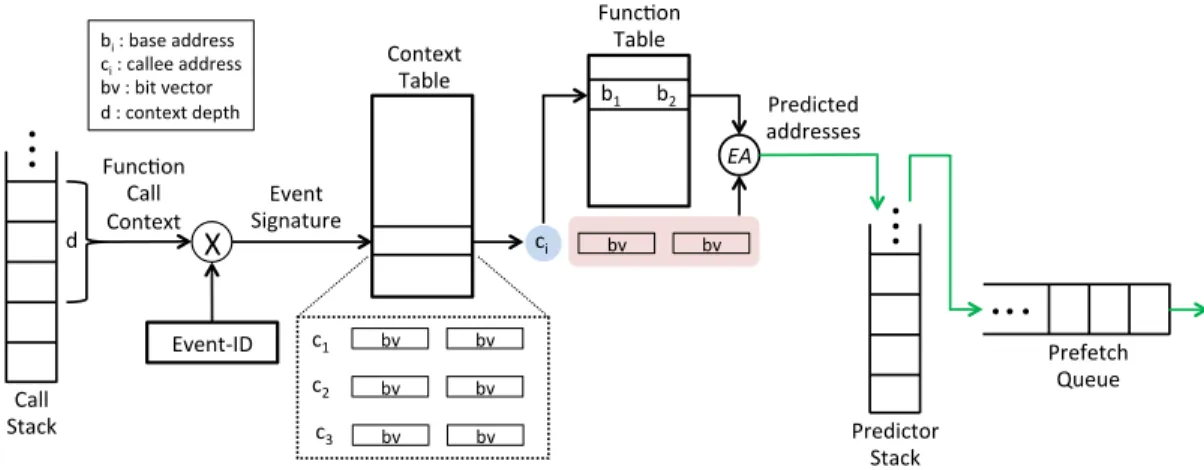
EFetchdesign architecture has been illustrated in Figure 6.
The event-ID is stored in the event-ID register. It is formed by the browser using the type of event and the JavaScript
function address. EA is a unit that forms addresses from
their compact stored representation consisting of a base ad-dress and a bit vector.
The current function call stack of the program is
main-tained in the Call Stack, each entry of which is a function
call address. On a function call, the function call address is
pushed onto theCall Stackand the event signature is
com-puted. The event signature and the function call address is
then used to index in to theCallee Predictor to obtain the
list of callees and their function bodies to be prefetched. TheCallee Predictorrecords the function bodies and callees corresponding to different event signatures. To save space, this information is maintained in two tables (Figure 6), one
EA Call Stack Predicted addresses Func2on Call Context Predictor Stack Prefetch Queue
Event-‐ID
X
Event Signature ci Context Table c1 c2 c3 bv bv bv bv bv bv bv bv Func2on Table b1 b2 bi : base address ci : callee address bv : bit vector d : context depth dFigure 6: Prefetcher Design Overview.
indexed by the context key - Context Table, the other
in-dexed by the function call address -Function Table. The
list of callees is stored in theContext Table, and their
func-tion bodies to be prefetched is obtained from theFunction
Table(Section 3.4).
If an entry is found in the Callee Predictor, the list of
callees is read out, and pushed on to the Predictor Stack
such that the first predicted callee is on the top of the stack. The Predictor Stack is used to maintain the state of the
prefetcher and synchronize it with the Call Stack. Each
entry of this structure stores a function address and four status bits (Section 3.4).
The function body addresses of the function at the top of thePredictor Stack (if it has not been prefetched yet) are
pushed in to thePrefetch Queue. Addresses present in this
queue are then prefetched.
If the prediction of callees was correct, it is guaranteed
that the top of thePredictor Stackmatches the next function
the program invokes. Thus, when the program invokes the
next function, the function at the top of thePredictor Stack
is validated, and prefetching under the new event signature is initiated. When the program returns from a function, the
entry at the top of thePredictor Stack is popped.
If the prefetcher mispredicts the next function to be ex-ecuted, detected by a mismatch in the function called and
function present at the top of the IPStack, prefetching is
halted. ThePredictor Stack is cleared from the top till the
parent of the current function. This is because, except till the parent of the current function, the prefetcher does not know how the call graph looks. This way, on a
mispredic-tion, the prefetcher aligns itself with the realCall Stack.
3.4
Design of Hardware Structures
Event-ID register : This register stores the event-ID
uniquely identifying an event. This ID is formed by the
browser using these two pieces of information - the type of
event (mouse click, mouse scroll, timed event, etc.) and
the JavaScript function called to handle the event. Using a special instruction (added in our design) this event-ID is stored in the event-ID register.
Call stack : This structure maintains the current
func-tion call stack of the program. Each entry in this stack is a function call address. On every function call, the call ad-dress of the function is pushed on to this stack. Conversely, on every return, the entry at the top of the stack is popped
out. It has 32 entries. If the structure overflows, the oldest entries are discarded.
Prefetch Queue: Prefetch requests are made from this
structure. It maintains a queue of L1-I cache block addresses to be prefetched. We observe that the L1-I cache blocks ac-cessed in a function are contiguous with a few discontinu-ities. Therefore, we record pairs of a base address with an associated bit vector representing the nearby blocks, similar to the scheme used in [10].
Callee Predictor: This structure is used to record the
function bodies and callees with respect to event signatures. This is a combination of two tables (Figure 6), one indexed
by the event signature - Context Table, the other indexed
by the function address -Function Table. Each entry in the
Function Table is a list of two base addresses (offsets from the function address at cache line granularity), pointing at
different points in the function body. Each entry in the
Con-text Tableis an ordered list of three unique callees (ordered by their first call) and two bit vectors for each callee. These are callees of the function at the top of the call stack for this event signature (Figure 6). The callees and the bit vectors
are read from theContext Table. The callee address is used
to index in to theFunction Table. The base addresses read
out from theFunction Table combined with the bit vectors
form the function body addresses to be prefetched. Both tables have 4k entries each.
Predictor Stack: It maintains the state of the prefetcher
and is used to synchronize it with the Call Stack. This is a 32-entry stack, each entry of which stores a function call address and four status bits. Following is a description of what each bit implies if it is set :
• Prefetch bit : Instruction cache blocks of this function
have been pushed on to the prefetch queue.
• Leaf bit : This is a leaf function.
• Parent Executing bit : This is a function whose prefetch
requests have been pushed on to the Prefetch Queue; it has completed execution, but its parent has not.
• Mispredict bit : There has been a misprediction and
this is the last correctly predicted function.
3.5
Prefetching Algorithm and Example
In our design we predict the instructions to be fetched by
predicting the next function to be called. Here, the top of
the stackmeans the first entry in thePredictor Stack that
On a function call (Figure 9(a)), given the current function call context and the event-ID, the event signature is formed.
If the top of thePredictor Stackmatches the function called,
it implies the prediction was correct. The event signature is used to index in to the Callee Predictor. If there is no entry, nothing is done. If there is an entry, the prefetcher reads the list of callees and pushes them in reverse order in to the Predictor Stack. This is so that the callees can be popped off the stack in the order in which they are predicted to be called.
If there is a mismatch, we try to match the function called
with any entry in thePredictor Stackgoing up from the top.
If it matches any entry, it means this function has been called again in the same invocation of its parent, and that we have prefetched it before. So nothing more is to be done.
If the current function does not match any entry, it means the prefetcher mispredicted the current function call. In this
case, prefetching is halted and thePredictor Stackis cleared
until the parent of the current function. This is because, except till the parent of the current function, the prefetcher does not know how the call graph looks. Prefetching restarts once either the parent returns, or if by using the current function as part of the event signature, the prefetcher can make predictions.
On all occasions, if the top of the Predictor Stack has
not been prefetched, prefetch requests for its function body addresses are made. Its Prefetch bit is then set marking that it has been prefetched. The prefetcher now waits for the program to catch up. We do not want to prefetch too far ahead of the program execution, unless it is a leaf function, in which case its sibling is prefetched as well.
Similarly, on a function return (Figure 9(b)), if the top
of the Predictor Stack matches the function returned, its
Parent Executing bit is set and its callees, if any, are popped. If there is a mismatch however, we try to match the function
returned with any entry in the Predictor Stack going up
from the top. If we find a match, it means the function has completed a previous call, and nothing more is to be done.
If the Mispredict bit of the top of the Predictor Stack is
set, it implies that a callee was mispredicted and the
Predic-tor Stack had already been cleared up till this entry before.
Otherwise, if the top of the Predictor Stack has not been
prefetched, follow the last step of the algorithm as in the case of a function call.
In our design, a prefetch request is made only if the cache block is not present in the L1-I cache.
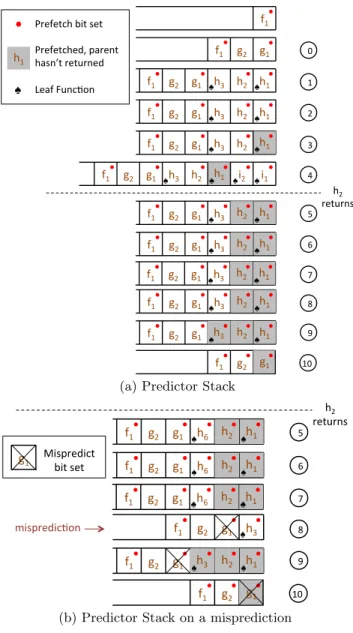
Figure 8 shows which function is prefetched relative to program execution. Following the algorithms described in Figures 9(a) and 9(b), Figure 10(a) shows a step-by-step walk-through of the states of the Predictor Stack as an ex-ample program executes. At the start of the call graph
(Fig-ure 7), the Predictor Stack hasf1at the top of the stack and
it has already been prefetched (Prefetch bit set).
In Step 1, when g1 is called, it matches the top of the
stack, implying the prediction was correct. Its callees are
pushed on to the stack. h1 is prefetched. Since it’s a leaf
function, the next callee,h2is also prefetched. This is not a
leaf function, so prefetching stops, waiting for the program
to catch up. Similarly, whenh2 is called in step 4, both of
its callees being leaves are prefetched, without waiting for
the call to the first calleei1.
Whenh1is called again in step 6, it does not match the top
of the stack. However, it does match an earlier entry since it
// On a func)on (f) call 1. if top (Predictor Stack) == f
a. Callees of f, if any, are pushed on to the Predictor Stack in reverse order
2. else if f matches any entry in the Predictor Stack going
up from top (Predictor Stack)
// f was called and prefetched before. // Nothing more to be done
3. else
// the func)on call was mispredicted
a. The Predictor Stack is cleared un)l the parent of f
b. The Mispredict bit of top (Predictor Stack) is set
c. f is pushed onto the Predictor Stack
d. The Prefetch bit of f is set
4. if fx (= top (Predictor Stack)) has not been prefetched
(its Prefetch bit is not set) a. Prefetch fx
b. Set its Prefetch bit
c. if fx is a leaf func)on (its Leaf bit is set)
i. fx = sibling of fx not been prefetched, go to step 4a
(a) Algorithm followed on a function call
// On a func)on (f) return
1. if top (Predictor Stack) == f
a. Its Parent Execu2ng bit is set
// f has returned but its parent has not. Its parent is the
// new top (Predictor Stack)
b. Its callees, if any, are popped from the Predictor Stack
2. else if f matches any entry in the Predictor Stack going
up from top (Predictor Stack)
// f has completed a previous call
// Nothing more to be done
3. if Mispredict bit of top (Predictor Stack) is set // a callee was mispredicted
// Nothing more is done
4. if fx (= top (Predictor Stack)) has not been prefetched
(its Prefetch bit is not set)
a. Prefetch fx
b. Set its Prefetch bit
c. if fx is a leaf func)on (its Leaf bit is set)
i. fx = sibling of fx not been prefetched, go to step 4a
(b) Algorithm followed on a function return Figure 9: Prefetching Design Algorithms
was its second call by its parent -g1. This is, therefore, not
a misprediction. This function has already been prefetched. The above is a case where the prefetcher always predicted correctly. Figure 10(b) shows a case where everything
pro-ceeds as before untilh3 is called, at which point a
mispre-diction is detected, since the next predicted callee ish6.
Whenh3 is called in step 8 the top of the stack does not
match the function called or any entries with their Parent Executing bit set. A misprediction is detected - the
Predic-tor Stack is cleared untilg1; it’s Mispredict bit is set, and
the newly called function (h3) is pushed on to the
Predic-tor Stack, with it’s Prefetch bit set. This way thePredictor
Stack is synchronized with theCall Stack.
Whenh3 returns, the top of the stack (g1) has a
Mispre-dict bit set, so nothing more is done.
4.
METHODOLOGY
In this work we have attempted to evaluate the
1 2 4 5 6 7 8 9 3 0 f1 f1 g2 g1 h1 h3 h2 f1 g2 g1 h1 h3 h2 f1 g2 g1 h1 h3 h2 f1 g2 g1 h1 h3 h2 f1 g2 g1 i2 i1 h1 h3 h2 f1 g2 g1 h1 h3 h2 f1 g2 g1 h1 h3 h2 f1 g2 g1 h1 h3 h2 f1 g2 g1 f1 g2 g1 h2 returns h1 h3 h2 f1 g2 g1 10 h1
Prefetch bit set Prefetched, parent hasn’t returned Leaf Func@on
(a) Predictor Stack
5 6 7 8 9 h1 h6 h2 f1 g2 g1 h1 h6 h2 f1 g2 g1 h3 f1 g2 g1 h1 h3 h2 f1 g2 g1 f1 g2 g1 h2 returns h1 h6 h2 f1 g2 g1 10 mispredic9on g1 Mispredict bit set
(b) Predictor Stack on a misprediction Figure 10: Prefetching example
nature of JavaScript execution is not captured by existing JavaScript benchmark suites like Octane [1] and Sunspider [3]. Real-world JavaScript web workloads, as executed in the rendering of popular web pages, bear little resemblance to the benchmark suites, as shown in [19]. An important difference is the lack of event-driven execution in existing benchmark suites. For the above reasons, for this work, we have created workloads from real web sites, studied their characteristics and evaluated our design using them.
4.1
Web Applications
Figure 11 lists the 7 real web applications that we have used in this study. These websites were chosen since they are both important and popularly visited, and they cut across a diverse range of tasks users typically perform on the web browser. Our applications cover e-commerce (ama-zon.com), search (bing.com), news (cnn.com), social net-working (facebook.com), mapping (maps.google.com), on-line document editing (docs.google.com) and onon-line image editing (pixlr.com).
Web Site Ac*ons performed #events
executed # JS-‐Execute instruc*ons amazon
(amazon. com)
Search for a pair of headphones, click on one result, go to a related item
7,787 432,875,253
bing
(bing.com) Search for the term “Roger Federer”, go to new results 4,858 258,961,747 cnn
(cnn.com) Click on the headline, go to world news 13,409 1,230,395,548 K
(facebook. com)
Visit own homepage, go to
communiMes, go to pictures 9,305 2,165,554,555 gmaps
(maps.google. com)
Search for driving direcMons between two addresses, get public transit direcMons, get biking direcMons
7,298 2,722,470,912
gdocs (docs.google.
com)
Open a spreadsheet, insert
data, add 5 values 1,714 808,941,337 pixlr
(pixlr.com/ editor)
Add various filters to an image uploaded from the computer
465 26,424,174
Figure 11: Web Sites visited and actions taken, and a measure of the size of the benchmarks
Core 4-‐wide, 1.66 GHz OoO, 96-‐entry ROB, 16-‐entry LSQ L1-‐(I,D)-‐Cache 32 KB, 2-‐way, 64 B lines, 2 cycle hit latency, LRU
L2 Cache 2 MB, 16-‐way, 64 B lines, 21 cycle hit latency, LRU Main Memory 4 GB DRAM, 101 cycle access latency, 12.8 GB/s bandwidth Branch Predictor PenQum M branch predictor
15 cycle mis-‐predict penalty 2k-‐entry Global Predictor, 256-‐entry iBTB 2k-‐entry BTB, 256-‐entry Loop Branch Predictor
Interconnect Bus
Energy modeling Vdd = 1.2 V, 45 nm
Figure 12: Details of the architecture simulated The actions taken on visiting each site (a browsing ses-sion), are meant to represent a typical behavior of a user on a short, but complete visit to the site. We kept the browsing sessions short, partly because it becomes logistically difficult to capture and study long-term uses of web applications, but also because some of these websites would typically be used in this manner. For example, searching for specific informa-tion or reading news headlines.
4.2
Workload Setup
We instrumented the open source web browser Chromium, running on Ubuntu 12.04. It uses the V8 JavaScript engine,
also used in Google Chrome. Our instrumentation setup
works as follows:
• We first, instrumented the C++ code used to
imple-ment the V8 JavaScript engine in Chromium. This helped us separate out the JavaScript part from the rest of the browser in the execution stream.
• Next we visit a website and perform the actions
de-scribed in Figure 11. In order to create a workload that is repeatable, we captured the instruction trace
of the browser1, using the trace-recording component
1
of SniperSim [7]. This generates binary trace files con-taining information about the instructions executed, the direction of branches and the memory addresses accessed.
• Finally, we fed these instruction traces, into the
Sniper-Sim simulator, and evaluated our design.
The architecture simulated is based on a mobile system -Exynos 5250. The architectural configuration is detailed in Figure 12.
In our experiments we have simulated the code executed by the web browser for JavaScript execution. This also in-cludes native code executed as part of library calls.
5.
RESULTS
In this section we first validate the premises our design is based on, going on to evaluate it, comparing it with previ-ously proposed instruction prefetcher designs.
5.1
Prefetch Accuracy and Coverage
The basic premises that our design is based on are that event signatures are highly correlated with the control flow inside functions and that they are repetitive.
The first premise implies that both the body of the func-tion and its callees are also highly correlated with the event signature. The second premise ensures that event signatures can be used to predict the callees and the function bodies. We, therefore, keep track of the list of callees of a function and their function bodies associated with the event signa-ture.
We use the following two metrics to validate the design choices made in our prefetching scheme.
• Prefetchaccuracyis defined as the percentage of
prefetch hits (blocks that were prefetched and later were a hit in the cache) over all prefetch requests is-sued.
• Coverage is the percentage of misses that became
prefetch hits as a results of prefetching - (#prefetch hits)*100/(#prefetch hits + #misses).
Each data point in all plots discussed in this section shows an average over all benchmarks.
5.1.1
Callee Set Prediction Accuracy
Any advantage to be gained from our design banks on the predictability of the list of callees using the event signature, since having made this prediction correctly, the prefetcher can prefetch the bodies of the functions predicted.
The list of callees is ordered by the first call to that callee. Maintaining an ordered list is important, since we are trying to predict the very next function to be called, staying one function ahead of program execution.
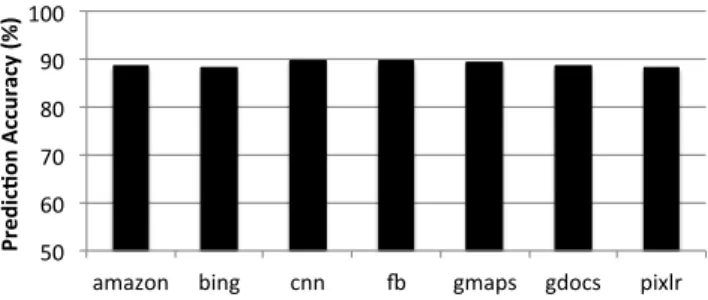
In Figure 14, we evaluate the predictability of the most recently seen callee set for that event signature. Here, a pre-diction is called accurate, if both the callees and their order is predicted correctly. As is evident from the figure, predict-ing that the last seen callee set for that event signature is going to be the next callee set is highly accurate.
5.1.2
Predicting Function Body
Having predicted the next function (callee) to be executed, it is important for the prefetcher to be able to predict the correct part of the function body to prefetch. Due to varying
90 92 94 96 98 100 50 60 70 80 90 100 1 2 3 4 8 16 Ac cu ra cy (%) Co ve ra ge (%) Coverage Accuracy
(a) Function Call Context Depth
25 50 75 100 50 60 70 80 90 100 1 2 3 All Ac cu ra cy (%) Co ve ra ge (%) Coverage Accuracy (b) Function History 60 70 80 90 100 50 60 70 80 90 100 0 1 2 3 Ac cu ra cy (%) Co ve ra ge (%) Coverage Accuracy (c) Prefetch Depth
Figure 13: Variation inCoverageandAccuracy with
varying Function Call Context Depth, Function
His-tory and Prefetch Depth. The diamond marks the
final design choice
control flow within a function, different parts of the function body may get executed on different calls.
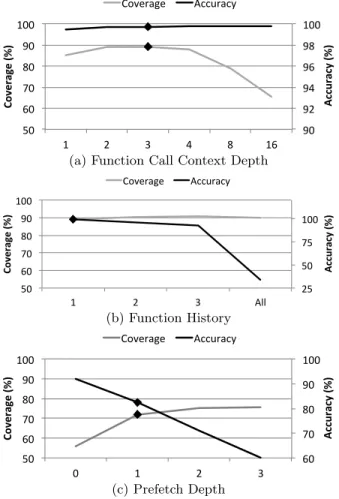
Given that, event signature is a good predictor for callees, it is expected that it will be a good predictor for function bodies. However, this prediction is not perfect, consequently different parts of the function body might execute with the same event signature. This opens up another dimension to this problem - how much of the executed function body his-tory to keep track of with the event signature. In Figure 13(b), we explore precisely this point. Here, a function
his-tory ofn, means that we keep track of and prefetch the
func-tion body addresses executed the lastntimes this function
was called with the same event signature. This figure shows a study of an ideal case, where a predicted I-cache block is brought in to the cache only when it is needed. There is no notion of timeliness - a block is considered prefetched as soon as it is predicted. This figure shows that the function body seen the last time is a good predictor of the function body going to be executed next. Using more history, does not significantly help cover more misses (coverage does not im-prove), but loses accuracy since it is prefetching more cache blocks that are not accessed.
5.1.3
Function Call Context Depth
Using function call context (and event-ID) to predict the callees of a function and their function bodies being the
cor-50 60 70 80 90 100
amazon bing cnn 2 gmaps gdocs pixlr
Pr ed ic 'o n Ac cu ra cy (%)
Figure 14: Callee Set Prediction Accuracy nerstone of our design, how much of the call stack (number of functions) to use to form the event signature is a vital ques-tion. It is logical to believe that using more functions to form the event signature will result in better accuracy in predict-ing callees and function bodies, since we have more precise context information. However, there can be two problems with using a deeper context history
• It might take long for the prefetcher to learn the
differ-ent contexts. Whenever we do not have the context in our table, we can not prefetch anything, thereby losing coverage.
• Using a deeper context history, results in the prefetcher
using potentially stale information for a shallower con-text.
In our studies we found out that the first potential prob-lem does not have a significant effect on our scheme. The prefetcher sees and is thus able to learn the frequently used long contexts fairly early. The second potential problem, does have significant effects. A shallower context can
ap-pear in multiple deeper contexts. Therefore, if we use a
deep context, we are likely to see older history (stale in-formation) for the shallower context. As we have seen from the discussion in Section 5.1.2, using recent history results in better predictions. Using too deep a context is also counter-intuitive, since in that case we would be trying to correlate functions that may not necessarily have any bearing on the control flow of a child function. For e.g. library function calls like printf(). Its usage is common across a wide range of user functions, and it is internal call stack might have little correlation to the main() function.
Figure 13(a) validates the above hypotheses. Coverage re-duces with increasing context depth without any noticeable change in accuracy.
5.1.4
Predicting Ahead of Program Execution
As discussed earlier, it is important for the prefetcher to stay ahead of program execution.
However, there are two issues with trying to prefetch too early - first, the cache block might get evicted by the time the program needs it; second, prediction accuracy of the prefetcher drops the further it goes ahead of the program, thereby issuing erroneous prefetches, causing pollution in the cache. Figure 13(c) confirms precisely the above arguments. In our workloads, the L2 miss rate for instructions is 2.8%, thus for most L1-I misses we only need to prefetch early enough to hide L2 access latency. A prefetch depth of 1 is thus sufficient.
5.1.5
Final Design Choice
In our final design we use a context depth of 3 and a prefetch depth of 1. We only keep track of the last seen
0 5 10 15 20 25 30 35 40
amazon bing cnn 1 gmaps gdocs pixlr gmean
% pe rf or m an ce im pr ov em en t
L1I-‐64KB N2L CGP PIF RDIP EFetch
Figure 16: Performance achieved compared to No Prefetching (NP) as the baseline
callee set and function body. A diamond marks our final design parameters in the earlier plots.
5.2
Performance
In this section we will compare and contrast our design with other relevant designs.
• NPis a design with no instruction prefetcher. This is
our baseline.
• N2Lprefetches the next 2 cache lines.
• CGPis our implementation of Call Graph Prefetching
[5].
• PIFis our implementation of the Proactive Instruction
Fetch [10].
• RDIP is our implementation of Return-Address-Stack
directed instruction prefetching [13].
• EFetchis our design.
In Figure 15, we show the number of prefetch hits, misses and erroneous prefetches as a percentage of the sum of
prefetch hits and load misses. EFetchissues far fewer
erro-neous prefetches than PIF. Erroerro-neous prefetches are those prefetches that never get hit before they are evicted. They hurt performance by polluting the cache kicking out poten-tially useful blocks, wasting L1-L2 bandwidth and
conse-quently wasting energy. Unlike EFetch, PIF, which
main-tains a temporal stream of cache block accesses, has no way of knowing when the event signature has changed, and thus, keeps prefetching off the end of the temporal stream. This scheme ensures high coverage, but also suffers from low
ac-curacy. EFetch also issues some erroneous prefetches since
it assumes the last seen callee set and their function bodies will be the same as this time for a particular event signature, which is not always true. However, it recovers quickly - on the very next function call or return. N2L does not perform well. This is to be expected due to the small function sizes, large number of function calls and complex control flow in-side functions.
EFetch performs better than RDIP, by achieving better
coverage, even though it loses out slightly in accuracy. RDIP achieves better accuracy since its signatures are able to point
at discrete call sites within functions. However, for web
workloads, this leads to a very large number of signatures that need to be kept track of, overflowing their table size, causing loss in coverage. Also, RDIP only keeps track of L1-I
0 50 100 150 200 250 N2L CGP PIF RD IP EF etc h N2L CGP PIF RD IP EF etc h N2L CGP PIF RD IP EF etc h N2L CGP PIF RD IP EF etc h N2L CGP PIF RD IP EF etc h N2L CGP PIF RD IP EF etc h N2L CGP PIF RD IP EF etc h
amazon bing cnn < gmaps gdocs pixlr
%( L1 -‐I m is se s + L1 -‐I pr ef et ch h its )
Prefetch Hits Misses Erroneous Prefetches
Figure 15: Each bar is divided in to three segments: Prefetch Hitsare misses removed by prefetching. Misses
are the remaining L1-I cache misses. Erroneous Prefetches are prefetches made which were never used (until
their eviction from L1-I cache).
0 0.2 0.4 0.6 0.8 1 1.2
amazon bing cnn 2 gmaps gdocs pixlr AMean
Re la %v e En er gy
N2L CGP PIF RDIP EFetch
Figure 17: Energy expended compared to No
Prefetching (NP) as the baseline
cache misses. The exact misses can change between dynamic instances of signatures, due to cache capacity and conflict
misses. EFetch keeps track of all L1-I cache accesses. For
web workloads, it is still able to keep hardware costs down due to small function sizes and better compaction of cache addresses.
Figure 16 shows the performance improvement of the
dif-ferent designs. EFetch performs as well or better than the
other designs on all benchmarks. L1I-64KB has an L1 in-struction cache of 64KB, roughly equal to the sum of the L1-I cache size in our baseline (NP) and the hardware
stor-age overhead of EFetch. On average, EFetch outperforms
L1I-64KB by 15%, N2L by 17%, CGP by 8.9%, PIF by 3.9% and RDIP by 11.5%.
5.3
Storage Overheads
We use 4K entry tables - context table, function table. Each entry in the context table stores 3 callee addresses and 2 bit vectors, along with a tag. Callee addresses are stored in the form of offsets in to the function table, using 12 bits each. The tag is 14 bits long. Therefore, a context table entry is 56 bits long.
Each entry in the function table stores 2 base addresses in the form of offsets from the function address, plus a tag. An offset needs 4 bits, tag is 14 bits in size, so each entry is 22 bits.
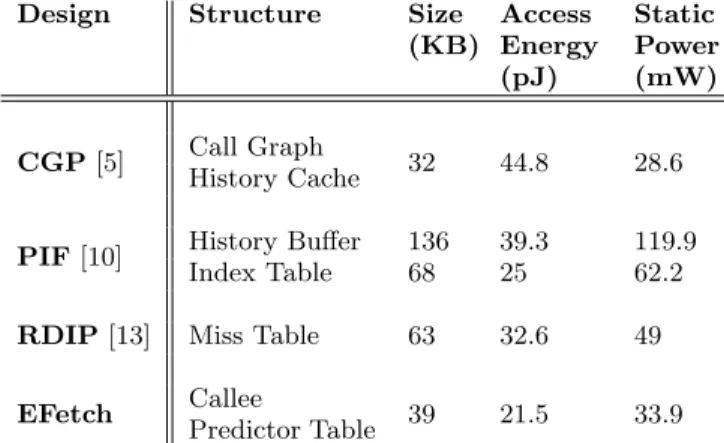
Both tables have 4k entries each, so a total storage of 4k*(56 + 22) bits = 39 kB is required. Comparing this with
Design Structure Size
(KB) Access Energy (pJ) Static Power (mW) CGP[5] Call Graph 32 44.8 28.6 History Cache
PIF[10] History Buffer 136 39.3 119.9
Index Table 68 25 62.2
RDIP[13] Miss Table 63 32.6 49
EFetch Callee 39 21.5 33.9
Predictor Table
Table 1: Energy and power estimates used for hard-ware structures
PIF, which needs 136 kB for the history buffer and 68 kB for the index table for a storage overhead of 204 kB, we get similar or better performance for 5.2 times less hardware storage cost.
5.4
Energy
We evaluated the energy expended by the different in-struction prefetcher designs using McPat 0.8 [14]. CACTI 5.3 [26] was used to determine the per-access energy and static power of the additional hardware structures as shown
in Table 1.2 Figure 17 shows thatEFetch uses less energy
than all other designs, owing to its better trade-off between prefetcher accuracy and coverage. We noticed from our eval-uation that the energy consumed by hardware structures added for instruction prefetching is very minimal, ranging
from 0.01% of the total energy consumed forEFetchto 1.06%
for PIF. Thus, to minimize energy consumed, it is not the additional hardware structures that need to be optimized, but the erroneous prefetches.
6.
RELATED WORK
Instruction fetch stalls cause a significant performance degradation, leading to a rich-body of work trying to solve
this problem. The earliest solutions to this problem
in-cluded next-line prefetching, taking advantage of sequen-2
tial instruction fetch [4]. This initial idea was expanded upon and next-N-line and instruction stream prefetchers were proposed [12, 18, 27, 22] using varying kinds of events to control the aggressiveness and lookahead of the prefetcher. Next–line prefetchers are simple and work well for sequential code. However, they have poor accuracy and are not able to prefetch ahead in time for code with frequent branches and function calls.
To be able to more effectively prefetch instructions ahead of time in branch and call heavy code, several branch pre-dictor based prefetchers [8, 20, 21, 24] have been proposed. Run-ahead execution [16], wrong-path instruction prefetch-ing [17] and usprefetch-ing an idle thread [15] or speculative threads [25, 28] can be used to generate future instruction accesses. Ferdman et. al. [10] showed that by using the instruction fetch sequence instead of the commit sequence, these ap-proaches suffer from interference caused by wrong-path exe-cution. Also these don’t have sufficient lookahead when the branch predictor traverses loops.
The discontinuity prefetcher [23] handles fetch disconti-nuities. It’s able to alleviate some of the issues with other branch-predictor based prefetchers by operating at an in-struction block granularity. But it’s lookahead is limited to one fetch discontinuity to avoid over-prediction. The branch history guided prefetcher (BHGP) [24] keeps track of branch instructions and imminent instruction cache misses, which are prefetched upon the next occurrence of the branch. How-ever, they cannot differentiate between different invocations of the same branch (which will have a bearing on the branch outcome and instruction cache misses seen) leading to lower coverage or accuracy. Our work, differs from the above in that it targets event-driven web applications, where each event can be completely independent of the others, thereby executing completely different code from one event to the
next. Also, we use event-ID and the function call stack
to predict the callees of function and their function bodies, and thus is neither affected by wrong-path execution nor is unable to differentiate between different invocations of the same function.
PIF [10] addresses the limitations of branch-predictor di-rected prefetching by recording temporal instruction com-mitted streams and fetch misses. By using the comcom-mitted stream of instructions, it remains unaffected by the pre-dictability of individual branches and wrong-path instruc-tions. To similarly be able to avoid disruptions caused by wrong-path instructions, our scheme updates the state of the prefetch structures as call and return instructions com-mit. Instead of using temporal streams of instructions, we utilize the event-ID and call graph information to predict the instruction cache blocks.
PIF needs to keep track of a large window of instructions committed to be able to predict the temporal stream accu-rately. The size of the hardware structures exceeds 200 kB, while our design needs less than 40 kB.
A recently proposed instruction prefetcher, RDIP [13], ex-ploits the information stored in the return address stack (RAS) and uses the return addresses of functions called, to predict and thereby prefetch the next segment of
func-tion executed. This scheme was evaluated on traditional
server workloads. RDIP relies on function call context
be-ing a good predictor of the next function called. Unlike
RDIP, EFetch targets event-driven web applications. To
do so, it utilizes the event-ID along with the function call
context (event signature) to predict the next function exe-cuted. In addition to differences discussed in Section 5.2,
EFetch prefetches only the part of the function body
exe-cuted the last time with the same event signature, avoiding erroneous prefetches. RDIP, on the other hand, accumulates L1-I cache misses incurred over all previous instances when the signature was seen.
Annavaram, Patel and Davidson used the current function to guide instruction prefetching for database applications in
[5]. EFetch, on the other hand is designed for event-driven
web applications. By making use of the event-ID and
mul-tiple functions in the call context,EFetchis able to
differen-tiate between invocations to the same function, and there is merit in this scheme, since it is a good predictor of varying
control flow inside the function. Also, EFetch fetches only
that part of the function body, that it predicts will get ex-ecuted. This is of significant importance for event-driven web workloads which are composed of a large number of very small functions, with some frequently executed very large functions. Importantly, on a single invocation of these large functions, only a small part of them is executed and it is composed of discontiguous I-cache blocks. An approach like the one in [5], would hurt performance by, on the one hand, fetching I-cache blocks beyond the boundary of small functions, and on the other hand, fetching contiguous cache blocks of the few very large functions, even though many of these I-cache blocks will go unused.
7.
CONCLUSION
Event-driven web applications are becoming a dominant
set of programs used in client-side computing.
Unfortu-nately, processor architecture optimizations studied in the past are not designed to take advantage of the unique char-acteristics of event-driven web applications.
In this paper we identified L1 instruction cache misses to be an important performance bottleneck in the web ap-plications. This issue is significantly more severe than it is for conventional applications. We proposed a new prefetcher that used event signatures (formed from function calling con-text and event-ID) to accurately prefetch instruction cache blocks. We demonstrated that the proposed prefetcher out-performs past designs, and also has modest storage require-ments.
8.
ACKNOWLEDGEMENTS
We would like to thank the anonymous reviewers for their valuable comments and feedback. This research was sup-ported by National Science Foundation grants CAREER-1149773 and SHF-1217917 and funding from Intel Corpora-tion.
9.
REFERENCES
[1] Octane benchmark suite.
https://developers.google.com/octane/.
[2] SPEC CPU 2006. http://www.spec.org/cpu2006/. [3] Sunspider benchmark suite.
https://www.webkit.org/perf/sunspider/sunspider.html. [4] D. Anderson, F. Sparacio, and R. M. Tomasulo. The
ibm system/360 model 91: Machine philosophy and
instruction-handling.IBM Journal of Research and
[5] M. Annavaram, J. M. Patel, and E. S. Davidson. Call
graph prefetching for database applications.ACM
Transactions on Computer Systems (TOCS),
21(4):412–444, 2003.
[6] C. Bienia, S. Kumar, J. P. Singh, and K. Li. The parsec benchmark suite: Characterization and
architectural implications. InProceedings of the 17th
International Conference on Parallel Architectures and Compilation Techniques, PACT ’08, pages 72–81, New York, NY, USA, 2008. ACM.
[7] T. E. Carlson, W. Heirman, and L. Eeckhout. Sniper: Exploring the level of abstraction for scalable and accurate parallel multi-core simulations. In International Conference for High Performance Computing, Networking, Storage and Analysis (SC), Nov. 2011.
[8] I.-C. K. Chen, C.-C. Lee, and T. N. Mudge. Instruction prefetching using branch prediction
information. InComputer Design: VLSI in Computers
and Processors, 1997. ICCD’97. Proceedings., 1997 IEEE International Conference on, pages 593–601. IEEE, 1997.
[9] H. Esmaeilzadeh, E. Blem, R. S. Amant,
K. Sankaralingam, and D. Burger. Dark silicon and
the end of multicore scaling. InComputer Architecture
(ISCA), 2011 38th Annual International Symposium
on, pages 365–376. IEEE, 2011.
[10] M. Ferdman, C. Kaynak, and B. Falsafi. Proactive
instruction fetch. InProceedings of the 44th Annual
IEEE/ACM International Symposium on
Microarchitecture, MICRO-44 ’11, pages 152–162, New York, NY, USA, 2011. ACM.
[11] M. Ferdman, T. F. Wenisch, A. Ailamaki, B. Falsafi, and A. Moshovos. Temporal instruction fetch
streaming. InMicroarchitecture, 2008. MICRO-41.
2008 41st IEEE/ACM International Symposium on,
pages 1–10. IEEE, 2008.
[12] N. P. Jouppi. Improving direct-mapped cache performance by the addition of a small fully-associative cache and prefetch buffers. In Computer Architecture, 1990. Proceedings., 17th Annual International Symposium on, pages 364–373. IEEE, 1990.
[13] A. Kolli, A. Saidi, and T. F. Wenisch. Rdip:
Return-address-stack directed instruction prefetching.
InProceedings of the 46th Annual IEEE/ACM
International Symposium on Microarchitecture, pages 260–271. ACM, 2013.
[14] S. Li, J. H. Ahn, R. D. Strong, J. B. Brockman, D. M. Tullsen, and N. P. Jouppi. Mcpat: an integrated power, area, and timing modeling framework for multicore and manycore architectures. In
Microarchitecture, 2009. MICRO-42. 42nd Annual
IEEE/ACM International Symposium on, pages
469–480. IEEE, 2009.
[15] C.-K. Luk. Tolerating memory latency through software-controlled pre-execution in simultaneous
multithreading processors. InComputer Architecture,
2001. Proceedings. 28th Annual International Symposium on, pages 40–51. IEEE, 2001.
[16] O. Mutlu, J. Stark, C. Wilkerson, and Y. N. Patt. Runahead execution: An alternative to very large instruction windows for out-of-order processors. In High-Performance Computer Architecture, 2003. HPCA-9 2003. Proceedings. The Ninth International Symposium on, pages 129–140. IEEE, 2003.
[17] J. Pierce and T. Mudge. Wrong-path instruction
prefetching. InMicroarchitecture, 1996. MICRO-29.
Proceedings of the 29th Annual IEEE/ACM International Symposium on, pages 165–175. IEEE, 1996.
[18] A. Ramirez, O. J. Santana, J. L. Larriba-Pey, and M. Valero. Fetching instruction streams. In Proceedings of the 35th annual ACM/IEEE
international symposium on Microarchitecture, pages 371–382. IEEE Computer Society Press, 2002. [19] P. Ratanaworabhan, B. Livshits, and B. G. Zorn.
Jsmeter: Comparing the behavior of javascript
benchmarks with real web applications. InProceedings
of the 2010 USENIX conference on Web application development, pages 3–3. USENIX Association, 2010. [20] G. Reinman, B. Calder, and T. Austin. Fetch directed
instruction prefetching. InMicroarchitecture, 1999.
MICRO-32. Proceedings. 32nd Annual International Symposium on, pages 16–27. IEEE, 1999.
[21] G. Reinman, B. Calder, and T. Austin. Optimizations enabled by a decoupled front-end architecture. Computers, IEEE Transactions on, 50(4):338–355, 2001.
[22] A. J. Smith. Sequential program prefetching in
memory hierarchies.Computer, 11(12):7–21, 1978.
[23] L. Spracklen, Y. Chou, and S. G. Abraham. Effective instruction prefetching in chip multiprocessors for
modern commercial applications. InHigh-Performance
Computer Architecture, 2005. HPCA-11. 11th International Symposium on, pages 225–236. IEEE, 2005.
[24] V. Srinivasan, E. S. Davidson, G. S. Tyson, M. J. Charney, and T. R. Puzak. Branch history guided
instruction prefetching. InHigh-Performance
Computer Architecture, 2001. HPCA. The Seventh International Symposium on, pages 291–300. IEEE, 2001.
[25] K. Sundaramoorthy, Z. Purser, and E. Rotenberg. Slipstream processors: improving both performance
and fault tolerance.ACM SIGPLAN Notices,
35(11):257–268, 2000.
[26] S. Thoziyoor, N. Muralimanohar, J. Ahn, and
N. Jouppi. Cacti 5.3.HP Laboratories, Palo Alto, CA,
2008.
[27] C. Zhang and S. A. McKee. Hardware-only stream prefetching and dynamic access ordering. In Proceedings of the 14th international conference on Supercomputing, pages 167–175. ACM, 2000. [28] C. Zilles and G. Sohi. Execution-based prediction
using speculative slices. InComputer Architecture,
2001. Proceedings. 28th Annual International Symposium on, pages 2–13. IEEE, 2001.