Security Analysis of the
SAML Single Sign-on Browser/Artifact Profile
Thomas Groß
IBM Zurich Research Laboratory
[email protected]
Abstract
Many influential industrial players are currently pursuing the development of new protocols for fed-erated identity management. The Security Assertion Markup Language (SAML) is an important standard-ized example of this new protocol class and will be widely used in business-to-business scenarios to reduce user-management costs. SAML utilizes a constraint-based specification that is a popular design technique of this protocol class. It does not include a gen-eral security analysis, but provides an attack-by-attack list of countermeasures as security consideration. We present a security analysis of the SAML Single Sign-on Browser/Artifact profile, which is the first one for such a protocol standard. Our analysis of the protocol design reveals several flaws in the specification that can lead to vulnerable implementations. To demonstrate their im-pact, we exploit some of these flaws to mount attacks on the protocol.
1. Introduction
One of the most important problems in the network-oriented industry currently is the reduction of user-management costs. Thus, many influential industrial players strive for the development of new protocols for federated identity management. Using these protocols, the companies are able to simplify user-management in an increasingly dynamic world and to benefit from user registrations done by other companies. The newly developed protocols will widely be used in business-to-business scenarios to allow the federation of inter-company services and to provide access control for supply-chain partners. Thus, major players in the access control market currently include these protocols in their products.
One of the most important proposals in this area is the Security Assertion Markup Language (SAML) [7, 8].
SAML is a very extensible, open standard, which makes it attractive as a basis for further development. Thus, var-ious protocols of the Liberty Alliance Project [11, 20] and the Shibboleth Project [4] build on SAML.
The salient feature of most of these protocols is that they only require a standard Web browser as a user agent. We call this protocol class browser-based or zero-footprint. This feature is motivated by the fact that most potential users do not want to install protocol-specific software. Furthermore, it is desirable that the protocols do not require active content or cookies, because many users are not willing to use them for security or privacy reasons. Given these restrictions, the protocol design-ers have to work with browser redirects and HTTP con-structs only, which implies new requirements that have not been considered by prior research.
In this paper, we analyze the SAML Single Sign-on Browser/Artifact profile, a three-party authenticatiSign-on protocol. Such a single sign-on protocol allows a user to sign-on only at his or her identity supplier, which in turn confirms the user’s identity to other parties. As the pro-tocol is part of the only open standard in this area and does not rely on active content or cookies, it is one of the most important browser-based protocols. Because nor-mal authentication protocols are known to be prone to design errors, we expect that the additional restrictions of this protocol further complicate a secure design. The involvement of a standard Web browser indeed makes it very difficult to utilize prior research proposals such as [2, 1] for robust protocol design.
In general, we consider the SAML Single Sign-on protocol well-designed and carefully described. Nev-ertheless, further analysis of the protocol is necessary. The security aspects of the protocol are formulated in a constraint-based manner and structured according to the architecture of SAML. This is a common technique in this area, but can hamper a faultless implementation, be-cause implementing software engineers may overlook a constraint or its impact on the protocol security. Further-more, this kind of description complicates a general
se-curity analysis. Thus, the protocol description does not provide such an analysis, but an attack-by-attack de-scription of countermeasures. This is a distinguishing feature to other protocols in this area, as some of them do not take such considerations at all. All told, the po-tential importance in industry and the new set of requiments make this protocol worth a closer look from a re-search perspective.
We present a general security analysis of the SAML Single Sign-on Browser/Artifact profile, which is the first one for this kind of protocol standard. We discov-ered security flaws, that allowed to several attacks on the protocol, some of them with possibly severe impact, such as man-in-the-middle attacks, attacks by informa-tion leakage, and message replay. We present these three attacks in detail and sketch further attack approaches.
The remainder of this paper is structured as follows: We present a short overview of the SAML message stan-dard and its Single Sign-on profile in Section 2. Sec-tion 3 introduces related protocols and attacks on them as well as prior research in this area. In Section 4, we describe the communication types introduced by the SAML Single Sign-on protocol. Section 5 contains our model for the login procedure and subsequent user track-ing. We describe the protocol schema of the SAML Single Sign-on Browser/Artifact profile in Section 6. In Section 7, we present three attacks on the protocol. We discuss the vulnerability of an implementation us-ing SSL or TLS channels in Section 8, and conclude our analysis in Section 9.
2. Security Assertion Markup Language
(SAML)
SAML is an open message standard that encodes se-curity assertions and corresponding protocol messages in XML format. The message standard itself is described in [7]. SAML allows so-called protocol bindings [8] that embed SAML constructs in other structures for trans-port. SAML, for instance, builds on the Simple Ob-ject Access Protocol (SOAP) with its SOAP over HTTP binding. In addition, the SAML standard includes de-scriptions of the use of SAML assertions in communica-tion protocols and frameworks [8]. These so-called pro-files contain protocol flows and security constraints for applications of SAML.
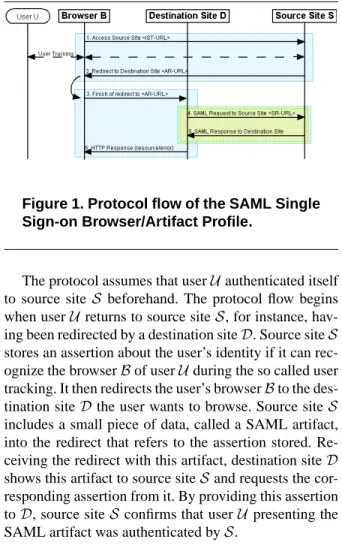
The SAML Single Sign-on Browser/Artifact Profile describes the usage of SAML messages to perform a sin-gle sign-on operation involving three parties – a userU
equipped with a standard browserB, a source siteS, and a destination siteD. We depict the protocol flow in Fig-ure 1.
Figure 1. Protocol flow of the SAML Single Sign-on Browser/Artifact Profile.
The protocol assumes that userU authenticated itself to source site S beforehand. The protocol flow begins when userU returns to source siteS, for instance, hav-ing been redirected by a destination siteD. Source siteS
stores an assertion about the user’s identity if it can rec-ognize the browserBof userU during the so called user tracking. It then redirects the user’s browserBto the des-tination siteDthe user wants to browse. Source siteS
includes a small piece of data, called a SAML artifact, into the redirect that refers to the assertion stored. Re-ceiving the redirect with this artifact, destination siteD
shows this artifact to source siteSand requests the cor-responding assertion from it. By providing this assertion toD, source siteS confirms that userU presenting the SAML artifact was authenticated byS.
3. Related Work
The first browser-based authentication protocol was, to our best knowledge, Microsoft Passport. Because the protocol is not published, we only refer to Microsoft’s whitepapers such as [15]. Recent research discovered multiple vulnerabilities of Passport and described sev-eral severe attacks [12, 21]. A new attack was found at the beginning of May 2003, but no details have been published yet.
Two other projects base their protocols on the SAML message standard. The Liberty Alliance Project makes public proposals, but is not the subject of a standard-ization process [11]. One of its protocols using an en-hanced client was vulnerable and attacked in [19]. The Shibboleth Project is a well-elaborated SAML applica-tion for inter-university federaapplica-tion [4]. In addiapplica-tion, [17] proposes a protocol called Browser-based Attribute Ex-change (BBAE) that may also be built on SAML. This protocol concentrates on attribute exchange and privacy issues.
anal-yses of browser-based protocols. Recently, [18] pro-vided an analysis of the privacy aspects of browser-based attribute-exchange protocols that covers SAML as well as Passport, Liberty and Shibboleth.
Considering prior research about general protocol de-sign, two of the best-known publications are [1] and [2]. Whereas [1] suggests various informal principles about general protocol design, [2] extends them for the us-age in public-key protocols. [10] presents more practi-cal analyses of client authentication on the Web, which is distantly related to the browser-based authentication protocols. One of the most well-analyzed authentication protocols of research is the Needham-Schroeder proto-col [16], which was analyzed and broken by [13] and [14]. These publications are useful as examples for pro-tocol design and analysis, too.
4. Communication
The SAML Single Sign-on protocol constrains the methods used to transfer messages with several security properties. It names two combinations of such proper-ties that we introduce in the following sections.
4.1. With Confidentiality and Integrity Only
The SAML Single Sign-on protocol refers to a mes-sage transfer that provides confidentiality and integrity but no authentication. Message transfers with these properties can be implemented by message security so-lutions or anonymous SSL/TLS channels [6]. This class of channels is naturally vulnerable to man-in-the-middle attacks. We formalize this kind of communication as fol-lows:S →cidR:adr–msg
The abstract identifiersS andRrefer to the participat-ing sender and recipient. We introduce the hostnameadr
and the messagemsg as parameters. Even if the mes-sage transfer does not utilize channels, we use a chan-nel identifiercidthat is written as an index of the send arrow. In an implementation without channels,cid rep-resents the underlying network connection. The channel identifier is defined as the first message is sent. It can be given as input for further send operations to stress the fact that the messages are being transferred through the same connection. We omit the addressadrin this case.
As the SAML Single Sign-on protocol does not use authentication in this kind of message transfer, we do not refer to fixed identities for the communicating par-ties. We therefore cannot relate the given security prop-erties to such identities either. Because of the lack of this relation, it is nearly impossible to match the prop-erties claimed to well-defined cryptographic propprop-erties.
We describe the security properties in the following paragraph and divide integrity into verifiability and non-malleability.
Confidentiality: Apart from the original sender, only one party can decrypt the messagemsg. This will usually be the party that controls the hostadr. Integrity: Verifiability – A party that reads the message
msg is able to verify whethermsg is in its origi-nal state of the send operation. The identity of the sender cannot be verified.
Non-Malleability – LetS be an honest sender of a messagemsgto a recipientR. Let an adversary
Asend messagesmsg0isimilar tomsgto recipient
R. Then the messagesRreceives are either identi-cal tomsgor independent of it.
4.2. Secure Channels
The SAML Single Sign-on specifies a second kind of message transfer. It claims the security properties confi-dentiality, integrity and bilateral authentication. We in-terpret a transfer type with these properties as a secure channel. It can be implemented with SSL/TLS channels with bilateral authentication, i.e. with server- and client-side certificates. We use the following notation:
S(snd id)⇒cidR(rcv id):adr–msg
Again, we have two communicating parties, a senderS
and a recipientR, whereShas an identitysnd idandR
an identityrcv id. We name the hostname of the recip-ient in the first send operation and omit it in subsequent steps if the same channelcidis used.
We describe the corresponding security properties in the following. We fix senderSand recipientRof a mes-sagemsgto facilitate the formalization. Both participat-ing parties can send and receive messages over an estab-lished channel.
Bilateral Authentication: Sender S and recipient R
identify themselves with their identitiessnd idand
rcv id. Both parties check the corresponding cer-tificates of the communication partner. They only proceed with the protocol if there is a valid certifi-cate chain to a trusted certification authority. Confidentiality: Only sender S with identity snd id
and recipientRwith identityrcv idcan read the messagemsg.
Integrity: The receivingRcan verify whether the mes-sage msg was sent by a sender S with identity
snd id. If the recipientRreceives a messagemsg,
R either receives message msg in the state in which the serverSsent it or gets an error message.
5. User Tracking
It is an important part of the SAML Single Sign-on protocol that source siteS does not require user U to re-login, but is supposed to recognizeU automatically. Thus, the entire protocol run can be accomplished with-out user interaction. We call the method for recognition of a user that logged in beforehand user tracking.
The protocol assumes that userU has already logged in earlier and thatU’s login has not timed out. When user
U’s browserBis redirected back to source siteSin pro-tocol step 1,S is able to link the browserBto the still valid login. Source site S deduces the identity of user
U from this link. We formulate the login itself as fol-lows:
(a) S →cidB U: login request
(b) U B →cidS: loginlU,S
(c) S →cidB: verification informationvi
In the login step, source siteSinitiates the user authen-tication using a given channel represented by its chan-nel identifiercid. BrowserBpresents a login request to userU, which we denote with the leads-to ( ) symbol. In the second step, userU inputs its login information
lU,S into browserB. This login information can for
in-stance be a combination of userU’s username and pass-word. BrowserBforwards it to source siteSthrough the channel referenced bycid. Source siteSresolvesU’s lo-gin informationlU,Sto its identityidU. After a
success-ful login, source siteSsends a piece of verification in-formationviback to browserB. This piece of informa-tion later confirms userU’s login.
The subsequent user tracking works without further user interaction:
(d) S →cid0 B: request forvi
(e) B →cid0 S: proof of knowledge ofvi
Source siteSinitiates the user tracking and requests the proof of knowledge of the verification information vi
through a given channel with idcid0. The browser looks up the verification information and responds toS. Hav-ing been convinced of the browserB’s knowledge, the source site resolves userU’s identityidU.
6. Protocol Schema
In this section we describe the protocol schema of the SAML Single Sign-on Browser/Artifact profile in detail. We already introduced the protocol run in Section 2 and depicted the protocol flow in Figure 1.
6.1. Step 1: Contact the Source Site
In the first protocol step, browserBestablishes con-tact to source siteS.
(a) B →bs cid S: ist host – GET <IST-URL>S?
TARGET=target. . .<HTTP-Version>
(b) S: Checks the request.
BrowserBconnects to the inter-site transfer URL< IST-URL>S of S.B andS use the message transfer with
confidentiality and integrity as described in Section 4.1 to send a target descriptiontargettoS. In substep 1b, source siteSparses the request and initiates a new ses-sion for it.Stries to extract a target descriptiontarget
from the request’s query string.
Lack of Authentication: This connection provides no unilateral authentication. Thus, browserB cannot nec-essarily verify the identity ofS by checking the server certificate ofSand the certificate chain to a trusted cer-tification authority. This lack of cercer-tification is a corner-stone of man-in-the-middle attacks on the communica-tion between browser and source site (B ↔ A ↔ S). An adversary who wants to act as man-in-the-middle at this point only needs to break the user tracking in the subse-quent step to succeed.
Message Format: The message sent toS is an HTTP GET request for the path of<IST-URL>S. It contains
the target resource targetthat user U wants to access on destination siteD. The SAML Single Sign-on Profile neither specifies further elements of this URL nor does it prohibit the inclusion of further elements. The proto-col description lacks an explicit naming of protoproto-col type or step, which hampers the dispatching of messages to different protocol modules. This also allows a cumula-tion of artifacts within this URL by a malicious destina-tion site and repetidestina-tion of the protocol steps 1 to 3.
User Tracking
As source siteSholds a connection to the browser at this time, it is a canonical solution to use this connec-tion for the user tracking. Unfortunately this connecconnec-tion does not provide authentication according to the SAML Single Sign-on Profile. Therefore verification informa-tion cannot be bound to a certified identity. We assume that browserBstores it by the hostname of source site
S.
(a) S →bs cidB: request forvi
(b) B →bs cidS: knowledge ofvi
In the situation described a man-in-the-middle can for-ward the communication between B and S. The two honest parties cannot distinguish the adversary from the
intended communication partner. In general, it is a de-sign flaw that the possibility of a man-in-the-middle at-tack is dependent on a strong user tracking. As user tracking is unspecified in the SAML Single Sign-on pro-tocol, we cannot assume that it is resistant against such attacks.
6.2. Step 2: Initiating the Redirect to the
Desti-nation Site
After a successful recognition of user U, source site S generates one or more SAML artifacts and in-cludes them in a so-called SAML searchpart. It redirects browserB to the artifact receiver URL<AR-URL>D
of destination siteDwith the SAML searchpart as query string.
(a) S :Determines the destination siteD correspond-ing to the target of Step 1. Looks up < AR-URL>D in its artifact receiver table.
(b) S : Generates one or more SAML artifacts
<SAMLart>ithat contain itsSourceIDS.
(c) S : Generates a SAML searchpartSAM Lspthat contains the target description and the generated ar-tifacts.
(d) S →bs cid B : <HTTP-Version> 302 <Reason
Phrase>
Location<AR-URL>D?SAM Lsp
In substep 2a, the source site looks up the artifact re-ceiver URL<AR-URL>D. As the SAML Single
Sign-on protocol does not specify this procedure, we assume that it searches for an artifact receiver URL having a hostname equal to that of the target resource. The source site generates a number of SAML artifacts and stores the information that the artifacts were issued to destination siteD. As the source site does not have a certificate or identity ofD, it can only use destination siteD’s host-name or<AR-URL>Das reference.
In this step we experience the same problems with the message format as in Step 1. Moreover, as we can-not rely on authentication either, the man-in-the-middle attack betweenBandSis possible.
6.3. Step 3: Redirect to the Destination Site
In Step 3, browserBconnects to destination siteD.Bdelivers the SAML artifacts to the<AR-URL>D.
(a) B :Extracts the URL <AR-URL>D?SAM Lsp
from the Location String of step 2 response. (b) B →bd cid D : ar host – GET <AR-URL>D?
SAM Lsp <HTTP-Version>
Lack of Authentication: In this protocol step we again do not have unilateral authentication. Because the pro-tocol does not specify short-term freshness measures or the necessity of channel-based security, a replay attack may be possible. An adversary can replay a message-wise encrypted HTTP request to the<AR-URL>D. The
lack of authentication also allows a man-in-the-middle attack betweenBandD. This is critical as the SAML Single Sign-on protocol trusts the assumption thatDis connected to browserBof userU.
6.4. Step 4: SAML Request
In step 4 the destination site establishes a secure channel to source site S. It uses the SourceID of the SAML artifacts received to find the corresponding SAML responder URL and sends a SAML request to it. (a) D : Check that each artifact <SAMLart>i the
SAM Lspcontains the sameSourceID.
(b) D : Look up <SR-URL>S corresponding to
SourceID
(c) Generate RequestID.
(d) D(idD) ⇒ds cid S(idS) : sr host – SAML
request to <SR-URL>S containing the artifacts
<SAMLart>i
In step 4a, the destination site generates a session for the incoming request and analyzes the URL of the re-quest. The destination site aborts the protocol run if the request is not intended for the<AR-URL>D, ifD
can-not parse the SAML searchpart, or if the request does can-not include SAML artifacts. The destination site checks the validity of the artifacts<SAMLart>i in the searchpart.
All artifacts must be well formated, have a valid version id, and contain the same non-emptySourceID. Desti-nation siteDuses thisSourceIDto look up the< SR-URL>S of source site S (substep 4b). In substep 4d,
the destination site establishes a secure channelds cid
to source siteS with bilateral authentication. It sends a SAML request with the received artifacts through this channel.
Specification of the Source Site Lookup: The protocol step does not fully specify which information destina-tion siteDknows of source siteS. The SAML Single Sign-on protocol only states that destination siteDcan look up<SR-URL>S. Thus, we can assume thatD
can-not look up the identityidS ofS.
One-request Property of the SAML Artifact: According to the SAML Single Sign-on protocol, SAML artifacts can be used only once. This is enforced by the source site in step 5, while destination site D does not store the artifacts received. Thus, if the transfer of the SAML
artifacts to the source site fails, the artifacts are still valid and reusable. As the SAML Single Sign-on pro-tocol specifies no resend operation upon such a failure, it may leave free valid artifacts.
6.5. Step 5: SAML Response
In Step 5, the source site analyzes the SAML re-quest and generates an adequate response. It sends the response back through the channel with idds cid gener-ated in step 4.
(a) S:Check for artifact destination equality. (b) S:Enforce of the one-time use of the artifacts. (c) S : Look up or generate SAML assertions
corre-sponding to the artifacts<SAMLart>i.
(d) S:Generate ResponseID.
(e) S(idS) ⇒ds cid D(idD) :SAML response from
<SR-URL>S containing SSO assertions about
idU or an error code. The response references the
RequestIDof the SAML request of step 4 in the
InResponseT oelement.
(f) D:Verify validity of SAML response.
In substep 5a, source siteSchecks whether the received artifacts were submitted from the same destination site, to which it issued them. According to the SAML Single Sign-on profile, the source site must return a response with no assertions if the artifacts were issued to an-other destination site. As the source siteScan only have stored the hostname or<AR-URL>to which it issued the artifacts, it will typically only compare the destina-tion site’s hostname with the stored hostname entry. If in substep 5b any of the artifacts have already been seen, source siteSresponds with an empty response. This is called the one-time request property of the SAML arti-fact. Each artifact can be used only once. Then in sub-step 5c the source site tries to determine the assertions corresponding to the artifacts given. If one of the asser-tions cannot be generated or looked up,Sresponds with no assertions. Source siteSgenerates a SAML response corresponding to the request id of the request given, and sends the SAML response back through the channel gen-erated in step 4.
Destination site D checks the response received in the subsequent substep. It checks whether the InResponseT o element is equal to its own
RequestID. Then it verifies the validity of the SAML assertions. There must be at least one SAML SSO as-sertion included in the response, and there must be exactly one assertion for each submitted SAML arti-fact. If these checks fail, D aborts the protocol run.
Otherwise D analyzes the SAML assertions to deter-mineU’s identityidU.
One-request Property of the SAML Artifact: The SAML Single Sign-on protocol states a one-time usage con-straint for the SAML artifacts: If a SAML artifact is psented to the source site again, the source site must re-turn the same message it uses upon a query with an un-known artifact. This property must be implemented with care as otherwise there is the danger of race conditions or left over valid artifacts because of protocol failures. Multiple Services on One Host: A source site S can only verify that it issued the artifact to the same host-name that submitted it in step 4. If there are multiple services on destination siteD, a malicious low-security service could use received artifacts to impersonate user
U to a high-security service. Let us consider this ex-ample: A bank DBank hosts a stock-market analysis
toolkit stock and its e-banking application ebank on the same host. It uses the SAML Single Sign-on for customization of the analysis toolkit and for login to userU’s e-banking account. A malicious stock-market analysis toolstock0could forward the artifacts received at<AR-URL>DBank,stock0to<AR-URL>DBank,ebank
and make e-banking transactions with the permissions of userU.
6.6. Step 6: Response to the Browser
In step 6, destination siteDresponds to browserB’s request. If D is convinced of userU’s identity idU, it
will present the target resource requested. Otherwise it will typically reply with an error message.
(a) D →bd cid?B:resource pagetargetor error mes-sage.
Specification of this Step: The SAML Single Sign-on protocol does not specify step 6 precisely: It leaves un-specified which connection to use and claims no security properties for this connection. We assume that the des-tination site uses the connection of step 3 identified by
bd cidto respond to the browser. We also assume that it has the same security properties as in step 3. This as-sumption is justified because HTTP servers normally re-spond through the same connection through which they received a request.
HTTP Referrer Tag: The SAML Single Sign-on proto-col does not specify the details of the HTTP message either. Therefore we can assume that the protocol does not handle the referrer tag of HTTP. According to [9] it may be set if the referrer has its own URI. This is the case for the<AR-URL>Dto which the browser is
con-nected. As the referrer tag includes the query string, it also contains the artifacts previously sent toD. Thus, if
artifacts were not consumed by source siteS, an adver-sary could obtain valid outstanding artifacts.
7. Attacks
We present three attacks on the SAML Single Sign-on Browser/Artifact profile that are based Sign-on the flaws identified above.
7.1. Connection Hijacking / Replay Attack
An adversary can break the SAML Single Sign-on Profile by connection hijacking and replay of an en-crypted redirect. The technique of connection hijacking is described in [5]. The prerequisites for this are as fol-lows:Prerequisites: An adversary A is capable of connec-tion intercepconnec-tion and can observe the connecconnec-tion from browser B to artifact receiver URL <AR-URL>D of
Step 3. In addition, the integrity property claimed in Step 3 is interpreted as message integrity without bind-ing to the sendbind-ing party and replay prevention.
The Attack: The attack refers to the protocol schema in Section 6. The attacker intercepts the step 3 redirect to destination siteDand replays the encrypted message.
3. B → D: Redirectpto<AR-URL>D
A: AdversaryAintercepts this redirect and finishes the connection fromBtoD.
3*. AB→ D: replay of redirectpto<AR-URL>D
The adversary resends the message as seen in the preceding step, impersonating browserB toD. It utilizes a modified channel subprotocol that allows already encrypted messages to be sent directly. The destination site cannot distinguish betweenB
and A because of the lack of authentication. D
therefore proceeds as specified in the protocol. 4. D → S: SAML requestqwith SAML artifacts of
p.
5. S → D: SAML responserwith assertions. The artifacts given in the SAML requestq of D
were issued toD. The SAML request is identical to the oneDwould have sent if it were connected toB.
6*. D → AB: Response to Step 3*
Dwill respond toAB and grantAB the same
per-missions as B with user U and certified identity
idU.
Discussion: Because of the integrity and confidential-ity property of step 3, adversaryAcannot see or mod-ify the content of the message p. But these properties are not strong enough to prevent a replay attack. Adver-sary Aimpersonates browser B to destination siteD. Because of the lack of authentication in this step and missing identifiers in the redirect,Dcannot distinguish between the parties Band AB. Apart from the IP
ad-dress of the communication partner, the view ofDis the same in the communication withBandAB.
Possible solutions: Source siteS can input the IP ad-dress of browser B as query string parameter into the redirect. The destination siteDchecks the IP address in the message received for equality with the IP address of browserB. If this check fails,Daborts the protocol run. This measure might interfere with the IP rollover of cer-tain ISPs, because it produces a false positive ifB’s IP address is changed between steps 2 and 3. A second pos-sibility to prevent the described attack is to enhance the integrity property claimed for the steps 1-3 so that it in-cludes binding to the sending party or the underlying channel. One can also use a secure channelB ↔ Din steps 3 and 6, which provides freshness and replay pre-vention.
7.2. Man-in-the-Middle Attacks
In this section we consider a concrete man-in-the-middle attack. We describe further techniques and en-try points for this kind of attack.
The general technique of man-in-the-middle attacks is described in [3]. [14] provides a concrete example of such an attack on the Needham-Schroeder Public-Key protocol.
7.2.1. Between B and S by DNS Spoofing This at-tack uses the well-known weakness that an adversary who controls the Domain Name Service (DNS) can im-personate one party to another. We present a man-in-the-middle attack in which adversaryAis a proxy between browserBand source siteS:B ↔ A ↔ S.
Prerequisites: Let A be an adversary that can break DNS. By doing so, the adversary can act with a host-name not belonging to him or her and can impersonate certain URLs to other parties. We additionally assume that the method of tracking an authenticated user of source siteS is unprotected against man-in-the-middle attacks.
The Attack: Adversary A uses its ability to break DNS to impersonate the inter-site transfer URL< IST-URL>S of source siteS to browserB.Aforwards all
communication until it obtains of unused SAML arti-facts.
AS: Impersonates the source site S’s
<IST-URL>S to browser B. =⇒ <
IST-URL>(SB)=<IST-URL>A.
1. B → AS: finish of the redirect
Note that the profile does not claim authentication for this step.
1*. AB→ S: finish of the redirect
The adversaryABimpersonates browserBtoS.
A: Acts as man-in-the-middle betweenBandS. Because the user-tracking system ofS is not resis-tant against man-in-the-middle attacks,Acan for-ward all communication betweenBandS during the user tracking.
2*. S → AB: redirect request to<AR-URL>D
This redirect contains the SAML artifacts for B
readable byAB.ABnow begins to impersonateB
to destination siteD.
3*. AB→ D: finish of redirect to<AR-URL>D
The adversaryABimpersonatesBtoD. The
redi-rect contains valid SAML artifacts and allowsAB
to act using the permissions ofU. 2. A → B: redirect request to<IST-URL>S
AdversaryAsends the original redirect to browser
B. As the profile assumes that the user has already been authenticated toS, there need not be any user interaction between protocol steps 1 and 2. There-fore, the adversary can re-initiate a normal proto-col run ofB with a high probability that the user will not notice the reset of the protocol run. Discussion: The profile does not claim unilateral au-thentication in steps 1 and 2. Therefore browserB can-not distinguish between the<IST-URL>Aof adversary
ASand<IST-URL>Sthat belongs to the honest source
siteS. The profile does not state which security assump-tions can be made about the tracking of an authenticated user by source siteS. Therefore we can assume that the adversary can forward this communication as well. Possible solutions: Unilateral authentication in all pro-tocol steps can prevent the adversary from impersonat-ing source siteSto browserB. Strong user tracking, re-sistant against man-in-the-middle attacks, can also help. However, as the user tracking is not specified in the SAML Single Sign-on protocol, it is not safe to rely on it.
7.2.2. Other Man-in-the-Middle Attacks To accom-plish the described man-in-the-middle attack in a non-portal scenario, an adversary can also manipulate the tar-get of the step-1 redirect. It can rewrite the HTTP re-sponse that initiates the redirect and change the target URL. As the SAML Single Sign-on protocol specifies
no security properties for this step 0, we can assume that the connection is unsecured.
An adversary also has the option to act as man-in-the-middle between browser B and destination siteD. As there is no unilateral authentication required in steps 3 and 6, a browserBcannot distinguish between an adver-saryAD and destination siteD.
7.3. HTTP Referrer Attack
The following attack allows an adversaryAto pro-voke an information leakage of valid SAML artifacts. It uses the Referrer Tag of HTTP (see [9]) to obtain un-used SAML artifacts.
Prerequisites: To accomplish this attack we need an ad-versaryAthat can tap channels and intercept arbitrary connections. In addition, letBbe a browser that sets the HTTP Referrer Tag by default.
We require some properties of the error messages produced by D if a protocol failure occurs: either the error page contains a link to a URL not providing confi-dentiality or integrity, or adversaryAis able to manip-ulate data transferred through connections that do not maintain the integrity property.
The Attack: The attack refers to the protocol schema in Section 6. The adversary provokes an information leak-age of valid unused artifacts by interrupting the connec-tion between destinaconnec-tion siteDand source siteS.
3. B → D: redirect to<AR-URL>D
which contains valid SAML artifacts. 4. D → S: SAML request to<SR-URL>S
A: AdversaryAintercepts this message. Therefore the SAML request is unsuccessful, andDsends an error message in the HTTP response of step 6. 6. D → B: error message
According to the profile no confidentiality or in-tegrity is required in this and subsequent steps. The adversaryAcan proceed in two ways:
• If the error message contains a link or redi-rect to a URL to partyP that is not secured,
Acan tap the channel the browser possibly establishes toP.
• If the adversary A is able to manipulate data transferred through connections, he can change the message of step 6 to a redirect to a partyP it has chosen.
7. B → P: HTTP request
The next request of the browser B. It contains
<AR-URL>D in the referrer tag including the
query string and therefore the still valid SAML ar-tifacts of step 4.Acan read them in plain text.
3*. A → D: redirect to<AR-URL>D
as read in the referrer tag.
Discussion: The message of step 6 allows information leakage: It does not claim confidentiality or integrity. The referrer tag is normally set if the source from which the user comes, has its own URI. It will contain the
<AR-URL>D, including the query string that contains
the still valid SAML artifacts.
Possible solutions: The HTTP specification [9] recom-mends not including the Referer tag in a request if the referring page was transferred with a secure protocol. Still, the implementation of this recommendation by Web browsers is beyond of the sphere of influence of SAML implementers. We can also prevent this attack by using a dereferrer redirect before step 6. This is a com-mon technique in current e-commerce implementations. This redirect is only needed if steps 4 or 5 were not suc-cessful or not all artifacts were consumed byD. A sec-ond approach is to enforce the one-time usage property of the SAML artifacts also at the destination site. As des-tination siteDhas already seen the artifacts in the reg-ular step 3, it will not accept them a second time. As source siteSchecks whether received artifacts were is-sued to the sending destination site, the artifacts can-not be used in the communication with other destina-tion sites.
8. Vulnerability of the SSL/TLS Binding
SOAP over HTTP is one of the most important bindings of the SAML Single Sign-on protocol. It uti-lizes SSL 3.0 or TLS 1.0 with unilateral authentication as communication channel for connections that require confidentiality and integrity.As this binding exceeds the security requirements of the protocol itself, our attacks will be more difficult to accomplish. The replay attack described in Section 7.1 no longer works, because the channels provide replay prevention. For the man-in-the-middle attack of Sec-tion 7.2 a stronger adversary is needed. This adversary not only needs to impersonate<IST-URL>S but also
present a valid certificate. As the user tracking itself does not require user interaction, the user has little chance to verify the certificate of source siteS. The referrer attack of Section 7.3 still works, as the SAML Single Sign-on protocol does not require any security measures in step 6 and therefore no SSL/TLS channel is used. At-tacks in which one has several services on the same des-tination site and one service holder tries to cheat another are still possible. They do not depend on the insecurity of the communication channels. The same holds for at-tacks that are based on race conditions and try to double-spend artifacts.
In general, it is a good idea to use SSL 3.0 or TLS 1.0 as communication channel. Their use enhances the secu-rity of the SAML Single Sign-on protocol dramatically, but does not guarantee complete security.
9. Conclusion
We have described several design flaws of the SAML Single Sign-on Browser/Artifact profile. In several in-stances, the protocol description is imprecise. We pre-sented three attacks on the protocol to demonstrate its vulnerability. Even a protocol binding with underlying SSL/TLS channels and unilateral authentication can be broken. Most implementations will simply use SSL/TLS channels with unilateral authentication, which compli-cates or prevents man-in-the-middle and replay attacks. This leaves the discovered referrer attack and attacks where the destination site provides multiple services on the same host.
We have deduced several recommendations for the design of browser-based protocols from our analysis. First of all, we strongly recommend that secure channels such as SSL 3.0 or TLS 1.0 with unilateral authentica-tion for message transfer always be used. They outmatch normal transfer of signed and encrypted messages, as they provide authentication, freshness, and replay pre-vention. We also recommend including more explicit-ness measures into the messages. It is important to name protocol type, protocol step, source and destination of a message explicitly in the message. Such measures could for instance prevent attacks where multiple services of a site are involved. We recommend not only considering successful protocol runs, but also analyzing all states the protocol can reach. Especially error states may hide op-portunities for attacks such as our referrer attack.
We are convinced that the SAML Single Sign-on Browser/Artifact profile is in general a well-written pro-tocol. In fact, it is one of the most carefully designed browser-based protocols in federated identity manage-ment. Nevertheless, several changes are required to im-prove its security and prepare for its broad application in industry.
Acknowledgment
We thank Michael Backes, Charlotte Bolliger, G¨unter Karjoth, Lilli-Marie Pavka, and Birgit Pfitzmann for the valuable reviews and helpful discussions.
References
[1] M. Abadi and R. Needham. Prudent engineering prac-tice for cryptographic protocols. IEEE Transactions on
[2] R. Anderson and R. Needham. Robustness principles for public key protocols. In CRYPTO: Proceedings of
Crypto, pages 236–247, Berlin, 1995. Springer-Verlag.
[3] B. B. Bhansali. Man-in-the-middle attack - a brief,
February 2001.
[4] S. Cantor and M. Erdos. Shibboleth-architecture draft v05, May 2002.
[5] P. Dave and N. Moussa. TCP connection hijacking, 2002. [6] T. Dierks and C. Allen. RFC 2246: The TLS protocol,
January 1999. Status: Standards Track.
[7] P. H.-B. et al. Assertions and protocol for the OASIS se-curity assertion markup language (SAML), 2002. [8] P. M. et al. Bindings and profiles for the OASIS security
assertion markup language (SAML), 2002.
[9] R. T. Fielding, J. Gettys, J. C. Mogul, H. Frystyk, L. Mas-inter, P. Leach, and T. Berners-Lee. RFC 2616: Hypertext transfer protocol – HTTP/1.1, June 1999. Status: Stan-dards Track.
[10] K. Fu, E. Sit, K. Smith, and N. Feamster. Dos and don’ts of client authentication on the web. In Proceedings of the
10th USENIX Security Symposium, 2001.
[11] J. Hodges and T. Wason. Liberty architecture overview, 2003.
[12] D. P. Kormann and A. D. Rubin. Risks of the passport single signon protocol. Computer Networks, 33:51–58, 2000.
[13] G. Lowe. Breaking and fixing the Needham-Schroeder public-key protocol using FDR. In Tools and Algorithms
for the Construction and Analysis of Systems (TACAS),
volume 1055, pages 147–166. Springer-Verlag, Berlin Germany, 1996.
[14] C. Meadows. Analyzing the needham-schroeder public-key protocol: A comparison of two approaches. In
ES-ORICS: European Symposium on Research in Computer Security. LNCS, Springer-Verlag, 1996.
[15] Microsoft. .net passport review guide, 2002.
[16] R. Needham and M. Schroeder. Using encryption for au-thentication in large networks of computers.
Communi-cations of the ACM, 21(12):393–399, 1978.
[17] B. Pfitzmann and M. Waidner. BBAE – a general pro-tocol for browser-based attribute exchange. Research re-port RZ 3455 (# 93800), IBM Research Division, Zurich, June 2002.
[18] B. Pfitzmann and M. Waidner. Privacy in browser-based attribute exchange. In Proceeding of the ACM Workshop
on Privacy in the Electronic Society, pages 52–62,
Wash-ington, DC, 2002. ACM Press.
[19] B. Pfitzmann and M. Waidner. Token-based web single signon with enabled clients. Technical Report IBM Re-search Report RZ 3458, IBM ReRe-search Division, 2002. [20] J. Rouault and T. Wason. Liberty bindings and profiles
specification, 2003.