Research Article
Crude Oil Price Forecasting Based on Hybridizing Wavelet
Multiple Linear Regression Model, Particle Swarm Optimization
Techniques, and Principal Component Analysis
Ani Shabri
1and Ruhaidah Samsudin
21Department of Science Mathematic, Faculty of Science, Universiti Teknologi Malaysia, 81310 Johor, Malaysia
2Department of Software Engineering, Faculty of Computing, Universiti Teknologi Malaysia (UTM), 81310 Johor, Malaysia Correspondence should be addressed to Ani Shabri; ani [email protected]
Received 31 December 2013; Accepted 18 March 2014; Published 8 May 2014 Academic Editors: S. Balochian, V. Bhatnagar, and Y. Zhang
Copyright © 2014 A. Shabri and R. Samsudin. This is an open access article distributed under the Creative Commons Attribution License, which permits unrestricted use, distribution, and reproduction in any medium, provided the original work is properly cited.
Crude oil prices do play significant role in the global economy and are a key input into option pricing formulas, portfolio allocation, and risk measurement. In this paper, a hybrid model integrating wavelet and multiple linear regressions (MLR) is proposed for crude oil price forecasting. In this model, Mallat wavelet transform is first selected to decompose an original time series into several subseries with different scale. Then, the principal component analysis (PCA) is used in processing subseries data in MLR for crude oil price forecasting. The particle swarm optimization (PSO) is used to adopt the optimal parameters of the MLR model. To assess the effectiveness of this model, daily crude oil market, West Texas Intermediate (WTI), has been used as the case study. Time series prediction capability performance of the WMLR model is compared with the MLR, ARIMA, and GARCH models using various statistics measures. The experimental results show that the proposed model outperforms the individual models in forecasting of the crude oil prices series.
1. Introduction
Crude oil prices do play significant role in the global economy and constitute an important factor affecting government’s plans and commercial sectors. Forecasting crude oil price is among the most important issues facing energy economists. Therefore, proactive knowledge of its future fluctuations can lead to better decisions in several managerial levels.
The literature dealing with forecasting crude oil is sub-stantial. The application of the classical time series models
such as autoregressive moving average (ARMA) (Yu et al. [1],
Mohammadi and Su [2], and Ahmad [3]) and econometric
model such as generalized autoregressive conditional
het-eroscedasticity (GARCH) type models (Agnolucci [4], Wei et
al. [5], Liu and Wan [6]) for crude oil forecasting has received
much attention in the last decade. But because the crude oil price has the volatility, nonlinearity, and irregularity, the classical and econometric model can lead to the decrease of the accuracy.
Due to the limitations of the classical and econometric models, soft-computing models, such as neural fuzzy
(Ghaf-fari and Zare [7]), artificial neural networks (Kaboudan [8],
Mirmirani and Li [9], Shambora and Rossiter [10], and Yu et
al. [11]), support vector machines (Xie et al. [12]), and genetic
programming (GP), provide powerful solutions to nonlinear crude oil price prediction. Many experiments found that the soft-computing models often had some advantages over statistical-based models. However, these AI models also have their own shortcomings and disadvantages. For example, ANN often suffers from local minima and over-fitting, while other soft-computing models, such as SVM and GP, including
ANN, are sensitive to parameter selection [1].
To remedy the above shortcomings, some hybrid meth-ods have been used recently to predict crude oil price and obtain the best performances. In last year, wavelet transform has become a useful method for analyzing such as variations, periodicities, and trends in time series. The hybrid models with wavelet transform processes have been improved for
Volume 2014, Article ID 854520, 8 pages http://dx.doi.org/10.1155/2014/854520
forecasting. For example wavelet-neural network (Jammazi
and Aloui [13], Qunli et al. [14], and Yousefi et al. [15]),
wavelet-least square support vector machines (LSVM) (Bao
et al. [16]), and wavelet-fuzzy neural network (Liu et al. [17])
have been employed recently on some studies in crude oil forecasting. They observed that the wavelet transform fairly improves forecasting accuracy.
A major drawback of wavelet transform for direction prediction is that the input variables lie in a high-dimensional feature space depends on the number of sub-time series components. Because the number of sub-time series compo-nents for wavelet is inadvisable to be too many, in this study principal component analysis (PCA) is proposed to reduce the dimensions of sub-time series components.
The multiple linear regressions (MLR) model that is much easier to interpret is considered as an alternative to ANN model. In this paper, a hybrid wavelet multiple linear regression (WMLR) model integrating wavelet and MLR is proposed for short-term daily crude oil price forecasting. The study applies particle swarm optimization (PSO) to adopt the optimal parameters to construct the MLR model. For verification purpose, the West Texas Intermediate (WTI) crude oil sport price is used to test the effectiveness of the proposed WMLR ensemble learning methodology. Finally to evaluate the model ability, the proposed model was compared with individual ARIMA and GARCH models.
2. Methodology
2.1. The ARIMA Model. The most comprehensive of all popu-lar and widely known statistical methods used for time series
forecasting are Box-Jenkins models (Box and Jenkins [18]).
It has achieved great success in both academic research and industrial applications during the last three decades. The general form of ARIMA models can be expressed as
𝑦𝑡=∑𝑝
𝑖=1
𝜙𝑖𝑦𝑡−𝑖+∑𝑞
𝑖=1
𝜃𝑖𝑒𝑡−𝑖+ 𝑒𝑡, (1)
where𝑝is the order of the autoregressive,𝑞is the order of the
moving average, and𝑒𝑡is the random error. The Box-Jenkins
methodology is basically divided into four steps: identifica-tion, estimaidentifica-tion, diagnostic checking, and forecasting.
2.2. The GARCH Model. GARCH models have found exten-sive application in the literature and the most popular
volatil-ity model is GARCH (1, 1) model proposed by Bollerslev [19].
The standard GARCH (1, 1) can be described as follows:
𝑟𝑡= 𝜇𝑡+ 𝜀𝑡= 𝜇𝑡+ ℎ1/2𝑡 𝜂𝑡 𝜂𝑡∼ 𝑁 (0, 1) ,
ℎ𝑡= 𝜔 + 𝛼𝜀2𝑡−1+ 𝛽ℎ𝑡−1, (2)
where 𝜇𝑡 denote the conditional mean andℎ𝑡 is the
con-ditional variances and𝜂𝑡 is a standardized error and 𝑟𝑡 =
ln(𝑥𝑡/𝑥𝑡−1)is log return.
2.3. Multiple Linear Regressions. Multiple linear regressions (MLR) model is one of the modelling techniques to investi-gate the relationship between a dependent variable and
sev-eral independent variables. Let the MLR have𝑝independent
variables with𝑛observations. Thus the MLR can be written
as
𝑌 = 𝑤0+ 𝑤1𝑥𝑖+ 𝑤2𝑥2+ ⋅ ⋅ ⋅ + 𝑤𝑝𝑥𝑝+ 𝜀𝑡, (3)
where𝑤are regression coefficients,𝑌is dependent variable,
𝑥𝑖 are independent varaiables and 𝜀𝑡 is fitting errors. The
method of least squares is generally used to estimate the coefficients model. In many applications, the results of a least squares fit are often unacceptable when the model is wrong or
when the model is misspecified (Bozdogan and Howe [20]).
In this study, particle swarm optimization (PSO) method is presented to determine the optimal parameters of the MLR model. The PSO methods have proven to be very effective in solving a variety of difficult global optimization problems
in forecasting (Chen and Kao [21] and Alwee et al. [22]),
heat problem (Ma et al. [23] and Tyagi and Pandit [24]), and
dynamic environments (Liu et al. [25]).
The classic solution of MLR model involves the mini-mization of the sum of the square errors between the model-predicted value and the corresponding data value:
min𝑓 (𝑤) =
𝑛
∑
𝑖=1
(𝑌𝑖− ̂𝑌𝑖)2, (4)
where 𝑛is the number of training data samples, 𝑌𝑖 is the
actual value, and ̂𝑌𝑖 is the forecasted value of train data.
The same methodology was used to solve this problem using
PSO algorithms. The solution with a smaller fitness𝑓(𝑤)of
the training data set has a better chance of surviving in the successive generations.
2.4. Particle Swarm Optimization. Particle swarm optimiza-tion (PSO) is a populaoptimiza-tion-based heuristic method inspired by the collective motion of biological organisms, such as bird flocking and fish schooling, to simulate the seeking
behavior to a food source (Bratton and Kennedy [26]). The
population of PSO is called a swarm and each individual in the population of PSO is called a particle. The PSO begins with a random population and searchers for fitness optimum just like genetic algorithm (GA). To find the optimum solution, each particle adjusts the direction through the best
experience which it has found (𝑝best) and the best experience
that has been found by all other members (𝑔best). Therefore,
the particles fly around in a multidimensional space towards the better area over the search process.
Each particle consists of three vectors: the position
for 𝑖th individual particle can be denoted as 𝑋𝑖 =
(𝑥(1)
𝑖 , 𝑥(2)𝑖 , . . . , 𝑥(𝐷)𝑖 ), the best previous position𝑝bestthat the
𝑖th particle has searched is 𝑃𝑖 = (𝑝(1)𝑖 , 𝑝(2)𝑖 , . . . , 𝑝(𝐷)𝑖 ), and
the fly velocity of the 𝑖th is 𝑉𝑖 = (V(1)𝑖 ,V(2)𝑖 , . . . ,V(𝐷)𝑖 ). The
function varying from problem in hand. During the iterative
procedure, the𝑖th particle at iteration𝑡is updated by
V𝑑𝑖 (𝑡 + 1) = 𝜔×V𝑑𝑖 (𝑡) + 𝑐1× 𝜑1× [𝑝𝑖𝑑(𝑡) − 𝑥𝑑𝑖 (𝑡)]
+ 𝑐2× 𝜑2× [𝑝𝑑𝑔(𝑡) − 𝑥𝑑𝑖 (𝑡)] , 𝑥𝑖𝑑(𝑡 + 1) = 𝑥𝑑𝑖 (𝑡) +V𝑑𝑖 (𝑡 + 1) ,
(5)
where𝜔is called inertia weight,𝑐1and𝑐2are acceleration
con-stants, and𝜑1and𝜑2are stochastic value of[0, 1]. In a PSO
system, particles change their positions at each time step until a relatively unchanging position has been encountered or a maximum number of iterations have been met. In general, the performance of each particle is measured according to a fitness function, which is problem dependent. In MLR model,
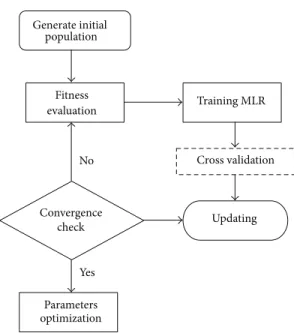
(4) is the fitness function under consideration.Figure 1shows
the flowchart of the developed PSO algorithm. For further details regarding PSO, please refer to Kennedy and Eberhart
[27] and Bratton and Kennedy [26].
2.5. Wavelet Analysis. Wavelet transformations provide ful decomposition of original time series by capturing use-ful information on various decomposition levels. Discrete wavelet transformation (DWT) is preferred in most of the forecasting problems because of its simplicity and ability to compute with less time. The DWT can be defined as
𝜓𝑚,𝑛(𝑡 − 𝜏 𝑠 ) = 1 √𝑠𝑚/2 0 𝜓 (𝑡 − 𝑛𝜏0𝑠𝑚0 𝑠𝑚 0 ) , (6)
where𝑚and𝑛are integers that control the scale and time. The
most common choices for the parameters𝑠0= 2and𝜏0 = 1.
𝜓(𝑡)called the mother wavelet can be defined as∫−∞∞ 𝜓(𝑡)𝑑𝑡 =
0.
For a discrete time series𝑥(𝑡)where𝑥(𝑡)occurs at discrete
time𝑡, the DWT becomes
𝑊𝑚,𝑛= 2−𝑚/2𝑁−1∑
𝑡=0
𝜓 (2−𝑚𝑡 − 𝑛) 𝑥 (𝑡) , (7)
where𝑊𝑚,𝑛is the wavelet coefficient for the discrete wavelet
at scale𝑠 = 2𝑚and𝜏 = 2𝑚𝑛. According to Mallat’s theory,
the original discrete time series𝑥(𝑡)can be decomposed into
a series of linearity independent approximation and detail signals by using the inverse DWT. The inverse DWT is given
by (Mallat [28]) 𝑥 (𝑡) = 𝑇 + ∑𝑀 𝑚=1 2𝑀−𝑚−1 ∑ 𝑡=0 𝑊𝑚,𝑛2 −𝑚/2𝜓 (2−𝑚𝑡 − 𝑛) (8) or in a simple format as 𝑥 (𝑡) = 𝐴𝑀(𝑡) + 𝑀 ∑ 𝑚=1 𝐷𝑚(𝑡) , (9)
where 𝐴𝑀(𝑡) is called approximation subseries or residual
term at levels 𝑀 and 𝐷𝑚(𝑡) (𝑚 = 1, 2, . . . , 𝑀) are detail
subseries which can capture small features of interpretational value in the data.
Generate initial population Fitness evaluation Convergence check Updating Parameters optimization Yes Training MLR Cross validation No
Figure 1: Flowchart of PSO algorithm.
2.6. Principal Component Analysis. In an MLR, one of main tasks is to determine the model input variables that affect the output variables significantly. The choice of input variables is generally based on a priori knowledge of causal variables, inspections of time series plots, and statistical analysis of potential inputs and outputs. PCA is a technique widely used for reducing the number of input variables when we have huge volume of information and we want to have a better
interpretation of variables (C¸ amdev´yren et al. [29]).
The PCA approach introduces a few combinations for model input in comparison with the trial and error process.
Given a set of centred input vectors 𝑥1, 𝑥2, . . . , 𝑥𝑚 and
∑𝑚𝑡=1𝑥𝑡 = 0, usually𝑛 < 𝑚. Then the covariance matrix of
vector is given by 𝐶 = 1 𝑙 𝑙 ∑ 𝑡=1 𝑥𝑡𝑥𝑇𝑡. (10)
The principal components (PCs) are computed by solving the
eigenvalue problem of covariance matrix𝐶,
𝜆𝑖𝑢𝑖= 𝐶𝑢𝑖, 𝑖 = 1, 2, . . . , 𝑚, (11)
where 𝜆𝑖 is one of the eigenvalues of 𝐶 and 𝑢𝑖 is the
corresponding eigenvector. Based on the estimated𝑢𝑖, the
components of 𝑧𝑡(𝑖) are then calculated as the orthogonal
transforms of𝑥𝑡:
𝑧𝑡(𝑖) = 𝑢𝑇𝑖𝑥𝑡, 𝑖 = 1, 2, . . . , 𝑚. (12)
The new components,𝑧𝑖(𝑡), are called principal components.
By using only the first several eigenvectors sorted in descend-ing order of the eigenvalues, the number of principal
com-ponents in𝑧𝑡can be reduced. So PCA has the dimensional
reduction characteristic. The principal components of PCA
have the following properties:𝑧𝑡(𝑖) are linear combinations
maximum variances (Jolliffe [30]). The calculation variance contribution rate is
𝑉𝑖= 𝜆𝑖
∑𝑚𝑖=1𝜆𝑖 × 100%. (13)
The cumulative variance contribution rate is
𝑉(𝑝) =∑𝑝
𝑖=1
𝑉𝑖. (14)
The number of the selected principal components is based on the cumulative variance contribution rate, which as a rule is
over 85∼90.
3. Computer Simulation
3.1. An Application. In this study, the West Texas Intermedi-ate (WTI) crude oil price series was chosen as experimental sample. The main reason of selecting the WTI crude oil is that these crude oil prices are the most famous benchmark prices, which are widely used as the basis of many crude oil price formulae. The daily data from January 1, 1986, to September 30, 2006, excluding public holidays, with a total of 5237 was employed as experimental data. For convenience of WMLR modeling, the data from January 1, 1986, to December 31, 2000, is used for the training set (3800 observations), and the remainder is used as the testing set (1437 observations).
Figure 2shows the daily crude oil prices from January 1, 1986, to September 30.
In practice, short-term forecasting results are more useful as they provide timely information for the correction of forecasting value. In this study, three main performance criteria are used to evaluate the accuracy of the models. These criteria are mean absolute error (MAE), root mean squared
error (RMSE), and𝐷stat. The MAE and RMSE can be defined
by RMSE= √1 𝑛 𝑛 ∑ 𝑡=1 (𝑦𝑡− ̂𝑦𝑡)2, MAE= 1 𝑛 𝑛 ∑ 𝑡=1𝑦𝑡− ̂𝑦𝑡. (15)
In crude oil price forecasting, improved decisions usually depend on correct forecasting of directions, of actual price,
𝑦𝑡and forecasted price, ̂𝑦𝑡. The ability to predict movement
direction can be measured by a directional statistic (𝐷stat) (Yu
et al., [1]), which can be expressed as
𝐷stat= 1 𝑁 𝑛 ∑ 𝑡=1𝑎𝑡× 100 %, 𝑎𝑡= {1, if (𝑦𝑡+1− 𝑦𝑡) ( ̂𝑦𝑡+1− ̂𝑦𝑡) ≥ 0 0, otherwise. (16)
3.2. Application and Result. At first, the MLR model without data preprocessing was used to model daily oil prices. In
0 10 20 30 40 50 60 70 80 90 0 1000 2000 3000 4000 5000 Cr ude o il p rices (US do lla r)
Daily (January1,1986–September30,2006)
Figure 2: Daily crude oil prices from January 1, 198, to September 30, 2006.
the next step, the preprocessed data which uses subtime series components obtained using discrete wavelet transform (DWT) on original data were entered to the MLR model in order to improve the model accuracy. For the MLR model, the original log return time series are decomposed into a certain number of subtime series components. Deciding the optimal decomposition level of the time series data in wavelet analysis plays an important role in preserving the information and reducing the distortion of the datasets. However, there is no existing theory to tell how many decomposition levels are needed for any time series.
In the present study, the previous log return of daily oil price time series is decomposed into various subtime series (DWs) at different decomposition levels by using DWT to estimate current price value. Three decomposition levels (2, 4, and 8 months) were considered for this study. For the WTI series data, time series of 2-day mode (DW1), 4-day mode (DW2) and 8-day mode (DW3), and approximate mode are
presented inFigure 3.
For the WTI series, six input combinations based on previous log return of daily oil prices are evaluated to esti-mate current prices value. The input combinations evaluated
in the study are (i) 𝑟𝑡−1, (ii) 𝑟𝑡−1, 𝑟𝑡−2, (iii) 𝑟𝑡−1, 𝑟𝑡−2, 𝑟𝑡−3,
(iv) 𝑟𝑡−1, 𝑟𝑡−2, 𝑟𝑡−3, 𝑟𝑡−4, (v) 𝑟𝑡−1, 𝑟𝑡−2, 𝑟𝑡−3, 𝑟𝑡−4, 𝑟𝑡−5, and (vi)
𝑟𝑡−1, 𝑟𝑡−2, 𝑟𝑡−3, 𝑟𝑡−4, 𝑟𝑡−5, 𝑟𝑡−6. In all cases, the output is the log
return of current oil prices,𝑟𝑡.
Each of DWs series plays distinct role in original time series and has different effects on the original prices oil series. The selection of dominant DWs as inputs of MLR model becomes important and effective on the output data and has positive effect excessively on model’s ability. The model becomes exponentially more complex as the number of subtime series as input variables increases. Using a large number of input variables should be avoided to save time and calculation effort. Therefore, the effectiveness of new series obtained by PCA is used as input to the MLR model. The PCA approach helps us to reduce the number of original variables to a set of new variables. Generally, the objective of PCA is to identify a new set of variables such that each variable, called a principal component, is a linear combination of the original
0 10 20 30 40 50 60 70 80 0 1000 2000 3000 4000 5000 A3 -a p p ro xima tio n
Daily (January1,1986–September30,2006)
(a) 0 1 2 3 0 1000 2000 3000 4000 5000 −4 −3 −2 −1 D1
Daily (January1,1986–September30,2006)
(b) 0 2 4 0 1000 2000 3000 4000 5000 −8 −6 −4 −2 D2
Daily (January1,1986–September30,2006)
(c) 0 1 2 3 4 0 1000 2000 3000 4000 5000 −4 −3 −2 −1 D3
Daily (January1,1986–September30,2006)
(d)
Figure 3: Decomposed wavelet subtime series components (Ds) of WTI crude oil price data.
Decompose input using DWT Running PCA the effective of PCs as input for MLR Data collection (yt)
Preprocessing for data
rt=lnyyt t−1 AM · · · DM Postprocess results (MLR) yt= yt−1exp(̂rt) D1 D2
Figure 4: The structure of the WMLR model.
Table 1: Eigen value and cumulative variance contribution rate of the 8 principal components.
PC 1 2 3 4 5 6 7 8
Eigen value 1.97 1.79 1.59 1.33 0.67 0.41 0.21 0.03 Cumulative
Variance Rate 0.25 0.47 0.67 0.84 0.92 0.97 1.00 1.00
the total variation were considered as the number of new variables.
For example, taking two previous daily oil prices as a random variable. Every previous daily oil price time series are decomposed using DWT into three decomposition levels, respectively. Thus there were 8 subseries considered for the PCA analysis. The result of PCA analysis is shown in
Table 1.Table 1shows that the first four principle components can explain 84% variation of the data variation with the eigenvalues greater than 1 to be retained, in which all the 4 PCs were included in the MLR model. Thus the 8 original variables can be replaced by 4 new irrelevant variables. For training MLR, the PSO algorithm solving the recognition problem is implemented and the program code including wavelet toolbox was written in MATLAB language. The WMLR model structure developed in present study is shown inFigure 4.
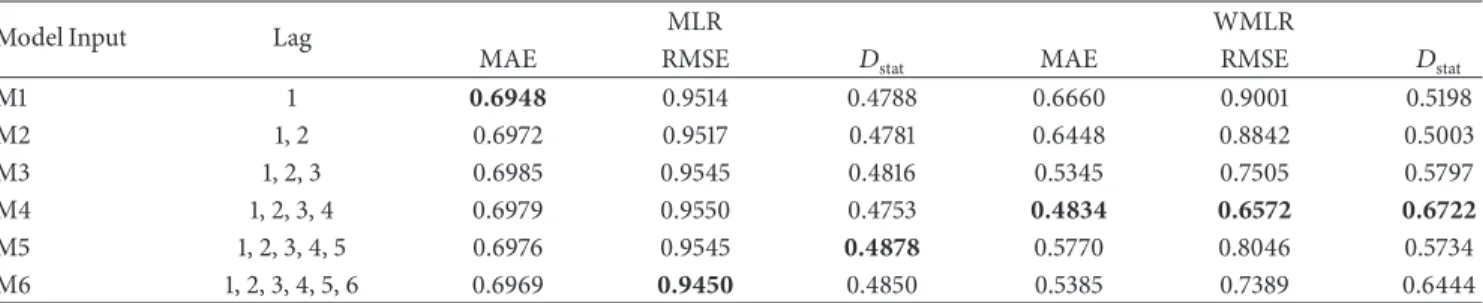
The forecasting performances of the MLR and WMLR
models in terms of the MAE, RMSE, and𝐷stattesting phase
are compared and shown in Table 2. Table 2 shows MLR
model; the M1 with 1 lag obtained the best MAE statistics of 0.6948 and the M6 with 6 lags obtained the best RMSE statistics of 0.9450, while the M1 with 5 lags obtained the best
GARCH ARIMA WMLR MLR 5 0 Er ro r −5 −10
Figure 5: The errors of MLR, WMLR, ARIMA, and GARCH models for crude oil price forecasting.
Table 2: Forecasting performance indices of MLR and WLR.
Model Input Lag MLR WMLR
MAE RMSE 𝐷stat MAE RMSE 𝐷stat
M1 1 0.6948 0.9514 0.4788 0.6660 0.9001 0.5198 M2 1, 2 0.6972 0.9517 0.4781 0.6448 0.8842 0.5003 M3 1, 2, 3 0.6985 0.9545 0.4816 0.5345 0.7505 0.5797 M4 1, 2, 3, 4 0.6979 0.9550 0.4753 0.4834 0.6572 0.6722 M5 1, 2, 3, 4, 5 0.6976 0.9545 0.4878 0.5770 0.8046 0.5734 M6 1, 2, 3, 4, 5, 6 0.6969 0.9450 0.4850 0.5385 0.7389 0.6444
𝐷statstatistics of 0.4878. For WMLR, model M4 with 4 lags
obtained the best MAE, RMSE, and𝐷statstatistics of 0.4834,
0.6572, and 0.6722, respectively. The equations of MLR with six input variables and WMLR with four input variables, respectively, are ̂𝑦𝑡= − 0.025𝑦𝑡−1− 0.047𝑦𝑡−2+ 0.22𝑦𝑡−3 − 0.082𝑦𝑡−4− 0.060𝑦𝑡−5+ 0.0004𝑦𝑡−6, 𝑟𝑡= 0.076𝑧1(𝑡) − 0.221𝑧2(𝑡) − 0.213𝑧3(𝑡) − 0.510𝑧4(𝑡) + 0.416𝑧5(𝑡) − 0.930𝑧6(𝑡) , (17)
where 𝑧𝑖(𝑡) are called principal components and ̂𝑦𝑡 =
𝑦𝑡−1exp(𝑟𝑡).
For further analysis, the best performance of the LR, WMLR, ARIMA, and ARIMA-GARCH models was com-pared with the best results of ARIMA and forward neural
network (FNN) studied by Yu et al. [1]. In Table 3, it
shows that WMLR outperform MLR, ARIMA, GARCH, Yu’ ARIMA and Yu’ FNN models in terms of RMSE statistics. This results show that the new series (DWT) have significant extremely positive effect on MLR model results.
Figure 5 shows the Box-plot for the ARIMA, ARIMA-GARCH, MLR, and WMLR models for testing period. It can be seen that the errors of WMLR model are quite close to the zero. Overall, it can be concluded that the WMLR model provided more accurate forecasting results than the other models for crude oil forecasting.
Table 3: The RMSE and MAE comparisons for different models.
Model RMSE MAE
ARIMA (2, 1, 5) 1.3835 1.0207
GARCH (1, 1) 0.9513 0.6947
MLR 0.9450 0.6969
WMLR 0.6572 0.4834
Yu’ ARIMA (Yu et al., [1]) 2.0350 —
Yu’ FNN (Yu et al., [1]) 0.8410 —
4. Conclusions
The accuracy of the wavelet multiple linear regression (WMLR) technique in the forecasting daily crude oil has been investigated in this study. The PCA is used to choose the principle component scores of the selected inputs which were used as independent variables in the MLR model and the par-ticle swarm optimization (PSO) is used to adopt the optimal parameters of the MLR model. The performance of the pro-posed WMLR model was compared to regular LR, ARIMA, and GARCH model for crude oil forecasting. Comparison results indicated that the WMLR model was substantially more accurate than the other models. The study concludes that the forecasting abilities of the MLR model are found to be improved when the wavelet transformation technique is adopted for the data preprocessing. The decomposed periodic components obtained from the DWT technique are found to be most effective in yielding accurate forecast when used as inputs in the MLR model. The accurate forecasting results
indicate that WMLR model provides a superior alternative to other models and a potentially very useful new method for crude oil forecasting. The WMLR model presented in this study is a simple explicit mathematical formulation. The WMLR model is much simpler in contrast to ANN model and can be successfully used in modeling short-term crude oil price. In the present study, three resolution levels were employed for decomposing crude oil time series. If more resolution levels were used, the results from WMLR model may turn out better. This may be a subject of another study.
Conflict of Interests
The authors declare that there is no conflict of interests regarding the publication of this paper.
Acknowledgments
The authors thankfully acknowledged the financial support that was afforded by Universiti Teknologi Malaysia under GUP Grant (VOT 06J13). Besides that, the authors would like to thank the Department of Irrigation and Drainage, Ministry of natural Resources and Environment, Malaysia, in helping us to provide the data.
References
[1] L. Yu, S. Wang, and K. K. Lai, “Forecasting crude oil price with an EMD-based neural network ensemble learning paradigm,”
Energy Economics, vol. 30, no. 5, pp. 2623–2635, 2008. [2] H. Mohammadi and L. Su, “International evidence on crude
oil price dynamics: applications of ARIMA-GARCH models,”
Energy Economics, vol. 32, no. 5, pp. 1001–1008, 2010.
[3] M. I. Ahmad, “Modelling and forecasting Oman Crude Oil Prices using Box-Jenkins techniques,”International Journal of Trade and Global Markets, vol. 5, pp. 24–30, 2012.
[4] P. Agnolucci, “Volatility in crude oil futures: a comparison of the predictive ability of GARCH and implied volatility models,”
Energy Economics, vol. 31, no. 2, pp. 316–321, 2009.
[5] Y. Wei, Y. Wang, and D. Huang, “Forecasting crude oil market volatility: further evidence using GARCH-class models,”Energy Economics, vol. 32, no. 6, pp. 1477–1484, 2010.
[6] L. Liu and J. Wan, “A Study of Shangai fuel oil futures price volatility based on high frequency data: long-range dependence, modeling and forecasting,” Economic Modelling, vol. 29, pp. 2245–2253, 2012.
[7] A. Ghaffari and S. Zare, “A novel algorithm for prediction of crude oil price variation based on soft computing,”Energy Economics, vol. 31, no. 4, pp. 531–536, 2009.
[8] M. A. Kaboudan, “Compumetric forecasting of crude oil prices,” inThe Proceedings of IEEE Congress on Evolutionary Computa-tion, pp. 283–287.
[9] S. Mirmirani and H. C. Li, “A comparison of VAR and neural networks with genetic algorithm in forecasting price of oil,”
Advances in Econometrics, vol. 19, pp. 203–223, 2004.
[10] W. E. Shambora and R. Rossiter, “Are there exploitable ineffi-ciencies in the futures market for oil?”Energy Economics, vol. 29, no. 1, pp. 18–27, 2007.
[11] L. Yu, S. Wang, and K. K. Lai, “A novel nonlinear ensemble forecasting model incorporating GLAR and ANN for foreign
exchange rates,”Computers and Operations Research, vol. 32, no. 10, pp. 2523–2541, 2005.
[12] W. Xie, L. Yu, S. Y. Xu, and S. Y. Wang, “A new method for crude oil price forecasting based on support vector machines,”Lecture Notes in Computer Science, vol. 3994, pp. 441–451, 2006. [13] R. Jammazi and C. Aloui, “Crude oil price forecasting:
exper-imental evidence from wavelet decomposition and neural network modeling,”Energy Economics, vol. 34, no. 3, pp. 828– 841, 2012.
[14] W. Qunli, H. Ge, and C. Xiaodong, “Crude oil price forecasting with an improved model based on wavelet transform and RBF neural network,” inProceedings of the International Forum on Information Technology and Applications (IFITA ’09), pp. 231– 234, May 2009.
[15] S. Yousefi, I. Weinreich, and D. Reinarz, “Wavelet-based predic-tion of oil prices,”Chaos, Solitons and Fractals, vol. 25, no. 2, pp. 265–275, 2005.
[16] Y. Bao, X. Zhang, L. Yu, K. K. Lai, and S. Wang, “Hybridizing wavelet and least squares support vector machines for crude oil price forecasting,” inProceedings of the 2nd International Workshop on Intelligent Finance, Chengdu, China, 2007. [17] J. Liu, Y. Bai, and B. Li, “A new approach to forecast crude
oil price based on fuzzy neural network,” inProceedings of the 4th International Conference on Fuzzy Systems and Knowledge Discovery (FSKD ’07), pp. 273–277, August 2007.
[18] G. E. P. Box and G. M. Jenkins,Time Series Analysis: Forecasting and Control, Holden-Day, San Francisco, Calif, USA, 1976. [19] T. Bollerslev, “Generalized autoregressive conditional
het-eroskedasticity,”Journal of Econometrics, vol. 31, no. 3, pp. 307– 327, 1986.
[20] H. Bozdogan and J. A. Howe, “Misspecified multivariate regres-sion models using the genetic algorithm and information complexity as the fitness function,”European Journal of Pure and Applied Mathematics, vol. 5, no. 2, pp. 211–249, 2012. [21] S. M. Chen and P. Y. Kao, “TAEIX forecasting based on
fuzzy time series, partical swarm optimization techniques and support vector machines,”Information Sciences, vol. 247, pp. 62– 71, 2013.
[22] R. Alwee, S. M. Shamsuddin, and R. Sallehuddin, “Hybrid support vector regression and autoregressive integrated moving average models improved by particle swarm optimization for property crime rates forecasting with economic indicators,”The Scientific World Journal, vol. 2013, Article ID 951475, 11 pages, 2013.
[23] R. J. Ma, N. Y. Yu, and J. Y. Hu, “Application of particle swarm optimization algorithm in the heating system planning problem,” The Scientific World Journal, vol. 2013, Article ID 718345, 11 pages, 2013.
[24] G. Tyagi and M. Pandit, “Combined heat and power dispatch using time varying acceleration coefficient particle swarm opti-mazation,”International Journal of Engineering and Innovative Technology, vol. 1, no. 4, pp. 234–240, 2012.
[25] L. Liu, S. Yang, and D. Wang, “Particle swarm optimization with composite particles in dynamic environments,” IEEE Transactions on Systems, Man, and Cybernetics B: Cybernetics, vol. 40, no. 6, pp. 1634–1648, 2010.
[26] D. Bratton and J. Kennedy, “Defining a standard for particle swarm optimization,” inProceedings of the IEEE Swarm Intel-ligence Symposium (SIS ’07), pp. 120–127, IEEE Service Center, Piscataway, NJ, USA, April 2007.
[27] J. Kennedy and R. Eberhart, “Particle swarm optimization,” inProceedings of the IEEE International Conference on Neural Networks, pp. 1942–1948, December 1995.
[28] S. G. Mallat, “Theory for multiresolution signal decomposition: the wavelet representation,”IEEE Transactions on Pattern Anal-ysis and Machine Intelligence, vol. 11, no. 7, pp. 674–693, 1989. [29] H. C¸ amdev´yren, N. Dem´yr, A. Kanik, and S. Kesk´yn, “Use
of principal component scores in multiple linear regression models for prediction of Chlorophyll-a in reservoirs,”Ecological Modelling, vol. 181, no. 4, pp. 581–589, 2005.
[30] I. T. Jolliffe,Principal Component Analysis, Springer, New York, NY, USA, 1986.
Submit your manuscripts at
http://www.hindawi.com
Computer Games Technology International Journal of
Hindawi Publishing Corporation
http://www.hindawi.com Volume 2014
Hindawi Publishing Corporation
http://www.hindawi.com Volume 2014 Distributed Sensor Networks International Journal of Advances in
Fuzzy
Systems
Hindawi Publishing Corporation
http://www.hindawi.com Volume 2014
International Journal of
Reconfigurable Computing
Hindawi Publishing Corporation
http://www.hindawi.com Volume 2014
Hindawi Publishing Corporation
http://www.hindawi.com Volume 2014
Applied
Computational
Intelligence and Soft
Computing
Advances inArtificial
Intelligence
Hindawi Publishing Corporation http://www.hindawi.com Volume 2014 Advances in Software EngineeringHindawi Publishing Corporation
http://www.hindawi.com Volume 2014
Hindawi Publishing Corporation
http://www.hindawi.com Volume 2014
Electrical and Computer Engineering
Journal of
Journal of
Computer Networks and Communications
Hindawi Publishing Corporation
http://www.hindawi.com Volume 2014 Hindawi Publishing Corporation
http://www.hindawi.com Volume 2014
Multimedia
International Journal of
Biomedical Imaging
Hindawi Publishing Corporation
http://www.hindawi.com Volume 2014
Artificial
Neural Systems
Advances in
Hindawi Publishing Corporation
http://www.hindawi.com Volume 2014
Robotics
Journal ofHindawi Publishing Corporation
http://www.hindawi.com Volume 2014 Hindawi Publishing Corporationhttp://www.hindawi.com Volume 2014 Computational Intelligence and Neuroscience
Hindawi Publishing Corporation
http://www.hindawi.com Volume 2014
Modelling & Simulation in Engineering Hindawi Publishing Corporation
http://www.hindawi.com Volume 2014
The Scientific
World Journal
Hindawi Publishing Corporation
http://www.hindawi.com Volume 2014
Hindawi Publishing Corporation
http://www.hindawi.com Volume 2014
Human-Computer Interaction
Advances in
Computer EngineeringAdvances in
Hindawi Publishing Corporation