Full Terms & Conditions of access and use can be found at
http://www.tandfonline.com/action/journalInformation?journalCode=wcsu20
The Clinical Supervisor
ISSN: 0732-5223 (Print) 1545-231X (Online) Journal homepage: http://www.tandfonline.com/loi/wcsu20
Supervision Process Seen as a Process of
Experiential Learning
Sonja Zorga PhDTo cite this article: Sonja Zorga PhD (1997) Supervision Process Seen as a Process of Experiential Learning, The Clinical Supervisor, 16:1, 145-161, DOI: 10.1300/J001v16n01_08 To link to this article: https://doi.org/10.1300/J001v16n01_08
Published online: 11 Oct 2008.
Submit your article to this journal
Article views: 150
of Experiential Learning
Sonja Zorga
ABSTRACT. In reflecting what actually happens in the supervision process we cannot overlook that one learns by experience or through experiential learning. The paper presents how the use of experience in supervision corresponds to Kolb’s model of learning as a cyclical process. Some propositions of modern learning, introduced by Can-tor in 1953, will be applied to supervision too. These assumptions are: learning depends on wanting to learn and on not knowing the answers in advance; individuals learn best when they are free to create their own responses in a situation and when they can learn in their own way; learning is largely an emotional experience; learning is integral–not an additive experience, but a remaking experience; to learn is to change, etc. [Article copies available for a fee from The Haworth Document Delivery Service: 1-800-342-9678. E-mail address: [email protected]]
Continuous professional development is an obligatory standard of contemporary professional workers. As Garrett and Barretta-Herman (1995) pointed out, professional development demands that practitioners maintain and extend their competence, increase their awareness of theoretical and practical advances and participate in forums that offer peer review and support. Supervision can be understood as one of the methods which transmit such professional knowledge, skills and values. Van Kessel and Haan (1993a) defined
Sonja Zorga, PhD, Docent for Developmental Psychology and Koordinator for Postgraduate Study of Supervision in Faculty of Education, University of Ljubljana.
Address correspondence to Sonja Zorga, Faculty of Education, Kardeljeva pl. 16, 1000 Ljubljana, Slovenia, Europa.
The Clinical Supervisor, Vol. 16(1) 1997
it as ‘‘a specific method of fieldwork education and staff develop-ment for those in professions or functions where the work is mainly or largely person-oriented’’ (p. 8).
In the educational setting supervision is a special learning, devel-opmental and supportive method, enabling professional workers to acquire new professional and personal insights through their own experiences. It helps them to integrate practical experiences with theoretical knowledge and to reach their own solutions to the prob-lems they meet at work, to face stress efficiently and to build up their professional identity. From this point of view, supervision is not only an important educational and developmental method, but also a useful method for prevention of mental health problems.
While traditionally supervision was in an educational setting understood mainly as control and professional counselling exer-cised by state administration, recent movements in Slovenia are trying to implement supervision as a method which focuses primari-ly on the educational function, strictprimari-ly separated from the adminis-trative control (Dekleva, 1995). Kadushin (1976) proclaimed that administrative and educational supervision share the same ultimate objective, which is to provide the best possible service to the cli-ents. While administrative supervision provides the structure di-rected toward this goal, educational supervision provides the train-ing (the knowledge and instrumental skills) which enables the worker an effective practice.
Through educational supervision workers internalise sets of prin-ciples, attitudes and values that will partly govern their behaviour. This enables them to act more autonomously and independently and to make appropriate decisions without feeling a constant need to consult the authority. In such a way ‘‘educational supervision is the context for role transition from lay person to professional, provid-ing the supervisee with the sense of occupational identity’’ (Kadu-shin, 1976, p. 129). Kadushin stressed, that the development of pro-fessional knowledge and skill permit relaxation of administrative controls, as a result of which the worker will not only feel a personal obligation to do a good job, but will also have the necessary compe-tence and capability to do so. That means that more educational supervision consequently requires less administrative supervision.
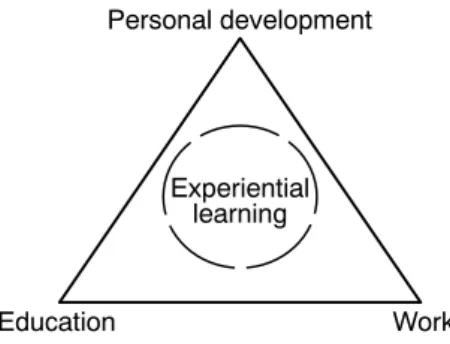
profes-sional workers must be of essential importance. Actually, the aim of supervision is to engage workers in a learning process helping them to integrate what they are doing, feeling and thinking (Kobolt, 1992). It connects practical experiences with theoretical knowledge and through them combines work with study, enables the transfer of theory into practice and encourages the learning of an autonomous action. In this way it contributes to the professional and personal development of a professional worker. That means that in supervi-sion, work, education and personal development are linked together through the process of experiential learning. Relations between those four elements are well presented in Kolb’s (1984) book en-titled, Experiential Learning (Figure 1).
LEARNING IN ADULTHOOD
Experts doing research on learning in adulthood have established that such learning is mostly based on life experience and is not acquired through formal education. Everyday life situations offer many learning opportunities. However, we do not learn the same from each experience, and some experiences have a greater impact on us than others. Since work plays an important role in the life of
FIGURE 1. Experiential learning as the process that links education, work, and personal development.
Note: Figure 1 is from Kolb, David A., Experiential Learning: Experience as the Source of Learning and Development, 1984, p. 4. Reprinted by permission of Prentice Hall, Upper Saddle River, New Jersey.
Personal development
Education Work
Experiential learning
an adult, it is only understandable that work experience represents most of the material we learn from in adulthood. In their study Aslanian and Brickell (1990, see Merriam and Clark, 1992, p. 2) found that fifty-six percent of the learners were learning because of some work-related transition.
Mezirow defines learning as the process of making a new or revised interpretation of the meaning of an experience, which guides subsequent understanding, assessment and action (see Merriam and Clark, 1992, p. 3). Like Piaget (1961), Mezirow also claims that several experiences from everyday life can easily be assimilated into our mental structure because they are congruent with experi-ences from earlier on. However, some life experiexperi-ences are incon-gruent with past ones and cannot be properly interpreted with the help of the existing mental structure only. Such experiences could be divorce, loss of job, a new position, the beginning of a new project, and many other unexpected situations one so frequently meets in innovative work. Experiences which cannot be readily assimilated challenge our existing mental structure towards restruc-turing and leads to new recognition (Piaget, 1961) or to perspective transformation (Mezirow, 1990, see Merriam and Clark, 1992, p. 3).
Under which conditions then do adults learn most? The results of a research by Merriam and Clark (1992), who collected data on the life events of 405 adults, showed that we learn more when the life situation is good. On the other hand, learning in so-called ‘‘hard times,’’ is of a more transforming nature and it more frequently encompasses the whole human being. In the so-called good times we are supposed to have more time and energy to concentrate on learning, but when life is not exactly what we would wish for, conflicts and pain absorb all of our energy while our attention is directed towards the search of a solution and a way out of the difficult situation. Thus, there is less learning in those periods, but the learning that does take place then brings about deeper changes in the human being (change of value system for example).
SUPERVISION AS A LEARNING PROCESS
In reflecting about what actually happens in a supervision pro-cess, it cannot be overlooked that one learns by experience or
through experiential learning. The phrase itself tells us that the really important thing is what one has experienced or lived through. There is an objective as well as a subjective side to this experience. Personal perception and the emotional response of a certain event might for the individual involved in it be even more relevant than the objective facts themselves. But to really learn from experience, to let the experience really have an impact, we must be aware of the importance of a dialogue, said the Dutch supervisor Hank Hane-kamp (personal communication, January 21, 1991). He stressed that the dialogue enables individuals to incorporate the experience into the knowledge about themselves and into the relationship they have to the world around them; it enables them to change their philoso-phy of life. Words are necessary to ‘‘find’’ the experience again, when they need it. It is therefore important that they find and re-member the right words.
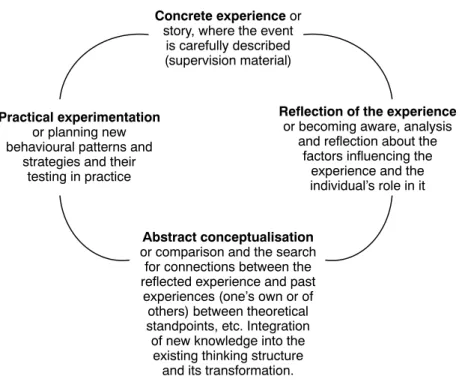
Kolb (1984), the founder of experiential learning defines learn-ing as a process, in which knowledge is created through the trans-formation of experience. Its basic components are experience and its transformation. The perception of experience does not suffice for learning, something must rather be done with it. The use of experi-ence in the supervision process corresponds to Kolb’s model of learning as a cyclical process in which four activities interact: the concrete experience, its reflection, its abstract conceptualisation and experimentation. Schematically, the described process of experien-tial learning in supervision, seen as a cyclical process, is presented in Figure 2.
Kolb stresses that the learning process can begin at any point of this circle but it should pass through all the four phases. Let us examine in more detail what role is ascribed to each of the four activities or learning phases in the supervision process.
As Tancig (1992, p. 124) states, the essence of the supervision method is in its systematic reflection of one’s own action or experi-ences. Hence in supervision, the learning process should typically begin with practical experience the worker acquires in performing his/her job. He/she brings experience into supervision in the form of a story. Here the description of the experience or the event should be as concrete and precise as possible. Sometimes a tapescript of the
FIGURE 2. Schematically described process of experiential learning in su-pervision.
Concrete experience or story, where the event
is carefully described (supervision material)
Practical experimentation or planning new behavioural patterns and
strategies and their testing in practice
Reflection of the experience or becoming aware, analysis
and reflection about the factors influencing the
experience and the individual’s role in it Abstract conceptualisation
or comparison and the search for connections between the reflected experience and past
experiences (one’s own or of others) between theoretical standpoints, etc. Integration of new knowledge into the
existing thinking structure and its transformation.
Note: From ‘‘Supervision in educational professions,’’ by S. Zorga, 1995, in Challenge of School Psychology: The Child’s Future in School, Family and Society, Proceedings. Sao Paulo: Editora Atomo Ltda., 265-268. With permission of the author.
conversation between the worker and client, client’s relative, col-league, etc., can prove to be very useful supervision material.
Usually we choose and then present at the supervision meeting such experience from our professional life, which we cannot ex-plain to ourselves, with which are constantly emotionally and men-tally involved, or simply wish to learn from it. In connection with this experience, we also formulate a specific question or a series of questions we then try to answer in the supervision process.
That means that our experience serves as learning material. The supervisor’s role is then to reshape the story from our professional life so as to enable us to learn from it about ourselves and about our
professional functioning. Once we have told the story, in which we describe our experience in great detail and are helped by the super-visor, the supervisor leads us on in our reflection about the experi-ence.
We reflect on the causes and circumstances that have led to the experience or have served as background for it. We discover what we were trying to achieve, why we have acted in a certain way or what has influenced our decisions. What have been the conse-quences of this action for us, for the client, his/her family or for our colleagues? We also bring to light our feelings and what we have experienced at work, as well as the feelings of the client or co-work-er. In the reflection process we are able to contemplate the experi-ences from a distance. We can connect with the background of our action and the forces which have, again and again, led us to beha-vioural patterns we might not like and are not professionally aquate. Reflecting on a concrete experience we can face our de-fences, emotional contents and behavioural styles. We can recognise our implicit theories, underlying attitudes and values directing our actions and emotional responses, as well as define the frame of reference through which we perceive the events and behaviour of others. In the supervision process we discover the true meaning of a certain event for ourselves personally and how it has influenced our professional action.
The next phase is the search for connections between the re-flected experience and our past experiences and the comparison of these experiences with the experiences of other participants in the supervision group. Comparison and search for connections with our existing knowledge, theories, attitudes and values are also made. This is an important phase of the learning process because here we acquire new knowledge which we have to incorporate in our cogni-tive structure and consequently reconstruct at some higher level.
Without this phase of abstract conceptualisation the learning pro-cess cannot be concluded, ‘‘because in spite of experiences, new theories and knowledge the teacher would still react in accordance with his existing thinking structure. Such deficiency in integrating practical and theoretical knowledge can be encountered in everyday practice. Even if the teacher is acquainted with theory, knows the optimal solution of a problem, he still does not apply this
knowl-edge when actually solving the problem. Active testing of new knowledge and its implementation into practice can proceed only once integration has taken place’’ (Peklaj, 1992, p. 120). Integration happens when our thinking structure is transformed or restructed by the inclusion of new knowledge and is suitably con-nected to the existing knowledge, thus creating new quality.
We undergo a learning process nobody can go through but our-selves. Sometimes this process of uncovering our feelings, thoughts, underlying attitudes, etc., connected with concrete events might be very painful. But the experience is worth going through because it results in better professional competence, an increased feeling of power and professional identity, and personal and professional growth and development.
When we discover the meaning of a certain experience or event, we frequently realise that this has been the experience of many generations and has already been written about in many profession-al texts. However, we must recognise it for ourselves, stresses the Dutch supervisor H. Hanekamp (personal communication, January 14, 1991). Only when we are able to integrate the experience and its meaning, does it become our own wisdom. This wisdom is not static, since in the process of integration we constantly have to recheck and reorganise our own knowledge and in this way change our cognitive structure. Thus the new theories and new knowledge we have acquired during the process of professional growth with the reflection of experience, combine with our former behavioural schemes and perceptions and form new patterns of professional action and beliefs.
Now we can observe our experience from a different point of view and see what we have learned from it and how we could have acted differently in a given situation. Based on the knowledge about what could have been different or how we could have acted differ-ently, we can now plan other ways of reacting and new behavioural patterns. We can create new concepts on which to base our profes-sional actions. The role of supervisor is to offer us opportunities for safe experimenting and testing of ways and behaviours which are new to us. He/she is to protect us from getting into situations that would endanger us. That is why he/she discusses with us the pos-sible solutions as well as their consequences. But which solution we
eventually decide upon and what we consequently learn from the supervised situation is our responsibility alone.
In our future work situations we can test these new forms of possible action. Such testing can then enable us to acquire new experience which can in turn serve as teaching material for the next supervision process.
The supervisor’s role is actually to guide workers in their learn-ing cycle through all four activities or phases of the learnlearn-ing process already described. He/she creates such learning situations which encourage workers to transit from one phase to another. Therefore the supervision meetings should take place parallel to work, so that the learning process proceeds in the form of a spiral reaching al-ways higher levels. The workers do their job, at the supervision meeting they reflect about what they have done and learn from it, then they return to their work and test what they have learned.
Of course it cannot be expected that the supervision process will immediately and directly lead to novel ways in the workers’ perfor-mance. At supervision meetings we frequently meet with and work on the transformation of old, deep set behavioural and emotional patterns. These patterns can be connected with ways of reacting that might have been effective in childhood, but we keep on applying them even though they no longer bring the desired results. These deep set patterns need quite some time to be changed consciously.
At the beginning of the transformation process we usually be-come aware of having taken a course of action we had not wished for and which does not seem to be effective. We come to the recog-nition of our behaviour when the event has already happened.
Then follows the recognition during the event itself: during the course of action we become aware of our own behaviour and we realise we should be acting differently. Sometimes such awareness enables the redirection of the outcome. In a dialogue with a client we can, for example, begin the conversation from a different start-ing point or maybe retract our decision in time. But at this stage it is in the majority of cases difficult to change our conduct in the middle of the action.
It is only in the next stage that we can recognise in advance a situation approaching where we usually reacted in a way we would like to avoid. Now we are prepared. In the concrete situation we can
react differently by using new strategies and ways of action which we have developed in the supervision process. If we realise that the new ways of reacting offer more suitable consequences or a better outcome than our original reaction, we gradually accept them and they become our new behavioural pattern. Only then can we speak of a really changed action pattern.
The cyclical model of experiential learning in supervision can be well compared with an interesting model Van Kessel and Haan (1993b) presented in their article, ‘‘The Intended Way of Learning in Supervision Seen as a Model.’’ Learning in supervision was broken down into three segments or successive stages. These three stages covered the complete circle of experiential learning and can be seen as the model for guiding the learning process. The stages are:
S the way of knowing (feeling, perception, awareness, thinking), by making the professional experience explicit, making it spe-cific, reflecting and problematizing it, getting an insight, nam-ing and generalisation;
S the way of choosing (willing) a desirable action, possibilities and choice of action and finally
S the way of acting (making a mental image, be able to, daring) by making a plan of action and performing the action.
FEATURES OF SUPERVISION AS A PROCESS OF EXPERIENTIAL LEARNING
Walter and Marks (1981) pointed out that in the year 1953 Natha-niel Cantor outlined in his book about the teaching–learning process nine propositions for modern learning. They are all still relevant and ‘‘can be applied to the general qualities of experiential learning, wherein the emphasis is placed on engaging the individual in the experiential learning’’ (Walter & Marks, 1981, p. 2). The assump-tions are:
1. Learning depends on wanting to learn.
2. The pupil learns only what he/she is interested in learning. 3. It is important that pupils share in the development and
4. Learning depends on not knowing the answers.
5. The individual learns best when he/she is free to create his/her own responses in a situation.
6. Every pupil learns in his/her own way. 7. Learning is largely an emotional experience.
8. Learning is integral; genuine learning is not an additive expe-rience, but a remaking experience.
9. To learn is to change.
Following we will look at these assumptions as they apply to supervision.
1. ‘‘Learning depends on wanting to learn.’’
The supervision is in a way an intimate process, that is why appropriate motivation and personal commitment of the profession-al worker are necessary for effective supervision work.
The supervisees usually independently and of their own free will decide to join the supervision process because they want to improve professionally and gain from their experiences what could be useful for their future work. Frequently they choose the super-visor too, so that they can trust him/her and feel safe in the learning process.
The problem arises when the worker is forced to participate in the supervision. Such ‘‘obligatory’’ supervision may be organised for all professionals in the institution and the learning process may not take place at all. The supervisees who do not want to participate can be destructive and supervision may not be effective–neither for them nor for their colleagues in the group. Yet the cause of failure lies not in the method itself but in the fact that one of its basic assumptions–motivation for learning, has not been taken into ac-count. The supervisees might not be willing to learn and show a passive resistance towards supervision or even want to prove (con-sciously or not) that their inclusion in the supervision process was not in place.
In his book, Supervision in Social Work, Kadushin (1976) writes about the conditions for effective teaching and learning in supervi-sion. He stresses motivation and presents some useful techniques to promote better motivation for learning in the supervision setting (pp. 131-135).
2. ‘‘The pupil learns only what he/she is interested in learning.’’ In the supervision process the supervisees choose supervision material (a concrete experience) themselves, so that the problem presented in supervision is relevant to them and actually originates from their experience. That means that they select the desired work-ing experience, situation or relationship they would like to look upon more precisely.
The workers comes to supervision not only with their material but also with a supervision question or a series of questions con-nected with their experience. The experiences mostly relate to the workers themselves and have in a certain way influenced their emotional response and action in a concrete situation. These ques-tions also refer to the search for better ways of handling a similar situation in the future. The more the supervisees are open to new ideas and insights and the less they are anxious and defensive con-cerning their job performance, the more they can gain from supervi-sion.
3. ‘‘It is important that pupils share in the development and management of the curriculum.’’
At the initial meeting the supervisor makes an agreement with the supervisees about the frequency, place and time of meetings and about the expectations and wishes of every participant. He/she also presents his/her ‘‘offer,’’ i.e., tells them what he/she as a supervisor can give them. At one of the first meetings a supervision contract should be made in which the framework and the focus of the super-vision should be defined, as well as the method of supersuper-vision, the way the participants and the supervisor will interact between indi-vidual supervision meetings, etc. Later in the supervision process the group can jointly add new rules or change unsuitable ones.
The workers who have joined the supervision process thus take an active part in the planning and organisation of supervision. They are to a great extent responsible also for the realisation of the con-tents because they have mostly contributed them themselves by bringing their experiences as a material for the supervision.
4. ‘‘Learning depends on not knowing the answers.’’
In the supervision process as in other forms of learning and teaching, the differences between the supervisor’s and the supervi-see’s roles disappear. The discussion of the problem presented by
the worker becomes a common reflection followed by a common pursuit of a solution. It is a social skills learning situation where an appropriate personal interaction is of utmost importance. The super-visor does not know the answers in advance, neither can he/she supply them to the worker during the supervision process. Answers are not yet known and it is only in the process that we find answers for ourselves, answers, which might be completely different from the answers our colleagues have reached at the same supervision meeting. What the answers are depends above all on our personal structure and our way of experiencing the world. It depends on the reference frame through which we perceive the world around us and the way we react to it.
5. ‘‘The individual learns best when he/she is free to create his/ her own responses in a situation.’’
The supervisor is a moderator, guiding the workers through their learning process. He/she is responsible for offering or enabling opti-mal learning conditions, where the workers can freely and openly reflect, compare and exchange experiences, search for their own solutions as well as check their premises. His/her task is only to show the supervisees another way how to think about the problem presented.
The supervisor is not to judge but rather to mirror the behaviour of the workers and make them see what they have done and how they were experienced by others. He/she voices his/her opinion about the story, yet does not teach the workers how to act. The basic characteristic of supervision is namely the freedom of workers to search for their own solutions, their own way of action, to learn about themselves, to face themselves etc.
It would of course be an utter illusion to think the supervisor does not influence what the professional learns in the supervision pro-cess. The supervisor who has succeeded in establishing a satisfying personal relationship with the supervisee will unintentionally exer-cise influence on the worker’s experience, values and attitudes with his/her own vision of the problems, his/her personal attitudes and values. How directly and to what extent these influences will be present, depends on the supervisor’s style, yet it is impossible to avoid them completely as it is impossible to avoid such influences in any other learning context.
6. ‘‘Every pupil learns in his/her own way.’’
The task of the supervisor is to enable the supervisees to learn in a way that proves most effective for them and which suits them best. He/she helps them find their own way of learning and to achieve this, it is important that he/she perceives the differences among several learning styles and that he/she knows how to use them effectively. So he/she must be acquainted with the characteris-tics of various learning styles and be flexible in adjusting his/her guidance of the supervision process to the style of the individual supervisee.
7. ‘‘Learning is largely an emotional experience.’’
The story the worker presents at a supervision meeting is in most cases strongly emotionally ‘‘loaded,’’ since it originates from con-crete working experiences. In the presentation these emotions are usually relived. Exposing the contradictions, dilemmas and person-al problems the supervisee is encountering, reveperson-al the feelings which are connected with the experience in question and the people involved. Specific examples are the supervisees’ previous experi-ences and their relationship with the persons involved in the ana-lysed event, and their own system of values, attitudes and implicit theories. Supervisees are faced with them all and they realise they have influenced their emotional response and the course of action they have taken in a concrete situation. That is why they are usually deeply emotionally engaged and only gradually do they manage to restore the necessary distance which would offer them the opportu-nity to learn from this experience.
For these reasons it is crucial that a trusting relationship and a safe emotional climate are established between the supervisor and supervisees. Certain things can be learned only in a personal con-text, in a personal relationship with somebody. The supervisor oper-ates through this relationship, while the supervisee learns from this same relationship.
In its essence the supervision process usually leads to the restruc-turing of the existing cognitive schemes and to the reorganisation of used behaviour and emotional reaction patterns. It can frequently be a painful process fundamentally endangering the feeling of an indi-vidual’s integrity.
8. ‘‘Learning is integral; genuine learning is not an additive expe-rience, but a remaking experience.’’
According to Kolb (1984), learning is a holistic process involv-ing the integrated functioninvolv-ing of the total organism–thinkinvolv-ing, feel-ing, perceiving and behaving. That can well be seen in the supervi-sion process, where learning is a cognitive process in which new experiences are harmonised, and new emotional responses and knowledge are integrated with the existing experiences, attitudes and behavioural patterns.
The integration process where new experience and theoretical knowledge combine with the existing thinking schemes can well be explained with the process of equilibration introduced by the Swiss psychologist Jean Piaget (1961) in his theory of cognitive develop-ment.
When we are faced with a behaviour or emotional response that cannot be explained on the basis of already acquired experience and knowledge (be it our emotional response and behaviour or that of our client, colleague, boss) we feel confused, helpless and incompetent. In this case Piaget (1961) speaks about a destroyed balance or dis-equilibration. Facing one’s own and/or other behaviour and/or emo-tional response, in a way unexplainable to us and therefore unaccept-able, a state of imbalance is reached at the level of our thinking activity. Our organism is namely faced with information which is not in accordance with the existing thinking schemes. Reflecting on this behaviour or emotional response, searching for factors influencing it, grounds connected with it and new patterns possible in a similar situation, makes possible the adaptation of some elements of experi-ence to the existing thinking schemes (assimilation). At the same time the transformation of existing attitudes, implicit theories and behavioural patterns influenced by this experience take place (ac-commodation). The result of these two processes is the acquisition of new knowledge, new skills, new experience and behavioural patterns and consequently the undertaking of action at a qualitatively differ-ent, higher level. The process of balancing existing attitudes, knowl-edge and behavioural patterns with new experiences and newly ac-quired knowledge can be called the process of equilibration.
9. ‘‘To learn is to change.’’
has been said so far. It might just be emphasised that the result of supervision is by definition personal and professional growth, i.e., change of the individual in the sense of development. When seeking answers, we frequently encounter the same theme, i.e., a personal one, which is typical for us and which represents our weakness or a ‘‘blind spot’’ in our professional and personal functioning. Yet when we come upon the known topic again and again we experi-ence the so called ‘‘Oh, yes effect,’’ the insight into our behaviour-al, thinking and emotional reaction patterns. We might have known them for a long time but have not been able to connect them with the analysed situation and the question raised about it.
In this way we gain insight into different levels and are able to see our problem from different points of view. Thus we can gradual-ly and thoroughgradual-ly integrate new knowledge into the existing mental structure, where known answers become more complex and more conscious and therefore new again.
The result of the so-called equilibration process is a new cogni-tion, a new behavioural pattern, different in quality from the pre-vious one.
For the conclusion, the author would like to quote the well known painter, Piet Mondrian, who recognised the process of equilibration and through it his artistic growth and development while he was painting. ‘‘Indeed, modern science defines life as a constant search for equilibrium. The closer we come to equilibrium–it is never fixed in space and time–the closer we come to real life, outside time and space. . . . and the more life (including ordinary life) means to us and the richer it reveals itself to be’’ (see Matthes, 1994, p. 61). And that is what learning in the supervision process can offer to the professional worker.
But we must bear in mind once again, that the supervisor can organise the setting, provide a suitable atmosphere for learning and make learning available but he/she cannot ensure what and if any-thing at all will be learned. The supervisees are the only ones who can decide it. They can take the opportunity and limitations offered in their own way; the supervisor can only assist them. And as Kadushin (1976) states, a result of educational supervision can be that ‘‘ . . . the worker is in a better position to evaluate his own performance. He learns the difference between good and poor
prac-tice and has some criteria by which he can be self-critical’’ (p. 130). And in this case administrative supervision lost its important role. If it is still strongly present in the system it can be more a burden than a help for creative and high quality performing job.
REFERENCES
Dekleva, B. (1995). Uvajanje supervizije kot razvojno-podporne dejavnosti na podrocju obravnavanja problemov v zvezi z odklonskostjo mladih. In: Dekle-va, B. (ed.): Supervizija v izvendruzinski vzgoji. Ljubljana, SI: Institut za kriminologijo pri Pravni fakulteti, 6-14.
Garrett, K.J., & Barretta-Herman, A. (1995). Moving from supervision to profes-sional development. The Clinical Supervisor, 13 (2), 97-110.
Kadushin, A. (1976). Supervision in social work. New York & London: Columbia University Press.
Kobolt, A. (1992). Supervizija–modeli spremljanja in pridobivanja izkusenj v casu studija in poklicnega dela. V: Kaj hocemo in kaj zmoremo, zbornik. Ljubljana, SI: Pedagoska fakulteta, 120-123.
Kolb, D.A. (1984). Experiential learning. Experience as the source of learning and development. Englewood Cliffs, NJ: Prentice-Hall, Inc.
Matthes, H. (1994). Aphorisms and reflections by Piet Mondrian. Kunst & Mu-seumjournaal, 3 (1), 57-62.
Merriam, S. B. & Clark, M. C. (1992). Adult learning in good times and bad.
Studies in Continuing Education, 14 (1), 1-13.
Piaget, J. (1961). La psychologie de l’intelligence. Paris: Librairie Armand Colin. Peklaj, C. (1992). Izkusenjsko ucenje kot izhodisce za izobrazevanje uciteljev. V:
Kaj hocemo in kaj zmoremo, zbornik. Ljubljana, SI: Pedagoska fakulteta, 117-120.
Tancig, S. (1992). Supervizija in reflektivno poucevanje v izobrazevanju uciteljev. V: Kaj hocemo in kaj zmoremo, zbornik. Ljubljana, SI: Pedagoska fakulteta, 124-126.
Van Kessel, L., & Haan, D. (1993a). The Dutch concept of supervision: Its essential characteristics as a conceptual framework. The Clinical Supervisor, 11 (1), 5-27.
Van Kessel, L., & Haan, D. (1993b).The intended way of learning in supervision seen as a model. The Clinical Supervisor, 11 (1), 29-44.
Walter, G. A., & Marks, S. E. (1981). Experiential learning and change. New York: John Wiley & Sons.
Zorga, S. (1995). Supervision in educational professions. In: Challenge of school psychology: The Child’s future in school, family and society, Proceedings. Sao Paulo: Editora Atomo Ltda., 265-268.