A Study on Privacy Preserving Data
Publishing with Differential Privacy
A Thesis Submitted to the
College of Graduate and Postdoctoral Studies
in Partial Fulfillment of the Requirements
for the degree of Master of Science
in the Department of Computer Science
University of Saskatchewan
Saskatoon
By
Tonny Shekha Kar
c
Permission to Use
In presenting this thesis in partial fulfilment of the requirements for a Postgraduate degree from the University of Saskatchewan, I agree that the Libraries of this University may make it freely available for inspection. I further agree that permission for copying of this thesis in any manner, in whole or in part, for scholarly purposes may be granted by the professor or professors who supervised my thesis work or, in their absence, by the Head of the Department or the Dean of the College in which my thesis work was done. It is understood that any copying or publication or use of this thesis or parts thereof for financial gain shall not be allowed without my written permission. It is also understood that due recognition shall be given to me and to the University of Saskatchewan in any scholarly use which may be made of any material in my thesis.
Requests for permission to copy or to make other use of material in this thesis in whole or part should be addressed to:
Head of the Department of Computer Science 176 Thorvaldson Building 110 Science Place University of Saskatchewan Saskatoon, Saskatchewan Canada S7N 5C9
Abstract
In the era of digitization it is important to preserve privacy of various sensitive information available around us, e.g., personal information, different social communication and video streaming sites’ and services’ own users’ private information, salary information and structure of an organization, census and statistical data of a country and so on. These data can be represented in different formats such as Numerical and Categorical data, Graph Data, Tree-Structured data and so on. For preventing these data from being illegally exploited and protect it from privacy threats, it is required to apply an efficient privacy model over sensitive data. There have been a great number of studies on privacy-preserving data publishing over the last decades. Differential Privacy (DP) is one of the state of the art methods for preserving privacy to a database. However, applying DP to high dimensional tabular data (Numerical and Categorical) is challenging in terms of required time, memory, and high frequency computational unit. A well-known solution is to reduce the dimension of the given database, keeping its originality and preserving relations among all of its entities. In this thesis, we propose PrivFuzzy, a simple and flexible differentially private method that can publish differentially private data after reducing their original dimension with the help of Fuzzy logic. Exploiting Fuzzy mapping, PrivFuzzy can (1) reduce database columns and create a new low dimensional correlated database, (2) inject noise to each attribute to ensure differential privacy on newly created low dimensional database, and (3) sample each entry in the database and release synthesized database. Existing literatures show the difficulty of applying differential privacy over a high dimensional dataset, which we overcame by proposing a novel fuzzy based approach (PrivFuzzy). By applying our novel fuzzy mapping technique, PrivFuzzy transforms a high dimensional dataset to an equivalent low dimensional one, without losing any relationship within the dataset. Our experiments with real data and comparison with the existing privacy preserving models, PrivBayes and PrivGene, show that our proposed approach PrivFuzzy outperforms existing solutions in terms of the strength of privacy preservation, simplicity and improving utility.
Preserving privacy of Graph structured data, at the time of making some of its part available, is still one of the major problems in preserving data privacy. Most of the present models
had tried to solve this issue by coming up with complex solution, as well as mixed up with signal and noise, which make these solutions ineffective in real time use and practice. One of the state of the art solution is to apply differential privacy over the queries on graph data and its statistics. But the challenge to meet here is to reduce the error at the time of publishing the data as mechanism of Differential privacy adds a large amount of noise and introduces erroneous results which reduces the utility of data. In this thesis, we proposed an Expectation Maximization (EM) based novel differentially private model for graph dataset. By applying EM method iteratively in conjunction with Laplace mechanism our proposed private model applies differentially private noise over the result of several subgraph queries on a graph dataset. Besides, to ensure expected utility, by selecting a maximal noise level
θ, our proposed system can generate noisy result with expected utility. Comparing with existing models for several subgraph counting queries, we claim that our proposed model can generate much less noise than the existing models to achieve expected utility and can still preserve privacy.
Acknowledgements
First of all, I would like to thank and express gratitude to my respected supervisor Dr. Chanchal K. Roy for his guidance, advice, comments, encouragement and helps during my whole thesis work. Without his kindness and support, this work wouldnt be possible to complete.
I would like to thank Dr. Jim Greer, Dr. Ian Stavness and Dr. Abdullah Mamun for making arrangements to attend to my thesis defense and evaluate my thesis work. In addition to that, I want to thank my honorable didi(sister), Dr. Banani Roy to help me design and present my thesis work to my thesis board within a short time. Moreover, I want to thank all the members of Software Research Lab of the University of Saskatchewan who helped me a lot to complete my thesis work perfectly and in time. And finally, I am grateful to the Department of Computer Science of The University of Saskatchewan for their generous financial support as a form of scholarship and bursaries which helped me to concentrate deeply on my thesis work.
I would like to thank all the anonymous reviewers who have spent their valuable time and share their valuable comments and suggestions on different parts of my thesis work.
Last of All, I would like to show my gratitude to all the staffs and members of the Department of Computer Science who have helped me to complete my thesis works related official procedures timely and perfectly; especially I want to thank Gwen Lancaster, Heather Webb and Sakiba Jalal.
I want to dedicate my thesis to my father, Asoke Kumar Kar, whose personality has influenced me a lot to be strong under any circumstances and at any stage of my life and has encouraged me a lot to complete my M.Sc. thesis work; my mother, Radha Rani Samadder, whose inspiration has given me both physical and mental strength in every step of my life and my elder sister, Shimu Kar, and my younger brother, Anmoy Kar, who have completed my life and encouraged me to achieve my goal.
Contents
Permission to Use i Abstract ii Acknowledgements iv Contents vi List of Tables ix List of Figures x List of Abbreviations xi 1 Introduction 2 1.1 Background Definitions . . . 5 1.1.1 − Differential Privacy . . . 5 1.1.2 Laplace Mechanism . . . 6 1.1.3 Exponential Mechanism . . . 6 1.1.4 Expectation Maximization . . . 7 1.1.5 Fuzzy Logic . . . 71.2 Privacy Problems in BigData . . . 7
1.3 Proposed Solutions . . . 9
1.3.1 Proposed solution for Categorical and Numerical Data . . . 9
1.3.2 Proposed solution for Graph Data . . . 9
1.4 Evaluation . . . 10
1.5 Thesis Organization . . . 10
2 Literature Review 11 2.1 Privacy Preserving Data Publishing . . . 11
2.2 Privacy preserving approaches . . . 13
2.2.1 Privacy preserving based on Randomization . . . 14
2.2.2 Privacy preserving based on Encryption . . . 14
2.2.3 Privacy preserving based on Clustering . . . 15
2.2.4 Privacy Preserving based on Suppression . . . 15
2.2.5 Privacy Preserving based on generalization . . . 16
2.2.6 Privacy Preserving based on Anatomization . . . 18
2.2.7 Privacy Preserving based on Permutation . . . 19
2.2.8 Privacy Preserving based on Perturbation . . . 19
2.2.9 Privacy Preserving based on Data Swapping . . . 19
2.3.1 K-Anonymity . . . 20
2.3.2 Km-Anonymity : . . . 21
2.3.3 Distributed K-Anonymity framework . . . 21
2.3.4 K-Anonymity Clustering . . . 21
2.3.5 l-Diversity . . . 22
2.3.6 t-closeness . . . 22
2.3.7 R-U Confidentiality Map . . . 23
2.3.8 Slicing . . . 23 2.3.9 Overlapped Slicing . . . 24 2.3.10 ε− Differential privacy . . . 24 2.3.11 Distributional privacy . . . 25 2.3.12 FF-Anonymity . . . 25 2.3.13 Personalized Anonymity . . . 25
2.4 Attacks on different Privacy models . . . 26
2.5 Threats to privacy . . . 27
2.5.1 Membership disclosure . . . 27
2.5.2 Identity disclosure . . . 28
2.5.3 Attribute disclosure . . . 28
2.6 Preliminaries . . . 28
3 PrivFuzzy: A Fuzzy Based Privacy Preserving Data Publishing Model 31 3.1 Related Work . . . 33
3.2 Overview of PrivFuzzy . . . 35
3.3 Preliminaries . . . 38
3.3.1 Differential Privacy . . . 38
3.3.2 Fuzzy Logic . . . 39
3.3.3 Principal Component Analysis . . . 40
3.3.4 Fuzzy Mapping . . . 41
3.4 Technical Details of PrivFuzzy . . . 42
3.4.1 High-to-Low Dimensional data conversion . . . 42
3.4.2 Fuzzy Mapping . . . 47
3.4.3 Ensuring Differential Privacy . . . 48
3.4.4 Utility/ Information Reconstruction . . . 50
3.5 Evaluation . . . 52
3.5.1 RQ 1: Is the data converted from high-dimensional to low dimension perfectly? . . . 55
3.5.2 RQ 2: Are all the relations among the original data preserved in low-dimensional converted data? . . . 56
3.5.3 RQ 3: Does PrivFuzzy successfully outperform available models in terms of preserving privacy? . . . 57
4 PrivGraph: Differentially Private Graph Data Publishing Model 60 4.1 Motivation . . . 60
4.2 Related Work . . . 63
4.3.1 Differential Privacy . . . 65 4.3.2 Expectation Maximization . . . 66 4.4 PrivGraph Overview . . . 67 4.5 Technical Overview . . . 68 4.5.1 Query Step . . . 69 4.5.2 Privacy Step . . . 69
4.5.3 Choice of Random Variable, R . . . 71
4.6 Experiment and Evaluation . . . 75
4.6.1 Graph Datasets: . . . 75
4.6.2 Methods to evaluate: . . . 76
4.6.3 Evaluation: . . . 77
4.6.4 Subgraph Counting Results . . . 77
4.6.5 Choice of θ and its effect: . . . 78
4.6.6 Triangle Counting . . . 79 4.6.7 K-star Counting . . . 81 4.6.8 K-triangles Counting . . . 81 4.6.9 K-cliques Counting . . . 85 5 Conclusion 86 Appendix A Appendix 101
List of Tables
3.1 Datasets selected for validating PrivFuzzy . . . 42
3.2 Generating Single Form of data . . . 46
3.3 Comparison of original datasets and synthetic datasets . . . 55
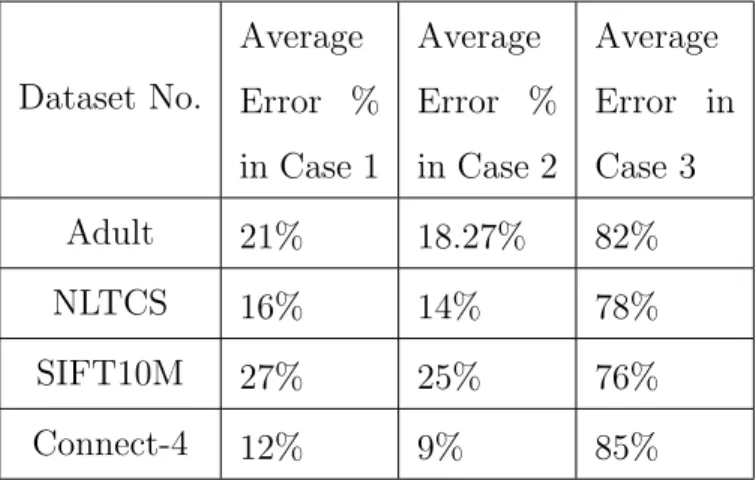
3.4 Results of SVM for each dataset . . . 57
4.1 Subgraph properties of Graph 4.1 . . . 62
4.2 Subgraph properties of Graph datasets used for evaluating PrivGraph . . . . 75
A.1 Code Example of Generating a user defined (Numerical) form of a dataset (categorical) leaving the numerical attributes as they are . . . 101
A.2 Code for Fuzzy mapping for a dataset (From the previous example) . . . 102
A.3 Code for Information Reconstruction . . . 103
List of Figures
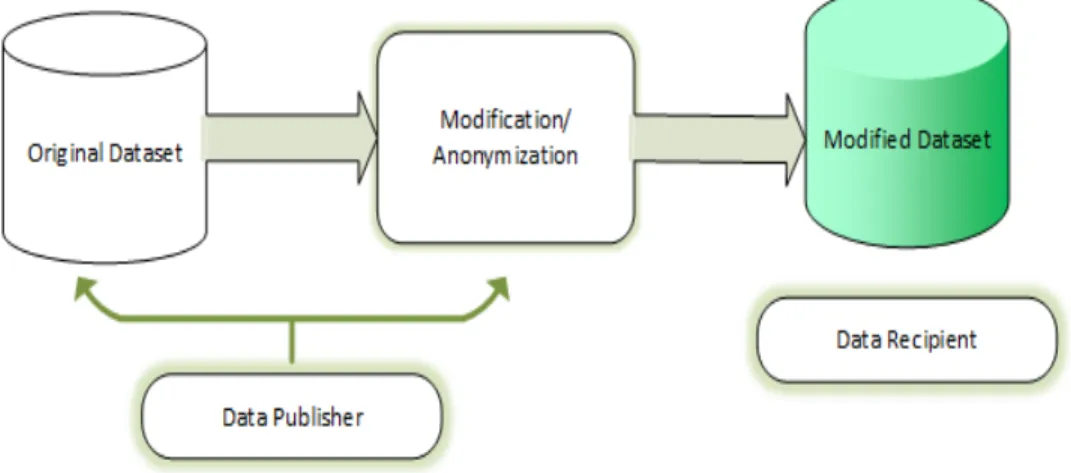
2.1 A simple PPDP model . . . 12
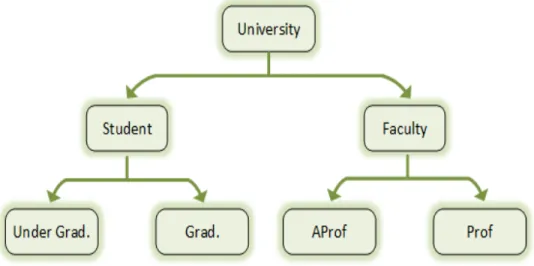
2.2 Example of Generalization using a university hierarchy . . . 16
3.1 Schematic Diagram for PrivFuzzy . . . 32
3.2 Basics of PrivFuzzy showing how 4 attributes of a dataset mapped together to generate a single attribute. . . 37
3.3 Output of PCA: For selecting related attributes. . . 47
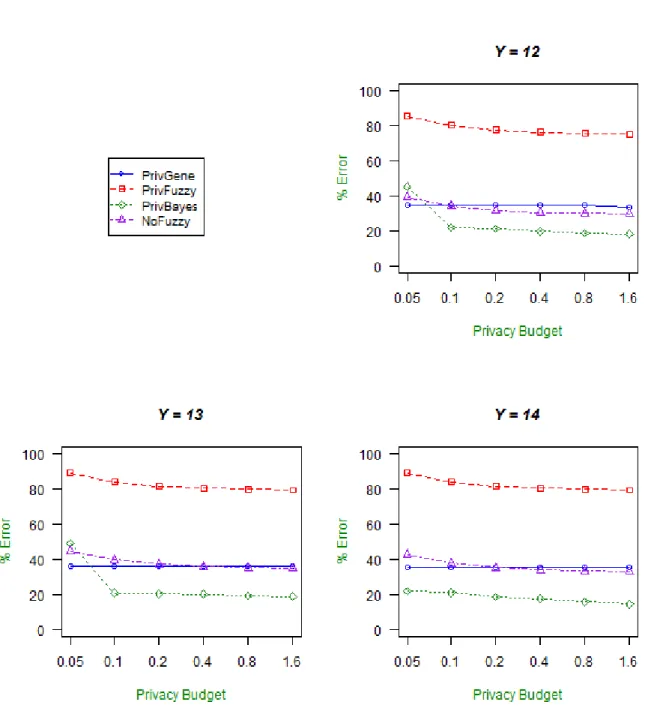
3.4 Percentage of misclassification errors for NLTCS dataset with variation of privacy budget for different privacy preserving models . . . 53
3.5 Percentage of misclassification errors for ADULT dataset with variation of privacy budget for different privacy preserving models . . . 54
4.1 Example of Global Sensitivity and Local Sensitivity in Graph. An addition of small amount of noise may change structure and query result of a graph . . . 61
4.2 Subgraph Examples . . . 62
4.3 Working Steps of PrivGraph . . . 67
4.4 Relative median error for different values of θ . . . 78
4.5 Effects of decreasing the values of θ with increasing ε. . . 79
4.6 Median Relative Error for Triangle counting based on Different Models . . . 80
4.7 Median Relative Error for K-Star counting based on Different Models . . . . 82
4.8 Median Relative Error for K-Triangle counting based on Different Models . . 83
List of Abbreviations
LOF List of Figures LOT List of Tables
PPDP Privacy Preserving Data Publishing DP Differential Privacy
SNR Signal to Noise Ratio EM Expectation Maximization PCA Principal Component Analysis SVM Support Vector Machine
Chapter 1
Introduction
Publishing a data set with preserving privacy has been subject to an extensive study over the decades. Very often we see that the owners of a database need to make their database available to all without sharing private, and sensitive information. This type of situation mainly appears at the time of revealing census data, financial data of the inhabitants of a zone or country, health profile data, company’s employee lists and so on. For each of these cases, there exists a number of users and each of the databases encounters a number of uses. Privacy-Preserving Data Publishing (PPDP) is mainly effective at the time of modeling any database to table schema, where each row collectively contains information of a human being or a subject system. Here, the primary goal is to make a portion of these data available to all by preserving the privacy of the sensitive information for each individual residing in the database. In this new era of Big Data and Cloud Computing, it is a great concern for the developers, and research question for the researchers to ensure privacy to the stored data and sensitive files in a cost-effective way. Cloud computing based systems require a good number of transactions between storage sections and application servers for performing a work. At the same time, it needs to support a lot of users too. To ensure the privacy of users’ sensitive information and publishing them to end users with preserving privacy, an efficient and cost-effective PPDP model is essential to implement.
Although a lot of systems or mechanisms are available at present to define privacy to a database, one of the present state-of-the-art mechanisms is to apply differential privacy [Dwo06] over the full database. This model provides strong privacy protection without limit-ing any assumption about notational adversary’s power even if the adversary possesses more background knowledge and reasoning power than the model itself. But applying differential privacy over any database is still a challenge to solve or overcome. The most important
challenge to mitigate is working with the high-dimensional database: a database with lots of attributes and tuples. Since the proposal of differential privacy, a lot of mechanisms have been proposed to work with differential privacy, but none of them has smoothly worked with high-dimensional database [Dwo06]. While working with Big Data it is obvious to work with data tables containing a lot of dimensions for keeping information. The reasons behind the ”challenge of Differential Privacy on Big Data” can be defined in two terms: (a) Out-put Scalability and (b) Signal-to-noise Ratio (SNR). Most of the algorithms represent the database according to its domain size which is represented as the product of cardinalities of the attributes of a database [XWG10]. In a practical scenario, many of the databases have larger domain size than the data size itself [CPST12]. Thus these databases are incompat-ible with those algorithms which work with domain size. For example, a data table of 16 attributes, where each attribute contains 10 probable values, will produce a domain size of
S = 1016 ≈ 10P B. This amount of data will cause those algorithms to work slowly, even sometimes make them unsuitable to apply, because of limitation in memory and computing hardware. In addition to that, if such a data table is considered for applying differential privacy, the addition of noise will dominate on original signal [ZCP+14] (although average
count per entry is very low). And it will make a larger portion of the data useless for further use after its release. We can explain these with a simple example. Let us consider the size of the data table under observation iss = 10M B. Now if the domain size isS = 10P B then average entry count would become s/S = 10−9. In contrast to this, differential privacy with privacy budget ε = 0.1 wants the input data magnitude to be around 10. Thus, a major portion of the published data becomes useless when differential privacy is added over the original data.
In addition to the above discussion on the regular representation of data, a large amount of related information of a dataset can easily be represented with the help of Graphs. Dif-ferent social network activities, communication patterns, disease transmission, and so on are examples of big datasets containing different sensitive data, e.g., one persons relation, age, income, marital status and so on. As a result, the release of private data with greater control is increasing day by day. At present, state of the art privacy preserving data publishing technique is Differential Privacy [Dwo06]. This model works effectively in releasing data in
form of histograms or counts since the magnitude of the statistical noise is often dominated by random variation in the data [ZCP+15]. This model sufficiently perturbs the processed
output data of a query so that information regarding the individual remains concealed from others. But this model is still not suitable to apply over big sized graph data as it generates a large amount of error on the result of a query run over graph data.
Query results over graph data are very important in the sense that it is used as input for different graph models, e.g., Kronecker Graph Models [MW12] and Exponential Graph Models [VG14]. For this reason, it is required to generate accurate query results from the given graph. But applying differential privacy mechanism on the query results perturbs the data in such a way that the resulting data become totally unfeasible to be fed to any other graph model. So, the problem presents in applying Differential Privacy over graph data while preserving their privacy is to produce a result which is strongly related to the actual result and can be applicable to any application which depends on Graph properties. For example, in a collaborative graph counting number of subgraphs such as triangle or clique can be important inputs for a graph model to figure out the communication pattern among its entities, which are important properties for describing a graph.
Although Differential Privacy provides strong support in preserving privacy while working with graph it induces noise proportional to the global sensitivity to the actual query result, by using Laplace distribution. Especially, by using random noise the direct application of it changes the original input in such a way that the input graph loses its properties. To make the Differentially Private output from a graph query more applicable, a lot of researchers to date have been working on this. Among them, Nissim et al. [KSA07] and Karwa et al. [VG14] present models which use global sensitivity to find out local sensitivity and build noise distribution from this. Local sensitivity represents a change in query answer over a graph, where one edge addition or deletion has taken place. Chen et al. [CZ13] worked on releasing a lower bound of the queried result, and its global sensitivity is very low. Hay et al. [MCGD09] designed a differentially private algorithm for releasing the degree sequence information of a sensitive graph. For defining their models’ acceptability, they worked on finding k-star from an input graph. This model works in two steps. First, it applied differential privacy over degree sequence result; Then, it applied a post-processing
step to reduce noise to achieve an almost accurate result from the query and improve the utility of the synthesized data. Finally, Zhang et. [ZCP+15] proposed an algorithmLadder
in which they have used probability distribution over the queried result, in order to maximize the utility of queried results. Here they used some additional graph properties, queried over those properties and tried to find out the most related results of the queries performed over a graph. Although all these studies on privacy preserving graph data publishing focused on probability distribution mechanisms and noise distribution based on local sensitivity, none of them has focused on reducing differential privacy error in a learning based way. The random behavior of differential privacy has generated some limitations to perform linear regression or other mathematical models for predicting low erroneous results from applied queries over the graph data.
1.1
Background Definitions
Before going into the details, in this section, we are going to discuss some terms and defi-nition we are going to use and modify in our thesis work. We are going to give some short descriptions on used terms and methods.
1.1.1
−
Differential Privacy
Let us consider a data setB which consists of sensitive information regarding users and need to be published. With Differential Privacy [Dwo06], it is required to modify the whole dataset with an algorithm Abefore publishing it in such a way that it is hard to get any information related to any entry of B from the output of the algorithm A. The general definition of Differential privacy can be stated according to the following definition:
Definition 1.1.1 (ε-Differential Privacy) If two datasetsB1 andB2 differ only in one entity
a randomized algorithm A satisfies ε−Dif f erentialP rivacy if and only if the output BO
supports the following equation
where Pr[.] represents the probability of an event occur.
1.1.2
Laplace Mechanism
In order to achieve differential privacy different differential private systems apply some kind of constrained noise to the actual query having low sensitivity [Pri]. Laplace mechanism is one of the ways to achieve differential privacy over a sensitive query result. This method applies differential private noise selected from the Laplace distribution over the query. The noise has λ as standard deviation and zero mean. Then the probability density function of such Laplace noise can be written as follows:
N oise(t) = Lap(t)∝exp
− |t|
λ
(1.2)
Now, if the actual query over a dataset, say x, is f then the differential private result after applying Laplace mechanism, ς(x) becomes:
ς(x) = f(x) +T (1.3)
where T ∼Lap(λ).
1.1.3
Exponential Mechanism
The exponential mechanism is another technique to achieve differential privacy [FK07]. Frank McSherry and Kunal Talwar developed this method. Generally speaking, any privacy meth-ods take a set comprising ofn elements as input having domainT and then map it to a range
S. The privacy methods only use an initial measure on the range S, say ζ refraining them from making any guess on the properties of actual domain and range. Now, if such methods use randomized mapping technique then the elements ofT relate to theS according to some probability distribution. After selecting the mapping technique and the initial measure, the privacy methods allocate some score using a score function to the pair (t, s), where, t ∈ Tn
and s ∈S. This score behaves as a preference or likelihood score. The privacy method then selects the pair with a higher score as the query result. By establishing the differential private
function, εεf(t), where f :Tn×S →Sis the score function, the exponential mechanism also works in this way to ensure differential privacy. Therefore, the Exponential mechanism can be formally defined as follows:
Definition 1.1.2 Let us consider a score function f : Tn×S →
S and the initial measure
over S is ζ. Then the private function becomes: εε
f(t) := Choose s with probability pr(s),
where pr(s)∝expεf(t,s)×ζ(s), t ∈Tn and s∈S.
According to this definition pr(s) increases exponentially with increased f(t, s) [FK07].
1.1.4
Expectation Maximization
According to statistical explanation, Expectation Maximization (EM) is an iterative algo-rithm which is used to find maximum likelihood estimation of parameters from a set of unobserved latent variables [DLR77]. Let us consider two unknown values of a dataset D, namely xand y. Then EM method first selects a random value for one of them, sayx. After that using the selected value ofxit computes the other,y. Finally using the computed value of y it estimates the value of x. These processes continue iteratively until a certain point arrives, where xand y converge to some predefined point.
1.1.5
Fuzzy Logic
Fuzzy Logic is one of the popular numerical value methods where the truth value of a variable can be any real number between Boolean value 0 and 1. It can also be named as many-valued logic [AV08]. It is usually used to represent any partial truth value where the truth ranges between completely true and completely false. Fuzzy Logic was first proposed by Lotfi Zadeh in 1965 as a part of Fuzzy Set Theory [Zad65].
1.2
Privacy Problems in BigData
With the advancement of technology and expansion of research areas nowadays the demand for available resources (i.e., information) is also increased. This results in an increase of the collection and usage of a large amount of data which lead us to store, use and handle big data.
For example, various Government agencies, as well as various businesses gather and generate huge quantities of data to build their budget or to invent and introduce modern techniques. Health science researchers require large quantities of data to enhance their research or to develop a new medicine. In a word, the collection and usage of big data have provided us with the chance of enhancing research over various domains. However, the increasing collection and usage of big data have also created the different privacy concerns. Often the privacy of the users is at risk of exposure. From the data generation phase to data storage phase big data suffers from privacy concerns.
The data generation can be performed in two ways: Active generation and Passive gen-eration. In an active generation, the data owner may knowingly send the data to a third party [LCJ+14]. In contrast, in passive generation phase [LCJ+14], a third party may collect the data from exploiting the browsing history or the usage history of IoT devices of the data owner. And in which case, the user may be uninformed about such a data collection. How-ever, in both of the data generation phases, the users may not be aware of the trustworthiness of the third parties and their information would be at risk of exposure. For example, often IoT devices (such as mobile phones) and support systems (such as customer care center) collect users personal data for research and quality assurance purposes and fail to protect the privacy of the data [JS16].
The data storage phase of big data also suffers from privacy concern. With the improve-ment of the technologies of data storage (e.g., the enhanceimprove-ment of cloud computing [Sim13], it is now possible to overcome the problem of storing a large amount of data. If such a system of data storage is damaged then it can cause massive destruction, since users private information might be exposed [Sim13]. And this can be more problematic in a distributed system, since such a system may comprise of applications and processes which may require numerous data tables residing in different data archives. And a breach in such system will face the challenge of preserving individuals privacy.
In addition to the above discussion, the privacy and security come together in big data. After storing the data in the cloud, the stored data suffers from the three concerns of data security, namely confidentiality, integrity, and availability [XX13]. Among these three, the first two concerns are directly allied with the privacy concern of the stored information.
The privacy of users data will be impacted directly if the data confidentiality or the data integrity is compromised [PMN16]. And the third concern: availability, indicates that the stored information should be accessible to the authorized users whenever needed [PMN16].
We can conclude that one of the primary challenges concerning big data is to preserve the privacy of its users and their stored information. This is because, once data owners store their sensitive data using third parties like cloud computing system for exploiting the advantage of big data storage, they lose their control over them. And their private data are at the risk of breach since such third-party clouds may not be thoroughly trustworthy [PMN16].
1.3
Proposed Solutions
For solving present problems of Privacy Preserving Data publishing with Differential Privacy, in this thesis, we have worked on two types of regular data representation.
• Categorical and Numerical Data
• Graph Data
1.3.1
Proposed solution for Categorical and Numerical Data
For categorical and numerical PPDP with differential privacy, we have focused on dimension reduction of given dataset preserving all of its relation and variables form. For ease of cal-culation, for categorical data, we have converted them to a unique numerical representation. For reducing the dimension of a given dataset, we have applied Fuzzy Mapping, adapted from the basics of Fuzzy Logic, and designed one algorithm to reveal data from the reduced dataset. As we worked with fuzzy logic, we named it PrivFuzzy. We have added random Laplace noise to each entity of the reduced dataset to ensure differentially private data and finally, based on the query, it replies the answer to the user with a differentially private entity.
1.3.2
Proposed solution for Graph Data
For Graph data PPDP with differential privacy, as the effect of Global Sensitivity is very high which changes the query result a lot, in this work, our main target was to improve
the utility of the differential private graph data. To achieve this, we have used Expectation Maximization method to maximize the expected utility of differentially private noisy result. We have tried to limit the generated error to a maximal threshold so that we can ensure the minimum expected utility. we named it PrivGraph.
1.4
Evaluation
For categorical and numerical data, PrivFuzzy is successful enough to reduce dataset size from 1/5 to 1/6 of its original size depending on the dimensions of the reduced dataset. It is successful enough to preserve all the relations between the entities of the dataset. After applying differential privacy in conjunction with introducing uncertainty on the dataset, it successfully responses to each query with great utility and high SVM misclassification results which ensures high privacy preserving data publishing.
For graph data publishing with differential privacy, even in the presence of global sensi-tivity, we have reduced the generated error to less than 10−3% which ensures the high utility of privacy preserving graph data publishing with differential privacy.
1.5
Thesis Organization
Rest of the thesis is organized in following way: Chapter 2describes a brief description of Pri-vacy Preserving Data Publishing mechanisms, present models, advancement and limitations of present models, acceptance of Differential Privacy in present PPDP and its limitations, Chapter 3represents our proposed solution, PrivFuzzyfor applying differential privacy for Privacy Preserving high dimensional Tabular data, its performance, and Chapter 4 briefly discusses onPrivGraph, our proposed solution for applying differential privacy with Privacy Preserving Big size Graph data publishing, its mechanisms and its performance on Privacy Preserving Graph Data publishing. Finally, in Chapter 5 we have discussed my overall contribution and some future directions of our present thesis work.
Chapter 2
Literature Review
Privacy preserving data publishing has been a crucial problem in recent years. Over the years extensive studies have been carried out in this field. In many situations, the owner of a dataset wants to release the data without exposing the private information about the owner of the data to be published. And this is a common scenario during the publication of data such as health records, census reports, financial transactions and so on, in order to use in any kind of medical or social analysis [ZCP+14] and so on. In other words, the major goal
of privacy preserving data publishing is to publish private sensitive data in such a way that it can be used in intended researches and at the same time privacy of individual information is maintained.
Over the years different models have been proposed for releasing private data without tam-pering its privacy such as K-anonymity [SS98], L-diversity [MJKV06], T-closeness [NTS07], Differential Privacy [Pri] and so on.
2.1
Privacy Preserving Data Publishing
Privacy preserving data publishing (PPDP) means publishing private data in such a way that it can be used in intended research and at the same time privacy of individual information is maintained. A simple PPDP model is shown in Figure 2.1. The whole task can be divided into two tasks: data collection and data publishing. The data publisher collects the data and applies some modification technique in order to preserve the privacy of individual information in the published data. Then the data publisher releases the modified version of the dataset to be used in intended purposes.
Figure 2.1: A simple PPDP model
publisher model.
Untrusted publisher[BKRP10] is one who is not trusted and who may try to identify and release private information of the owner of the data. Several solutions have been proposed to handle untrusted publisher. Yang et al. [ZSR05] proposed several cryptographic mech-anisms to anonymously collect data from several users without involving any trusted third party. Other efficient techniques such as statistical methods [War65], Randomized Partial Checking [MAR02] as well as anonymous communication systems (such as [Cha81]) can also be used to handle untrusted publisher. On the other hand, Trusted publisher [BKRP10] is one who is trustworthy and in which owners of the data are eager to release their infor-mation to the publisher. However, trust is not applicable to the recipient of the data. For this reason, in this thesis work, we did not consider the privacy issues about data recipient and only have worked with the privacy issues related to data publishing. Each PPDP model includes its particular prerequisites and expectations. Some of the acceptable prerequisites and expectations discussed in the literature [BKRP10,Ind14] are explained below.
The novice data publisher: The novice data publisher is only worried about the collection of data and neither intend to know about who will be the user of the data [Ind14] nor about the data mining [BKRP10]. For example, the hospitals in California publish patient records on the Web [DMC07]. The hospitals do not know who the recipients are and how the recipients will use the data. The hospital publishes patient records because it is required by regulations [DMC07] or because it supports general medical research, not because the
hospital needs the result of data mining. As a result, in this scenario, it is insensible for the data publisher to be presumed to do an additional task than making the data anonymous.
The expert data discloser can be an attacker: Another assumption in PPDP is that the expert data discloser can be an attacker. For example, the data recipient such as a medication research company is a reliable entity; however, it is infeasible to expect that all of the members of the company is reliable.
Publish data, not the data mining result: PPDP focuses on publishing individual data. This prerequisite is more inflexible than releasing the results of data mining [BKRP10,
Ind14]. For example, in the case of the Netflix data publishing, useful information may be some type of associations of movie ratings. However, Netflix decided to publish data records instead of such associations because the participants, with data records, have greater flexibility in performing the required analysis and data exploration, such as mining patterns in one partition but not in other partitions, visualizing the transactions containing a specific pattern, trying different modeling methods and parameters, and so forth. The assumption for publishing data and not the data mining results is also closely related to the assumption of a novice data publisher. For example, Netflix does not know in advance how the interested parties might analyze the data. In this case, some basic ”information nuggets” should be retained in the published data, but the nuggets cannot replace the data [BKRP10, Ind14].
Trustworthiness in data: Sometimes it is essential that each and every published data can be correlated to an actual individual. For example, in case of the patient health record, the data recipient such as an antidote researcher may need to investigate the actual patient data in order to find some previously undiscovered side effects of the tested medicine [Ema06]. If a released data cannot be related to an actual patient, it would be hard to apply results of the experiment in the physical world.
2.2
Privacy preserving approaches
The main idea of Privacy Preserving Data Publishing is to publish data in such a manner that the individual information will not be revealed. Sweeny [Swe02] says that the individual information is stored in the form of a relational database such as a table of some attributes
and some records which can be of any form such as Quasi Identifier [Ind14, ide], Sensitive Attribute [Ind14, YYC+09, SA], Non-Sensitive Attribute [Ind14] and so on. Different
ap-proaches have been developed in order to satisfy PPDP [SP14, YMJY09]. Following are some of the approaches used in developing PPDP model.
2.2.1
Privacy preserving based on Randomization
In general, Randomization can be defined as a process which can be used to make something random [Ran]. It is also an ability to make an entire database anonymous in order to maintain certain semantics [SP14]. Randomization is considered as a key technique in PPDP which provides prior knowledge as well as maintains the stability in utility and privacy [SP14,MPA13]. In order to achieve this stability, noise is added to the data. In other words, in order to obtain PPDP model, randomized data distortion techniques are used by many researchers. Several researchers use randomization to mask the record and try to make the private data invisible by making some moderate version of the attribute values randomly [HHSK03]. The primary benefit of privacy preserving based on randomization is its simpler nature [CP08]. Randomization also does not need to know about the distribution of other entries in the attributes [CP08]. As a result, it can be developed during the time of collection of data and the anonymization process can be performed without using a trusted server [CP08]. Besides its benefits randomization technique also has some problems. Randomization treats all attribute values equally without taking into account the local density of the data. As a result, the outlier data are vulnerable to adversarial attacks than attribute values in more dense regions in the data [CP08, Agg07] which decreases the data utility.
2.2.2
Privacy preserving based on Encryption
Data privacy can be achieved to a higher extent by applying cryptography based PPDP method [MPA13]. Encryption techniques can be used to ensure the security and integrity of the transferred data.
2.2.3
Privacy preserving based on Clustering
Clustering is a process of grouping entities in a dataset in such a way that entities from the same group are more similar to each other than entities from other groups based on some predefined grouping criteria [Hua98]. Various PPDP models have been proposed based on clustering. Ji-Won et. al [JAEN07] proposed a model in order to reduce the loss of information and to maintain better quality in data. The main concept here is to group the similar data in an equivalent class. In order to obtain anonymity [GFK+06], every cluster
must comprise a predefined number of data values. Oliveira and Za¨ıane [SO03] proposed a family of geometric data transformation methods to anonymize the private numerical data. In order to achieve PPDP, Qiong et. al. [QYQ08] divided the data using de-clustering and constrained the data in each group to be possessed distinct sensitive values, as well as [QYQ08] ensured that the size of the minimal groups must be greater than or equal to a threshold value. Two of the various benefits of these proposed methods based on clustering is that they all play a vital role in achieving high accuracy and availability [YMJY09]. Besides its’ several key benefits, privacy preserving based on clustering has some problems as well. Experiments with natural data show that the quality of the cluster resulting from maintaining the structure of the cluster in anonymization step is better than that of anonymized data without preserving the structure of the cluster in anonymization step [BKLP09]. But the key challenge of anonymization for clustering is having insufficient class labels in order to guide the anonymization process [BKLP09].
2.2.4
Privacy Preserving based on Suppression
Data anonymization can be performed using suppression technique. Suppression is used to hide description of a table [LSS02]. Suppression can be used to anonymize the distinct attribute values and their description such as Quasi Identifier [SP14, BKRP10]. Different researchers have proposed different suppression techniques. Researchers in literature [RR05,
Iye02,KDR05,Sam01,TN06] used Record or Tuple level suppression which can be defined as suppression or elimination of an entire record [BKRP10]. Researchers in literature [KBP07,
instances of a given value in a table [BKRP10]. Cell suppression [LSS02, Cox80, AR04] can be defined as suppression of some instances of a given value in a table [BKRP10]. Suppression replaces some values with a special value and shows that value of an attribute in a table is not revealed.
2.2.5
Privacy Preserving based on generalization
Figure 2.2: Example of Generalization using a university hierarchy
Generalization is often used to anonymize data. Generalization can be formally defined as follows:
Definition 2.2.1 (Generalization) ”A generalization is defined as a broad statement or an idea that applies to a group of people or things.”
Definition 2.2.2 (Generalization) ”A generalization is a concept in the inductive sense of that word or an extension of the concept to less-specific criteria.”
, In order to achieve data anonymization generalization, is used to substitute a value by its parent in the architecture or by some other value. There are different types of generalization techniques which are often used by different researchers.
• Full domain generalization [BKRP10, Swe02, KDR05, Sam01]: Full domain generalization is also known as global generalization. Full domain generalization gener-alizes all values in an attribute to the same level of the tree structure. For example, in
Figure 2.2, if Undergrad and Grad are generalized to Student then AProf and prof will also be generalized to Faculty. This scheme contains small search space but it suffers from largest data distortion [BKRP10]. It is easier to apply queries on any full domain generalized dataset.
• Subtree generalization [BKRP10, RR05, Iye02, KDR05, BKP07, BKP05]:
Sub tree generalization generalizes either all child or none at any node other than leaf node. For example, in Figure 2.2, if Undergrad is generalized to Student then according to Sub tree generalization Grad must be generalized to Student, but, AProf and Prof can be left ungeneralized.
• Sibling generalization [BKRP10, KDR05]: Sibling generalization follows similar generalization technique as Subtree generalization. The only difference between these two is that in Sibling generalization may leave some siblings ungeneralized. For exam-ple, in Figure 2.2, if we use Sibling generalization, then prof is generalized to Faculty while AProf may be left ungeneralized. This generalization technique suffers from less distortion than that of the above two methods.
• Local Generalization: Local generalization is also known as cell generation [BKRP10,
KDR05, KB06, JWJ+06]. All of the above generalization techniques are examples of Global generalization to some extent. Local Generalization differs from Global gener-alization in such a way that in this genergener-alization attribute values can be generalized to different levels. For example, in Figure 2.2, Prof may be generalized to Faculty in one tuple of the dataset and may be left ungeneralized or suppressed in other tuples. This method results in less deviation of data than other methods since it experiences more flexibility than those of the Global methods [BKRP10]. Apart from its benefits this flexibility negatively affects the data utility which in turn creates a problem in queries. Data generated from application of Global generalization methods do not face this type of problem.
• Multidimensional Generalization [BKRP10,NP11, KDR06a, KDR06b]: Let
as a function fi :DXi →D
∗ for each attributeX
i in the dataset. On the other hand, a
multidimensional generalization can be shown as an functionf :DX1×···×DXm →D
∗,
which can be used to generalize A = (a1,· · ·, am) to A∗ = (b1,· · ·, bm) where either
ai = bi or ai is a child node of bi in the tree structure of Xi. For example, (Grad,
MSc) can be generalized to (Grad, Any Type) and (Grad, PhD) can be generalized to (Student, PhD) because tree structure (Figure 2) contains both Grad and student. Multidimensional generalization experiences less deviation in data than that of Full dimensional and Subtree generalization.
• Set Partitioning (SP) [TN06]: In Set Partitioning (SP) generalizations does not require a pre-specified ordering of the data record and the entire data can be partitioned into different sets where each set represents a generalization.
• Guided Set Partitioning (GSP) [TN06]: Semantic relationship is not included in Set Partitioning. In order to include semantic information in set partitioning Guided Set Partitioning is proposed [TN06]. According to this method if two attribute values from two different groups are generalized to some value t then all attribute values in that two groups also have to be generalized to t.
• Guided Ordered Partitioning (GOP) [TN06]: In this generalization method if two values: a and b where a <b from two different groups are in the same partition Y then any value between the least element in a ∈ S group and the largest element in b
∈ S group must also be in Y [TN06].
2.2.6
Privacy Preserving based on Anatomization
Xiao and Tao [XY06a] propose a model using anatomization. In this method, data privacy is preserved by using two different tables for releasing Quasi Identifier and Sensitive attributes. Anatomization generates two tables directly from the data namely Quasi Identifier Table (QIT) and Sensitive Table (ST) where QIT holds the values of Quasi Identifier and ST contains the values of Sensitive Attributes and does not modify the values of Quasi Identifier and Sensitive attributes. Xiao and Tao [XY06a] demonstrate that since Anatomization does
not modify the values of Quasi Identifier and Sensitive attributes these two tables can produce more correct results of aggregate queries.
2.2.7
Privacy Preserving based on Permutation
Zhang et. al. [QNDT07] propose a PPDP model which preserves privacy using permutation that shares the concept of anatomization. In this method, the key idea is to divide the data into some groups and then rearrange the values among every group [BKRP10].
2.2.8
Privacy Preserving based on Perturbation
Privacy in data publishing can be achieved using the perturbation method. In this method, the key idea is to generate a synthetic data from the original data in such a way that the resulting data after applying perturbation method does not vary much than the underly-ing information which can be learned from the data without applyunderly-ing perturbation method [BKRP10]. Since the published data is a synthetic form of the natural data one of the key benefits of this method is that an attacker cannot reveal the private information by getting the published data [BKRP10].
2.2.9
Privacy Preserving based on Data Swapping
PPDP can be achieved using data swapping. In this method, anonymized data is generated by swapping the sensitive values among the entire data table. The numerical attributes [SMT82] and categorical attributes [Rei84] can be preserved using data swapping. The key advantage of data swapping is that in this method lower order marginal are preserved and are not perturbed and as a result, aggregate computations can be applied without revealing private information [CP08]. An alternate method to data swapping is rank swapping. In rank swapping the values of a sensitive attribute W is ranked and arranged in an ascending manner and then ranked values are swapped among each other randomly within a restricted range [BKRP10]. Rank swapping is applied on each value in the original record.
2.3
Privacy models
Privacy preserving data publishing has been the key focus of many researchers over the years which requires extensive study. One of the key questions here is ”why preserving privacy is so crucial?” In order to answer this question, we can look back to the research and development which have been made in recent years in different areas from daily life to government policy-making, medication, statistics and so on. All of these development requires decision making which in turn needs to access available information. More realistic data can help in making a better decision. For example, a medical research organization may require real data in order to find the side effects of a tested drug. Therefore publishing natural data is necessary. However, the data to be published may contain sensitive information about a particular person releasing of which may violate the privacy of that person. Therefore it is crucial to preserve the privacy of sensitive information. Preserving privacy is also crucial in utilizing data effectively. In order to achieve privacy preserving data publishing (PPDP), different researchers have proposed different models.
2.3.1
K-Anonymity
K-Anonymity is a property of anonymized data [SS98].
Definition 2.3.1 ( K-Anonymity) ”Let T ( D1,· · ·, Dn ) be a table and QT be the Quasi
Identifier corresponded to T. Now, T is said to satisfy K-Anonymity if and only if each sequence of values in T [QT] appears with at least k occurrences in T [QT] [12]. And T is
called K-Anonymous.”
While working with large data different problems arise. K-Anonymity can be used to solve these problems. Generalization can be applied on K-Anonymity in order to anonymize the real value of a sensitive attribute [Agg05]. K-Anonymity combined with perturbation method can work satisfactorily with the aggregated distribution of a particular entity than working with the inter-attribute relation of that entity [SP14]. Gaussian clustering and 2-anonymity have been proposed on K-2-anonymity which can assure PPDP by computing the probability and assigning zero as its value [Agg05].
2.3.2
K
m-Anonymity :
He et. al. [YJ09] propose Km-Anonymity for using in set-valued in the more general
trans-actional database. According to Li et. al. [TNJI12] Km-anonymity can be used to protect a transactional database from an attacker who knows almost m entries in a transaction. In order to get better performance, various anonymization technique can be applied on Km
Anonymity. For example, generalization technique can be applied on Km-Anonymity in
or-der to provide protection to the set-valued record [SP14]. If we consider k-1 transactions then the similar transaction may occur again. In order to indicate how many transactions have been made Km-Anonymity uses local generalization technique in a top-down manner
[SP14, YJ09]. In order to make the cluster of identical items from a set-valued database in a top-down fashion set partition methods can be used along with the Km Anonymity [YJ09].
Km Anonymity may help in protecting the privacy of a transactional database from being
exposed by an attacker who may identify m items in the database.
2.3.3
Distributed K-Anonymity framework
K-Anonymity re-identify the data in less than a set of K items in order to preserve pri-vacy. The key assumption here is that data is released from a single source of data and generalization is then applied to anonymize data by replacing it by some specific values. In order to protect the sensitivity of data in practice data from more than one source cannot be shared directly [WC06]. Jiang and Clifton [WC06] propose distributed K-Anonymity to solve this problem by using a global unique identifier without exposing its identity. Jiang and Clifton [WC06] use commutative cryptography in order to encrypt the global identifier. They design a secure 2-party framework in order to use in their experiment as an instance of multiparty computation. Distributed K-Anonymity framework provides a secure 2-party framework where those two parties are required to be semi-honest [WC06].
2.3.4
K-Anonymity Clustering
One of the key expectations of K-Anonymity is to minimize the loss of information due to the modification of data. This loss of information can be reduced using clustering [JAEN07].
Hierarchical clustering is particularly used to make a database K-Anonymous among other clustering techniques [JAEN07]. Chiu and Tsai [CC07] propose a K-Anonymity clustering model using Weighted Feature C-means Clustering (WF-C-means) which can be used to diminish the distortion of information. WF-C-means divides the data into some equivalent clusters and it also solves the problem of weight adjustment which is not possible by C-means algorithm [CC07]. After using WF-C-means algorithm the model [CC07] uses a class merging technique which merges legal equivalent groups with illegal ones in order remove the illegal ones. The key benefit of K-Anonymity clustering is that this method maintains efficiency in computations along with scalability [CC07].
2.3.5
l-Diversity
K-Anonymity is a useful method to make a database anonymous. But it often suffers from homogeneity attack and background knowledge attack [MJKV06, AJDM06]. Homogeneity attack implies that if a situation arises where all values of a sensitive attributes are the same in a set of k entries then those values can be predicted even from K-Anonymized data [SS98] where background knowledge attack implies that it is feasible to assume the values of a sensitive attribute by associating it with the values of one or more quasi-identifier [MJKV06]. In order to solve the problems, associated with K-Anonymity, Ashwin et. al. [AJDM06] propose a model namely l-Diversity which is an extension of K-Anonymity. This model preserves privacy by obtaining the minimization in data granularity [MJKV06]. l-diversity uses generalization and suppression in order to minimize the granularity of data [MJKV06]. Intra-group diversity is used in this model along with data anonymization [MJKV06]. The key assumption here is that the sensitive values are represented in a well manner over the groups in a data record [AJDM06].
2.3.6
t-closeness
l-diversity is useful in handling the problems such as homogeneity attack and background knowledge attack [MJKV06,AJDM06] associated with K-Anonymity. This model minimizes the data granularity [MJKV06] which in turn may contribute to the reduction of effectiveness
of data mining algorithms [NTS07]. Another problem with l-diversity is that it does not take into account the underlying distribution of values [NTS07] while in practice the natural data may show some semantical equivalency. Nonetheless, K-Anonymity and l- diversity cannot avert disclosure of sensitive attributes [AR12]. In order to solve all of these problems, t-closeness has been proposed. This model is an extension of l-diversity model which works with the sensitive attributes values by considering the underlying distribution among the values. Li et. al. [NTS07] define t-closeness formally as follows:
The t-closeness Principle: ”An equivalence class is said to have t-closeness if the distance between the distribution of a sensitive attribute in this class and the distribution of the attribute in the whole table is no more than a threshold t. A table is said to have t-closeness if all equivalence classes have t-closeness.”
According to Aggarwal and Yu [CP08] in the formal definition of t-closeness [NTS07] the threshold t provides an upper bound on the differences of the distribution of the values of a sensitive attribute from the global distribution of values. In order to deal with numeric at-tributes, applying t-closeness is more advantageous than many other PPDP methods [CP08].
2.3.7
R-U Confidentiality Map
Data anonymization may minimize the data utility gain [SP14]. In order to increase this gain, the balance should be maintained among the two key factors Risk (R) and Utility (U). Here R represents the statistical disclosure risk with some numerical values and U represents the usefulness of published data to a legal user of the data with some numerical values [GSS01]. U is represented as a distortion measure when it is used to show the differences between real data and anonymized data [SA03]. The R-U confidentiality map can be used to examine the tradeoffs among the disclosure risk and the data utility. In any PPDP model sensitivity of a private data can be preserved by guarantying security, anonymity, and confidentiality.
2.3.8
Slicing
Slicing is another well-recognized technique in generating anonymized data. Slicing divides the data vertically as well as horizontally [TNJI12]. Li et. al. [TNJI12] develop slicing
model by taking into account two popular anonymization technique namely Bucketization and Generalization. Slicing performs better than generalization since it can work well on data with a high dimension which is not possible with generalization [TNJI12]. It also preserves data utilization better than generalization. Slicing also operates well with a sensitive attribute than bucketization [TNJI12]. Slicing also outperforms bucketization in providing protection against threats to the privacy preserving. Slicing provides protection against membership disclosure threats which is not possible using bucketization method [TNJI12]. Slicing also preserves the correlation among sensitive attributes [SP14].
2.3.9
Overlapped Slicing
Jayanthi et. al. [DB13] propose overlapped slicing. Overlapped slicing can duplicate a sensitive attribute in several columns [SP14]. Then each column can contribute in several attribute correlations [DB13]. Like slicing [TNJI12] overlapped slicing divides the dataset into both vertical and horizontal set by duplicating the attributes in several columns. In the horizontal set, each tuple is grouped together while in vertical set attributes are correlated [SP14]. Sensitive Attribute values can be positioned in every column of the data record [SP14]. Then random permutation can be performed on columns holding sensitive attribute [DB13]. Overlapped slicing also provides protection against membership disclosure like slicing by differentiating the real record from the fake ones where the risk of disclosure arises [SP14]. However, since overlapped slicing results in attribute correlations more than slicing privacy loss may take place to some extent [SP14].
2.3.10
ε
−
Differential privacy
Dwork [Dwo06] proposes a privacy preserving data publishing model called ε-Differential privacy. She proposes that by making the data available for an intended research the risk of revealing privacy of the owner of the data should not be enhanced. Dwork [Dwo06] proposes that ε-differential privacy model can assure that the result of any analysis will not be affected much as a result of adding or deleting a single tuple from the statistical dataset. This model also follows that even if several datasets are joined there will be no disclosure risk.
ε-Differential privacy model also claims that the outcome of any techniques of anonymizing data will not differ much whether the owner of the data gives the real data to the publisher [BKRP10].
2.3.11
Distributional privacy
Blum el. al. [AKA08] propose a PPDP model called distributional privacy. The main concept of this model is that when a record is selected from a distribution the only information that record exposes should be about that distribution [BKRP10]. Distributional privacy is more efficient than differential privacy [BKRP10]. However, such model [AKA08] can only answer the queries with a few constraints. More research should be performed to answer queries with more complicated constraints.
2.3.12
FF-Anonymity
In practice, the key assumption of all of the PPDP model is that the data to be published can be divided into Sensitive attribute and Quasi Identifier attributes. But if a situation arises when an attribute has sensitive values as well as identifying values then this assumption fails. Wang et. al. [KYAR09] identify a new attack known as freeform attacks and propose a model known as FF-Anonymity. They define freeform attack as follows:
Definition 2.3.2 (Freeform attack) ”Assume a published table T*. Given a threshold σ0
on observability, a freeform attack with respect to T* has the form A → b, where b is a non-observable value in Cut(M, T*) for some attribute M and A is an observable value set in Cut+(U −M, T*).”
FF-Anonymity [KYAR09] can solve this type of freeform attack by forcing the formA→b
to remain below a given threshold value [BKRP10].
2.3.13
Personalized Anonymity
Xiao and Tao [XY06b] propose a PPDP model using personalized anonymity in order to provide each data owner the ability to indicate their individual degree of privacy protection.
The key assumption in this model [XY06b] is that each sensitive attribute has a taxonomy tree and that each data owner defines a guarding node in that tree. If an adversary can learn about the sensitive values within the subtree of the data owners guarding node with breach probability more than a predefined value. Guarding node and breach probability can be defined [XY06b] as follows:
Definition 2.3.3 (GUARDING NODE) ”For a tuple tεT, its guarding node t·GN is a node on the path from the root to t·As in the taxonomy of As.”
Definition 2.3.4 (BREACH PROBABILITY) ”For a tuple tεT, its breach probability Pbreach(t) equals the probability that an adversary can infer from the published table T∗ that any of the associations {o, v1},· · ·,{o, vn} exists in T, where v1,· · ·, vn are the leaf values in
the subtree of (t·GN).”
2.4
Attacks on different Privacy models
For getting access to private data, attackers try to attack privacy models in various ways. Privacy models can be differentiated in two separate classes according to ways of attack on them.
First category of models is consisting ofLinkage attacks where attackers try to build up a link between data table of different records which are already published or sensitive data and owner of records. We can name them as record linkage, table linkage and attribute linkage respectively. Usually, in all of these attacks attacker knows the Quasi Identifier of the owner. In second category attackers have an intention to gain more information along with avail-able background knowledge in the published record. This can be classified as a probabilistic attack if the difference between attackers prior and post beliefs are found.
Different types of attacks on privacy models are given below:
• Record Linkage:
In record linkage attackers try to match a value with values at a table and try to find out message or storage related to that value. This message is usually called group
message. In this attack, there is a probability to identify a victims record perfectly with help of additional information or knowledge.
• Attribute Linkage:
Attack that is performed with help of linking an attribute of record is considered as Attribute linkage. Through this process, an attacker may not get all the records but he/she might get some sensitive information regarding Victims’ associated group.
• Table Linkage:
In table linkage attackers are able to find out all types of information stored in a table related to the victim. Both record linkage and attribute linkage are combined in table linkage.
• Probabilistic Linkage:
This type of attack is not directly linked with the record, attribute or table of a record. Except these, probabilistic type attack mainly deals with attackers’ belief on sensitive data of a record which is already published and analyzed by the attackers. This type of attack briefly can create a difference between prior belief and posterior beliefs of data to an attacker.
2.5
Threats to privacy
Publishing a private data may suffer from different types of privacy threats. During the publishing of private data especially microdata the published data may suffer from following types of disclosure threats.
2.5.1
Membership disclosure
Membership information can reveal the identity of an entity from the published data. There-fore, it is crucial to avert an attacker from knowing whether a particular persons’ data is in the published table. This is more necessary especially when data is collected from a wide
range of population based on some sensitive criteria [TNJI12]. And this particular threat to published data is known as Membership disclosure.
2.5.2
Identity disclosure
Another threat to published data is Identity disclosure [TNJI12]. In practice, most of the time a single person is related to a particular record in the published data. If a persons identity is exposed then his corresponding private information will not be private anymore. Identity disclosure can be protected by protecting membership disclosure only when the membership information is unknown to the attacker. If the attacker is certain about the membership of an individual in a published record then protecting membership disclosure may not be applicable or it may be insufficient in protecting identity disclosure.
2.5.3
Attribute disclosure
Another threat to published data is attribute disclosure [TNJI12]. It may occur if the pub-lished data helps in exposing the value of a sensitive attribute of a particular person more than it would possible from the unpublished data. Attribute disclosure is closely related to identity disclosure and membership disclosure. If the identity of a person is exposed then the value of the sensitive attribute related to him/her is also exposed. However, exposing of an attribute value can happen whether the identity is exposed or not especially when the value of the sensitive attribute is identical in each of the matching records.
2.6
Preliminaries
Quasi Identifier: ”Quasi-identifiers are pieces of information that are not of themselves unique identifiers, but are sufficiently well correlated with an entity that they can be combined with other quasi-identifiers to create a unique identifier [ide].”
Sensitive Attribute: ”The attributes of a database whose values the owner of the database does not want to be revealed are known as sensitive attribute [SA].”
intent is privacy protection. It is the process of either encrypting or removing personally identifiable information from data sets so that the people whom the data describe remain anonymous. Using this process we can enhance the information transfer among entities e.g., between two branches of a company while minimizing the chance of unintended disclosure in such a way that it ensures post-anonymization as well as evaluation [ano].”
ε− Differential privacy ”A randomized algorithm X is ε− differentially private if for all datasets D1 and D2 that differ on a single element (i.e., data of one person), and all
S ⊆Range(X),
P r[X(D1)∈S]≤eε×P r[X(D2)∈S]
where the probability is computed based on the random nature of the algorithm and
Chapter 3
PrivFuzzy: A Fuzzy Based Privacy
Preserv-ing Data PublishPreserv-ing Model
In this chapter, we present a fuzzy logic [Zad65, Zad97] based privacy preserving data publishing (PPDP) model which is light-weight and solves the problem of publishing differ-entially private high-dimensional data in an easier and simpler way. Unlike previous studies with differential privacy, we have tried to estimate low-dimensional data set from the original data, without losing any relationships among attributes. And we have tried to do this with the belief that, for any approximation, the resulting data set will maintain high accuracy for both non-linear and linear queries. At the same time, when approximating low-dimensional data we tried to generate uncertainty among the data sets in the belief that this generated uncer-tainty will behave as injected noise in database [Oak13]. This addition of uncertainty before injectingLaplacenoise of differential privacy will result in a model that might outperform the available models for PPDP by increasing the prediction error, and thus, strengthening the privacy of it. Besides, our model preserves the utility of the noisy data for intended analysis performed by a trusted curator (a trusted and authorized person responsible for both storing the sensitive database and answering the counting queries) by minimizing the Laplace noise added to the sensitive data. We have developed our model as query-independent, so any type of queries can be evaluated on the same set of the database.
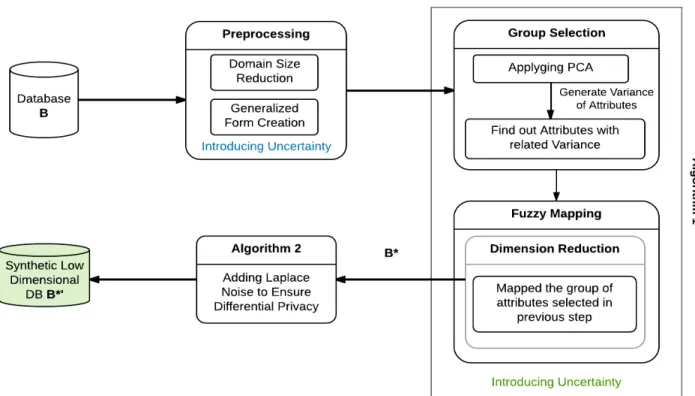
Figure 3.1: Schematic Diagram for PrivFuzzy
Therefore, our model consists of three steps: (1) Pre-processing step to prepare the origi-nal dataset for applying our PrivFuzzy model, (2) Fuzzy mapping step to apply our modified fuzzy mapping technique to convert the high dimensional dataset to a lower dimensional one and, (3) Final step to apply Laplace noise to ensure differential privacy over the lower di-mensional dataset. For evaluation purposes, we have worked on the low-didi-mensional dataset (generated from the execution of our model on a given high-dimensional dataset) to avoid signal to noise problem. And this work is done implicitly, to avoid the scalability problem. For evaluating our work, we have shown a comparison in terms of misclassification error, resulted from the application of multiple Support Vector Machine (SVM) classifiers, with closely related state of the art models, PrivGene [ZXY+13] and PrivBayes [ZCP+14]. We have selected these two models since they are two state of the art models. PrivBayes also did the conversion of high-dimensional datasets to lower ones. Besides, this model is also query-independent. We have shown an extensive evaluation on the strength of synthesized data sets in preserving privacy, generated from PrivFuzzy on both linear and non-linear queries. From this comparison, we have been success
![Table 3.1: Datasets selected for validating PrivFuzzy Dataset Name Data Type No. of Attributes Adult [Lic13a] Multivariate 14](https://thumb-us.123doks.com/thumbv2/123dok_us/374476.2541281/54.918.244.671.232.402/table-datasets-selected-validating-privfuzzy-dataset-attributes-multivariate.webp)