Metropolitan Highway System |
FY2013-FY2017
Capital Maintenance Program
TABLE OF CONTENTS
Summary and Introduction 1
Capital Maintenance Program FY2013-FY2017 13
Estimating Cost and Schedule 20
Capital Maintenance Program Projects by MHS Facility 24
Central Artery/Tunnel 24
Sumner / Callahan Tunnels 27
Central Artery North Area (CANA) Tunnel 29
Boston Extension 30
Tobin Bridge 32
MHS Wide Projects 34
LIST OF FIGURES
Figure 1 – Metropolitan Highway System by Facility 1
Figure 2 - Capital Maintenance Program Summary Percentage of Costs by Facility 3
Figure 3 – MHS 5-Year CMP Construction Costs 5
Figure 4 – Central Artery / Tunnel Facility 7
Figure 5 – Sumner / Callahan Tunnels Facility 8
Figure 6 – CANA Tunnel Facility 9
Figure 7 – Boston Extension Facility 10
Figure 8 – Tobin Bridge Facility 11
Figure 9 – Central Artery / Tunnel Percentage of Costs by Class 24
Figure 10 – Sumner / Callahan Tunnels Percentage of Costs by Class 27
Figure 11 – CANA Percentage of Costs by Class 29
Figure 12 – Boston Extension Percentage of Costs by Class 30
Figure 13 – Tobin Bridge Percentage of Costs by Class 32
Figure 14 – MHS Wide Percentage of Costs by Class 34
LIST OF TABLES
Table 1 – Summary of Capital Project Costs 4
Table 2 - MHS Condition Rating Scale 16
Table 3 - Comparison of S2S and Massport Rating System to NBIS Rating System 17
Table 4 – CA/T Facility Capital Projects Estimated at Greater Than or Equal to $5 Million 25 Table 5 – Sumner/Callahan Tunnels Facility Capital Projects Estimated at Greater Than or Equal to $5 Million 28 Table 6 – CANA Tunnel Facility Capital Projects Estimated at Greater Than or Equal to $0.75 Million 29 Table 7 – Boston Extension Facility Capital Projects Estimated at Greater Than or Equal to $5 Million 30 Table 8 – Tobin Bridge Facility Capital Projects Estimated at Greater Than or Equal to $2 Million 32 Table 9 – MHS Wide Capital Projects Estimated at Greater Than or Equal to $2 Million 35
APPENDIX
Summary and Introduction
MassDOT is responsible for the safe and efficient operation of one of the most important elements of the Massachusetts transportation network, the Metropolitan Highway System (MHS). The MHS serves hundreds of thousands of motorists every day, including commuters traveling to work, truckers moving goods into and out of the state, and visitors who come to enjoy our state's many cultural, recreational, and historic attractions. Constant wear with increasing traffic, harsh New England weather, and the increasing age of a portion of the MHS all make it essential that a strategic plan be in place to ensure that the sound condition and effective operation of this infrastructure are maintained. This Capital Maintenance Program (CMP) was developed to set forth projects required to achieve that broad goal.
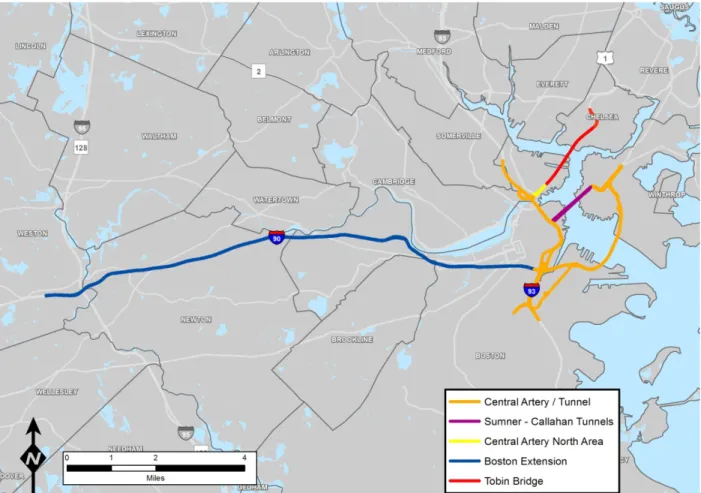
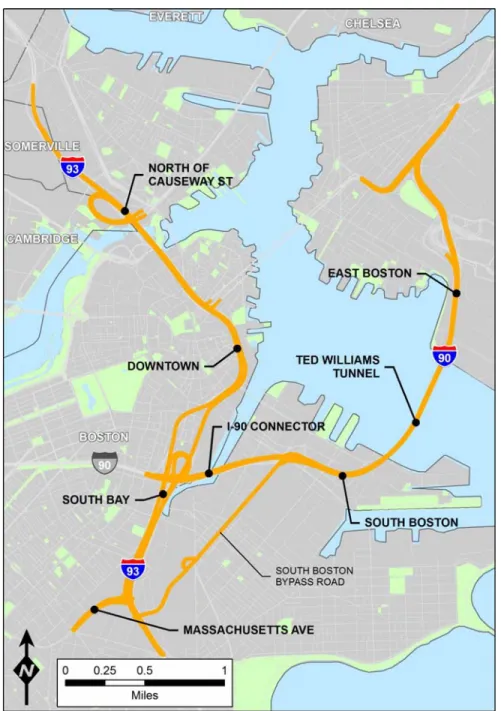
The Metropolitan Highway System (MHS) is a system of roadways, tunnels, bridges and appurtenant support facilities that are owned and operated by the Massachusetts Department of Transportation (MassDOT). The MHS system includes portions of some transportation facilities that were under the jurisdiction of other agencies at an earlier time. Those agencies include the Massachusetts Port Authority (Massport) and the former Massachusetts Turnpike Authority (Masspike). The MHS system, organizationally within the recently created District 6 of MassDOT, includes five distinct, interconnected transportation facilities. These facilities are shown in the following figure.
These combined transportation facilities are key components of the regional highway transportation network serving metropolitan Boston. They include relatively new, as well as aging, tunnels, highways, bridges and buildings. These transportation facilities have a complex system of supporting infrastructure which includes, for example: tunnel ventilation systems with heavy machinery and high-voltage electrical systems housed in a number of separate vent buildings; drainage systems, including pump stations with mechanical equipment, networks of piping and generators; and a number of building structures that support highway operations, toll operations, maintenance and State Police activities.
Each of the MHS facilities and the associated supporting infrastructure have unique needs to keep them operating safely, efficiently and maintained to a state of good repair throughout their expected service life. The MHS facilities are subject to a wide range of operating conditions. These conditions include damp, corrosive environments; vehicle exhaust which coats tunnel surfaces with a layer of carbon residue; severe winter conditions, including exposure to deicing agents, freeze/thaw cycles and snow plowing operations; vibration from heavy traffic loadings and machinery; and unanticipated events such as over-height vehicles and vehicle collisions, all of which have impacts on the infrastructure.
This Capital Maintenance Program (CMP) has been prepared to document planned and on-going projects throughout the MHS system in order to focus the resources required to bring the system into a state of good repair. This CMP has identified projects that MassDOT intends to undertake, maintain and, in some cases, improve the overall integrity and safety of this vital transportation network. New projects and maintenance needs were developed after a review of inspection data, staff requests, and site visits. This document will serve MassDOT as a tool to program and prioritize capital projects going forward based on:
1. Condition-based deficiencies using the extensive data collected by various regular and special inspections
conducted by MassDOT of all MHS facilities
2. Programmed projects developed by MassDOT that address preventative maintenance; maintain and/or
extend the service life of an asset; and/or improve the overall integrity and safety of the MHS facilities
3. On-going initiatives by MassDOT (Special Projects) to address certain deficiencies within the I-90 and I-93
Tunnels. These Special Projects address the anticipated needs of five specific issues, including:
Overhead tunnel roadway lighting fixtures
Safety/emergency egress railing
Water infiltration into tunnels
Ground freezing around I-90 Tunnel in the vicinity of South Station
I-90 Connector Tunnel Super Plug
4. Address remaining long-term maintenance items identified in the Stem to Stern Safety Review
This five year CMP is intended to coordinate, enhance and consolidate current procedures for programming projects throughout the MHS system. This CMP contains a list of pre-existing and newly proposed projects that are intended to bring the MHS system to a state of good repair. These are projects that are intended to improve the condition and maintain the continued functioning of these agency assets. This CMP was produced by collecting and reviewing recent inspection reports (including condition ratings) and other technical data regarding observed deficiencies reported by the many inspectors involved with MassDOT’s inspection program. These inspections were performed by various engineering firms, as well as by MassDOT’s own forces.
In addition to the available written information, numerous meetings and work sessions were held by MassDOT personnel from the Engineering, Construction, Facilities, Maintenance and Operations Departments to discuss current and potential future needs, as well as to identify other projects that are being contemplated. These meetings were held at various times starting with the initiation of this CPM process and throughout the development of this document.
This CMP should be considered a living document in that it will be regularly updated and revised as various projects are completed and as new projects are added or combined.
This CMP includes all capital project expenditures associated with the MHS to be programmed to occur over the five year period from FY2013 – FY2017 as listed in the Appendix. This will serve as a work plan for MassDOT as the basis to identify the resources needed to support its implementation. The Appendix includes condition-based projects as well as projects that enhance the life and/or serviceability of an asset.
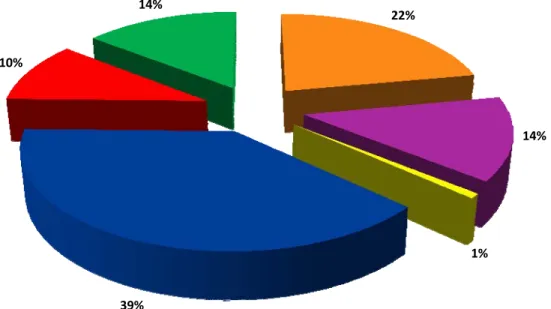
The following figure shows the distribution of capital project costs within each of the MHS facilities. 14% 22% 1% 39% 10% 14%
CentralArtery/Tunnel Sumner ‐CallahanTunnels CANA
BostonExtension TobinBridge MHS‐Wide
Figure 2 - Capital Maintenance Program Summary Percentage of Costs by Facility
MassDOT approached this CMP with the intention of investing heavily in maintenance needs. Maintenance projects are performed on structures and facilities that are generally in acceptable condition, but have some problems that have been identified through periodic inspections. These projects are intended to address these relatively minor deficiencies before they grow into major problems requiring more costly work. This is a cost effective means of keeping the MHS in a state of good repair and extending its service life.
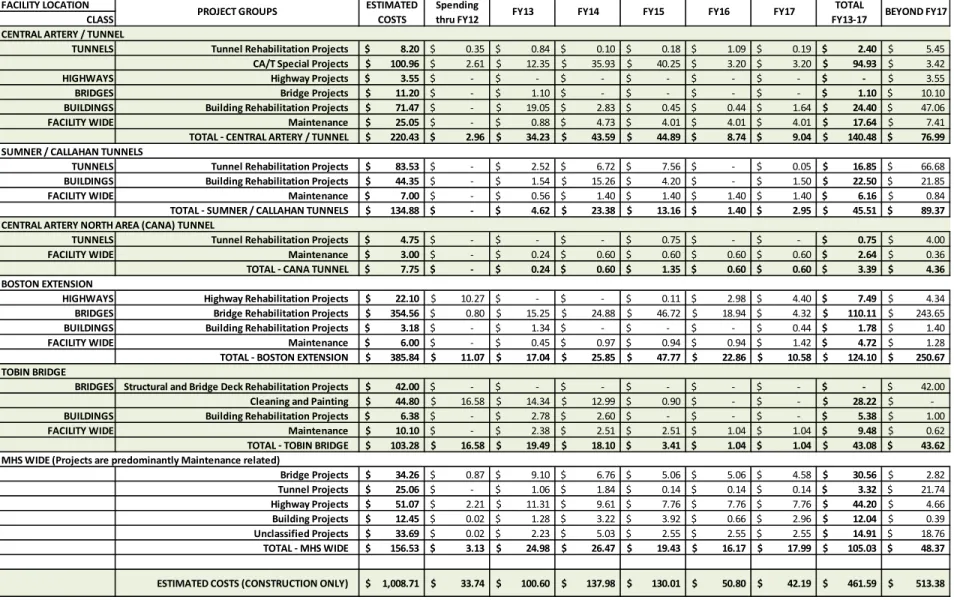
This CMP proposes to invest approximately $33 Million per year in annual maintenance projects to address ongoing and projected needs. Maintenance projects will be reevaluated on an annual basis as this program is updated. Within each project class listed in Table 1, projects groups are arranged by MHS facility and project class to show how the estimated construction costs are expected to be allocated over the five years of this CMP.
Table 1 – Summary of Capital Project Costs
By MHS Facility, Project Class and Project Group ($ = Millions)
FACILITYLOCATION
PROJECTGROUPS ESTIMATED
COSTS
Spending
thruFY12 FY13 FY14 FY15 FY16 FY17
TOTAL
FY13‐17 BEYONDFY17 CLASS
CENTRALARTERY/TUNNEL
TUNNELS TunnelRehabilitationProjects $ 8.20 $ 0.35 $ 0.84 $ 0.10 $ 0.18 $ 1.09 $ 0.19 $ 2.40 $ 5.45
CA/TSpecialProjects $ 100.96 $ 2.61 $ 12.35 $ 35.93 $ 40.25 $ 3.20 $ 3.20 $ 94.93 $ 3.42
HIGHWAYS HighwayProjects $ 3.55 $ ‐ $ ‐ $ ‐ $ ‐ $ ‐ $ ‐ $ ‐ $ 3.55
BRIDGES BridgeProjects $ 11.20 $ ‐ $ 1.10 $ ‐ $ ‐ $ ‐ $ ‐ $ 1.10 $ 10.10
BUILDINGS BuildingRehabilitationProjects $ 71.47 $ ‐ $ 19.05 $ 2.83 $ 0.45 $ 0.44 $ 1.64 $ 24.40 $ 47.06
FACILITYWIDE Maintenance $ 25.05 $ ‐ $ 0.88 $ 4.73 $ 4.01 $ 4.01 $ 4.01 $ 17.64 $ 7.41
TOTAL ‐CENTRALARTERY/TUNNEL $ 220.43 $ 2.96 $ 34.23 $ 43.59 $ 44.89 $ 8.74 $ 9.04 $ 140.48 $ 76.99
SUMNER/CALLAHANTUNNELS
TUNNELS TunnelRehabilitationProjects $ 83.53 $ ‐ $ 2.52 $ 6.72 $ 7.56 $ ‐ $ 0.05 $ 16.85 $ 66.68
BUILDINGS BuildingRehabilitationProjects $ 44.35 $ ‐ $ 1.54 $ 15.26 $ 4.20 $ ‐ $ 1.50 $ 22.50 $ 21.85
FACILITYWIDE Maintenance $ 7.00 $ ‐ $ 0.56 $ 1.40 $ 1.40 $ 1.40 $ 1.40 $ 6.16 $ 0.84
TOTAL ‐SUMNER/CALLAHANTUNNELS $ 134.88 $ ‐ $ 4.62 $ 23.38 $ 13.16 $ 1.40 $ 2.95 $ 45.51 $ 89.37
CENTRALARTERYNORTHAREA(CANA)TUNNEL
TUNNELS TunnelRehabilitationProjects $ 4.75 $ ‐ $ ‐ $ ‐ $ 0.75 $ ‐ $ ‐ $ 0.75 $ 4.00
FACILITYWIDE Maintenance $ 3.00 $ ‐ $ 0.24 $ 0.60 $ 0.60 $ 0.60 $ 0.60 $ 2.64 $ 0.36
TOTAL ‐CANATUNNEL $ 7.75 $ ‐ $ 0.24 $ 0.60 $ 1.35 $ 0.60 $ 0.60 $ 3.39 $ 4.36
BOSTONEXTENSION
HIGHWAYS HighwayRehabilitationProjects $ 22.10 $ 10.27 $ ‐ $ ‐ $ 0.11 $ 2.98 $ 4.40 $ 7.49 $ 4.34
BRIDGES BridgeRehabilitationProjects $ 354.56 $ 0.80 $ 15.25 $ 24.88 $ 46.72 $ 18.94 $ 4.32 $ 110.11 $ 243.65
BUILDINGS BuildingRehabilitationProjects $ 3.18 $ ‐ $ 1.34 $ ‐ $ ‐ $ ‐ $ 0.44 $ 1.78 $ 1.40
FACILITYWIDE Maintenance $ 6.00 $ ‐ $ 0.45 $ 0.97 $ 0.94 $ 0.94 $ 1.42 $ 4.72 $ 1.28
TOTAL ‐BOSTONEXTENSION $ 385.84 $ 11.07 $ 17.04 $ 25.85 $ 47.77 $ 22.86 $ 10.58 $ 124.10 $ 250.67
TOBINBRIDGE
BRIDGES StructuralandBridgeDeckRehabilitationProjects $ 42.00 $ ‐ $ ‐ $ ‐ $ ‐ $ ‐ $ ‐ $ ‐ $ 42.00
CleaningandPainting $ 44.80 $ 16.58 $ 14.34 $ 12.99 $ 0.90 $ ‐ $ ‐ $ 28.22 $ ‐
BUILDINGS BuildingRehabilitationProjects $ 6.38 $ ‐ $ 2.78 $ 2.60 $ ‐ $ ‐ $ ‐ $ 5.38 $ 1.00
FACILITYWIDE Maintenance $ 10.10 $ ‐ $ 2.38 $ 2.51 $ 2.51 $ 1.04 $ 1.04 $ 9.48 $ 0.62
TOTAL ‐TOBINBRIDGE $ 103.28 $ 16.58 $ 19.49 $ 18.10 $ 3.41 $ 1.04 $ 1.04 $ 43.08 $ 43.62
MHSWIDE(ProjectsarepredominantlyMaintenancerelated)
BridgeProjects $ 34.26 $ 0.87 $ 9.10 $ 6.76 $ 5.06 $ 5.06 $ 4.58 $ 30.56 $ 2.82 TunnelProjects $ 25.06 $ ‐ $ 1.06 $ 1.84 $ 0.14 $ 0.14 $ 0.14 $ 3.32 $ 21.74 HighwayProjects $ 51.07 $ 2.21 $ 11.31 $ 9.61 $ 7.76 $ 7.76 $ 7.76 $ 44.20 $ 4.66 BuildingProjects $ 12.45 $ 0.02 $ 1.28 $ 3.22 $ 3.92 $ 0.66 $ 2.96 $ 12.04 $ 0.39 UnclassifiedProjects $ 33.69 $ 0.02 $ 2.23 $ 5.03 $ 2.55 $ 2.55 $ 2.55 $ 14.91 $ 18.76 TOTAL ‐MHSWIDE $ 156.53 $ 3.13 $ 24.98 $ 26.47 $ 19.43 $ 16.17 $ 17.99 $ 105.03 $ 48.37
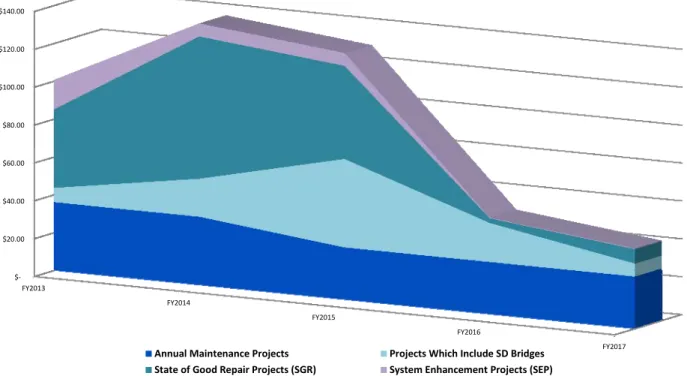
The following figure shows expenditures by project category. The categories presented are State of Good Repair (SGR) Projects (which include the subsets Annual Maintenance and projects including Structurally Deficient Bridges) as well as System Enhancing Projects (SEP) for Fiscal Years 2013 through 2017.
$140.00 $120.00 $100.00 $80.00 $60.00 $40.00 $20.00 $‐ FY2013 FY2014 FY2015 FY2016 FY2017 AnnualMaintenanceProjects ProjectsWhichIncludeSDBridges
StateofGoodRepairProjects(SGR) SystemEnhancementProjects(SEP)
Figure 3 – MHS 5-Year CMP Construction Costs
($ = Millions)
Description of MHS Facilities
For the purposes of this CMP, the Metropolitan Highway System is segmented into five major facilities, each of which is briefly described below. Figure 1 provides a general plan view of the transportation system associated with these five MHS facilities. In addition, to account for system-wide projects, a sixth designation named MHS Wide has been established.
Metropolitan Highway System Facilities
Central Artery/Tunnel
Sumner/Callahan Tunnels
Central Artery North Area (CANA) Tunnel
Boston Extension (Weston to Boston)
Tobin Bridge
MHS Wide
The MHS transportation network consists of almost 250 lane miles of roadway of which approximately two-thirds are toll roads and one-third are non-revenue facilities. That network includes over 160 bridges and viaducts, including the Leonard P. Zakim and Tobin Bridges; seven major tunnel structures, including the three tunnels under Boston Harbor (Ted Williams Tunnel, Sumner Tunnel and Callahan Tunnel), the I-93 Northbound and Southbound tunnels (Thomas
P. “Tip” O’Neill Tunnel) through Downtown Boston, the I-90 Connector Tunnel through South Boston; the Central Artery North Area Tunnel through Charlestown; and at-grade highways and roadways.
The tunnels include a complex network of supporting infrastructure that includes significant mechanical, electrical, plumbing and communications (M/E/P/C) systems. That infrastructure includes 13 major tunnel ventilation buildings that provide ventilation to the tunnels. Some of the buildings housing these ventilation systems are incorporated as part of hotel, office building and parking garage structures adjacent to the Surface Artery, and are not generally visible to the public. Additionally, there are seven fan rooms/chambers within the overall MHS system.
The MHS system also includes many varied support facilities such as maintenance buildings/garages, toll plazas and administration and operations buildings.
According to the Traffic and Revenue Study prepared for MassDOT dated January 28, 2010, the following are the approximate average daily traffic volumes (thousand vehicles per day) which use the MHS.
Central Artery I-93 140 - 180
Ted Williams Tunnel 70
Sumner / Callahan Tunnels 48
Boston Extension 103 - 128
Tobin Bridge 75
Central Artery / Tunnel
The Central Artery / Tunnel is a complex system of roadways, bridges, tunnels and structures which carry portions of I-90, I-93 and US-1. It connects I-93 with I-90 and US-1 and connects to the Sumner / Callahan Tunnels. The Central Artery/Tunnel Project started construction in late 1991. The underground tunnel system replaced an elevated steel highway structure and introduced interstate connections to South Boston and Logan Airport. Twenty-five associated ramps connect the tunnels to surface arteries and interchanges. The project also added a new crossing below Boston Harbor, the Ted Williams Tunnel, which is a toll road. The project reached substantial completion on January 13, 2006. As of June 2009, the entire project was considered 100% complete.
For the purpose of this CMP, the Central Artery/Tunnel facility is divided into the following eight areas:
South Bay – I-90/1-93 Interchange
I-90 Connector - I-90 between the Boston Extension and the Ted Williams Tunnel
South Boston – Seaport Access
Ted Williams Tunnel – I-90 beneath Boston Harbor between South Boston and Logan Airport
East Boston – I-90 east of the Ted Williams Tunnel
Massachusetts Avenue – I-93 Interchange with Massachusetts Avenue
Downtown – I-93 Tunnels from South Bay to North of Causeway Street
North of Causeway Street – I-93/US-1 Interchange to Cambridge Street
The overall limits of the Central Artery / Tunnel facility, including the eight geographic areas listed previously are shown in the figure below. This facility includes approximately 107 lane miles of roadway, primarily tunnels or bridges, of which approximately 35 lane miles are toll roads. The tunnels include seven ventilation buildings, three fan chambers, 30 pumping stations and almost 90 utility rooms.
Figure 4 – Central Artery / Tunnel Facility
Sumner / Callahan Tunnels
The Sumner / Callahan Tunnels connect I-93 and Downtown Boston to East Boston and Logan Airport. The Sumner Tunnel was constructed in the 1930’s and initially served as a two-way roadway. In 1958, the Massachusetts Turnpike Authority was authorized by the legislature to construct the Lieutenant William F. Callahan, Jr. Tunnel from downtown Boston to East Boston; to acquire and make necessary initial repairs to the existing William H. Sumner Tunnel; and to operate and maintain both tunnels. The Sumner Tunnel was rehabilitated in the 1960’s when the Callahan Tunnel, an independent parallel tunnel structure, was constructed. Until 1995, when the Ted Williams Tunnel was completed, these tunnels served as the primary link between
Downtown Boston and Logan Airport. The Sumner Tunnel, which carries traffic into downtown Boston, is a toll facility.
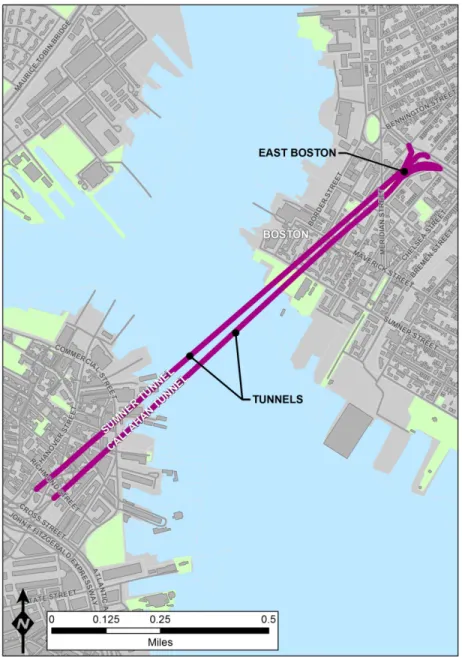
The westerly ends of both tunnels connect into ramps that were constructed as part of the Central Artery/Tunnel Project. The limits of the Sumner / Callahan Tunnels are shown below. For the purpose of this CMP, the Sumner / Callahan Tunnels are divided into two areas: tunnels and East Boston.
The Sumner / Callahan tunnels are 5600 feet and 5900 feet long respectively. This facility includes four ventilation buildings, a toll plaza in East Boston and six storm water pumping stations.
Central Artery North Area (CANA) Tunnel
The Central Artery North Area is a system of tunnels and other structures, which connects I-93 to the Tobin Bridge in Charlestown. The Central Artery North Area Tunnel was constructed in the 1980’s by the Massachusetts Highway Department.
Unlike the Sumner, Callahan and Ted Williams Tunnels, the CANA Tunnel was built using cut and cover construction techniques. The configuration of the CANA tunnel is different from the other tunnels in that it does not have a fresh air duct; there are exhaust ducts located along the side of the tunnel. The exhaust from vehicles is drawn into the exhaust duct and moved through the exhaust vents by the fans in the ventilation buildings. The figure below shows the overall limits of the CANA Tunnel.
The combined length of the CANA tunnel (northbound and southbound) is 2440 feet. The facility includes two ventilation buildings and one storm water pumping station.
Boston Extension
The Boston Extension is the portion of I-90 from the Route 128/I-95 interchange in Weston to the interchange at 93 in Boston. It extended the Initial Turnpike, which ended at Route 128, into Boston where it connected with I-93. This segment of the Turnpike has become known as the Boston Extension. Traffic began using this new 12 mile section of the Massachusetts Turnpike toll road In September 1964.
The Boston Extension overall limits are shown below. For the purpose of this CMP, the Boston Extension is divided into the following five areas, from west to east:
Weston (starting at Ridgeway Road, just west of the interchange with Route 128/I-95)
Newton
Brighton (including a short section in Brookline)
Prudential Passageway (also referred to as the Prudential Tunnel) passes under the Prudential, Copley and
Hancock private developments in the Back Bay is classified herein as a highway
Boston (ending at the point where the Boston Extension connects with the I-90/I-93 Interchange completed
as part of the Central Artery/Tunnel Project)
The Boston Extension has approximately 116 lane miles of roadway, all of which are toll road. This facility includes four storm water pumping stations, several toll facilities and four fan rooms within the Prudential Passageway.
Tobin Bridge
The Maurice J. Tobin Memorial Bridge is a high-level bridge that spans the Mystic River from Charlestown to Chelsea. The Tobin Bridge, a two-level toll facility, was opened to traffic on February 27, 1950. Comprised of nine lane miles of roadway, it carries US-1 from CANA to Chelsea. The Tobin Bridge is the longest toll bridge in New England. The Tobin Bridge, which was previously owned and operated by Massport, was transferred to MassDOT on January 1, 2010. Bridge maintenance and painting, including lead paint removal, have been significant initiatives at the Tobin under the direction of Massport, and are expected to continue under the direction of MassDOT as capital projects in order to maintain the facility in a state of good repair.
For the purpose of this CMP, the Tobin Bridge is divided into three areas: Boston approach, Bridge and Chelsea approach as shown below.
MHS Wide
CMP projects which will extend throughout more than one of the five MHS facilities are considered to be MHS Wide. The current MHS Routine Maintenance projects which are contracted annually, including scheduled and emergency repairs, have been incorporated into this CMP, most of which have been categorized as MHS Wide. Projects which integrate communications between the various facilities, miscellaneous maintenance projects for tunnels, and projects to remediate bridge and tunnel deficiencies related to the Stem to Stern report also fall into this category.
MassDOT, on an ongoing basis, evaluates the conditions of MHS infrastructure through their district operations divisions. Regular inspections, observations, and routine repairs reveal deficiencies in various infrastructure assets which are addressed by ongoing maintenance activities or are programmed into future maintenance projects. Annual maintenance projects are developed for a variety of maintenance activities including plumbing, HVAC, traffic signal repairs, guardrail repairs, and lighting.
Bridge maintenance is carried out in accordance with the Bridge Maintenance Policy adopted by MassDOT. The Bridge Maintenance Policy provides a focus on maintenance and operations with an emphasis on systems management, operations management, response maintenance, preventative maintenance and design modification (corrective) maintenance. The Bridge Maintenance Policy provides guidance on treatments and services for the bridge assets owned, maintained and operated by MassDOT.
On an annual basis MassDOT evaluates required maintenance needs and prioritizes activity accordingly. The resultant maintenance projects are system-wide enabling MassDOT to have the flexibility to respond to scheduled and unanticipated maintenance needs in an expedited and cost effective fashion.
Capital Maintenance Program FY2013-FY2017
This CMP was developed in two major phases: 1. Needs analysis
2. Project programming
The needs analysis included the review of multiple data sources, correlation of condition rating scales, development of a database to sort and analyze collected data, and development of conceptual projects to address identified needs. The initial needs analysis was unconstrained with regard to budget and staff resources and was instead strictly data-driven.
In the project programming phase needs were included into proposed projects along with order-of-magnitude construction cost estimates and schedules. Programming was done to establish a project list that fit within available budgets and resources. As a result of this programming, this CMP currently identifies 383 projects valued at approximately $1.01 billion.
Development of Five Year CMP
MHS Data Sources
The data used to generate this CMP was obtained from the following sources:
Tunnel Inspection Reports
Bridge Inspection Reports
2009 Triennial Inspection Report
Stem to Stern Safety Review
Previously Defined and Pre-CMP MassDOT Projects
Tobin Bridge Facility Information
Inspections associated with the reports noted above were performed by various engineering firms under contract with MassDOT and by MassDOT's in-house personnel. The MHS bridges and tunnel segments are cataloged, inspected and tracked based on a unique three character alpha-numeric Bridge Identification Number (BIN) assigned by MassDOT to various segments of each facility. The structures identified by these BINs varied in length from less than 50 feet to more than 5,000 feet.
Tunnel Inspection Reports
Tunnel inspections for MHS tunnel structures are performed on the following frequency; the results of these inspections were reported in a standardized format.
12-Month Overhead Items Tunnel Inspections
The 12-month Overhead Items Tunnel Inspections are inspections of overhead items in the MHS tunnels, which could pose a safety hazard to the traveling public if these items became loose or deteriorated to the extent that they would fall from their present location onto the roadway.
36-Month All Items Tunnel Inspections
The 36-month All Items Tunnel Inspections are inspections of all accessible/visible elements within the MHS tunnels.
Note: Future Tunnel Inspections
As a result of a recent Federal Highway Administration (FHWA) audit finding, roof girders in the I-93 tunnel will be inspected every two years in accordance with the National Bridge Inspection Standards (NBIS) inspection protocol.
Bridge Inspection Reports
Bridge inspections for MHS bridge facilities are performed on the following frequency; the results of these inspections were reported in a standardized format. Refer to Table 2 for the Condition Rating Scale.
24-Month Routine Bridge Inspections
The 24-month Routine Bridge Inspections included all of the various components of MHS bridge structures. The inspections were conducted in conformance with the NBIS procedures and the results were incorporated into the MassDOT 4D bridge software system. This information was subsequently reported to the FHWA as part of the National Bridge Inventory (NBI).
Special Member Inspections
When a Routine Bridge Inspection established a low rating on a bridge element based on the NBIS rating system, an increased inspection frequency was instituted. These increased frequency inspections are categorized as Special Member Inspections. (Note: Inspection rating scales, including the NBIS rating system, will be discussed in a subsequent section of this CMP document.) The Special Member Inspection frequency was either a 12 month or 6 month interval to more closely monitor the condition of those items. The Special Member Inspections were conducted in conformance with the NBIS procedures and the results were incorporated into the MassDOT 4D bridge software system.
2009 Triennial Inspection Report
The 2009 Triennial Inspections consisted of visual inspections of elements of the MHS facilities accessible to inspectors. They did not include detailed inspections or in-situ testing of the items. Sign supports were examined by the NBIS process. Various mechanical, electrical and plumbing elements of the MHS facilities were inspected as part of the Triennial Inspections.
Stem To Stern Safety Review
The Stem to Stern Safety Review (S2S) (Volume 1, Phase 1, dated 11/15/06) was prepared by Wiss, Janney, Elster Associates, Inc. (WJE) in response to emergency legislation and Executive Order No. 474 drafted by Governor Romney in August 2006 and under the Authority of Chapter 153 of the Acts of 2006. The purpose of the Order was to establish the MHS Safety Review Team and conduct an independent, comprehensive safety review of the MHS facilities, excluding the Tobin Bridge. The S2S provided a safety review of the facilities, established a work plan for the most safety critical elements and reported those priorities back to the Governor.
Pre-CMP MassDOT Projects
Projects that have been designated Pre-CMP are projects which had either been previously programmed in a capital plan by MassDOT or were currently underway in construction or design at the time this program was developed.
A number of these pre-existing projects are annual maintenance projects which include dollars budgeted to MHS facilities. For contract administration purposes and economies of scale many annual maintenance projects include multiple funding sources which enables the MassDOT to utilize these contract services on both MHS and non-MHS facilities. The MHS portion of these annual projects are included in this CMP as recurring contracts to remediate deficient items on a scheduled and/or emergency basis. For the purposes of this CMP, 2012 budget values are assumed for each of the years of this program.
Tobin Bridge Facility Information
Historically, Tobin Bridge inspections were not recorded in the 4D bridge software system and inspection information relative to reported conditions was not consistent with the NBIS rating system. However, in 2011 MassDOT began to populate condition ratings for the bridge per NBIS format into the 4D software. As of April 2012 all Tobin Bridge inspections have been entered into the 4D software system.
A visual inspection was performed on the Tobin Bridge facility for Massport in 2008. This inspection included the bridge and its support facilities. The support facilities condition ratings presented in that inspection were used in the development of this CMP. The correlation between the rating in this Massport inspection and the NBI based MassDOT system is presented in Table 3.
Correlation of Condition Rating Scales
NBIS Rating system (used on all MassDOT Inspections)
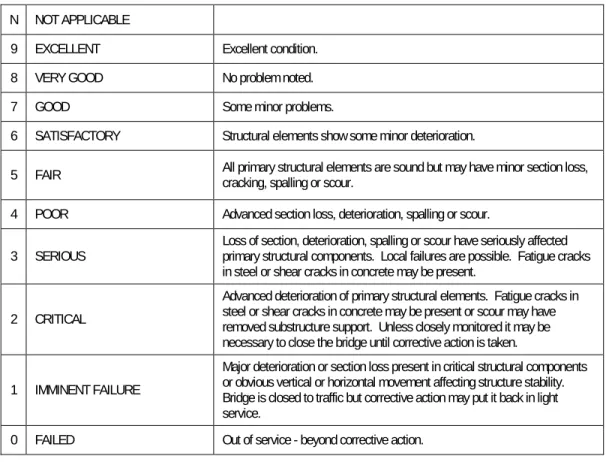
The ratings used to describe conditions in all bridge inspection reports, including Special Member Inspections, are in accordance with the NBIS as shown in Table 2. This basic rating system was adopted and used within all tunnel inspection reports and the 2009 Triennial Report. Although the descriptions used in the various types of inspections reviewed during the preparation of this CMP may have slightly different terminology, the actual rating numbers correlate closely. All ratings established during those inspections have been incorporated into a database.
The NBIS rating system is included in the tabulation following.
Table 2 - MHS Condition Rating Scale
N NOT APPLICABLE
9 EXCELLENT Excellent condition. 8 VERY GOOD No problem noted.
7 GOOD Some minor problems.
6 SATISFACTORY Structural elements show some minor deterioration.
5 FAIR All primary structural elements are sound but may have minor section loss, cracking, spalling or scour. 4 POOR Advanced section loss, deterioration, spalling or scour.
3 SERIOUS Loss of section, deterioration, spalling or scour have seriously affected primary structural components. Local failures are possible. Fatigue cracks in steel or shear cracks in concrete may be present.
2 CRITICAL
Advanced deterioration of primary structural elements. Fatigue cracks in steel or shear cracks in concrete may be present or scour may have removed substructure support. Unless closely monitored it may be necessary to close the bridge until corrective action is taken. 1 IMMINENT FAILURE
Major deterioration or section loss present in critical structural components or obvious vertical or horizontal movement affecting structure stability. Bridge is closed to traffic but corrective action may put it back in light service.
0 FAILED Out of service - beyond corrective action.
Other Rating Systems Used (Stem to Stern Safety Review and Tobin Bridge Facility Inspections)
In addition to the above rating system used on all MassDOT inspections, different rating systems were used by WJE for the Stem to Stern Safety Review. Inspections completed by Massport for the Tobin Bridge facility also used a different rating system. Applicable portions of these rating systems are shown in the following table along with their correlation to the MHS rating scale.
Table 3 - Comparison of S2S and Massport Rating System to NBIS Rating System
MHS CONDIT ION RAT INGS
FAILE D "IMMI NENT " FAIL URE CRITI CAL SERI OUS POORFAIR SATIS FACT ORY GOODVERY GOOD EXCE LLEN T NOT A PPLIC ABLE 0 1 2 3 4 5 6 7 8 9 N 3 M assp or t Co nd iti on Ra ting
s Urgent Item requires immediate
action High
Priority Medium Priority
Item should be addressed within one to two years Item requires action in the very near future
1 2 St em to St er n Immediate or dangerous condition Remediation recommended as soon as possible Remediation recommended in coordination with near-term maintenance and capital improvement programs Co nd iti on Ra ting s R2 R1 IC
Database Management and Utilization
Deficiency data was obtained from the most recent inspection reports for each location of the MHS. A master database, created using Microsoft Access software, contains all deficiencies rated 5 or less. The database was queried to identify the condition rating of MHS elements that were rated 5 or less.
The database contains a table of projects defined for this CMP. This table contains detailed project information as well as additional fields and placeholders for future use in the MassDOT Project Info system.
All data in the Microsoft Access database has been formatted for easy incorporation into the MassDOT Project Info system. For example, field properties such as data type and maximum number of characters have been matched to the corresponding fields in the Project Info system. Certain drop-down fields in the database are linked to lookup tables so that choices are limited to only valid selections, thereby increasing data integrity and enhancing the ease of data integration.
Project Programming
The following is a brief description of the methodology used to define projects in the four classes grouped as Bridges, Buildings, Highways and Tunnels. Projects developed which incorporate two or more of the above classes were labeled as Unclassified for the purposes of this CMP. Each class used a methodology best suited for the respective project group. Recommendations for potential corrective measures were made, including the following:
A strategy on how to package the work (corrective measures)
Related cost information sufficient for budgeting purposes only
Schedule information that describes the approximate duration needed to perform the work
Projects to include in the five year CMP
Pre-CMP projects were compared with the list of newly defined projects generated from the deficiency list and combined where appropriate.
In general, all projects presented in this CMP are either State of Good Repair (SGR) projects or System Enhancing Projects (SEP).
SGR Projects are proposed projects that are intended to maintain the current functionality of an existing asset. These projects are proposed to maintain the asset and maintain its service life so that it will continue to operate and function as designed. The majority of projects in this CMP are SGR Projects.
The purpose of SEP projects is to enhance the service life of an asset, improve customer service levels, continue preventative maintenance initiatives, provide system enhancements and/or provide regional benefits. These projects were not specifically developed on the basis of a condition-based assessment of inspection ratings. These projects are included within this CMP since they are important to maintaining and extending the service life of the various MHS system assets.
Bridges
After reviewing the reports, bridges that had major elements with condition ratings of 5 or less, which would involve a significant amount of work to address, were defined as individual projects. In some cases, bridges that required similar work and with less significant deficiencies were combined into projects with other bridges. The bridge project quantities were generally estimated using the original construction drawings to establish total quantities for each element and a percentage of the total was used for the project estimate. Buildings
The primary source of information for buildings was all deficiencies rated 5 or less from the 2009 Triennial inspection report. The deficiencies covered structural, site civil, mechanical, electrical, plumbing and communications. “Buildings” included Fan Rooms, Toll Plazas, Pump Stations, Vent Buildings and Communication Tower facilities. Building-related deficiencies were generally grouped into projects by individual building locations when deemed appropriate. Some of these locations were sufficiently close enough to be combined.
Highways
The highway projects were defined by collecting all highway related deficiencies rated 5 or less from the inspection reports. Portions of the Metropolitan Highway System that are bridges or tunnels are excluded from the list of highway projects. “Highway” projects included guide sign structures for both roadway and
tunnels, interchanges, parks, pavement, roadside protective devices, concrete structures, retaining walls and roadway elements of the Prudential Passageway. Highway projects were generally grouped by like items.
Tunnels
Tunnel projects were defined using information gathered from several sources. The primary source of information used to develop projects was tunnel inspection reports from overhead inspections performed annually and all item inspections performed every three years. Generally, tunnel items with a condition rating of 5 are structurally sound, but may have minor section loss, cracking or spalling and are defined as being in “Fair” condition.
For each tunnel deficiency rated a 5 or less, the associated comment in the inspection report was reviewed to determine the corrective measures needed to improve the condition to a state of good repair. Because of the size of a typical tunnel BIN, inspection report comments quantify deficiencies in general terms, often documenting the most severe location or a location representative of others throughout the entire BIN using terms such as frequent, isolated or numerous. With this information, the approximated quantity of assumed deficiencies in “Fair” or worse condition were incorporated into projects.
Maintenance Projects
Maintenance projects were developed based on a review of inspection documents, site visits, and staff input. Generally these projects have been developed in this CMP to target groups of similar deficiencies spread over multiple locations whose remediation to a state of good repair is maintenance or preservation in nature. These projects fall under the category of Targeted Maintenance Projects. In other instances, small projects or isolated, similar deficiencies have been grouped into a Pre-CMP Annual Maintenance Project where applicable.
Examples of this type of work include regular maintenance of mechanical and electrical systems, cleaning and painting, joint repairs, and deck, superstructure and substructure repairs. Maintenance work is less expensive and generally takes less time than rehabilitation and replacement work, requires limited or no design, right-of-way, and environmental permits, and offers the best opportunity to bundle several projects of similar need together in one contract to expedite delivery of projects under the program. This same methodology has been widely employed in MassDOT’s Accelerated Bridge Program and has proven to be an effective way to maintain healthy bridges.
Projects Resulting from Stem To Stern Review Report
MassDOT recently updated the list of outstanding S2S deficiencies (dated 6/1/11). These deficiencies remained unresolved at that time based on reviews by MassDOT, Corp of Engineers (COE), the DOT Inspector General and the FHWA. This most recent list was incorporated into this CMP. S2S deficiencies with an equivalent rating of 5 or less were then categorized by location of the facility and deficiency type. A total of 140 unresolved S2S deficiencies were included in this CMP. Based on facility location and deficiency type, most of the S2S deficiencies were packaged into projects created as a result of the MHS inspections.
Private Facility Projects
A review of the inspection reports yielded projects which are located on property leased by private entities. These projects are not included in this program as funding is the responsibility of the private entity. MassDOT regularly works with the owners’ of the private facilities to advise them of deficiencies and to schedule repairs in a timely manner.
Project Programming Refinements
As previously described, initial projects were defined after a review of available inspection data, staff input, and site visits. The initial analysis was unconstrained with regard to budget and staff resources and was instead strictly data-driven.
Project scopes were then proposed to accommodate identified needs. In some cases, proposed projects generated through this process were already being developed by MassDOT. In those cases, the existing project scopes were compared to identified needs.
In all cases, newly proposed projects and pre-existing project scopes were reviewed to optimize efficiencies. Some project scopes were adjusted to capitalize on emerging construction techniques such as rapid replacement of bridges and in other cases, projects were bundled or grouped to take advantage of economies of scale.
MassDOT will continue to review and refine scopes of proposed projects as they are further developed. MassDOT’s public process will be used for projects that will have community impacts, such as new bridge decks connecting to city streets and facilities in populated areas. Where possible, projects will be designed in accordance with MassDOT’s GreenDOT initiative utilizing sustainable practices and complete streets planning that includes bicycle and pedestrian accommodations.
Estimating Cost and Schedule
Traditional project delivery methods were assumed in the development of costs and schedules for this CMP. However, the use of alternate project delivery methods could significantly affect these costs and schedules. In addition, it is expected that the cost estimates and schedules shown in this document will be refined as future versions of this CMP are prepared.
Cost Estimates
Project representative items were used as the basis to develop the order of magnitude costs for each project. These representative items were chosen as those items which were likely to determine the largest portions of the project cost as well as those which would lend themselves to comparison with other similar projects. Unit costs were applied to these items based either on RS Means data or on MassDOT Weighted Average Bid Prices on a case-by-case basis with regard to which was most comprehensive or representative of the work. Items which did not fall into a specific category of either of these were estimated based on RS Means derived crew costs and expected activity duration.
Costs were then added to the above construction costs to account for the following items: Mobilization
Percentages for the costs to mobilize equipment were added to each project. Five percent was added to operations which were mobile or item based by nature which generally involve mobile equipment which would move from location to location to perform the work. Ten percent was generally added to the minor bridge rehabilitations and tunnel projects which are location-based and which involve less intensive repairs to more than one item at a single location. Fifteen percent was added to the major bridge or tunnel rehabilitation projects which generally last more than one year and involve wide ranging construction equipment to perform the repair or replacement of major components of the bridge or tunnel.
Incidental Items
Percentages were added to account for incidental items which are not reflected in the major item estimate, generally twenty to forty percent based on the type of project. Twenty percent was applied to the projects which involve the repair or replacement of a singular item to account for minor repairs or materials not encompassed by the unit cost of replacement of that item. Thirty percent was added to the projects which involved repairs or partial replacement of more than one major item such as minor bridge rehabilitation and tunnel repairs. These projects were assumed to encompass work on additional minor items to complete the project which were not included in compiling the cost estimate and were likely to have moderate levels of traffic setups involved. Forty percent was added to the major bridge or tunnel rehabilitation projects which included the replacement of, or intensive repair to, major components of the bridge or tunnel. The intent of the addition of this percentage was to encompass the many items which were not used in compiling the cost estimate but that were expected to need replacement or repair when a major component is replaced. This percentage was also intended to account for the fact that these projects were likely to require more intensive traffic closures and the need to restore landscaped areas or other disturbed areas.
Work Site Accessibility / Construction Window
Percentages were also added to bridge, highway and tunnel projects to reflect the issues concerning construction windows and work site accessibility such as whether a majority of the work needed to be performed with traffic detours and/or temporary lane closures on major roadways or over railroads. Due to the wide range in scenarios that were encountered when reviewing these projects, this percentage ranged between zero and fifty percent. For the projects which were relatively unaffected by traffic issues, no percentage was added. Many bridge rehabilitation projects involved work over I-90. For those projects, an additional twenty-five percent was added to account for work which was affected by traffic restrictions. Fifty percent was added to account for the decrease in work window encountered when a project is performed over a railroad. When a project was located over both I-90 and a railroad, thirty percent was added so that both of these items were taken into consideration. In general, for work performed which requires lane closures in the tunnels, forty percent was added to adjust for the decrease in workable hours per shift due to lane restrictions.
These percentages are intended to take the projects from the four different classes – Bridge, Highway, Tunnel and Building – and coordinate them so that they can be compared against each other to identify costs which are relatable as an order-of-magnitude. The percentages do not apply precisely as described in all cases, but were used as a general guide to determine what was applicable to each project.
Condition-based project costs represent the cost associated with bringing deficient items to a state of good repair. These costs generally do not indicate the full cost to implement more comprehensive repairs or full replacement of items which can meet the state of good repair criteria with less comprehensive repairs. Additional budget could be applied to certain projects to upgrade the condition of other items which may not be deficient at this time but which will continue to deteriorate over this five year period and beyond or which may include obsolete equipment.
The costs presented and discussed in this CMP are construction costs only. Additional costs will be incurred to account for a total project cost which would include items such as program management, survey services, design, permitting, right-of-way, construction phase engineering, traffic safety and control, material testing services, construction inspection, contingencies and cost escalation over time. It should be noted that up-front activities such as program management, design, permitting and bid document preparation costs will generally be incurred in large part in the fiscal year prior to construction.
Schedule
The methodology used to approximate each project’s schedule involved an order-of-magnitude level of detail sufficient for programming purposes only.
MassDOT employed a scoring system as a basis for the initial scheduling of capital projects into fiscal years 2013 through 2017. Annual Maintenance projects were not scored and were instead given priority for each fiscal year. Additionally projects that were already in or near a construction phase in the current fiscal year were not scored and were given priority. All other projects were scored, including those that were in development and near the end of their design cycle but scheduled to be advertised in a future fiscal year.
Each project was scored for five different impact categories on a scale of 1-10, 1 being the least impact, 10 being the most impact. Each category is weighted using a multiplier with a total possible score of 100 for a project. This scoring methodology enables projects with differing scopes to be put into context with one another in a common system.
Five criteria were used for scoring:
Category Multiplier
Health & Safety 3.5
Deferral Impacts 2.5
Economic and Operational
Impacts 1.5
Legal Mandates and
Environmental Impacts 1.5
Road User Benefits 1
Projects that have a high health and safety impact and cannot easily be deferred, such as projects which include structurally deficient bridges, were generally scored highest. Projects that have no major health and safety impacts or ones that can be deferred easily were generally given the lowest scores.
The scoring was then used as a basis for the first attempt at scheduling project construction start dates in each fiscal year. Annual maintenance projects and active projects were scheduled first in each fiscal year. Construction start dates for the scored projects were then scheduled into the balance of each fiscal year with the higher scoring projects placed in the beginning of the schedule and lower scoring projects placed near the end of the schedule.
After the first draft schedule was completed the program was distributed to subject matter experts within MassDOT for further review and refinement. Subject matter experts reviewed individual projects to ensure that projects with critical needs were scheduled appropriately and that anticipated project development durations were consistent with the proposed project start dates. Project risks, utilities, permitting and limitations on staff and consultant resources
that can impact the project development duration were further considered. As needed, the subject matter experts refined project schedules and reprogrammed projects into a second draft schedule.
Schedules were further evaluated for impacts due to possible disruption of traffic and for impacts to the available construction budget. Projects that are in close physical proximity and have opposing traffic requirements were rescheduled to minimize impacts on each other and the traveling public. Larger projects with spending programmed over multiple fiscal years were further rescheduled to avoid adverse impacts on the MHS budget. This final refinement of project schedules led to the issuance of the schedule of projects contained herein.
Projects that were not scheduled into the five year program were deferred to beyond FY2017. These projects will be reevaluated on a periodic basis and programmed into future five year capital programs.
32.4%
24.0%
Capital Maintenance Program Projects by MHS Facility
Central Artery/Tunnel
The CMP work for the Central Artery/Tunnel Facility was packaged into 75 projects consisting of the following: 3 Bridge Projects
19 Building Projects 2 Highway Projects 14 Tunnel Projects 37 Maintenance Projects
The work includes various project types such as Bridge Structures Maintenance, Tunnel Repairs, Building Rehabilitations, and I-90/I-93 Special Projects.
1.6%
5.1%
BRIDGEPROJECTS TUNNELPROJECTS HIGHWAYPROJECTS BUILDINGPROJECTS MAINTENANCE
Figure 9 – Central Artery / Tunnel Percentage of Costs by Class
Table 4 – CA/T Facility Capital Projects Estimated at Greater Than or Equal to $5 Million
Projects with Expenditures In 5-Year Period ($ = Millions)
(see Appendix for expanded list)
Project
Info # Project Description Extended Description
Office Estimate (Construction)
606734
BOSTON ‐I‐93ANDI‐90TUNNELS ‐
ROADWAYOVERHEADLIGHTING
SAFETYANDENERGYEFFICIENCY
IMPROVEMENTS
Roadwayoverheadlightingsafety
andenergyefficiency
improvements.
$57.00
606502
BOSTON ‐LEAK,FIREPROOFING&
MISCELLANEOUSREPAIRSINI‐93
TUNNEL
I‐93Tunnelceilingleak,
fireproofingandmiscellaneous
repairs.
$11.86
606730
BOSTON ‐INVESTIGATIONAND
REMEDIATIONOFI‐90CONNECTOR
GROUNDFREEZEISSUES
InvestigationandremediationofI‐
90Connectorgroundfreezeissues. $8.00
606738
BOSTON ‐FITOUTOFPARCEL7
OFFICEBUILDING(BLACKSTONE
STREET)
Parcel7OfficeBuildingFitout $8.00
605920
BOSTON ‐PAVEMENTREPAIRS,
LEAKREPAIRS&SUPERPLUG
REPAIRSONI‐90
I‐90ConnectorTunneljoint
remediation $6.60
606740 BOSTON ‐REPAIRSTOMASSDOT
BUILDINGAT185KNEELANDSTREET
Bituminousconcretepavement
rehabilitationincludinglighting,
concretesidewalkreplacement,
masonryrepairs,door
replacement,M‐E‐Prepairs.
$5.00
I-90/I-93 Special Projects
The projects presented in this section are currently being developed. They generally involve complex issues and require the completion of engineering studies and evaluation before a project scope, timeline, and cost estimate can be incorporated into this CMP. A preliminary cost estimate and schedule has been developed based on the current anticipated scope of each project. Where noted, several projects have a cost range which will vary based on the final scope developed. As the projects progress through the development stage the project scope, schedule, and cost will be refined and incorporated into this program in a future update.
Various engineering and/or construction work is on-going for the following Special Projects:
Overhead tunnel roadway lighting fixtures
Water infiltration into tunnels
Safety/emergency egress railing
Ground freezing at I-90 Tunnel in the vicinity of South Station
Super Plug between the casting basin and the I-90 Connector Cast-In-Place cut and cover tunnel
I-90/I-93 – Tunnel Roadway Lighting
During 2011, corrosion was discovered in components which support portions of the overhead tunnel roadway lighting located in the Central Artery Tunnels (I-90/I-93). New inspections of these items were subsequently performed and all of the light fixtures were retrofitted in place with a banding system to improve safety. A study of alternatives for upgrading or replacing some or all of these fixtures and their attachments is currently being performed. Consideration is being made to improve the energy efficiency of the lighting system by utilizing rapidly improving lighting technology. MassDOT is currently considering study alternatives. Preliminary budget allowances have been included in this CMP for this project.
Central Artery Tunnels - Water Infiltration
Multiple areas where the groundwater surrounding the tunnel has infiltrated through the tunnel walls and tunnel roof-to-wall joint have been encountered in the I-93 Northbound and Southbound Tunnels since initial tunnel construction. Left unchecked, this infiltration will contribute to the accelerated corrosion of many of the structural, mechanical and electrical components of the tunnel. For the last several years MassDOT has appropriated maintenance funds towards an I-93 infiltration mitigation program which has successfully managed the infiltration of groundwater in the I-93 Tunnel.
The primary focus of infiltration mitigation work has been to keep the water off the driving surface to prevent icing on the roadway and to protect the tunnel support systems, both structural and electrical from the corrosive effects of the water. Associated repairs to the tunnel roadway surface are also undertaken as part of this program. MassDOT is evaluating future approaches to managing infiltration and expects that these efforts will continue to be a regular part of ongoing tunnel maintenance.
I-90/I-93 – Tunnel Safety/Emergency Egress Railing
An investigation is currently underway to evaluate retrofitting or replacing portions of the safety rail located in the Central Artery Tunnels (I-90/I-93/Ted Williams Tunnel). The safety rail that is presently in place has been struck in several motor vehicle accidents.
I-90 Tunnel - Ground Freeze
During the construction of the I-90 Connector Tunnel soils were frozen near South Station as a soil stabilization method. The thawing process has caused some soil settlement greater than what was originally anticipated, and in some instances has caused some appurtenances to the tunnel, such as drain lines, to deflect to unacceptable levels.
MassDOT has been evaluating and testing the thaw area and is investigating several methods to fill the settlement and make repairs to a 42” gravity drain pipe that has deflected. MassDOT is planning a project in 2012 to replace this pipe.
I-90 Tunnel Joint - Super Plug
MassDOT has been evaluating methods for controlling groundwater infiltration at the joint of the I-90 Connector tunnel east of the immersed tube tunnel section at a cast-in-place cut and cover box section of the tunnel. The roadway is approximately forty feet below the ground surface with approximately ten feet of cover over the top of the tunnel. The approximate groundwater elevation is five feet below the surface.
In 2000/2001, a water dam system known as the “Super Plug” was installed at this joint enabling construction work on the South Boston side of the tunnel to proceed. The west end of the Super Plug section was constructed to form a rigid support and thermal movements at this location have not been a problem to date. The east end of the Super Plug section is much less rigid than the west end and significant differential thermal movements have occurred between the Super Plug section and the abutting cut and cover tunnel section. At times, the thermal movements have caused a gap to form which allows groundwater to infiltrate. MassDOT has attempted to remediate the infiltration by injected crack sealant, grouting and modification with a surface waterstop system and mini-plug joint. However, the infiltration still persists and is causing further deterioration of the surrounding concrete tunnel elements. MassDOT is planning a project in 2012 to excavate to the Super Plug and evaluate remediation options.
Sumner / Callahan Tunnels
The CMP work for the Sumner and Callahan Tunnels Facility was packaged into 24 projects consisting of the following:
14 Building Projects 5 Tunnel Projects 5 Maintenance Projects
The work includes various project types such as Tunnel Repairs, Vent Building Exteriors and Building Rehabilitations.
5.2%
61.9% 32.9%
TUNNELPROJECTS BUILDINGPROJECTS MAINTENANCE
Table 5 – Sumner/Callahan Tunnels Facility Capital Projects Estimated at Greater Than or Equal to $5 Million
Projects with Expenditures In 5-Year Period ($ = Millions)
(see Appendix for expanded list)
Project
Info # Project Description Extended Description
Office Estimate (Construction)
605912
BOSTON ‐DECKREPLACEMENT,
REPAVING&REPAIROFTHE
CALLAHANTUNNEL
Reconstructandrepaveroadway
surfaceoftheCallahanTunnel.
Concreterepairs/leakrepairstothe
supplyairduct.Projecttoinclude
miscellaneousstructuralrepairsin
EastBostonPortalandMid‐River
PumpStationsaswellasrepairof
cathodicprotection.
$16.80
605911
BOSTON ‐CALLAHANTUNNELVENT
BUILDING#12BRICKVENEER
REPLACEMENT
BrickfacadereplacementofVent
Building#12fortheCallahan
Tunnel.
$7.00
606481
EASTBOSTON ‐CALLAHANTUNNEL
VENTBUILDING#13BRICKVENEER
REPLACEMENT
BrickfacadereplacementofVent
Building#13fortheCallahan
Tunnel.
$7.00
606660
BOSTON ‐SUMNERTUNNEL
MECHANICAL&ELECTRICAL
UPGRADESINCLUDING13.8V
SWITCHGEAR
Theprojectconsistsofreplacing
the13.8vswitchgearattheSumner
TunnelandotherMEPCrelated
itemsincludingUPSreplacements
intheventbuildings.Projectto
includeMEPCrepairstotheEast
BostonPortalPumpStationand
theMid‐RiverPumpStation.