Centre for Risk & Insurance Studies
enhancing the understanding of risk and insuranceOPTIONS ON NORMAL UNDERLYINGS
Paul Dawson, David Blake, Andrew J G Cairns, Kevin Dowd
OPTIONS ON NORMAL UNDERLYINGS
Abstract
The seminal option pricing work of Black and Scholes [1973] and Merton [1973] was predicated on the price of the underlying asset being lognormally distributed. Ever since it became clear that a geometric Brownian motion process provides a more plausible model of asset prices than its arithmetic equivalent, it has been assumed that an option pricing model for a normally distributed underlying asset was redundant. Nevertheless, 34 years after Black and Scholes [1973] and Merton [1973], we identify a contemporary need for such a model: namely when we wish to price an option on a survivor swap. In this case, an option-pricing model based on a normal underlying is not some flawed relative of Black-Scholes, as it is usually considered to be, but is instead the key to pricing this type of swaption correctly – and hence, a very useful tool in the rapidly emerging universe of mortality derivatives. Accordingly, this paper derives the call and put valuation models for options on normal underlying assets, and derives their Greeks. It then shows how this option pricing model can be used to price swaptions on survivor swaps.
Paul Dawson David Blake Andrew J G Cairns Kevin Dowd This version:19 November 2007 PRELIMINARY VERSION – COMMENTS WELCOME. NOT TO BE QUOTED
WITHOUT PERMISSION FROM AUTHORS
Corresponding author: Paul Dawson, Kent State University, e-mail:[email protected]
OPTIONS ON NORMAL UNDERLYINGS
1. IntroductionThe seminal option pricing work of Black and Scholes [1973] and Merton [1973] was
predicated on the assumption that the geometric (or continuously compounded) returns of the asset under option are normally distributed, or equivalently, that prices of that asset are
lognormally distributed. Subsequent research (e.g. Cox and Ross [1976]) has considered other
distributions and, especially since Rubinstein [1994], research has analyzed the distributions implied in market prices of options across a range of strike prices.
One case which has not been given much attention is that in which the price of an asset, rather than its returns, is normally distributed. This case was famously considered by Bachelier’s model of arithmetic Brownian motion (Bachelier [1900]). However, such a
distribution would allow the underlying asset price to become negative, and this uncomfortable implication can be avoided by using a geometric Brownian motion (GBM) instead.
Consequently, the Bachelier model came to be was regarded as an instructive dead end. The lack of interest in an option-pricing model with a normally distributed underlying was therefore hardly surprising.
Nonetheless, we suggest here that it is premature to conclude that an option pricing model with a normal underlying is of no use. An example of such a requirement arises from some recent work on survivor derivatives. Dowd, Blake, Cairns and Dawson [2006] identify a
premium, π, in the pricing of survivor swaps, which must be permitted to become negative.
Dawson, Blake, Cairns and Dowd [2007] then go on to establish that π is the essential
stochastic variable in the pricing of survivor swaptions, and further show that the distribution
of π is approximately normal. Thus, pricing a survivor swaption requires an option pricing model with a normal underlying.
The principal purpose of the present paper is to provide such a model. Accordingly, section 2 derives the formulae for the call and put options for a European option with a normal underlying and presents their Greeks. Section 3 discusses how the model can be applied to price swaptions on survivor swaps. Section 4 tests the model and section 5 concludes. The derivation of the Greeks is presented in the appendix.
2. Model Derivation
For the remainder of the paper, we consider an asset with forward price F, with -∞ <F< ∞. We
do not consider the case of an option on a normally distributed spot price, as this is an obvious special case of an option on a forward price. We denote the value of European call and put
options by c and p respectively. The strike price and maturity of the options are denoted by X
and τ respectively. The annual risk-free interest rate is denoted by r and the annual volatility
rate (or the annual standard deviation of the price of the asset) is denoted by σ.
We first establish the put-call parity condition. The put-call parity condition for the options under consideration in the present paper is the same as that applicable in Black [1976]
for options on forward contracts with lognormally distributed prices, i.e.
( )
( )
τ −
= − r F-X
p c e 1
Proof of this condition follows the same reasoning as Stoll [1969]. Consider an investor who holds a call option in tandem with a short position in an otherwise identical put. At maturity, either the investor will choose to exercise the call option or the put option will be exercised against him/her. Either way, the investor will acquire the forward contract at the strike price,
X. The investor has thus replicated a forward contract at a price of X. A zero value forward
contract has a price of F. The forward value of the portfolio of long call and short put is thus F
– X. Its present value is then e-rτ(F – X) and it follows that
(
)
( )
(
)
( )
τ τ − − − = − ∴ = − − r r c p e F X p c e F X 2 3 QEDThe Black-Scholes-Merton dynamic hedging strategy can be implemented if there is assumed to be a liquid market in the underlying asset. In such circumstances, a risk-free portfolio of asset and option can be constructed and the value of an option is simply the present value of its expected payoff. The values of call and put options can then be presented as
(
)
(
(
)
)
( )
(
)
(
(
)
)
( )
τ τ τ τ τ τ τ τ − − = × > × > − = × < × − < | | r r c e P F X E F F X X p e P F X X E F F X 4 5in which Fτ represents the forward price at option expiry, and Fτ ~N(F,σ2τ).
If N(z) is the standard normal cumulative density function of z, with z ~ N(0,1), the
corresponding probability density function, N'(z), is:
( )
π
− = 2 2 1 '( ) 2 z N z e 6and it follows that
(
)
( )( )
( )( )
σ τ τ σ τπ
π
− − ∞ − − −∞ > = = −∫
∫
2 2 2 2 2 2 1 2 1 1 2 X F X X F X P F X e dF e dF 7 8 Defining σ − =F X t d then gives: 4(
)
( )
( )
( ) ( )
σ τ
σ τ
− > = − − = = 1 X F P F X N F X N N d 9 10 11We next consider the conditional expected value of Fτ, i.e. the expected value of F at
expiry given that the call option has expired in the money:
(
)
( ) ( )( )
τ σ τ τ τ σ τπ
π
− − ∞ − − ∞ > =∫
∫
2 2 2 2 2 2 2 | 1 2 X F X X F X F e dF E F F X e dF 12A well-known result from expected shortfall theory – see, e.g. Dowd [2005, pp. 154] - shows that: ( ) ( )
( )
( )
( )
( )
( )
( )
( )
τ σ τ σ τσ τ
π
σ τ
σ τ
π
σ τ
σ τ
− − ∞ − − ∞ − = + − − − = + − − = +∫
∫
2 2 2 2 2 2 ' 2 1 1 2 ' 1 ' X F X X F X X F F N e dF F X F N e dF N d F N d N d F N d 13 14 15Substituting (11) and (15) into (4) gives:
( )
( )
( )
( )
τσ τ
− = × × + − ' r N d c e N d F X N d 16and so gives us the call option pricing formula we are seeking in (17) below.
(
) ( )
( )
(
)
( )
τσ τ
− = r − + ' c e F X N d N d 17Substituting (17) into (3) then gives
(
) ( )
( )
(
)
( )
(
) ( )
(
)
( )
(
)
( )
(
)
(
( )
)
( )
(
)
( )
τ τ τ τσ τ
σ τ
σ τ
− − − − = − + − + = − − + = − − + ' 1 ' 1 ' r r r r p e F X N d N d F Xe e F X N d N d e X F N d N d 18 19 20Thus, the corresponding put option formula is given by (21) below.
(
) ( )
( )
(
)
( )
τσ τ
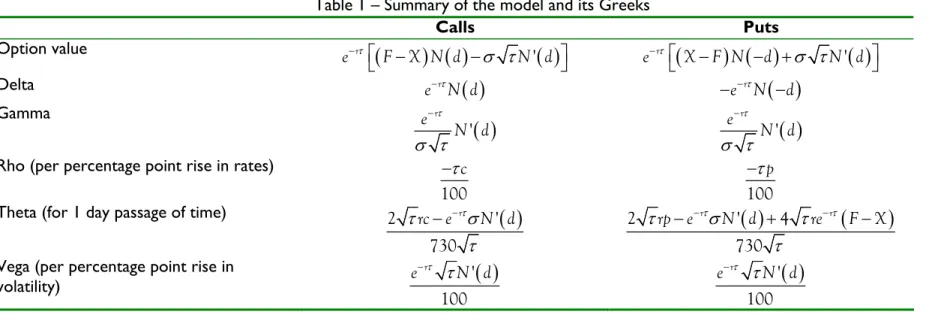
− = r − − + ' p e X F N d N d 21Table 1 presents the Greeks. Their derivation can be found in the appendix.
Insert Table 1 about here
3. A practical application
As noted earlier, a practical illustration of the usefulness of this option pricing model can be
found in the pricing of survivor swaptions or options on survivor swaps. Dowd et al. [2006]
propose a survivor swap contract in which the receive-fixed party commits to making a payment stream based on the actual survivorship rate of a specified cohort and receives in return a fixed payment stream, based on the expected survivorship rate of that cohort expected at the time of
the swap contract formation multiplied by (1+π). The term π is a risk premium reflecting the
potential errors in the expectation and π can be positive or negative, depending on whether
greater longevity (π > 0) or lesser longevity (π < 0) is perceived to be the greater risk. It can also be zero, when the risks of greater longevity and lesser longevity exactly balance. Typically,
however, we would expect πto be in the region close to zero, and in this region, andDawson et
al. [2007] go on to show that the distribution of π is approximately normal when underlying
aggregate mortality shocks obey the beta process set out in Dowd et al. [2006, pp. 5-7]. They
then propose a European survivor swaption contract, in which the option holder has the right, but not the obligation, to enter into a survivor swap contract on pre-specified terms at some time in the future. These options can take one of two forms: a payer swaption, equivalent to
our earlier call, in which the holder has the right but not the obligation to enter into a pay-fixed swap at the specified future time; and a receiver swaption, equivalent to our earlier put, in which the holder has the right but not the obligation to enter into a receive-fixed swap at the specified future time.
In order to price the swaption using the usual dynamic hedging strategies assumed for pricing purposes, we are also implicitly assuming that there is a liquid market in the underlying asset, the forward survivor swap. Naturally, we recognize that this assumption is not yet
empirically valid, but we would defend it as a natural starting point, not least since survivor swaptions cannot exist without survivor swaps.
We now consider an example calibrated on swaptions that mature in 5 years’ time and are based on a cohort of US males who will be 70 when the swaptions mature. The strike price
of the swaption is a specified value of π and for this example, we shall use an at-the-money
forward option, i.e. X is set at the prevailing level of π for the forward contract used to hedge
the swaption. Setting the option at the money forward means that the payer swaption premium and the receiver swaption premium are identical at all times.
Using the same mortality table as Dowd et al. [2006], and assuming, as they did,
longevity shocks, εi, drawn from a beta distribution1 with parameters 1000 and 1000 and a
yield curve flat at 6%, Monte Carlo analysis with 10,000 trials shows the distribution of π for
the forward swap to have the following values:
Mean 0.001156
Annual variance 0.000119
Skewness 0.008458 Kurtosis 3.029241
1See Dowd et al [2006] for the significance of the longevity shocks, ε
i, and the beta distribution..
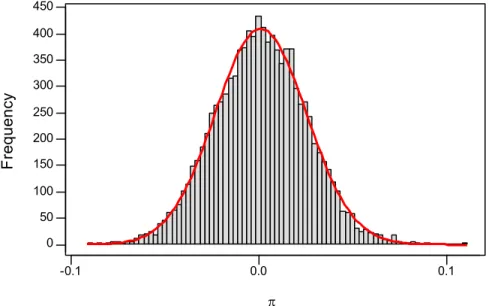
The distribution is shown in Figure 1 below.
Figure 1 – Distribution of the values of the π for a 45 year survivor swap starting in 5 years’ time, from a Monte Carlo simulation of 10,000 trials with εi values drawn from a beta
distribution with parameters (1000, 1000). A normal distribution plot is superimposed.
-0.1 0.0 0.1 0 50 100 150 200 250 300 350 400 450 F requenc y π
A Jarque-Bera test on these data gives a value of 0.476. Given that the test statistic has a
χ2 distribution with 2 degrees of freedom, this test result is consistent with a normal
distribution.
Figure 2 below shows the options premia for both payer and receiver swaptions across
π values spanning + 3 standard deviations from the mean. The gamma, or convexity, familiar
in more conventional option pricing models is also seen here.
Figure 2 – Premia for the specified survivor swaptions 0.000% 0.500% 1.000% 1.500% 2.000% 2.500% 3.000% -3 .1 5% -2 .7 2% -2 .2 8% -1 .8 4% -1 .4 1% -0 .9 7% -0 .5 4% -0 .1 0% 0. 33 % 0. 77 % 1. 20 % 1. 64 % 2. 08 % 2. 51 % 2. 95 % 3. 38 % π Pr em ium Payer Receiver
As with conventional interest rate swaptions, the premia are expressed in percentage terms. However, whereas with interest rate swaptions, the premia are converted into currency amounts by multiplying by the notional principal, with survivor swaptions, the currency
amount is determined by multiplying the percentage premium by in which
N is the cohort size, is the discount factor applying from option expiry until time t,
is the payment per survivor due at time t, S(t) is the proportion of the original cohort expected
to survive until time t, such expectation being observed at the time of the option contract, and
=
∑
50 , 1 ( ) expiry t t t N A P S t , expiry t A Pt 9where all members of the cohort are assumed to be dead after 50 years.2 N A is known with certainty at the time of option pricing.
=
∑
50 1 ( ) expiry,t t t P S t 1 0.5Figure 3 below shows the changing value of these at the money forward payer and receiver swaptions as time passes. The rapid price decay as expiry approaches, again familiar in more conventional options, is also seen here.
Figure 3 – Options premia against time
0.0000% 0.1000% 0.2000% 0.3000% 0.4000% 0.5000% 0.6000% 0.7000% 0.8000% 5 4.5 4 3.5 3 2.5 2 1.5 0 Years to expiry Pr em iu m
2This approach is equivalent to that used in the pricing of an amortizing interest rate swap, in which the
notional principal is reduced by pre-specified amounts over the life of the swap contract.
4. Testing the model
The derivation of the model is predicated on the assumption that implementation of a dynamic hedging strategy will eliminate the risk of holding long or short positions in such options. We test the effectiveness of this strategy by simulating the returns to dealers with
(separate) short3 positions in payer and receiver swaptions, and who undertake daily rehedging
over the 5 year (1,250 trading days) life of the swaptions. We use Monte Carlo simulation to model the evolution of the underlying forward swap price, assuming a normal distribution. We assume a dealer starting off with zero cash and borrowing or depositing at the risk-free rate in
response to the cashflows generated by the dynamic hedging strategy. As Merton [1973, p165]
states, “Since the portfolio requires zero investment, it must be that to avoid “arbitrage” profits, the expected (and realized) return on the portfolio with this strategy is zero.” Merton’s model was predicated on rehedging in continuous time, which would lead to expected and realized returns being identical. In practice, traders are forced to use discrete time rehedging, which is modeled here. One consequence of this is that on any individual simulation, the realized return may differ from zero, but that over a large number of simulations, the expected return will be zero. This is actually a joint test of three conditions:
i. The option pricing model is correctly specified – equations (17) and (21) above ,
ii. The hedging strategy is correctly formulated – equations (A1) and (A2) below, and
iii. The realized volatility of the underlying asset price matches the volatility implied in the
price of the option trade. We can isolate this condition by forecasting results when this condition does not hold and comparing observation with forecast. The dealer who has sold an option at too low an implied volatility will expect a loss, whereas the dealer sells
3The returns to long positions will be the negative of returns to short positions.
at too high an implied volatility can expect a profit. This expected profit or loss of the dealer’s portfolio, E[Vp], at option expiry is:
(
)
( )
( )
(
)
( )
τσ
σ
σ
τ
σ
σ
∂ = − ∂ = − ' r p implied actual implied implied actual c E V e N d 25 26in which σimplied and σactual represent, respectively the volatilities implied in the option price and
actually realized over the life of the option.
We have conducted simulations across a wide set of scenarios, using different values of
π,σimplied and σactual and different degrees of moneyness. In all cases, we ran 250,000 trials and
in all cases, the results were as forecast. By way of example4, we illustrate in Table 2 the results
of the trials of the option illustrated in Figures 1 and 2. The t-statistics relate to the differences
between the observed and the forecast mean outcomes.
Insert Table 2 about here
The reader will note that the differences between the observed and expected means are very low and statistically very insignificant. This reinforces our assertion that the model
provides accurate swaption prices.
5. Conclusion
Ever since it became clear that a GBM process provides a more plausible model of asset prices than an arithmetic Brownian motion process, it has been taken for granted that there was no
4Results of the full range of Monte Carlo simulations are available on request from the corresponding
author.
point developing an option pricing model for a normally distributed underlying. Nevertheless, 34 years after Black and Scholes [1973] and Merton [1973], we suggest that there are possible circumstances in which we might need such a model, and a contemporary example is when we wish to price a swaption on a survivor swap. In this case, an option-pricing model based on a normal underlying is not some flawed relative of Black Scholes, as it is usually considered to be, but is instead the key to correctly pricing this type of swaption – and hence, a very useful tool in the rapidly emerging universe of mortality derivatives.
Appendix – Derivation of the Greeks Delta (∆c, ∆p)
The option’s deltas follow immediately from (17) and (21) :
( )
( )
( )
(
τ τ − −)
∂ ∆ = = ∂ ∂ ∆ = = − − ∂ r c r p c e N d F p e N d F A1 A2 Gamma(Γc, Γp)( )
( )
( )
( )
( )
τ τ τσ τ
− − − ∂ ∂ ∂∆ Γ = = = ∂ ∂ ∂ ∂ ∂ = × ∂ ∂ = 2 2 ' r c c r r e N d c F F F N d d e F d e N d (A3) A4 A5( )
( )
( )
( )
( )
( )
( )
( )
( )
τ τ τ τσ τ
σ τ
− − − − ∂∆ ∂ − ∂ Γ = = = − ∂ ∂ ∂ ∂ − ∂ − − × ∂ ∂ = − = 2 2 ' ' r p p r r r e N d p F F F d N d e F d e N d e N d A6 A7 A8 A9 Rho ( , Ρc Ρp)(
)
(
)
τ
τ
∂ Ρ = = − ∂ ∂ Ρ = = − ∂ c p c c r p p r A10 A11 14Theta (Θc, Θp)
(
) ( )
( )
(
)
τσ
τ
τ
− ∂ ∂ = − + ∂ ∂ ' r c e F X N d tN d A12By the product rule
(
) ( )
( )
(
) ( )
( )
(
)
(
) ( )
( )
(
)
(
) ( )
( )
(
)
(
)
(
) ( )
( )
(
) ( )
( )
τ τ τ τ τ τσ τ
σ τ
τ
τ
τ
σ τ
τ
σ τ
τ
τ
σ τ
σ τ
τ
− − − − − − ∂ = − + ∂ + ∂ − + ∂ ∂ ∂ ∂ = − + ∂ ∂ = − + ∂ ∂ ∴ = + ∂ ∂ = − + = − − + ∂ ' ' Let ' Let ' ' ' r r r r r r c F X N d N d e e F X N d N d A F X N d N d e B e F X N d N d c A B A F X N d N d e re F X N d N d A13 A14 A15 A16 A1(
)
(
)
(
)
τ
= − ∂ ∴ = − + ∂ rc c rc B 7 A18 A19Applying the sum rule
(
) ( )
( )
(
)
( )
( )
(
)
(
)
( )
(
)
( )
(
)
(
)
τ τ τ τ τσ τ
σ τ
τ
τ
τ
τ
σ τ
τ
τ
− − − − − ∂ ∂ ∂ = − + = − + ∂ ∂ ∂ ∂ = − ∂ ∂ ∂ ∂ ∴ = − + + ∂ ' ' Let Let D= ' r r r r r B e F X N d N d e F X N d e N d C e F X N d e N d c rc C D A20 A21 A22 A23The chain rule then implies
(
)
( )
(
)
( )
(
)
(
) ( )
(
)
(
) ( )
(
)
τ τ τ ττ
τ
τ
τ
τ
− − − − ∂ ∂ ∂ = − = − ∂ ∂ ∂ − = − − ∂ ∴ = − − + ∂ ' 2 ' 2 r r r r d C e F X N d e F X N d d e d F X N d e d F X N d c rc D A24 A25 A26 15By the product rule
( )
( )
( )
(
)
( )
(
)
( )
(
)
( )
( )
(
)
(
) ( )
( )
(
)
τ τ τ τ τ τ τ τ τσ τ
σ τ
σ τ
τ
τ
τ
σ τ
τ
σ τ
τ
σ
σ τ
τ
τ
σ
τ
τ
τ
− − − − − − − − − ∂ = ∂ + ∂ ∂ ∂ ∂ ∂ = ∂ ∂ ∂ ∂ = = ∂ − ∂ ∴ = − − + + ∂ D= ' ' ' Let ' Let F= ' ' ' 2 ' ' 2 2 r r r r r r r r r e N d e N d e N d E e N d e N d e N d E e N d e d F X N d e N d c rc F A27 A28 A29 A30 A31 By chain rule( )
( )
(
)
( )
(
)
(
) ( )
( )
( )
(
)
τ τ τ τ τ τσ τ
σ τ
τ
σ
σ τ
τ
σ
σ τ
τ
τ
τ
τ
− − − − − − ∂ ∂ ∂ = = ∂ ∂ ∂ = − ∂ ∴ = − − + + ∂ 2 2 ' ' ' 2 ' ' ' 2 2 2 r r r r r r d F e N d e N d d e d N d e d F X N d e N d e d N d c rc A32 A33 A34 Tidying up( )
(
)
(
)
( )
(
(
)
)
(
)
( )
(
)
(
)
( )
(
)
( )
(
)
τ τ τ τ τσ
σ τ
τ
τ
τ
τ
σ τ σ τ
τ
σ τ
σ τ σ τ
τ
σ τ
τ
σ
τ
− − − − − − ∂ = − + − + + ∂ = − + − − + + = − + − + + = − + = − + 2 2 2 2 ' 2 2 2 ' 2 ' 2 ' 2 ' 2 r r r r r d F X c d rc e N d e N d rc d F X d e N d rc d d e N d rc e N d rc A35 A36 A37 A38 A39Since it is conventional for practitioners to quote theta as the change in an option’s value as one day passes
( )
(
)
ττ
σ
τ
− − Θ = 2 ' 730 r c rc e N d A40The equivalent value for a put option can be obtained quite easily from put-call parity and
equation (A40).
(
)
( )
(
)
(
)
( )
(
)
(
)
(
)
(
)
( )
(
)
(
( )
)
(
)
(
)
( )
(
)
(
)
τ τ τ τ τ τ τ τ τ τ ττ
τ
τ
σ
τ
σ
τ
σ
τ
τ
σ
τ
τ
− − − − − − − − − − − = − − ∂ ∂ ∂ ∴ = − − ∂ ∂ ∂ = − + − − = − + − + − − = − + − − − + − ∴Θ = ' 2 ' 2 ' 2 2 2 ' 4 730 r r r r r r r r r r r p p c e F X p c e F X e N d rc re F X e N d r p e F X re F X e N d rp re F X rp e N d re F X 1 A41 A42 A43 A44 A45 Vegaσ σ
∂ ∂ ∂ ∂ , c p(
) ( )
( )
(
)
τσ τ
σ
σ
− ∂ ∂ = − + ∂ ∂ ' r c e F X N d N d A46(
)
( )
( )
(
)
(
)
( )
(
)
( )
(
)
(
)
τ τ τ τσ τ
σ
σ
σ
σ τ
σ
σ
− − − − ∂ ∂ = − + ∂ ∂ ∂ − ∂ ∂ ∂ ∂ = + ∂ ' Let G = Let H = ' r r r r e F X N d e N d e F X N d e N d c G H A47 A48 A49 A50 17By the chain rule
(
)
( )
(
)
( )
(
)
(
) ( )
(
)
( )
(
)
τ τ τ τσ
σ
σ
τ
− − − − ∂ ∂ ∂ = − = − ∂ ∂ ∂ − − = = − 2 ' ' r r r r d G e F X N d e F X N d d e d F X N d e d N d A52 A53 A54By the product and chain rules
( )
( )
( )
(
)
( )
( )
(
)
(
)
( )
(
)
(
)
( )
( )
(
)
( )
(
)
τ τ τ τ τ τ τ τ τσ τ
σ τ
σ τ
σ
σ
τ
σ τ
σ
τ
τ
τ
σ
τ
− − − − − − − − − ∂ ∂ ∂ ∂ = + ∂ ∂ ∂ ∂ = + = + ∂σ
∴ = + − ∂ = 2 2 2 2 H = ' ' ' ' ' 1 ' 1 ' ' ' r r r r r r r r r d e N d e N d e N d d d e N d e N d e d N d c e d N d e d N d e N d A55 A56 A57 A58 A59Since practitioners generally present vega in terms of a one percentage point change in volatility, we present vega here as
( )
(
)
ττ
σ
− ∂ = ∂ ' 100 r e N d c A60Put-call parity shows that the vega of a put option equals the vega of a call option.
(
) ( )
(
)
(
)
τ τσ
σ
σ
σ
− − = − − ∂ ∂ ∂ ∂ ∴ = − − ∂ ∂ ∂ ∂ = r r p c e F X p c c e F X 1 A61 QED 18References
Bachelier, Louis. (1900) Théorie de la Spéculation. Paris: Gauthier-Villars.
Black, Fischer, [1976]. “The Pricing of Commodity Options.” Journal of Financial Economics, 3:
167 – 179.
Black, Fischer and Myron Scholes, [1973]. “The Pricing of Options and Corporate Liabilities.”
Journal of Political Economy. 81: 637 - 654.
Cox, John C. and Stephen A. Ross, [1976]. “The Valuation of Options for Alternative
Stochastic Processes.” Journal of Financial Economics. 3: 145 – 166.
Dawson, Paul, David Blake, Andrew J G Cairns and Kevin Dowd, [2007]. “Completing the Market for Survivor Derivatives.” Working Paper.
Dowd, Kevin, [2005]. Measuring Market Risk. Second edition. John Wiley.
Dowd, Kevin, Andrew J G Cairns, David Blake and Paul Dawson, [2006]. “Survivor
Swaptions.” Journal of Risk and Insurance. 73: 1 – 17.
Merton, Robert C., [1973]. “Theory of Rational Option Pricing.” Bell Journal of Economics and
Management Science. 4: 141 – 183.
Rubinstein, Mark, [1994]. “Implied Binomial Trees.” Journal of Finance. 49: 771 – 818.
Stoll, Hans, [1969]. “The Relationship between Put and Call Option Prices.” Journal of Finance.
14: 319 – 332.
Table 1 – Summary of the model and its Greeks Calls Puts Option value −τ
(
−) ( )
−σ τ
( )
' r e F X N d N d e−rτ(
X F N d−) ( )
− +σ τ
N d'( )
Delta e N d−rτ( )
−e N d−rτ( )
− Gamma( )
τ σ τ − ' r e N d( )
τ σ τ − ' r e N dRho (per percentage point rise in rates) −
τ
100
c −
τ
100
p
Theta (for 1 day passage of time)
τ
τσ
( )
τ
− − 2 ' 730 r rc e N dτ
τσ
( )
τ
τ(
)
τ
− − − + − 2 ' 4 730 r r rp e N d re F XVega (per percentage point rise in
volatility)
( )
ττ
− ' 100 r e N d −ττ
'( )
100 r e N dTable 2 – Results of Monte Carlo simulations of delta hedging strategy
Payer Receiver
σimplied σactual Expected
value Mean deviation Standard t-stat Expected value Mean deviation Standard t-stat
1.088998% 1.088998% 0.0000% 0.0002% 0.2092% 0.40 0.0000% 0.0002% 0.2036% 0.42
1.088998% 0.988998% 0.0892% 0.0894% 0.1897% 0.45 0.0892% -0.0894% 0.1853% 0.46
1.088998% 1.188998% -0.0892% -0.0891% 0.2287% 0.24 -0.0892% -0.0891% 0.2221% 0.24
Simulations carried out using @Risk, with 250,000 trials.