Electronic Payment and Online Gaming
Gerald Draxler, Johannes Sametinger, Andreas Wiesauer
Johannes Kepler University Linz, A-4040 Linz, Austria
[email protected], [email protected], [email protected]
Abstract. We will evaluate electronic payment (ePayment) systems by employing a use-value analysis. The key success factors of ePayment systems are security and flexibility. Not surprisingly, it turns out, that there is neither a "best" nor a "most secure" ePayment system. The adequacy of these systems depends on the application context. A use-value analy-sis is an appropriate and easy to use evaluation method, because it allows the consideration of different application pers-pectives. In fact, many ePayment systems are available today, but there are still contexts that require a tailored solution. Online gaming will be given as an example. For this purpose, we will introduce BetMPay, an ePayment system that of-fers a high level of anonymity, payment guarantee for providers, as well as consumer protection. This system also suf-fers from drawbacks in comparison to other existing system. This again will be outlined by a use-value analysis.
1
Introduction
Today, transactions on goods, e.g., books or electronic devices are increasingly carried out over the Internet. Customers and merchants regularly face the problem of handling payments. Various payment systems are availa-ble that rely on different paradigms, e.g., credit cards, debit notes or payment via cell phones. Online store oper-ators often have difficulties in selecting the appropriate systems for their needs. Criteria include usability, user acceptance or common usage in existing web shops. Many electronic payment systems are available and their use is constantly rising. But there are scenarios, where special requirements exist that are not sufficiently fulfilled by available systems. For example, online gaming clients often prefer to indulge their passion anonymously.
In this paper we present an overview on different elec-tronic payment systems and evaluate their benefits from various perspectives. Additionally, we present a solution that had been implemented with the focus at customer anonymity. This system had been developed in the context of online betting applications and additionally aims at providing effective cost control for customers as well as paying guarantees.
In Section 2 we shortly introduce online gaming. Sec-tion 3 describes aspects of electronic payment and intro-duces a selection of ePayment systems. In Section 4 we focus on requirements that are important for any electron-ic payment system. We also depelectron-ict criteria that can be
used for evaluation. Section 5 provides an evaluation of ePayment systems by employing a use-value analysis. In Section 6 we introduce an ePayment system that is fo-cused on customer anonymity, and we also compare it to the other systems. Related work follows in Section 7, and a conclusion is given in Section 8.
2
Online Gaming
In this context, "gaming" means the playing of games for something of material value like money. Games focus on an event with an uncertain outcome and the intent of win-ning additional material value [17]. The outcome of the game is typically evident within a short period of time, e.g., the final score of sports events. Online games are played for electronic money and require electronic pay-ment systems.
An example provider of online gaming is bwin who is offering up to 30,000 bets daily with betting action in more than 90 sports [www.bwin.com]. Bwin offers a wide range of payment methods, including credit cards and online banking deposits. Reliable transfer of money is crucial. Above all, gaming providers need to be sure that money of their clients can actually be collected.
3
ePayment
Electronic payment or ePayment is the transfer of elec-tronic means of payment from the payer to the payee through the use of an electronic payment instrument [11].
ePayment systems are used to transfer money from one account to another at the same or another financial institu-tion. ePayment is an important part of eCommerce, as goods and services offered through the Internet are most conveniently paid in electronic form.
Several factors influence payment over the Internet [8]. For example, the Internet does not have an established security architecture. Both seller and buyer are not physi-cally present in an online transaction. Goods are available only as virtual representations. And there is no synchroni-zation between payment and delivery of goods.
3.1 Classification
Numerous ePayment systems are on the market. They can be classified based on several categories, see [1] and [11]. ePayment systems can be divided into electronic cash mechanisms and credit-debit systems. Electronic cash resembles conventional cash and is based on tokens. Elec-tronic tokens represent value and are exchanged for pay-ment.
Credit-debit systems are based on bank accounts. In credit-debit systems, money is represented by records in bank accounts. Payment information is sent over computer networks, e.g., the Internet. Electronic cash has several advantages like the potential for anonymity and the lack of the need to contact a central system. In pre-paid systems, the payer’s account is debited before the payment. Pay-now systems debit the payer’s account at the time of pay-ment. In post-pay systems, the account of the payee is credited before the account of the payer is debited.
Another distinctive feature is micro payment ability. Micro payments typically amount to a value of less than 1 Euro or 1 Dollar. In contrast, macro payments start at an amount of 10 Euros/Dollars and small payments are in between. There can also be a limit on the amount of mon-ey that can be paid, e.g., the amount that had been prepaid or the credit card limit.
3.2 Available Systems
Too many ePayment systems are available to provide an exhaustive list. We have chosen a few that are widely available. Not all systems are offered world-wide; we have also included systems available in Austria, the home country of the authors. Additional ePayment providers and services can be found, for example, in [4].
Credit cards entitle their holders to buy goods and ser-vices based on the holders' promise to pay for these [5]. Credit card providers offer various levels of security in order to prevent fraud, e.g., the card security code. Veri-fied by Visa and MasterCard SecureCode depict addition-al security measures for online transactions. When credit
card information is entered online, the user has to authen-ticate herself, i.e., to confirm her identity with an addi-tional password. Debit cards are used like credit cards for telephone and Internet purchases or like ATM cards for money withdrawal. In both situations, funds are imme-diately transferred from the holders' bank account. This is in contrast to credit cards, where users have to pay back on a later date. Maestro is an example for a widely known debit card service [www.maestrocard.com].
PayPal is an e-commerce business that allows world-wide payments and money transfers over the Internet [www.paypal.com]. Paybox offers payments via users’ mobile phones in Austria. A user simply provides her phone number or, for anonymity, an alias number, gets an SMS (simple text message) from PayBox and confirms the payment [www.paybox.at]. PaySafeCard is a pre-paid system primarily for online shopping. It allows online cash payments without a bank account or credit card [www.paysafecard.com].
4
ePayment Requirements
Concerns on data security and on the misuse of private data are important factors for electronic payments. These concerns alone can hinder the development of e-com-merce [15]. Security requirements will depend on the amount of money being transferred, i.e., macro payments require higher security than micro payments. Smaller risks and cost considerations lead to the acceptance of less security. However, concerns about security are key factors in discouraging consumers from online payments [9].
Security comprises integrity, availability, and confiden-tiality [8]. For online gaming, anonymity is an additional important security aspect. ePayment providers have to make sure that all these facets are considered sufficiently, including e.g., software security, network security and organizational security. The payment card industry data security standard helps organizations of payment cards to prevent fraud [6]. This can be achieved through increased data controls and decreased exposure of data to potential compromise. Evaluating the security of systems is a diffi-cult and time-consuming task. In order to make this task manageable for our purpose, we will use the following properties that can be assessed with reasonable effort.
Passwords. How many characters must users enter in order to enter the system? We use a qualitative measure – high if a minimum length of eight characters and com-pliance to defined rules, e.g., use of special characters, are required; medium if passwords are used but do not comply with rules and low if no passwords/PINs are employed.
Password renewal. Password renewal defines whether users are asked to change their passwords periodically.
Login brute-force. Login brute-force prevention ad-dresses effective measures for preventing brute-force attacks, see [12].
Certificates and SSL. Certificates and the use of SSL/TLS address the security of the communication channel, e.g., whether communication is encrypted and authenticity of the counterpart can be determined.
Authentication. We again use a qualitative measure – two-factor authentication, one factor authentication and authentication that is solely based on information that cannot be considered as sufficiently secret, e.g., account information or credit card numbers. Two factor authenti-cation means that authentiauthenti-cation is based on knowledge, e.g., passwords, and the possession of artifacts like cell phones. As access or transactions codes are sent to these cell phones, their possession is crucial for payments. One factor authentication is based on knowledge or possession.
Lock-out. Systems may lock out a certain user upon re-quest. A lock-out can be initiated by users whenever they realize that authentication information had been lost or stolen in order to prevent malicious transactions.
Anonymity. We differentiate between information that is easily linked to identities like credit card numbers and information that is more difficult to use to reveal identi-ties, e.g., phone numbers. Thus, we use yes/no values. Additional security features address the fact whether criti-cal transactions are secured by certain measures, e.g., use of transaction authentication numbers (TAN). Additional non-security requirements include micropayments, guar-anteed payments, cross-border payments, offline payments and market penetration.
5
Analysis
As ePayment systems rely on different paradigms, they are difficult to compare. Our analysis does not aim at determining the best or most secure system. Instead, we want to provide a comprehensive overview on functionali-ties and security aspects of different systems.
5.1 Methodology
An evaluation determines the value or usefulness of a solution with respects to given objectives. Use-value anal-ysis does not only cover quantitative but also qualitative criteria [7]. It involves the following steps [2]:
− Identification of evaluation criteria
− Assessing values of criteria for each system
(quantitative or qualitative)
− Quantification of qualitative values (scaling) − Weighting of criteria depending on importance
For the analysis, we use criteria outlined in section 4 together with requirements concerning system flexibility, e.g. micro payment or cross border payment ability.
5.2 Results
Table 1 shows the parameter values of the different sys-tems. The values were retrieved by literature analysis, statistics, interviews of ePayment system providers and self-experimentation. We have to quantify our qualitative measures. We rank "high" by 3, "medium" by 2 and "low" by 1 and further "yes" by 3 and "no" by 1. Therefore, systems with higher use-values will be preferable. We can compare the systems based on these values. The adequacy of the values depends on the point of view, e.g., seller or buyer. We can reflect this by assigning different weight-ings to the chosen criteria. These weightweight-ings are calcu-lated as follows: We use a base of 100. Since we have 14 criteria, we get an average weighting of 7 (100/14 rounded). We almost triple the average weighting and use 20 as a maximum weighting factor for eminently signifi-cant criteria. Since less important criteria shall not be completely disregarded, we use 3 as minimum weighting factor. Different points of views can be reflected by as-signing different weightings in the range of 3 to 20.
A user study has shown that it is important from the perspective of customers to guarantee anonymity, ease of use and security. Furthermore, customers prefer systems that they already use or that they can use in other contexts too, i.e., flexible systems with high market penetration [3]. Given these considerations, Table 2 shows the results of our use-value analysis from a customer perspective. Click & Buy emerges as the preferable system. In contrast, pro-viders demand payment guarantees as well as high market penetration in order to prevent customer distraction [10].
Click & Buy is also preferable from a provider perspec-tive. This table is not shown due to space limitations.
An advantage of such use-value analyses is that they are easy to adjust according to requirements in a given context. For example, if it is central to provide high flex-ibility, we can adjust the weightings of micropayment ability, cross-border payment ability and offline payment ability and conclude that Paybox is our first choice.
6
BetMPay
Although there are many ePayment systems available, there can be application contexts in which requirements cannot be fulfilled by existing systems. In this section, we will describe BetMPay – a system that has been developed to support special needs of online gaming companies. These special needs are anonymity, prevention of custom-er addiction and a high level of payment guarantees.
Table 1: Values of Payment System Criteria Criteria/ System C r e d it C a r d u si n g S S L V e r if ie d b y V IS A P a y p a l P a y sa fe ca r d P a y b o x C li c k a n d B u y D e b it C a r d Password
Strength Low Low Med Med Med High Low Password
Renewal No No No No No Yes No Login Brute
Force No No Yes No Yes Yes No Certificates Yes Yes Yes Yes Yes Yes Yes SSL/TLS Yes Yes Yes Yes Yes Yes Yes
Authentica-tion Method Low Med Med High High Med Med User
Lock-out Yes Yes No No Yes Yes No Additional
Security No No No Yes Yes No Yes Market
Penetration High Low High Med Med High Low Anonymity No No No Yes Yes Yes Yes
Micro-payment No No Yes Yes Yes Yes Yes Payment
Guarantee Low High High Low Med High Low Cross border
Payment Yes Yes Yes Yes Yes Yes No Offline
Payments Yes Yes No No Yes No Yes
Table 2: Use-values from a Customer Perspective
Criteria/ System C r e d it C a r d u si n g S S L V e r if ie d b y V IS A P a y p a l P a y sa fe ca r d P a y b o x C li c k a n d B u y D e b it C a r d W ei g h ti n g Password Strength 3 3 6 6 6 9 3 3 Password Renewal 3 3 3 3 3 9 3 3 Login Brute Force 6 6 18 6 18 18 6 6 Certificates 15 15 15 15 15 15 15 5 SSL/TLS 15 15 15 15 15 15 15 5 Authentication Method 10 20 20 30 30 20 20 10 User Lock-out 15 15 5 5 15 15 5 5 Additional Security 5 5 5 15 15 5 15 5 Market Penetration 30 10 30 20 20 30 30 10 Anonymity 15 15 15 45 45 45 45 15 Micro- payment 10 10 30 30 30 30 30 10 Payment Guarantee 3 9 9 9 3 6 9 3 Cross border Payment 30 30 30 30 30 10 10 10 Offline Payments 30 30 10 10 30 30 10 10 Use-value 190 186 211 239 275 257 216
6.1 Context
Online gaming is a sensitive area, since it may impose dangers on customers, e.g., getting addicted. We can therefore identify three main requirements: At first, cus-tomers need anonymity. They may not want that others know about their activities. Furthermore, we need a me-chanism that helps to prevent addiction. Finally, providers demand payment guarantees. They may regularly get in contact with (addicted) indebted or insolvent customers.
BetMPay supports all three major requirements.
6.2 Scenario
Anonymity is one critical success factor of ePayment systems. BetMPay operates according to the following paradigm: Customers can buy vouchers for bets (offline) in gaming offices, kiosks or petrol stations. These vouch-ers represent a fixed value which can be used for gaming activities on online platforms. For this purpose, the
cus-tomer has to register at a web application when she uses the payment system for the first time. The only informa-tion needed for registrainforma-tion is a valid cell phone number.
The system does not store any names, addresses or bank account data. If buyers do not disclose their cell phone number, e.g., by enlisting in phone directories, their identity cannot be determined using common methods.
After registration, the customer can enter a 16-character code printed on the voucher. The amount of the voucher will be credited to her account and can be used for gaming activities. Whenever customers win a game or decide to withdraw money credited to their account, they can create a payment ticket. The ticket consists of a security code which is sent to the customer via SMS. Afterwards she may go to gaming offices or kiosks, where the payment ticket is validated by cell phone number and the security code. The amount will get cashed out.
Together with a high level of anonymity, this paradigm further supports the other major requirements. On the one
hand, it provides better cost control for customers. As many customers of online gaming companies are compul-sive gamblers, the system requires them to buy additional vouchers offline. This is not as comfortable as transferring money from bank accounts by means of credit cards, but it gives gamblers a chance to rethink their decision ("cool down phase") and can prevent them from making overhas-ty investments. On the other hand, the system provides guarantees for gaming companies: Customers can only bet with payments already made (pre-payment). As compul-sive gamblers are often heavily indebted or even insol-vent, companies do not have to fear losses or costly legal processes in order to recover debts.
6.3 System Architecture
The architecture of BetMPay is conceived in a classical three layer approach. The client is designed as a thin client using HTML in order to omit installation of software on the client side. Business logic is realized by ASP.NET components, which are operated by an IIS server. Data logic is realized using SQL databases. Since we do not use stored procedures, views or triggers, we support almost any relational database product.
6.4 Risks and Countermeasures
We will outline BetMPay’s major risks and countermea-sures from the perspective of design and implementation.
System Design. The system faces two fundamental secu-rity risks. At first, malicious users may fake vouchers by auto-generating the 16-character code and therefore be able to transfer credits, for which they never paid. To mitigate this risk, special measures for creating the code are used. The code is separated into an application num-ber, a ticket number and one part of a ciphered message. The other part of the ciphered message is stored in a data-base when the code is generated. Whenever a user re-deems a voucher, the two parts of the message get assem-bled, deciphered and compared to the template. Thus, the validity of the voucher can be checked.
The second fundamental risk is the fact that cashing out requires the possession of a specific cell phone. If the cell phone gets lost or stolen, other persons may retrieve mon-ey from the account. The risk gets reduced primarily by the circumstance that users have to create payment tickets. Users can create such tickets only with the password of the account. We have a two factor authorization in this case, i.e., possession of the cell phone and knowledge of the password. In addition, payment tickets are sent to the cell phone via SMS. Customers can ask their cell phone provider to lock the phone as soon as they recognize their loss. The cell phone will not be able to receive SMSs
anymore. This provides further protection even in the case when a malicious person has the phone and knows the account password.
Generated payment tickets could be used when a cell phone gets stolen or lost. In case the malicious person only has the cell phone but does not know the account password, the customer may lock the account and there-fore prohibit any cashing outs. If the malicious person also knows the account password, he can change the password and prevent logins by the regular customer. This risk can only be overcome by instructing users to use their pay-ment tickets carefully. For example, they should be gener-ated only shortly before a cashing out is requested.
System Implementation. BetMPay uses several strategies for mitigating common security risks, like brute forcing, SQL injection, or man-in-the-middle attacks. In order to prevent login brute force attacks, the number of login attempts within a certain time frame is determined. When-ever a certain threshold is exceeded, the user gets locked. SQL injection attempts can be mitigated by input valida-tion. We use a double strategy and validate input on the client as well as on the server side. On the client side, a configurable AJAX component is used whereas the server side validation is done by .NET methods. For preventing man-in-the-middle attacks, communication between client and server is encrypted by means of HTTPS and the use of a certificate signed by a trusted certificate authority.
Password policy. A configurable AJAX component on the client side informs users whether their password com-plies with defined rules (minimum length, special charac-ters). Additionally, passwords are checked on the server, e.g., if passwords have been used before. Users have to update password periodically.
6.5 Evaluation
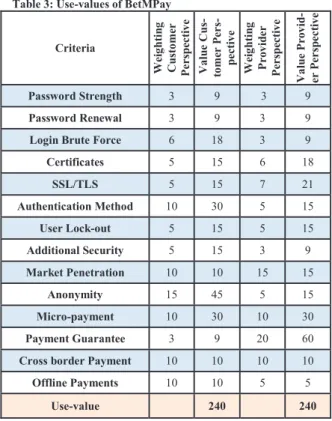
Table 3 shows the results of the use-value analysis of
BetMPay that have been gathered from a usability study.
BetMPay is ranked third from a customer perspective and fourth from a provider perspective. This comes from re-strictions regarding cross-border payment ability and the market penetration of this system. The aspect of prevent-ing overhasty decisions has not been considered in our analysis. We can therefore conclude that if market pene-tration can be increased and cross-border support will be added, BetMPay will be a good choice for online gaming.
7
Related Work
Benefits and costs of ePayments as well as a tool for sys-tem comparison are given in [16]. There are also evalua-tions and comparisons of electronic payment systems.
Table 3: Use-values of BetMPay Criteria W ei g h ti n g C u st o m er P er sp ec ti v e V a lu e C u s-to m er P er s-p e c ti v e W ei g h ti n g P r o v id e r P er sp ec ti v e V a lu e P ro v id -e r P e r sp e c ti v e Password Strength 3 9 3 9 Password Renewal 3 9 3 9
Login Brute Force 6 18 3 9
Certificates 5 15 6 18 SSL/TLS 5 15 7 21 Authentication Method 10 30 5 15 User Lock-out 5 15 5 15 Additional Security 5 15 3 9 Market Penetration 10 10 15 15 Anonymity 15 45 5 15 Micro-payment 10 30 10 30 Payment Guarantee 3 9 20 60
Cross border Payment 10 10 10 10
Offline Payments 10 10 5 5
Use-value 240 240
Wright evaluates privacy, traceability, transaction cost, and the ability to build up the customers purchasing pat-tern of credit card payment systems, an electronic check system and digital cash systems. He evaluates advantages and disadvantages to customers, merchants, service pro-viders as well as financial institutions [13]. Wright sug-gests a new system for increased user acceptance, which allows payments over telephone networks for purchases made over the Internet. Yu et al. explore advantages and limitations of online credit card payment, electronic cash, electronic checks, and small payments. Systematic and detailed comparisons of alternative systems are provided [14]. Their analysis was targeted at companies planning to adopt or to improve an ePayment system.
8
Conclusion
We have shown an evaluation of various ePayment sys-tems by employing a use-value analysis. Key success factors of ePayment systems are security and flexibility. There is no "best" or "most secure" ePayment system. The adequacy of these systems depends on the application context. Use-value analysis is an appropriate and easy to use evaluation method, since it allows the consideration of different application perspectives. Despite the fact that many ePayment systems are available, there are contexts that require tailored solutions, as is the case with online
gaming. We have introduced BetMPay, an ePayment system that offers a high level of anonymity, payment guarantees for providers, as well as consumer protection. One major drawback of BetMPay is that it requires an established selling infrastructure, i.e., concluding contracts with gaming offices or kiosks.
References
1. Abrazhevich D.: Electronic Payment Systems: a User-Centered Perspective and Interaction Design, 2004. http://www.idemployee.id.tue.nl/g.w.m.rauterberg/publicatio ns/PhD-Thesis%20%28Abrazhevich%202004%29.pdf 2. Heinrich L.J.: Informationsmanagement, 7th Edition,
Olden-bourg 2002.
3. Leibold K., Stölzle R., Stroborn K.: ePayments und die Meinung der Konsumenten – Online-Survey; in Handbuch ePayment. Zahlungsverkehr im Internet: Systeme, Trends, Perspektiven (Ketterer K.H., Stroborn K.). Fachverlag Deut-scher Wirtschaftsdienst, Köln 2002, p. 109-118.
4. NACHA – Electronic Payments Association. Electronic Payments Review & Buyer's Guide 2009. www.nacha.org 5. O’Sullivan, A., Sheffrin S.M: Economics - Principles in
Action, Prentice Hall, 2003.
6. Payment Card Industry (PCI). Data Security Standard Re-quirements and Security Assessment Procedures, Version 1.2.1, July 2009. www.pcisecuritystandards.org/se-curity_standards/pci_dss.shtml
7. Pahl G., Beitz W., Wallace K., Feldhusen J., Blessing L.: Engineering Design: A Systematic Approach, 3rd Edition, Springer 2007.
8. Slay, J., Koronios, A.: Information Technology, Security and Risk Management John Wiley & Sons, 2005.
9. Sumanjeet S.: Emergence of Payment Systems in the Age of Electronic Commerce: The State of the Art, Global Journal of International Business Research Vol. 2. No. 2. 2009. 10. Tan, M.: E-Payment – The Digital Exchange, Singapore
University Press, 2004.
11. Tsiakis T., Stephanides G., Pekos G.: Trust and Security in Electronic Payments: What We Have and Need to Know? www.waset.org/journals/waset/v5/v5-36.pdf, 2005.
12. Viega J., McGraw G.: Building Secure Software, Addison-Wesley Professional Computing Series, 2002.
13. Wright, D., Comparative Evaluation of Electronic Payment Systems, Infor -Ottawa-, Vol. 40, Part 1, pages 71-85, 2002. 14. Yu H.-C., Hsi K.-H., Kuo P.-J., Electronic payment systems:
an analysis and comparison of types, Technology in Society 24, pages 331-347, 2002.
15. Electronic Payment Systems Observatory (ePSO), Building Security and Consumer Trust in Internet Payments, – The potential of “soft” measures, Background Paper No. 7, 2002 16. Electronic Payments, www.electronic-payments.co.uk. 17. Wikipedia,Gambling, http://en.wikipedia.org/wiki/Gambling